BAE/Bofors LEMUR, a Remote Control Weapon Station/Electro-Optic Sensor for Patrol Boats

This is a Remote Control Weapon Station comparable to the Mk38 mod2 used on the Webber Class WPCs. There are many such systems, but I am highlighting it because it is already in use on a boat much smaller than the Webber class. The Combat Boat 90 (time 7:10 in the video above) is only 53 feet (16.1 meters) long and 22.6 tons full load. That is about one quarter the displacement of the 87 foot Marine Protector class, less than one fifteenth the size of a Webber class. It actually displaces a little less than the 45 foot Response Boat, Medium (RB-M). I particularly like that this system has been mated with the 30mm M230 chain gun from the Apache Helicopter that is capable of penetrating light armor (see below). That could give us serious penetrating power.

Like most of these systems, they incorporate electro-optic devices which can be used for SAR, target identification, or to enhance navigation.

Thanks to Lee for bringing this to my attention. 

Japan’s US-2 Amphibious Aircraft

ShinMaywa US-2

An Asia Times article advocating the US procure some of these aircraft, has promoted me to look again at a relatively unique aircraft, Japan’s US-2 amphibian built by ShinMaywa.

It has been a while since the USCG operated amphibious aircraft. Having been a passenger on an HU-16E during a water landing as a cadet, I can attest it was interesting. I would be hard put to justify Coast Guard procurement of these, even though they share engines and propellers with the C-130Js and C-27Js. The need for urgent rescue beyond the range of our helicopters or the in flight refueled range of ARRS helicopters is very rare. Water landings at sea are inherently dangerous and impose additional costs in maintenance due to corrosion. Amphibians also tend to have aerodynamic disadvantages that effect efficiency daily, while the likelihood of being forced down at sea is now much more remote.

Still the ability to land at sea or near small islands with no airports is intriguing.  Reportedly India is buying twelve of these. Both Russia (Beriev BE-200) and China (Harbin SH-5 and AVIC AG600) build or have built amphibious aircraft of similar size.

ShinMeiwa, now ShinMaywa, has a long history or building seaplanes and amphibious aircraft. Its corporate progenitor, Kawanishi Aircraft Company, built four engine seaplane patrol bombers (H6K “Mavis” and H8K “Emily”) used in WWII as well as what may have been the best Japanese fighter of WWII.

Worth Reading–25 May, 2018

Ince Inebolu missile attack

Photo: Damage to the Turkish-flagged bulk carrier Ince Inebolu after last weeks missile attack. –Reuters

Ran across a number of post of interest to Coast Guard readers. Nothing I felt I needed to comment on, but perhaps interesting.

“IMO approves new Inmarsat advance in maritime safety services”–MarineLink”

“Pirate Attacks Grow in South America and Caribbean” MarineLink

“INMARSAT Faces US Chinese Competition in Maritime Safety” MarineLink

“Missile Struck Turkish Ship Off Yemen, EU NAVFOR Official Says” gCaptain

“Canada Announces New Measures to Enhance Safety of Marine Navigation” gCaptain

“Pence Warns Coast Guard Graduates of the Perils Facing the US” Navy Times

“Saildrones Voyage Into Remote Waters” Baird Maritime

“IMO Okays US-Russian Bering Strait Routing Plan” MarineLink

“Sinking of the US Cargo Vessel El Faro, Illustrated Digest” NTSB pdf

A couple of new boats.:


USN Reestablishes 2nd Fleet

Former crest of US 2nd Fleet. US Navy Image.

US Naval Institute News Service is reporting the Navy will be reestablishing the Second Fleet, which will cover the Western Atlantic. In the past it also covered the Caribbean and the Eastern Pacific drug transit zones.

Second Fleet will be the Atlantic counterpart of the Third Fleet in the Pacific.

How it will relate to Forth Fleet that currently handles the drug transit zones is not yet clear.

We are certain to see interaction with the CG Atlantic Area Commander, and probably at least one liaison officer.

“Sailors, Coast Guardsman Remember Firebolt Shipmates”–Navy News Release

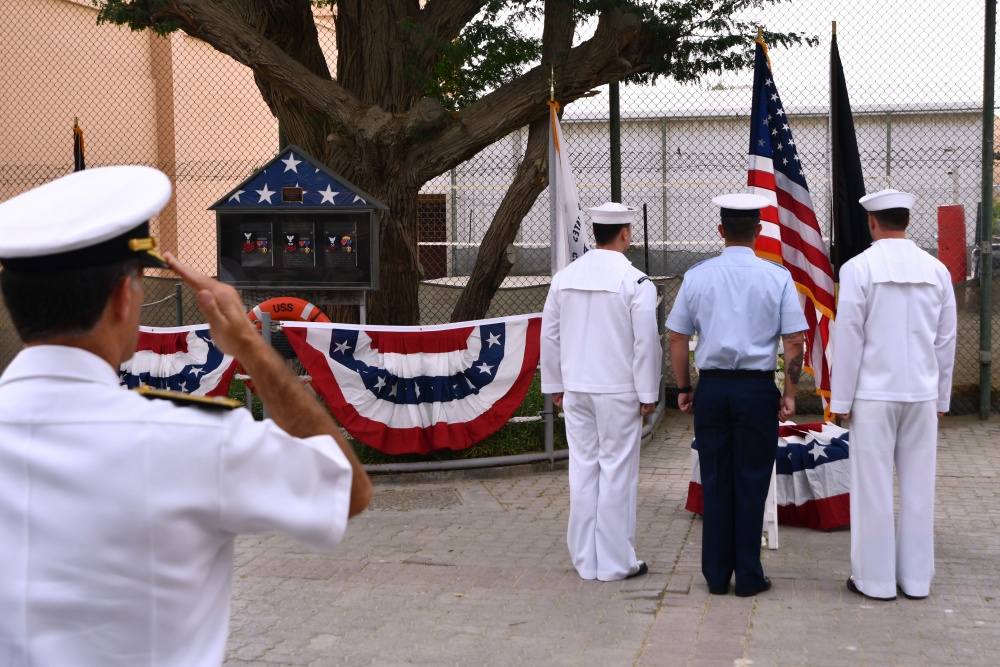
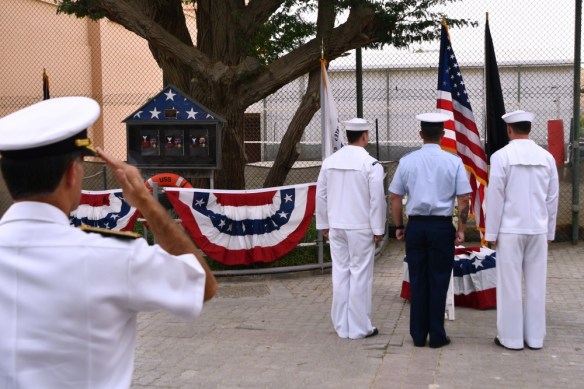
MANAMA, Bahrain (April 24, 2018) Vice Adm. Chris Aquilino, commander of U.S. Naval Forces Central Command, salutes as Sailors and Coast Guardsmen participate in a wreath laying ceremony to honor Coast Guardsman Damage Controlman 3rd Class Nathan B. Bruckenthal, Signalman 2nd Class Christopher E. Watts and Boatswain’s Mate 1st Class Michael J. Pernaselli who perished while conducting maritime security operations in the Northern Arabian Gulf on April 24, 2004. Firebolt is assigned to Commander, Task Force 55, in the U.S. 5th Fleet area of operations in support of maritime security operations to reassure allies and partners and preserve the freedom of navigation and the free flow of commerce in the region. (U.S. Navy photo by Mass Communication Specialist 1st Class Mark Meredith/Released)

The following is a Navy news release. I believe there is an error in that I believe there was a second Coast Guardsman on the RHIB when the incident occurred. 

Story Number: NNS180424-30Release Date: 4/24/2018 4:26:00 PM
By Mass Communication Specialist 1st Class Mark Meredith, U.S. Naval Forces Central Command Public Affairs

MANAMA, Bahrain (NNS) — Sailors and Coast Guardsmen gathered for a wreath laying memorial service and 5k run at Naval Support Activity Bahrain April 24 to remember and honor their fallen shipmates who made the ultimate sacrifice 14 years ago.

The service honored Coast Guardsman Damage Controlman 3rd Class Nathan B. Bruckenthal, Navy Signalman 2nd Class Christopher E. Watts and Navy Boatswain’s Mate 1st Class Michael J. Pernaselli who perished while conducting maritime security operations in the Northern Arabian Gulf April 24, 2004.

Coast Guard Patrol Forces Southwest Asia (PATFORSWA) Commodore, Capt. Clinton Carlson was the guest speaker and spoke to the service and dedication of the men who lost their lives.

“At the time, I was a young lieutenant, assigned to Port Security unit 311 in San Pedro, California,” he said. “For the 311 Sailors, the attack was personal. This was family, and for me it was one of those days that I will always remember where I was because my Coast Guard, and the nature of my service had changed forever.”

On April 24, 2004, Firebolt was in the vicinity of the Khawr Al Amaya Oil Terminal in Iraq, with the mission of defending the terminal against attack. A suspicious dhow was spotted nearby, and Firebolt deployed a rigid-hull inflatable boat (RHIB) manned by six Sailors and a U.S. Coast Guardsman to investigate the vessel. The dhow, realizing the RHIB was in pursuit, sped toward the oil terminal. The RHIB maneuvered into position to intercept the vessel, but the dhow exploded in an apparent suicide attack. Minutes later, two other dhows exploded prematurely in what was an attempted coordinated attack on Iraq’s offshore oil infrastructure. Though the crew of the RHIB had successfully protected the oil platform, the wake created by the explosions capsized the small boat, claiming the lives Pernaselli, Watts and Bruckenthal, who was the first Coast Guardsman to die in action since the Vietnam War.

The commanding officer of Firebolt, Lt. Cmdr. Roger Young, also gave remarks, stressing the sacrifice the service members made for their shipmates.

“I am pleased to report that the memory of our shipmates has not been forgotten and their sacrifice likely spared the lives of countless other Sailors onboard every warship that sailed the Arabian Gulf,” said Young. “Their sacrifice serves as a reminder that the threat we face is real and that no mission is routine.”

The memorial honoring the legacies of these brave service members stands across the courtyard from the PATSFORSWA headquarters, and features the service members’ rating badges, a folded flag and a life ring from Firebolt.

This year’s memorial service holds particular significance for the Coast Guard, as they took delivery of the USCGC Nathan Bruckenthal, a 154-foot patrol craft, in March 2018.

“Their devotion to duty and selfless sacrifice continue to serve as shining examples to all of us who strive to make the world more secure,” said Capt. Carlson. “They remind us that no mission is routine and that true security has been hard-earned through challenging naval operations among U.S. and allied forces through the years.”

U.S. 5th Fleet area of operations encompasses about 2.5 million square miles of water area and includes the Arabian Gulf, Gulf of Oman, Red Sea and parts of the Indian Ocean. The expanse comprises 20 countries and includes three critical choke points at the Strait of Hormuz, the Suez Canal and the Strait of Bab al Mandeb at the southern tip of Yemen.

PATFORSWA’s mission is to command, train, equip and provide mission ready Coast Guard forces to conduct maritime security operations in U.S. Central Command’s (CENTCOM) area of responsibility.

Thanks to Bryant’s Maritime Blog for bringing this to my attention. 

Addendum

Thanks to Bill Wells we can add an addendum. There was a second coastguardsman on the RHIB when the explosion occurred, BM1 Joseph Ruggiero. His story is  here. There is a video here.

The Pentagon Is Making a Ray Gun to Stop Truck Attacks–DefenseOne

Wonder if this might work on boats as well?

DefenseOne reports

The Defense Department’s Joint Non-Lethal Weapons Program, or JNLWD, is pushing ahead with a new direct energy weapon that uses high-powered microwaves to stop cars in their tracks without damaging the vehicle, its driver, or anyone else.

The jammer works by targeting the car’s engine control unit causing it to reboot over and over, stalling the engine. Like an invisible hand, the microwaves hold the car in place. “Anything that has electronics on it, these high-powered microwaves will affect,” David Law, who leads JNLWD’s technology division, said in March. “As long as the [radio] is on, it holds the vehicle stopped.”

I also have to wonder if it would work on old style ignition systems without computers and sophisticated electronics.

Saudis Buying 39 High Speed (45 knot) 106 foot Patrol Boats–WPB Replacement?

NavyRecognition is reporting award of a contract for 39 high speed 32.2 meter vessels that will probably be going to the Saudi Coast Guard.

In view of the need to replace the 87 foot Marine Protector class in the not too distant future, (The oldest, USCGC Barracuda (WPB-87301) was commissioned 20 years ago today, 24 April 1998.) this class might be worth a look. It is an example of the possible.

This is a CMN (French) design. CMN his a long history of building high speed vessels including the Israeli SA’AR 1, 2, and 3 missile boats and the widely used La Combattante series of fast attack craft.

Characteristics are reported as follows:

Length Overall : 32.20 m (105.6 ft)
Beam Overall : 7.00 m (23 ft)
Maximum draught : 1.40 m (4.6 ft)
Maximum speed : 43 Knots
Range at 12 Knots : 800 NM
Range at 33 Knots : 580 NM
Crew : 12
Fuel : 21 m3
Fresh water : 1 m3
Hull & Superstructure : Aluminium
Classification : Bureau Veritas

4.8 m outboard RHIB mounted on stern ramp

Three diesel engines

Three Waterjets : Two steering & one booster

Two main generators

Yes, it is larger than the Marine Protector class 87 foot WPBs by 19 feet, but the Webber class are 44 feet longer than the 110s they replaced, so the gap between new generation vessels would be greater than the previous generation 48 feet vice 23 feet.

Range, endurance, and crew size are similar to that of the Marine Protector class.

If you have been reading this blog for a while, you know I think the Webber class WPCs are, and are being used as, more small cruising cutter than as a “Fast Response Cutter” sitting in port waiting for a SAR call. These could be the real “fast response cutter,” and in many cases, they could beat a helicopter to the scene.


Antarctic Resupply at McMurdo–After the Icebreaker

MSC M/V Ocean Giant at the ice pier, McMurdo Station

The Military Sealift Command has given us a three part series on their operations to resupply McMurdo Station

“Military Sealift Command’s Expeditionary Port Unit 114 Gets Operation Deep Freeze 2018 Underway On Time”

“Military Sealift Command Chartered Ship Arrives in Antarctica in Support of Operation Deep Freeze 2018”

“MSC Operation Deep Freeze 2018 Fuel Delivery Operations begin at McMurdo Station With Arrival of M/T Maersk Peary

Thanks to Lee for bringing this to my attention.