This Day in Coast Guard History, March 5

Based on the Coast Guard Historian’s timeline, https://www.history.uscg.mil/research/chronology/
With inspiration from Mike Kelso

March 5

1881  The crew of Life-Saving Station No. 10, Ninth District (Louisville), won acclaim with a dangerous rescue at the wreck of James D. Parker, a well-known river boat lost in the Indiana chute of the Ohio Falls.  She was a stern-wheel steamer of over 500 tons owned by the Cincinnati and Memphis Packet Company and bound from Cincinnati to Memphis.  Her crew numbered 50, including the captain, and she had 55 passengers on board, a number of whom were women and children.

From 1881 to 1972 “… the Louisville Lifeboat Station was in operation at Louisville, Kentucky.  The station was located just above the falls of the Ohio River and was authorized by an act of Congress on 2 March 1881.  It was the only permanently located floating lifeboat station in the world.

“During the floods of 1883-1884, the surfmen of the station ‘rescued and took to places of safety over 800 imperiled persons, men, women and children–among them many sick and infirm–and supplied food and other necessities to more than 10,000.’ [USLSS Annual Report, 1883]. “

This Day in Coast Guard History, March 1

Based on the Coast Guard Historian’s timeline, https://www.history.uscg.mil/research/chronology/
With inspiration from Mike Kelso

 March 1

1876  Nuova Ottavia, an Italian vessel, grounded near the Jones Hill North Carolina Life-Saving Station.  The rescue attempt by the crew of that station resulted in the loss of seven surfmen, the first deaths in the line of duty since the service began using paid crews in 1870.  Among the dead was African-American Surfman Jeremiah Munden, the first African-American surfman to die in the line of duty.

1902  The first regular light stations in Alaska were established at Southeast Five Finger Island and at Sentinel Island.  Both were on the main inside passage between Wrangell Strait and Skagway.

1927  The U.S. Lighthouse Service put into effect a system of broadcasting radio weather reports by four lightships stationed along the Pacific Coast.

1933  In the interest of administrative economy and efficiency, the 13th and 14th Lighthouse Districts were consolidated with the 15th Lighthouse District.  Also, the aids to navigation on the entire Mississippi River system were placed in charge of a civilian lighthouse engineer as superintendent.  This relieved the Army engineers detailed for that duty.  The offices at Rock Island, Illinois and Cincinnati, Ohio were discontinued, and all the river work was placed under a single office at St. Louis, Missouri.

1975  The Coast Guard issued regulations that became effective on March 1, 1975 that required an emergency position indicating radio beacon (EPIRB) on small passenger vessels engaged in ocean and coastwise service.

1977  The Coast Guard began enforcement of the Fishery Conservation and Management Act with 19 cutters and 17 aircraft patrolling within the 200-mile Fishery Conservation Zone.

2003  Administrative control of the Coast Guard transferred to the newly created Department of Homeland Security from the Department of Transportation, where it had served since April 1, 1967.

Courtesy Photo | USCGC Escanaba (WMEC 907) and USCGC Richard Snyder (WPC 1127) practice maneuvering with the Royal Canadian Navy’s HMCS Goose Bay (MM 707) in the Davis Strait on Aug. 13, 2021. In Operation Nanook, the U.S. Coast Guard seeks to work collaboratively with other international partners to enhance collective abilities to respond to safety and security issues in the High North through the air and maritime presence activities, maritime domain defense, and security exercises. (Photo courtesy Royal Canadian Navy)

2015  Her Majesty’s Canadian Ships Goose Bay and Shawinigan, in collaboration with the U.S. Navy and in support of the U.S. Coast Guard, assisted in seizing more than 1000 kg of cocaine while patrolling in the Caribbean Sea, as part of Operation CARIBBE.  Following the initial search of a suspect vessel by a boarding team from USS Kauffman, HMCS Goose Bay was tasked to conduct an additional inspection.  A subsequent boarding and search of the suspect vessel by the USCG LEDET embarked with HMCS Goose Bay, supported by HMCS Shawinigan, resulted in the seizure of 1017 kg of cocaine.

Coast Guard Cutter Alex Haley (WMEC 39) transits inbound Dutch Harbor while on patrol in the Gulf of Alaska. As the only major cutter homeported in Alaska, Alex Haley’s primary missions are search and rescue, international/domestic fisheries enforcement, and homeland defense. (U.S. Coast Guard Photo by Lt. j.g. John Walsh)

2015  CGC Alex Haley returned to Kodiak, Alaska, following a successful 70-day deployment patrolling more than 10,800 miles throughout the Bering Sea and Aleutian Islands.  Alex Haley,  the “Bulldog of the Bering,” departed Kodiak on December 1, 2014 and spent 70 days conducting law enforcement and community outreach operations in the Bering Sea and Aleutian Islands.  During the deployment, Alex Haley’s crew performed 41 at sea domestic fisheries enforcement boardings and covered more than 5,000 square miles in search efforts for the sunken Korean fishing vessel 501 Oryong.

SAN FRANCISCO. The Coast Guard Cutter Waesche transits through the San Francisco Bay for the first time en route to its homeport of Alameda, Calif., Feb. 28, 2010. The Waeshe is the second Legend Class Cutter and is scheduled to be commissioned in May.(U.S. Coast Guard photo by Petty Officer 3rd Class Kevin Metcalf)

2015  CGC Waesche returned to homeport at Coast Guard Island in Alameda following a 79-day, 13,000 nautical-mile patrol in the Eastern Pacific Ocean.  Since its departure on December 12, 2014, Waesche patrolled international waters off the coast of Central America, disrupting Transnational Organized Crime networks through joint inter-agency counter-drug operations, seizing nearly 1,400 lbs of cocaine with an estimated value of more than $22 million.  During the last four weeks of its deployment, crewmembers aboard Waesche spent time off the coast of San Diego completing rigorous proficiency exercises geared toward sharpening the unit’s readiness to conduct the many operations that are vital to the Coast Guard’s military, homeland defense, and law enforcement missions. Many of these exercises included helicopter operations, gunnery, shipboard firefighting and damage control, and medical training. Additionally, they practiced national defense scenarios to ensure seamless integration with partners from the Department of Defense.

“Coast Guard Cutter Joseph Gerczak returns home following 37-day law enforcement patrol in American Samoa” –CG News

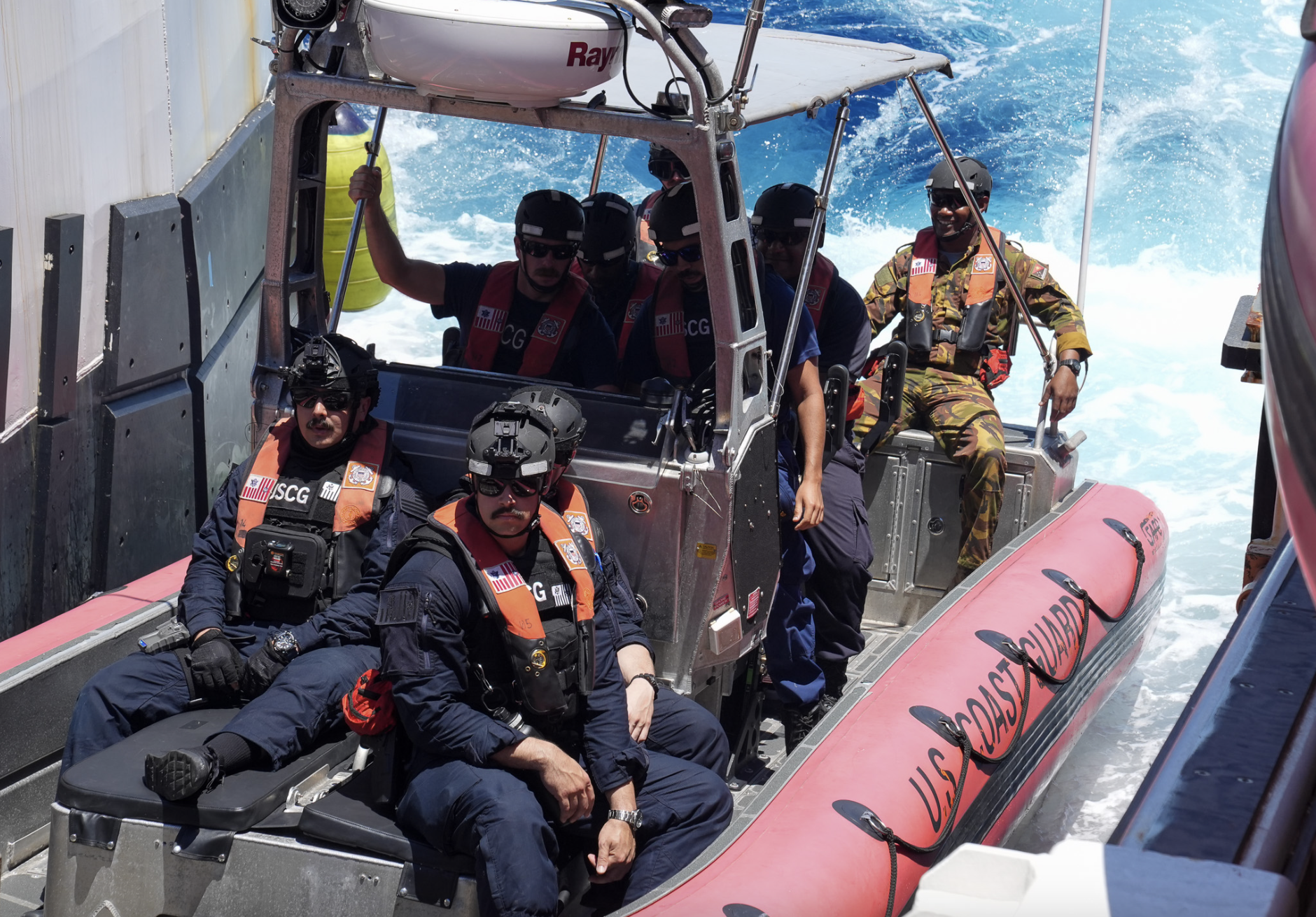
A small boat crew assigned to U.S. Coast Guard Cutter Joseph Gerczak (WPC 1126) gets underway to conduct a boarding on a U.S. flagged fishing vessel near American Samoa Feb. 3, 2025. Due to American Samoa’s status as a U.S. territory, the Coast Guard has the authority to conduct boardings in the U.S. Exclusive Economic Zone surrounding the territory, which extends up to 200 nautical miles offshore. (U.S. Coast Guard photo by Ensign Samuel Carrol)

Below is a news release from Coast Guard News. This is a bit unusual in the small size of the unit involved, a 353 ton, 154 foot long patrol craft and in the location and duration of the patrol.

This seems to make more likely suggestions that we will see Fast Response Cutters like this one based in American Samoa in the future. If previous basing patterns are followed, we should expect three.

Feb. 23, 2025

Coast Guard Cutter Joseph Gerczak returns home following 37-day law enforcement patrol in American Samoa

HONOLULU – The crew of the U.S. Coast Guard Cutter Joseph Gerczak (WPC 1126) returned home to Honolulu Saturday following a 37-day territorial integrity patrol along the U.S. maritime border in American Samoa.

The Joseph Gerczak crew departed Coast Guard Base Honolulu in January and traveled more than 7,300 nautical miles spanning from the Hawaiian Islands to American Samoa.

The crew patrolled the U.S. territorial maritime border and safeguarded the U.S. Exclusive Economic Zone surrounding American Samoa, which extends up to 200 miles offshore.

During the patrol, the crew conducted boardings on two U.S.-flagged fishing vessels to ensure the territorial integrity of the U.S. maritime border and deter any threat of illicit trafficking. The crew also ensured the safety of the U.S. fishing fleet by reviewing the vessels’ documentation, examining the captains’ permits and inspecting the vessels’ required safety equipment, fishing gear and, when applicable, the on-board catch. The crew worked alongside a National Oceanic and Atmospheric Administration Office of Law Enforcement Officer, who assisted the boarding team in identifying two living marine resource violations for which the vessel was cited.

The cutter’s boarding teams observed 10 total violations, including a non-U.S. master who was neither a U.S. citizen nor U.S. national, expired documentation, an expired survival craft, expired hydrostatic releases for emergency position indicating radio beacons, expired flares, unsatisfactory condition of life jackets, and damaged turtle mitigation gear.

Due to safety violations, the Joseph Gerczak crew terminated the voyage of one fishing vessel and escorted the vessel to port in Pago Pago, American Samoa.

“Coast Guard law enforcement boardings and vessel safety inspections are vital to ensuring safety of those at sea and protecting our precious marine ecosystems,” said Lt. Caitlin Piker, commanding officer, Cutter Joseph Gerczak. “Our patrols also enhance maritime domain awareness and serve as a critical line of defense against illegal activities that threaten our nation’s security.”

In accordance with the President’s Executive Orders and direction from Adm. Kevin Lunday, the acting commandant of the Coast Guard, the Coast Guard is increasing cutter patrols and operations in American Samoa. The Coast Guard is surging assets to increase presence in key areas to protect America’s maritime borders, territorial integrity, and sovereignty.

The Joseph Gerczak is a 154-foot Sentinel-class fast response cutter homeported in Honolulu. The cutter’s primary missions are maritime law enforcement, search and rescue, and national defense.

-USCG-

Selling Seapower / Failing PR

120727-N-VD564-015
PACIFIC OCEAN (July 27, 2012) Ships and submarines participating in Rim of the Pacific (RIMPAC) exercise 2012 are in formation in the waters around the Hawaiian islands. Twenty-two nations, more than 40 ships and submarines, more than 200 aircraft and 25,000 personnel are participating in the biennial Rim of the Pacific (RIMPAC) exercise from June 29 to Aug. 3, in and around the Hawaiian Islands. The world’s largest international maritime exercise, RIMPAC provides a unique training opportunity that helps participants foster and sustain the cooperative relationships that are critical to ensuring the safety of sea lanes and security on the world’s oceans. RIMPAC 2012 is the 23rd exercise in the series that began in 1971. (U.S. Navy photo by Chief Mass Communication Specialist Keith Devinney/Released)

It is apparent the Federal Government has been failing in demonstrating its value to the public. Of all the government agencies, the Coast Guard is among the leaders in keeping the public informed, but, even there, it seems we could be doing better.

I am a regular user of web sites that are charged with telling the stories of various agencies. Almost every day I go through my “Recommended Blogs” list of 30 web sites looking for news that may be of interest to our readers. The list includes:

  • Four Coast Guard run sites
  • Joint Interagency Task Force South
  • Three Combatant commander sites–for NORTHCOM, SOUTHCOM, and INDOPACOM
  • Four numbered Fleet commands–5th, 4th, 3rd, and 2nd

12 of the 30 are government sites and really the commercial sites tend to be more interesting.

The Coast Guard sites are generally good. MyCG is for internal consumption and United States Coast Guard News is good for both internal and external audiences. Both seem to have something new almost every day. Acquisitions Directorate (CG-9) is more specialized and less frequent, but I pass along virtually everything they post because it is all important and tends not to repetitive.

Unfortunately Defense Video Information Distribution Service Coast Guard News Wire seems to be underutilized. Their latest video was posted February 2, over a month ago. This would seem to be a good venue for providing videos that might appear on TV on a slow news day (although we don’t seem to be having many of those). When I use a video from this site, I usually pull the same videos off of YouTube because they are more easily accessible, but the site does alert me to the existence of the videos. Unfortunately there just isn’t much content there.

I would have thought Joint Interagency Task Force South would have had a lot of Coast Guard related stories, and much of their content is, but currently, the latest story was posted Nov. 19, 2024 and the one before that was Nov. 5, 2024. The one before that was August 27, 2024. Seven stories in the last year. That’s not frequent enough for most news agencies to bother looking at the site.

NORTHCOM’s on line magazine The Watch adds new content frequently. Most is not Coast Guard or Naval related. I think more of it should be, but it is probably not surprising since NORTHCOM is also NORAD.

SOUTHCOM, I would have thought, would have a lot of Coast Guard related content. Their web site has had four posts about the set up of the retention center at Gitmo 4 to 6 February, but before that they were a lot more quiet. Two posts in January; two posts in December; four in November; two in October; eight in September which included UNITAS, but there was never even a wrap-up at the conclusion of UNITAS. I had to go back to June 6,2024 to find a Coast Guard related story, and there were very few Navy related stories.

INDOPACOM”s Indo-Pacific Defense Forum seems to be written more for an international audience than to inform US citizens, and as such it does an excellent job. Much of it is Naval and coast guard related.

Second Fleet has not had a single story this calendar year. Last story was December 3, 2024, eleven weeks ago.

Third Fleet does not seem to have anything to report except units deploying or returning from deployment.

Fourth Fleet, you would expect to have a lot of Coast Guard related stories, since most of their ships are white with racing stripes, but you would be wrong. There were 14 stories in all of 2024, only a little over one a month. Not one story about a Coast Guard unit. No wrap up following UNITAS2024, I entered Coast Guard in the search function for this site and got this, “Sorry, no results found for ‘coast guard’. Try entering fewer or more general search terms.” They have, until recently showing interest in showing how they are helping prepare GITMO to receive immigrants, generally had any stories of any kind only infrequently. Remarkably I got this when I entered UNITAS (their premier annual international exercise) in the search function, “Sorry, no results found for ‘UNITAS’. Try entering fewer or more general search terms.”

Fifth Fleet, US Naval Forces Central Command, is something of a bright spot. They add a story about once a week, but perhaps more importantly the stories tend to be more operationally focused. Coast Guard Fast Response Cutters featured regularly.

“USCGC Clarence Sutphin Jr. Rescues Seven Mariners” –NAVCENT

M/V SHAYESTEH listing in the Arabian Gulf. Photo courtesy CENT COM

Below is a News release from U.S. Naval Forces Central Command Public Affairs. Other reports, here and here, indicate that the ship was Iranian owned but of Qatari registry and the rescued included five Iranians and two Indian nationals.

Feb 15, 2024
FacebookXCopy LinkEmailShare
U.S. 5TH FLEET – The U.S. Coast Guard Sentinel-class fast-response cutter USCGC Clarence Sutphin Jr. (WPC 1147) seizes a vessel carrying military-grade weapons and other lethal supplies in the Arabian Sea, Jan. 28. Clarence Sutphin Jr. operates in the U.S. 5th Fleet area of operations to help ensure maritime security and stability in the Middle East region.


20250218-G-NO416-1001 CENTRAL ARABIAN GULF – A U.S. Coast Guard team from the fast-response cutter USCGC Clarence Sutphin, Jr. (WPC 1147) rescue seven mariners as their vessel slowly sinks in the Central Arabian Gulf, Feb. 18. The mine countermeasures ship USS Devastator (MCM 6) watches over the scene as backup during the rescue operation. (Photo by U.S. Coast Guard)

USCGC Clarence Sutphin Jr. Rescues Seven Mariners

February 19, 2025

Crewmembers of the U.S. Coast Guard fast-response cutter USCGC Clarence Sutphin, Jr. (WPC-1147) and the mine countermeasures ship USS Devastator (MCM 6) rescued seven mariners from a disabled vessel in the international waters of the Central Arabian Gulf, Feb. 18.

Following a distress signal from the mariners, the Coastguardsmen embarked a rigid-hull inflatable boat to offer assistance. After determining the vessel was no longer sea worthy, the Coastguardsmen brought the mariners back to their ship. Devastator provided back-up support during the operation.

None of the mariners appeared to be injured.

“Providing assistance at sea to mariners in distress is a core Coast Guard mission,” said Coast Guard Lt. Michael O’Dell, Clarence Sutphin, Jr.’s commanding officer. “It is inherently dangerous, but the team executed without hesitation – without fear – to extend their compassion to people in a dire situation. I’m incredibly proud of to be a part of this team.”

Clarence Sutphin, Jr. is forward deployed to the U.S. 5th Fleet area of operations as part of Patrol Forces Southwest Asia. Devastator is an Avenger-class mine countermeasures ship also forward deployed to U.S. 5th Fleet. Both ships help ensure maritime security and stability in the Middle East region.

The U.S. 5th Fleet area of operations encompasses about 2.5 million square miles of water area and includes the Arabian Gulf, Gulf of Oman, Red Sea and parts of the Indian Ocean. The expanse is comprised of 20 countries and includes three critical choke points at the Strait of Hormuz, the Suez Canal and the Strait of Bab al Mandeb at the southern tip of Yemen.

This Day in Coast Guard History, February 19

Based on the Coast Guard Historian’s timeline, https://www.history.uscg.mil/research/chronology/
With inspiration from Mike Kelso

February 19

1845  Administrative control of the Lighthouse Establishment was transferred to Revenue Marine Bureau.

1845  Metal buoys were first put into service. They were riveted iron barrels that replaced the older wooden stave construction.

1862  Congress authorized revenue cutters to enforce the law outlawing the importation of Chinese “coolie” labor.

1941  The Coast Guard Reserve was established after Congress passed the Auxiliary & Reserve Act.  The Auxiliary was created from former Reserve.  The legislation was introduced by Representative Gordon Canfield of New Jersey.

USS Bayfield (APA-33) in the transport area off Iwo Jima, 20 february 1945.
Frames from a short film called “Amphibious Invasion of Iwo Jima, H-Hour Minus One”. Dept. of the Navy. National Archives ID 80201, Local ID 428-NPC-15841.

1945  The invasion of Iwo Jima commenced.  Coast Guard units that participated in this campaign included the Coast Guard-manned USS Bayfield, Callaway, 14 LSTs, and the PC-469.  Three of the LSTs were struck by enemy shore fire: LST-792, LST-758, and LST-760.

The U.S. Navy attack transport USS Callaway (APA-35) off the New York Naval Shipyard (USA), on 18 September 1943. Callaway was loading supplies from a civilian barge. Also alongside is the tug handling the barge and two Coast Guard motor boats.

1988  The largest drug bust in Hawaiian waters to date took place with seizure of the Panamanian-flagged freighter Christina M 800 miles southeast of Hawaii.  The units involved were the Navy fast frigate USS Ouellet with a Coast Guard Law Enforcement Detachment from the CGC Jarvis embarked, the CGC Mallow, and an AIRSTA Barbers Point HC-130.


“South Korea to Transfer BAE Jambelí to Ecuador to Strengthen Its Maritime Capability in Pacific” –Navy News

BAE Jambelí, Former S. Korean Coast Guard cutter KCG3001 (screen grab)

Navy News reports that South Korea is transferring a 30 year old Coast Guard cutter to Ecuador,

“The Ecuadorian Navy will soon receive an addition to its fleet with the transfer of the BAE Jambelí (MP-56), a large patrol vessel previously part of the South Korean Coast Guard. The ship’s transfer to Ecuador, officially announced in mid-2024, highlights the strengthening of international cooperation and the strategic realignment of military resources between nations.”

The ship was the former S. Korean Cutter KCG3001.

KCG3001

Hull Vane Update

Below is a news release from Hull Vane. Not the first time I have passed along the reports of success with this adaptation and the suggestion that the Coast Guard should look at this.

“RNLN Patrol Ship Hull Vane Retrofit Matches Predicted Performance” –Naval News

“New Danish 64m Patrol Vessel Nordsøen optimised, built and delivered with Hull Vane®” –News Release

“Hull Vane To Be Fitted On Royal Netherlands Navy OPV” –Naval News

“Dutch Navy To Test Hull Vane Hydrofoil On HNLMS Zeeland OPV” –Naval News

Hull Vane Experiment on 52 Meter OPV

Hull Vane Claims Improved Performance

Hull Vane on an OPV


Hull Vane and TotalEnergies conducted a pilot project by installing a Hull Vane® on one of the company’s chartered Fast Support Vessels (FSVs) in order to reduce the CO2 emissions. Following successful sea trials, which confirmed the predicted savings in fuel consumption and CO2 emissions, and having used the Hull Vane® for several months in operation, TotalEnergies confirms the fuel saving of 11% in general.

The pilot project was done on Ava J McCall, a 59m (194 ft) Fast Support Vessel owned by Seacor Marine, and designed by Incat Crowther. The vessel is in operation in West-Africa, transporting goods and personnel to the oil fields offshore Nigeria. Ava J McCall is powered by five waterjets, with a combined propulsion power of just over 10.000 kW. Hydrodynamic studies at Hull Vane showed that the Hull Vane® would save around 10% in fuel consumption at the ship’s typical operating speeds of between 15 to 25 knots. The Hull Vane®, built in the Netherlands, was shipped to Ivory Coast where it was installed during Ava J McCall’s scheduled maintenance period in late 2022.

The Naval Architects of Incat Crowther USA took care of the structural integration of the Hull Vane®. The Hull Vane® is placed underneath the waterjets, and does not increase the draft, the beam or the length of the vessel. Upon completion, DP trials showed no effect on the Dynamic Positioning Capabilities of the vessel, which has DP-2 notation.

Once in operation, the fuel consumption data was compared with the measurements after the last dry-docking, a year ago, to eliminate the effect of cleaning and re-painting the hull. Ava J McCall now consumes 14% less at 16 knots and 9% less at 21 knots. This is a bit higher and very close to the CFD predicted results. Over a full year, the CO2 reduction provided by the Hull Vane® on Ava J McCall amounts to 650 tons. That’s 250.000 litres of diesel less consumed per year.

“We are constantly looking for ways to reduce the carbon footprint of our operations, and when we found out about Hull Vane®, our interest was raised,” said David Flajolet, Marine Specialist at TotalEnergies. The pilot project we did with Hull Vane® has been a success; contrary to most of the decarbonizing systems on board vessels, Hull Vane® does not require active management from the crew and this is a key point for us. Its ability to be retrofitted for a limited cost and technical complexity make the solution a quick win for TotalEnergies. Further to the return of experience with the Ava J Mc Call, it has been decided to make it mandatory on the future Call for Tender for FSIVs in Nigeria.

Niels Moerke, CEO of Hull Vane BV: “There are now six FSV’s operating with Hull Vanes worldwide, and on all of them, savings have been proven to exceed 10% over their operational profile. It has been a real pleasure to work with TotalEnergies, and we are delighted with this solid endorsement of our solution. We think that TotalEnergies is right that oil majors should take the initiative to apply Hull Vane® in the offshore market. Hull Vane® is probably the easiest way for oil majors to reduce their operational CO2 emissions without impacting their actual operation. With relative short payback periods ranging from one to three years for these kinds of vessels, it’s also a risk-free investment. We look forward to design and build the Hull Vanes for other FSVs in the fleet chartered by TotalEnergies

This Day in Coast Guard History, February 13

Based on the Coast Guard Historian’s timeline, https://www.history.uscg.mil/research/chronology/
With inspiration from Mike Kelso

February 13

Douglas R5D-3; “OFF TO HEAT AN ICEBERG: A 1,000-pound thermite bomb enclosing a cluster of small bomblets, each capable of burning at a temperature of 4,300 degrees Fahrenheit, rides under the wing of a Coast Guard UF-2G amphibian plane toward an iceberg target in the foggy Grand Banks region of Newfoundland. The temperature of one bomblet equals half the sun’s surface temperature. This bomb was one of twenty cluster bomb of thermite and petroleum types air-dropped on selected icebergs during heat destruction tests made by the International Ice Patrol force in June, at the height of the 1959 heavy ice season. Above the bomb carrier is a large passenger type Coast Guard R5D plane, one of three used on regular ice observation flights out of Argentia, Nfld. The more modern R5Ds this year replaced old World War II B-17 bomber type planer with plexiglass noses where ice observation instruments and carries a crew of about seven. Ice is observed from many windows. Averaging 6 to 8 hour ice observation flights, the R5D patrols an area of about 14,000 square miles in the Grand Banks region. The R5D plane here wears one of the new paint schemes currently being tested for easy air visibility by the U.S. Coast Guard on its various planes. In place of the dull silver gray and orange trim formerly used, the new dress is made of glowing fluorescent colors–orange nose, wing tips, tail and body strip with black edgings, and main body in brilliant white.”; Photo No. 5854; 17 July 1959; photographer unknown.

1960  A Coast Guard R5D aircraft from Honolulu dropped a pump to the Japanese training vessel Toyama Maru, which had radioed that it was taking on water and was in danger of sinking off Palmyra Island.  The pump controlled flooding until the arrival of CGC Bering Strait, whose crew made repairs to the Japanese vessel, using 2,500 pounds of sand and cement parachuted by a Honolulu-based SC-130B plane.

1963  The Bureau of Customs requested Coast Guard assistance to search the M/V Holland Diepe in Tacoma, Washington, for narcotics.  Narcotics agents had previously apprehended three Chinese crew members of the vessel in a Seattle hotel.  COTP Seattle provided a search party of two officers and eight enlisted men, who were joined by 10 Customs agents.  Two-man teams searched assigned areas of the vessel.  A first search of seven hours uncovered a considerable quantity of raw opium.  The search party then departed, as if the search were ended, but 45 minutes later they boarded the vessel once more, lined up the crew in the mess hall, and searched them and the ship again.  This search, lasting three hours, uncovered more opium, both raw and prepared for smoking, a small quantity of heroin, and several opium pipes.  A total of six pounds of opium was seized.  WPB 82336 conducted waterside surveillance during the search.

1969  The National Transportation Safety Board issued its “Study of Recreational Boat Accidents, Boating Safety Programs, and Preventive Recommendations”.

In response to the Iraqi action of firing oil wells and pumping stations in Kuwait, two HU-25A Falcon jets from Air Station Cape Cod, equipped with Aireye technology, which precisely locates and records oil as it floats on water], departed for Saudi Arabia. The Falcons mapped over 40,000 square miles in theatre and located every drop of oil on the water. This was used to produce a daily updated surface analysis of the location, condition and drift projections of the oil. The Aviation Detachment was deployed for 84 days, flew 427 flight hours and maintained an aircraft readiness rate of over 96 percent.

1991  During Operation Desert Storm, two HU-25A Falcon jets from Air Station Cape Cod, equipped with AIREYE technology, departed for Saudi Arabia for service with the Inter-agency oil spill assessment team. They were accompanied in flight by two C-130 aircraft from Air Station Clearwater carrying spare parts and deployment packages.