“Coast Guard’s heavy icebreaker returns to the U.S. after 128-day deployment in support of Operation Deep Freeze” –D11

The U.S. Coast Guard Cutter Polar Star (WAGB 10) and crew sail under San Francisco’s Golden Gate Bridge upon returning to the United States following their 128-day deployment to Antarctica to support Operation Deep Freeze 2025, March 30, 2025. Polar Star’s crew completed their 28th voyage to Antarctica in support of the joint military service mission to resupply and maintain the United States Antarctic Stations. U.S. Coast Guard photo by Auxiliarist Pablo Fernicola.

Below is a news release.

A couple of noteworthy items, first, why is Polar Star, based in Seattle, going into San Francisco?

For the fifth year in a row, Polar Star is going into an extended maintenance and dry-docking period in Vallejo, this time for the final phase of a five year rolling service life extension program. Apparently the plan is to do the same thing with USCGC Healy.

Second, a unique ship, the Japanese built HMNZS Aotearoa,had an at sea crew exchange with Polar Star and used the channel broken by Polar Star to get to McMurdo. HMNZS Aotearoa, is, I believe, the world’s only ice strengthened underway replenishment ship, perhaps something the US Navy or Coast Guard might want to consider, given the increased interest in the Arctic.

HMNZS Aotearoa (A11) participating in the International Fleet Review 2022. Japanese Government photo

April 2, 2025

Coast Guard’s heavy icebreaker returns to the U.S. after 128-day deployment in support of Operation Deep Freeze

SAN FRANCISCO – The U.S. Coast Guard Cutter Polar Star (WAGB 10) and crew returned to the United States, arriving in San Francisco Sunday, following a 128-day deployment to Antarctica in support of Operation Deep Freeze (ODF) 2025.

Polar Star completed its 28th voyage to Antarctica in support of the joint military service mission to resupply and maintain the United States Antarctic Stations. Every year, a joint total force team works together to complete a successful Operation Deep Freeze in support of the U.S. National Science Foundation (NSF) – the agency that manages the United States Antarctic Program (USAP).

Polar Star departed Seattle bound for Antarctica on Nov. 22, 2024, traveling over 25,000 miles through the North Pacific, South Pacific, and Southern Oceans.

Polar Star made two logistical stops in Pearl Harbor, Hawaii, and Sydney en route to Antarctica. In Sydney, the cutter and crew hosted the U.S. Consul General Christine Elder and other members of the U.S. Embassy.

In Antarctica, the cutter encountered 14 miles of fast ice up to six feet thick. Polar Star created a navigable route and cleared Winter Quarters Bay for two cargo vessels and HMNZS Aotearoa to reach NSF McMurdo Station. While operating in McMurdo Sound, Polar Star, and Aotearoa conducted an at-sea crew exchange to build camaraderie and a shared understanding of each vessel’s unique capabilities in the polar regions. At the conclusion of vessel operations at McMurdo Station, the cutter departed the Antarctic region on March 3 after 60 days of support to ODF 2025.

Polar Star provides heavy icebreaking capabilities to facilitate sealift, seaport access, bulk fuel supply, and cargo handling for two of three permanent U.S. research stations in Antarctica, with NSF McMurdo Station being the largest. The cutter’s icebreaking capabilities enable the safe delivery of critical supplies to sustain USAP’s year-round operations and support international partnerships in the harsh Antarctic environment. It is vitally important that the U.S. maintains a maritime domain presence in Antarctica to protect international access to the region, in line with the Antarctic Treaty System.

Polar Star also worked with the Commission for the Conservation of Antarctic Marine Living Resources (CCAMLR) to support a secure and sustainable Southern Ocean. Polar Star was the first United States surface asset to support CCAMLR. The crew’s efforts to observe and monitor fishing and other activity on the high seas safeguarded resources and U.S. national interests in the Antarctic region.

“This crew continues to amaze me by how well they work together through every challenge,” said Capt. Jeff Rasnake, Polar Star’s commanding officer. “And I am so very proud of how each person brought their best energy every day to keep the ship running, to endure the strain of this long deployment, to take care of each other, and to truly thrive as a team.”

On their journey back to the United States, Polar Star’s crew moored in French Polynesia. Polar Star’s stop in French Polynesia included visits with the Commander of the Armed Forces in French Polynesia, Naval Base Papeete Commandant, and the Secretary to the High Commissioner of French Polynesia. These engagements underscored the United States’ continued commitment to a secure and prosperous Indo-Pacific region.

“But our work isn’t done,” said Rasnake. “As we wrap up ODF 25, we must quickly transition to the first phase of ODF 26 – heavy depot maintenance. There’s no time to waste as we work to ensure Polar Star is ready to roll into her 50th year of service.”

Polar Star will enter the final phase of its five-year Service Life Extension Project (SLEP). SLEP was awarded to Mare Island Dry Dock, LLC, in Vallejo, to recapitalize targeted systems, including the cutter’s propulsion, communication, machinery control, and auxiliary systems, and to conduct significant maintenance extending the cutter’s service life. Completing SLEP will significantly mitigate the risk of lost operational days due to unplanned maintenance or system failures by replacing obsolete, unsupportable, or maintenance-intensive equipment. Each phase is coordinated so that operational commitments, like Operation Deep Freeze missions in Antarctica, will still be met.

The Seattle-based Polar Star is the only United States asset capable of providing assured access to both polar regions. The cutter is a 399-foot heavy polar icebreaker commissioned in 1976. It weighs 13,500 tons, is 84 feet wide, and has a 34-foot draft. The six diesel and three gas turbine engines produce up to 75,000 horsepower.

Next year’s Operation Deep Freeze will be Polar Star’s 29th and will coincide with Polar Star’s 50th commissioning date anniversary.

This Day in Coast Guard History, April 3

Based on the Coast Guard Historian’s timeline, https://www.history.uscg.mil/research/chronology/
With inspiration from Mike Kelso

April 3

1882  The schooner Morris was unable to enter Muskegon, Michigan, between the piers and was aided by the lookout of Station No. 8, Eleventh District.  He used a heaving-stick and throwing a line to get a hawser to the vessel.  The same service was rendered later in the day by two of the station men to the schooner Willis Smith of South Haven.

Lt. Jack C. Rittichier, HONORED ON PANEL 58W, LINE 14 OF THE WALL, born 08/17/1933, killed in action 06/09/1968, QUANG TRI Province, Vietnam. Awarded the Silver Star, three Distinguished Flying Crosses and three Air Medals. 

1968  Coast Guard exchange pilots arrive in South Vietnam to fly combat SAR missions with the Air Force.

Launch of USCGC Mackinaw (WLBB-30) on April 2, 2005. Photo by Peter J. Markham.

2014  CGC Mackinaw, home-ported in Cheboygan, Michigan, conducted an escort on Lake Superior near Whitefish Point.  Mackinaw’s crew worked together with the crew of Canadian Coast Guard Ship Pierre Radisson, home-ported in Quebec City, as part of an ongoing bi-national agreement between the U.S. and Canada, to break sheet ice that was nearly 40 inches thick.

Canadian Coast Guard Ship Pierre Radisson, Quebec City, Canada, 9 June 2009, Photo credit: Cephas via Wikipedia.

Third Fleet and DOD Becoming Involved in Maritime Migrant Interdiction

The U.S. Coast Guard conducts operations with the USS Spruance
PACIFIC OCEAN (March 28, 2025) “A U.S. Coast Guard MH-60T conducts flight operations with the Arleigh Burke-class guided-missile destroyer USS Spruance (DDG 111) while underway in the Pacific Ocean, March 28, 2025. U.S. Navy assets are employed under U.S. Northern Command’s maritime homeland defense authorities with a U.S. Coast Guard Law Enforcement Detachment embarked to enable maritime interdiction missions to prevent the flow of illegal drugs and other illegal activity. U.S. Northern Command is working together with the Department of Homeland Security to augment U.S. Customs and Border Protection along the Southern border with additional military forces.” (U.S. Navy photo by Mass Communication Specialist Seaman Joey Sitter)

Below is a Coast Guard District 11 news release.

I believe, this is the first time Navy units operating under Third Fleet have been involved in Migrant interdiction efforts. With USS Spruance on the West Coast and USS Gravely on the Gulf coast, its obvious DOD has been told to show up.

Small numbers of Navy ships, usually frigates or littoral combat ships, have routinely engaged in drug interdiction under the direction of Forth Fleet and SOUTHCOM, and have rescued migrants during unusual surges of immigrants like the Mariel Boat Lift of 1980.

For short periods during the first Trump administration, Navy ships were surged to Forth Fleet to augment drug interdiction efforts.

NORTHCOM has played little part in maritime interdiction of any kind, apparently satisfied that DHS was handling the job.

PACIFIC OCEAN (March 28, 2025) Members of the U.S. Coast Guard conduct small boat operations with the Arleigh Burke-class guided-missile destroyer USS Spruance (DDG 111) and U.S. Coast Guard cutter USCGC Terrell Horne (WPC 1131) while underway in the Pacific Ocean, March 28, 2025. U.S. Navy assets are employed under U.S. Northern Command’s maritime homeland defense authorities with a U.S. Coast Guard Law Enforcement Detachment embarked to enable maritime interdiction missions to prevent the flow of illegal drugs and other illegal activity. U.S. Northern Command is working together with the Department of Homeland Security to augment U.S. Customs and Border Protection along the Southern border with additional military forces. (U.S. Navy photo by Mass Communication Specialist Seaman Joey Sitter)

While I don’t think these destroyers will add much to the already substantial effort already being made by the Coast Guard and its regular partners, they do provide a degree of missile defense to the US coast that has been missing and a ready response in the event of a maritime terrorist attack in their vicinity, so I am glad to see them underway. US Navy crews may be overworked, but it is not because their ships are underway too much. The average USN combatant is underway less than 90 days a year.

Certainly, there is a desire to show results. There is an implication rather than a statement that the people on the boat were attempting to enter the US, but that is not really clear. “50 miles southwest of San Diego” suggests that the boat was in the Mexican EEZ, well South of the border, and a 35 foot boat is not typical of the Panga-style boats recently intercepted smuggling migrants along the West Coast. It could have broken down off San Diego and drifted South? Had the boat been tracked heading North? Did the American own the boat? Was the boat destroyed after the passengers and crew were removed? Time will tell. 

Coast Guard Cutter Active and partnership agencies interdict a migrant vessel, approximately 20 miles off the coast of Point Loma, California, Jan. 27, 2025. The crew of Active, the Coast Guard Cutter Terrell Horne and U.S. Customs and Border Protection members worked together to interdict this illegal migrant operation, which had 21 individuals aboard. (U.S. Coast Guard courtesy photo)


March 31, 2025

Coast Guard, Navy rescue 18 people from disabled vessel off San Diego coast

U.S. Coast Guard Pacific Southwest Phone: (206) 815-6689

SAN DIEGO – A Coast Guard Air Station San Diego MH-60 Jayhawk helicopter aircrew and the crew of the Arleigh Burke-class guided-missile destroyer USS Spruance (DDG 111) rescued 17 aliens and one American aboard a disabled and adrift vessel approximately 50 miles southwest of San Diego Sunday.

A 35–foot vessel with 18 individuals aboard was spotted in international waters taking on water and requesting assistance around 7:55 a.m.

The Spruance launched a 7-meter rigid hull inflatable boat crew to assist. The 18 individuals were rescued from the water and safely brought aboard the Spruance.

Watchstanders from Coast Guard Sector San Diego then launched an MH-60 Jayhawk helicopter aircrew to transport the persons from Spruance to Coast Guard Sector San Diego.

All 17 aliens and the one American were brought to Sector San Diego over two separate flights due to passenger constraints.

The 18 individuals were transferred to Department of Homeland Security partners.

Irregular maritime migration aboard unseaworthy or overloaded vessels is always dangerous, and often deadly. Do not take to the sea. You could lose your life. We remain steadfast in our commitment to saving lives and discouraging anyone from taking to the sea in ways that are unsafe and illegal.

This Day in Coast Guard History, April 1

Based on the Coast Guard Historian’s timeline, https://www.history.uscg.mil/research/chronology/
With inspiration from Mike Kelso

April 1

1813  At 1100 in the morning, while at anchor in Charleston Harbor, the powder room of the cutter Gallatin exploded, blowing off the cutter’s stern and quarterdeck.  The explosion and subsequent fire killed three crewmembers instantly and seriously wounded five more.  The cutter sank at its anchorage.  A Charleston newspaper reported, “Between the hours of ten and eleven yesterday forenoon, a most awful explosion took place in this harbor, on board the Revenue schooner GALLATIN, commanded by Capt. John. H. Silliman. . .There were about 35 persons in all on board; of this number about 10 were on the quarter deck and in the cabin; part of them employed in cleaning the arms. Thus situated, the dreadful explosion took place, and in one instant the whole quarter deck with all of those upon it, were hurled into the air. Some of the bodies were thrown nearly as high as the mast head of the vessel; others were driven through the cabin and lodged upon the main deck. The whole stern of the vessel was torn down to a level with the water.”  Those who were killed were Gunner’s Mate Thomas Feld, George Segur, and one unidentified seaman.  The reported wounded were William Pritchard (Gunner), John McCoan, Benjamin Chart, George Craft, and William Hunter (Boy).

1897  Under an Executive Order dated May 6, 1896, federal Civil Service rules were applied to the Life-Saving Service.

Elmer Stone, Coast Guard Aviator #1

1916  The official birthday of Coast Guard aviation.  On this date, Third Lieutenant Elmer F. Stone reported to Pensacola Naval Air Station for flight training.  He was the Coast Guard’s first aviator.

he bow and midsection of Coast Guard manned LST-884 being salvaged after 1 April 1945 Kamikaze attack, 9 July 1945. She was too damaged to be of any use and was sunk later in 1946.
US National Archives ID # 193705117, a US Army Air Corps photo now in the collections of the US National Archives

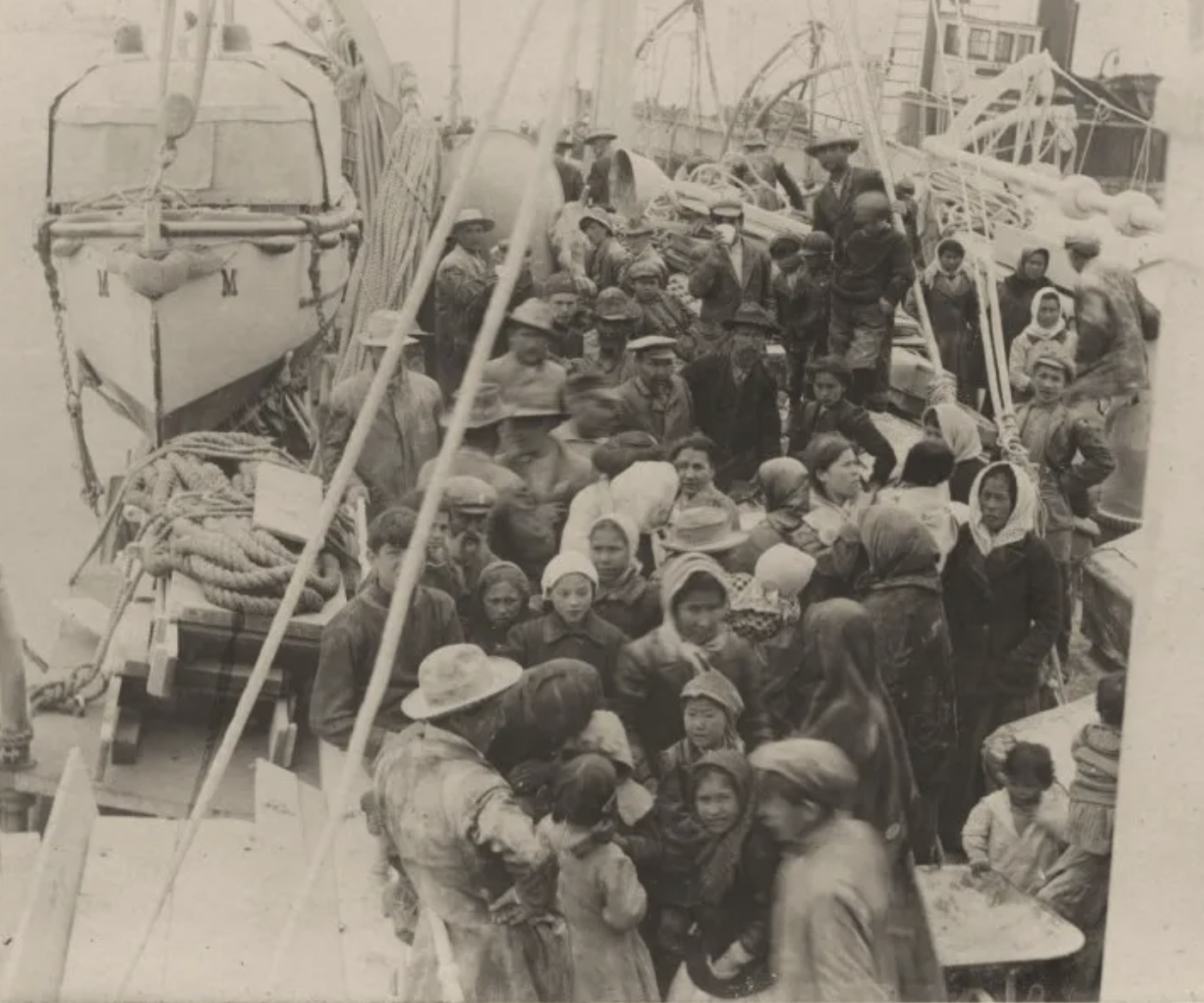
1945  The invasion of Okinawa in the Ryukyu Islands commenced.  In all, seven Coast Guard-manned transports, 29 LSTs, the cutters Bibb and Woodbine, and 12 Coast Guard-manned LCI(L)s participated in the bloodiest invasion ever undertaken by the United States.  Over 13,000 Americans were killed and another 36,000 were wounded during the conquest of this Japanese possession.

USS LST-884 crew photo. Notice the many different uniforms, a result of the crews loss of almost everything in the fire. This picture was taken once the crew was reunited at Ulithi.

The original 1903 Scotch Cap Light, located on the SW corner of Unimak Is., Alaska . US Coast Guard photos

1946  A tsunami swept away the light station at Scotch Cap, Alaska, killing the station’s entire five-man crew.  They were: BMC Anthony L. Petit, MoMM 2/c Leonard Pickering, F 1/c Jack Colvin, SN 1/c Dewey Dykstra, and SN 1/c Paul James Ness.

1967  The Coast Guard ended its 177-year association with the Treasury Department when it transferred to the newly-created Department of Transportation (DOT).  DOT was created when President Lyndon Johnson signed Executive Order 167-81.  The Coast Guard was the largest agency in the new department.

1969  The Coast Guard established an Ocean Engineering Division within the Office of Engineering.  The new division was formed to improve engineering support for the marine sciences and short-range aids to navigation missions.

1977  CGC Dauntless operating along with CGC Cape Fox in the area of Cay Lobos Bahamas boarded F/V Big Champ.  The boarding party discovered 5,000 lbs. of marijuana.  The vessel and marijuana were seized and the four POB were arrested.

USCGC Acushnet (WMEC-167) crew members inspecting a navigation buoy in Alaskan waters, date and location unknown. Photo courtesy Marine Exchange Alaska. Robert Hurst
http://www.navsource.org/archives/09/37/3709.htm

1978  CGC Acushnet changed designation from WAGO to WMEC “to allow for the increased multi-mission utilization of the vessel.”  Acushnet’s primary mission continued to be Marine Science Activities (MSA) “due to its special capabilities for environmental buoy deployment.”

The U.S. Coast Guard high endurance cutter USCGC Gallatin (WHEC-721) lies tied up at a pier at Naval Station Roosevelt Roads, Puerto Rico, during exercise “Ocean Venture ’88”, on 30 March 1988.

1984  CGC Gallatin made the largest maritime cocaine seizure to date when it boarded and seized the 33-foot sailboat Chinook and her crew of two.  A boarding team discovered 1,800 pounds of cocaine stashed aboard the sailboat.

This Day in Coast Guard History, March 31

Based on the Coast Guard Historian’s timeline, https://www.history.uscg.mil/research/chronology/
With inspiration from Mike Kelso

March 31

1932  The United States signed a Whaling Convention at Geneva with 21 other countries.

USCGC Tuscarora

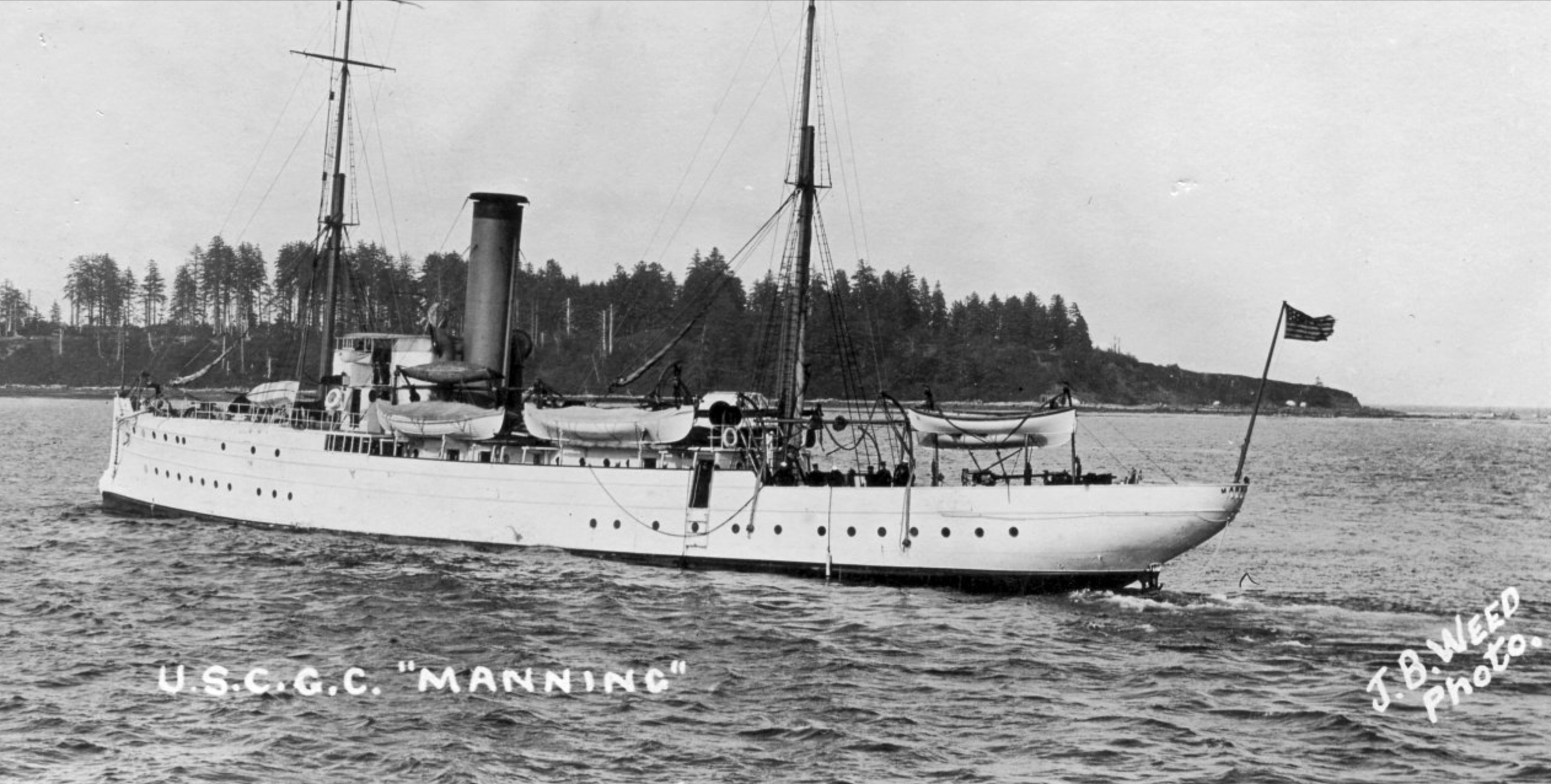
1934  At high noon on March 15, 1934, CGC Tuscarora fired a shot from one of its batteries, a shot that started the fifth international St. Petersburg to Havana racing classic.  Tuscarora served as the official Coast Guard escort for the race.

World War II US Naval Districts from which the USCG Districts were derived.

1948  The Tenth District, with headquarters at San Juan, Puerto Rico and comprising of the Panama Canal Zone, all of the island possessions of the United States pertaining to Puerto Rico and the Virgin Islands, and all United States reservations in the islands of the West Indies and on the north coast of South America, was abolished, and its functions, responsibilities, and facilities were transferred to and combined with the Seventh District, with headquarters at Miami, Florida.

1995  Coast Guard Communication Area Master Station Atlantic sent a final message by Morse Code and then signed off, officially ending more than 100 years of telegraph communication.

Response Boat, Medium (RB-M). Photo from Vigor

2008  The U.S. Coast Guard took delivery of its first Response Boat–Medium (RB-M) from Marinette Marine Corporation.  Following completion of underway trials on March 17, 2008 near Tacoma, Washington, RB-M 45601 was trailered cross-country for delivery in Portsmouth, Virginia.  After one week of familiarization for the Coast Guard Transition Team (responsible for facilitating the introduction of the planned 180 boats to the fleet) Station Little Creek, Virginia took delivery of RB-M 45601 on April 7, 2008. The RB-M acquisition was initiated to replace the aging 41’ Utility Boats and other Non-Standard Boats.  The RB-M is a self-righting, 45-foot all-aluminum boat with twin diesel engines and water jet propulsion.

USCGC Midgett is in the Western Pacific–Making Friends and Influencing People

Coast Guard Cutter Midgett’s (WMSL 757) law enforcement team and Papua New Guinea shipriders return after a boarding in Papua New Guinea’s exclusive economic zone, Mar. 11, 2025. Papua New Guinea lies in the heart of key shipping routes and lucrative fisheries. The U.S. Coast Guard and Papua New Guinea collaborate to mitigate shared maritime challenges and threats, promoting regional security and stability within Oceania. (U.S. Coast Guard photo by Petty Officer 3rd Class Jennifer Nilson)

Below is a news release from US Coast Guard News.


March 26, 2025

U.S. Coast Guard cutter promotes regional security in the Pacific with Papua New Guinea

RABAUL, Papua New Guinea – The U.S. Coast Guard Cutter Midgett (WMSL 757) recently concluded its second port call in Papua New Guinea (PNG), following nine days of shiprider operations with representatives from the PNG Defence Force, PNG Customs Service, and PNG National Fisheries Authority.

Midgett was invited by the Papua New Guinea government to participate in the operation. The PNG shipriders led the mission by selecting vessels of interests and conducting boardings while the U.S. Coast Guard provided ship based and shoreside support. The successful shiprider operations reinforced the importance of deepening and expanding strong bilateral relationships.

During the nine-day operation, Midgett facilitated six at-sea inspections within the PNG Exclusive Economic Zone (EEZ) under the PNG-U.S. bilateral agreement. The U.S Coast Guard and PNG’s bilateral maritime law enforcement agreements enhance PNG sovereignty with the capacity to enforce PNG’s maritime laws through shared information exchanges and joint patrols that deter illegal activities and malign behavior in PNG’s EEZ.

While in Rabaul, Midgett hosted a key leadership engagement with the East New Britain Governor, Michael Marum, and PNG fisheries stakeholders. During the engagement, members of Midgett and PNG representatives participated in roundtable discussions focused on PNG-U.S. bilateral agreements and security within the PNG EEZ and received a tour of the cutter.

Midgett crewmembers visited a local school to participate in sports and seamanship activities. Midgett also hosted students on board, allowing students to learn about shipboard life and participated in firefighting training.

Commissioned in 2019 and homeported in Honolulu, Midgett is the eighth Legend-class National Security Cutter. At 418-feet, these cutters are the largest and most capable in the U.S. Coast Guard fleet. Equipped with advanced technology, they are ideally suited to support a wide range of missions, including maritime security, law enforcement, and search and rescue operations.

“Coast Guard increases operational presence near southwest border between U.S. and Mexico” –D11

Coast Guard Cutter Active and partnership agencies interdict a migrant vessel, approximately 20 miles off the coast of Point Loma (San Diego), California, Jan. 27, 2025. The crew of Active, the Coast Guard Cutter Terrell Horne and U.S. Customs and Border Protection members worked together to interdict this illegal migrant operation, which had 21 individuals aboard. (U.S. Coast Guard courtesy photo)

Below is a District 11 (California) news release.

We have seen a noticeable increase in West Coast migrant interdictions near the Southern border that suggested much increased human trafficking. This is apparently in response to that increase.


March 28, 2025

Coast Guard increases operational presence near southwest border between U.S. and Mexico

ALAMEDA, Calif. – The Coast Guard has increased its operational presence near the southwest border between U.S. and Mexico to enhance border security, immigration enforcement and to protect the territorial integrity of the United States.

Coast Guard District Eleven (D11) has expanded its posture from previous steady state counter-illicit-maritime-activities to gain full operational control of the Southwest Maritime Border.

Since Jan. 21, D11 has tripled its forces operating on the southern border and coordinated Coast Guard surface and air presence with partners to detect, deter, and interdict alien and drug smuggling ventures. D11 diverted aircraft, cutters, small boats and crews under its operational control to the southern border, increasing the illegal alien apprehension rates by 75% with multiple smuggling attempts continuing to occur each night. The Coast Guard remains committed to a persistent operational presence to ensure border security and territorial integrity of the United States.

Irregular maritime migration aboard unseaworthy or overloaded vessels is always dangerous, and often deadly. D11 remains steadfast in its commitment to saving lives and discouraging anyone from taking to the sea in ways that are unsafe and illegal.

D11 has taken immediate actions to increase operational presence and focus to combat illegal fentanyl threatening the United States. In recent years, smuggling ventures across the southern border have been found to include bulk cocaine, methamphetamines, and fentanyl. This trafficking of illegal drugs poses an urgent threat to the American people, and the members of the Coast Guard do everything in their power to interdict drugs before they reach our shores and citizens. Accordingly, the Coast Guard has increased operations to interdict, seize, and disrupt the transshipment of cocaine and other bulk illicit drugs by sea. This includes operations in the Eastern Pacific and the Western Hemisphere Transit Zone, a major highway for illegal smuggling activity. Through sustained counter-narcotics operations, the Coast Guard has imposed billions of dollars of costs on the criminal networks, continuing the fight against corruption and violence fueled by narco-trafficking. Coast Guard law enforcement action and presence is critical to countering the destabilizing impacts of transnational organized crime. Since January 21, the Coast Guard has interdicted more than 68,800 lbs of cocaine and 4,200 lbs of marijuana totaling nearly $785 million in wholesale value.

These trends may change due to an influx of Coast Guard assets coupled with Department of Defense (DoD) resources and U.S. Border Patrol in a coordinated effort to protect our southern borders and maritime approaches. U.S. Northern Command (NORTHCOM) recently deployed two U.S. Navy warships to the southern border to protect the territorial integrity of the United States and support Department of Homeland Security (DHS) and Coast Guard operations.

These U.S. Navy warships will operate in direct support of the Coast Guard and carry Coast Guard law enforcement teams that will enable them to conduct border security operations under Coast Guard authorities. As the Coast Guard hardens and sustains its operational posture, including the arrival of these U.S. Navy warships, it is fully integrated with DHS and DoD through NORTHCOM and U.S. Southern Command.

Additionally, D11 is assisting with the national transport of illegal aliens to designated locations in Texas and California, where DoD then transports the aliens internationally for repatriation. The Coast Guard continues to devote its forces from across the nation to support these flights. These combined surface and air operations demonstrate the Coast Guard’s continued dedication to control, defend, and secure U.S. borders, territorial integrity, and ensure sovereignty.

D11 plays a crucial role in homeland security and economic prosperity by conducting border security and counter-drug operations to safeguard the integrity of the Southwest Border and its maritime approaches, effectively interdicting, seizing and disrupting drug and alien smuggling at sea.

This Day in Coast Guard History, March 29 / 30

Based on the Coast Guard Historian’s timeline, https://www.history.uscg.mil/research/chronology/
With inspiration from Mike Kelso

March 29

1867  The lighthouse at Timbalier Bay was destroyed in a hurricane.  The brick tower “was leveled to the ground and covered with from three to six feet of water.”  The Lighthouse Board commended the keepers, “who faithfully performed their duty, barely escaping with their lives, and living for some days in an iron can buoy . . .”

Members of the Overland Relief Expedition

1898  Lieutenants David Jarvis and Ellsworth P. Bertholf and Surgeon Dr. Samuel J. Call of the Revenue cutter Bear reached Point Barrow, Alaska, after a 2,000 mile “mush” from Nunavik Island that first started on December 17, 1897, driving reindeer as food for 97 starving whalers caught in the Arctic ice.  This Overland Rescue was heralded by the press and at the request of President William McKinley, Congress issued special gold medals in their honor.

1938  By an Executive Order of this date, President Franklin Roosevelt enlarged substantially the number of “personnel in the Lighthouse Service who are subject to the principle of the civil service,” which allowed advancement in the Service based solely on individual merit.

1984  Coast Guard AIRSTA Cape May and Group Cape May responded to severe flooding in southern New Jersey and Delaware after a late winter storm struck the area on March 29, 1984.  Coast Guardsmen evacuated 149 civilians from Cape May and Atlantic City.

1985  The last lightship in service with the Coast Guard, CGC Nantucket I, was decommissioned, thus ending 164 years of continuous lightship service by the U.S. Government.  Nantucket I was the last of the U.S. lightships and the last of the Nantucket Shoals lightships that watched over that specific area since June of 1854.  Launched as WLV-612 in 1950 at Baltimore, the ship also stood watch as the light vessel for San Francisco and Blunts Reef in California, at Portland, Oregon, and finally at Nantucket Shoals.  Nantucket I also spent time in service as a “less-than-speedy” law enforcement vessel off Florida.

Photograph of Ellsworth P. Bertholf, Commandant of the U.S. Revenue Cutter Service from 1911 to 1915 and Commandant of the U.S. Coast Guard from 1915 to 1919. Coast Guard photo.

2005  The keel was laid for the first of the new 418-foot National Security Cutters, CGC Bertholf (WMSL-750), named for Commodore Ellsworth Bertholf, former commandant of the U.S. Coast Guard.  Bertholf was constructed at Northrop Grumman Ship Systems in Pascagoula, Mississippi.  The cutter was christened on November 11, 2006 after being launched on September 29, 2006.  The Coast Guard commissioned Bertholf on August 4, 2008.

March 30

1867  The United States signed the Alaska purchase treaty with Russia.

Admiral Russell R. Waesche, Sr., USCG Commandant 1936 to 1945

1942  By Presidential proclamation, the Coast Guard was designated as a service of the Navy to be administered by the Commandant of Coast Guard under the direction of the Secretary of the Navy, similar to the administration of the Marine Corps.

As Commandant from 1936 through 1945 Waesche insured the successful integration of the U.S. Lighthouse Service, a purely civilian agency, with the Coast Guard in 1939 as ordered by President Franklin Roosevelt. He also presided over the greatest expansion of the USCG in its history and made sure the service maintained its separate identity while it was under the administrative control of the U.S. Navy. Admiral Waesche saw his small peacetime fleet swell with Coast Guardsmen manning more than 750 cutters, 3,500 miscellaneous smaller craft, 290 Navy vessels, and 255 Army vessels. The Coast Guard participated in every major amphibious operation. Furthermore, activities at all Coast Guard air stations were increased as aviators engaged in anti-submarine and convoy escort operations and performed numerous search and rescue missions. In 1943 Waesche also secured Congressional support for the Coast Guard’s return to the control of the Treasury Department as quickly as possible after the end of the Second World War. In doing this, the service avoided the problems that occurred after the end of the First World War when the Navy attempted to maintain its control of the Coast Guard.

Admiral Waesche earned praise from the Secretary of the Navy for his stewardship of the Coast Guard during the Second World War.

After the longest tenure as Commandant, Admiral Waesche retired from the Coast Guard effective 1 January 1946. He died later that year on 17 October 1946 and was buried at Arlington National Cemetery on 21 October. Two weeks after he retired Navy Secretary James Forrestal decorated Admiral Waesche with the Distinguished Service Medal for “exceptionally meritorious service to the government of the United States in a duty of great responsibility as Commandant, United States Coast Guard.”

In March 1946 President Harry S. Truman nominated the ten top U.S. wartime generals and admirals to retain permanently their wartime ranks. At the same time the President announced the formation of an “elder statesmen’s organization” for national defense consisting of those ten officers. Admiral Waesche was one of those officers so-designated.

Though largely responsible for the efficient expansion of the service, Admiral Waesche also improved the traditional functions of the Coast Guard. The activities on the Great Lakes and the inland waterways were extended and intensified. His administration placed increased emphasis on maritime safety, icebreaking, and aids to navigation. As Commandant he also took a keen interest in the work in the field and frequently made personal inspections of district units and activities. In short his tenure as Commandant was one of the most successful in the service’s distinguished history.

Admiral Waesche received an honorary degree as Doctor of Engineering from Purdue University in February, 1944. He was elected President of the Society of American Military Engineers in May, 1944. He was survived by his wife, Agnes R. Cronin, and four sons, three of whom entered military service. His oldest son, Russell Randolph Waesche, Jr., later retired from the Coast Guard as a flag officer.

This Day in Coast Guard History, March 27/28

Based on the Coast Guard Historian’s timeline, https://www.history.uscg.mil/research/chronology/
With inspiration from Mike Kelso

March 27

1943  CG-85006 (ex-Catamount) exploded off Ambrose Light while on Coastal Picket patrol duty.  Of a total of ten crew members on board, four drowned while five were reported missing.  Only the commanding officer, CBM Garfield L. Beal, USCG, escaped.  He was picked up six hours later by a passing merchant ship.  The cause of the explosion was never ascertained.

1964  An earthquake which hit 9.2 on the Richter scale and an ensuing tsunami struck Alaska, killing 125 people and causing $311 million in property damage.  Coast Guard units responded in what was called “Operation Helping Hand.”  Within two hours of the earthquake, which began at 1732 local time, CGCs Storis, Minnetonka, and Sorrel were ordered to Prince William Sound; Bittersweet to Seward; and Sedge to Valdez.  “The following morning, three fixed-wing aircraft from Air Detachment Kodiak surveyed the damage while helicopters evacuated those in need.   By March 31, most of the direct assistance had been rendered and the task of repair and clean up began.  Approximately 360 civilians were evacuated from villages and isolated areas in Kodiak Island and Prince William Sound.  Storis was diverted to Cook Inlet for icebreaking duties in the Port of Anchorage until 18 April.” [Kenneth Arbogast, et al, The U.S. Coast Guard in Kodiak, Alaska, p. 15.]  A number of the Coast Guard stations in the area sustained damage, some of it severe.  The only Coast Guard fatality occurred when the tsunami struck the light station at Cape St. Elias and one crewman, EN3 Frank O. Reed, was swept out to sea and perished.

USCGC Wrangell WPB-1322 and USS Ronald Reagan CVN-76

2003  During Operation Iraqi Freedom CGC Wrangell, homeported in Portland, Maine, along with a Coast Guard HH-65 Dolphin helicopter from Air Station Honolulu, escorted the first waterborne humanitarian aid shipment into the port of Umm Qasr without incident, while members of Coast Guard Port Security Unit 311, from San Pedro, California, assisted other coalition forces protecting the harbor.  The shipment, consisting of vital aid donated by numerous countries, was carried aboard the British ship RFA Sir Galahad.

March 28

1963  Three new 44-foot Motor Lifeboats departed the Coast Guard Yard for their designated stations.  Two were assigned to stations in the Third Coast Guard District, Sandy Hook Lifeboat Station and Eatons Neck Lifeboat station, while the third was assigned to Chatham Lifeboat Station in the First Coast Guard District.

1968  The Secretary of Transportation released his Report on Recreational Boat Safety. The report contained a detailed explanation of the proposed legislation and the programs the department intended to undertake.

1993  A Colonial Pipeline Company pipe ruptured, spilling 400,000 gallons of diesel fuel into the Sugarland Run creek in Herndon, Virginia.  The EPA requested the assistance from the National Strike Force.  Other units mobilized for the clean-up operation included a helicopter from AIRSTA Cape May, an air-eye HU-25 from AIRSTA Cape Cod, personnel from MSO Baltimore, CGC Capstan, and reservists from the region.  The strike team used the new DESMI 250 skimmer and pump to control the spill.  Coast Guardsmen assisted with the cleanup and safety operations as well as provided technical assistance.  By April 2, Colonial Pipeline, who claimed responsibility for the spill, had more than 250 contract personnel handling cleanup operations.  The strike teams stayed on site to monitor the cleanup.  The last strike team member left the spill site on April 10.

Storis to Make First Patrol This Summer

gCaptain reports, “Coast Guard Icebreaker ‘Storis’ To Achieve Initial Operating Readiness by August 2025.

“[The vessel] should achieve its initial operating capability operating up in the Arctic August of this year,” Alaska Senator Dan Sullivan stated during a joint session of the state’s legislature.

The ship still will not have been modified to its final form, but it is probably a good idea to get some experience with the ship.

The complete buildout and conversion of the vessel will take an additional year, according to Sullivan. The USCG previously stated that selection of the crew of 60 will begin in Summer 2026. It is unclear how the vessel will be staffed for the 2025 patrol.