Chuck Hill's CG Blog

Chuck Hill's CG Blog

The Last 76mm Gun Shoot?

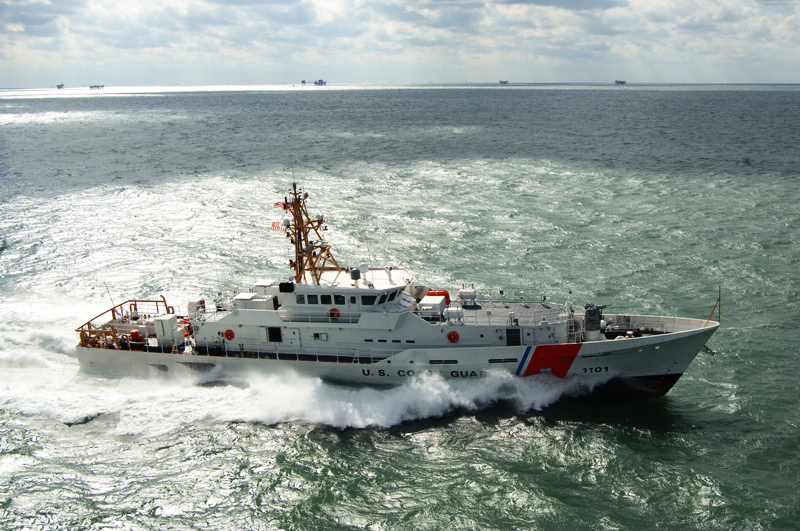
Coast Guard Cutter Mohawk’s (WMEC 613) Mk 75 weapon system fires, Aug. 16, 2024, during a gunnery exercise in the Florida Straits. Mohawk was the last Famous-class medium endurance cutter to fire the onboard Mk 75 mm gun weapon system as large caliber weapon systems onboard these cutters are being modernized for the service life extension program. (U.S. Coast Guard photo by Ensign Brian Morel)

Below is a Coast Guard news release. It is otherwise a pretty typical patrol report, but I wanted to call your attention to one paragraph,

“Of note, this patrol marked a significant historical event for the Coast Guard’s Famous-class medium endurance cutter fleet. Mohawk was the last in its class to fire the onboard Mk 75 mm gun weapon system. The largest caliber weapon in the Coast Guard inventory, it has been utilized by Famous-class cutters like Mohawk since they were first commissioned in the 1980’s. Now, large caliber weapon systems onboard Famous-class cutters are being modernized for a service life extension program.”

Does this really mean the Coast Guard is stopping support for all 76mm gun and Mk92 fire control systems even though only six WMEC270s are expected to receive the full life extension program? USCGC Harriet Lane which went through a partial SLEP, has also swapped out her 76mm for a 25mm Mk38, but that still leaves six WMEC270s that will not go through the service life extension program. Will they also lose their 76mm guns?

The 25mm Mk38 is a poor substitute for the 76mm gun that is upgradable and still in service with about 40 countries.


Oct. 23, 2024

Coast Guard Cutter Mohawk returns home from 62-day migrant interdiction operations patrol

KEY WEST, Fla. — The crew of Coast Guard Cutter Mohawk (WMEC 913) returned to their homeport of Key West, Oct. 11, following a 62-day migrant interdiction operations patrol in the Florida Straits.

Mohawk’s crew deployed in support of Homeland Security Task Force – Southeast (HSTF-SE) and Operation Vigilant Sentry (OVS) while underway in the Seventh Coast Guard District’s area of responsibility. While on patrol, crew members worked alongside additional Coast Guard units and partner agency crews to detect, deter and intercept unsafe and illegal migrant ventures bound for the United States.

While at sea, Mohawk crew members interdicted and rescued 41 migrants from unseaworthy vessels. Of these, Mohawk’s crew rescued 25 migrants aboard a single disabled vessel found taking on water in the Florida Straits on Aug. 20. Throughout the deployment, Mohawk cared for a total of 53 migrants, providing shelter, sustenance, hydration and medical care before conducting safe repatriation back to their country of origin.

On Oct. 3, Mohawk’s crew conducted a rescue of four personnel stranded on the remote island of Cay Sal, Bahamas after their seaplane was disabled. Mohawk coordinated with a U.S. Navy P-8 Poseidon airplane and a Coast Guard Air Station Miami HC-144 Ocean Sentry airplane to vector in Mohawk’s small boat crew for the rescue.

Most recently, the crew of Mohawk extended their deployment in response to the approach of Hurricane Milton. Mohawk sortied alongside other Key West-based Coast Guard cutters to avoid potential storm damage and ensure response readiness after the hurricane. Mohawk’s crew also conducted a tow of the Isaac Mayo during the sortie for several days of rough seas as the cutter was disabled due to scheduled maintenance.

Of note, this patrol marked a significant historical event for the Coast Guard’s Famous-class medium endurance cutter fleet. Mohawk was the last in its class to fire the onboard Mk 75 mm gun weapon system. The largest caliber weapon in the Coast Guard inventory, it has been utilized by Famous-class cutters like Mohawk since they were first commissioned in the 1980’s. Now, large caliber weapon systems onboard Famous-class cutters are being modernized for a service life extension program.

To successfully conduct the migrant interdiction mission, Mohawk partnered with U.S. Customs and Border Protection – Air and Marine Operations air and boat crews as well as additional Coast Guard units to include Coast Guard Cutters Charles Sexton (WPC 1108), Raymond Evans (WPC 1110), Isaac Mayo (WPC 1112), Maple (WLB 297), Coast Guard Station Key West, Coast Guard Sector Key West and Coast Guard Air Station Miami.

“Outstanding work by the Mohawk crew. I am very proud of our ability to secure our nation’s maritime borders while maintaining the safety of life at sea,” said Cmdr. David Ratner, commanding officer of Mohawk. “We understand the importance of deterring unlawful and dangerous maritime migration attempts on often overloaded and unseaworthy vessels. One such vessel with 25 migrants on board was disabled with insufficient fuel to make it to land and was taking on water.”

Mohawk is a 270-foot, Famous-class medium endurance cutter with a crew of 100. The cutter’s primary missions are counter-drug and migrant interdiction operations, enforcement of federal fishery laws as well as search and rescue in support of Coast Guard operations throughout the Western Hemisphere. Mohawk falls under the command of U.S. Coast Guard Atlantic Area, which is based in Portsmouth, Virginia. U.S. Coast Guard Atlantic Area oversees all Coast Guard operations east of the Rocky Mountains to the Arabian Gulf.

For information on how to join the U.S. Coast Guard, visit GoCoastGuard.com to learn about active duty and reserve, officer and enlisted opportunities. Information on how to apply to the U.S. Coast Guard Academy can be found here.

“Chinese Ship Expelled From Neighbor’s Waters” –MSN

On Monday (21/10/2024) Indonesian Coast Guard and Navy expelled CCG 5402 (left center) from North Natuna Sea after it was reported to have disrupted seismic survey activities. In the photo, the Indonesian CG vessel, KN Tj data (lower right) is supported by the Indonesian Navy vessel KRI Sutedi Senoputra,  (upper right) Source: X

MSN reports,

“Indonesia on Monday expelled a Chinese coast guard ship from its maritime zone after it allegedly interfered with a seismic survey operation.”

“An Indonesian coast guard cutter approached the Chinese ship, coming within around 8 miles of it and issuing a radio warning. However, the Chinese vessel insisted it was operating within Chinese waters.”

The Indonesian Navy sent reinforcements to support the cutter in the form of a patrol aircraft and a corvette.

“The Indonesian vessels shadowed the Chinese counterpart until it was ultimately expelled from Indonesia’s EEZ, per the statement.”

How long that took is not clear.

The same China Coast Guard ship (bearing an earlier hull number) and a Philippine supply boat engage in a standoff as the Philippine boat attempts to reach the Second Thomas Shoal, a South China Sea reef inside the Philippine EEZ, on March 29, 2014, Jay Directo—AFP

Correlation of Forces:

Correlation of forces is a term the Soviets used, and the Chinese would understand. It means if there were conflict what would be the likely outcome, and in any tense situation, the thought has to be at least in the back of the mind of the players, and will influence decision makers. 

China CGC 5402 is reportedly a Zhaolai class, formerly hull number 3401. The Zhaolai-class China Coast Guard cutters are reported to have a displacement of 4,896 tons and are 99 meters in length. It is a relatively big cutter, but closer to an Offshore Support Vessel than a warship. They go back to at least 2014, and were built before the China Coast Guard began building cutters armed with medium caliber guns. It is not clear if China CGC 5402 is now armed with heavy weapons. In the photo above, a foundation for what would probably be a 76mm gun is visible, but I have seen no photos of this class so armed.

The Indonesian cutter, KN Tanjung Datu, is the largest cutter in the Indonesian CG. It is reportedly 2400 tons, but I suspect the full load displacement is greater considering it is 110 meters (360′) in length with a beam of 15.5 m (51′), making it almost as large as the USCG’s new 4,500 ton Offshore Patrol Cutters. The USCG has exercised with her (photo below). She is armed with a 30mm Mk44 chain gun in a Aselsan SMASH remote weapon station, but the Indonesians did not assume that would be enough. They called in reinforcements in case things went South.

Indonesian Maritime Security Agency vessel KN Tanjung Datu, left, sails alongside U.S. Coast Guard Cutter Stratton during joint exercises in the Singapore Strait in August 2019. IMAGE CREDIT: PO1 LEVI READ/USCG

The smallest vessel in the photo at the head of the post (KRI Sutedi Senoputra) was also, by far the most heavily armed. It is only 935 tons, full load, lighter than a WMEC210, and 43 years old, but it is faster than either of the cutters at 24 knots and armed with a twin 57mm, a twin 30mm, and two 20mm. It also has RBU-6000 ASW rocket launchers which may have some anti-surface capability. (see photo below)

The Indonesian Corvette, KRI Sutedi Senoputra, is a former East German Parchim class corvette like this one.

The incident happened within 200 nautical miles of Indonesian territory so attack aircraft would not be too far away.

The Indonesians have been acting aggressively against Chinese fishing vessels in their EEZ. They don’t seem to be unwilling to insist on their rights.

The Chinese probably don’t want to risk an armed conflict before they are ready to attack Taiwan with all the logistical preparation that would require. They seem to have been losing influence in Indonesia, and don’t want further alienate Indonesia and to push them closer to the US.

This Day in Coast Guard History, October 20

Based on the Coast Guard Historian’s timeline, https://www.history.uscg.mil/research/chronology/
With inspiration from Mike Kelso

1892  After ten years of difficult and costly construction, the St. George Reef Lighthouse, built on a rock lying six miles off the northern coast of California, midway between Capes Mendocino and Bianco, was first lit. “St. George Reef Light marks a hazardous line of rock outcrops that extend northwest from Crescent City to form Saint George Reef. The light was abandoned in 1975 and replaced with a navigational buoy to the west of its current location.”

1920  The Superintendent of the 5th Lighthouse District inspected the aids to navigation “in New River Inlet and Bogue Sound, North Carolina by hydroplane in two hours, which would have required at least four days by other means of travel, owning to the inaccessibility of the aids inspected.”

1944  Allied landings on Leyte, Philippine Islands commenced.  Many Coast Guard units participated in the landings, which marked the fulfillment of General Douglas MacArthur’s promise to the Filipino people that he would return to liberate them from the Japanese.

1950  President Harry S. Truman issued an executive order “activating” the Magnuson Act, which had been passed by Congress earlier that month.  This act, authorizing the president to invoke the Espionage Act of 1917, tasked the Coast Guard once again with the port security mission.

Ferry George Prince

1976  The 120-foot ferry vessel George Prince, carrying 96 passengers and crew along with approximately 30 vehicles, collided with the Norwegian tank vessel Frosta in the Mississippi River about 20 miles above New Orleans.  George Prince was underway from Destrehan to Luling, Louisiana and was loaded to capacity.  Frosta struck  George Prince on the port side aft and the ferry quickly capsized and drifted upside down until it grounded on the right descending bank approximately one mile downstream from the point of collision.  “Ninety-six passengers and crew were aboard the ferry when it was struck, and seventy-eight perished. This accident is the deadliest ferry disaster in United States history.”

USCGC Cuyahoga (WIX-157) after being raised. USCG photo.

1978  CGC Cuyahoga sank after colliding with M/V Santa Cruz II near the mouth of the Potomac River.  Eleven Coast Guard crewmen were killed.

USCGC MUNRO

2021  CGC Munro (WMSL 755) and crew returned to their Alameda, California homeport after a 102-day, 22,000 nautical mile deployment to the Western Pacific. Munro departed Alameda in July and operated under the tactical control of the U.S. Navy’s 7th Fleet to promote a “free and open Indo-Pacific.” Munro’s crew executed numerous cooperative engagements, professional exchanges and capacity building efforts with naval allies and partners, including the Japan Coast Guard, Japan Maritime Self Defense Force, Philippine Coast Guard and Bureau of Fisheries and Aquatic Resources, Royal Australian Navy, and Indonesia Maritime Security Agency.

This Day in Coast Guard History, October 17

Based on the Coast Guard Historian’s timeline, https://www.history.uscg.mil/research/chronology/
With inspiration from Mike Kelso


USRC Eagle under full sail, in a painting by Patrick O’Brien. She was a topsail schooner, standard in revenue cutters of her period.

1814  The crew of USRC Eagle, which had been driven ashore near Negros Head, New York in an encounter with the British brig HMS Dispatch, dragged the cutter’s guns up a bluff in an effort to continue the battle.  The New York Evening Post gave an account of what happened next to the out-gunned cutter and its crew:

“During the engagement between the Cutter EAGLE and the enemy, the following took place which is worthy of notice.  Having expended all the wadding of the four-pounders on the hill, during the warmest of the firing, several of the crew volunteered and went on board the cutter to obtain more.  At this moment the masts were shot away, when the brave volunteers erected a flag upon her stern; this was soon shot away, but was immediately replaced by a heroic tar, amidst the cheers of his undaunted comrades, which was returned by a whole broadside from the enemy.  When the crew of the Cutter had expended all their large shot and fixed ammunition, they tore up the log book to make cartridges and returned the enemy’s small shot which lodged in the hull.  The Cutter was armed with only 6 guns, 4 four-pounders and 2 twos with plenty of muskets and about 50 men.  The enemy being gone and provisions scarce the volunteers from this city left Captain Lee and his crew and arrived here on Thursday evening the 13th instant, in a sloop from Long Island. . .We have since learned that Captain Lee succeeded in getting off the Cutter and was about to remove her to a place of safety when the enemy returned and took possession of her.  She was greatly injured, but it is expected that the enemy will be able to refit her to annoy us in the sound.”

Crews assigned to Coast Guard Air Station Sitka, the Coast Guard cutter Douglas Denman, Sitka Mountain Rescue and the Sitka Fire Department participate in the first day of a weeklong search and rescue exercise in Sitka, Alaska, May 9, 2023.

1977  The Coast Guard commissioned AIRSTA Sitka.

1989  An earthquake registering 7.1 on the Richter Scale hit Northern California, killing 67 people.  Coast Guard units assisted state and local agencies in rescue and relief operations.

Types of Naval Mines

2014  U.S. and Canadian military personnel and government civilian agencies participated in Exercise Frontier Sentinel 14 (FS 14) from October 17-24, 2014. This full-scale exercise is the final phase of a three-part scenario that focuses on maritime homeland security.  FS 14 was a combined U.S. Coast Guard Atlantic Area, Canadian Joint Task Force Atlantic, and U.S. Navy Fleet Forces Command exercise designed to test the coordinated response against a maritime threat to North American ports.  “This exercise tests the ability of U.S. Coast Guard, Navy, Canadian forces, and civilian agencies to successfully respond to a complex maritime threat to the homeland,” said VADM William Lee, Coast Guard Atlantic Area commander.  “Exercises such as Frontier Sentinel allow us to strengthen partnerships with our Canadian and Navy counterparts in a realistic setting, which will enable us to improve our interoperability, so we are prepared to respond to any and all maritime threats to the homeland.”  Phases one and two of FS 14 occurred in August and September and focused on maritime threats in the waters of the Atlantic Ocean, including Halifax, Nova Scotia.  Phase three of the exercise will focus on the coordinated detection, assessment and response to a mine threat in the Delaware Bay.  The exercise is limited to specific areas in Delaware Bay and should not significantly impact vessel traffic or bay operations.  Frontier Sentinel is an annual exercise series, initiated in 2006, established to improve the collaborative information exchange, planning and coordinated response between operational-level commands of the Tri-Party, which consists of U.S. Coast Guard, U. S. Fleet Forces Command, and Canadian Joint Task Force Atlantic, in response to security and defense threats in the maritime domain.

030321-N-4655M-029
The Arabian Gulf (Mar. 21, 2003) — Coalition Navy Explosive Ordnance Disposal (EOD) team members inspect camouflaged mines hidden inside oil barrels on the deck of an Iraqi shipping barge. The shipping barge was intercepted and inspected by Coalition Maritime Interdiction Operation (MIO) and Vessel Board Search and Seizure (VBSS) teams from the patrol craft USS Chinook (PC 9) in the early hours of Operation Iraqi Freedom. Operation Iraqi Freedom is the multi-national coalition effort to liberate the Iraqi people, eliminate Iraq’s weapons of mass destruction and end the regime of Saddam Hussein. U.S. Navy photo by PhotographerÕs Mate 2nd Class Richard Moore. (RELEASED)

2015  The Coast Guard issued a certificate of inspection to the LNG-powered M/V Isla Bella.  The 736-foot, 3,100 TEU, U.S.-flagged vessel is the first container ship in the world capable of operating on liquefied natural gas.  Isla Bella was the first of two Marlin-class containerships built by NASSCO in San Diego for operation by TOTE Services in the Jones Act trade between Jacksonville, Florida and Puerto Rico.

This Day in Coast Guard History, October 16

Based on the Coast Guard Historian’s timeline, https://www.history.uscg.mil/research/chronology/
With inspiration from Mike Kelso

1790  A contract was signed for the construction of the “first” of the 10 revenue cutters, Massachusetts, at Newburyport, Massachusetts.

1952  A Merchant Marine Detail was established at Yokohama, Japan to handle increased merchant marine problems occurring there as a result of the Korean Conflict.

Pan Am Flight 6 ditching in the Pacific Ocean, photographed from US Coast Guard Cutter Pontchartrain. Note that engine #4 appears to be feathered.

1956  CGC Pontchartrain, on Ocean Station November, rescued the passengers and crew of Pan American Clipper Flight 6 after the clipper ditched between Honolulu and San Francisco. All 31 aboard survived with only minor injuries.

PanAmFlight6-Ditches. US Coast Guard Photo

USCGC Storis, a Arctic Patrol Cutter.

1992  CGC Storis became the first foreign military ship to visit the Russian port of Petropavlosk since the Crimean War.  During the goodwill visit, Storis conducted joint operations with the Russian icebreaker Volga.

Phalanx vs SeaRAM

A Phalanx Close-In Weapons system (CIWS) during a live-fire practice by a guided-missile cruiser in November 2023. MC2 Malachi Lakey/US Navy

The War Zone has a good article on the Phalanx weapon system that arms US Coast Guard National Security Cutters (NSC) talking about ammunition costs.

The cost of ammunition for these systems actually looks trivial compared to the cost of missiles, but I am not really a fan of their use on cutters.

While it has been improved, the basic system goes back to 1973, plenty of time for adversaries to redesign their missiles to minimize its effectiveness.

The projectile is a high density, solid 12.7mm (.50″) sub-caliber discarding sabot round with no explosive content.

An enemy using anti-ship cruise missiles will endeavor to fire several missiles and have them arrive simultaneously. On a Navy DDG or FFG, they can begin countering cruise missiles as soon as they appear over the horizon or even earlier, as demonstrated recently in the Red Sea. Consequently, their Phalanx would only have to deal with rare leakers.

Cutters have, at best, a chance of bringing down a cruise missile with the 57mm. We don’t yet have a smart munition considered reliably effective against cruise missiles.

Phalanx’s effective range is reportedly 1,625 yards. A 600 knot anti-ship cruise missile covers that distance in less than five seconds. New generation supersonic missile cover that distance in far less time. The system does not move on to a second threat until the system’s radar recognizes that the first target is no longer a threat. It seems unlikely that Phalanx could engage more than one missile, much less more than two if they are timed to arrive simultaneously. There is also a good possibility that even if successfully engaged at very short range, missile debris might still impact the ship.

Replacing the Phalanx with SeaRAM, which has an operational range of 9 km (5.6 mi), would at least allow it to engage several targets simultaneously since it is a “fire and forget” system. The switch should be easy. The mount, footprint, and support requirements are the same with minimal changes required to the ship. Like Phalanx, SeaRAM is an autonomous system. It can also be used against surface targets.

Even with their superior long-range systems, the Navy began replacing one of the two Phalanx systems on some destroyers with SeaRAM in 2015. The Littoral Combat Ships which have a combat system similar to the National Security Cutters were equipped with SeaRAM or RAM from the beginning (2008).

There are no US Navy ships armed with only guns and CIWS.

“Coast Guard Announces Conditions of Entry for Vessels Arriving from Sudan to Enhance U.S. Port Security” –CG News

Sudan displayed in dark green color, claimed territories not administered in light green

An interesting short announcement from Coast Guard News.


Coast Guard Announces Conditions of Entry for Vessels Arriving from Sudan to Enhance U.S. Port Security

Oct. 7, 2024

The Coast Guard has announced conditions of entry for vessels arriving from the Republic of Sudan in the Federal Register.

“Northrop Grumman Unveils the Next Generation of Bushmaster® Chain Gun®” –News Release

Northrop Grumman’s M230LF Dual Feed Bushmaster® Chain Gun® will offer two feed paths that can switch between air burst and high explosive, dual purpose ammunition rounds. (Photo Credit: Northrop Grumman)

Below is a news release from Northrop Gruman. The gun has been around since 1973 when developed for the AH-64 Apache attack helicopter, but the dual feed is new. While they say the single feed and dual feed share 60%-part commonality, that means they are 40% different so there are significant changes.

Dual feed is a big deal because it means a gun in a remote weapon station can now be ready to deal with both surface and air threats.

I’m pretty sure, the Coast Guard wants to be able to counter drone attacks–both air and surface. This weapon, used in a remote weapons system, is small enough to be considered a .50 caliber replacement, and it would be much more effective against both air and surface threats.


For the first time operators can change between advanced ammunition rounds with the flip of a switch

PLYMOUTH, Minn. – Oct. 9, 2024 – Northrop Grumman Corporation (NYSE: NOC), a leading manufacturer of medium-caliber cannons, is introducing its next-generation M230 Link Fed (M230LF) Dual Feed Bushmaster® Chain Gun®, offering two ammunition feed paths for the first time. This new 30x113mm medium caliber chain gun is a proven variant of the M230LF chain gun to counter uncrewed aerial threats (C-UAS) and ground engagements.

  • By offering a dual feed, the need for mixed ammunition belts in a single feed is eliminated.
  • The ability to switch between two kinds of ammunition is now possible. A standard recommended ammunition load includes XM1211 proximity fuzed rounds for C-UAS and XM1198 high explosive, dual purpose rounds for anti-armor capability.
  • The M230LF is currently at Technology Readiness Level 6. Meeting this threshold enables the capability to undergo live fire demonstrations that are currently scheduled for early 2025.

Northrop Grumman Unveils the Next Generation of Bushmaster Chain Gun

Northrop Grumman’s M230LF Dual Feed Bushmaster® Chain Gun® will offer two feed paths that can switch between air burst and high explosive, dual purpose ammunition rounds. (Photo Credit: Northrop Grumman)

Expert:

Dave Fine, vice president, armament systems, Northrop Grumman: “The M230LF Dual Feed Bushmaster Chain Gun offers new flexibility by switching between ammunition paths using dual-feed technology. Using advanced technology combined with five decades of battle-proven experience, this next-generation cannon will empower operators to quickly respond to threats. This chain gun is the latest in our Bushmaster line to deliver reliable, multi-mission capabilities addressing the evolving threat environment.”

About the M230LF Dual Feed Bushmaster:

As the first medium caliber chain gun in the world to offer a dual feed, the M230LF brings flexible lethality to the evolving battlespace. The cannon’s system can instantly switch between ammunition paths, enabling operators to seamlessly address targets that require different 30x113mm ammunition types.

A dual feed system gives operators the option to change between advanced ammunition rounds with the flip of a switch, delivering increased mission flexibility and lethality. The ability to select between two different rounds ensures targets are addressed with the best ammunition for the target type saving time, reducing logistical burdens and allowing for more engagements before needing to reload the system.

For operators already using the M230LF, the Bushmaster loads out at a similar weight to the single feed M230LF and features 60%-part commonality, leading to faster routine repairs and decreased down time for maintenance. Single feed M230LF cannons will continue to be produced for customers that prefer that option.

Northrop Grumman is a leading global aerospace and defense technology company. Our pioneering solutions equip our customers with the capabilities they need to connect and protect the world, and push the boundaries of human exploration across the universe. Driven by a shared purpose to solve our customers’ toughest problems, our employees define possible every day.

“Interview with the Chief of the Colombian Navy” –Naval News

The 93-meter Offshore Patrol Vessel (OPV) is the first OPV that was designed and built by national means in Colombia

Naval News has an excellent interview with Vice Admiral Juan Ricardo Rozo Obregon, Chief of the Colombian Navy. It covers many topics of common interest with the US Coast Guard.

He mentions an intelligence sharing system I was not aware of.

Currently, we have developed capabilities in information systems and software development, reaching a high degree of technological independence. This autonomy has allowed the creation of advanced technological solutions with our own resources, reflected in the digitalization and automation of processes. An important example of these advances is the development of the Orion Platform, which integrates drug trafficking information from more than 62 countries worldwide, registering alerts and operational results with real-time visualization and monitoring.

Simon Bolivar, Arctic-capable Research Ship (Colombian Navy photo)

Also discussed is Colombian Navy support of Antarctic research.

Illustration of the Colombian Navy’s future SIGMA 10514 frigate (Damen picture)

An accompanying illustration of one of the five Damen designed light frigates Colombia is building gives us a bit more indication of how they will be armed. There is a 76mm on the bow, a 16 cell vertical launch system, quad cruise missile launch tubes between the bridge and the stacks, and a BAE 40m Mk4 well aft on top of the hangar. They will probably have ASW torpedo tubes as well.

“Coast Guard Polar Security Cutter (Polar Icebreaker) Program: Background and Issues for Congress, Updated October 2, 2024” –CRS

USCG Polar Security Cutter [Image courtesy Halter Marine / Technology Associates, Inc.]

The Congressional Research Service has once again updated their look at the Polar Security Cutter (heavy icebreaker) program. Also included are looks at the Great Lakes and Commercial Icebreaker procurement efforts. (See the latest version here.)

I have reproduced the summary below.

The news here is that there is so little news.

  • Polar Security Cutter, “The Coast Guard’s proposed FY2025 budget requests no procurement funding for the PSC program.”
  • Commercially available Polar Icebreaker, “The Coast Guard’s proposed FY2025 budget requests no procurement funding for the CAPI program.”
  • Great Lakes Icebreaker, “The Coast Guard’s proposed FY2025 budget requests no procurement funding for the program.”
  • Arctic Security Cutter (the Medium Icebreaker), the PSC is “to be followed at some later point (emphasis applied–Chuck) by the acquisition of new Arctic Security Cutters (ASCs)…

GAO has been saying the Coast Guard cannot possibly build the Polar Security Cutters for the price currently contracted. The shipyard has been building some sample sections. I suspect that part of the reason is to find a more realistic estimate of how much they will cost. “If substantial cost growth occurs in the PSC program, it could raise a question regarding whether to grant some form of contract relief to the PSC shipbuilder.”

Note, there is still no publicly available information from the 2023 Fleet Mix study, other than the required number of icebreakers. Why not?


SUMMARY

Required number of polar icebreakers. A 2023 Coast Guard fleet mix analysis concluded that the service will require a total of eight to nine polar icebreakers, including four to five heavy polar icebreakers and four to five medium polar icebreakers, to perform its polar (i.e., Arctic and Antarctic) missions in coming years.

Current operational polar icebreaker fleet. The operational U.S. polar icebreaking fleet currently consists of one heavy polar icebreaker, Polar Star, and one medium polar icebreaker, Healy. A second Coast Guard heavy polar icebreaker, Polar Sea, suffered an engine casualty in June 2010 and has been nonoperational since then. Polar Star and Polar Sea entered service in 1976 and 1977, respectively, and are now well beyond their originally intended 30-year service lives. The Coast Guard plans to extend Polar Star’s service life until the delivery of at least the second Polar Security Cutter (PSC; see next paragraph).

Polar Security Cutter (PSC). The Coast Guard Polar Security Cutter (PSC) program aims to acquire four or five new PSCs (i.e., heavy polar icebreakers), to be followed at some later point by the acquisition of new Arctic Security Cutters (ASCs) (i.e., medium polar icebreakers). The Coast Guard in 2021 estimated PSC procurement costs in then-year dollars as $1,297 million (i.e., about $1.3 billion) for the first ship, $921 million for the second ship, and $1,017 million (i.e., about $1.0 billion) for the third ship, for a combined estimated cost of $3,235 million (i.e., about $3.2 billion). The PSC program has received a total of about $1,731.8 million in procurement funding through FY2024. The Coast Guard’s proposed FY2025 budget requests no procurement funding for the PSC program. One oversight issue concerns the accuracy of the PSC’s estimated procurement cost, given the PSC’s size and internal complexity as well as cost growth in other Navy and Coast Guard shipbuilding programs. If substantial cost growth occurs in the PSC program, it could raise a question regarding whether to grant some form of contract relief to the PSC shipbuilder. Another oversight issue concerns the delivery date for the first PSC: the Coast Guard originally aimed to have the first PSC delivered in 2024, but the ship’s estimated delivery date has been delayed repeatedly and may now occur no earlier than 2029.

Commercially available polar icebreaker (CAPI). The Coast Guard’s proposed FY2024 budget requested, and the FY2024 Department of Homeland Security (DHS) Appropriations Act (Division C of H.R. 2882/P.L. 118-47 of March 23, 2024) provided, $125.0 million in procurement funding for the purchase of an existing commercially available polar icebreaker (CAPI) that would be modified to become a Coast Guard medium polar icebreaker. The ship the Coast Guard intends to purchase and modify is Aiviq, a U.S.-registered ship that was originally built to serve as an Arctic oil-exploration support ship, and which has an icebreaking capability sufficient for the ship to serve following modification as a Coast Guard medium polar icebreaker. The Coast Guard’s proposed FY2025 budget requests no procurement funding for the CAPI program. The Coast Guard’s FY2025 Unfunded Priorities List (UPL) includes an item for $25.0 million in procurement funding for the ship.

Great Lakes icebreaker (GLIB). The Coast Guard’s FY2024 budget initiated a program for procuring a new Great Lakes icebreaker (GLIB) that would have capabilities similar to those of Mackinaw, the Coast Guard’s existing heavy GLIB. The FY2024 DHS Appropriations Act (Division C of H.R. 2882/P.L. 118-47 of March 23, 2024) provided $20.0 million in procurement funding for the GLIB program. The Coast Guard’s proposed FY2025 budget requests no procurement funding for the program. The Coast Guard’s FY2025 UPL includes an item for $25.0 million in procurement funding for the program.