“Coast Guard Polar Security Cutter (Polar Icebreaker) Program: Background and Issues for Congress, Updated July 1, 2021” –CRS

The Congressional Research Service has once again updated their look at the Polar Security Cutter (heavy icebreaker) program. (See the latest version here.)

While hindsight suggest that it should have been started much earlier, it seems the program, at least in Congress, is on track with bipartisan support. The first two ships have been funded, and the FY2022 budget includes money for long lead time items for number three.

Two questions have emerged:

How Many and What Type?:

Until recently the Coast Guard had been justifying the program based on a 2010 “High Latitude Mission Analysis Report” (my summary here) which indicated a requirement for three heavy and three medium icebreakers for the Coast Guard to complete its statutory missions. There have been suggestions that the total of six icebreakers should include four or even six heavy icebreakers, but,

“Starting in January 2021, Admiral Karl Schultz, the Commandant of the Coast Guard, has stated publicly that the Coast Guard would ideally like to have a fleet of six PSCs and three new medium polar icebreakers (which the Coast Guard in late 2020 began referring to publicly as Arctic Security Cutters, or ASCs), for a total fleet of nine PSCs and ASCs.” (p.4)

Reported Delay in Construction Start on First PSC?:

We know Halter Marine had to reinforce some of their facilities, because the Polar Security Cutter will be, on the basis of weight/length, the heaviest vessel they have ever built. But lately, there has been a report, that start of construction has been substantially delayed, and it is unclear if this will impact the planned delivery date.

Another potential issue for Congress concerns a reported delay in the start of construction of the first PSC. A June 28, 2021, press report states:

Cutting of steel on the first new Coast Guard heavy polar icebreaker could happen in the coming months, which is close to a year later than originally expected, but the forecast to start production still appears hazy.

Coast Guard Commandant Adm. Karl Schultz said on Monday [June 28] that “They tell me we should be cutting steel on the first articles here in the coming months, so, hopefully there is steel cutting this year and contractually…we’re on contract for that ship [in] late ’24.”…

The Coast Guard originally had expected the first PSC to be delivered in the first half of 2024 the potential to accelerate delivery into late 2023. That appears unlikely now given that the start of construction appears to be about a year behind schedule.” (p.13)


“Coast Guard opens seasonal forward operating location in Kotzebue, Alaska” –D17

Aerial view of Kotzebue, Alaska, U.S., U.S. Army Corps of Engineers, photographer not specified or unknown

Below is a District 17 news release in full. Kotzebue is located just North of the Arctic Circle.

united states coast guard
 News Release U.S. Coast Guard 17th District Alaska

Coast Guard opens seasonal forward operating location in Kotzebue, Alaska

Coast Guard FOL Kotzebue Operations

Editors’ Note: Click on image to download high resolution version.

JUNEAU, Alaska — Coast Guard Air Station Kodiak crews opened a seasonal forward operating location today in Kotzebue.

Air Station Kodiak aircrews transferred aviation airframes and equipment to Kotzebue to reduce response time to the Bering Strait and Northern Slope regions in anticipation of historically increased maritime activity in that region during summer operations. 

“Establishing forward operating locations helps us mitigate many of the major challenges we face when operating in the Arctic, including the environment, vast distances, and limited infrastructure,” said Cmdr. Molly Hayes, Operation Arctic Shield operational planner. “Pre-staging flight crews from Air Station Kodiak saves critical time and resources when conducting missions in the Arctic region.” 

In support of Arctic Shield 2021 operations, aircrews operate out of the forward operating location, where they provide coverage to the entire northwestern portion of Alaska. Operation Arctic Shield is the Coast Guard’s rapid and proactive mobilization of resources focused on performing the service’s 11 statutory missions throughout the Arctic to ensure maritime safety, security, and stewardship. It is an annual operation that began in 2009. 

Former USCGC Sherman in Action

Sri Lanka Navy Offshore Patrol Vessel SLNS Gajabahu (P-626) the former USCGC Sherman

For those that might we wondering what has happened to those 378s we transferred to other navies and coast guards, here is a glimpse of the former USCGC Sherman participating in an exercise, as reported by the US Naval Institute News Service.

Participants included, in addition to Sri Lanka’s SLNS Gajabahu (P626), formerly USCGC Sherman (WHEC-720), transferred to Sri Lanka Navy in August 2018, Indian-built SLNS Sayurala (P623), the Sri Lankan Air Force, JMSDF Asagiri-class destroyer JS Yuugiri, USS Charleston (LCS-18), a USN P-8 maritime patrol aircraft, and an MH-60S attached to Charleston.

There is a video here.

The former USCGC Courageous (WMEC-622) also serves the Sri Lankan Navy.

“VESSEL REVIEW | THE WATCHER – SEVEN-METRE AUTONOMOUS PATROL BOAT CAPABLE OF LONG-ENDURANCE OFFSHORE MISSIONS” –BairdMaritime

MetalCraft Marine 7 meter “The Watcher” Autonomous Surface Vessel (ASV)

Back in November 2020 we learned about a month long evaluation of unmanned surface systems. Now we have more information on one of the two systems tested.

BairdMaritime reports on the 22 foot (6.7 m) “The Watcher” autonomous surface vessel that is said to be capable of operating autonomously for up to 30 days. Three-liter Volvo 220 HP (164 kW) diesel inboards propel it up to 1,800 nautical miles, while solar panels power the electronics.

MetalCraft Marine 7 meter “The Watcher” Autonomous Surface Vessel (ASV)

This report is part of BairdMaritimes “Welcome to USA Week!” look at the US maritime industry. Check it out.

MetalCraft Marine 7 meter “The Watcher” Autonomous Surface Vessel (ASV)

“U.S. Coast Guard releases 2020 Boating Safety Statistics Report” –News Release

News Release below. Quite an uptick in recreational boating deaths and injuries.

News ReleaseU.S. Coast Guard Headquarters

U.S. Coast Guard releases 2020 Boating Safety Statistics Report

WASHINGTON — The U.S. Coast Guard released its 2020 Recreational Boating Statistics Report Wednesday, revealing that there were 767 boating fatalities nationwide in 2020, a 25.1 percent increase from 2019.

From 2019 to 2020, the total number of accidents increased 26.3 percent (4,168 to 5,265), and the number of non-fatal injured victims increased 24.7 percent (2,559 to 3,191).  There is evidence that boating activity increased significantly during the pandemic, from reports of increased boat sales, insurance policies taken out, insurance claims, and calls for towing assistance. With the increased exposure (i.e., more boating hours), there was greater risk of deaths, injuries, and accidents.  The Coast Guard is analyzing variables associated with boating activity to normalize this accident data.

Alcohol continued to be the leading known contributing factor in fatal boating accidents in 2020, accounting for over 100 deaths, or 18 percent of total fatalities.

The report also shows that in 2020:

  • The fatality rate was 6.5 deaths per 100,000 registered recreational vessels, the highest in the program’s recent history. This rate represents a 25 percent increase from last year’s fatality rate of 5.2 deaths per 100,000 registered recreational vessels.
  • Property damage totaled about $62.5 million.
  • Operator inattention, operator inexperience, improper lookout, excessive speed, and machinery failure ranked as the top five primary contributing factors in accidents.

Capt. Scott Johnson, chief of the Office of Auxiliary and Boating Safety at Coast Guard Headquarters, reflected on a number of cases where boaters had recently purchased the vessel involved in the incident, but had not taken many of the proper safety precautions before getting underway. 

Where the cause of death was known, 75 percent of fatal boating accident victims drowned.  Of those drowning victims with reported life jacket usage, 86 percent were not wearing a life jacket.  

“It’s crucial for boaters to wear a life jacket at all times because it very likely will save your life if you enter the water unexpectedly,” said Johnson.  “The Coast Guard reminds boaters to make sure that life jackets are serviceable, properly sized, and correctly fastened.”  

Where boating instruction was known, 77 percent of deaths occurred on vessels where the operator had not received boating safety instruction.  The Coast Guard recommends that all boaters take a boating safety course that meets the National Boating Education Standards prior to getting out on the water.

The most common vessel types involved in reported accidents were open motorboats, personal watercraft, and cabin motorboats.  Where vessel type was known, the vessel types with the highest percentage of deaths were open motorboats (50 percent), kayaks (15 percent), and pontoons (9 percent). 

The report is based off on incidents that resulted in at least one of the following criteria:  death, disappearance, injury that required medical treatment beyond first aid, damages to the vessel(s) or other property that equaled or exceeded $2,000, or a loss of vessel.

The Coast Guard reminds all boaters to boat responsibly on the water: wear a life jacket, take a boating safety course, attach the engine cut-off switch, get a free vessel safety check, and boat sober.

“The Coast Guard thanks our boating safety partners,” said Johnson, “they continue to demonstrate a committed effort to reduce loss of life, injuries and property damage through education and enforcement.”

To view the 2020 Recreational Boating Statistics, visit  http://uscgboating.org/statistics/accident_statistics.php. For more information on boating responsibly, visit http://www.uscgboating.org.

“HMS Protector Sails Further North Than Any Other Royal Navy Ship in History” –gCaptain

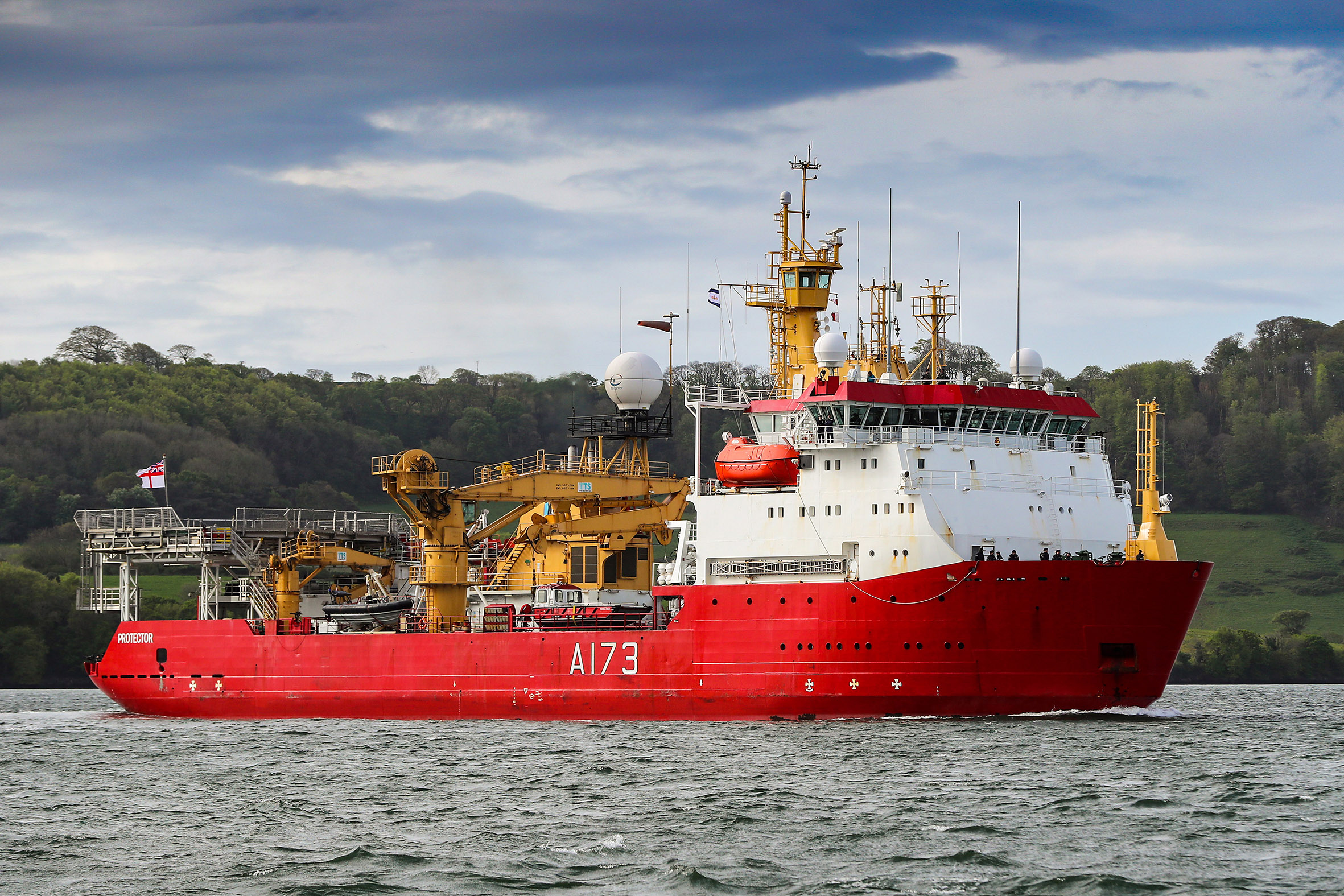
HMS Protector returned to Plymouth today (25th April 19) after 4 years away. The Royal Navy’s ice patrol ship will spend a few days at HMNB Devonport before she sails to the North East of England for a maintenance refit. Image: LPhot Paul Hall

gCaptain reports,

“The Royal Navy’s HMS Protector has set a record for sailing closer to the North Pole than any other British surface ship in history.”

and they got some help from the US Coast Guard.

“On board Protector are scientists, engineers and advisors including from the Ministry of Defence and the British Antarctic Survey, as well as two Royal Navy officers who sailed into the Alaskan Arctic aboard the U.S. Coast Guard cutter Polar Star this past winter, and ice-breaking expert Lieutenant Lauren Kowalski, also from the U.S. Coast Guard.”

Sea-Air-Space 2021

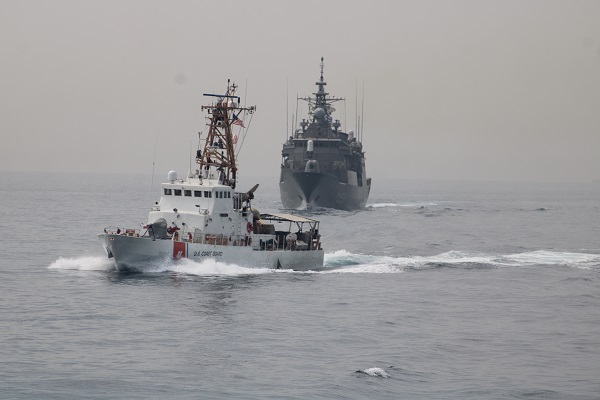
ARABIAN GULF (Feb. 25, 2021) The U.S. Coast Guard cutter USCGC Maui (WPB 1304) and the Greek navy guided-missile frigate HS Hydra (F452) participate in a passing exercise in the Arabian Gulf, Feb. 25, 2021. U.S. Coast Guard Patrol Forces Southwest Asia (PATFORSWA) is comprised of six 110-foot cutters, the Maritime Engagement Team, shore-side support personnel, and is the Coast Guard’s largest unit outside of the U.S. playing a key role in supporting Navy security cooperation, maritime security, and maritime infrastructure protection operations in the U.S. 5th Fleet area of operations. (U.S. Coast Guard photo)

The “2021SEA-AIR-SPACE (SAS) GLOBAL MARITIME EXPOSITION” is scheduled August 2-4. In addition there is a two day “Prequal” July 20-21, a STEMEXPO August 1, and a Transition Connection onsite job fair on August 4 (Coast Guard day)

It appears the Coast Guard will be well represented at the event. The Commandant and six other Coast Guard flag officers are expected to attend.

Below is the ALCOAST announcing the event.

R 231708Z JUN 21
FM COMDT COGARD WASHINGTON DC
TO ALCOAST
BT
UNCLAS
ALCOAST 230/21
SSIC 5700
SUBJ: 2021 SEA-AIR-SPACE (SAS) GLOBAL MARITIME EXPOSITION

1. The annual Sea-Air-Space (SAS) Global Maritime Exposition will be held 1-4 August 2021 at the Gaylord National Resort and Conference Center, located in National Harbor, MD. SAS was founded in 1965 as a means to bring the U.S. defense industrial base, private-sector United States companies and military leaders together for an annual educational, innovative, and professional event located in the heart of Washington, DC. Sea-Air-Space is now the largest maritime exposition in the U.S. and continues as an invaluable extension of the Navy League’s mission of maritime policy, education, and sea service support.

2. This year’s exposition will feature U.S. Coast Guard senior leaders participating in panel discussions on Arctic domain readiness; Indo-Pacific security strategy; cybersecurity; diversity and inclusion; illegal, unreported, and unregulated fishing; COVID-19 response; and more. This event will provide USCG participants professional development opportunities with the most up-to-date information regarding the current state of the defense industry as well as a vision of the future. Dynamic luncheon and keynote speakers will provide members an open forum to fully disclose up-to-the-minute information relevant to CG missions which will improve CG processes and ensure we set the conditions for a better CG future.

3. In conjunction with Sea-Air-Space 2021, the annual Navy League STEM Expo will also be held at the Gaylord National Resort and Conference Center on Sunday, 1 August. Anyone attending SAS is welcome at the STEM Expo.

4. Subject to command approval, attendance is allowed at no cost to the government. Supervisors should ensure attendance aligns with an employee’s primary duties. Employees who wish to attend for personal interests may use annual leave, accrued compensatory time off or earned credit hours (if available), or leave without pay. Commands outside the National Capital Region may submit no-cost permissive orders for military members who attend.

5. Registration information and exposition details are available on the SAS website:
(Copy and Paste Below URL into Browser)

www.seaairspace.org

There is no charge to attend SAS for Coast Guard military members or Coast Guard civilian employees.

6. A shuttle will run from Coast Guard Headquarters to SAS and back on a regular basis Monday, Tuesday, and Wednesday of the exposition. The shuttle schedule, parking rates, and other logistical details are available at the SAS website.

7. Uniform is Tropical Blue or equivalent for uniformed attendees and business professional for civilians.

8. The COMDT (CG-0923) POCs are Ms. Allison Lane, 202-372-1196, Allison.Q.Lane@uscg.mil or LCDR Emily Brockway, 202-372-4641, Emily.H.brockway@uscg.mil.

9. RDML M. W. Raymond, Acting Director, Governmental and Public Affairs (CG-092), sends.

10. Internet release is authorized.

“JUST IN: Coast Guard in Talks to Add Ships to Heavy Icebreaker Program” –National Defense

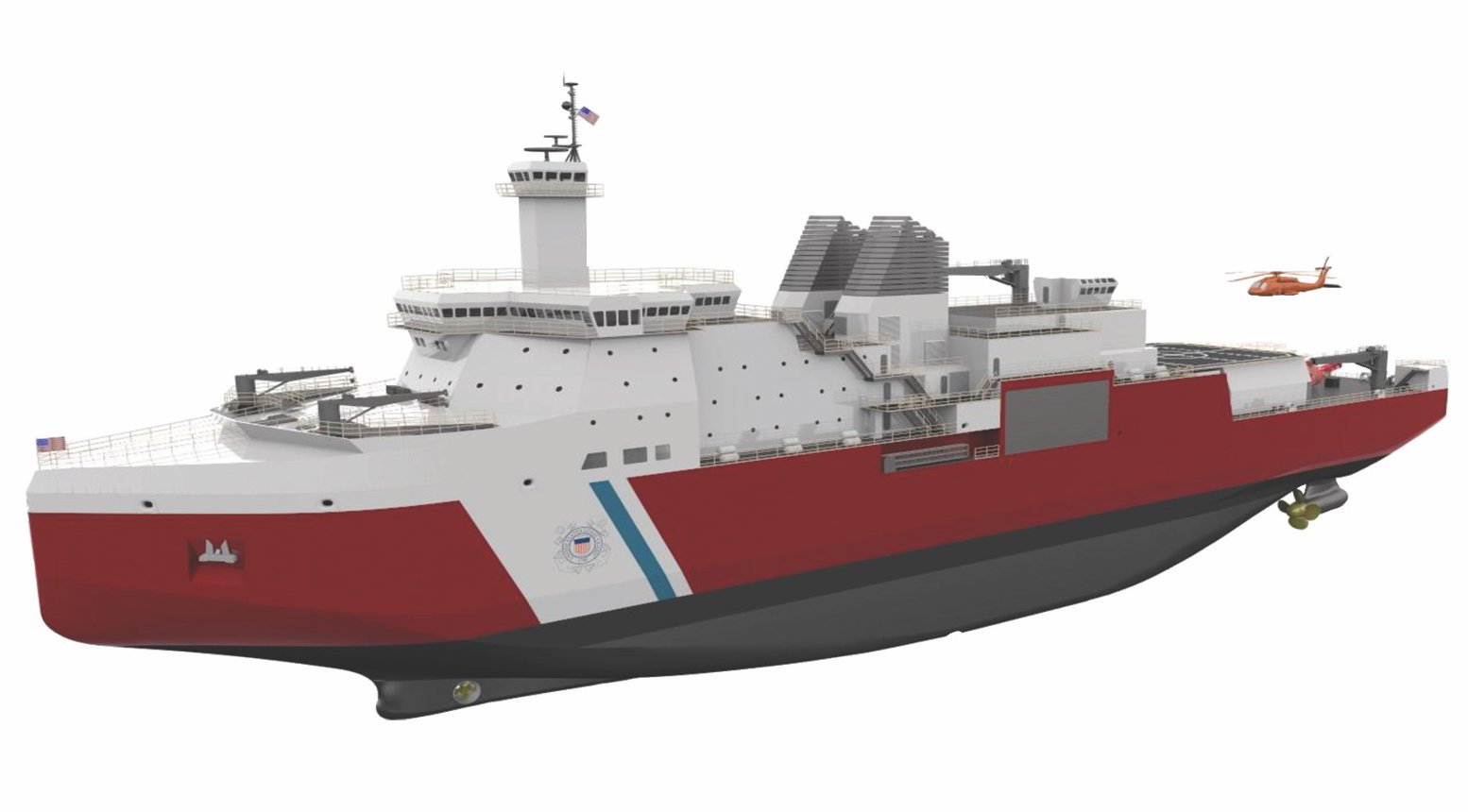
Artist rendering of the VT Halter Polar Security Cutter design.

Looks like it is official now, the the Coast Guard is seeking more than three heavy icebreakers (Polar Security Cutters), not in place of one or more of the three medium icebreakers (Arctic Security Cutters) but in addition. This presumably means we are seeking more than six polar icebreakers.

National Defense reports.

Warning Shots off Crimea?

Russian photo

You have probably heard that HMS Defender was confronted by Russian military forces during a transit off Crimea. The Russians claim they dropped bombs in the path of the British Destroyer and that the Russian Coast Guard fired warning shots. The British say it did not happen. I can’t comment on the claim of bombs being dropped, but lets look at the evidence the Russians provided of warning shots, it the form of the photo above. 

Let’s do a little photo interpretation. The Russian ship firing is apparently a Rubin class Coast Guard cutter.

Russian Rubin class Coast Guard cutter. Photo by Florstein (WikiPhotoSpace)

The gun is the AK-630, a 30mm Gatling gun. It is claimed to be effective against surface targets out to 5,000 meters or about 5,500 yards. It is an awsome weapon at close range, but its absolute maximum ballistic range is 8,860 yards (8,100 m).

HMS Defender, if that is the ship identified as such, is on the extreme horizon and might actually be somewhere beyond the visual horizon. Looking at the Rubin class cutter, it appears that the photo was taken from the Bridge or perhaps more likely, the flying bridge, on deck above to avoid reflections off the bridge windows. That puts the height of eye at about 30, or more likely 40 feet. We can calculate the distance to the horizon.

1.17 times the square root of your height of eye in feet = Distance to the horizon in nautical miles.

From a height of eye of 30 feet, the visual horizon is 6.4 nautical miles or more than 12,800 yards away. If the photo was taken from a height of 40 feet the distance to the visual horizon is 7.4 nautical miles or about 14,800 yards.

So HMS Defender was probably a minimum of 4000 yards or two nautical miles beyond the maximum range of the 30mm. In addition the gun was not pointed at the destroyer so the projectiles landed more than two miles from the Destroyer.

HMS Defender had no reason to believe that the shooting had any thing to do with them.

What we have here is a bite of theater. The Russians claim that fired warning shots while doing it in such a way that the British attached no significance to the firing.

The Drive seems to have come to the same conclusion.