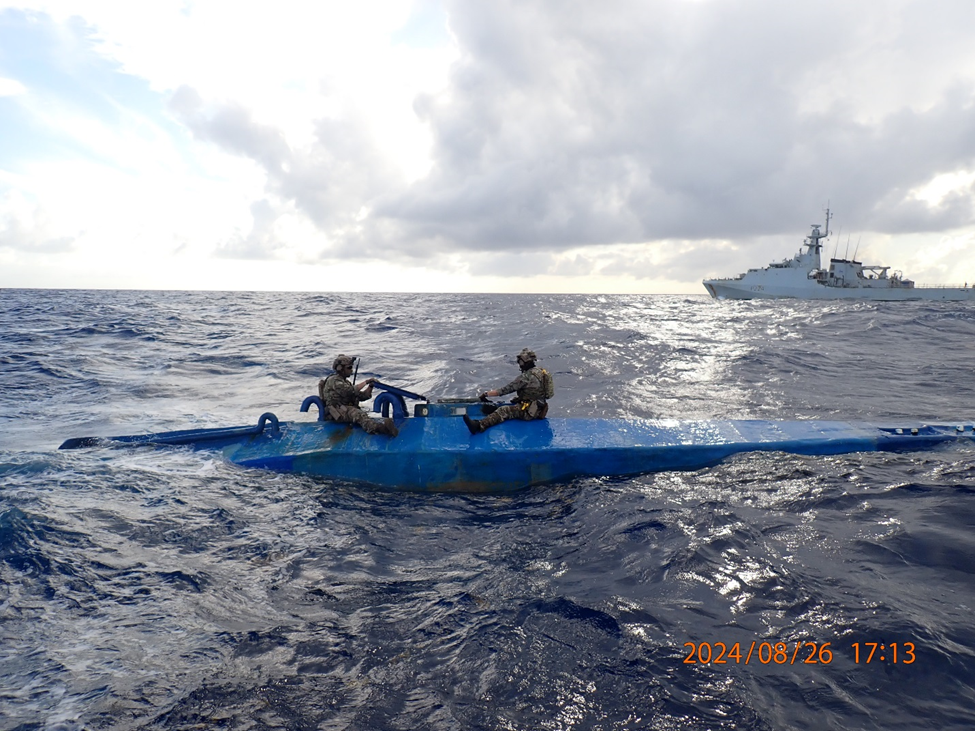
“Trump declares drug cartels operating in Caribbean unlawful combatants” –Defense News / “U.S. Military Conducts Latest Deadly Strike on Drug Boat Near Venezuela as Trump Declares ‘Armed Conflict’ with Cartels” –gCaptain

Defense News reports,

“President Donald Trump has declared drug cartels to be unlawful combatants and says the United States is now in a “non-international armed conflict,” according to a Trump administration memo obtained Thursday by The Associated Press, after recent U.S. strikes on boats in the Caribbean.”

gCaptain reports there has been a fourth attack.

Many questions have been raised about the legality of these attacks, but I will not address them here. I do question their effectiveness.

Admittedly can’t say that law enforcement efforts, including those of the Coast Guard, despite many successes, has kept drugs out of the country. The financial rewards of a successful shipment have made even very risky voyages too profitable. Probably few if any of the smugglers we catch are high in the cartel organizations so the kingpins are not directly at risk in either of capture or death. The long used capture method does at least provide a potential source of intelligence. The new (take no prisoners) approach may have the advantage of frightening aways potential boat crews for the smugglers but there are reasons to suggest the attacks in the Caribbean will also fail to stop the importation of large quantities of drug and fail to stop the large number of deaths by drug overdose that pointed to as justification for these extreme measures

Most drug overdoses were by the use of synthetic opioids that are not generally transported in the go fast boats we have seen destroyed.

“Overall, drug overdose deaths rose from 2019 to 2022 with 107,941 drug overdose deaths reported in 2022. Overdose deaths declined to 105,007 in 2023. Deaths involving synthetic opioids other than methadone (primarily illicitly manufactured fentanyl or IMF) decreased from 73,838 overdose deaths reported in 2022, to 72,776 in 2023. Those involving cocaine continued to increase with 29,449 deaths in 2023.”

Because fentanyl is so compact it usually crosses the borders over land at regular ports of entry.

Most Seizures Occur At Ports of Entry Where U.S. Citizens Are The Primary Smugglers...This fact sheet uses two separate datasets to confirm what has long been reported by law enforcement sources and other researchers: that the majority of fentanyl smuggled across the southern border enters not on the backs of migrants crossing the border on foot, but in the vehicles and on the bodies of U.S. citizens and other lawful entrants seeking admission at land ports of entry. Using two separate datasets described below, we confirm roughly four in five people apprehended for smuggling fentanyl into the United States at the southern border between October 2018 and June 2024 were U.S. citizens—the rest were largely individuals with visas, border crossing cards, or other permission to enter the United States lawfully at a port of entry.

Currently the kinetic attacks are limited to the Caribbean while far more drugs are intercepted in the Eastern Pacific. Even if drug shipments are closed off entirely it is likely shipments through other routes will increase to meet demand.

Apparently the attacks are also having unintended consequences.

President Trump “Speaking to military leaders in Quantico, Virginia, he suggested the operations are already proving effective: ‘Now we have a problem. General Caine says, sir, there are no boats out there, not even fishing boats. They don’t want to go fishing.’”

Apparently many local mariners have less confidence in our ability to identify and attack only the smugglers.

“U.S. Warships Have This Seldom Discussed But Very Powerful Optical Targeting System” –The War Zone

Mk20 mod1 Electro Optic Sensor System (EOSS)

The War Zone provides a discussion of a frequently overlooked bit of hardware that the National Security Cutters share with Cruisers and Burke class destroyers.

I did a short post about this system back in 2017.

What is it good for?

“The primary purpose of the system is to provide highly accurate targeting information to the ship’s gun weapon system. In many instances, the ship’s radar may make an initial detection of a potential threat, and the Mk20 is then cued to visually confirm the target, and provide precise range and position for gun engagement. The goal is first shot hit accuracy. Of course, sailors are quite creative and immediately recognize the Mk20’s excellent performance as a situational awareness and navigation aid. We have heard of crews using the Mk20 to visually investigate suspicious vessels, and help navigate through congested waters. The operators find the thermal imaging capability and resolution particularly useful in nighttime operations.”

“Coast Guard issues request for proposal to inform future boat recapitalization efforts” –CG-9

Response Boat, Small

The Acquisition Directorate (CG-9) reports they are looking for proposals for new Response Boat, Small (RB-S). You can find the specs and other information here.


The Coast Guard issued a request for proposal (RFP) today as a first step to assess the options in the marketplace for response boats that can meet Coast Guard mission requirements. The deadline for responses is Nov. 21. The RFP can be viewed here.

Based on responses to the RFP, the Coast Guard may award up to four separate contracts. Each awardee will deliver one “demonstration boat” featuring design and performance characteristics closely aligned with Coast Guard mission needs and requirements. The Coast Guard will conduct testing with each demonstration boat to develop and validate performance requirements, assess industrial capabilities and gather data about the marketplace to inform acquisition strategies for future boat recapitalization activities.

For more information: Boat Acquisition Program

“Coast Guard awards contract for new heavy weather surf boats” –Coast Guard News

Second-generation special-purpose craft – heavy weather (SPC-HWX II) boat. Artistic rendering courtesy of Rozema Boat Works Inc.

Below is a Coast Guard news release.

I think these could replace 87 foot WPBs in some places and do so with lower operating costs.

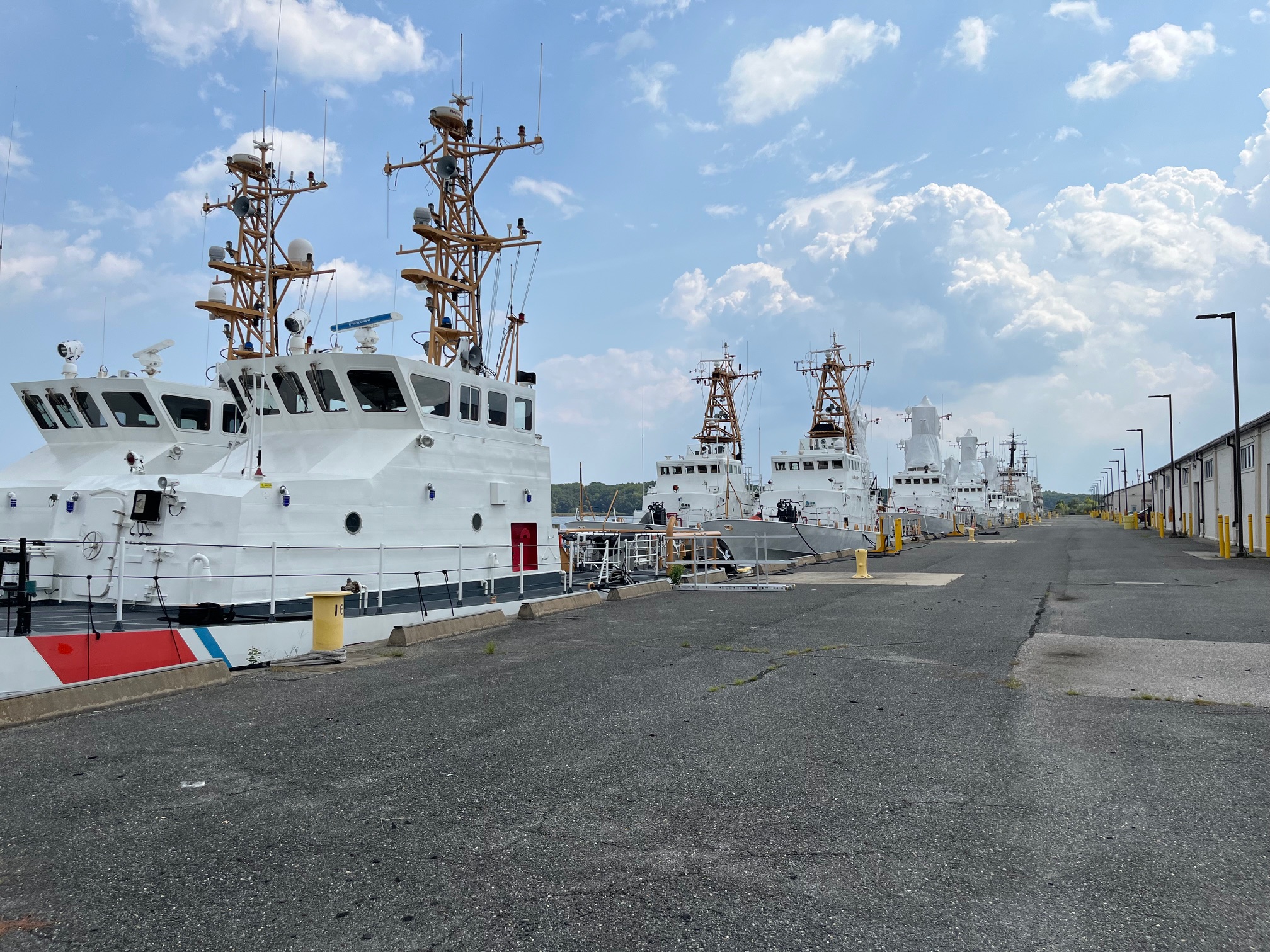
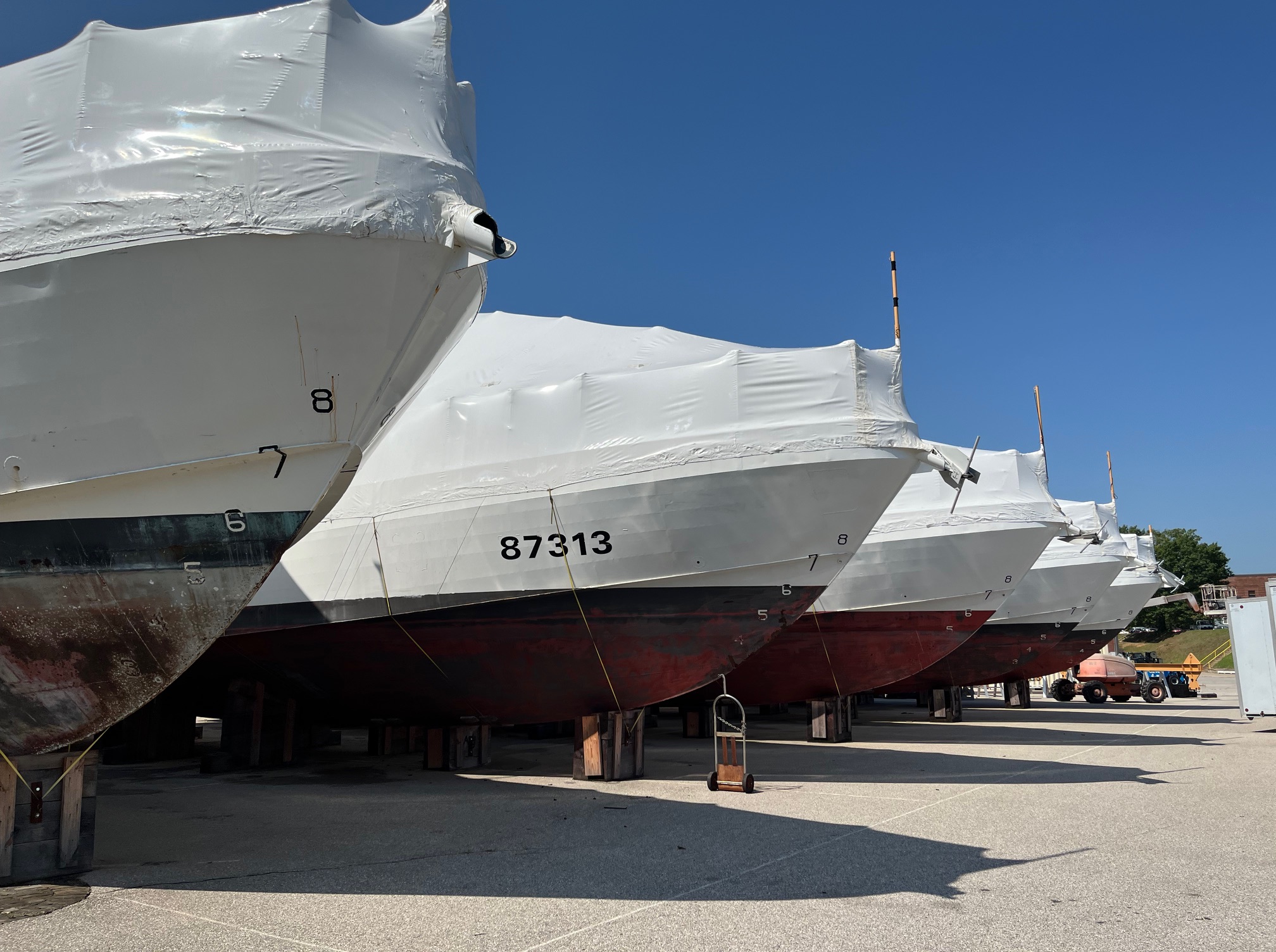
It is time to replace the older 87 foot WPBs. The oldest are already 28 years old.  In some cases they are being replaced by Webber Class WPCs, but other than the RB-M there is no smaller replacement is in sight. There is certainly no way the Webber class will replace both the 49 Island class and the 70 or so Marine Protector class.

These large surf boats could be very useful in areas around small ports that occasionally experience heavy weather.


Sept. 30, 2025

Coast Guard awards contract for new heavy weather surf boats

SEATTLE — The Coast Guard awarded an indefinite delivery, indefinite quantity (IDIQ) contract on Sept. 29 to Rozema Boat Works, Inc. of Mount Vernon, Washington to acquire up to six second-generation special-purpose craft – heavy weather (SPC-HWX II) boats.

The total potential value of the contract is $70.9 million and the first SPC-HWX II is anticipated to be completed in fiscal year 2027. The SPC-HWX II will replace the 52-foot first generation of special-purpose craft – heavy weather boats, which entered service in the 1950s and 1960s.

These vessels were retired in 2021 due to increasing maintenance challenges. Like their predecessors, the SPC-HWX IIs will serve in the Pacific Northwest.

These next-generation vessels are designed to perform a wide range of Coast Guard missions in extreme weather and challenging surf conditions that exceed the capabilities of other boats, such as search and rescue; disabled vessel towing; and law enforcement and ports, waterways and coastal security missions.

Measuring 64 feet in length, the SPC-HWX II will feature self-righting capability and be capable of operating in 35-foot seas, 25-foot surf, and winds up to 60 knots. Powered by twin 1,200-horsepower diesel engines, it will reach speeds of 20 knots, tow up to 300 tons, and operate up to 150 miles offshore. With accommodation for a relief crew, the SPC-HWX II will have an endurance up to 48 hours, a critical feature for long-range heavy-weather operations.

Coast Guard “Rear Admiral Randall takes the helm of Key West Joint military command” –SOUTHCOM

Below is a SOUTHCOM news release.

I knew the Coast Guard had officers on the staff of Joint Interagency South, but I was not aware that a Coast Guard Officer was in charge, though it makes a lot of sense.


July 16, 2025

Rear Admiral Randall takes the helm of Key West Joint military command

Coast Guard Rear Admiral Jeff Randall assumed command of Joint Interagency Task Force South (JIATFS) in a Change of Command ceremony held today at the Tennessee Williams Theater in Key West, FL.

Supporting U.S. national security priorities, JIATFS is a U.S. Department of Defense command that leverages the capabilities of U.S. Intelligence and Law Enforcement agencies, Allies and Partner Nations to detect, monitor, and support interdiction of illicit narcotics movements in the air and maritime throughout the Western hemisphere.

Rear Admiral Randall is the 19th director of the 36-year-old task force and assumed command from Coast Guard Rear Admiral Jo-Ann Burdian, who has been nominated as Commander, Coast Guard Atlantic Area.

A native of Abilene TX, Rear Admiral Randall is a 1993 graduate of the U.S. Coast Guard Academy where he earned a Bachelor of Science in Civil Engineering. He also holds a Master of Marine Affairs from the University of Washington and served as the Coast Guard’s Fellow to the Brookings Institution and Council on Foreign Relations.

He was awarded numerous personal, unit, campaign, and service awards.

The Change of Command ceremony was presided over by Admiral Alvin Holsey, Commander of U.S. Southern Command.

“Canada, U.S. conduct live-fire exercises, ship exchanges in Bering Sea” –The Watch


The Royal Canadian Navy ship Regina and the U.S. Coast Guard cutter Waesche sailed through the Bering Sea together for a week in last August 2025, conducting maritime maneuvers, including live-fire exercises, in Operation Latitude. U.S. ALASKAN COMMAND

NORTHCOM’s on-line magazine The Watch reports on a week of joint operations between  USCGC Waesche and Canadian Forces including particularly the Frigate Regina. The two ships are in some ways surprisingly similar, sharing the 57mm Bofors gun, Phalanx CIWS, and LM2500 engine.

The story goes on to describe other exercises the Canadian Navy is conducting.

“Coast Guard Cutter Polar Star Returns to Seattle after 308 days” –USCG News

The rudder of the USCGC Polar Star (WAGB 10) is being removed while in a Vallejo, Calif., dry dock, April 1, 2025. The maintenance work completed over the past five years recapitalized integral systems, including propulsion, communication, and machinery control systems. (U.S. Coast Guard photo by Seaman Nestor Molina)

Below is a Coast Guard News Release.

The Coast Guard did a Service Life Extension Program on a 49 year old ship because its replacement is still not ready. Let that sink in for a while.

In addition to the work listed in the release, they removed the centerline shaft for servicing and inspection, exchanged all three propellers, and renewed both forward and aft main deck surfaces.

The ship has not seen its homeport for ten months and the intention is to do the same sort of five year phased SLEP on USCGC Healy, meaning she will have similar long periods away from homeport. At least she is at an age where SLEP is appropriate.

Ships should be home-ported in places they can be worked on.

50 year old ships should be the exception not the rule.


Sept. 25, 2025

Coast Guard Cutter Polar Star Returns to Seattle after 308 days

SEATTLE — After 308 days away from its Seattle home port, the 49-year-old U.S. Coast Guard Cutter Polar Star (WAGB 10) and crew returned home Tuesday. 

Upon completing Operation Deep Freeze (ODF) 2025, Polar Star returned directly to Mare Island Dry Dock in Vallejo, Calif., to complete the final year of a five-year Service Life Extension Program (SLEP).

Polar Star’s SLEP completion comes at a time when the Polar Regions are becoming more consequential, and the demand for U.S. Coast Guard presence, leadership, and vigilance continues to grow.

The maintenance work completed over the past five years recapitalized integral systems, including propulsion, communication, and machinery control systems. These efforts are designed to extend the cutter’s service life as the Coast Guard begins construction of its first Polar Security Cutter. Until PSCs becomes operational, Polar Star will remain the only U.S. icebreaker capable of completing the annual breakout of McMurdo Sound, Antarctica in support of the U.S. Antarctic program (USAP).

“Much has been asked of this ship over the past five decades,” said Capt. Jeff Rasnake, Polar Star’s commanding officer. “The completion of this extensive five-year maintenance and recapitalization project is a major milestone in enabling Polar Star’s operations into the future.”

Polar Star’s SLEP has been completed in five phases to maintain its operational capability to complete annual polar deployments. Phase Five, the last phase in its SLEP, began March 30, 2024, focusing on these projects:

  • Gyro repeater recapitalization to ensure that these critical pieces of navigation equipment are updated to modern standards, enabling safe navigation of the cutter.
  • Ancillary pumps and motors recapitalization through the replacement of critical main propulsion and auxiliary systems with modern supportable units.
  • Heating, ventilation, and air conditioning systems refurbishments; multiple zones were refurbished with ventilation trunks, fans, and heaters to improve air circulation and maintain a comfortable living environment for the ship’s crew during extended deployments.

The completion of Polar Star’s five-year SLEP underscores the importance of the annual ODF mission, the U.S. military support mission for the USAP, which facilitates the transport of personnel, equipment and supplies required to maintain the U.S.’s strategic presence in Antarctica. Having participated in a majority of these missions since they began in the 1950s, the U.S. Coast Guard will continue to support the U.S.’s continued presence on the Antarctic continent as part of the Joint Task Force – Support Forces Antarctica.

Work completed in Phase Five took 175 days and represented an additional $12.7 million investment in the U.S. Polar capability. While at Mare Island, Polar Star received support from both Coast Guard Base Seattle and Base Charleston’s Naval Engineering Departments to perform a center section overhaul on one of Polar Star’s nine main diesel engines. In parallel with this work, members from the Coast Guard Yard in Baltimore completed vital work on the ship’s sanitary systems.

Additional major work completed includes removing the centerline shaft for servicing and inspection, exchanging all three propellers, and renewing both forward and aft main deck surfaces.

“This is a tremendous ship, and it is in better shape today than it was ten years ago,” said Rasnake. “That’s a testament to the unrelenting efforts of the crew, the enduring support of our mission partners, and the renewed enthusiasm and investment in our nation’s polar icebreaking capabilities.”

Commissioned in 1976, Polar Star is 399 feet, weighing 13,500 tons with a 34-foot draft. Despite reaching nearly 50 years of age, Polar Star remains the world’s most powerful non-nuclear icebreaker with the ability to produce up to 75,000 shaft horsepower.

“Coast Guard to invest $350 million in robotics and autonomous systems” –CG News

Below the line is a Coast Guard News release. I have found some illustrations of what these systems look like.

Qinetiq mini-SPUR robots


Sept. 24, 2025

Coast Guard to invest $350 million in robotics and autonomous systems

WASHINGTON — The Coast Guard announced Wednesday it will invest nearly $350 million to expand robotics and autonomous systems, strengthening mission execution and operational capabilities.

The funding, provided under the One Big Beautiful Bill Act (OBBBA), includes $11 million in fiscal year 2025 for immediate upgrades to critical autonomous systems.

Initial investments include:

  • $4.8 million to procure 16 VideoRay Defender remotely operated vehicles (ROVs) to replace Deployable Specialized Forces’ aging fleet.
  • $2 million to procure six Qinetiq Squad Packable Utility Robot (SPUR) and 12 mini-SPUR robots to replace outdated unmanned ground vehicles (UGVs) at Strike Teams.
  • $4.3 million to purchase 125 SkyDio X10D short-range unmanned aircraft systems (SR-UAS).

These investments are the first in a series of robotics and autonomous systems projects the Coast Guard will pursue using OBBBA funding. The technologies will meet immediate mission needs, improve personnel safety and strengthen the Coast Guard’s capabilities to control, secure, and defend U.S. borders and maritime approaches.

“These unmanned systems provide increased domain awareness, mitigating risk and enhancing mission success as the Coast Guard continues to operate in hazardous environments,” said Anthony Antognoli, the Coast Guard’s first RAS program executive officer. “The Coast Guard’s mission demands agility, awareness and adaptability. Robotics and autonomous systems deliver all three, enabling us to respond faster, operate smarter and extend our reach where it matters most. We are not waiting for the future to arrive. We are delivering it to the fleet today.”

The Coast Guard’s Deployable Specialized Forces will use the new ROVs for waterfront and pier inspections, hull assessments, subsurface infrastructure surveys, disaster response and search and rescue missions. Their use will reduce reliance on Coast Guard divers, improving efficiency and safety.

Coast Guard Strike Teams, which respond to hazardous materials spills, major marine casualties, groundings, natural disasters, chemical, biological, radiological or nuclear (CBRN) incidents and national special security events, will use the new UGVs to access and sample air in confined spaces aboard commercial vessels.

The SR-UAS will support operations including infrastructure inspections, environmental observation, pollution response, post-storm surveys, ice surveys and communications.

The Program Executive Office for Robotics and Autonomous Systems is part of the Coast Guard’s Force Design 2028 plan, which aims to fully integrate capabilities across the service. Focused on four campaigns – people, organization, contracting and acquisition and technology – Force Design 2028 is an accelerated effort to establish a blueprint for change and transform the Coast Guard into a more agile, capable, and responsive force.

“First Coast Guard aerial vehicle pilot gets his wings” –MyCG

Lt. Cmdr. Ryan Major awarded U.S. Navy Aerial Pilot (AVP) insignia at the RAS Exposition
Vice Commandant Adm. Thomas Allan presents Lt. Cmdr. Ryan Major the U.S.Navy Aerial Pilot (AVP) insignia at the Robotics and Autonomous Systems (RAS) Exposition held at Coast Guard Headquarters in Washington, D.C. on August 26, 2025. Major is the first Coast Guard UAS pilot to receive this distinction who has not completed traditional military flight training.

Below is a MyCG story.

The decision to buy shore based Medium Altitude Long Endurance MQ-9 drones along with this appear to mark a major shift away from the Coast Guard’s past dependence on Customs and Border Protection and Contractor Owned/Contractor Operated UAS. (The relationship with Customs and Border Protection remains close.)

We may be seeing the birth of an entire new community. I have been hoping to see UAS be made more an integral part of the Coast Guard.


Sept. 24, 2025

First Coast Guard aerial vehicle pilot gets his wings

By Kathy Murray, Senior Writer, MyCG

Navy Aerial Vehicle Pilot (AVP) insignia

As a boy, Lt. Cmdr. Ryan Major was fascinated with flying. Not only had his great grandfather flown B-25s in WW II, two of his cousins became military pilots and his parents both worked for the airline industry. “I grew up around aviation and have always loved it,” he says.

So, Major was understandably thrilled last month when he became the first Coast Guard aerial vehicle pilot to earn his wings.

Major, an unmanned aircraft systems (UAS) aviator based in San Angelo, Texas, took the stage to receive this honor during the Robotic and Autonomous Systems (RAS) Exposition held at Coast Guard headquarters on August 26. As his parents watched from the audience, Vice Commandant, Adm. Tom Allan pinned the Navy Aerial Vehicle Pilot (AVP) insignia to his uniform.

“We are entering a new era of Coast Guard aviation where unmanned systems will play and increasingly vital role,” Allan said. “So we’ve opened up MQ-9 Flight Assignments to a broader range of qualified personnel.”

To Major, the recognition marked the culmination of an aviation career he’s been building for more than 20 years. Even prior to joining the Coast Guard in 2004, Major completed civilian flight training and became a certified flight instructor. Once in, he excelled as an aviation electronics technician and got a bachelor’s degree in aeronautical science. He served as a rotary wing sensor instructor, then later earned a commission and worked at the Coast Guard Research and Development Center (RDC) and managed projects at C5 ISC.

When the Coast Guard solicited for the new insignia, Major was working as an IT/Project Management Officer. But having accumulated more than 1,500 manned civilian flight hours over his career, he knew he had the required time in the air. “I jumped at it,” he said.

To qualify for the AVP, Major also had to complete the approved Customs and Border Protection Air and Marine Operations (CBP AMO) initial MQ-9 flight training course and local training syllabus. Historically, only Coast Guard aviators have been eligible for assignment to this JPO. But because of the unique differences between manned and unmanned aircraft, this requirement was recently adjusted to allow Coast Guard members who meet the CBP MQ-9 hiring requirements to also be eligible for assignment.

Coast Guard officials determined Major’s civilian training and certifications, together with his CBP MQ-9 training exceeded the typical requirements to wear the AVP insignia.  As a result, he is now designated as Coast Guard MQ-9 Aircraft Commander and assigned the AVI 13 officer subspecialty code.

“Being an MQ-9 pilot was my pathway to become a Coast Guard pilot,” says Major, noting he’s always enjoyed being part of a crew with a common mission. “I also like the interoperability aspect of working the CBP AMO.”

The AVP insignia is reminiscent of traditional aviator wings. It features an inverted delta displayed on the shield centered on two cross anchors and flanked by wings.

Establishing a new pilot insignia for UAS pilots who operate the MQ-9 paves the way for a new career path in the service and is part of a larger initiative to expand the use of robotics and autonomous capabilities across all Coast Guard missions. In July, a program executive office—the RAS PEO—was set up to accelerate the adoption of uncrewed systems (UxS) in the field as part of Force Design 2028 modernization efforts.

This rapidly evolving technology is expected to be the biggest enhancement to operations since the inception of aviation.  The RAS PEO will focus on testing and acquiring unmanned aircraft, surface, subsurface, and space systems and developing a future-ready workforce equipped to use them in the field.

The Coast Guard received $24.59 billion in the spending bill the President signed in July.  Some $266 million of that is earmarked to purchase as many as four MQ-9 drones to assist with migrant and drug interdictions.  These long-range drones, which can operate up to 24 hours collecting intelligence in a 60-to-80-mile radius, are significant force multipliers for the Service.

“Germany to buy anti-torpedo torpedo in 2026, leaked document shows” –Defense News

Defense News reports,

“The German military intends to start the procurement process for a novel “Anti Torpedo Torpedo” in 2026, according to a budget planning document published by Politico Europe on Tuesday.”

I first reported on this system in September 2024. French and Turkish companies are also apparently attempting to develop an anti-torpedo torpedo. Russia has long claimed that their light weight torpedo had hard-kill anti-torpedo capability. In April 2025 we had a report that the Netherlands had decided to purchase anti-torpedo torpedoes. In May 2025 we got an indication that the system the Netherlands was intending to use was the German SeaSpider.

The US counterpart anti-torpedo-torpedo is the Mk58 Very Light Weight Torpedo, also known as the Compact Rapid Attack Weapon or CRAW. In July, Naval News reports its status here. 168 US ships equipped with Nixie are expected to get this system which I believe would include some Coast Guard cutters.

I also hope to see the M58 equip large numbers of cutters as an anti surface weapon that would give cutters to ability to forcibly stop even large ships.

The Mk58, like the SeaSpider might also be usable against Unmanned Undersea Vessels.