“Coast Guard Cutter Oliver Berry Returns Home Following 7,000-Nautical-Mile Patrol in South Pacific” –Military.Com

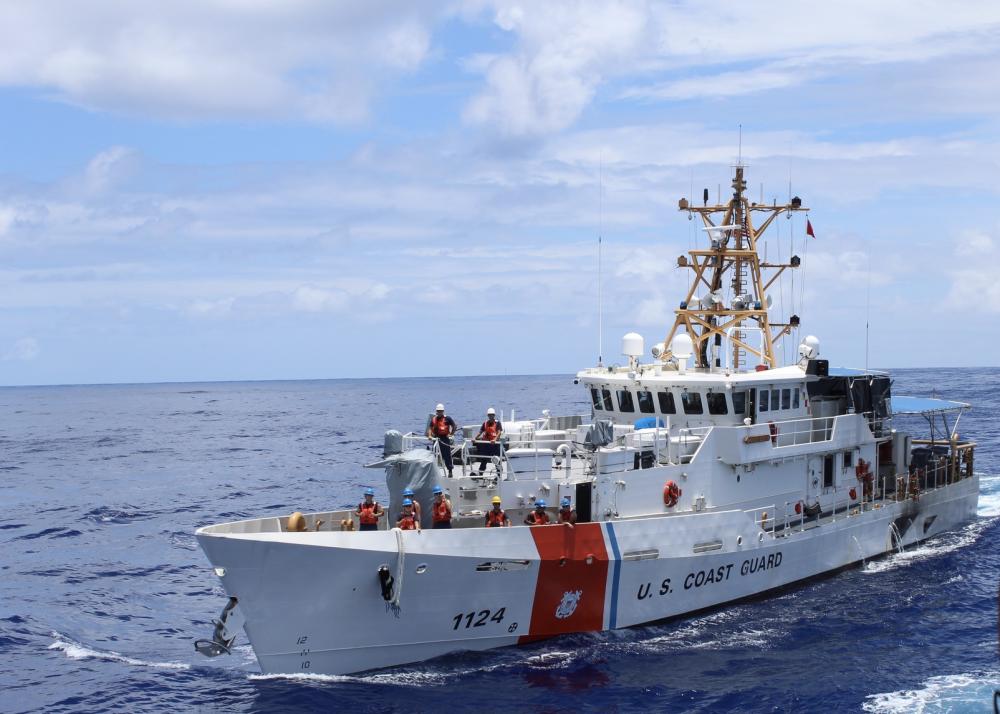
From a previous patrol. The Coast Guard Cutter Oliver Berry conducts a patrol in and around American Samoa, covering 8,169 nautical miles. The crew sought to combat illegal, unregulated, and unreported fishing and other maritime threats across the Pacific to protect the United States and our partner’s resource security and sovereignty. (U.S. Coast Guard photo courtesy of the CGC Juniper)

Military.com reports,

The U.S. Coast Guard Cutter Oliver Berry returned home to Honolulu this week in time for holiday festivities following a 38-day expeditionary fishery patrol in the South Pacific.

The Oliver Berry’s crew conducted 12 fisheries boardings, identified 16 fishery and safety violations and completed 18 community relation events while sailing from Honolulu to Kiribati, Samoa, the kingdom of Tonga and American Samoa during the 7,000-nautical-mile patrol before returning to its homeport on Tuesday, according to a news release.

These extraordinary voyages by these little ships are becoming routine. Also an indication of how difficult it is to prosecute IUU.

“US gov’t pledges more capacity-building programs for PCG” –Manila Bulletin

Certainly this will involve more “capacity building” and possibly more equipment transfers, but, perhaps more importantly, the US is sharing intelligence with the Philippines and other SE Asian nations to enhance maritime domain awareness.

I hope this will be another step toward a law enforcement alliance, a “Combined Maritime Security Task Force, Pacific,” perhaps following the model of the “Combined Maritime Force” in SW Asia.

Thanks to Xavier Ng for bringing this to my attention. 

Another Gun/Missile Remote Weapon Station Suitable for Patrol Boats

Navy Recognition reports,

At Euronaval 2022, a naval defense exhibition that was held in Paris, French Company Nexter unveils the latest generation of its NARWHAL 20mm remote-controlled turret which is now armed with one 20mm automatic cannon and the MBDA’s AKERON guided missile launch pod.

I am not a fan of this particular system. I would like to see at least a 30mm gun, but it is more evidence of the practicality and desirability of combining small missiles with a gun mounted on a remote weapon station.

Would really like to see the Coast Guard push for an upgrade of their Mk38 gun mounts to incorportate either APKWS or Hellfire / JAGM.

USV Attacks on Sevastopol and Novorossiysk

I certainly applaud the exploits of the Ukrainian Navy in taking the fight to the Russians using innovative means, here and here, but let us look at this from the prospective of the defender.

Naval Blogger Cdr Salamander offers some thoughts on the lessons of the recent attack on the Russian Navy Base in Sevastopol, but I think he may be selling the Russians short, under estimating the effort they put forth and suggesting that we would have done much better.

Quite properly he puts the attack in a historical context and calls for the US to be ready for similar attacks on US assets in US ports, but I have to take issue with his apparent belief that the Russian did not attempt to prepare for this type of attack.

This is another demonstration that the military culture of Russia is broken. The human element in the Sevastopol was manifested in the complete lack of preparation for the attack in spite of the warnings so clearly provided in September.

The Russians have a history of their ships being attacked in port that goes back to at least the Russo-Japanese war when the Japanese opened the war with a torpedo attack on the Russian fleet inport in Port Author. The unpleasant experience was repeated in WWI and WWII. As a result they have a relatively robust coastal and harbor defense organization, maybe better than ours.

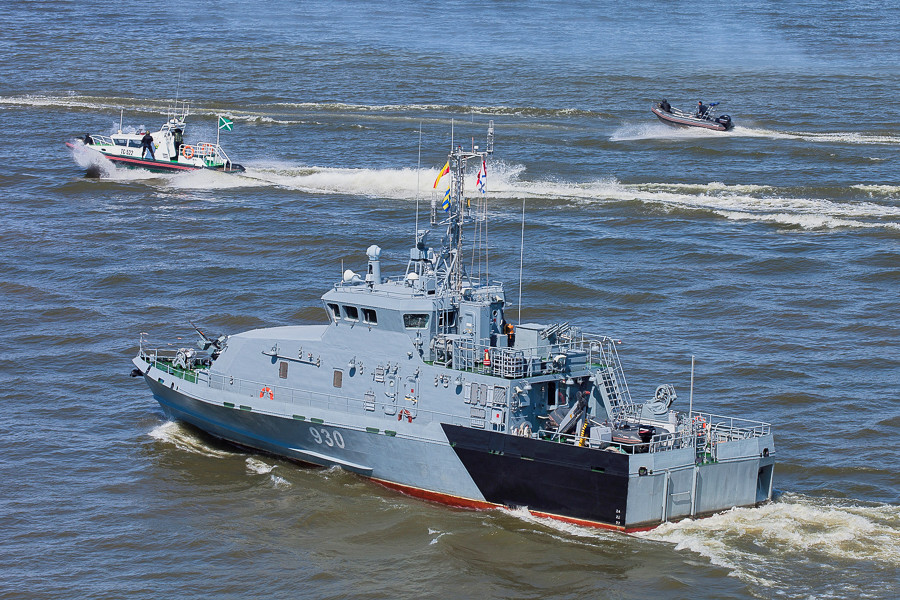
Grachonok class anti sabotage ship P-351 in Astrakhan. Photo credit Mil.Ru

The Russians have built a number of “anti-sabotour” boats that are equipped with DP-64 anti-sabotage grenade launchers and DP-65 remotely-controlled rocket grenade launcher system, a type of weapon I don’t believe we have in the US inventory. Reportedly there are ten of these anti-sabotour boats stationed in the Black Sea.

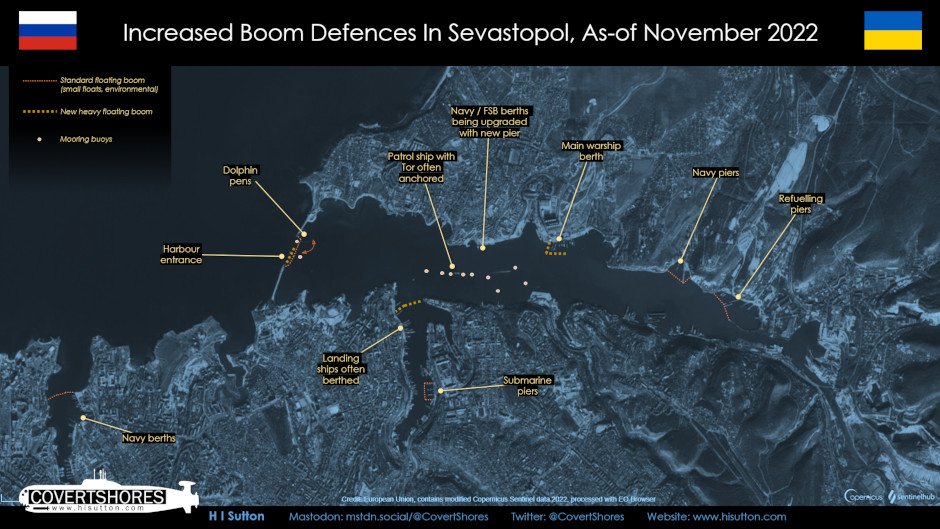
The Russians do not appear to have taken the most obvious and immediate steps to address this cheap, low-tech threat. They did not have significant barriers in place at the entrance to their harbors or around their ships’ berths. They did not have Sailors on watch with weapons at the ready.

Actually the Russians did have a physical barrier, probably a net. The shape of the bow, the shallow draft, and waterjet propulsion of the Ukrainian USVs may have allow them to jump the net.

The video above, taken by one of the attacking craft, shows an armed helicopter shooting at the craft. It seems likely this helicopter was there and airborne when the attack occured because it was part of a defense plan.

The Ukrainians applied the “quantity has a quality of its own” principle. I believe I saw a report that nine USVs were used in the attack. If only three ships were damaged, then it appears the Russians successfully countered 67% of the threat. Additionally the response might have resulted in the Ukrainians damaging easier targets, closer at hand, rather than the ones they had originally intended. From the Ukraininan point of view, the damage may have been less than they had expected or hoped for, nevertheless we see it as a success. Unfortunately for the defenders, anything less than 100% success is a failure.

Achieving 100% success is not as easy as the referenced post seems to suggest. Crew served Ma Duce .50 cal. are not adequate weapons. If the Russians had had something like APKWS, in the right places, I doubt those ships would have been damaged.

An Observation on the Ukrainian Attack Craft: 

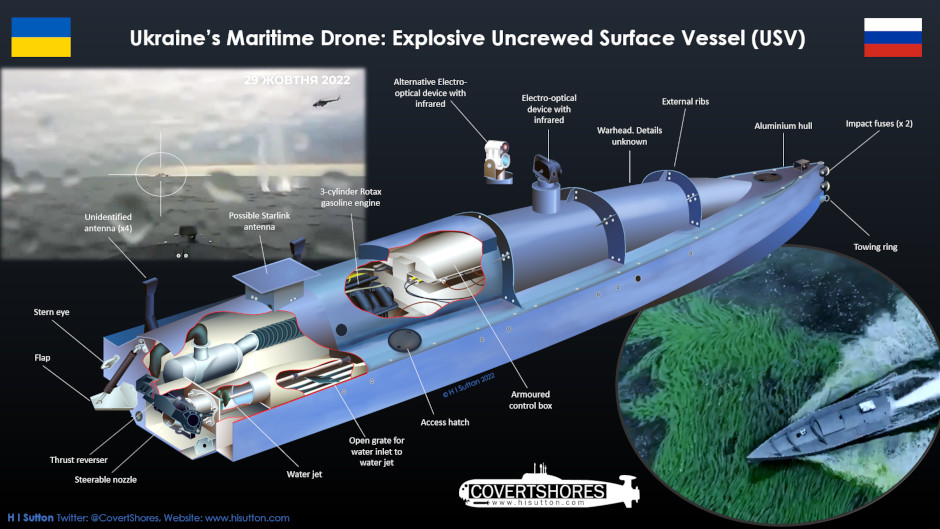
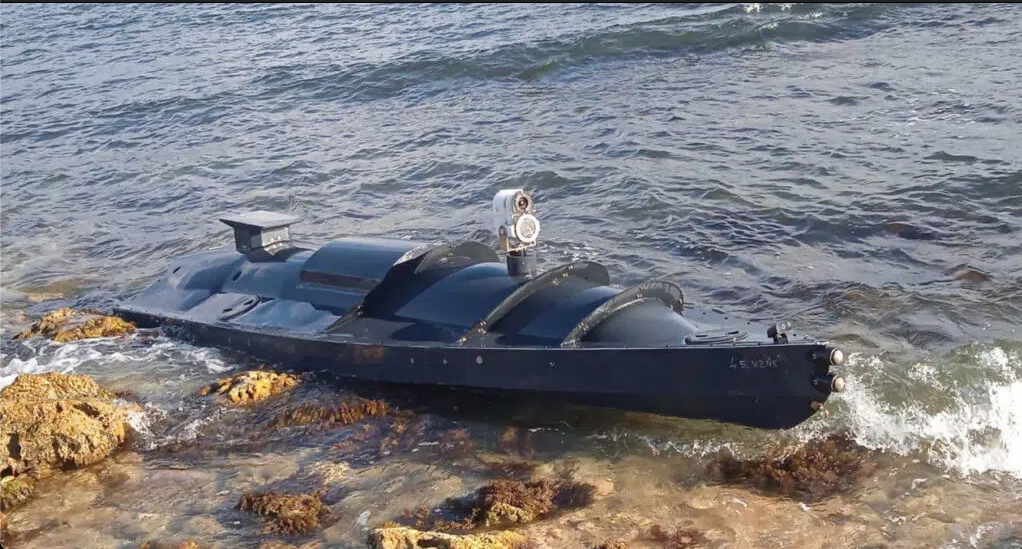
Since our first glimpse of these Ukrainian suicide drone boats, I have wondered about the “external ribs” as they are labeled above. Certainly they could be structural, but that seemed unlikely.

The most likely way to detect these craft at night is by their IR signature or seeing their wake. If the craft is pointed at you, those “ribs” might obstruct the view of the hot portions of the craft and its wake. They would also minimize light reflected from the inevitably wet top portion of the craft.

Image of the suspected Ukrainian USV circulating on Russian social media. Image via Naval News

Portugal to Build a New Type of Ship–UxS Carrier

The “plataforma naval multifuncional” (multifunctional naval platform). Portuguese Navy image.

It is not often an entirely new category of ship emerges, but this seems to be the case. Perhaps it was inevitable, but it looks like the Portuguese may be the first to make it happen–a specialized, built for purpose, unmanned systems mothership.
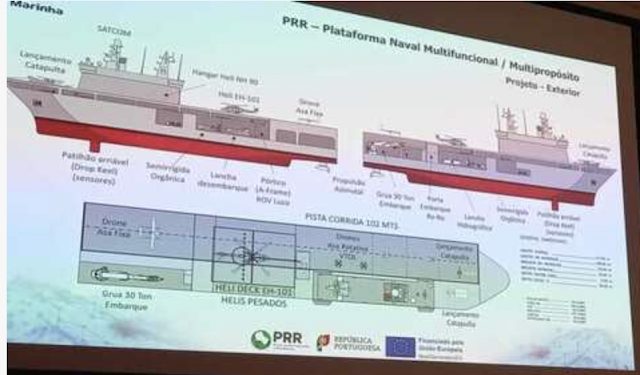
Wish the specs in the lower right above were readable. 

First heard about this ship from Cdr. Salamander. He has some interesting ideas about how such a ship could be used. It is part research ship, part disaster response vessel, and, significantly for the Coast Guard, part Offshore Patrol Vessel. There is more about the ship from Naval News. It is not particularly large, with a crew of about 90 and accommodations for another 100. The cost is reportedly about $100M US, much less than the cost of the Offshore Patrol Cutter. Judging by the size of the helicopter (reportedly an NH-90) on the model, it appears to be 100 to 110 meters (328-360 feet) in length, about the length of the OPC, maybe less. It must be pretty broad if that is an MQ-1C Gray Eagle on the deck. The Span of the Gray Eagle is 56 ft (17 m), but it just does not look like it is in scale. Maybe they have a European sourced UAS in mind. Beam looks to be about 20 to 22 meters based on my presumptions about the length, that is 66 to 72 feet. Those proportions are similar to those of the 6,615 ton Canadian Harry DeWolf class Arctic Offfshore Patrol Ship, 103.6 m (339 ft 11 in) long and a beam of 19 m (62 ft 4 in). By comparison, the beam of both the NSC and OPC is 16m or 54 feet.

The thing that makes this ship totally unique is the runway and ski-jump designed expressly for fixed wing unmanned air systems.

Artist rendering of MQ-9B STOL landing on a big-deck amphibious assault vessel. Photo: Courtesy of General Atomics Aeronautical.

What might make this very useful is the newly developed STOL version of the MQ-9B with shorter span, high lift, folding wings.

Not sure I like this particular design. It is not clear how many UAS and helicopters can be carrier or if there is hangar space. The island is unnecessarily thick and looks too far forward. No indication of speed or endurance. The speed in unlikely to exceed 20 knots, between 16 and 18 knots seems likely, but the concept is novel. Look forward to seeing the ship in final form.

Late Addition: 

After posting this on Facebook, I got some additional information. This is a Google translate from Portuguese. Thanks to Pedro Mateus.

MULTI-PURPOSE PLATFORM SHIP Lisbon, Portugal June 20, 2022 On June 20, 2022, the Portuguese Navy launched a tender limited by simplified prior qualification, via procedure no. of a Multipurpose Vessel/Platform (N-PM), with an execution period of up to 3 years (with delivery until December 2025), for a base price of 94.5 million Euros.

This Multipurpose Ship/Platform (N-PM) will have a total length, between perpendiculars, of 100 meters, a maximum beam (at flight deck level) of 20 meters and a maximum draft of 7.5 meters. It will follow STANAG 4154 (Ed 3) standards and will be able to maintain the operation of lowering and hoisting vessels in sea state 5 on the Douglas Scale. Its garrison will be composed of 1 commander, 7 officers, 8 sergeants and 29 soldiers, in a total of 45 elements. It has accommodation sized up to 28 officers, 30 sergeants and 32 enlisted men, for a total of 90 elements (in addition to the commander). It will be dimensioned for a range of 45 days at a cruising speed of 10 knots.

The N-PM shall comprise a set of aviation facilities including, among others, a flight deck (a ski-jump runway, a spot for helicopter operation, with lighting system, GPI, etc.), hangar for a helicopter (with support for hydraulic maintenance stations, overhead crane, technical lighting, etc.) and a hangar for unmanned aircraft. In terms of organic helicopter, it should support the Lynx MK95A and NH90 aircraft (either in “spot” or in hangar) and EH101 (“spot”). The flight deck must allow the operation of different types of unmanned aircraft, commonly known as “drones” (Ogassa OGS42, Tekever AR3, etc.), as well as all the support required for vertical refueling operations (VERTREP).

Within the scope of semi-rigid vessels, the N-PM will have 3 vessels: a vessel with
SOLAS (“Safety of Life at Sea”) certification for operation as “Fast
Rescue Boat”, with a power of not less than 250 hp; and two non-cooperative approach vessels, with capacity for 8 equipped soldiers, with a maximum speed of 35 knots or higher and a minimum autonomy of 60 nautical miles, for inspection missions , policing, combating drug trafficking, assault and support for a small embarked force.

Following the good practices and installation and operation recommendations of the “Alliance of European Research Fleets” (EUROFLEET), in terms of support systems for scientific research, the N-PM will be designed to be able to operate subsurface Unmanned Vehicles (VENTs) and remotely operated vehicles – “Remotely Operated Vehicle” (ROV). It will have a sensor pavilion (“drop keel”) for the installation of scientific and acoustic sensors; a large volume “Rosette” CTD system (for deep water sampling, with probe capable of operating up to 6,000 m); an MVP system, “Moving Vessel Profiler”, capable of operating up to 700 meters deep with the ship sailing at 8 knots; an “Acoustic Doppler Current Profiler” (ADCP); a “Global Acoustic Positioning System” (GAPS), capable of operating up to 4,000 meters deep. In addition to these organic systems, the N-PM will have the capacity and integration for several other non-organic systems (Piston Corer – Calypso, Vibrocorer, Box Corer, Multi Corer, etc.) as well as all operating and support winches.

Under an integrated architecture of command and control, platform management, and digital information processing and management systems, this N-PM will have a set of navigation systems (IBS, DDU, TACAN, Secure GPS, etc.), with navigation radar surveillance systems, combined warning radar (ARPA capability, “Automatic Radar Plotting Aid” and IMO certification; ECM and Anti-Jamming) and IFF/W-AIS identification systems, as well as underwater surveillance systems (bathythermograph; support for XBT/XSV probe used in the Navy (XBT4, XBT5, XBT7 and MK-8 XBT/XSV) or CTD type probes). In terms of external communications, it will have, among others, satellite communication systems SATCOM and MILSATCOM, GMDSS, submarine telephone, SART, EPIRB and ICCS.

In terms of armament, the N-PM will be equipped, at least, with 4 “softmounts” for a Browning M2 .50 heavy machine gun, with a firing range limiter and respective accessories, and a base, with ballistic protection for the Browning part and respective operator; and with 2 pieces of Hotchkiss salvo. The N-PM will be equipped with magazines and armories capable of storing various portable weapons, ammunition, pyrotechnic material and demolition material and respective detonators.

Technical drawing and 3D model via the Portuguese Navy Ships Directorate
Editing and composition by “Espada & Escudo”

“Putin touts Russia’s ‘Arctic power’ with launch of nuclear icebreakers”

Launch ceremony for the nuclear-powered icebreaker "Yakutia" in Saint Petersburg

Launch ceremony for the nuclear-powered icebreaker “Yakutia” in St. Petersburg

Some news from MSN about two new Russian nuclear powered icebreakers, one launch, one “flag raising,” and a reference to a real monster,

Putin said a super-powerful nuclear 209-metre icebreaker known as “Rossiya”, with a displacement of up to 71,380 tonnes, would be completed by 2027. It will be able to break through ice four metres thick.

“U.S. 5th Fleet Reveals New Details on Iranian Drone Attack on Tanker” –USNI

Graphic illustration and images captured by a U.S. Navy explosive ordnance disposal team aboard M/T Pacific Zircon, Nov. 16, showing the location where an Iranian-made unmanned aerial vehicle (UAV) penetrated M/T Pacific Zircon’s outer hull during an attack Nov. 15. The one-way UAV attack tore a 30-inch-wide hole in the outer hull on the starboard side of the ship’s stern, just below the main deck. US Navy graphic

The US Naval Institute has a post providing addition detail about the November 15  drone attack on tanker Pacific Zircon.

The primary thrust of the post seems to be, to confirm that the drone was of Iranian origin, but then, that was almost assumed. They seem to have proven that, identifying it as a Shahed-136 design, a “loitering munition.”

For me the new information was where the tanker was targeted and the extent of the resulting damage.

When I first heard that this drone had hit the hull, I thought perhaps the Iranians had decided it was not to their advantage to kill crew members, as had happened in the July 30 attack on the tanker Mercer Street, but apparently that was not the case, since this strike was also on the stern where it is more likely to effect crewmembers.

As to the weapon’s effect, the Shahed–136 reportedly has a 30–50 kilograms (66–110 lb) warhead. referencing a 5th Fleet report, USNI notes,

On Nov. 15, a Shahed 136 explosive-tipped drone flew into the aft section of the merchant oil tanker M/T Pacific Zircon punching a hole through the hull, “while subsequently penetrating and damaging internal compartments. The UAV’s explosive impact also damaged a shipboard boiler, potable water tank and life raft,” reads the statement.

That they managed to damage engineroom equipment, which presumably required penetration of multiple internal bulkheads, after penetrating the hull, is more than I would have expected. The anti-armor, shaped charge version of the munition, which would result in a narrowly focused path of destruction, may have been used.

Another report from Business Insider vis Yahoo that includes more photos here.

“Coast Guard Establishes Cyber Reserve Component and Cyber Billets” –Seapower

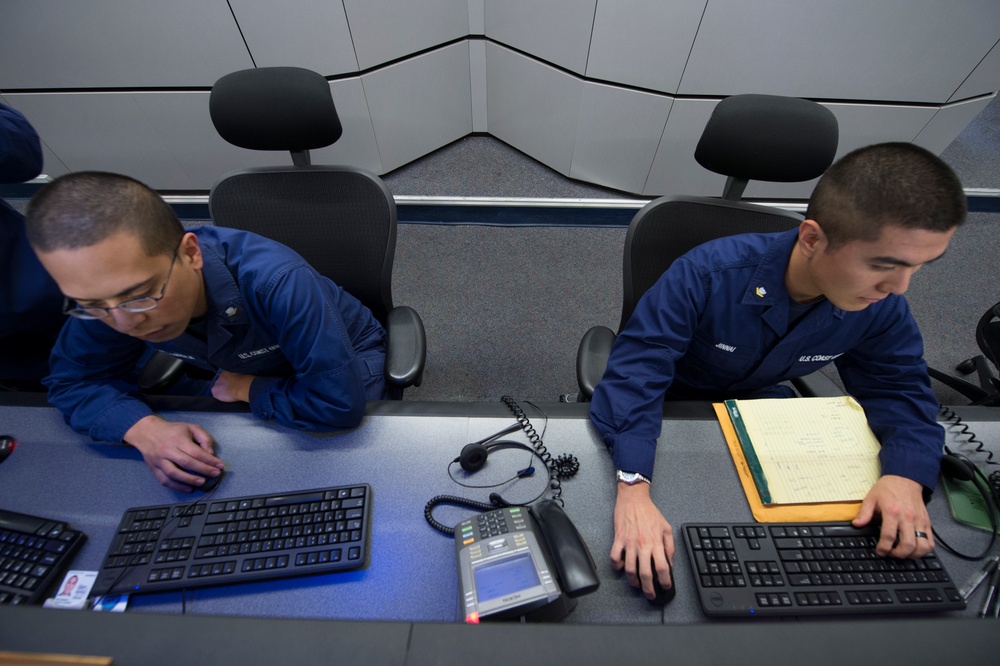
Coast Guard Information Systems Technicians inside a server room at the Telecommunication and Information Systems Command (TISCOM) Jan. 24, 2013. U.S. COAST GUARD / Petty Officer 2nd Class Etta Smith

The Navy League’s on-line magazine, Seapower, reports,

The Coast Guard is creating three reserve entities to strengthen its cyber capabilities, the service’s headquarters announced in an internal message.

“MH-65 upgrades were invaluable to mission success in the aftermath of Hurricane Ian” –CG-9

The report below is from the CG-9 website

MH-65 upgrades were invaluable to mission success in the aftermath of Hurricane Ian

Air Station Miami crew during Hurricane Ian

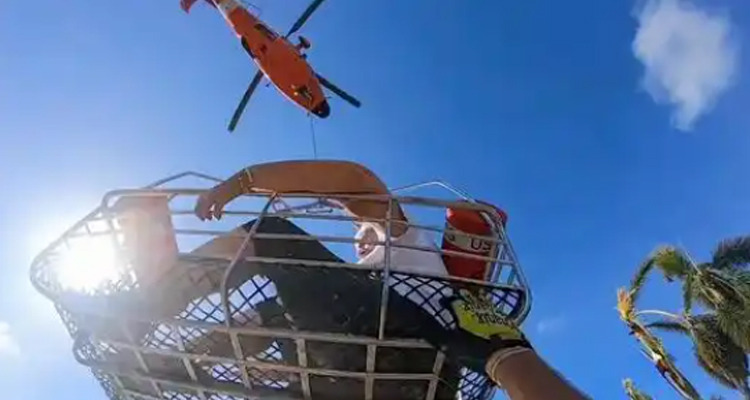
The Air Station Miami crew evacuates a person in the aftermath of Hurricane Ian. In addition to Air Station Miami’s MH-65Es and HC-144Bs, the coordinated rescue included one MH-65E from Air Station Houston and two MH-65Ds from Air Station Savannah. Total statistics for the coordinated rescue: 46 lives saved, 36 lives assisted and 19 pets saved. U.S. Coast Guard photo by Air Station Miami.


Hurricane Ian caused nearly 150 fatalities when it swept through Florida in late September 2022 and has been cited as the deadliest hurricane to hit Florida since 1935. In the search and rescue efforts that followed, Air Station Miami crewmembers played a pivotal role in rescuing both human and animal survivors. According to the pilots, upgrades on the Coast Guard’s MH-65E proved vital during multiple rescue missions. In the days following the storm they were faced with harried conditions when fuel stops were limited, communications were intermittent and lives depended on the speed and awareness of the crew.

The upgraded MH-65E, or Echo, sports an all-glass cockpit and Common Avionics Architecture System (CAAS) that replaced legacy analog components. The new system aligns with Federal Aviation Administration next-generation requirements that call for performance and space-based navigation and surveillance, allowing for more three-dimensional approaches and flight patterns as well as higher visibility of the helicopter by other on-scene aircraft.

Integral to the CAAS is the automatic dependent surveillance-broadcast, or ADS-B, which allowed command aircraft (both Coast Guard HC-144 and Navy P-3) to track the MH-65E even when it was no longer visible to the crews. The moving map on the pilot screens can be overlayed with the traffic collision avoidance system (TCAS), which helps deconflict airspace with multiple aircraft maneuvering in tight quarters. The display can be placed across four multi-function display (MFD) screens and is accessible to both pilots.

“The TCAS was immensely helpful, especially being able to use the moving map overlay,” said Lt. Audra Forteza. “There were so many aircraft in the area, both military and civilian, and not everyone was making traffic calls as they should be – the TCAS allowed us to quickly and efficiently find the most imminent threat and maneuver to maintain separation. Knowing where exactly to look for a target made identification much faster and allowed us to focus on the mission at hand vice continually searching for other aircraft.”

The crewmembers were equally impressed by the bingo fuel alerts, an aviator term used to describe the minimum fuel an aircraft requires to land safely at its designated landing site. Fuel stops were severely limited because of widespread power outages on the ground. This meant that finding an airport with a generator strong enough to facilitate refueling was largely based on recommendations from other parties in communication with the aircrews. “Word of mouth was key to success for aircrews operating the area to determine which airports had fuel,” Forteza said. “And the people at the airfields were extremely accommodating in getting crews food, fuel, water and bathrooms.”

The MFD screens were also very useful when it came to hoisting survivors out of difficult situations while maintaining situational awareness and control of the aircraft. Forteza was able to monitor her co-pilot safely and effectively while they operated the hoist in a series of challenging urban environment rescues over the course of several days.

Additionally, utilizing the upgraded radar weather mode allowed for safe navigation between hurricane bands as the crews searched for survivors by painting a clearer, more accurate picture of the evolving weather situation even when their in-flight tablets did not have reception. In response to Hurricane Ian, Air Station Miami pilots flew a total of 46 hours over several days. Forteza and Lt. Danielle Benedetto personally contributed to saving the lives of 16 people, as well as five cats and three dogs. The air station fully transitioned to the MH-65E in July 2021.

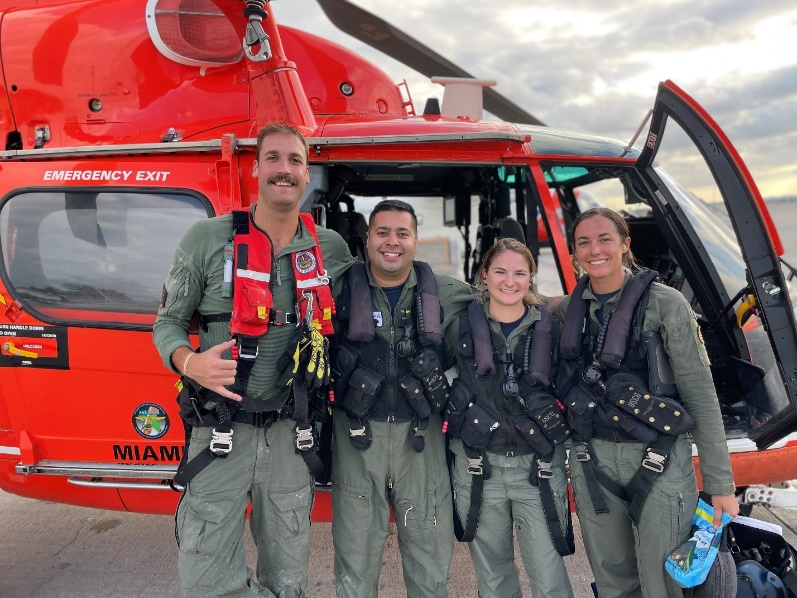
Air Station Miami crew

Air Station Miami crew, from left: Petty Officer 2nd Class Tyler Kilbane, Petty Officer 2nd Class Nick Rodriguez, Lt. Audra Forteza and Lt. Danielle Benedetto. U.S. Coast Guard photo.

Live shots taken by Minotaur-equipped HC-144

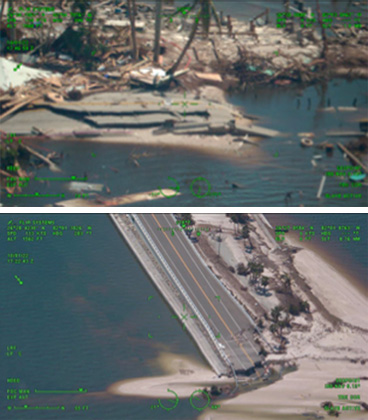
Live shots of Hurricane Ian damage taken by Minotaur-equipped HC-144 aircraft were used to support the Incident Management Team. U.S. Coast Guard photos.

MH-65E transition
The Coast Guard has completed 52 out of 98 total conversions including avionics upgrades to the Echo configuration and Service Life Extension work. Air stations that have completed the transition and number of aircraft:

Houston 3
Miami 5
Port Angeles, WA 3
Barbers Point, HI 4
North Bend, OR 5
Helicopter Interdiction Tactical Squadron 12
Humboldt Bay, CA 3
San Francisco 7

Next up for conversion are Atlantic City, N.J., and Savannah, GA

For more information: MH-65 Short Range Recovery Helicopter Program page and Minotaur Mission System Program page