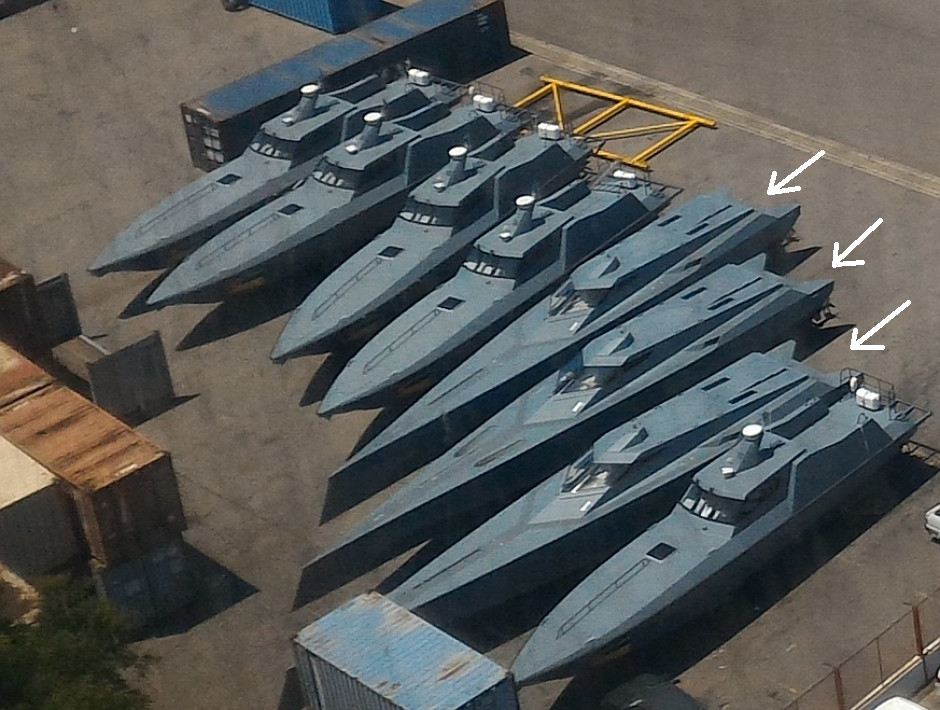
Covert Shores brings us an interesting, but ultimately sad story of Mozambique’s attempts to provide a naval/coast guard force. There are interesting classes of patrol and interceptor classes here, all let down by inadequate support.

Covert Shores brings us an interesting, but ultimately sad story of Mozambique’s attempts to provide a naval/coast guard force. There are interesting classes of patrol and interceptor classes here, all let down by inadequate support.

Below is a news release reporting the arrival of two Webber class WPCs to their new homeport as they join PATFORSWA.
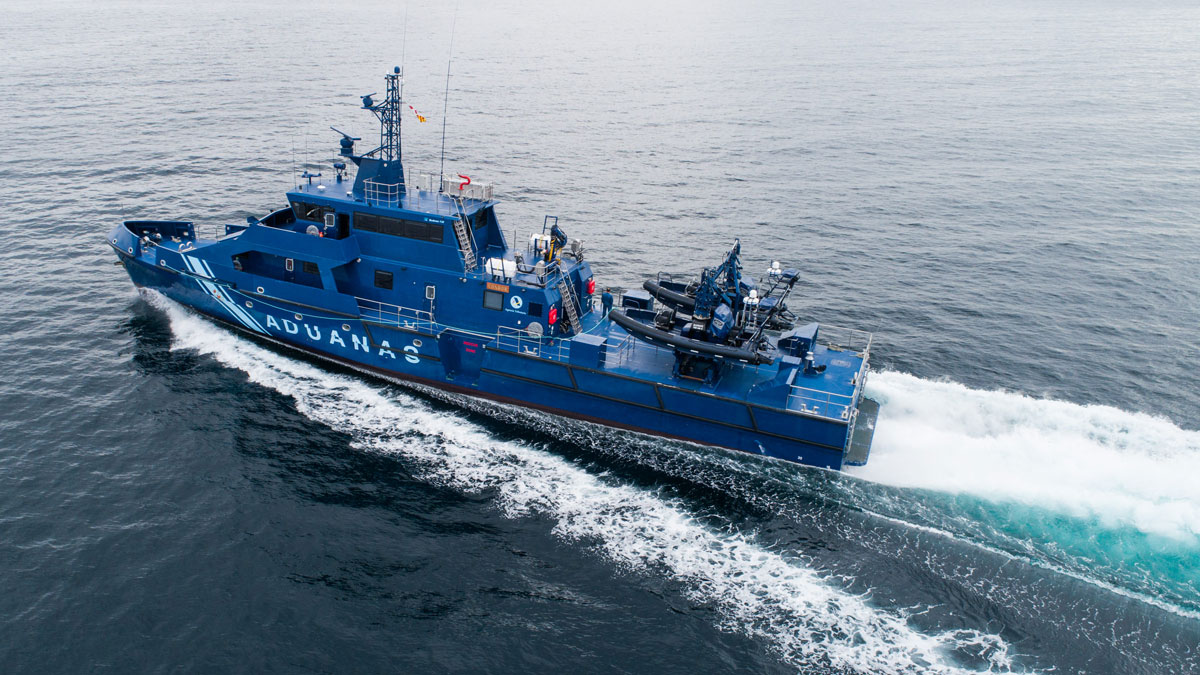
Seawaves reports delivery of a new 43 meter patrol boat,
May 13, 2021 – Rodman Polyships S.A.U., a shipyard of the Rodman Group specialized in the building of all types of FRP (Fiberglass Reinforced Polyester) vessels, finishes this April the delivery of a new vessel to the Spanish Tax Administration Agency (Agencia Estatal de Administración Tributaria). This is the new Rodman 138, the longest offshore patrol vessel in Fiberglass Reinforced Polyester that has been built in Europe and probably worldwide, so far, which is already part of the Customs Surveillance fleet to carry out missions at sea and provide coastal patrol service, covering large surveillance areas.
Specifications describe a vessel slightly smaller than the Webber class WPC.
Length: 43 meters, Speed 26 knots, range 2000 nautical miles, Crew 18
The remarkable characteristic is the performance on what appears to be relatively low power. For the claimed 26 knots top speed “Propulsion is provided by two 1,500 kW four-stroke diesel engines.” That is about 4000 HP, about on third of the power the Webbers require to reach 28 knots.

Below is an Atlantic Area news release that provides a wrap up of USCGC Hamilton’s very much not routine deployment to the 6th Fleet. We can expect two more similar deployments, in the Fall and again early in 2022. The third FRC to be stationed in Guam, Frederick Hatch (WPC-1143), followed the first two Bahrain bound ships that deployed with Hamilton in the construction sequence and was accepted in February. PATFORSWA FRC#3 has already been busy. While as a pre-commissioning unit Glen Harris was deployed to assist the Seacor Power. Glen Harris arrived on the scene within 30-minutes and was able to rescue one of the six people to survive the incident.
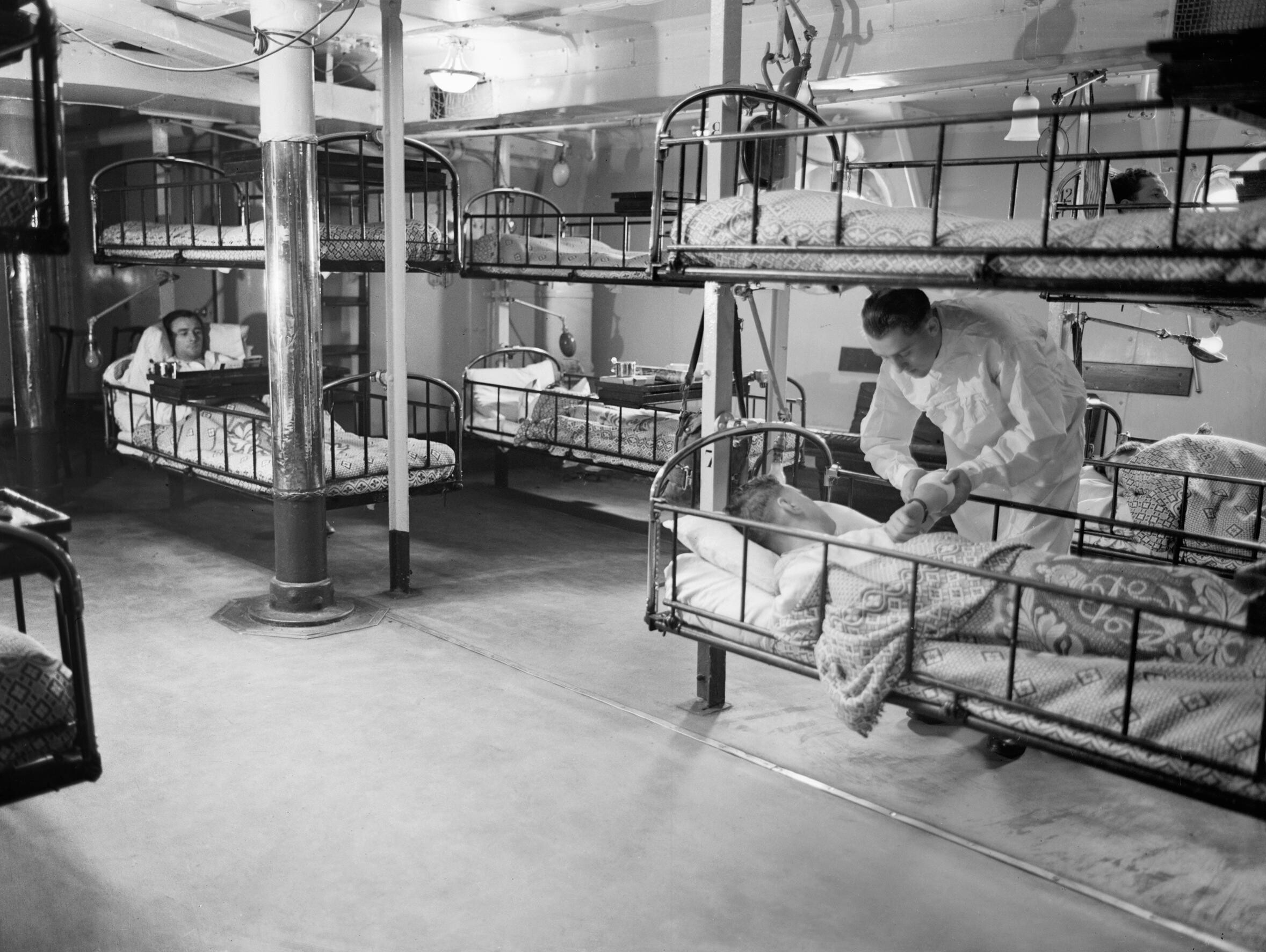
I have a friend who is looking at improving ships’ sick bays. I could not really offer any suggestions, but perhaps you can.
I don’t expect a lot of responses, but perhaps some of you can help even if you think the suggestion is minor. Please add a comment.
What improvements, additions, or changes might make ships’ sick bays more useful? more flexible? more capable? More accessible?
Do we need more privacy? Connectivity to advice from ashore? Robotic assistance?

This is a follow-up to an earlier post, “Coast Guard Continuing Quest to Deploy Counter-Drone Systems” –Seapower, that suggested, if cutters were given a Remote Weapons Station {RWS) similar to the one on the Interim Maneuver Short Range Air Defense (IM-SHORAD) vehicle pictured above, it would provide a great deal of flexibility in responding to a broad spectrum of threats, and that the Navy might be interested in a similar mount for their light amphibious warship (LAW).
I got to wondering how close that possibility might be. The Navy Department supplies the Coast Guard’s ships’ weapons, so there is no chance the Coast Guard could get such a weapon unless it was being used by either the Navy or Marine Corps.
Turns out the possibility may not be that remote.
Kongsberg claims to be the leading manufacturer of Remote Weapon Stations.
“Kongsberg is the world’s leading manufacturer of RWS, delivering nearly 20,000 RWS units to more than 20 countries worldwide. All RWS systems – including turrets – bound for U.S. customers are manufactured in Kongsberg’s Johnstown, Penn. facility with significant support from a U.S. supply base.”
Their portfolio of eight RWS, includes at least three in service with the Navy Department and one used by the Coast Guard. Remote weapon systems – KONGSBERG Defence and Aerospace.

Their middle weight “Protector RS6” which is also designated as the XM914 is the basis for the IM-SHORAD. It is also used by the Marine Corps as the Remote Weapon System for their Marine Air Defense Integrated System, which is a lighter system than the IM-SHORAD having no provision for Hellfire and only two Stingers on the mount. Kongsberg Awarded Contract to Deliver XM914 Remote Weapon Stations to the US Marine Corps for the Marine Air Defense Integrated System – Soldier Systems Daily.
Their light weight “Protector RS4 Naval” is the basis of the Mk50 remote .50 cal. The Sea PROTECTOR MK50 supporting the U. S. Navy – KONGSBERG The Coast Guard has four 87 foot patrol boats used for SSBN force protection that are equipped with these and we expect to have two on each of the Offshore Patrol Cutters.
One of Kongsberg’s heavier RWS, RT20 with a high velocity 30mm gun has been selected for the USMC Amphibious Combat Vehicle (ACV) program, and is fully marinized to allow operations in marine environments. Kongsberg MCT-30 30mm Turret Selected for USMC ACV (overtdefense.com)
It is not the 30mm gun that makes the RS6 mount an attractive alternative to the Mk38, it is the ability to also mount Hellfire and Stinger, though the availability of a proximity fuse is a significant advantage. The gun itself is not superior to the 25mm and is definitely inferior to the higher velocity 30mm guns that use 30×173 ammunition which also includes a proximity fused round.
On the other hand this 30mm, in the RS6 mount is lighter than the Mk38 mod2/3 and would be a huge improvement over the .50 cal. Using both the 30mm and the coaxial 7.62mm on our smaller units would allow the use of the 7.62 for accurately placed warning shots and the 30mm for greater effectiveness should that be necessary. The addition of Hellfire and or APKWS would allow small units to deal with even larger threats.
Kongsberg seems to be able to integrate numerous weapon systems into these systems.


For an overview of the IM-SHORAD system, here is a video (sorry about the commercials).

If you want to know how the DOD is structured and where the money goes, this is your source. It is 140 pages and has some great graphics. Credit the USNI for alerting me to this.
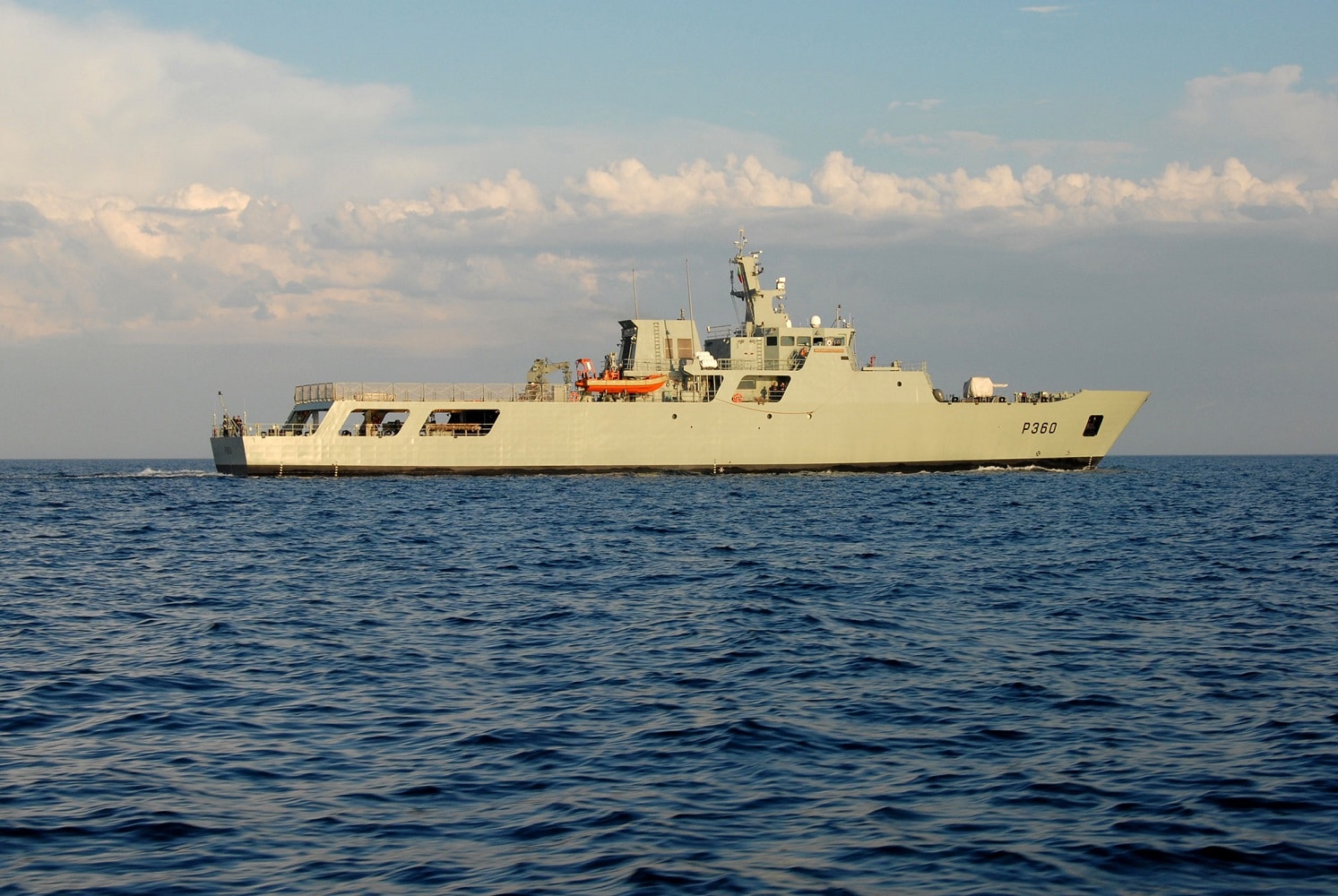
Naval News reports Portugal has decided to procure six additional Offshore Patrol Vessels of the Viana do Castelo class, adding to the four currently in service.
This has been something of a slow-motion program, with the first two of class being laid down in 2004 but not commissioned until 2011 and 2013. After the first two ships, the pace improved considerably. The third and fourth, built by a different shipyard, were laid down in 2017 and commissioned in 2018 and 2019. The additional six ships are expected to be commissioned by 2029, with the first to be commissioned in 2023.
The ships themselves fall between the 210s and 270s in terms of sophistication and capability. About the size of the 270s but without a hangar and only a 30mm gun with an optical firecontrol system. Their speed is better than either USCG cutter at 21 knots. The crew is much smaller, 35 with accommodations for 32 additional.
They are equipped for mine laying. Two of the existing ships have pollution recovery systems.
Below is the full text of the President’s remarks at the Class of 2021 commencement. This is the source. A video of the address is above.
MAY 19, 2021 • STATEMENTS AND RELEASES
United States Coast Guard Academy
New London, Connecticut
11:46 A.M. EDT
THE PRESIDENT: Mr. Secretary, thank you. Hello, Coast Guard Academy. I tell you what — we’re going to speak for about four hours to see if those white uniforms last longer to keep the heat away than these poor guys in their graduation gowns here. God, love you. I thought I was hot in a blue suit. (Laughter.)
Governor Lamont, it’s good to see you, man. You’ve been a good friend a long time.
And I understand the senior senator from this state for a long time, Chris Dodd, is here. I don’t know where you’re — I don’t — I don’t think you’re in the class, Chris. But you’re one of the — where is he? Chris, welcome, pal — one of the finest men I’ve ever served with in my whole career.
And Mayor — Mayor Passero, I — I want to thank you for being here. Thanks for the passport into town.
And I want to thank, again, the Secretary Mayorkas for joining me today as well. He understands — he understands well how vital the Coast Guard is to our economic, our environmental, and national security, and how central you are to our Homeland Security mission.
Admiral Schultz, congratulations on a — an outstanding new corps of officers.
This past year, there can be no doubt the Class of ‘21 is ready for whatever its mission may be.
I know this day is doubly important to the Admiral because he’s not only the Commandant of the Coast Guard — well, let me say it another way: In 2013, I think, I gave the commencement here, and I was pointing out how the Coast Guard was adapting so rapidly to changing conditions. And I said, “This is not your father’s Coast Guard.” I take that back. (Laughter.) First-Class Eric Schultz, this is your father’s Coast Guard. (Laughter and applause.)
And I know it probably embarrasses you to be — to point you out and say that, but I had a son in the United States military. He was very proud. He was a major in the U.S. Army. He won the Bronze star. I guess — anyway, when he went to Iraq for a year, he had the — he got the general to agree to change his name from “Biden” to “Hunter,” his mother’s maiden name, because he didn’t want to be viewed as having getting any favor — have gotten any favors.
Admiral Kelly, I want to thank to you and the entire staff of the Academy for your commitment to training the next generation of leaders.
And I brought with me a former Academy grad, who now serves as my Coast Guard Mil Aide, Lieutenant Commander Jayna — now, I’m going to embarrass her — Jayna McCarron, of the Class of 2007. As we were coming in on Marine One, I thought she was going to light up like a candle. She’s so excited being back here. She’s an outstanding reflection of this institution.
And Admiral Kelly, I want to congratulate all of you on everything you’ve done this year to keep this school open and running, and to be as safe as it possibly can and could be in the middle of a pandemic.
You know, the instructors; the cadets; the cafeteria; the support staff; public works; the campus safety team; the science department; the medical staff; the Morale, Well-Being, and Recreation team — everyone went above and beyond the normal call of duty to try to make it work, and you did.
And I hear that Mrs. Paula Springer’s cookies for cadets were particularly a boost in morale.
And what you all — what you all achieved together embodies the Coast Guard creed: “Always ready.” “Always ready.”
I want to thank you. I want to thank you, Cadet Steyller — excuse me — Seyller — for speaking on behalf your class. And congratulations on earning the honor of being the Class of ‘21’s Distinguished Graduate.
But most importantly, I want to thank your parents and families for everything — everything they have done to support you, and all of you — and I’m going to — and those watching online as well. There’s — not all can be here.
You’ve raised these cadets to be fierce patriots as well as young people of incredible courage and determination. You were the ones who first installed in them the sense of service, who helped them hear the calling of a higher duty. So, it’s your day, too.
Cadets, stand up, turn around, and salute your parents. (Applause.) Get up. Up, up, up. (Applause.)
I tell you what, all those parents watching on television, you raised a fine, fine, fine group of women and men.
Cadets, you knew when you chose the Academy you were choosing a more difficult path than some of your high school classmates. You were signing up for the honor of service, and the additional responsibilities that go with it.
But I hope today you take the time to reflect on how much all of the hard work and extra — extra effort you engaged in was worth. And I hope that you take immense pride — immense pride in all that time at the Academy and all the Academy has given to you.
Because you’ve achieved something few others can claim: You survived R-Day and Billet Night. You made it through Swab Summer. You got a haircut that showed every damn bump on your head. (Laughter.) You learned to square the corners and square your medals — look, your meals, I should say.
And you memorized — and this the part I found would have been hard — memorized Running Lightning [Light]. I’m going to ask you all to stand up and repeat it. No, I’m only kidding. (Laughter.)
You earned your shoulder boards and your aiguillettes. You passed through 100th week, and maybe spent a little too much time at the Slice. (Laughter and applause.) You can clap. Come on, man. You’re moving on. Show a little courage. (Laughs.)
And then, like all the students across the country, you had to figure out what it meant to finish your second-year class [second-class year] in virtual ins- — with virtual instruction.
The pandemic upended so much of our lives. As was mentioned several times so far, last year’s graduating class didn’t get to have this ceremony in-person. But the Coasties fashion that you all have — you met the threat head on.
You adapted, showed your resilience, and you led. The class of ’21, you were the ones to test and improve the restricted movements protocols that allowed you to return to class on campus. And with careful precautions and regular testing, you were able to go back to your lives and training here in New London, to conduct your first-year class [first-class year] in person.
It certainly looked and felt different, I’m sure. But you found ways — you found ways to keep many of the Academy’s traditions alive, and maybe even formed a few new ones. You still were able to bring your cars on campus; you just weren’t allowed to go anywhere in those cars. (Laughter.)
Man, I tell you what, I’d have trouble watching my car sit there. But maybe dipping your ring in Crown Park or having your Ring Dance outside will be a new standard. The Super Bowl of Inter-Company sports may become an annual event.
And by the way, congratulations to Bravo Company, by the way, for — on your victory. You can clap. It’s okay. (Applause.) Even if you lost, you got to clap.
And though everything you found — through it all, you found ways to excel in the classroom and athletics. You’ve got nine All-Americans in your ranks today, including a recordsetter in the track and field 5,000 meters.
And most importantly — most importantly, you had each other’s backs. When times got hard, you were there for one another. That’s something you all learn quickly at the Academy.
You can’t crew the Tall Ship Eagle without working together; it’s not possible. So, the pandemic didn’t change that, but it made it more important.
I know we wish more of your loved ones could be here today to celebrate with you in person, packed into the stands for your big day, especially because so many of you come from families of proud traditions of service.
First Class Rachel Piche is about to become the third-generation Academy grad. Meanwhile, First Class Jacquelyn Tidd bucked a long tradition in her family and joined the Coast Guard over — came to the Coast Guard Academy over the Naval Academy, unlike her mother, father, uncle, and grandfather.
Well, Cadet Tidd, there’s a seat on Air Force One if you have to get home. (Laughter.) It may be tough. I can only assume that you will enjoy educating your family about how the Coast Guard is, quote, “The hard nucleus around the Navy forms in times of war.” (Laughter.)
You are a quiet — you’re a really dull class. (Laughter.) I mean, come on, man. Is the sun getting to you? (Laughter.) I would think you’d have an opportunity when I say that about the Navy to clap, but — but being here together — (applause).
But all kidding aside, being here together is a victory in and of itself. An important marker in the progress we’ve made to turn the tide of this pandemic. It’s a testament to the skill and military discipline and sense of responsibility you already embody. So there is no doubt in my mind that the 140th graduating class of the United States Coast Guard Academy will reflect — will reflect the very best of our country in the proudest tasitions [traditions] of our service.
Look, just a — and, in just a few minutes, you’ll be ensigns in the U.S. Coast Guard. But the only Anchor Cadet is the only one going home with 240 bucks in his pocket. (Laughter.)
And before — before I go much further, as your Commander-in-Chief — I’ve been looking forward to being able to do this for a long time; I want to you to — I want to keep a longstanding tradition that — and here it goes: I hereby absolve all those serving restrictions of minor infractions — absolved.
Now, you have no idea how much I wish I had been able to do that at my graduation — (laughter) — at my graduation — (applause) — from the University of Delaware. Because I need — as we say in my faith, I needed absolution. (Laughs.) You all think I’m kidding. I’m not. (Laughter.) Minor infractions like using a fire extinguisher to hose down an RA, but other than that, nothing much.
Look, cadets, today you’re joining a chain of service that links each of you to our history. It’s a connection to the very earliest days of our nation as part of this country’s oldest, continuous seagoing service.
But no class gets to choose the world into which it graduates, and demands and the challenges you’re going to face in your career are going to look very different than those who walked these halls before you.
You chose, as a class motto — it reflects this reality: you said, “We are the future.” I don’t think you have any idea how — how profound that assertion is.
The world is changing. We’re at a significant inflection point in world history. And our country and the world — the United States of America has always been able to chart the future in times of great change. We’ve been able to constantly renew ourselves. And time and again, we’ve proven there’s not a single thing we cannot do as a nation when we do it together — and I mean that — not a single solitary thing.
And this is particularly important in this moment of accelerating global challenges, hybrid threats that don’t stop at our border. We have to meet them on the land and the sea, wherever we find them. And that’s where the Coast Guard excels.
The pandemic response would not necessarily have been considered a Coast Guard mission until there were more than 250,000 stranded cruise passengers who needed to be safely disembarked during COVID-19.
Now we see, with harrowing clarity, how important halting this pandemic and improving our ability to prevent and respond to the next one is in our national security. That’s why 500 Coast Guard reservists have deployed in support of FEMA and other nationwide vaccination efforts.
Disaster response has long been part of the Coast Guard’s mission. But with the pace of climate change accelerating, we’re seeing more frequent and more intense storms that call for you to respond.
Last year was the most active hurricane season on record — 30 named storms — and the Coast Guard was always there to respond, even at the height of the pandemic.
But you’ve also been a part of our response to wildfires in the west, record flooding in the heart of the country. And these patterns are only going to get worse if we fail to take immediate and ambitious actions on climate.
Whether it’s interdicting illicit drug shipments at sea before they enter the United States or your stewardship of the environment, the Coast Guard has always recognized the broader definition of our national security.
Alexander Hamilton may have been among the first to champion the principle that economic security is national security when he created the Revenue Cutter Service. But if it was true in 1790, it’s gospel in 2021.
The best way to meet the wide array of threats we face today is by investing in American’s — in America’s enduring advantages and ensure that we’re operating from a position of strength.
Our economic vitality at home, our ability to trade with the world is essential to that strength. More than one quarter of the U.S. GDP is transported through the waters that keep us sa- — that keep us safe. And we’re going to increasingly see our skills called upon internationally as well.
For decades, the United States has underwritten international maritime security. We and our partners have kept the sea lanes open and secure. We developed clear rules of the road, behavior is in bounds — important — out of bounds for other nations — to ensure that we can share peacefully in the natural bounty of the sea.
And for decades, those rules suppoted — supported global economic strength that benefited nations everywhere and helped people around the world develop their economic potential. But, as you know, increasingly, we’re seeing those rules challenged, both by the rapid advance of technology and the disruptive actions of nations like China and Russia — with whom I’ve had direct discussions of this with President Xi as well as President Putin.
Longstanding, basic maritime principles like freedom of mari- — of navigation are a bedrock of a global economic and global security. When nations try to game the system or tip the rules in their favor, it throws everything off balance. That’s why we are so adamant that these areas of the world that are the arteries of trade and shipping remain peaceful — whether that’s the South China Sea, the Arabian Gulf, and, increasingly, the Arctic.
It’s of vital interest to America’s foreign policy to secure unimpeded flow of global commerce. And it won’t happen without us taking an active role to set the norms of conduct, to shape them around democratic values, not those of autocrats.
And it’s why we’ll continue to support the United Nations Convention on the Law of the Seas, which outlines many of the key principles to ensure that our waters of our planet are not exploited by any one nation, but are preserved for the benefit of all. But they’re being challenged now — all of it.
So as we work together with our democratic partners around the world to both update the rules for this new age — to hold all of us accountable to living up to those rules, your mission — your mission will become even more global and even more important. You have an essential role in our efforts to ensure a free and open Indo-Pacific.
Our new agreement for the Coast Guard to partner with Taiwan will help ensure that we’re positioned to better respond to shared threats in the region and to conduct coordinated humanitarian and environmental missions.
U.S. Coast Guard partnership with nations throughout the region to take on issues like illegal, unreported, and unregulated fishing are essential to building the muscle of cooperation. When distant-water fishing fleets travel thousands of miles to strip maritime resources without regard to catch regulations or internationally established economic zones, it hurts everyone.
Which is why we sent the U.S. Coast Guard Cutter Bertholf to partner with Ecuador last summer to disrupt and deter a Chinese distant-water fleet operating near the Galapagos Islands.
We’re fielding requests from other nations all across the Indo-Pacific that are eager to partner with our Coast Guard because of your reputation of professionalism and your unrivaled skill.
And the Coast Guard will be an increasingly central element in our engagement in the Indo-Pacific to protect lives, to preserve the environment, to safeguard sovereignty throughout the region.
In the Arabian Gulf, we’re in the process of deploying six new fast-response cutters to update Patrol Force Southwest Asia. The Coast Guard’s expertise is helping our partners in the region to enforce maritime law and perform search and seizure operations.
I’m sure you all saw the pictures of the enormous load of illicit weapons confiscated in the Arabian Sea all laid out across the rear deck of the USS Monterey. Coast Guard was critical to that seizure and to keeping those weapons out of conflict in the region.
Based alongside the U.S. Navy Fifth Fleet in Bahrain, you had to face down harassment of Iranian fast-attack boats in recent weeks. And in recent weeks, the U.S. Coast Guard Cutter Maui had to fire 30 warning shots to deter such irresponsible and unsafe maneuvers in the region.
The world is changing. We need you even more.
And in the Arctic, the Coast Guard is the prow of American presence in the region, rapidly growing in strategic importance as ice recedes and new sea lanes open. We, the United States, are an Arctic nation, and the United States must demonstrate our leadership and engagement, our diplomacy, and our operational skill.
We must continue to model responsible maritime behavior and uphold clear rules of international agreements that will protect and steward this pristine environment and secure it for future generations — and, by the way, as you — as you know by now, to protect our homeland security as well.
And we have to make sure that every country respects these international norms. So we need them — we need modern ice breakers, yes, but just as critically, we need to stand shoulder-to-shoulder with those Allies and partners who share our values, including Indigenous communities who are the keepers of traditional knowledge about the Arctic waters.
Class of 2021: It’s time for you to go out and be the future, to make the future.
You’ve learned your history and your science. You predicted and practiced your disciplines on land and sea. You’ve shown that you are salty.
This year, the Academy is graduating a class that is just over one third women, and those — (applause) — you’ve got it.
I was telling the Commandant, I just appointed three women as combatant commanders around the world. (Applause.) And those numbers are going up year by year.
As I said, I recently nominated Vice Admiral Linda Fagan, class of ’85, and the Coast Guard’s the first female four-star admiral. (Applause.)
We need to see more women at the highest levels of command. We have to make sure that women have the chance to succeed and th- — thrive throughout their careers. There’s a saying that we use in a different context — a Chinese saying that says, “Women hold up half the world.” It’s an absolutely stupid position not to make sure they represent at least half of what we do.
Every member of our armed forces should feel safe and respected in the ranks. (Applause.) That’s why my administration is committed to taking on the scourge of sexual assault and harassment in the military.
We’re joining a ser- — you’re joining a service that not only serves as America’s front line, it increasingly looks like America. This year’s class is also just over one third underrepresented minorities, including some of the highest number of African Americans, Asian Americans, and Pacific Islanders.
Each of you — (applause) — each of you will be asked to lead people who come from different backgrounds. Your challenge, as a leader, is to treat every single person with equal dignity and respect, and find ways to unlock everyone’s talent.
You know, you’ve already done some important work as a class, including with a — the class-wide equity walk and discussion groups in the wake of George Floyd’s murder.
Our national successes depend on our capacity to harness the full range of ideas and experiences that exist in our country, and to deliver on the promise of the American Dream for all of America.
You know, America is unique. America is the only country in the world that’s — was founded on an idea. You can define every other country in the world based on ethnicity or geography. We’re the only one based on an idea. Not a joke.
The idea was, “We hold these truths to be self-evident, that all men [and women] are created equal… endowed by their Creator with certain unalienable Rights… Life, Liberty and the pursuit of Happiness.” We hear it all the time, but it’s who we are. We can’t be different than attempting to continue to have that arc move toward justice.
But with this generation of graduates of new ensigns in the United States Coast Guard who have volunteered to serve our country, I’ve never been more optimistic about our future.
You understand in your bones that our diversity is one of the enduring advantages and inherent strengths to America.
In your careers, you’re going to face challenges you can’t predict. You’re going to be asked to lead in ways and navigate new paths.
But when the storms gather or the seas of life grow rough, remember the Coast Guard’s marching song to sing on land and sea: “Through surf and storm… howling gale, High shall [your] purpose be.”
The class of 2021, you have it all. You really do. And we need you badly. And I’m not — that’s not hyperbole; the country needs you.
The press always asks me why I’m so optimistic about America’s chances in the world. And I’ve said from the time I decided to run, “Because of this generation.” You’re the most progressive, best-educated, least prejudiced, most open generation in American history. We need you badly. You’re ready; it’s time to get underway.
God protect you all as you set out on your journey. And may God protect all those who wear the uniform of the United States of America. God bless America.
Thank you very much.
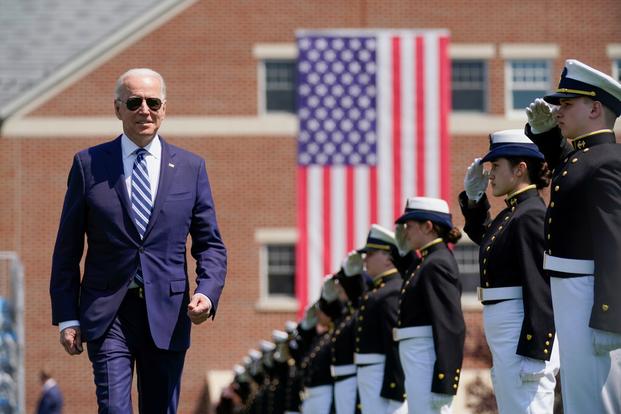
Military.Com reports on the President’s Coast Guard Academy commencement address.


 Chuck Hill's CG Blog
