Thales Acoustic Shot Detector sensor dome mounted on a BAE Systems Pacific 950 Autonomous Rigid Hull Inflatable Boat Photo: Thales.
Naval News reports the availability of a type of sensor I was not even aware of, at least for the maritime environment.
“As far as Thales UK are aware, it is the first acoustic shot detection system that has successfully undertaken a live firing trial on a maritime vessel. Acusonic detects and combines two key sounds associated with incoming hostile fire: the supersonic shockwave of the bullet and the muzzle blast. Unique algorithms in Acusonic’s software then use this data to derive range, bearing and caliber of incoming fire,” said Adrian Rondel of Thales UK.
Certainly in some circumstance, when a vessel takes in coming fire, it may not be clear where the shoots are coming from. Making that determination quickly and accurately could be critical.
Apparently the device can be used even on small craft as seen on an RHIB in the photo above. It is, “…100% protected against solid objects such as dust and sand, and can withstand being submerged for at least 30 minutes in 15 centimeters to 1 meter of water.”
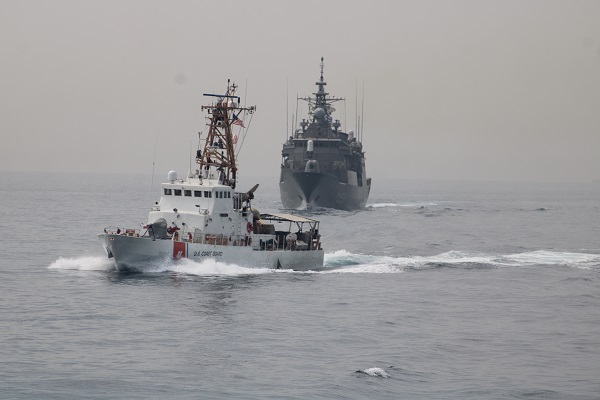
BLACK SEA (April 30, 2021) U.S. Coast Guard members conduct boat and flight procedures on the USCGC Hamilton (WMSL 753) with Turkish naval members aboard the TCG Turgutreis (F 241) in the Black Sea, April 30, 2021. Hamilton is on a deployment in the U.S. Sixth Fleet area of operations in support of U.S. national interests and security in Europe and Africa. (U.S. Coast Guard photo)
Below is a LANTAREA news release. Additional photos here.
News Release U.S. Coast Guard Atlantic Area
USCGC Hamilton (WMSL 753) concludes Black Sea operations
BLACK SEA — The Legend-class national security cutter USCGC Hamilton (WMSL 753) transited from the Black Sea to the Mediterranean Sea, concluding the crew’s recent Black Sea operations and engagements, May 14, 2021.
Hamilton entered the Black Sea on April 27, 2021, in support of NATO Allies and partners. Hamilton is the first U.S. Coast Guard cutter to visit the Black Sea since 2008. The last U.S. Coast Guard cutter to visit the Black Sea, USCGC Dallas (WHEC 716), sailed to the Black Sea twice, in 2008 and 1995.
“Operating in the Black Sea these last few weeks has strengthened our enduring partnerships with regional maritime forces,” said Capt. Timothy Cronin, commanding officer of Hamilton. “Our time in this critical waterway also reinforced our commitment to maintaining freedom of movement in international waters for all nations. The Black Sea is not owned by any one nation; it belongs to the world.”
While in the Black Sea, the crew of Hamilton operated with Black Sea partner navies and coast guards and made two port visits.
Within the first week of arriving in the Black Sea, Hamilton’s operations with the Turkish navy Yavuz-class TCG Turgutreis (F 241) included passing exercises and cross-platform helicopter operations with a Turkish Bell UH-1 Iroquois helicopter and their embarked U.S. Coast Guard MH-65 Dolphin helicopter.
Hamilton conducted exercises with the Georgian coast guard. Hamilton crewmembers executed search and rescue patterns, simulated survivor rescue training, helicopter hoisting evolutions, approaches for towing, and ship communications with the Georgian coast guard vessels Dioskuria (P 25) and Ochamchire (P 23), May 2-3. These maneuvers and operations enhanced the proficiency in specific mission areas familiar to both coast guards.
On May 4, the Hamilton team called on Batumi, Georgia, for engagements with Georgian coast guard leadership and local Georgian representatives. Upon arrival, the crew was greeted with a Georgian demonstration of dancing and singing after conducting the U.S. and Georgian national anthems. The Georgian coast guard and Hamilton also conducted several tours, a dinner, and a five-kilometer run to foster camaraderie.
Hamilton conducted maritime law enforcement, search and rescue, and ship handling operations with Ukrainian navy vessel Island-class patrol boat Starobilsk (P 241) and Ukrainian border guard vessel Kuropiatnikov (BG 50), May 9-10.
These operations increased interoperability as a part of a regional effort to bolster maritime partnerships with NATO Allies and partners. The next day, Hamilton conducted a port visit in Odesa, Ukraine, where the crew conducted maritime law enforcement training with the maritime border guard and exchanged damage control and firefighting expertise with the Ukrainian navy. Hamilton also served as the training platform for the Ukrainian 73rd Special Force Unit to conduct maritime law enforcement training.
The Hamilton crew conducted its final operations in the Black Sea with Romanian Navy Frigate Mărășești (F111) and Bulgarian corvette Bodri (BGS 14) on May 13, 2021. The vessels executed passing and communications exercises and flight operations with the Hamilton’s MH-65 Dolphin helicopter detachment aircrew.
The U.S. Coast Guard is conducting a routine deployment in U.S. Sixth Fleet, working alongside Allies, building maritime domain awareness, and sharing best practices with partner nation navies and coast guards.
Hamilton is the fourth national security cutter and is the fifth named for the father of the U.S. Coast Guard – Alexander Hamilton, the first secretary of the treasury and advocate for creating the U.S. Revenue Cutter Service.
The U.S. Coast Guard remains operational during COVID-19, following all COVID-19 safety precautions and regulations.
U.S. Sixth Fleet, headquartered in Naples, Italy, conducts the full spectrum of joint and naval operations, often in concert with allied and interagency partners, to advance U.S. national interests and security and stability in Europe and Africa.
“The New Zealand Defence Force has issued a request for information on design and build solutions for an eventual ice-strengthened offshore patrol vessel that the Royal New Zealand Navy would operate in the Southern Ocean and Antarctic’s Ross Sea for at least four months per year.”
“The RFI anticipates the ship will be 295-377 feet in length (90 to 115 meters-Chuck), with accommodations for 100 people, including 60 crew members, 30 scientific staff and a military helicopter flight crew of 10. The RFI cautions that the ship will traverse “one of the roughest seas in the world.” Waves in the region regularly exceed 33 feet and some are more than 66 feet high.”
Really sounds like they may be looking at something like Canada’s Arctic Offshore Patrol Ship, but it would require additional accommodations and greater range.
Where will it be built? Not a clue really. New Zealand does not have the shipyard. The latest New Zealand Navy ship, HMNZS Aotearoa, was built in Korea. Their two frigates and two OPVs were built in Australia. Their two frigates recently went through an extensive renovation in Canada. If, as the linked article suggests, either Damen or Fincantieri get the contract, it could be built in Europe, possibly with the basic construction done in Eastern Europe and fitting out completed in Western Europe.
“The two 58 metre patrol boats, TTS Port of Spain (CG41) and TTS Scarborough (CG42), were accepted by Lieutenant Commander Francise Paulette Cazoe of the TTCG, at a delivery ceremony held at Austal Australia’s Henderson shipyard today, attended by Western Australia Minister for Minister for Police: Road Safety; Defence Industry; and Veterans Issues, The Hon Paul Papalia CSC MLA.”
The Cape class is also used by the Australian Navy and Border Force. This is the first export of the class.
My August 2019 post, reporting the order for these vessels, provides specifications and compares them with the Webber class WPCs.
A production focused around the winners of the U.S. Coast Guard 2020 Capt. Niels P. Thomsen Innovation Award at Coast Guard Headquarters, Washington DC, April 30. 2021. Six individuals or teams win the award annually for innovations that pushes the Coast Guard forward. (U.S. Coast Guard video by Petty Officer 2nd Class Ronald Hodges)
Not unexpected. Here is the news release about Hamilton’s operations with the Ukrainian Navy.
U.S. Coast Guard Atlantic Area, news release
USCGC Hamilton conducts exercises with Ukraine
BLACK SEA — Ukrainian navy Island-class patrol boat Starobilsk (P 241) and the Ukrainian Sea Border vessel Kuropiatnikov (BG 50) maneuver in front of USCGC Hamilton (WMSL 753) after conducting communication, passing, and maneuvering exercises in the Black Sea, May 9, 2021. Hamilton is on a routine deployment in the U.S. Sixth Fleet area of operations in support of U.S. national interests and security in Europe and Africa. (U.S. Coast Guard photo by Petty Officer 3rd Class Sydney Phoenix)BLACK SEA — Seaman Solis Headlam looks out to the Ukrainian navy Island-class patrol boat Starobilsk (P 241) aboard USCGC Hamilton (WMSL 753) after conducting communication, passing, and maneuvering exercises in the Black Sea, May 9, 2021. Hamilton is on a routine deployment in the U.S. Sixth Fleet area of operations in support of U.S. national interests and security in Europe and Africa. (U.S. Coast Guard photo by Petty Officer 3rd Class Sydney Phoenix)
BLACK SEA — The Legend-class national security cutter USCGC Hamilton (WMSL 753) conducted a series of operational exercises with Ukraine, May 9, 2021, in the Black Sea.
Hamilton conducted maritime law enforcement, search and rescue, and ship handling operations with the Ukrainian navy vessel Island-class patrol boat Starobilsk (P 241). These operations were designed to increase interoperability as a part of a regional effort to bolster maritime partnerships with NATO partners.
“Hamilton was honored to conduct at-sea operations with the Ukrainian navy,” said Capt. Timothy Cronin, commanding officer of Hamilton, “Because we have shared interests, these events promote our strong partnership in ensuring safe and lawful activity in the Black Sea.”
The U.S. Coast Guard has a long and enduring partnership with regional maritime forces, particularly in strengthening maritime forces in Georgia and Ukraine. Hamilton conducted at sea engagements with the Georgian coast guard and a port visit in Batumi, Georgia, last week.
“This was a great opportunity to interact and share best practices with the Ukrainian navy,” said Petty Officer 2nd Class Jason Dunsavage, Hamilton crew member. “Both of our crews take pride in being professional mariners, and today, we proved that. We look forward to doing it again.”
Hamilton is the first U.S. Coast Guard cutter to visit the Black Sea since 2008. The last U.S. Coast Guard cutter to visit the Black Sea, USCGC Dallas (WHEC 716), sailed to the Black Sea twice, in 2008 and 1995.
Hamilton is the fourth national security cutter and is the fifth cutter named for the father of the U.S. Coast Guard – Alexander Hamilton, the first Secretary of the Treasury and advocate for the creation of the U.S. Revenue Cutter Service.
The U.S. Coast Guard remains operational during COVID-19, following all COVID-19 safety precautions and regulations.
The U.S. Coast Guard is conducting a routine deployment in the U.S. Sixth Fleet area of operations, working alongside NATO Allies and partners, building maritime domain awareness, and sharing best practices with partner nation navies and coast guards.
U.S. Sixth Fleet, headquartered in Naples, Italy, conducts the full spectrum of joint and naval operations, often in concert with allied and interagency partners, to advance U.S. national interests and security and stability in Europe and Africa.
ARABIAN GULF (Feb. 25, 2021) The U.S. Coast Guard cutter USCGC Maui (WPB 1304) and the Greek navy guided-missile frigate HS Hydra (F452) participate in a passing exercise in the Arabian Gulf, Feb. 25, 2021. U.S. Coast Guard Patrol Forces Southwest Asia (PATFORSWA) is comprised of six 110-foot cutters, the Maritime Engagement Team, shore-side support personnel, and is the Coast Guard’s largest unit outside of the U.S. playing a key role in supporting Navy security cooperation, maritime security, and maritime infrastructure protection operations in the U.S. 5th Fleet area of operations. (U.S. Coast Guard photo)
The US Naval Institute news service reports that USCGC Maui twice fired warning shots totaling about 30 rounds of .50 caliber, first as two Iranian Revolutionary Guard boats out of a total of 13, closed to 300 yards and a second time as they continued to approach to about 150 yards.
Guided-missile cruiser USS Monterey (CG-61); patrol ships USS Thunderbolt (PC-12), USS Hurricane (PC-3) and USS Squall (PC-7), and Coast Guard patrol boats, USCGC Wrangell (WPB-1332) and USCGC Maui (WPB-1304) were escorting an Ohio-class guided-missile submarine USS Georgia (SSGN-729). USN helicopters were also overhead.
“The U.S. naval vessels were escorting Georgia as the submarine was transiting on the surface. Two Iranian vessels broke away from the larger group, transited to the opposite side of the U.S. formation, and approached Maui and Squall from behind at a rate of speed in excess of 32 knots with their weapons uncovered and manned,”
USS Georgia was built as a ballistic missile submarine but was converted to carry cruise missiles and support special operations.
It seems likely that the composition of such escort groups will be more heavily weighted with Coast Guard patrol craft as the Navy decommissions their Cyclone class PCs, including the three that participated in this escort and as Webber class WPCs replace the Island class patrol boats like Maui and Wrangell.
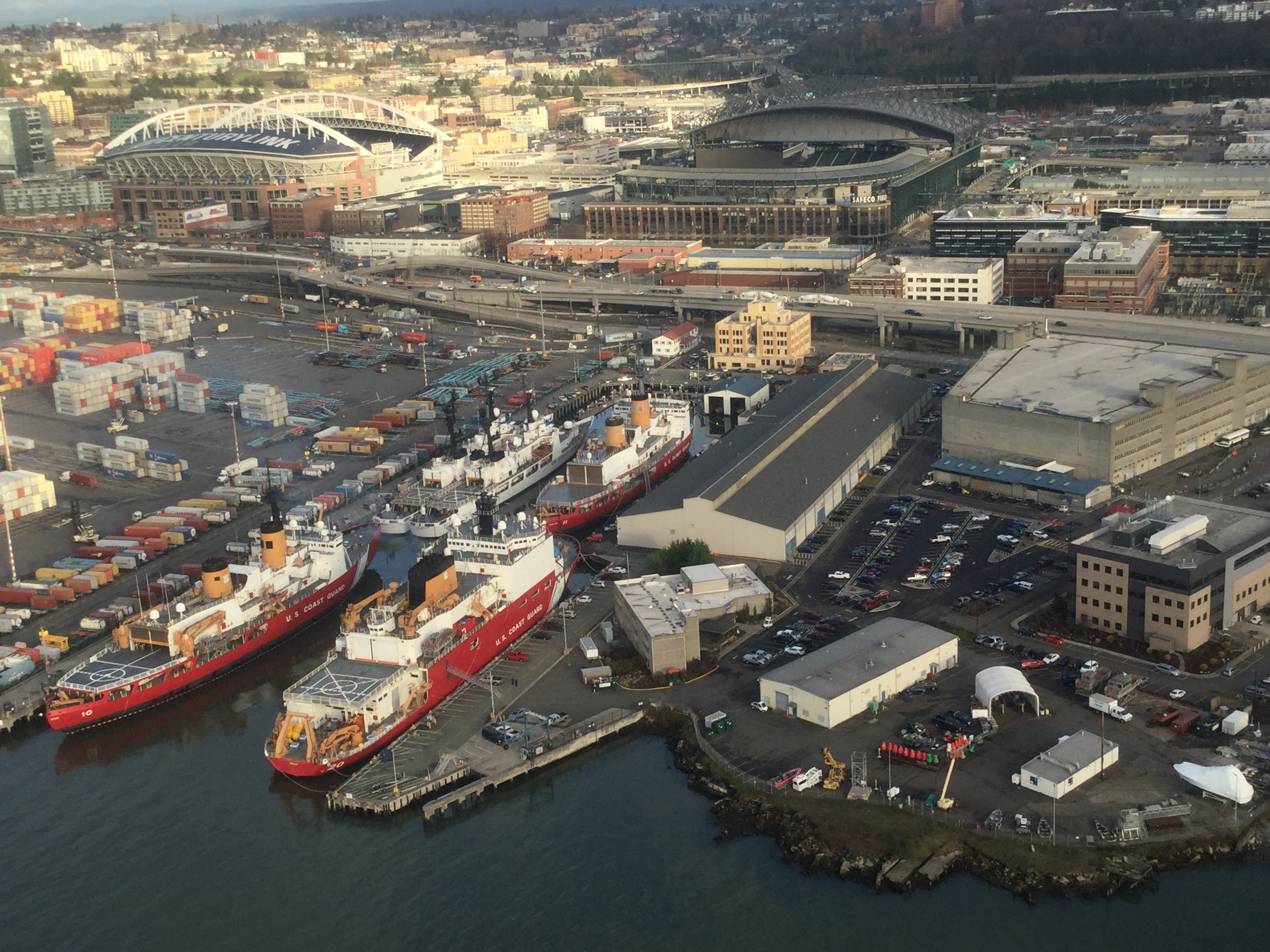
In addition to basing the three currently planned Polar Security Cutters, the proposal refers to basing other cutters as well.
This suggests either the “Arctic Security Cutter” (medium icebreaker) and/or the Offshore Patrol Cutter. The OPC seems most likely, and we may see as many as three based in Seattle. If so, it probably means none in Port Angeles or Warrenton, OR. This would seem to follow the pattern of concentrating ships of a class together to facilitate support and maintenance.
Before the current round of recapitalization, beginning with the Bertholf class National Security Cutters, PACIFIC AREA had 13 large patrol cutters, 10 WHECs and three 210 foot WMECs. Three OPCs in Seattle, along with the two planned for Kodiak, two planned for San Pedro, and six NSCs in Alameda and Honolulu would restore that number.
Given the greater emphasis on the Western Pacific and Arctic, along with the fact that FRCs are performing missions that used to require WMECs, particularly in the 7th and 8th Districts, we might expect the number of large patrol cutters in the Pacific to increase, but the total number is now expected to shrink from 44 (or 42 depending on when you counted) to 36. Still 13 ships would only constitute just over one third of the total fleet. I would feel a lot more comfortable if we had three OPCs each in Kodiak, San Pedro, and Seattle, in addition to the six NSCs for a total of 15 large patrol cutters in PACAREA, and three ships of a class at a base makes good sense for the support point of view. .
Coast Guard Cutter Legare (WMEC 912) patrols in the Caribbean in April 2021. The cutter was deployed in support of Operation Unified Resolve/Martillo under the tactical control of Joint Interagency Task Force South (JIATF-S) and the Seventh Coast Guard District. (U.S. Coast Guard courtesy photo)
“While on patrol, the Legare provided surface support to Coast Guard MH-60 Jayhawk helicopters that were forward-deployed to Air Station Borinquen, which specialize in airborne interdiction tactics. With the combined efforts of JIATF-S and allied nation assets, the Legare disrupted over $23.5 million dollars in contraband while patrolling known smuggling routes south of the Dominican Republic.”
This may be in response to difficulties keeping H-65s operational. The 270s were always supposed to able to operate H-60s and the Coast Guard has recently added the tail fold feature to some H-60s that will make them easier to hangar. It is not clear if the MH-60 was hangared or if it even operated off Lagare.
Comments from those who may know would be welcomed.





 Chuck Hill's CG Blog