This Day in Coast Guard History, June 8

Based on the Coast Guard Historian’s timeline, https://www.history.uscg.mil/research/chronology/
With inspiration from Mike Kelso

June 8

1882  The sloop-rigged yacht Circe, of Cleveland, was dismasted at 1 o’clock in the afternoon about a mile outside of Cleveland Harbor.  The crew of Station No. 8, Ninth District (Cleveland), discovered the accident and towed her safely into the harbor.

On 8 June 1973, OCS Class 2-73 graduated from their training at Yorktown, Virginia.
The entire class was twenty-nine strong. In their ranks at graduation for the first time were five women. One of those women graduates was Margaret R. Riley. During
her thirty-year career CAPT Riley served as the Executive Officer of the Integrated
Support Command, Boston, Massachusetts and was later assigned to the Coast
Guard Headquarters in Washington, DC. She also served as the Commanding Officer
of the Supply Center, Baltimore, Maryland; and the Commanding Officer of the
Integrated Support Command, Boston and retired in 2003 as Director of the
Leadership Development Center at the U.S. Coast Guard Academy in New London,
Connecticut. CAPT Riley died in January 2008 following a long illness.

1973  The first women since World War II graduated from the Reserve Officer Candidate Program (OCS) and were commissioned ensigns.  They trained aboard CGC Unimak for a two-week cruise, thereby becoming the first women to see service afloat.

USCGC Unimak (WHEC-379) underway, 8 June 1987. US Coast Guard photo


This Day in Coast Guard History, June 7

Based on the Coast Guard Historian’s timeline, https://www.history.uscg.mil/research/chronology/
With inspiration from Mike Kelso

June 7

1902  The Alaskan Game Law was  passed and it was to be enforced by the Revenue Cutter Service “on request” of the Secretary of Agriculture.  It was not effectively enforced by Coast Guard until 1925, however.

1924  Congress passed the Oil Pollution Act and the enforcement responsibility was assigned to the Coast Guard.

An over-the-horizon-IV cutter boat from Coast Guard Cutter Valiant transports people and their
belongings from St. Thomas to the cutter during Hurricane Irma relief efforts in the U.S. Virgin Islands Sept. 12, 2017. Valiant crewmembers transported more than 95 adults, children and pets that day. U.S. Coast Guard photo

2011  The Coast Guard awarded four firm fixed-price production contracts to deliver the first test boats for the seven-meter Cutter Boat Over-The-Horizon-IV (CB-OTH-IV) project.  The contracts were awarded to MetalCraft Marine U.S. (Clayton, New York), SAFE Boats International (Port Orchard, Washington), Silver Ships, Inc. (Theodore, Alabama), and William E. Munson Company (Burlington, Washington).  The Coast Guard planned to acquire up to 71 seven-meter CB-OTH-IVs.  The acquisition also included up to 20 boats for Customs and Border Protection and 10 boats for the U.S. Navy, for a total of up to 101 boats.  SAFE Boats won the competition.

“Lawmakers decry DHS secretary’s push to slash Coast Guard infrastructure budget by 90%” –Stars and Stripes

State of Coast Guard shore side Infrastructure FY2023

Stars and Stripes reports,

Kristi Noem, the secretary of the Department of Homeland Security, wants to slash the Coast Guard’s shore infrastructure budget by 90% … Noem has proposed $21 million for fiscal 2026, which begins Oct. 1, to repair and maintain the Coast Guard’s shore infrastructure — a fraction of the more than $400 million that the service received in 2024. But a federal watchdog reported in March that the Coast Guard would need at least $7 billion to fix its shore infrastructure, which includes family housing and barracks, boat stations, piers, lighthouses, firing ranges, airfields, and Coast Guard shipyards.

Read more at: https://www.stripes.com/branches/coast_guard/2025-06-05/coast-guard-budget-noem-18023552.html
Source – Stars and Stripes

You can see the GAO report referenced in the article here.

Thanks to MikeB for bringing this to my attention. 

Construction on OPCs #3 and #4 Suspended

Maritime Executive reports,

The U.S. Coast Guard, which has been struggling with its new ship efforts, has reportedly placed a temporary stop work order on two cutters under construction in its Heritage-class Offshore Patrol Class. Reports of the pause come a day after the Department of Homeland Security announced it had canceled a contract for another cutter in its Legend-class national security cutter and the Department has promised to overhaul the operations of the USCG under its Force Design 2028 project.

News of the pause was reported by Defense Daily which wrote that work on the third and fourth vessels underway at Eastern Shipbuilding is being delayed as issues regarding funding and delays in the timing of the program are underway. Work on the third cutter, to be named, Ingham, has been underway since mid-2022 when the keel was laid, and steel cutting is underway for number four, USCG Rush.

We have noted already that Eastern seems to have had problem. Note, at this point, this is not a cancellation as happens with NSC#11 yesterday. But it looks like it may be a prelude to negotiations that may lead to cancellation, in that it puts these two ships into a status similar to that of NSC#11 prior to the cancellation.

Thanks to Andy for bringing this to my attention.

This Day in Coast Guard History, June 6

Based on the Coast Guard Historian’s timeline, https://www.history.uscg.mil/research/chronology/
With inspiration from Mike Kelso

June 6

1900  Secretary of the Treasury was authorized to establish anchorage grounds at Kennebec River, Maine.

U.S. Revenue Service cutter Manning, crowded with Kodiak residents seeking safety during the 1912 eruption of Novarupta, which resulted in about a foot of ashfall on Kodiak over nearly three days. The photograph was published in Griggs, 1922, and was taken by J.F. Hahn, U.S.R.S.

1912  The Novarupta-Katmai Volcano erupted near Kodiak, Alaska, from June 6-9, 1912.  Revenue Cutter Manning and other cutters as well as personnel assisted in relief efforts, including providing fresh water to the inhabitants of Kodiak, distributing relief supplies, and building a new village for the displaced inhabitants.  The new village was named Perry after the commanding officer of Manning, Revenue Captain K. W. Perry, USRCS.  Captain Perry also established a refugee camp for persons displaced by the falling ash.

Photo by J. B. Weed from the collection of Arthur Heinickle

US Coast Guard 83-foot rescue boat CGC-16 transferring wounded troops to USS Joseph T. Dickman APA-13 off of Normandy France at 0930 local time on D-Day – June 6, 1944
One account;
“The relatively small cutter could only hold about 20 wounded men at a time, and double that number were often taken aboard. But in one instance, 140 men shared 1,000 square feet. Casualties and unwounded survivors crammed the forecastle, pilot house, and engine room, and those incapable of going below lined the deck topside, side by side. Walking wounded were jammed into the tiny crew’s quarters and piled into bunks in three tiers of four.”
LIFE Magazine Archives – Ralph Morse Photographer

1944  Nearly 100 Coast Guard cutters, Coast Guard-manned warships and landing craft participated in the invasion of Nazi-occupied Europe at Normandy, France.  The Coast Guard-manned landing craft LCI(L)s-85, 91, 92, and 93 were lost at the Omaha beachhead that day.  Sixty cutters sailed in support of the invasion forces as well, acting as search and rescue craft for each of the five landing beaches.  A Coast Guard manned assault transport, the USS Bayfield, served as the command and control vessel for the landings at Utah Beach.  Coast Guard officers commanded one of the assault groups that landed troops on Omaha Beach that morning.

A convoy of Landing Craft Infantry (Large) sails across the English Channel toward the Normandy Invasion beaches on D-Day, 6 June 1944. Each of these landing craft is towing a barrage balloon for protection against low-flying German aircraft. Among the LCI(L)s present are: LCI(L)-56, at far left; LCI(L)-325; and LCI(L)-4. Photograph from the U.S. Coast Guard Collection in the U.S. National Archives.

LCI(L) 85 shortly before she sank, D-Day, 6 June 1944.

LCI-93 Omah beach

1945  Coast Guard-manned USS Sheepscot (AOG-24) went aground and was lost off Iwo Jima. No lives were lost.

USS Sheepscot (AOG-24) under way, August 1944, location unknown. Sheepscot is painted camouflage scheme 32/8AO.
US Navy photo

1977  Coast Guard recruiting officers were directed to advise all women applicants that women were “now subject to possible assignments to sea and isolated duty.  In line with this change in policy, all women enlisted personnel who are approaching reenlistment, and all women officers reaching three years of service before an extension/integration board, should be aware that they too will be subject to unrestricted assignments to sea and isolated duty as the needs of the Coast Guard require,” according to a Coast Guard official announcement.

USCGC Polar Sea

1985  CGC Polar Sea departed Seattle for a voyage through the Northwest Passage by way of the Panama Canal, the east coast, and then Greenland, sparking an international incident with Canada.  She completed the first solo circumnavigation of the North American continent by a U.S. vessel and the first trip by a Polar-Class icebreaker.  She also captured the record for the fastest transit of the historic northern route.  She arrived back in Seattle on October 27, 1985.

Golden Venture

1993  The 150-foot tramp steamer Golden Venture ran aground on Rockaway beach in New York with some 300 illegal Chinese migrants on board.  Ten drowned or died of hypothermia, six vanished, and the rest were rescued by the Coast Guard and local agencies.

An over-the-horizon-IV cutter boat from Coast Guard Cutter Valiant transports people and their
belongings from St. Thomas to the cutter during Hurricane Irma relief efforts in the U.S. Virgin Islands Sept. 12, 2017. Valiant crewmembers transported more than 95 adults, children and pets that day. U.S. Coast Guard photo

2013  The Coast Guard today placed an order for sixteen Cutter Boat-Over the Horizon-IVs (CB-OTH-IV) and associated parts and logistics information from SAFE Boats International LLC of Bremerton, Washington.

Coast Guard Air Station Barbers Point aircrews conduct flight formations in the soon to be retired HC-130H Hercules airplane. The HC-130H model has been assigned to the unit since 1959 and is being replaced by the HC-130J model. (U.S. Coast Guard photo by Lt. Cmdr. Scott Handlin)

2023  A Coast Guard team from AIRSTA Barbers Point returned from a mission supporting storm relief efforts on Guam following Typhoon Mawar. CG District 14 reported 31 Coast Guard personnel out of AIRSTA Barbers Point, supported by three aircraft, clocked 97.3 hours of flight time, transported 396,231 pounds of cargo and 169 passengers. During their relief efforts the team completed 19 “vital missions” across 33 sorties. A major task for the Barbers Point team was delivering supplies to Rota, an island of about 1,890 people in the Commonwealth of the Northern Mariana Islands — a U.S. territory neighboring Guam that was also hit by the typhoon.

National Security Cutter #11 Cancelled

USCGC Calhoun (NSC#10) arrives Charleston.

Below the line is a news release from the Department of Homeland Security. I have to admit I did not see this coming.

Huntington Ingalls Industries reported they had begun construction May 11, 2021. That was four years ago. Four years is typically about how long it takes to build a ship.

Maritime Executive reports, “construction of the 11th ship had been halted since at least November 2024 with the ship 15 percent complete.” Delivery had been expected in 2024.

The entire program has been slow. One ship was commissioned in 2008, one in 2010, one in 2012, one in 2014, one in 2015, one in 2017, two in 2019, one in 2021, but then CALHOUN was not commissioned until 2024. A three year gap in what was presumably a mature program, what happened? I had heard the National Security Cutters may have had some problems, but the only specific I had heard is that they had cooling problems maintaining maximum speed if the sea temperature was too high.

US Naval Institute News notes that existing National Security Cutters have had problems with parts shortage, “Ingalls spokeswoman Kimberly Aguillard told USNI News in a Thursday statement. ‘In mutual agreement with the USCG, we have signed a contract modification that identifies an alternate strategy related to the sunsetting of the NSC program, which has already exceeded the original acquisition objective of eight ships. Rather than proceeding with construction of the eleventh ship of the NSC class, we have agreed to execute a plan that maximizes readiness of the existing NSC fleet, by supporting overall operational availability and capability of the first ten NSCs in service.’”

Obviously this is the final nail in the coffin for any hope of NSC#12.

What does this move mean for the OPC program which actually seems to have had more problems than the NSC program? The construction contract for the first OPC was issued September 2018 and delivery was expected 2021. It has been 20 months since the future USCGC Argus was launched but still not only no delivery, no pictures of the ship underway, Also no reports of progress on the other three ships Eastern was contracted to build.


Secretary Noem Saves American Taxpayers Hundreds of Millions by Negotiating New Contract for the Coast Guard

Release Date: June 5, 2025

DHS is revolutionizing national security while saving the taxpayer over $260 million

WASHINGTON – Department of Homeland Security Secretary Kristi Noem announced that she successfully saved the American taxpayer over $260 million by cancelling a failing U.S. Coast Guard (USCG) shipbuilding project.

Shipbuilding company Huntington Ingalls (HII) began production of a Legend-class National Security Cutter (NSC) in May 2021. It was supposed to be delivered by 2024 at the latest but is still nowhere near complete.

This is about fulfilling President Trump’s commitment to the American taxpayer,” said Secretary Noem. “Huntington Ingalls owed us this cutter over a year ago. As the Trump administration is revitalizing the U.S. Coast Guard through Force Design 2028, we need to be smart with the American taxpayer’s money. This project was over time and over budget. Now the money can be redirected to ensuring the Coast Guard remains the finest, most-capable maritime service in the world. I would like to extend my thanks to Huntington Ingalls for negotiating in good faith.”

In addition to returning over $260 million to the U.S. Treasury, the Coast Guard will receive $135 million in parts that will be used to retrofit, upgrade, and maintain the Coast Guard’s existing fleet of 10 Legend-class cutters. By cancelling the production of NSC #11 and securing the parts deal with HII, Secretary Noem has ensured that the Treasury will recoup the remaining funds for use where they are most needed.

This Day in Coast Guard History, June 5

Based on the Coast Guard Historian’s timeline, https://www.history.uscg.mil/research/chronology/
With inspiration from Mike Kelso

June 5

1794  The Third Congress authorized an additional 10 revenue cutters and gave the Treasury Department the responsibility for lighthouses, beacons, buoys, and piers.

1912  Senator Charles E. Townsend of Michigan introduced a bill to consolidate Life-Saving Service and Revenue Cutter Service to form the Coast Guard.  The bill became law on January 28, 1915.

Thomasania Montgomery

1975  ENS Thomasania Montgomery and ENS Linda Rodriguez graduated from Coast Guard Officer Candidate School, Yorktown, VA, thereby becoming the first African-American female commissioned officers in the Coast Guard.

“USCGC Storis departs on maiden voyage” –USCG News

Pascagoula, MISS – The U.S. Coast Guard Cutter Storis is shown here from a top view while underway, June 3, 2025. The Storis is the Coast Guard’s first new polar icebreaker acquisition in 25 years and will expand U.S. operational presence in the Artic Ocean. Photos courtesy of Edison Chouest Offshore.

Below is a USCG news release. There are a couple of interesting details in this release.

First the statement that, “Storis is commanded by Capt. Keith M. Ropella who currently serves as chief of cutter forces at Coast Guard Headquarters in Washington D.C….” This seems to suggest that Captain Rosella is commanding a ship from his desk in CG HQ. I have heard of something similar, the CO of the CG Yard is nominally CO of the cutters that are stored at the Yard that are “in commission, special.”

Second, “The vessel is manned with a hybrid crew consisting of military cuttermen and civilian mariners.” I don’t know if the Coast Guard has ever done this, but this seems to similar to the way the Navy mans their Expeditionary Sea Base (ESB) ships. Will Storis normally be manned this way?

I have a complaint about this news release. The opening paragraph says, “The U.S. Coast Guard Cutter Storis (WAGB 21)…departed on its maiden voyage to safeguard U.S. sovereign interests in the Arctic and conduct Coast Guard missions.” It departed Pascagoula Mississippi; I don’t think it is going to the Arctic. I think it is in transit to Seattle.  Why didn’t they just say that? That would explain the unusual command and manning or is the Coast Guard going to depart from its usual operating procedures?


June 4, 2025

USCGC Storis departs on maiden voyage

PASCAGOULA, Mississippi – The U.S. Coast Guard Cutter Storis (WAGB 21), the Coast Guard’s first polar icebreaker acquired in more than 25 years, departed on its maiden voyage to safeguard U.S. sovereign interests in the Arctic and conduct Coast Guard missions.

Storis’ departure marks an early milestone in the Service’s transformation through Force Design 2028 (FD2028), which includes reforming Coast Guard acquisitions to rapidly deploy capabilities to execute the Coast Guard’s missions.

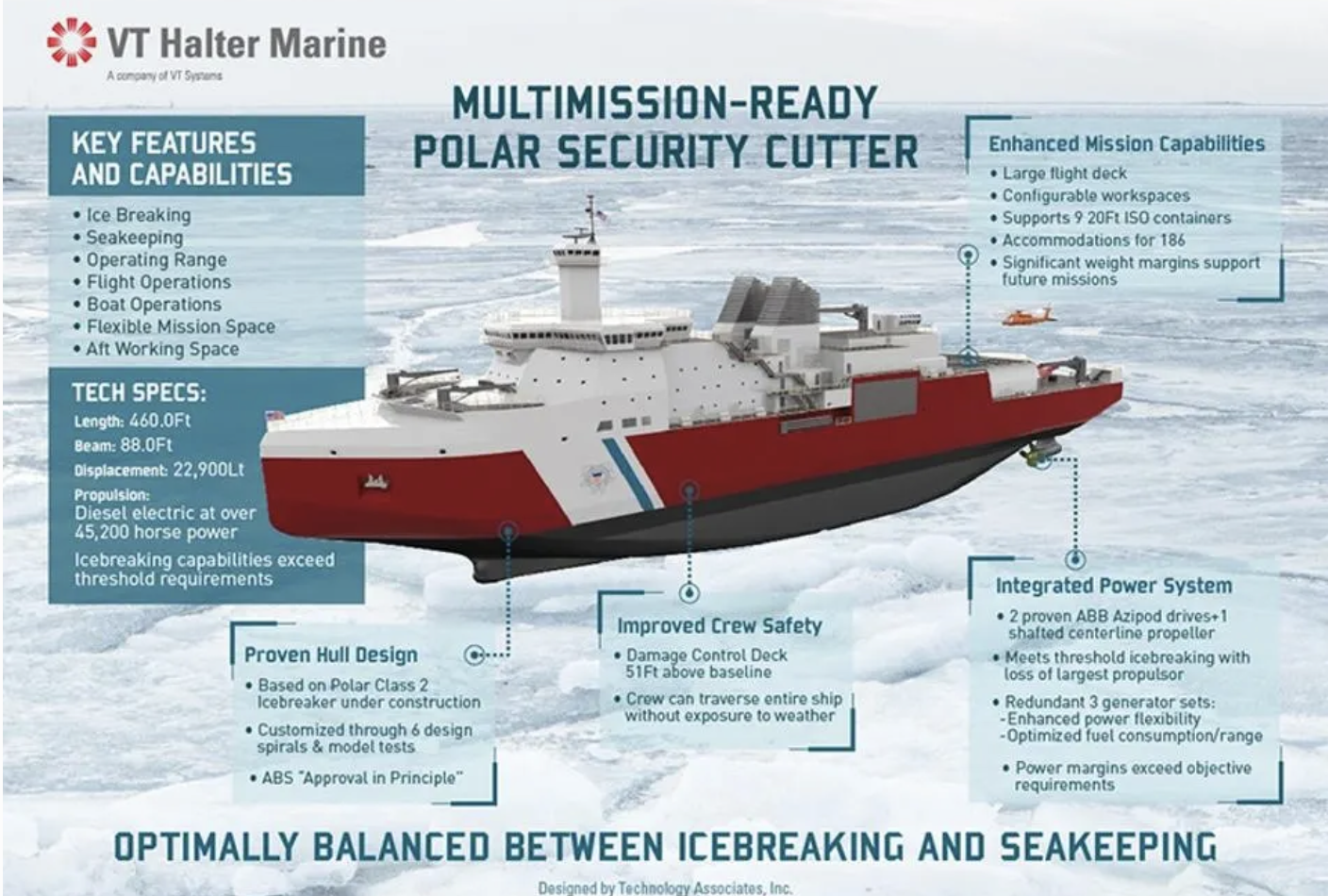
The motor vessel Aiviq, acquired Dec. 20, 2024, from an Edison Chouest Offshore subsidiary, was renamed Storis following modifications to enhance communications and self-defense capabilities. The vessel will expand U.S. operational presence in the Arctic and support Coast Guard missions while the service awaits the delivery of the Polar Security Cutter (PSC) class. The Coast Guard will continue evaluating the cutter’s condition and requirements to achieve full operational capability.

Storis is commanded by Capt. Keith M. Ropella who currently serves as chief of cutter forces at Coast Guard Headquarters in Washington D.C., and previously commanded Coast Guard Cutter Polar Star (WAGB 10), from July 2022 to July 2024.

The vessel is manned with a hybrid crew consisting of military cuttermen and civilian mariners. This is the second vessel in Coast Guard history to bear the name Storis. The original Storis, known as the “Galloping Ghost of the Alaskan Coast,” had a storied history conducting 64 years of icebreaking operations in Alaska and the Arctic before being decommissioned in 2007.

Storis will be commissioned this August in Juneau, Alaska, which will eventually be the vessel’s permanent homeport. Until the necessary shore infrastructure improvements are completed in Juneau, Storis will be temporarily berthed in Seattle, Washington, with the Service’s two other polar icebreakers.

The acquisition was made possible through the Don Young Coast Guard Authorization Act of 2022 and fiscal year 2024 appropriations. It does not affect the ongoing procurement of PSCs and is not part of the PSC program of record.

The Coast Guard operates the United States’ fleet of icebreakers to assure access to the polar regions to protect U.S. sovereignty. To fulfill this mission and meet operational needs in the polar regions, the Coast Guard requires a fleet of eight to nine polar icebreakers. In support of the President’s intent to acquire at least 40 new icebreakers, the Coast Guard is working to replace, modernize and grow its aging fleet of icebreakers, which currently includes 3 polar icebreakers, 21 domestic icebreakers and 16 ice-capable buoy tenders. As the United States’ third polar icebreaker, Storis will provide near-term operational presence and support national security as a bridging strategy until the full complement of PSCs is delivered.

Announced by Secretary of Homeland Security Kristi Noem on May 21, FD 2028 is a blueprint to transform the Coast Guard into a stronger, more ready and capable fighting force. This initiative will include campaigns focused on people, organization, contracting and acquisition, and technology. You can read more about FD 2028 here: Force Design 2028.

This Day in Coast Guard History, June 4

Based on the Coast Guard Historian’s timeline, https://www.history.uscg.mil/research/chronology/
With inspiration from Mike Kelso

June 4

USS Asterion bow after collision with SS Kokoku Maru

1963  USS Asterion and SS Kokoku Maru collided in a heavy fog 40 miles west of San Francisco, killing one crewman of the latter ship and injuring three others. The Coast Guard cutters Magnolia, Comanche, Avoyel, and patrol boat CG-95311, as well as two commercial tugs, converged on the scene.  Comanche and Magnolia successfully removed all 43 survivors from the disabled Kokoku Maru, all of whom were subsequently delivered safely ashore. Although Asterion was able to proceed under its own power, the Japanese ship had to be towed by the commercial tugs to San Francisco.  When the bilge pumps on one of the tugs failed, Coast Guard aircraft dropped emergency pumping equipment to control the flooding.  The two tugs then successfully towed the Kokoku Maru into San Francisco harbor.

USCGC Avoyel (WMEC-150) passing Naval Station Treasure Island and Yerba Buena Island while out bound from San Francisco Bay heading back to her homeport of Eureka, CA. Bay in 1959.

USCGC Comanche (WMEC-202) underway in San Francisco Bay, 16 November 1971.
US Coast Guard photos.

USCG ELD,Explosives Loading Detachment, Vietnam

1966  Coast Guard Explosive Loading Detachments (ELDs) 1 & 2 arrived in South Vietnam and were assigned to U.S. Army logistics commands.

The Coast Guard Cutter Dependable sits moored to the pier during a Heritage Recognition Ceremony in Virginia Beach, Virginia, April 9, 2024. The Heritage Recognition Ceremony celebrated the Dependable, its current and past crew members, and its accomplishments, before it was placed in commission, special status. (U.S. Coast Guard photo by Senior Chief Petty Officer Nick Ameen)

2023 CGC Dependable (WMEC 626) returned to its home port in Virginia Beach on Sunday, 4 June 2023, following a 42-day patrol in the Florida Straits and Windward Passage. Dependable’s crew contributed to the interdiction, care and repatriation of over 300 migrants while patrolling the Seventh Coast Guard District’s area of responsibility in support of Operation Vigilant Sentry and Homeland Security Taskforce — Southeast. While operating in the Florida Straits, Dependable was supported by multiple Coast Guard air assets to interdict two known drug smugglers in the vicinity of the Old Bahama Channel. Dependable’s small boat crew stopped the vessel and embarked the smugglers. Over 1,100 pounds of contraband was recovered, making this the first drug bust for the cutter in more than three years. Throughout the patrol, Dependable also collaborated with numerous other Coast Guard and partner assets, including a Coast Guard Law Enforcement Detachment embarked on the Navy ship USS Little Rock. “The crew has been training to conduct migrant interdiction operations since July 2022,” said LCDR Dana Prefer, Dependable’s executive officer. “In preparation for the recent uptick in maritime migration ventures, we worked hard to qualify over 50 crew members to provide security and care for the migrants embarked aboard the cutter. All the training and preparation paid off as it was truly a team effort to interdict, process, and care for the well-being of migrants throughout our patrol.”

This Day in Coast Guard History, June 2 / 3

Based on the Coast Guard Historian’s timeline, https://www.history.uscg.mil/research/chronology/
With inspiration from Mike Kelso

June 2

1882  At 1600 in the afternoon of 2 June 1882 a young man named John Kramer, twenty-two years of age, fell off the harbor pier at Kenosha, Wisconsin, while fishing. His cries for help were heard by Surfman Mahoney of Station 13, Eleventh District, who ran to his aid and found him clinging to the pier, but just on the point of letting go, being unable to maintain his hold longer. The stout surfman had a hard time to get him up on the pier, which was six feet high from the water, but stuck to the work and succeeded, saving the young man’s life.

June 3

1882  At 8 in the morning, the three-masted schooner J.P. Decamdres, bound for Milwaukee with a cargo of cord-wood and railroad ties, stranded about one mile north of the life-saving station at the entrance to Milwaukee Harbor (No. 15, Eleventh District) and became a total wreck.  Her crew of six men and a passenger were rescued by the lifesaving crew.

“Convoy WS-12: A Vought SB2U Vindicator scout bomber from USS Ranger (CV-4) flies anti-submarine patrol over the convoy, while it was en route to Cape Town, South Africa, 27 November 1941. The convoy appears to be making a formation turn from column to line abreast. Two-stack transports in the first row are USS West Point (AP-23) — left –; USS Mount Vernon (AP-22) and USS Wakefield (AP-21). Heavy cruisers, on the right side of the first row and middle of the second, are USS Vincennes (CA-44) and USS Quincy (CA-39). Single-stack transports in the second row are USS Leonard Wood (AP-25) and USS Joseph T. Dickman (AP-26).”

1941  President Franklin D. Roosevelt signed an executive order making 2,100 US Coast Guard officers and men available to man four transports, USS Leonard Wood, Hunter Liggett, Joseph T. Dickman, and Wakefield, along with 22 other ships manned by US Navy personnel.

US Coast Guard manned Attack Transport USS Leonard Wood (APA-12) underway 28 April 1944. Source Robert Hurst

USS Hunter Liggett (APA-14) c1944

USS Joseph T. Dickman (APA-13) underway in April 1942. Her camouflage is Measure 32R.
US Navy photo #: NH 99278 from the collections of the Naval Historand Heritage Command, courtesy Shipscribe.com.

The U.S. Navy troop transport USS Wakefield (AP-21) off the Boston Naval Shipyard, Massachusetts (USA), in March 1944. Wakefield had been completely rebuilt at Boston after a large onboard fire in September 1942.

1982  USS Farragut towed two vessels seized by the Coast Guard to San Juan, Puerto Rico, marking the first time that a Navy ship took an active role in law enforcement and the interdiction of drug smuggling in the Caribbean.

The U.S. Navy guided missile destroyer USS Farragut (DDG-37) underway in the Atlantic Ocean on 2 July 1982.