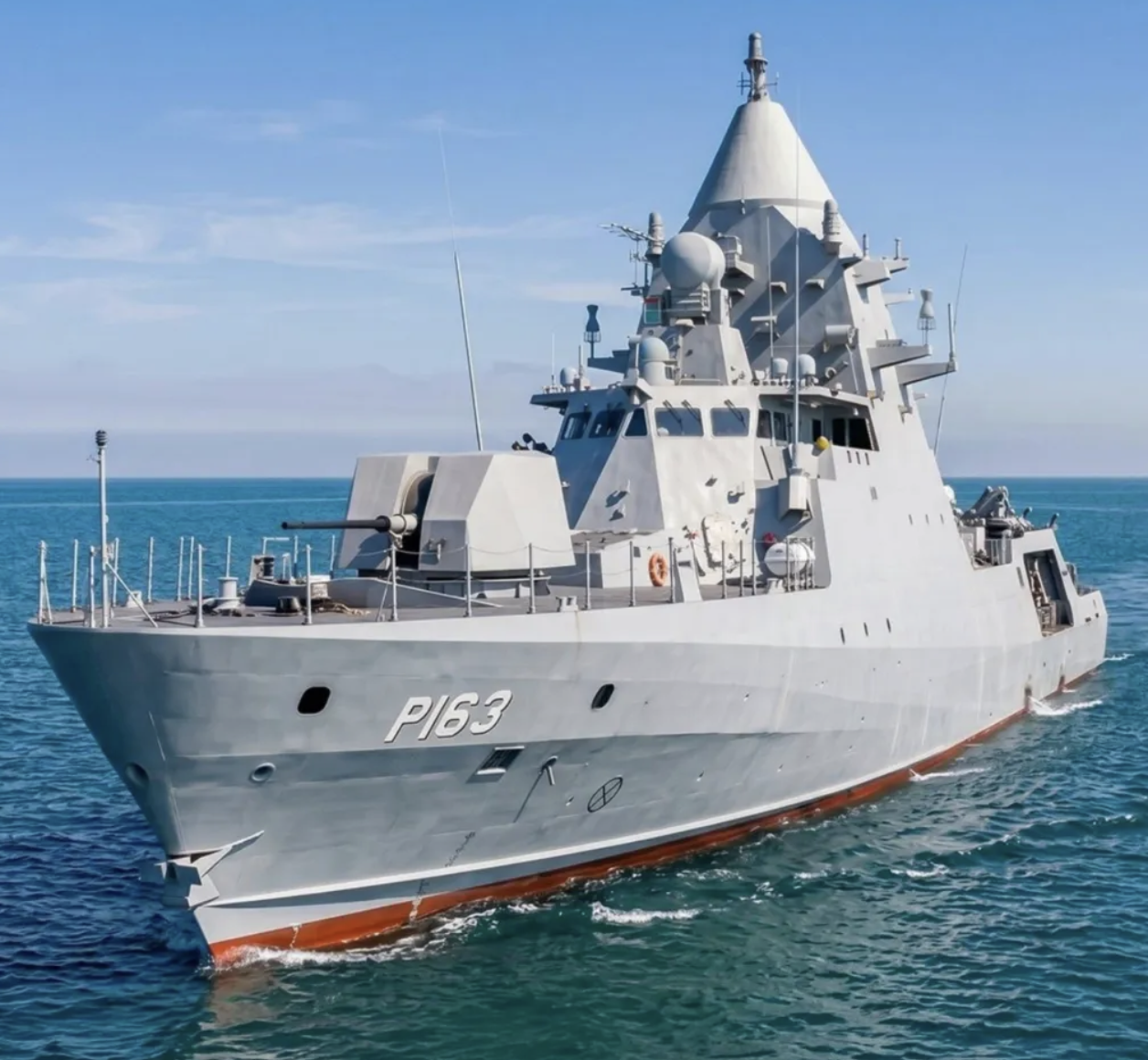
United Arab Emirates’ Falaj 3 offshore patrol vessel underway. Edge Group
TWZ (The War Zone) reports on the first of four of the United Arab Emirates’ Falaj 3 or Altaf class of “Offshore Patrol Vessels,” noting “…at around 670 tons full load displacement, and a crew of just 39, it may be one of the most heavily armed warships anywhere in the world for its size.”
Installed systems include:
- Leonardo 76mm OTO Super Rapid gun equipped with the STRALES guided ammunition system
- eight-cell vertical launch system loaded with MBDA VL MICA surface-to-air missiles
- 21-cell Raytheon Mk 49 launcher for the RIM-116 Rolling Airframe Missile (RAM)
- four MM40 Exocet Block 3C anti-ship missiles
- two 12-cell Low-cost Guided Imaging Rocket (LOGIR) guided rocket launchers
- two Electro Optic Systems (EOS) R400-M 30mm remote weapon stations
They lack ASW and aviation facilities.
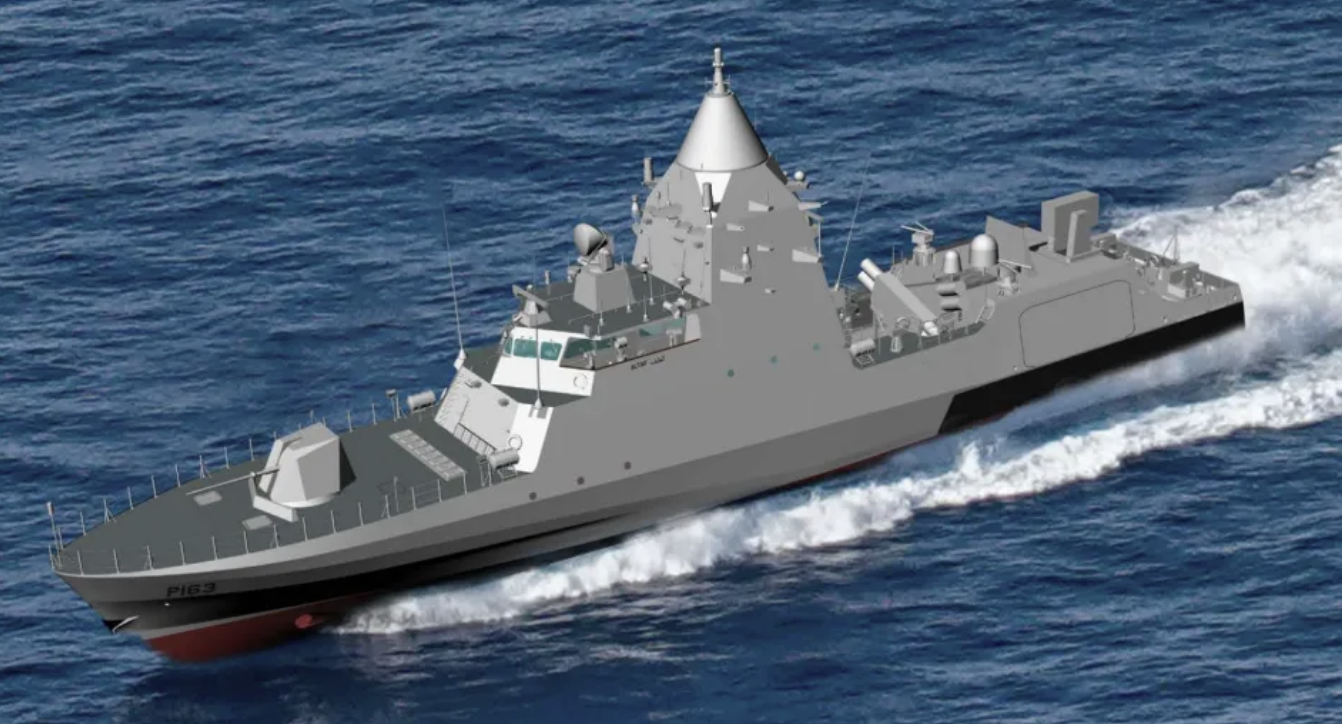
A rendering of the Falaj 3 reveals the locations of the various weapons and sensors. Edge Group
Since these are nominally Offshore Patrol Vessels, what immediately jumps out for a Coast Guard reader is that this little ship has four missile systems: VL MICA, RIM-116 RAM, MM40 Exocet, and LOGIR. All four can be used against surface targets and three systems have at least some AAW capability in addition to the capability of the 76 and 30 mm guns.
The UAE is in a rough neighborhood. Dubai is only 150 kms (81 nautical miles) from Iran. The UAE has been targeted by Iran in the current conflict. They have a lot of incentive to be prepared to deal with swarming unmanned air and surface craft. (Fear of death focuses the mind wonderfully.)
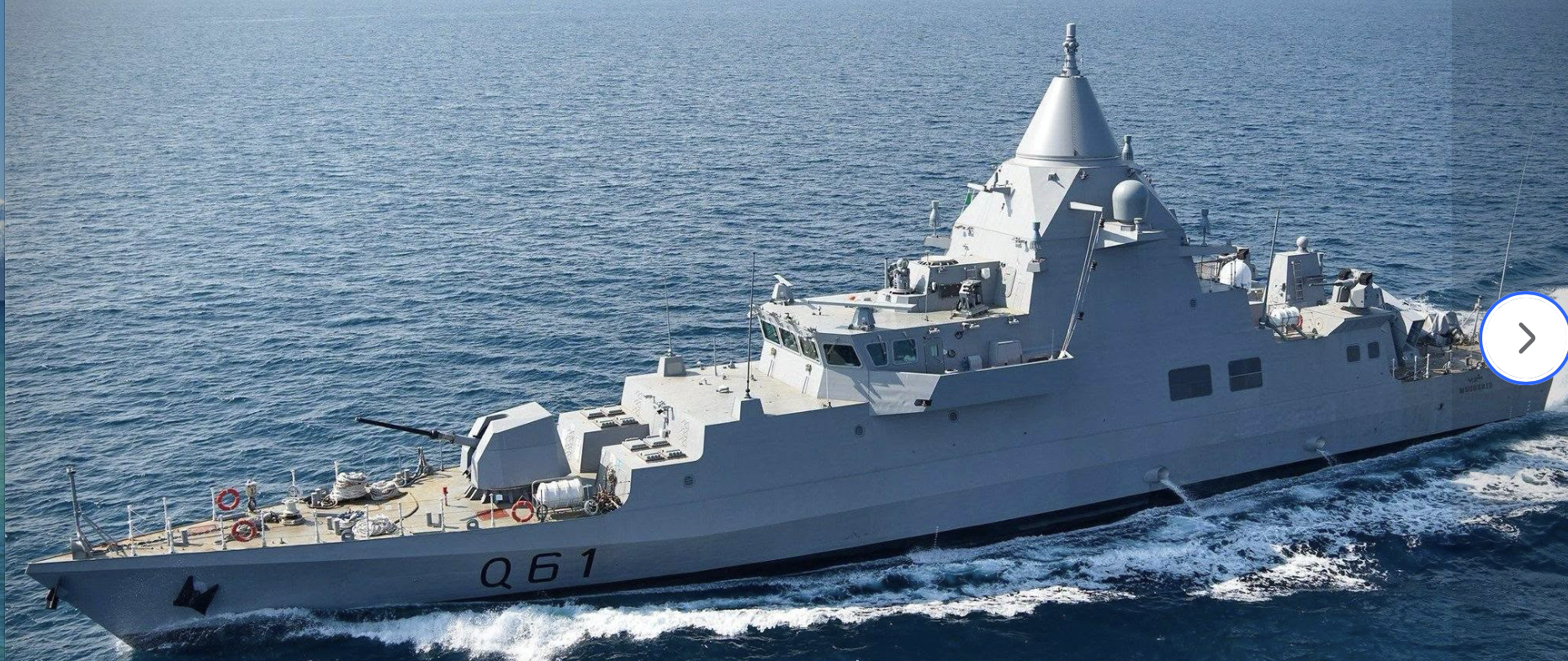
Musherib-class OPV Qatar
UAE’s neighbor, Qatar, sees a similar environment and came up with a similar ship, the Musherib-class OPVs of the Qatari Emiri Navy. Both are slightly shorter and much lighter than a WMEC210. The Musherib class is armed with:
Being hemmed in by its neighbors, UAE’s waters and EEZ are only about one ninetieth of that of the US. This means they don’t need the range or seakeeping of most Offshore Patrol Vessels and in fact this ship has less range than the Webber class WPCs (2000 miles vs 2500. Range of the Musherib class is even less, only 1500 miles).
These are not really large enough to be considered full fledged Offshore Patrol Vessels. You certainly would not want to send one to patrol the Bering Sea. They are tailored for their unique environment, but really I think they may have gotten the anti-air and anti-surface armament right and it would certainly fit on a larger ship.
They have a high probability of success against unmanned aircraft and surface vessels. The two 12-cell Low-cost Guided Imaging Rocket (LOGIR) (similar to APKWS) guided rocket launchers combined with the 21 round RAM launcher and the eight VL MICA provide a deep ready magazine against unmanned systems. These ships could probably forcibly stop even a large merchant ships, although it might require throwing every thing they have at it. You might think the four Exocets would be enough, but the Tanker War demonstrated that, tankers particularly, are very hard to stop unless you can target the propulsion.
For the Coast Guard in peacetime, I see a shortfall in the ability to deal with terrorists using UAVs, USV, or merchant ships. 30mm guns capable of firing air burst ammunition and APKWS appear to be relatively simple, economical counters.
APKWS has become the go-to-system for shooting down UAS economically.
25 mm Mk38 mounts could be upgraded with the Mk44 Bushmaster II firing the 30 ×173mm round.
“The Mk44 Bushmaster II is a 30 mm chain gun manufactured by Northrop Grumman. It is a derivative of the 25 mm M242 Bushmaster, and uses 70% of the same parts as the M242 while increasing the firepower by as much as 50% with the 20% increase in caliber size. The barrel is chromium-plated for extended life. The gun uses standard GAU-8 Avenger ammunition that is available in API (Armor-Piercing Incendiary), HEI (High-Explosive Incendiary) and APFSDS-T (Armor-Piercing Fin-Stabilized Discarding Sabot-Tracer) variants.
“The gun can be converted to a caliber of 40×180mm, which involves changing the barrel and a few key parts, to use the SuperShot 40 cartridge.”
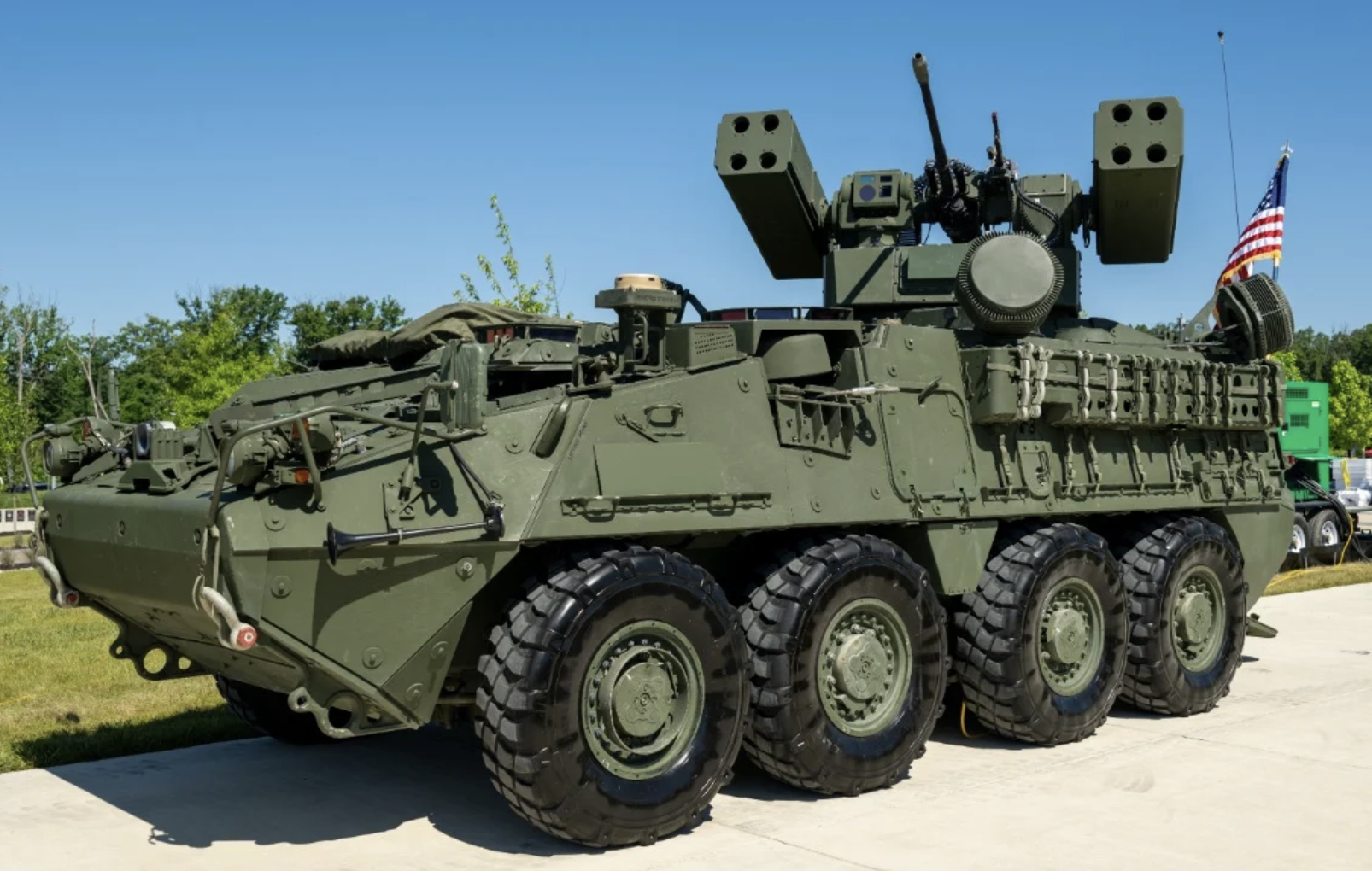
For units that do not have the Mk38 mount, conventional 7.62mm and .50 caliber mounts could be replaced by the XM914 Remote Weapon Station as used by the Army and in the Marine Corps MADIS which “includes the XM914E1 30mmx113mm DC driven cannon with a co-axial M240 (7.62mm) machine gun, an integration kit for the Stinger Air-To-Air Launcher (ATAL) and provisions for future C-UAS defeat systems.”
We could put two of them on every cutter, WPC and larger, including icebreakers and buoy tenders.

Kongsberg Defence & Aerospace XM914 remote weapon system (RWS) Photo credit: Janes
The US has a shortage of ASW escorts so I think adding sonar and support facilities for ASW helicopters is the most important improvement we could make for a future conflict with Russia and/or China.
I would also love to see the Rolling Airframe Missile (RAM) on every large patrol cutter. SeaRAM is a direct replacement for Phalanx installed on the Bertholf class. RAM also has a “HAS” mode to target Helicopter, Aircraft, and Surface targets. Range is reported to be ten Nautical Miles. The missile has a 11.3 kg (24 lb 15 oz) warhead.
The gun we have, the 57mm Mk110 is not as capable as the Leonardo 76mm OTO Super Rapid gun equipped with the STRALES guided ammunition system, since we have yet to produce a guided projectile effective against cruise missiles (no ALaMO does not qualify), so I would be happy to trade the 57mm for eight or more VLS that could provide ESSM and VL ASROC and even Standard or Tomahawk. Would even trade it for a SeaRAM system.
I don’t see much likelihood of Cutters exchanging anti-ship missiles with Chinese destroyers but cutters may be assigned to enforce a blockade so, while surface to surface missiles are probably the least urgent addition, they might still have a place on large cutters.




 Chuck Hill's CG Blog