This Day in Coast Guard History, April 3

Based on the Coast Guard Historian’s timeline, https://www.history.uscg.mil/research/chronology/
With inspiration from Mike Kelso

April 3

1882  The schooner Morris was unable to enter Muskegon, Michigan, between the piers and was aided by the lookout of Station No. 8, Eleventh District.  He used a heaving-stick and throwing a line to get a hawser to the vessel.  The same service was rendered later in the day by two of the station men to the schooner Willis Smith of South Haven.

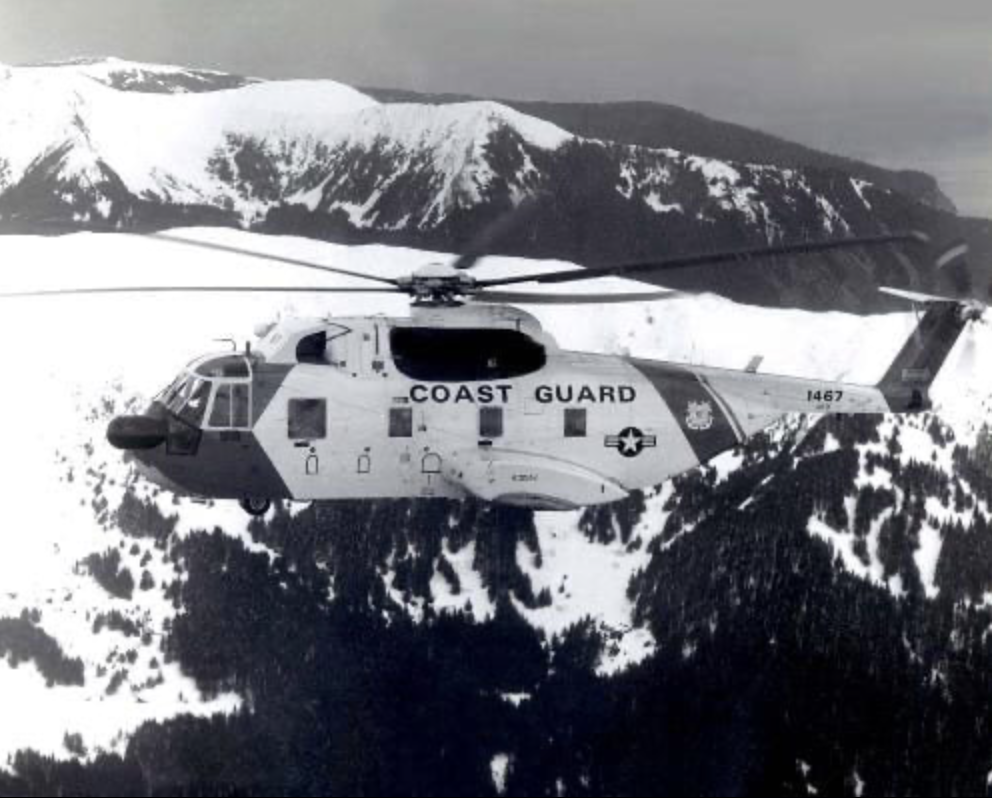
Lt. Jack C. Rittichier, HONORED ON PANEL 58W, LINE 14 OF THE WALL, born 08/17/1933, killed in action 06/09/1968, QUANG TRI Province, Vietnam. Awarded the Silver Star, three Distinguished Flying Crosses and three Air Medals. 

1968  Coast Guard exchange pilots arrive in South Vietnam to fly combat SAR missions with the Air Force.

Launch of USCGC Mackinaw (WLBB-30) on April 2, 2005. Photo by Peter J. Markham.

2014  CGC Mackinaw, home-ported in Cheboygan, Michigan, conducted an escort on Lake Superior near Whitefish Point.  Mackinaw’s crew worked together with the crew of Canadian Coast Guard Ship Pierre Radisson, home-ported in Quebec City, as part of an ongoing bi-national agreement between the U.S. and Canada, to break sheet ice that was nearly 40 inches thick.

Canadian Coast Guard Ship Pierre Radisson, Quebec City, Canada, 9 June 2009, Photo credit: Cephas via Wikipedia.

Third Fleet and DOD Becoming Involved in Maritime Migrant Interdiction

The U.S. Coast Guard conducts operations with the USS Spruance
PACIFIC OCEAN (March 28, 2025) “A U.S. Coast Guard MH-60T conducts flight operations with the Arleigh Burke-class guided-missile destroyer USS Spruance (DDG 111) while underway in the Pacific Ocean, March 28, 2025. U.S. Navy assets are employed under U.S. Northern Command’s maritime homeland defense authorities with a U.S. Coast Guard Law Enforcement Detachment embarked to enable maritime interdiction missions to prevent the flow of illegal drugs and other illegal activity. U.S. Northern Command is working together with the Department of Homeland Security to augment U.S. Customs and Border Protection along the Southern border with additional military forces.” (U.S. Navy photo by Mass Communication Specialist Seaman Joey Sitter)

Below is a Coast Guard District 11 news release.

I believe, this is the first time Navy units operating under Third Fleet have been involved in Migrant interdiction efforts. With USS Spruance on the West Coast and USS Gravely on the Gulf coast, its obvious DOD has been told to show up.

Small numbers of Navy ships, usually frigates or littoral combat ships, have routinely engaged in drug interdiction under the direction of Forth Fleet and SOUTHCOM, and have rescued migrants during unusual surges of immigrants like the Mariel Boat Lift of 1980.

For short periods during the first Trump administration, Navy ships were surged to Forth Fleet to augment drug interdiction efforts.

NORTHCOM has played little part in maritime interdiction of any kind, apparently satisfied that DHS was handling the job.

PACIFIC OCEAN (March 28, 2025) Members of the U.S. Coast Guard conduct small boat operations with the Arleigh Burke-class guided-missile destroyer USS Spruance (DDG 111) and U.S. Coast Guard cutter USCGC Terrell Horne (WPC 1131) while underway in the Pacific Ocean, March 28, 2025. U.S. Navy assets are employed under U.S. Northern Command’s maritime homeland defense authorities with a U.S. Coast Guard Law Enforcement Detachment embarked to enable maritime interdiction missions to prevent the flow of illegal drugs and other illegal activity. U.S. Northern Command is working together with the Department of Homeland Security to augment U.S. Customs and Border Protection along the Southern border with additional military forces. (U.S. Navy photo by Mass Communication Specialist Seaman Joey Sitter)

While I don’t think these destroyers will add much to the already substantial effort already being made by the Coast Guard and its regular partners, they do provide a degree of missile defense to the US coast that has been missing and a ready response in the event of a maritime terrorist attack in their vicinity, so I am glad to see them underway. US Navy crews may be overworked, but it is not because their ships are underway too much. The average USN combatant is underway less than 90 days a year.

Certainly, there is a desire to show results. There is an implication rather than a statement that the people on the boat were attempting to enter the US, but that is not really clear. “50 miles southwest of San Diego” suggests that the boat was in the Mexican EEZ, well South of the border, and a 35 foot boat is not typical of the Panga-style boats recently intercepted smuggling migrants along the West Coast. It could have broken down off San Diego and drifted South? Had the boat been tracked heading North? Did the American own the boat? Was the boat destroyed after the passengers and crew were removed? Time will tell. 

Coast Guard Cutter Active and partnership agencies interdict a migrant vessel, approximately 20 miles off the coast of Point Loma, California, Jan. 27, 2025. The crew of Active, the Coast Guard Cutter Terrell Horne and U.S. Customs and Border Protection members worked together to interdict this illegal migrant operation, which had 21 individuals aboard. (U.S. Coast Guard courtesy photo)


March 31, 2025

Coast Guard, Navy rescue 18 people from disabled vessel off San Diego coast

U.S. Coast Guard Pacific Southwest Phone: (206) 815-6689

SAN DIEGO – A Coast Guard Air Station San Diego MH-60 Jayhawk helicopter aircrew and the crew of the Arleigh Burke-class guided-missile destroyer USS Spruance (DDG 111) rescued 17 aliens and one American aboard a disabled and adrift vessel approximately 50 miles southwest of San Diego Sunday.

A 35–foot vessel with 18 individuals aboard was spotted in international waters taking on water and requesting assistance around 7:55 a.m.

The Spruance launched a 7-meter rigid hull inflatable boat crew to assist. The 18 individuals were rescued from the water and safely brought aboard the Spruance.

Watchstanders from Coast Guard Sector San Diego then launched an MH-60 Jayhawk helicopter aircrew to transport the persons from Spruance to Coast Guard Sector San Diego.

All 17 aliens and the one American were brought to Sector San Diego over two separate flights due to passenger constraints.

The 18 individuals were transferred to Department of Homeland Security partners.

Irregular maritime migration aboard unseaworthy or overloaded vessels is always dangerous, and often deadly. Do not take to the sea. You could lose your life. We remain steadfast in our commitment to saving lives and discouraging anyone from taking to the sea in ways that are unsafe and illegal.

“Coast Guard Cutter Midgett to return to Honolulu following Operation Blue Pacific patrol” –D14

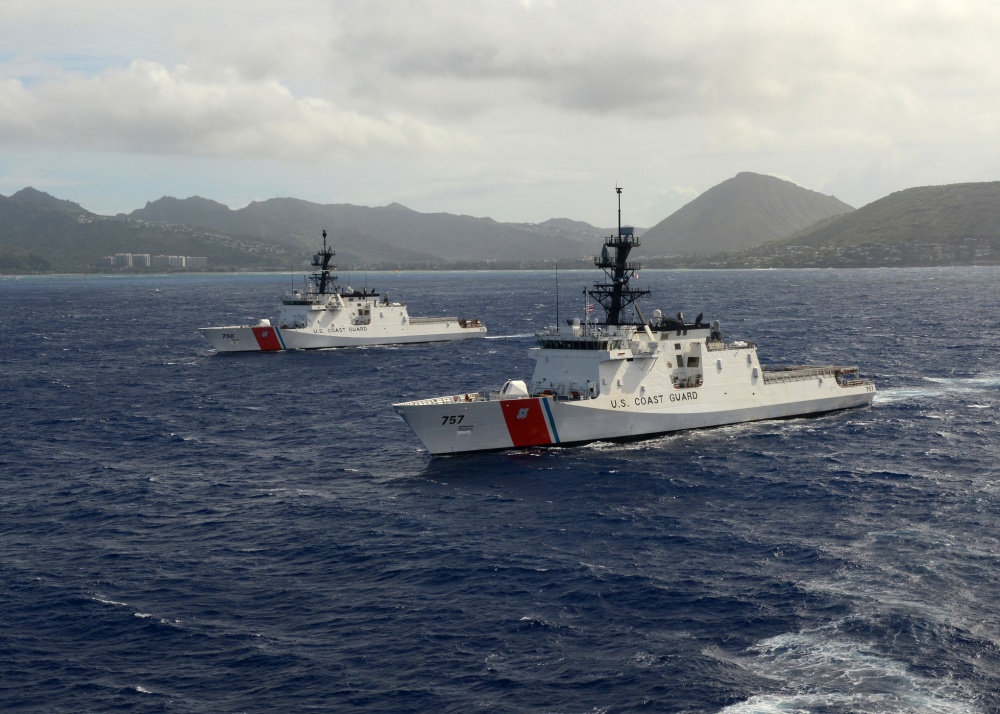
USCGC Midgett (WMSL 757) get underway from Honolulu to conduct sea trials off the coast of Hawaii, Dec. 13, 2024. Midgett is the eighth Legend-class national security cutter, suited to support various missions such as maritime security, law enforcement, and search and rescue. (U.S. Coast Guard photo by Petty Officer 2nd Class Tyler Robertson)

Below is a US Coast Guard District 14 news release.

I like the fact that they included links for previous releases about Midgett’s patrol. Presumably she departed on or about January 15. Really think these types of releases should include departure dates and list of port calls.


March 31, 2025

Media Advisory: Coast Guard Cutter Midgett to return to Honolulu following Operation Blue Pacific patrol

Who: U.S. Coast Guard Capt. Matthew Rooney, commanding officer of Coast Guard Cutter Midgett (WMSL 757) and crew.

What: Coast Guard Cutter Midgett and crew are scheduled to return home following a 76-day Operation Blue Pacific patrol in Oceania. Media are invited to watch the Midgett and crew moor at Sand Island and families reunite with crew members. Media will be able to film the cutter’s return and interview crew members.

Where: Coast Guard Base Honolulu, 400 Sand Island Parkway, Honolulu, HI 96819

When: Tuesday, April 1 at 8 a.m.

HONOLULU – The crew of Coast Guard Cutter Midgett (WMSL 757) is slated to return to Coast Guard Base Honolulu Tuesday.

The Midgett’s crew deployed in support of Operation Blue Pacific, the Coast Guard’s multi-mission campaign that enhances maritime governance and security in Oceania, from January 16 to April 1.

During the patrol, the Midgett crew conducted shiprider operations, key leadership engagements, and community relations activities in Tuvalu, Fiji, New Zealand, Australia, Papua New Guinea, Republic of Marshall Islands, and American Samoa. The crew also conducted astern refueling with Coast Guard Cutter Frederick Hatch (WPC 1143) and escorted the Hatch to dry dock in Honolulu.

For more information about the Midgett’s patrol:

Commissioned in 2019 and homeported in Honolulu, Midgett is the eighth Legend-class National Security Cutter. At 418-feet, these cutters are the largest and most capable in the U.S. Coast Guard fleet. Equipped with advanced technology, they are ideally suited to support a wide range of missions, including maritime security, law enforcement, and search and rescue operations.

For more information follow us on FacebookX, and Instagram.

This Day in Coast Guard History, April 1

Based on the Coast Guard Historian’s timeline, https://www.history.uscg.mil/research/chronology/
With inspiration from Mike Kelso

April 1

1813  At 1100 in the morning, while at anchor in Charleston Harbor, the powder room of the cutter Gallatin exploded, blowing off the cutter’s stern and quarterdeck.  The explosion and subsequent fire killed three crewmembers instantly and seriously wounded five more.  The cutter sank at its anchorage.  A Charleston newspaper reported, “Between the hours of ten and eleven yesterday forenoon, a most awful explosion took place in this harbor, on board the Revenue schooner GALLATIN, commanded by Capt. John. H. Silliman. . .There were about 35 persons in all on board; of this number about 10 were on the quarter deck and in the cabin; part of them employed in cleaning the arms. Thus situated, the dreadful explosion took place, and in one instant the whole quarter deck with all of those upon it, were hurled into the air. Some of the bodies were thrown nearly as high as the mast head of the vessel; others were driven through the cabin and lodged upon the main deck. The whole stern of the vessel was torn down to a level with the water.”  Those who were killed were Gunner’s Mate Thomas Feld, George Segur, and one unidentified seaman.  The reported wounded were William Pritchard (Gunner), John McCoan, Benjamin Chart, George Craft, and William Hunter (Boy).

1897  Under an Executive Order dated May 6, 1896, federal Civil Service rules were applied to the Life-Saving Service.

Elmer Stone, Coast Guard Aviator #1

1916  The official birthday of Coast Guard aviation.  On this date, Third Lieutenant Elmer F. Stone reported to Pensacola Naval Air Station for flight training.  He was the Coast Guard’s first aviator.

he bow and midsection of Coast Guard manned LST-884 being salvaged after 1 April 1945 Kamikaze attack, 9 July 1945. She was too damaged to be of any use and was sunk later in 1946.
US National Archives ID # 193705117, a US Army Air Corps photo now in the collections of the US National Archives

1945  The invasion of Okinawa in the Ryukyu Islands commenced.  In all, seven Coast Guard-manned transports, 29 LSTs, the cutters Bibb and Woodbine, and 12 Coast Guard-manned LCI(L)s participated in the bloodiest invasion ever undertaken by the United States.  Over 13,000 Americans were killed and another 36,000 were wounded during the conquest of this Japanese possession.

USS LST-884 crew photo. Notice the many different uniforms, a result of the crews loss of almost everything in the fire. This picture was taken once the crew was reunited at Ulithi.

The original 1903 Scotch Cap Light, located on the SW corner of Unimak Is., Alaska . US Coast Guard photos

1946  A tsunami swept away the light station at Scotch Cap, Alaska, killing the station’s entire five-man crew.  They were: BMC Anthony L. Petit, MoMM 2/c Leonard Pickering, F 1/c Jack Colvin, SN 1/c Dewey Dykstra, and SN 1/c Paul James Ness.

1967  The Coast Guard ended its 177-year association with the Treasury Department when it transferred to the newly-created Department of Transportation (DOT).  DOT was created when President Lyndon Johnson signed Executive Order 167-81.  The Coast Guard was the largest agency in the new department.

1969  The Coast Guard established an Ocean Engineering Division within the Office of Engineering.  The new division was formed to improve engineering support for the marine sciences and short-range aids to navigation missions.

1977  CGC Dauntless operating along with CGC Cape Fox in the area of Cay Lobos Bahamas boarded F/V Big Champ.  The boarding party discovered 5,000 lbs. of marijuana.  The vessel and marijuana were seized and the four POB were arrested.

USCGC Acushnet (WMEC-167) crew members inspecting a navigation buoy in Alaskan waters, date and location unknown. Photo courtesy Marine Exchange Alaska. Robert Hurst
http://www.navsource.org/archives/09/37/3709.htm

1978  CGC Acushnet changed designation from WAGO to WMEC “to allow for the increased multi-mission utilization of the vessel.”  Acushnet’s primary mission continued to be Marine Science Activities (MSA) “due to its special capabilities for environmental buoy deployment.”

The U.S. Coast Guard high endurance cutter USCGC Gallatin (WHEC-721) lies tied up at a pier at Naval Station Roosevelt Roads, Puerto Rico, during exercise “Ocean Venture ’88”, on 30 March 1988.

1984  CGC Gallatin made the largest maritime cocaine seizure to date when it boarded and seized the 33-foot sailboat Chinook and her crew of two.  A boarding team discovered 1,800 pounds of cocaine stashed aboard the sailboat.

This Day in Coast Guard History, April 2

Based on the Coast Guard Historian’s timeline, https://www.history.uscg.mil/research/chronology/
With inspiration from Mike Kelso

April 2

Aircraft maintenance on the ramp at the Morehead City air station. Aircraft was a Curtis HS-2L

1924  Congress appropriated $13,000,000 for ten air stations and equipment.  Congress first authorized the stations on August 29, 1916, but did not provide for sufficient funding until this date. The first Coast Guard Air Station had been established in 1920 in Morehead City, NC.

The Morehead City air station remained in commission until July, 1922 at which time personnel were transferred to other assignments and the aircraft were returned to the Navy. There would be no more Coast Guard aviation activity until the advent of the Coast Guard Air Station at Gloucester Massachusetts in 1926. Only five out eleven of the initial cadre returned to flight status.

HU-25 CGNR 2110 Photographer: Glenn Chatfield
Notes: At Cedar Rapids, IA

1982  The first of a new type of aircraft was added to the Coast Guard’s air fleet, a HU-25A Guardian, was dedicated and christened at Aviation Training Center Mobile.

In response to the Iraqi action of firing oil wells and pumping stations in Kuwait, two HU-25A Falcon jets from Air Station Cape Cod, equipped with Aireye technology, which precisely locates and records oil as it floats on water], departed for Saudi Arabia. The Falcons mapped over 40,000 square miles in theatre and located every drop of oil on the water. This was used to produce a daily updated surface analysis of the location, condition and drift projections of the oil. The Aviation Detachment was deployed for 84 days, flew 427 flight hours and maintained an aircraft readiness rate of over 96 percent.

1983  The State Department forwarded a request for assistance from the United Arab Emirates to help prepare for an oil spill cleanup in the Persian Gulf.  The spill occurred after combat operations during the Iran-Iraq war had left many oil wells burning and leaking oil.  Four Coast Guard pollution experts responded to the request.

“Indonesia-Vietnam EEZ deal upholds international law, sends message to China” –Indo Pacific Defense Forum

Indonesian Defense Minister Sjafrie Sjamsoeddin, left, and Vietnamese Defense Minister Gen. Phan Van Giang inspect honor guards before their meeting in Jakarta, Indonesia, in March 2025. IMAGE CREDIT: THE ASSOCIATED PRESS

INDOPACOM’s on-line magazine, Indo-Pacific Forum reports,

Indonesian and Vietnamese leaders said their countries expect to formally agree in 2025 on exclusive economic zone (EEZ) boundaries. The move not only settles a long-standing debate on the countries’ overlapping maritime territories, but it also presents a united front to oppose China’s expansive and illegal claims on the South China Sea.

This is the way it should be. All the claimants to the South China Sea should settle their disputes by arbitration or submitting the dispute to the international tribunal set up under UNCLOS. This will expose the Chinese claims as unreasonable and illegal.

Other similar settlements are in the works.

Meanwhile, Philippine and Vietnamese officials have said they are ready to negotiate overlapping claims to the continental shelf in the South China Sea. “Both the Philippines and Vietnam agree that the way to move forward … is for dialogue and consultation,” Jonathan Malaya, the Philippine National Security Council’s assistant director general, said in July 2024, according to The Philippine Star newspaper.

Settling these disputes will also facilitate cooperation in search and rescue, fisheries management, and pollution response.

“Wash the Sky Clean of Drones” –USNI

Powerful shipboard firefighting monitors can operate with flow rates in the vicinity of 16,000 gallons per minute, generating nozzle pressures and forces capable of knocking down or destroying drones with seawater. SHUTTERSTOCK

Captain Karl Flynn, U.S. Marine Corps, offers a novel counter to small drones,

It is well established that unmanned aerial systems (UASs) and vehicles (UAVs) are cheap, ubiquitous, and deadly against ground forces. While U.S. Navy ships and aircraft have proven themselves effective at shooting them down in the Red Sea, unmanned aircraft could soon become more dangerous in multiple environments: busy ports, canals, straits, the littorals, and other choke points. The Navy should explore using high-powered water cannons—also known as firefighting monitors—as ship-based counter-UAS (cUAS) weapons.

Now, I don’t think this would work against anything, but the small First Person Video drones that are now extremely common, but that is what the Coast Guard is most likely to encounter. At close range, water under high pressure can be damaging, but it’s not likely to cause collateral damage, like firearms could.

There are, of course, other reasons we might want to have powerful fire monitors.

SAN DIEGO (July 12, 2020) The U.S. Navy amphibious assault ship USS Bonhomme Richard (LHD-6) on fire at Naval Base San Diego, California (USA), on 12 July 2020. On the morning of 12 July, a fire was called away aboard the ship while it was moored pier side at Naval Base San Diego. Base and shipboard firefighters responded to the fire. Bonhomme Richard was going through a maintenance availability, which began in 2018. The fire was extinguished on 16 July.

They can also be used in less than lethal confrontations.

Screengrab from Philippine Coast Guard shows a Philippine vessel being water cannoned by the China Coast Guard on April 30, 2024.

They have become a regular feature of Gray Zone activities in the Western Pacific.

A water cannon battle between Taiwanese and Japanese Coast Guard vessels.

Frankly, what we have now looks kind of wimpy by comparison.

U.S. Coast Guard Cutter Waesche and Japan Coast Guard vessel JCGC Wakasa (PL-93) test their water cannons during a trilateral search and rescue exercise in the East Sea, June 6, 2024. Coast Guardsmen from Japan, Republic of Korea and the United States used the trilateral training as an opportunity to rehearse cohesion between the nations when operating together. The U.S. Coast Guard has operated in the Indo-Pacific for more than 150 years, and the service is increasing efforts through targeted patrols with our National Security Cutters, Fast Response Cutters and other activities in support of Coast Guard missions to enhance our partnership. (U.S. Marine Corps photo by Cpl. Elijah Murphy)

This Day in Coast Guard History, March 31

Based on the Coast Guard Historian’s timeline, https://www.history.uscg.mil/research/chronology/
With inspiration from Mike Kelso

March 31

1932  The United States signed a Whaling Convention at Geneva with 21 other countries.

USCGC Tuscarora

1934  At high noon on March 15, 1934, CGC Tuscarora fired a shot from one of its batteries, a shot that started the fifth international St. Petersburg to Havana racing classic.  Tuscarora served as the official Coast Guard escort for the race.

World War II US Naval Districts from which the USCG Districts were derived.

1948  The Tenth District, with headquarters at San Juan, Puerto Rico and comprising of the Panama Canal Zone, all of the island possessions of the United States pertaining to Puerto Rico and the Virgin Islands, and all United States reservations in the islands of the West Indies and on the north coast of South America, was abolished, and its functions, responsibilities, and facilities were transferred to and combined with the Seventh District, with headquarters at Miami, Florida.

1995  Coast Guard Communication Area Master Station Atlantic sent a final message by Morse Code and then signed off, officially ending more than 100 years of telegraph communication.

Response Boat, Medium (RB-M). Photo from Vigor

2008  The U.S. Coast Guard took delivery of its first Response Boat–Medium (RB-M) from Marinette Marine Corporation.  Following completion of underway trials on March 17, 2008 near Tacoma, Washington, RB-M 45601 was trailered cross-country for delivery in Portsmouth, Virginia.  After one week of familiarization for the Coast Guard Transition Team (responsible for facilitating the introduction of the planned 180 boats to the fleet) Station Little Creek, Virginia took delivery of RB-M 45601 on April 7, 2008. The RB-M acquisition was initiated to replace the aging 41’ Utility Boats and other Non-Standard Boats.  The RB-M is a self-righting, 45-foot all-aluminum boat with twin diesel engines and water jet propulsion.

“Sweden Tests Torpedo 47 on Combat Boat 90 Highlighting Mobile Littoral Warfare Capability” –Navy News

A Torped 47 is launched from a Combat Boat 90

Army Recognition’s Navy News reports

On March 28, 2025, the Swedish Defence Materiel Administration (Försvarets Materielverk – FMV) announced that it had successfully conducted a live-fire sea trial of the lightweight Torpedo 47 (Tp 47), deployed from a non-traditional naval platform, specifically a Combat Boat 90 (CB90). The test was carried out in cooperation with the Swedish Armed Forces and defence company Saab as part of an initiative to explore the possibility of deploying the weapon system beyond its original operational scope.

It should be no surprise that small vessels can carry torpedoes. Torpedoes have allowed small craft to be giant killers since the Civil War, sinking battleships in the Russo-Japanese War and World War I.

MIR USV firing torpedo (Screenshot from SSB video)

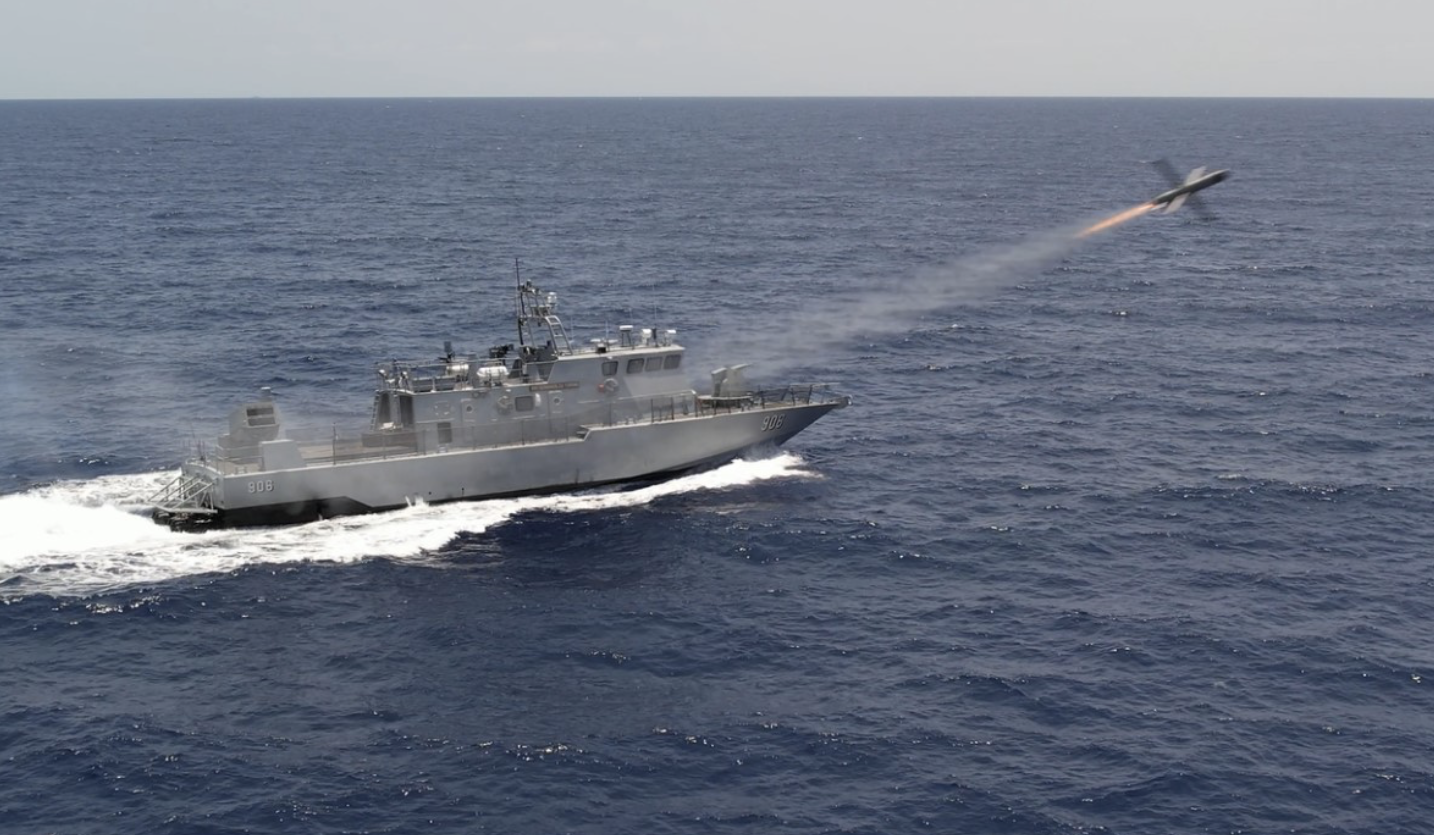
Even so, thought it was worth passing this along. We have seen photos of Unmanned Surface Vessels (like the ones above and below) launching light weight torpedos, but this is the smallest modern manned vessel I have seen equipped with torpedoes of any kind.

Elbit Systems’ Seagull unmanned surface vessel (shown firing a torpedo) recently exhibited its anti-submarine detection capabilities using a dipping sonar rig and proprietary software.

The Torped 47 is a light weight torpedo, a bit larger than the NATO standards like the Mk54, 400mm in diameter vs 324mm and about 140 pounds heavier. It is unique among light weight torpedoes in having wire guidance, like the larger heavy weight torpedoes, allowing mid-course corrections and is designed to engage both surface and subsurface targets.

Torped 47 is used by Sweden, Finland, and Ukraine.

The Combat Boat 90 has an overall length of only 52 feet and displaces less than 23 tons full load, one 15th the size of a Webber class FRC and about one quarter the size of an 87 foot WPB.

While there are other weapons that might work, a torpedo that targets propellers, is the only weapon I feel confident would allow a small cutter to reliably, forcibly stop a ship. It also has the advantage of not endangering anyone on an adjacent shore. Used against medium to large ships, it would be unlikely to release the ship’s cargo such as oil or Natural Gas.

USCGC Midgett is in the Western Pacific–Making Friends and Influencing People

Coast Guard Cutter Midgett’s (WMSL 757) law enforcement team and Papua New Guinea shipriders return after a boarding in Papua New Guinea’s exclusive economic zone, Mar. 11, 2025. Papua New Guinea lies in the heart of key shipping routes and lucrative fisheries. The U.S. Coast Guard and Papua New Guinea collaborate to mitigate shared maritime challenges and threats, promoting regional security and stability within Oceania. (U.S. Coast Guard photo by Petty Officer 3rd Class Jennifer Nilson)

Below is a news release from US Coast Guard News.


March 26, 2025

U.S. Coast Guard cutter promotes regional security in the Pacific with Papua New Guinea

RABAUL, Papua New Guinea – The U.S. Coast Guard Cutter Midgett (WMSL 757) recently concluded its second port call in Papua New Guinea (PNG), following nine days of shiprider operations with representatives from the PNG Defence Force, PNG Customs Service, and PNG National Fisheries Authority.

Midgett was invited by the Papua New Guinea government to participate in the operation. The PNG shipriders led the mission by selecting vessels of interests and conducting boardings while the U.S. Coast Guard provided ship based and shoreside support. The successful shiprider operations reinforced the importance of deepening and expanding strong bilateral relationships.

During the nine-day operation, Midgett facilitated six at-sea inspections within the PNG Exclusive Economic Zone (EEZ) under the PNG-U.S. bilateral agreement. The U.S Coast Guard and PNG’s bilateral maritime law enforcement agreements enhance PNG sovereignty with the capacity to enforce PNG’s maritime laws through shared information exchanges and joint patrols that deter illegal activities and malign behavior in PNG’s EEZ.

While in Rabaul, Midgett hosted a key leadership engagement with the East New Britain Governor, Michael Marum, and PNG fisheries stakeholders. During the engagement, members of Midgett and PNG representatives participated in roundtable discussions focused on PNG-U.S. bilateral agreements and security within the PNG EEZ and received a tour of the cutter.

Midgett crewmembers visited a local school to participate in sports and seamanship activities. Midgett also hosted students on board, allowing students to learn about shipboard life and participated in firefighting training.

Commissioned in 2019 and homeported in Honolulu, Midgett is the eighth Legend-class National Security Cutter. At 418-feet, these cutters are the largest and most capable in the U.S. Coast Guard fleet. Equipped with advanced technology, they are ideally suited to support a wide range of missions, including maritime security, law enforcement, and search and rescue operations.