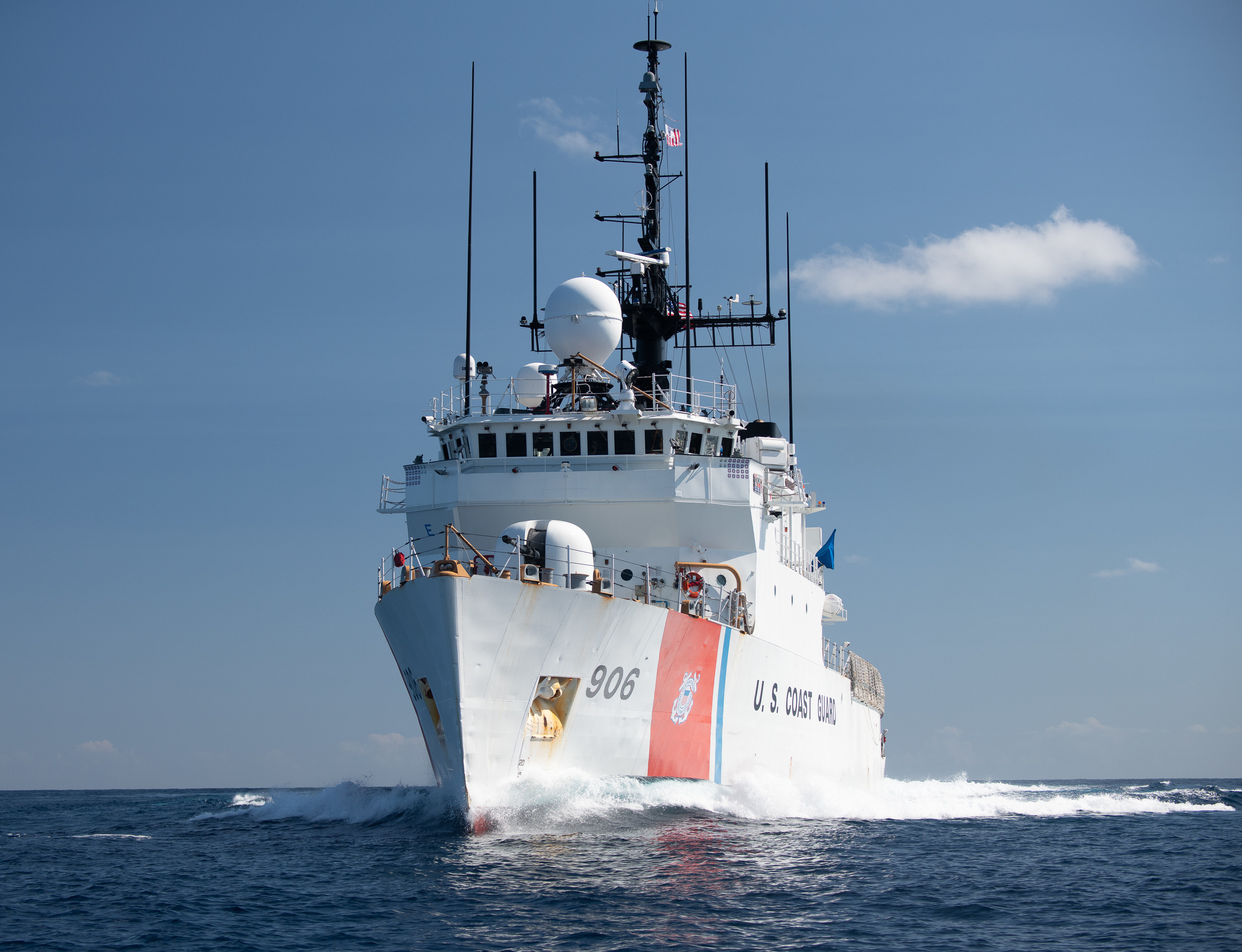
“U.S. Coast Guard cutter arrives in Papua New Guinea, embarks law enforcement officers to conduct joint maritime patrol” –News Release

Officials from multiple agencies stand in the engine control room of the Coast Guard Cutter Midgett (WMSL 757) in Papua New Guinea Mar. 6, 2025. Papua New Guinea lies in the heart of key shipping routes, where freedom of navigation for the transport of global goods and fisheries and deep-sea resources abounds. The Coast Guard and Papua New Guinea collaborate to mitigate shared maritime challenges and threats, promoting regional security and stability within Oceania. (U.S. Coast Guard photo by Petty Officer 3rd Class Jennifer Nilson)

Below is a Coast Guard news release.

For those with an interest in World War II history. The Battle of the Coral Sea turned back a Japanese force that had planned to attack Port Moresby on the East end of New Guinea.

Battle of Coral Sea. United States Army Center of Military History. The Campaigns of MacArthur in the Pacific, Volume I. Reports of General MacArthur., p. 48, Plate 14. Port Moresby, NewGuinea is in the upper left; Guadalcanal, Tulagi and other Solomon Islands in the upper right; Australia to the South and West

March 12, 2025

U.S. Coast Guard cutter arrives in Papua New Guinea, embarks law enforcement officers to conduct joint maritime patrol

PORT MORESBY, Papua New Guinea — At the invitation of the Papua New Guinea government, the U.S. Coast Guard Cutter Midgett (WMSL 757) arrived in Port Moresby, Thursday, to embark Papua New Guinean law enforcement officers. This visit directly supports Papua New Guinea’s leadership in the Pacific Islands and its commitment to maritime security, specifically in combatting illegal, unreported, and unregulated fishing.

Midgett’s presence reinforces the U.S. Coast Guard’s commitment to deeper relations with Pacific Island nations and regional stability. This collaborative effort marks the first time a national security cutter, the U.S. Coast Guard’s most capable law enforcement cutter, will conduct bilateral maritime law enforcement operations in Papua New Guinea’s Exclusive Economic Zone (EEZ), under the existing bilateral agreement that was singed in May 2023.

This joint patrol will represent a tangible demonstration of the bilateral agreement between the United States and Papua New Guinea, strengthening maritime governance within the Pacific and deterring illegal activities within Papua New Guinea’s EEZ to promote the sustainable use of marine resources.

Midgett, commissioned in 2019 and homeported in Honolulu, is the eighth Legend-class national security cutter. These 418-foot vessels are equipped with advanced technology and a range of capabilities, making them ideally suited to support a wide range of missions, including maritime security, law enforcement, and search and rescue operations. Midgett’s deployment to Oceania highlights the United States’ enduring commitment to promoting a peaceful, secure, prosperous, and resilient Pacific Islands region.

This Day in Coast Guard History, March 13

Based on the Coast Guard Historian’s timeline, https://www.history.uscg.mil/research/chronology/
With inspiration from Mike Kelso

March 13

1882  At 7 P.M., the schooner Annie L. Palmer bound for New York from Baracoa, Cuba, with a cargo of fruit, and a crew of six persons, stranded about two hundred yards off-shore, one mile north of Station No. 16, Fourth District, New Jersey.  The patrolman reported it to the keeper.  The life-saving crew boarded the vessel by 8 o’clock and found that she had grounded at low water and could not be moved until the tide rose.  They ran an anchor to keep the vessel from working farther on, and waited for the flood tide.  At half past 2 the next morning, the tide rose and they succeeded in heaving the vessel off.  They then took her to a safe anchorage.

1974  A 200-foot fishing vessel requested evacuation of a crewman, who had severe headaches from a head injury.  The vessel was directed to proceed to the vicinity of Boston Light Vessel where upon arrival a motor lifeboat from Coast Guard Station Point Allerton evacuated the patient to Coast Guard Base Boston.  A waiting ambulance transported the patient to Brighton Hospital.

HITRON member from Jacksonville, Fla., mans an M-240 machine gun on board a Stingray MH-68A helicopter during a homeland security patrol around New York City

2000  The Coast Guard announced the successful completion of Operation New FrontierNew Frontier was an evaluation of the use of armed helicopters and high-speed small boats to stop small, high-speed smuggling vessels, referred to as “go-fasts,” that smuggled narcotics to the U.S.  Of the six go-fasts detected, all six were captured.  CGCs Gallatin and Seneca took part in the evaluations.

“Brazil to start the construction of 11 new NPa500MB offshore patrol vessels” –Navy News

The planned total cost for the eight NPa500MB OPVs is estimated at 2.8 billion reais (~476 million USD), while three other vessels will be specifically configured for mine countermeasures operations. (Picture source: Emgepron)

Army Recognition’s Navy News reports,

“…February 24, 2025, the Brazilian Navy’s Naval Systems Design Center (CPSN) delivered the basic engineering plan for the 500-ton offshore patrol vessel (NPa500MB) to Emgepron, a state-owned company responsible for naval projects, in late January. This step is part of the Patrol Vessel Acquisition Program (PRONAPA), which involves the domestic construction of 11 offshore patrol vessels (OPVs) with a high percentage of locally sourced components. These vessels are designed for the surveillance and protection of the Exclusive Economic Zone (EEZ), search and rescue operations, and combating illegal activities such as illegal fishing.

Brazil has the tenth largest EEZ in the world at 3,830,955 km sq., about one third that of the US, less than Canada, Japan, or New Zealand, but more than Chile, Kiribati, or Mexico.

Brazil has no Coast Guard. The Brazilian Navy operates 22 vessels they refer to as offshore patrol vessels. Only three are what the USCG would call medium endurance cutters. Four are near 40 year old former Royal Navy 890 ton 14 knot steel hulled minesweepers. 12 are 217 tons full load, 152’7″ (46.5 m), 26.5 knot patrol craft commissioned 1993 to 2009.

The remaining three are 500 ton, 182’5″, 21 knot Macaé class. Two vessels of this class are still building.

Macaé class patrol craft Navio-Patrulha Maracanã (P72) – 2023

If the Brazilian patrol vessel fleet were to provide the same coverage as the US Coast Guard in proportion to the size of their EEZ, they would need 12 large patrol ships (over 1000 tons) and about 20 smaller patrol craft. (They may be supplementing their patrol force with other classes of vessels.)

The new design appears to be an evolutionary outgrowth of the Macaé class since it is only slightly larger and has similar layout and performance: overall length of 58.9 meters (193’3″), a beam of 9.0 meters (29’6″), a maximum draft of 2.5 meters (8’2″), and a displacement of 564 tons

Presumably the Brazilian Navy sees the Macaé class as successful, but the new ships do not appear to be a significant improvement over the Macaé class. As I noted earlier (How Long Should an OPV be? Is There a Minimum?) I believe a length of at least 80 meters is the minimum for a truly fully capable OPV. In addition to better range, endurance, and seakeeping, the additional length allows incorporation of features that appear to be becoming standard on OPVs, including multiple, more capable, 8 to 11 meter RHIBs (perhaps a stern ramp), space for containerized mission modules and unmanned systems, and a flight deck and hangar for at least UASs.

The Macaé class was based on the 400 ton, 55 meter French P400 class patrol vessel. The French came to believe they needed a larger vessel and have begun replacing their P400 class with vessels with the 80 meter POM. Perhaps Brazil should again look to France and base their next OPV on the more capable POM.

Is the Coast Guard Going to Bring a Knife to a Gun Fight? A Gun to a Missile Fight?

The first three fast response cutters—the USCGC Richard Etheridge (WPC-1102), Bernard C. Webber (WPC-1101), and William Flores (WPC-1103). Credit U.S. COAST GUARD. In case of a maritime terrorist attack, Webber class Fast Response Cutters are likely to be the most potent response the Coast Guard would be able field. 

Why is it that the Coast Guard has not mounted missiles or torpedoes on their ships since about 1991?

Currently the US Coast Guard’s most powerful weapons are the 57mm Mk110 and the 76mm Mk75. Do they assure that the Coast Guard will be able to take actions inherent in Coast Guard missions, including the ability to forcibly stop any vessel–any vessel— regardless of size? Will the larger cutters mounting these weapons even be in the vicinity when needed? When called upon, will the units on scene have any effective weapons?

I don’t think so.  In fact, we are less capable of doing so than we were in the 1930s.

When asked about this in 2020, then Commandant, Admiral Fagan, is reported to have said essentially, “For the present time, the U.S. Coast Guard is satisfied with keeping the current ‘gun and no missiles’ weapons fit the same and exercising the White-Hull Humanitarian symbol of Search and Rescue and Maritime Law Enforcement wherever and whenever the large Coast Guard Cutters sail into far off seas.”

My response at the time was here. I recognize some advantage in being seen as non-threatening, but few people would mistake even a missile armed Cutter for an invading force, and torpedoes are useless against targets on land. Coast Guard cutters overseas missions are primarily law enforcement. In the future, cutters may be in gray zone conflicts with the aggressive China Coast Guard–the largest coast guard fleet in the world, which usually operates cutters in groups. We don’t want USCG cutters to look like they can be pushed around.

Looking helpless may not inspire confidence in our allies.

This Chinese coast guard ships armed with 76mm and 30mm guns© Kyodo

Wartime:

It seems likely that, if the US has a conflict with China, one of the first things the Coast Guard will have to do is seize all Chinese owned/flagged/manned vessels in US waters. Naturally some will resist. The Coast Guard will need to be able to overcome any resistance without asking for help from other armed services because they will be busy elsewhere.

As the conflict develops, it it likely the Coast Guard will be involved in blockade operations and otherwise tasked with hunting down Chinese controlled shipping that might be carrying agents, special forces, mines, or even containerized missile launchers.

We are not just talking about small vessels here. Some are over a thousand feet long and there are hundreds of them.

Law Enforcement/Counter-Terrorism:

Coast Guard vessels patrol boat size and larger are not just SAR assets. They are law enforcement units and in wartime combatants. Included in their peacetime law enforcement role is counter terrorism.

Wise men learn from the mistakes of others. Consider the lessons to be learned from the response to attacks on 9/11 and the North Hollywood shootout.

9/11: We knew about kamikazes. We knew airplanes loaded with fuel could be used as weapons. We knew that big planes were more destructive than small ones.

Domain awareness failed when the aircraft turned off or changed their transponder codes. Communications between FAA and NORAD were poor. Interceptors were too few and too far between. Interceptors once launched were sent in the wrong directions. Managers focused on the first attack, which was then already over, refused to receive a report of the second attack in progress.

Too many layers of decision making between detection and action. For timely action, best if the unit that detects an attack can respond immediately, and Coast Guard units are likely to be the first to recognize a maritime terrorist attack.

North Hollywood Shootout:

“The North Hollywood shootout, also known as the Battle of North Hollywood, was a confrontation between two heavily armed and armored bank robbers, Larry Phillips Jr. and Emil Mătăsăreanu, and police officers in the North Hollywood neighborhood of Los Angeles on February 28, 1997.

In this case the response to the crime was prompt but inadequate. At the time, the police on patrol were generally armed with only the classic 38 Special revolver, 9mm handguns, and a few shotguns. The bank robbers armor was impervious to these weapons. The robbers carried automatic rifles with high capacity magazines with up to 100 rounds. The two robbers fired approximately 1100 rounds. Some police officers even reequipped themselves with weapons from a local firearms dealer.

An inventory of the weapons used by the two bank robbers:

  • A Bushmaster XM-15 converted illegally to fire full auto with two 100-round Beta Magazines and fitted with a M16A1-style handguard
  • A Heckler & Koch HK-91 semi automatic rifle with several 30-round magazines
  • A Beretta 92FS with several magazines
  • Three different civilian-model Norinco Kalashnikov-style rifles converted illegally to fire full auto with several 75- to 100-round drum magazines and 30-round box magazines

The police were ultimately successful because of the overwhelming response. Over 300 law enforcement officers from various forces had responded to the citywide tactical alert, but they were really not prepared to confront just two men who were armed or protected in ways they did not expect. The perpetrators, Phillips was shot 11 times, including his self-inflicted gunshot wound to the chin, while Mătăsăreanu was shot 29 times. Twelve police officers and eight civilians were injured.

If terrorist sage a maritime attack, it is unlikely to be what the Coast Guard has trained for. Coast Guard capabilities are public knowledge. Ballistic protection to protect terrorist operators or shooters against common Coast Guard weapons is relatively easy.

Terrorist can easily put protected firing positions and strong points on a ship, even if the Coast Guard has not done it.

Tests have shown that 25mm Mk38 rounds may not even penetrate a quarter inch of aluminum.

Even relatively small terrorist controlled vessels could be armed with a variety of weapons more destructive than the .50 caliber machine gun or the 25mm gun. RPGs (rocket propelled grenades) are common, but there are recoilless rifles, heavy machine guns, anti-tank and anti-aircraft guns up to 152mm, and anti-tank guided missiles that would also work well against a cutter, that are widely distributed.

Here are two examples. Both are widely available, compact, and hard hitting. The options are almost endless.

122mm howitzer D-30 (2A-18) Chief Designer F. F. Petrov (1960) Maximum range: 15300 meters Rate of fire: 6 – 8 rounds per minute Mass: 3200 kg Shell mass: 22 kg. Photo credit George Shuklin

The 122-mm howitzer D-30

 … is a Soviet howitzer that first entered service in 1960. It is a robust piece that focuses on the essential features of a towed field gun suitable for all conditions. The D-30 has a maximum range of 15.4 km (9.6 mi) or 21.9 km (13.6 mi) using rocket-assisted projectile ammunition.

With its three-leg mounting, the D-30 can be rapidly traversed through 360 degrees. Although no longer manufactured in the countries of the former Soviet Union, the D-30 is still manufactured internationally and is in service in more than 60 countries’ armed forces.

Finnish D-30 in direct fire during a training exercise. Photo credit: Jaakko Pulkkinen

Map of D-30 operators in blue with former operators in red. From Wikipedia. Credit: Jurying

9M133 Kornet:

9M133 Kornet. Control check of cadets of the Training Center for Combat Use of Missile Troops and Artillery of the Ground Forces of the Western Military District (Moscow Region).

The 9M133 Kornet (Russian: Корнет; “Cornet”, NATO reporting name AT-14 Spriggan, export designation Kornet-E) is a Russian man-portable anti-tank guided missile (ATGM) intended for use against main battle tanks. It was first introduced into service with the Russian army in 1998.

The Kornet is among the most capable Russian ATGMs. It was further developed into the 9M133 Kornet-EM, which has increased range, an improved warhead, and equipped with an automatic target tracker (fire-and-forget capability).

The Kornet has been widely exported and is produced under license in several countries. It was first used in combat in 2003 and has since been used in many conflicts.

Kornet-EM missiles truck mounted Kornet-D launcher. Credit: Mike1979 Russia. Looks like this could be easily mounted in a container.

Map with 9M133 operators in blue. Author: Jurryaany

NON-STATE USERS:

This Day in Coast Guard History, March 11

Based on the Coast Guard Historian’s timeline, https://www.history.uscg.mil/research/chronology/
With inspiration from Mike Kelso

March 11

U.S.R.C. Gresham, flagship of the patrol fleet, America’s Cup races, 1901, Library of Congress. Yes, this is the same Gresham referred to below. She was decommissioned 7 April 1944, then almost 47 years old. 

1934  USCGC Gresham’s small boat crew defeated a team from the Royal Navy cruiser HMS Danae (5,603 tons full load) in a surfboat race over a two-mile course laid out in Mobile Bay.  Gresham and the City of Mobile had been hosting the British warship since March 8, 1934.

USCGC Itasca as HMS Gorlsston

1941  Congress passed the Lend-Lease Act.  Under the auspices of Lend-Lease all 10 of the Coast Guard’s famous Lake-class cutters were transferred to the Royal Navy.  Three were lost in action against Axis forces.  These 250-foot cutters had been designed by the Coast Guard Constructor RADM Frederick A. Hunnewell and featured a slightly raked stem and a cruiser stern.  Their innovative turbine-electric drive power plant was developed by Coast Guard CAPT Quincy B. Newman.  These were the first ships to have alternating current, synchronous motor for propulsion – the whole ship ran off the main turbine.  The auxiliary generators were tied into the main generator electrically, after sufficient speed was attained.  At that point, no steam was required to drive the turbines on the auxiliary generators.  The propulsion plant achieved remarkable efficiency.

USCGC Long Island. Photo from DAKOTA CREEK INDUSTRIES, INC. | P.O. Box 218 | Anacortes, WA 98221

2010  USCGC Long Island returned to its homeport of Valdez, Alaska, after providing patrol support to the 2010 Winter Olympics in Vancouver.  Long Island conducted patrols, boardings, and professional exchanges with Navy cruisers, destroyers, multi-agency aircraft and other Coast Guard units such as high endurance cutters, patrol boats, Maritime Safety and Security Teams, and the Maritime Security Response Team. The crew transited more than 2,500 miles roundtrip for the mission including underway maintenance and port calls to Washington state, Canada and Southeast Alaska.  They conducted periodic law enforcement boardings to ensure vessels were in compliance of all U.S. laws and regulations to assist their Canadian counterparts.  The Coast Guard was the lead for all U.S. maritime military naval forces supporting the 2010 Winter Olympics and had the dual responsibility of supporting Canadian Maritime operations while contributing to the larger Canadian government communications effort in promoting public confidence and security.  Vancouver, British Columbia, hosted the 2010 Olympics from February 12-28, 2010.

This Day in Coast Guard History, March 10

Based on the Coast Guard Historian’s timeline, https://www.history.uscg.mil/research/chronology/
With inspiration from Mike Kelso

March 10

1909  The British barkentine Ladysmith, during a thick fog, stranded three miles WSW of the Fisher’s Island Life-Saving Station.  The keeper was notified by telephone and the life-savers, in surfboat, proceeded to the scene.  They safely rescued the Ladysmith’s master, his wife, and 9 seamen.

A U.S. Coast Guard Grumman HU-16E Albatross (serial 7250, ex USAF 51-7250) from USCG Air Station Cape Cod, Massachusetts (USA) in flight. Coast Guard photo.

1983  The Coast Guard retired the last operational HU-16E Albatross, ending the “era of seaplanes” for the service.

The Coast Guard Cutter Polar Star cuts through Antarctic ice in the Ross Sea near a large group of seals as the ship’s crew creates a navigation channel for supply ships, January 16, 2017. The resupply channel is an essential part of the yearly delivery of essential supplies to the National Science Foundation’s McMurdo Station.US Coast Guard photo by Chief Petty Officer David Mosley

2015  CGC Polar Star returned to Seattle after a 101-day Antarctic deployment.  Polar Star departed Seattle for Operation Deep Freeze 2015, the military resupply and logistical support mission for the U.S. Antarctic Program’s McMurdo Station. Polar Star escorted the cargo vessel Ocean Giant and fuel tanker Maersk Peary to McMurdo Station through ice ranging in thickness from 5 to 10 feet. Upon completion of Deep Freeze, Polar Star’s crew rescued 26 fishermen aboard the 207-foot F/V Antarctic Chieftain.  The mariners were trapped in a heavy pack ice near Cape Burks, Antarctica, for almost two weeks.  The crew diverted to provide assistance to the fishermen.  After navigating across 753 miles with 89 miles of treacherous ice conditions, Polar Star’s crew located the Antarctic Chieftain and towed the fishing vessel through 49 miles of pack ice before transferring the Antarctic Chieftain to the New Zealand fishing vessel Janas.

DAKAR, Senegal – U.S. Coast Guard Lt. Cmdr. Nicholas Forni, executive officer aboard USCGC Spencer (WMEC 905) and Lt. Jacob Balchikonis, operations officer aboard Spencer, meet with Lt. Col. Sam Kunst, U.S. Marine Corps Attaché to Dakar, Senegal, Jan. 17, 2023. Spencer is on a scheduled deployment in the U.S. Naval Forces Africa area of responsibility, employed by the U.S. Sixth Fleet, to carry out joint training, exercises, and maritime security operations alongside AFRICOM partners in support of U.S. interests abroad, regional partnerships, and to strengthen international maritime governance. (U.S. Coast Guard photo)

2023  CGC Spencer returned to their home port in Portsmouth on 10 March 2023 following an 88-day deployment to Africa. During the patrol, Spencer’s crew worked to combat illicit transnational activities, including illegal, unregulated and unreported fishing, by conducting multinational law enforcement operations in the Atlantic Ocean, the US Coast Guard (USCG) said. Spencer’s crew also participated in the Obangame Express 2023 maritime exercise with participants from the US Navy, US Coast Guard and 17 West African partners. Conducted by US Naval Forces Africa, Obangame Express focusses on countering illegal, unreported, and unregulated fishing and other sea-based illicit activity. Spencer’s crew hosted multiple African country representatives, held diplomatic engagements and participated in community relations events during port visits in Cabo Verde, The Gambia, Senegal, Sierra Leone, Togo, Nigeria and Côte D’Ivoire. Spencer’s port visit to Lomé, Togo marked the first US ship visit to Togo since 2012. While at sea, Spencer also interdicted a Brazilian sailing vessel carrying 3,040 kilograms of suspected cocaine worth over $109 million. Spencer’s crew was augmented with several temporarily assigned members, including Tactical Law Enforcement and Maritime Safety and Security Team personnel, medical officers from the US Public Health Service and Coast Guard, US Coast Guard Auxiliary Chinese language translators, electronics technicians and a yeoman.

2023 CGC Kimball (WMSL 756) and crew returned to their Honolulu homeport, Friday, following a 42-day, 10,000 nautical mile Western Pacific patrol. Kimball was the first U.S. military ship in recent history to visit the port city of Kagoshima, Japan, where the crew partnered with service members from Japan Coast Guard’s 10th District to plan and conduct combined operations and search-and-rescue exercises. Kimball’s crew met with Japan Coast Guard senior leadership and hosted Japan Coast Guard servicemembers, U.S. Consulate Fukuoka staff, community leaders and local media aboard the cutter during the port visit in support of Operation SAPPHIRE. Operation SAPPHIRE is a joint agreement between the U.S. and Japan Coast Guards signed in 2022 for enhancing cooperation between the two sea services. SAPPHIRE is an acronym for the ‘Solid Alliance for Peace and Prosperity with Humanity and Integrity on the Rule of law-based Engagement.’ “By collaborating with Japan Coast Guard members and conducting evolutions that enhanced communication and inter-operability during the patrol, the crew continued to strengthen a solid foundation for the positive and productive relationship with the maritime service of a like-minded nation,” said CAPT Tom D’Arcy, Kimball’s commanding officer. Kimball’s crew demonstrated proficiency in the ship’s aviation program by working with an air operations inspection team to conduct a biennial Shipboard-Aviation Standardization Inspection (AVSTAN). By achieving their AVSTAN certification, Kimball can continue deploying with aviation detachments during future patrols. Kimball also supported U.S. Coast Guard efforts to increase its presence in the Indo-Pacific. Kimball’s crew delivered a MH-65 Dolphin helicopter from Air Station Barber’s Point to Santa Rita, Guam, to enable forward operations that extend the service’s air coverage in the region. During the patrol, the cutter’s engineering department was presented with the RADM R. S. Lucas Plaque Award for their outstanding contributions to the Coast Guard’s naval engineering program. Members from Kimball’s engineering department were cited for excellence and ingenuity during recent patrols and for completing three extensive industrial periods encompassing significant maintenance, contractual repair projects, and casualty repairs valued at over $4.4 million. “I am extremely proud of our crew’s accomplishments,” said D’Arcy. “Kimball continues to remain on the front lines of the Coast Guard’s strategic plan. Our engagements in Japan strengthened our existing relationships with international partners who uphold good maritime governance. Kimball’s patrol re-affirmed the U.S. Coast Guard’s commitment to facilitating a free and open Indo-Pacific.”

This Day in Coast Guard History, March 8/9

Based on the Coast Guard Historian’s timeline, https://www.history.uscg.mil/research/chronology/
With inspiration from Mike Kelso

Sorry I am late getting these published

March 8

USCGC Argo, same class as USCGC Calypso as equipped in WWII.

1942  A Coast Guard aircraft located the lifeboats of SS Arubutan, which had been sunk by a German U-boat off the North Carolina coast, and directed CGC Calypso to them.

The U.S. Coast Guard icebreaker USCGC Eastwind (WAGB-279) was one of three icebreakers used by Operation Deep Freeze in the Ross Sea area, December 1955. US Navy photo.

1963  CGC Eastwind crossed sixty degrees south latitude north-bound after 126 days in the Antarctic Region as a part of Operation Deepfreeze 63, setting a new record for a single cruise in that area.

1973  The first “Coast Guard-controlled drug seizure” took place when the cutter Dauntless seized the sport fishing vessel Big L which was smuggling an “illicit cargo” of one ton of marijuana.

USCGC ALERT departing Astoria

2015  CGC Alert returned to its homeport of Astoria, Oregon, following a 61-day counter narcotics patrol off the coast of Central and South America.  The crew of the 46-year old ship interdicted two suspected smuggling vessels stopping an estimated 2,300 pounds of cocaine worth approximately $28 million.  On two separate occasions, the crew found sea turtles entangled in abandoned fishing gear.  The crew’s efforts saved three turtles, allowing them to swim away unharmed.  Coast Guardsmen aboard also improved their proficiency by conducting 94 safety and mission specific drills.  These exercises included shipboard emergency response, navigation proficiency, and live-fire gunnery exercises.

March 9

The grounded SS Robert E. Lee seen in background and Coast Guardsmen row out in surfboat on rescue mission. Photo by Boston Herald-Traveler Photographer Leslie Jones. Full photo set viewable here.

1928  A pulling surfboat with nine men aboard, under the command of Boatswain’s Mate First Class William Cashman, got underway from the Manomet Life-Saving to go to the rescue of the steamer Robert E. Lee.  The Lee had grounded on Mary Ann Rocks in a heavy gale.  While returning to the station the surfboat capsized due to extremely heavy seas, spilling all nine men into the water.  Six were rescued but “Captain” Cashman, Surfman Frank W. Griswold, and Surfman Edward R. Stark perished in the line of duty in the freezing water.  During the on-going search and rescue operations all 236 passengers and crew from the Robert E. Lee were saved.

Leopold CO, LCDR Kenneth Coy Phillips

1944  The U-225 torpedoed and sank the Coast Guard-manned destroyer escort USS Leopold (DE-319) off Iceland.  The attack marked the introduction of a newly developed acoustic torpedo.  All 13 officers and 148 (out of 186) enlisted men on board were killed.  The 28 survivors were rescued by USS Joyce (DE-317), another Coast Guard-manned destroyer escort.

A Coast Guard manned LST

1946  The Coast Guard-manned LST-767 was damaged in a hurricane near Okinawa.  She was later declared a total loss and was decommissioned.

A Point White sister-ship also assigned to Operation Market Time during the Vietnam War

1966  CGC Point White, on duty with Coast Guard Squadron One, Division 13, in Vietnam, captured a Vietcong junk after a running firefight.  Point White was in Vietnam only a month when she started conducting patrols on a Viet-Cong-controlled area of the Soi Rap River.  Point White used a plan of steaming out of the patrol area and covertly returning.  On March 9th, she spotted a junk crossing the river and attempted to stop it.  The junk opened fire with small arms, including automatic weapons.  Point White returned the fire and rammed the junk, throwing the occupants into the water.  The cutter’s commanding officer, LTJG  Eugene J. Hickey, rescued a survivor who turned out to be a key VC leader of the Rung Sat Secret Zone.  During March, three WPBs of Division 13 killed twenty-seven VC in action, captured seven more, and confiscated considerable contraband.

By U.S. Navy – United States Naval Operations Vietnam, Highlights; June 1966 – Map – U.S. MARKET TIME Forces, Public Domain, https://commons.wikimedia.org/w/index.php?curid=34475896

1996  The first “all-Coast Guard” Ceremonial Honor Guard carried out a wreath laying at the Tomb of the Unknown Soldier in Arlington National Cemetery.

“Davie Awarded Major Contract by Canada to Build Polar Icebreaker” –Davie News Release

Yesterday we learned that Canada had awarded a contract to Seaspan to build a 26,000 ton Polar Icebreaker. Today we learn that Canada awarded a second contract to a different shipyard, to build an additional 22,800 ton, 138.5 meter, polar icebreaker to a different design.

Below are news releases from Davie and Helsinki Shipyard.

It is almost impossible to accurately compare shipbuilding costs internationally, but the cost of this Canadian contract, $3.25B Canadian ($2.26B US), seems to suggest current estimates for the Polar Security Cutter are at least in the ballpark, and not outrageously high, rather that the initial contract was significantly underbid.


Davie Awarded Major Contract by Canada to Build Polar Icebreaker

March 8, 2025

Lévis — Davie, the Québec-based international shipbuilder, today announced it has been awarded a contract by the Government of Canada for the construction of a needed polar icebreaker. This initiative will leverage Davie’s international presence, with work beginning in 2025, under a robust contract framework that will enable Davie and Canada to set new standards of efficiency and productivity in vessel procurement.

Through this agreement, valued at $3.25 billion, Davie will deliver its production-ready heavy icebreaker design called the Polar Max to Canada by 2030. To support the rapid delivery of the ship, Davie will capitalize on the expertise of Helsinki Shipyard, which was acquired by Davie in 2023 with the support of the Québec government. Helsinki Shipyard has built over 50% of all the world’s icebreakers.

“Today marks a significant milestone in our commitment to enhancing our nation’s maritime capabilities” said The Honourable Jean-Yves Duclos, Minister of Public Services and Procurement and Quebec Lieutenant. “The contract awarded to Chantier Davie Canada Inc. for the build of a new polar icebreaker underscores our dedication to ensuring safe and efficient navigation in Arctic regions. This state-of-the-art vessel will not only strengthen our icebreaking fleet, but will also support critical scientific research and environmental protection efforts, and ensure national security in the Arctic. We are proud to take this step forward in strengthening our maritime infrastructure for safeguarding Canada’s sovereignty in the Arctic.”

While the early phase of the polar icebreaker construction is underway, the modernization of Davie’s Lévis Shipyard will continue, giving Davie time to accelerate the hiring of skilled workers across all trades. This will enable Davie to leverage its Canadian supply chain sooner than anticipated, while ensuring the completed polar icebreaker is delivered from Lévis. Davie plans to implement a workforce exchange, enabling Québec employees to learn world-class icebreaker construction expertise first-hand from their Finnish colleagues.

Davie President & CEO, James Davies, said: “Today’s announcement is truly transformative. Canada deserves immense credit for partnering with Davie on this groundbreaking procurement. Delivering such a special ship in a timely manner is in the best interests of all Canadians. It will accelerate economic benefits for Quebecers and strengthen the skills of our talented Lévis’ shipbuilders. In a volatile world, we can and must forge shipbuilding collaborations with trusted allies like Finland to secure shared interests. If not now, then when?”

“It is fitting that this announcement comes as Davie celebrates its 200th anniversary. The construction of the polar icebreaker will create opportunities for our employees and will place us firmly on track to create thousands of jobs far more quickly. Our Québec suppliers will be rapidly activated to help us deliver this needed ship in record time. There is a geopolitical imperative to act to protect our interests and we thank the Government of Canada and the Government of Québec for their vision and recognizing the time is now,” commented Alex Vicefield, Chairman and CEO of Inocea, the parent company of Davie Shipbuilding.

This contract is huge win for the ICE Pact. The Polar Max will be the first flagship project of the trilateral partnership. It will be proof that transatlantic collaboration is possible with the Polar Max delivered by Canadian shipbuilders supported by their Finnish colleagues.

A Win for Québec and for Canada

This announcement will bring immense benefits to Québec and the rest of Canada. Davie is committed to building a strong network of shipbuilding suppliers and plans to invest more than $200 million in local small- and medium-sized businesses to help them scale and reap the opportunities of shipbuilding contracts over the coming years and further Québec’s position as a naval construction hub.

Building on the success of our delivery of the NSC Asterix in 2018, Davie is once again committed to delivering on time and on budget.

As the global leader in Arctic shipbuilding, Davie stands out for its innovative approach and commitment to doing things differently. By working closely with Canada, Davie designed the strategy to expedite production and improve efficiency. This program will showcase Davie’s shipbuilding excellence, strengthen the local shipbuilding value chain, and create future major export opportunities for everyone involved.

About Davie

Based in Québec, Canada since 1825, Davie is a world-class designer and builder of specialist, mission-critical ships such as icebreakers, ferries and warships for government and commercial customers. Davie became a partner in the Government of Canada’s National Shipbuilding Strategy on April 4, 2023. This historic agreement is for the design and construction of the largest and most technologically advanced ice-going ships ever constructed in and for Canada. The initial $8.5 billion package of work includes seven heavy icebreakers and two large hybrid-powered ferries. In November 2023, Davie acquired Finland’s Helsinki Shipyard, the world leader in icebreaker design and construction. Find out more at davie.ca and helsinkishipyard.fi.


DAVIE AND CANADIAN GOVERNMENT AGREE ON HEAVY ICEBREAKER CONSTRUCTION – WORK TO BEGIN AT HELSINKI SHIPYARD

8.3.2025

Canadian-owned Davie, which owns the Helsinki Shipyard, signed an agreement with the Canadian government to construct a heavy icebreaker. The new vessel will be based on Davie’s advanced Polar Max icebreaker, created by the Helsinki Shipyard basing on Aker Arctic’s original Aker ARC 148 hull form.

Polar Max is the first newbuild project at the Helsinki Shipyard under Davie’s ownership, and it will be carried out in collaboration between Finnish and Canadian maritime industry experts. The work will begin in Helsinki and be completed at Davie’s shipyard in Canada. The finished vessel is scheduled to be delivered to the Canadian government by 2030. The unique expertise of the Helsinki Shipyard will play a significant role in delivering the vessel on such a fast schedule.

The construction of the icebreaker is expected to increase the direct workforce at the Helsinki Shipyard by around 500 employees, with many hundreds more employed throughout the Finnish maritime industry cluster.

The icebreaker order is part of Canada’s national shipbuilding program. This new order is the second heavy icebreaker project in this program. The project is also aligned with the principles of the Icebreaker Collaboration Effort (“ICE Pact”) between Finland, the United States and Canada, which originated from President Trump’s 2020 discussions with the Finland government. The ICE Pact supports the West’s urgent need to build advanced icebreaker fleets to counter the expansion of adversaries in the polar regions.

“When we acquired Helsinki Shipyard, we pledged to rebuild this historic business. The Polar Max project is evidence that we are delivering on our promise. We can’t wait to begin this new chapter in Helsinki Shipyard’s story. The Canadian government deserves immense credit for partnering with Davie on this groundbreaking procurement. In such a volatile world, we can and must forge shipbuilding collaborations with trusted allies like Finland to defend our shared interests. If not now, then when?” said James Davies, President & CEO, Davie Shipbuilding.

“The Polar Max project is an important milestone in expanding production and design in Helsinki. The project is an excellent example of Finland’s leading Arctic shipbuilding expertise, which is in significant demand internationally,” said Kim Salmi, CEO of Helsinki Shipyard.

Polar Max will be 22,800 tonnes vessel with a length of 138,5 meters. Additionally, it functions as a research vessel, capable of performing oil spill response operations and emergency towing year-round. Davie continues to promote similar projects internationally and aims to accelerate the development of Finland’s maritime industry ecosystem and the creation of Finnish maritime innovations.

Canada’s Contribution to Drug Interdiction Effort

A recent Marine Link post regarding a joint Canadian, Colombian, US drug interdiction, “Canadian, U.S. Coast Guards Team on Caribbean Sea Drug Bust”,

On March 1, 2025, His Majesty’s Canadian Ship (HMCS) Harry DeWolf successfully assisted a United States Coast Guard (USCG) Law Enforcement Detachment (LEDET) in conducting a seizure of 750 kilograms of cocaine in the Caribbean Sea. This seizure, supported by Colombian air and maritime assets, has an estimated street value $18.8 million.

HMCS Margaret Brooke and HMCS Harry DeWolf 

also included the graphic at the head of the post.

Notably the Canadian vessels involved are Canadian Navy rather than Canadian Coast Guard. All actual law enforcement actions were taken by embarked USCG teams acting under USCG authority. HMCS Summerside, Edmonton, and Yellowknife are smaller than WMEC210s, at 55.3 m (181 ft 5 in) in length. Canadian interdictions were done in the Eastern Pacific as well as in the Caribbean/Atlantic.

190729-N-AD499-1166 SEATTLE (July 29, 2019) The Royal Canadian Navy Kingston-class coastal defence vessel HMCS Edmonton (MM 703) participates in a parade of ships in Elliott Bay during the 70th annual Seattle Fleet Week. Seattle Fleet Week 2019 is a time-honored celebration of the sea services and provides an opportunity for the citizens of Washington to meet Sailors and Coast Guardsmen, as well as witness firsthand the latest capabilities of today’s maritime services. (U.S. Navy photo by Mass Communication Specialist 3rd Class Victoria Foley/Released)

Her Majesty’s Canadian Ship Yellowknife (HMCS-706) pulls into the Port of San Diego to offload $44.2 million worth of cocaine, Sept. 12, 2024. The Yellowknife’s crew interdicted a panga-style boat 430 miles southwest of Acapulco, Mexico, September 5 during a Eastern Pacific counter-narcotics patrol under the direction of U.S. Coast Guard District 11 and Joint Inter-Agency Task Force South. (U.S. Coast Guard photo by Chief Petty Officer Levi Read/Released)

SOUTHCOM PR Much Improved

Partial Image of SOUTHCOM web site.

Last month I took several commands’ public relations organizations to task for poor performance, “Selling Seapower/Failing PR.”

This is what I said about SOUTHCOM, “I would have thought, would have a lot of Coast Guard related content. Their web site has had four posts about the set up of the retention center at Gitmo 4 to 6 February, but before that they were a lot more quiet. Two posts in January; two posts in December; four in November; two in October; eight in September which included UNITAS, but there was never even a wrap-up at the conclusion of UNITAS. I had to go back to June 6,2024 to find a Coast Guard related story, and there were very few Navy related stories.”

They seem to be doing much better now. There were 15 stories in February and already three stories, including one including the Coast Guard very prominently, in March. The Coast Guard related story was lifted whole cloth from a 7th District news release, but I have no problem with that. There it will be seen by a different readership.