This Day in Coast Guard History, January 28

Based on the Coast Guard Historian’s timeline, https://www.history.uscg.mil/research/chronology/
With inspiration from Mike Kelso

1885 Keeper Marcus Hanna of the Cape Elizabeth Light Station saved two men from the wrecked schooner Australia.  For this rescue Hanna was awarded the Gold Lifesaving Medal.  He was also awarded the Medal of Honor for his actions at Port Hudson in 1863.  He is the only person to have ever received both awards.

1915 President Woodrow Wilson signed into law the “Act to Create the Coast Guard,” an act passed by Congress on January 20, 1915 that combined the Life-Saving Service and Revenue Cutter Service to form the Coast Guard (38 Stat. L., 800).  The Coast Guard, however, still considers the date of the founding of the Revenue Cutter Service, August 4, 1790, as its official birthday, even though the Lighthouse Service, absorbed in 1939, is even older than that, dating to August 7, 1789.  Under the new law the Coast Guard officially became “part of the regular military establishment of the United States.”

The U.S. Coast Guard buoy tender USCGC Blackthorn (WLB-391), in the 1972. US Coast Guard photo.

1980 CGC Blackthorn sank in Tampa Bay after colliding with the tanker Capricorn.   Twenty-three Coast Guard personnel were killed in the tragedy.

The STS-51L crewmembers are: in the back row from left to right: Mission Specialist, Ellison S. Onizuka, Teacher in Space Participant Sharon Christa McAuliffe, Payload Specialist, Greg Jarvis and Mission Specialist, Judy Resnik. In the front row from left to right: Pilot Mike Smith, Commander, Dick Scobee and Mission Specialist, Ron McNair. 15 November 1985

1986 NASA’s space shuttle Challenger exploded after lift-off, killing the entire crew. Coast Guard units, including the cutters Dallas, Dauntless, Harriet Lane, Bear, Tampa, Cherokee, Sweetgum, and Point Roberts conducted the initial search and rescue operations and later assisted in the recovery of much of the shuttle’s wreckage.  Other units included personnel from Station Port Canaveral, air stations Miami, Clearwater, and Savannah, as well as Coast Guard reservists and Auxiliarists. Dallas served as the on-scene commander for what was a joint Coast Guard, NASA, Navy, and Air Force search and recovery operation.

2003 DOD submitted a request for Coast Guard forces in support of Operation Enduring Freedom.  The Commandant, ADM Thomas Collins, approved that request and ordered the deployment of eight 110-foot patrol boats, crews, and support units.  The cutters were CGCs: WrangellAdakAquidneckBaranofGrand IsleBainbridge IslandPea Island, and Knight Island.


This Day in Coast Guard History, January 27

Based on the Coast Guard Historian’s timeline, https://www.history.uscg.mil/research/chronology/
With inspiration from Mike Kelso

January 27

1909 The schooner Nelson Y. McFarland issued a distress call after dropping anchor near the White Head, Maine, Life-Saving Service station.  Although anchored against the tide, she was becalmed, yet her stern swung so close to the ledge that “a change of wind or tide would have thrown the vessel upon the rocks.  A pulling boat and crew from the station responded to the call and the men rowed to the ship’s aid.  After a 3-hour, pull the surfmen succeeded in towing the schooner to a safe anchorage in Seal Harbor.”

USCGC Rush

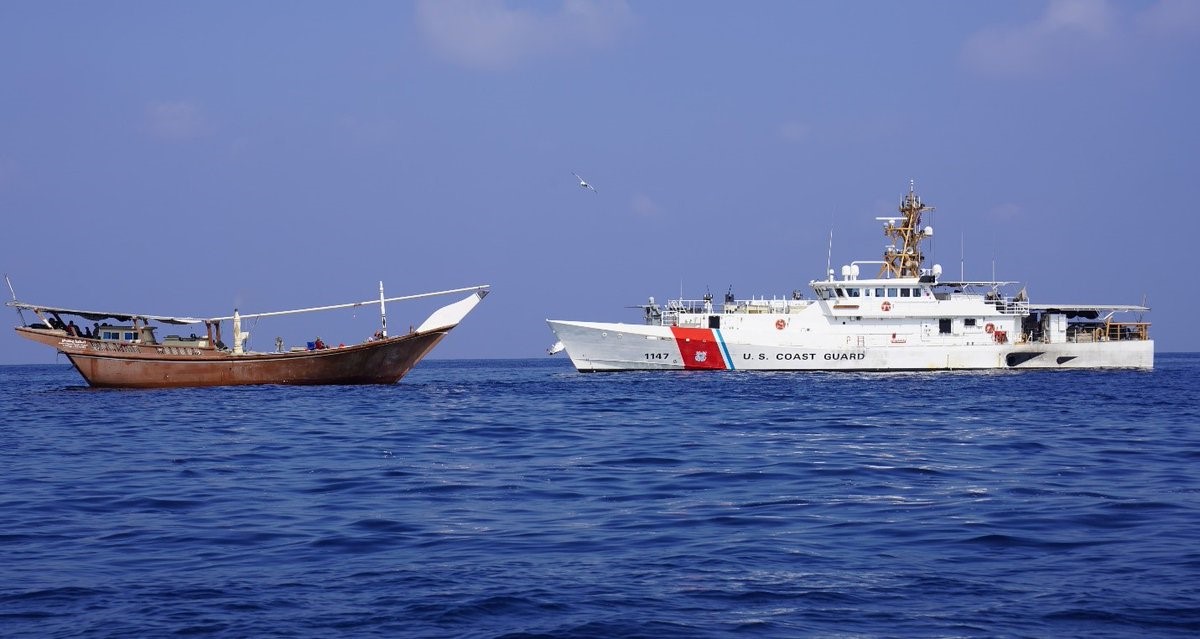
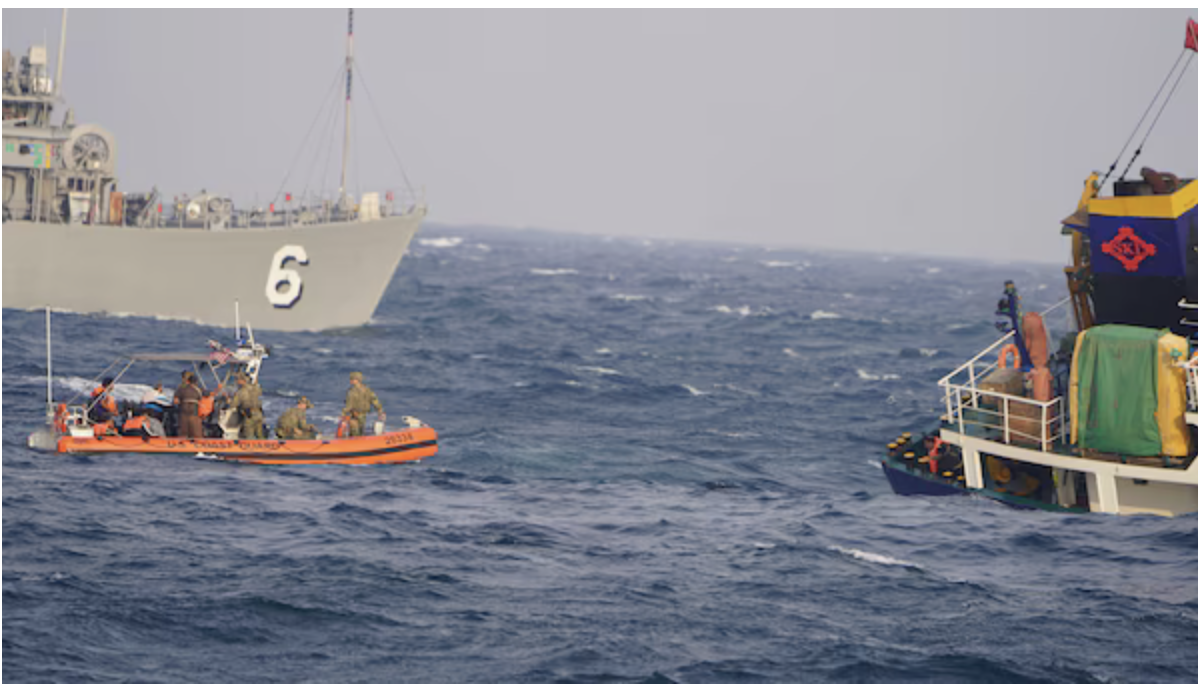
1993 Communications Station Guam received a mayday broadcast from the M/V East Wood.  The ship’s radio operator claimed that the vessel had been taken over by hijackers and that there were 400 people in the vessel’s two main cargo holds.  Another transmission claimed that 10 persons were going to be thrown overboard.  The Coast Guard dispatched an HC-130 from AIRSTA Barbers Point and ordered CGC Rush to intercept.  A boarding team from the Rush seized the vessel and escorted it to an Army installation on the Marshall Islands.  There were 527 Chinese nationals and 10 crewmembers aboard.  The Chinese nationals were repatriated to China and nine of the crewmen were sent to Indonesia.  The 10th crewman was taken to Honolulu to investigate whether prosecution was possible under U.S. law.


APKWS Takes Down Cruise Missile

Vampire Surface to Air/Surface guided 70mm Guided Rocket System using Fletcher launcher and APKWS guided Hydra Rockets.

We have reports that the Ukrainian Navy has shot down a Russian KH-59 cruise missile using an APKWS guided 70mm guided Hydra Rocket.

Russian made Kh-59 air to surface cruise missile. Photo from Wikipedia

I have an intense interest in the system because I believe it meets many of the US Coast Guard’s needs for increased capability against drones, aircraft, small fast highly maneuverable surface craft, and larger vessels, while being small and light enough to equip WPBs. I have been talking about APKWS since 20217. 

And it is cheap. For comparison, an all-up APKWS round cost about the same as a single 57mm Mk110 round, the probability of hit is higher, the effective range–about 5,000 meters–may be shorter, but each round can be more destructive.

The weapon is already in the USN supply system. The Navy would be paying for them, but we have to ask for them, not just for wartime, but for peacetime counter-terrorism as well.

The VAMPIRE system can fit in almost any pickup or vehicle with a cargo bed. (Courtesy of L3Harris)

The complete system was developed by L3Harris.

“Proximity fuzes are used to engage fast-moving targets like drones, aircraft or missiles. L3Harris’ Vehicle-Agnostic Modular Palletized ISR Rocket Equipment (VAMPIRE™), equipped with the WESCAM MX™-10D RSTA sensor system, uses proximity fuzes in order to significantly increase the probability of hitting the target.”

In addition, Vampire includes the four round Fletcher Launcher from Arnold Defense and the APKWS guidance system for 70mm Hydra Rockets.

I believe the Fletcher launcher can be mounted on the mounts we use for the .50 caliber machine gun.

Installed on a cutter, we could have the Electro-optic device on the mast and a Fletcher launcher on either side.

An alternative c-UAS system with radar here.

There is no indication what type of patrol boat the Vampire system was mounted on, but I hope it was one of the former US Coast Guard patrol boats transferred to the Ukraine Navy. Three of the four largest vessels in the Ukrainian Navy are former USCG Island class WPBs. A fourth was lost in combat.

Ukrainian Navy Island-class patrol boats, formerly of the U.S. Coast Guard, conduct maritime security operations in the Black Sea off the coast of Odesa, Ukraine.
UKRAINIAN NAVY

This Day in Coast Guard History, January 26

Based on the Coast Guard Historian’s timeline, https://www.history.uscg.mil/research/chronology/
With inspiration from Mike Kelso

January 26

Every Coast Guard Aircraft Type Pictured Together In Rare ‘Family Photo’. Pictured: HC-130J, C-27J, HC-144, C-37B, MH-60T, MH-65E.

1939 Ground was broken for the construction of an air station at Elizabeth City, North Carolina.  With the support of Congressman Lindsay Warren and a favorable vote by local county and city officials regarding a bond issue, the land was secured for the new facility which was constructed by the WPA.

1953 Coast Guard forces assisted civilian authorities in evacuating 191 persons from the Coxuille Valley, Oregon flood area.

Coast Guard Cutter Healy (WAGB 20) and crew conduct formation steaming exercises with Candian Coast Guard Ship Sir Wilfrid Laurier and crew in the Beaufort Sea, July 28, 2023. The crew conducted a passenger exchange with the Sir Wilfrid Laurier off the coast of Utqiagvik, Alaska. (U.S. Coast Guard photo by Petty Officer 1st Class Michael Underwood)

1963 The modern Canadian Coast Guard was founded on this date.  Their official motto is Saluti Primum, Auxilio Semper (Safety First, Service Always).

1991 Upon receiving a request from the Saudi government, the Bush Administration determined that the Coast Guard would head an interagency team to assist the Saudi government in an oil spill assessment and plan for a clean-up operation after an intentional Iraqi oil spill.

1990 Coast Guard Air Station St. Augustine, home of CGAW-1, was formally commissioned.  The Navy loaned E2Cs to the Coast Guard for use in the efforts by CGAW-1 to track drug shipments by radar.  One E2C, #3501, crashed during a landing at Roosevelt Roads, Puerto Rico, on August 24, 1990 and all four crewmen on board were killed.  CGAW-1 was disbanded soon thereafter and the remaining E2Cs were returned to the Navy.

“This Icebreaker Has Design Problems and a History of Failure. It’s America’s Latest Military Vessel” –Military.Com / Was Halter Marine Ever Really Qualified to Build the PSC?

The tug Aiviq traveling with the mobile drilling unit Kulluk in tow 116 miles southwest of Kodiak City, Alaska, in 2012. Credit: U.S. Coast Guard | Petty Officer 2nd Class Chris Usher

Military.com provides an article, originally published by ProPublica, that questions the acquisition of the new USCGC Storis, formerly M/V Aiviq., suggesting undue influence in the decisions to procure the vessel and to homeport it in Anchorage.

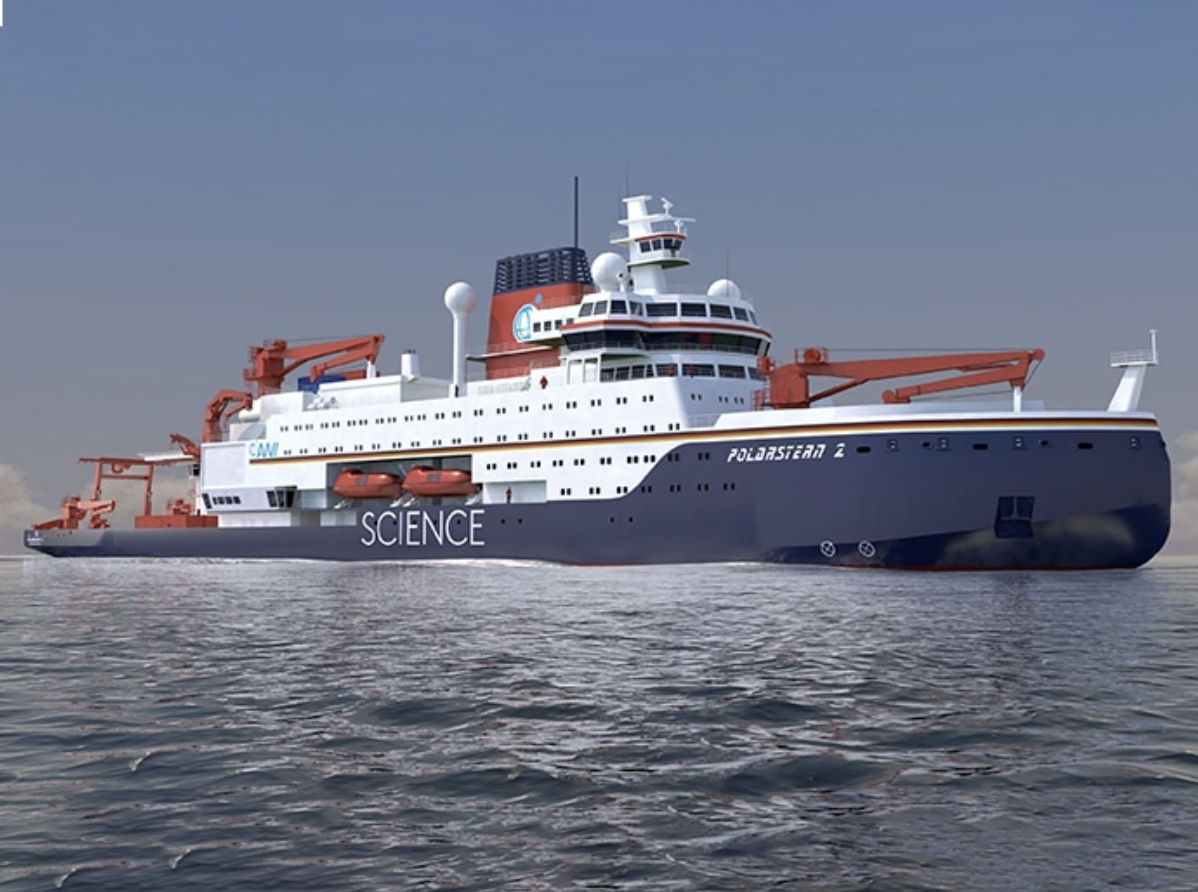
Photo of a model of Halter Marine’s Polar Security Cutter seen at Navy League’s Sea-Air-Space Exhibition have surfaced. Photo credit Chris Cavas.

We would like to think that the Coast Guard has free reign in its award of contracts, but that is, of course, not entirely true.

With this and with the long history of difficulties with the Polar Security Cutter (PSC) program, I have to wonder about the decision to award the contract to award the decision to relatively inexperienced Halter Marine for a design that did not meet the RFP requirement that the design be based on a proven design.

In February 2017, the USCG awarded five fixed-price contracts for heavy polar icebreaker design studies to Bollinger ShipyardsItaly’s Fincantieri Marine GroupNational Steel and Shipbuilding CompanyHuntington Ingalls Industries, and Singapore’s Halter Marine Inc .

On 23 April 2019 Halter Marine was awarded a $745.9M contract for detailed design and construction of the lead ship. This was probably the low bid, but it has proven an unrealistically low bid.

Of the five contenders, Halter Marine was the least experienced and the least familiar to the Navy and Coast Guard.

Halter Marine had changed hands in 1983, 1996, 1999, 2003, and 2022, not a picture of stable management, and it was not partnered in this offer with any experienced builder of icebreakers.

At the time of the award, Halter Marine had built two ships for the US Navy, none for the Coast Guard. The two ships for the Navy were USNS Howard O. Lorenzen (T-AGM-25), 12,642 tons, a Missile Range Instrumentation Ship and USNS Maury (T-AGS-66), 5000 tons, an oceanographic survey ship.

The Navy’s experience with the construction of USNS Howard O. Lorenzen might have raised red flags. Defense News’ Chris Cavas reported,

“The new ship, built under an initial $199 million contract awarded in 2006, has been under construction at VT Halter’s yard since August 2008, when delivery was scheduled for June 2010. The design is based on a pair of Navy survey ships built in the mid-1980s.
“The Navy’s Board of Inspection and Survey, known as INSURV, conducted the Lorenzen’s acceptance trials in the Gulf of Mexico during the week of May 9, …”
“The trial “was reported as unsatisfactory” by INSURV…The failed grade was due to three major discrepancies – thrust bearing temperature, and steering and anchor demonstrations. Three of 15 graded areas – electrical, damage control and aviation – were also graded unsatisfactory.
“INSURV recommended that acceptance not take place until the systems “can be fully re-demonstrated.”
“…In recent years, problems have emerged with several ships under construction at the Moss Point yard for U.S. government customers.
“Last fall, the National Oceanographic and Atmospheric Administration (NOAA), for which VT Halter built a number of fisheries research ships, abruptly canceled completion of a new research ship when it was nearly finished, claiming it was overweight and unable to carry out its coastal mapping mission. The ship was seized by NOAA and moved elsewhere for completion and modifications.
“In 2005, contract disputes led the U.S. Army to cancel completion of a logistics vessel and delay delivery of two others.

The Coast Guard might also have looked at their safety record.

 “…in 2009, unsafe working conditions led to an explosion that killed two employees and injured five others. The company was fined $1.32 million by the United States Department of Labor for 17 willful and 11 serious violations, including willfully exposing workers to toxic fumes in a confined space. According to Secretary of Labor Hilda L. Solis, the explosion “was a horrific and preventable situation. VT Halter Marine was aware of the hazards and knowingly and willfully sent workers into a confined space with an explosive and toxic atmosphere.”

The use of a never completed design should have disqualified Halter Marine. With this as background, could the Coast Guard have missed the warning signs, or might they have been overruled in the selection of the yard? Could this have been a case of undue influence? Who made the final decision, the Coast Guard/Navy acquisition team, the Commandant, the Department of Homeland Security, or someone else? and why?

“US Senate Confirms Kristi Noem as Secretary of the Department of Homeland Security in Sweeping Bi-Partisan Vote” –DHS

Portrait of Governor Kristi Noem, 23 April 2023.

Below is a Department of Homeland Security news release.


Release Date: January 25, 2025

WASHINGTON – Today, the United States Senate voted overwhelmingly to confirm Kristi Noem as the 8th Secretary of the Department of Homeland Security in a vote of 59- 34.

A statement from Secretary Noem on her confirmation is below:

“As the Secretary of the Department of Homeland Security, I will work every day to keep all Americans safe and secure. One of my top priorities is achieving President Trump’s mandate from the American people to secure our southern border and fix our broken immigration system.

“The Trump Administration will once-again empower our brave men and women in law enforcement to do their jobs and remove criminal aliens and illegal gangs from our country. We will fully equip our intelligence and law enforcement to detect and prevent terror threats and will deliver rapid assistance and disaster relief to Americans in crisis.

“I thank President Trump and the US Senate for their trust in me. Together, we will ensure that the United States, once again, is a beacon of freedom, safety, and security for generations to come.”

Prior to her confirmation as Secretary of the Department of Homeland Security, Secretary Noem served as South Dakota’s 33rd Governor and first ever female governor.  A rancher, farmer, and small business owner, Noem served in the South Dakota legislature for years and was later elected to serve as South Dakota’s sole member of the U.S. House of Representatives.

This Day in Coast Guard History, January 24/25

Based on the Coast Guard Historian’s timeline, https://www.history.uscg.mil/research/chronology/
With inspiration from Mike Kelso

January 24

USCGC Citrus, 1984, after conversion to a medium endurance cutter.

1968  Seifu Maru, a Japanese refrigerator vessel, reported a fire and requested clearance to enter Dutch Harbor, Alaska to combat it.  They also reported that two crewmembers had been overcome by smoke and requested their evacuation for hospital treatment.  Clearance was granted and CGC Citrus was ordered to proceed and assist in fighting the fire. The burning ship arrived in Dutch Harbor and advised that the fire was raging between the decks.  Fire fighting parties from Citrus began assisting the crew of the Japanese vessel. Coast Guard aircraft evacuated three patients from Seifu Maru to Kodiak for hospitalization.  The fire assistance rendered by Citrus in a four-day operation saved the Japanese vessel.

1984  MSO Memphis responded to what appeared to be a routine grounding when three barges being towed down river by the M/V Karman P. broke away 40 miles south of Memphis.  Initial reports passed to MSO Memphis by way of Group Lower Mississippi River said the tank barge APEX-3506, with one million gallons of slurry-grade number six oil had grounded with “no damage and no pollution.”  After a boarding team arrived and found the barge sinking and having no means to lighter the cargo, they called in the Gulf Strike Team.  Eventually, through the efforts of MSO Memphis, Gulf Strike Team, Atlantic Strike Team, National Strike Force Dive Team, and the Navy Superintendent of Salvage, as well as a private salvage firm, the barge’s cargo was lightered and the barge itself saved.

January 25

1799 Having existed essentially nameless for 8-1/2 years, Alexander Hamilton’s “system of cutters” was referred to in legislation as “Revenue Cutters.”  Some decades later, the name evolved to Revenue Cutter Service and Revenue Marine.

1940 The ocean station program was formally established on this date under orders from President Franklin Roosevelt.  The Coast Guard, in cooperation with the U. S. Weather Service, was given responsibility for its establishment and operation.  The program was first known as the Atlantic Weather Observation Service and later by thousands of Coast Guardsmen who served after World War II as the “Ocean Station” (OS) program.  Cutters were dispatched for 30-day patrols to transmit weather observations and serve as a SAR standby for transoceanic aircraft.  The program ended in the 1970s.

2004 A helicopter crew from AIRSTA Detroit helped rescue 14 people stranded on an ice floe about one mile west of Catawba Island, Ohio. (It happened again Feb. 7, 2023.)

Patrol Cutter Comparison 2000, 2008, Now, and Future

Coast Guard Cutters Venturous (WMEC 625) and Hamilton (WMSL 753) rendezvous at sea, Nov. 21, 2024, in the Eastern Pacific Ocean. Venturous’ crew conducted a 40-day counter drug patrol within the Coast Guard Eleventh District area of responsibility in support of Joint Interagency Task Force – South. (U.S. Coast Guard photo)

A friend posted the following in response to a post I made on facebook.

The CG placed 20+ vessels into a special status: they are no longer operating nor are they crewed. The personnel and operational funds were redirected to other current and future needs. Current and future budgets should look to downsize shoreside administrative functions by simplifying business processes so that resources can be redirected to operational needs.

Current fleet compared to the fleet in 2000:

So, I decided to look at the current active fleet, first in comparison to the fleet in 2020. At that time, we had 12 WHECs, 32 WMECs, and 49 WPB110s, a total of 93 ships. Currently we have as best I can tell 10 NSCs, 23 WMECs, 58 WPC158s, and 3 WPB110s for a total of 94.

In terms of manpower, the fleet in 2000 required crews totaling 5703 while the current fleet requires a complement of 4785.

The full load tonnage of the fleet in 2000 was 92,168 tons; for the current fleet 102,596 tons. 

Decline before Renewal:

The first National Security Cutter was not commissioned until 2008 and the first Fast Response Cutter not until 2012.

Between 2000 and 2008 the Coast Guard decommissioned three WMECs and eight WPB110s. The 110s as a result of the failed attempt to lengthen them, for a total of 11 ships bring the total down to 82. That would have reduced the manpower requirement to 5347.

The future fleet: 

The currently projected fleet will include 11 NSCs, 25 OPCs, and 67 FRCs for a total of 103. Estimated manning (OPC unknown but I assumed 100, NSC assumed 126, that may be low) would be 5494, and a total tonnage of 185,651 tons full load.

We are moving toward a fleet with fewer large ships, but they will be significantly larger and a fleet of significantly more small ships each significantly larger.

The way the NSCs have been pushed and Webber class WPCs’ better seakeeping and greater number of programmed days underway probably translates into considerably more ship days underway.

In view of the deteriorating world situation, I would like to see some of the out-year OPCs replace by a more capable warship, perhaps smaller and in greater numbers.

I see a need to replace at least some of the WPB87 footers with high-speed craft capable both of speeding to a SAR case of shore and countering a terrorist attack–a true Fast Response Cutter.

“Ministers Joint Statement by the Quad Foreign Ministers” –State Department

A Japan Coast Guard helicopter approaches an Indian Coast Guard patrol vessel during a joint exercise off Chennai, India, January 2018 (Photo: The Asahi Shimbun via Getty) “It’s time for a “Quad” of coast guards,” David Brewster–This modest proposal could help bring stability and security to the Indo-Pacific, without the military fanfare.

Below is a State Department release of a joint statement by the US Secretary of State and foreign ministers of Australia, India, and Japan.

This article from the “The Strategist” suggests that this statement reflects the new administration’s position, and that it moves the Quad closer to a security agreement.

The fact that the Quad foreign ministers meeting was virtually Secretary of State Marco Rubio’s first official activity will be read as a sign of President Trump’s willingness to back the quartet, which after all was revived in 2017 during his first term in office.


Joint Statement by the Quad Foreign Ministers, Media Note, Office of the Spokesperson, January 21, 2025

We, the Secretary of State of the United States and the Foreign Ministers of Australia, India, and Japan, met today in Washington D.C. to reaffirm our shared commitment to strengthening a Free and Open Indo-Pacific where the rule of law, democratic values, sovereignty, and territorial integrity are upheld and defended. Our four nations maintain our conviction that international law, economic opportunity, peace, stability, and security in all domains including the maritime domain underpin the development and prosperity of the peoples of the Indo-Pacific. We also strongly oppose any unilateral actions that seek to change the status quo by force or coercion.

We are committed to strengthening regional maritime, economic, and technology security in the face of increasing threats, as well as promoting reliable and resilient supply chains. We look forward to advancing the work of the Quad in the coming months and will meet together on a regular basis as we prepare for the next Quad Leaders’ Summit hosted by India.

“Hellenic Navy names four (former USCG) Island-class patrol vessels (Video)” –Naval Today

Credit: Ministry of National Defense (Greece)

Naval Today reports on the commissioning of four former US Coast Guard Island class cutters into the Greek Navy.

Lots of friendly nations are benefitting from receipt of previously well-maintained US Coast Guard vessels through Foreign Military Sales. Their availability helps our friends in the maintenance of a global rules based maritime environment. Ships that are no longer economical to support in the US, may be maintainable in other countries where labor costs are lower.

This movement of retiring ships should be part of regular Coast Guard planning. We should set a reasonable life, say 30 years for large ships and 25 for smaller, and produce a 30 year ship building plan. Yes, it may change, and it should, but it would establish expectations for future budgets. We should produce a new projection every year.