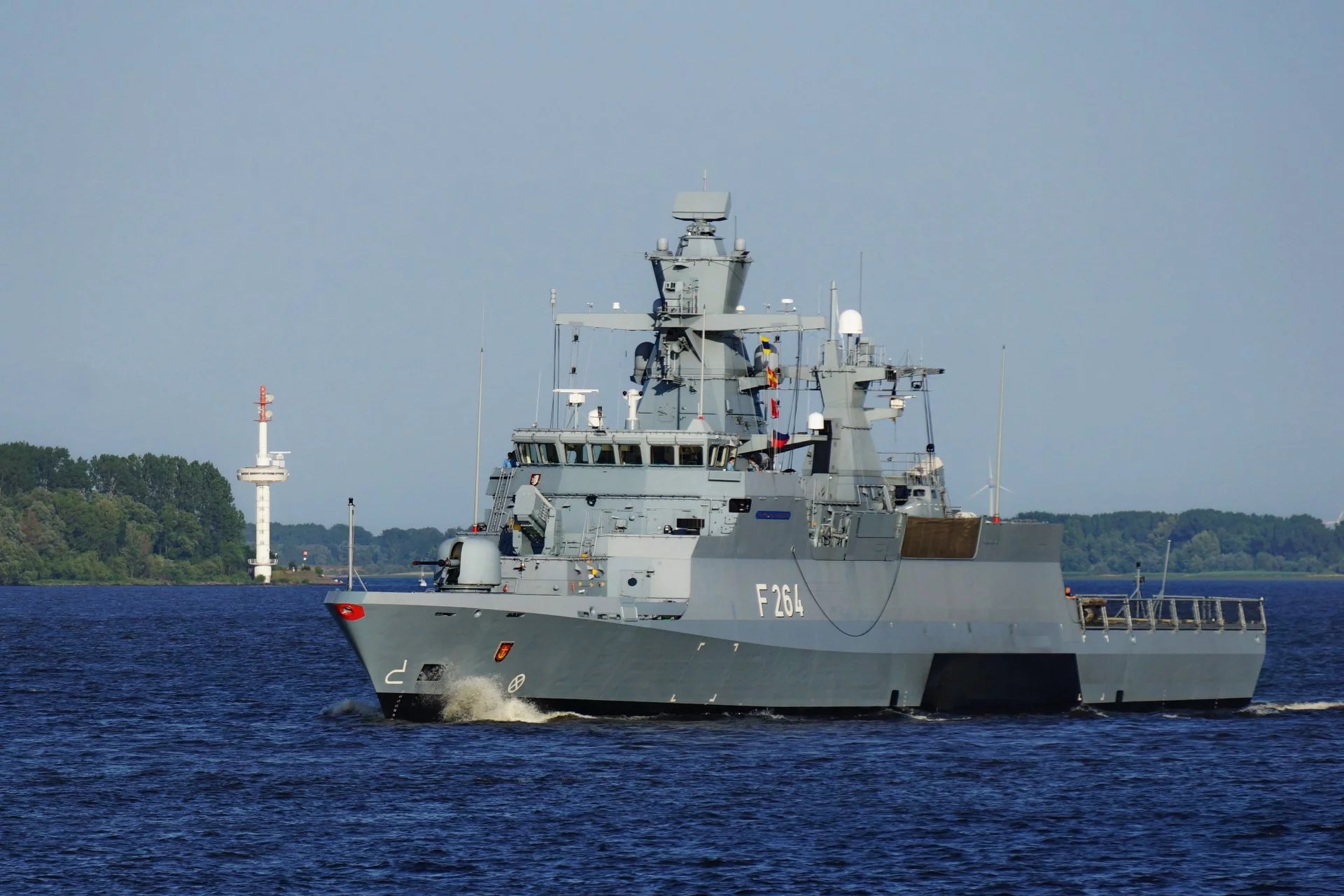
According to information published Die Zeit on October 17, 2024, the German Navy corvette Ludwigshafen am Rhein, deployed as part of the United Nations Interim Force in Lebanon (UNIFIL), successfully intercepted and neutralized an approaching drone near the Lebanese coast.
Unfortunately, the report does not specify which defensive system brought down the drone, but the corvette is relatively small, only a little larger than a WMEC270, and compared to the American DDGs that have been operating against kamikaze drones in the Red Sea, their options were limited. It has two 21 cell RAM (rolling airframe missile) launcher, a 76 mm gun similar to that found on the WMEC270s, two 27mm guns, and an Electronic Countermeasures System.
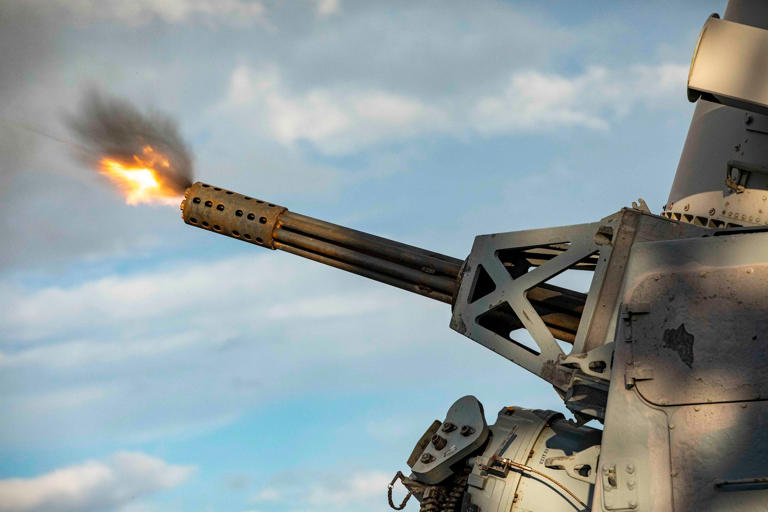
Most US successes against drones have involved air to air intercepts or the use of very expensive standard missiles, with some attributed to medium range ESSMs (Evolved Sea Sparrow Missiles). In one case a drone was brought down by a Phalanx CIWS (Close in Weapon System) like that mounted on the National Security Cutters, but that was a last ditch effort not a weapon of choice.
The Italian Navy, showing great confidence in their 76mm Strales system, shot down a kamikaze drone after forgoing an opportunity to engage it with surface to air missiles.
1853 The English ship Western World grounded off Spring Lake, New Jersey, during a gale with about 600 persons on board. Everyone was rescued using equipment at the nearby station.
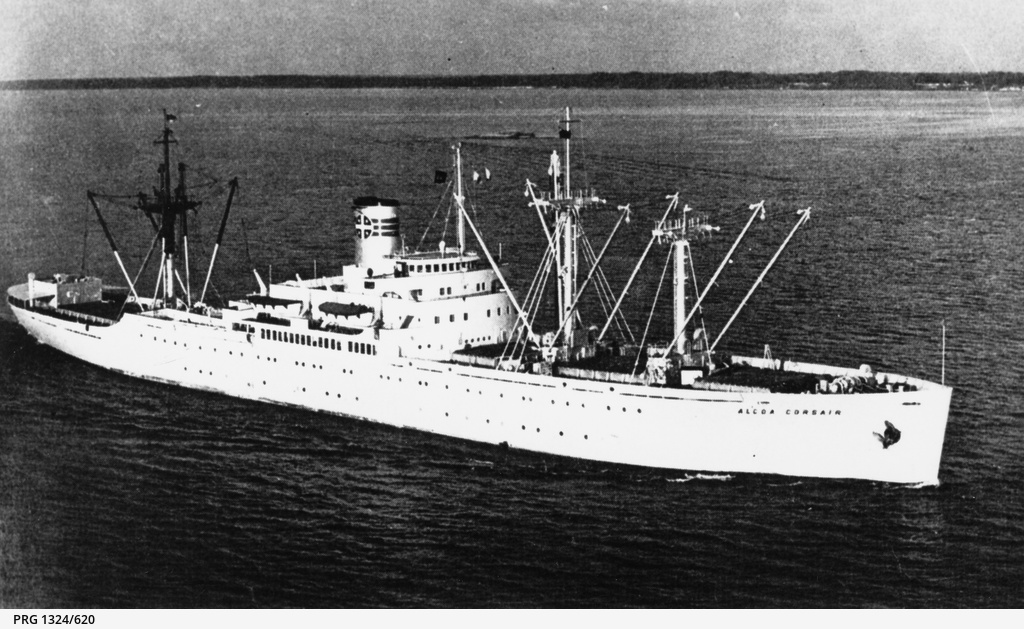
SS Alcoa Corsair
1960 Early in the morning on October 22, 1960, SS Alcoa Corsair and SS Lorenzo Marcello collided near the mouth of the Mississippi River. Although the Lorenzo Marcello suffered no casualties and proceeded to New Orleans, Alcoa Corsair had eight fatalities, nine injured, and one missing, besides being forced to beach because of severe damages. A Coast Guard helicopter removed four of the critically injured crewmen while Coast Guard boats and other craft ferried the remaining ones ashore to waiting ambulances.
Northwest Airlines DC-7
1962 Shortly after a Northwest Airlines DC-7 with 102 occupants ditched in the waters of Sitka Sound, Alaska, a Coast Guard amphibian sighted five life rafts. All on board survived, although three suffered minor injuries. A Federal Aviation Administration supply boat picked up the survivors, later transferring them to CGC Sorrel, which took them to Sitka, Alaska.
USCGC Charles Sexton (WPC-1108). US Coast Guard photo.
2014 The crew of CGC Charles David Jr. repatriated 43 Cuban migrants to Bahia de Cabañas, Cuba. These repatriations were a result of three separate interdictions of people attempting to illegally migrate to the United States. On October 18, 2014, the crew of CGC Charles Sexton interdicted 22 Cuban migrants from two separate interdictions in the Florida Straits. The next day, October 19, Sexton interdicted another 21 Cuban migrants. All of the migrants were safely removed from their makeshift vessels and were transferred to the Charles David Jr. for repatriation.
Throughout the 1970s, Confidence’s crews seized international vessels originating from the Soviet Union, South Korea, Panama, and other nations for violating U.S. fishery laws.
1971 Alaska Senator Mike Gravel criticized the punishment of 18 crewmen of CGC Confidence for showing support for Greenpeace and asked the Commandant, Admiral Chester Bender, to investigate.
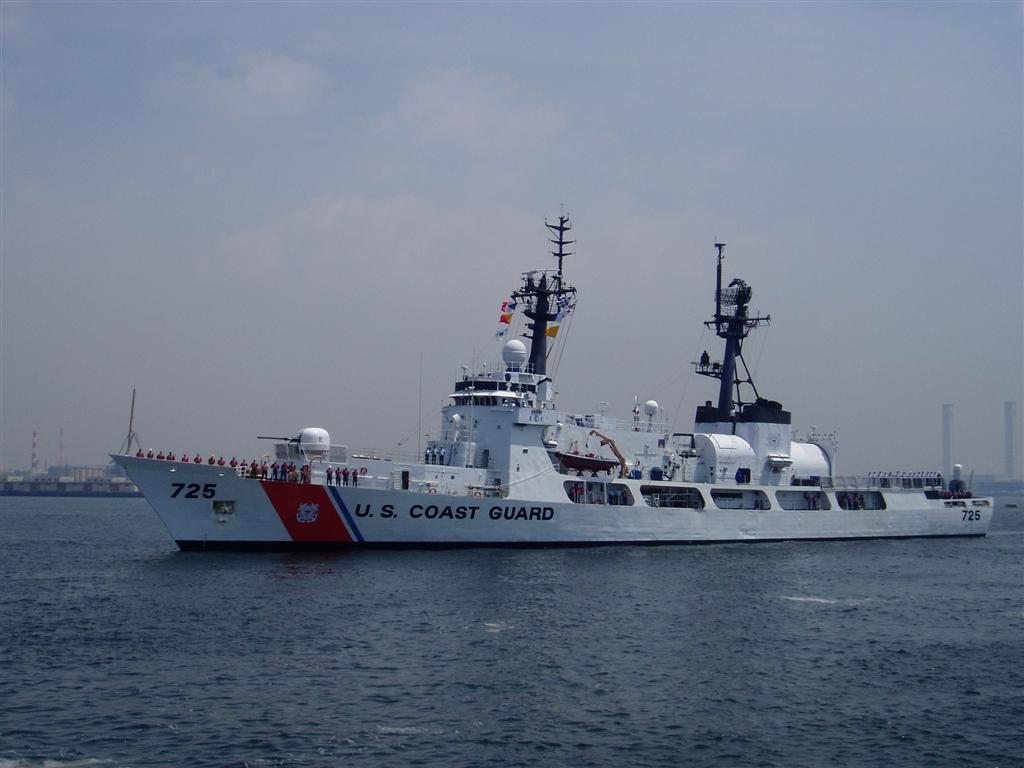
USCGC Jarvis (WHEC-725) participating in RIMPAC 2005.
2009 While on a law enforcement patrol in the Eastern Pacific off the coast of Central America, CGC Jarvis intercepted and captured a self-propelled semi-submersible (SPSS) first located by a U.S. Customs and Border Protection patrol aircraft. Jarvis’s boarding team discovered 4,500 kilos of narcotics aboard the craft and arrested the SPSS’s four crewman.
1892 After ten years of difficult and costly construction, the St. George Reef Lighthouse, built on a rock lying six miles off the northern coast of California, midway between Capes Mendocino and Bianco, was first lit. “St. George Reef Light marks a hazardous line of rock outcrops that extend northwest from Crescent City to form Saint George Reef. The light was abandoned in 1975 and replaced with a navigational buoy to the west of its current location.”
1920 The Superintendent of the 5th Lighthouse District inspected the aids to navigation “in New River Inlet and Bogue Sound, North Carolina by hydroplane in two hours, which would have required at least four days by other means of travel, owning to the inaccessibility of the aids inspected.”
1944 Allied landings on Leyte, Philippine Islands commenced. Many Coast Guard units participated in the landings, which marked the fulfillment of General Douglas MacArthur’s promise to the Filipino people that he would return to liberate them from the Japanese.
1950 President Harry S. Truman issued an executive order “activating” the Magnuson Act, which had been passed by Congress earlier that month. This act, authorizing the president to invoke the Espionage Act of 1917, tasked the Coast Guard once again with the port security mission.
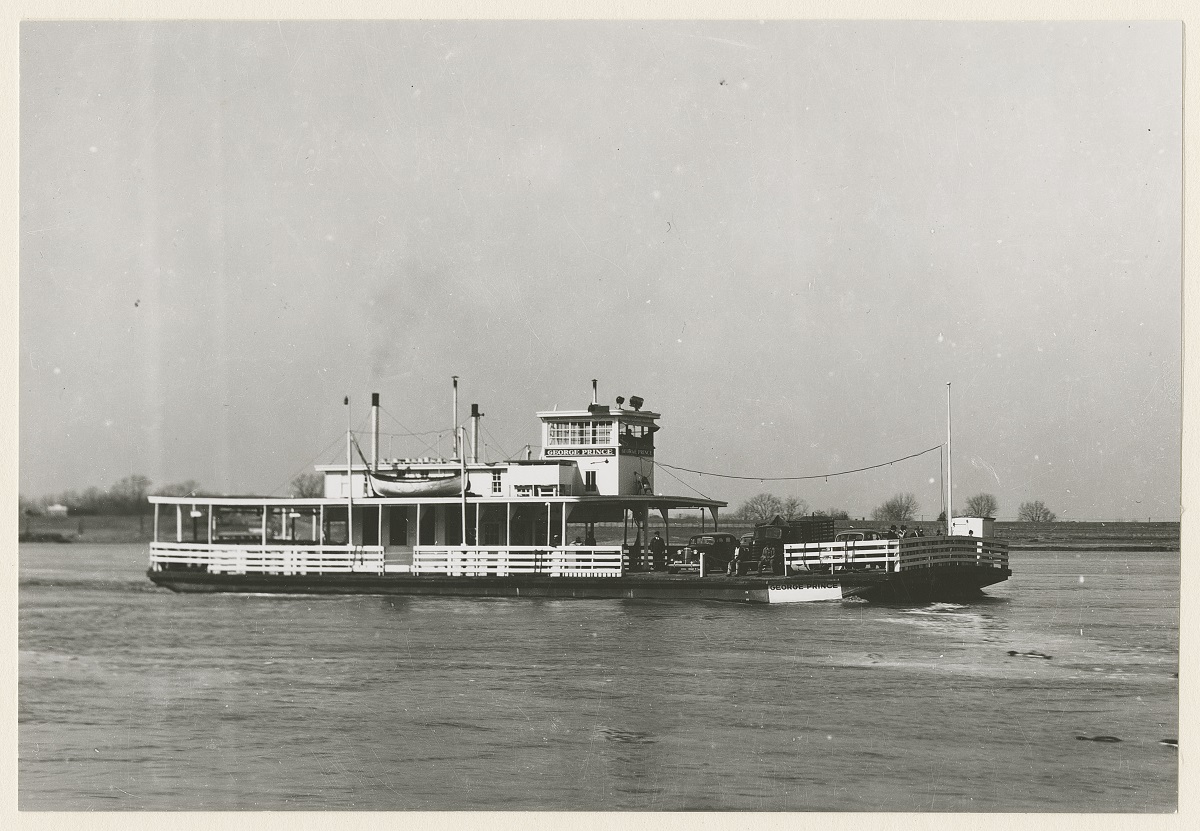
Ferry George Prince
1976 The 120-foot ferry vessel George Prince, carrying 96 passengers and crew along with approximately 30 vehicles, collided with the Norwegian tank vessel Frosta in the Mississippi River about 20 miles above New Orleans. George Prince was underway from Destrehan to Luling, Louisiana and was loaded to capacity. Frosta struck George Prince on the port side aft and the ferry quickly capsized and drifted upside down until it grounded on the right descending bank approximately one mile downstream from the point of collision. “Ninety-six passengers and crew were aboard the ferry when it was struck, and seventy-eight perished. This accident is the deadliest ferry disaster in United States history.”
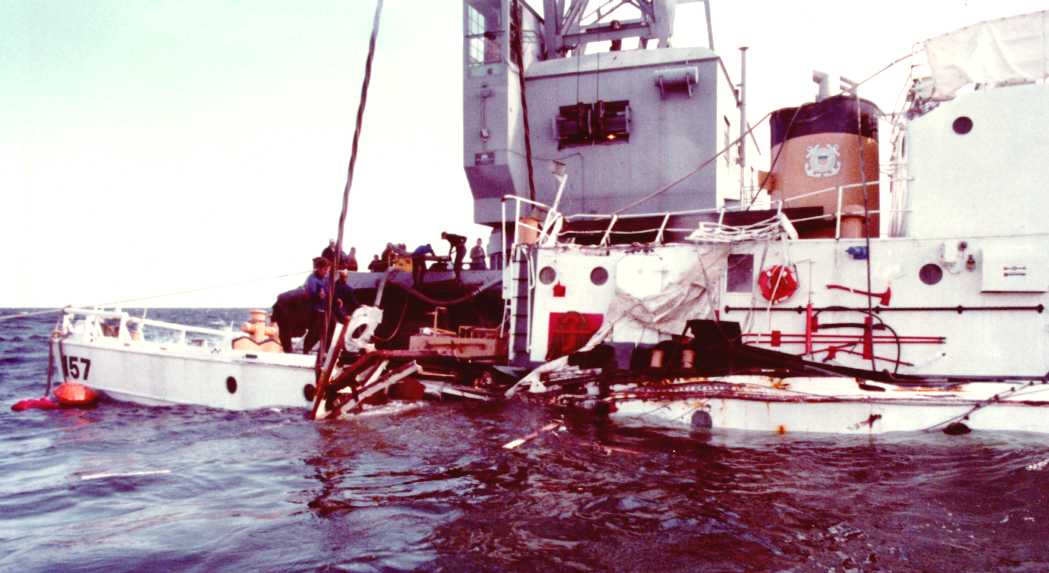
USCGC Cuyahoga (WIX-157) after being raised. USCG photo.
1978 CGC Cuyahoga sank after colliding with M/V Santa Cruz II near the mouth of the Potomac River. Eleven Coast Guard crewmen were killed.
USCGC MUNRO
2021 CGC Munro (WMSL 755) and crew returned to their Alameda, California homeport after a 102-day, 22,000 nautical mile deployment to the Western Pacific. Munro departed Alameda in July and operated under the tactical control of the U.S. Navy’s 7th Fleet to promote a “free and open Indo-Pacific.” Munro’s crew executed numerous cooperative engagements, professional exchanges and capacity building efforts with naval allies and partners, including the Japan Coast Guard, Japan Maritime Self Defense Force, Philippine Coast Guard and Bureau of Fisheries and Aquatic Resources, Royal Australian Navy, and Indonesia Maritime Security Agency.
1881 The sloop Zulu Chief with four passengers and a crew of two men struck the bar off Hog Island Inlet, Virginia at a point about half a mile from the beach. The accident occurred at 11 o’clock am in plain view of the crew of Station No. 9, Fifth District, on Hog Island. They launched the surfboat and went to the sloop’s assistance. She was pounding heavily and lay in a very dangerous position. The life-saving crew went to work without delay and carried out her anchors and succeeded in saving the vessel.
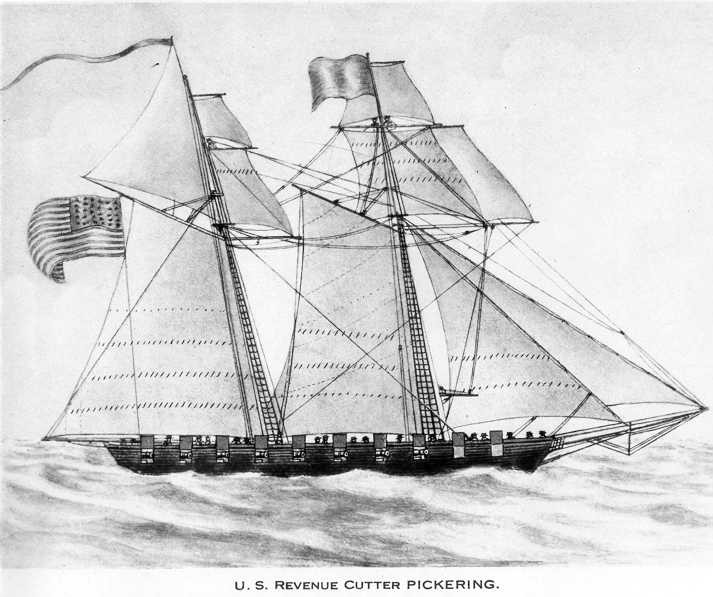
United States Revenue Cutter Service Ship Pickering, later renamed to USS Pickering U.S. Navy Historical Center Photograph- -Released
1799 USRC Pickering (70 men) (having been transferred to the US Navy 20 May) captured the French privateer L’Egypte Conquiste (250 men) on this date during the Quasi-War with France.
1848 Captain Douglas Ottinger, USRM, was designated by the Secretary of the Treasury to supervise the construction of the first Life-Saving stations and the equipment and boats to be placed at them.
USRC Eagle under full sail, in a painting by Patrick O’Brien. She was a topsail schooner, standard in revenue cutters of her period.
1814 The crew of USRC Eagle, which had been driven ashore near Negros Head, New York in an encounter with the British brig HMS Dispatch, dragged the cutter’s guns up a bluff in an effort to continue the battle. The New York Evening Post gave an account of what happened next to the out-gunned cutter and its crew:
“During the engagement between the Cutter EAGLE and the enemy, the following took place which is worthy of notice. Having expended all the wadding of the four-pounders on the hill, during the warmest of the firing, several of the crew volunteered and went on board the cutter to obtain more. At this moment the masts were shot away, when the brave volunteers erected a flag upon her stern; this was soon shot away, but was immediately replaced by a heroic tar, amidst the cheers of his undaunted comrades, which was returned by a whole broadside from the enemy. When the crew of the Cutter had expended all their large shot and fixed ammunition, they tore up the log book to make cartridges and returned the enemy’s small shot which lodged in the hull. The Cutter was armed with only 6 guns, 4 four-pounders and 2 twos with plenty of muskets and about 50 men. The enemy being gone and provisions scarce the volunteers from this city left Captain Lee and his crew and arrived here on Thursday evening the 13th instant, in a sloop from Long Island. . .We have since learned that Captain Lee succeeded in getting off the Cutter and was about to remove her to a place of safety when the enemy returned and took possession of her. She was greatly injured, but it is expected that the enemy will be able to refit her to annoy us in the sound.”
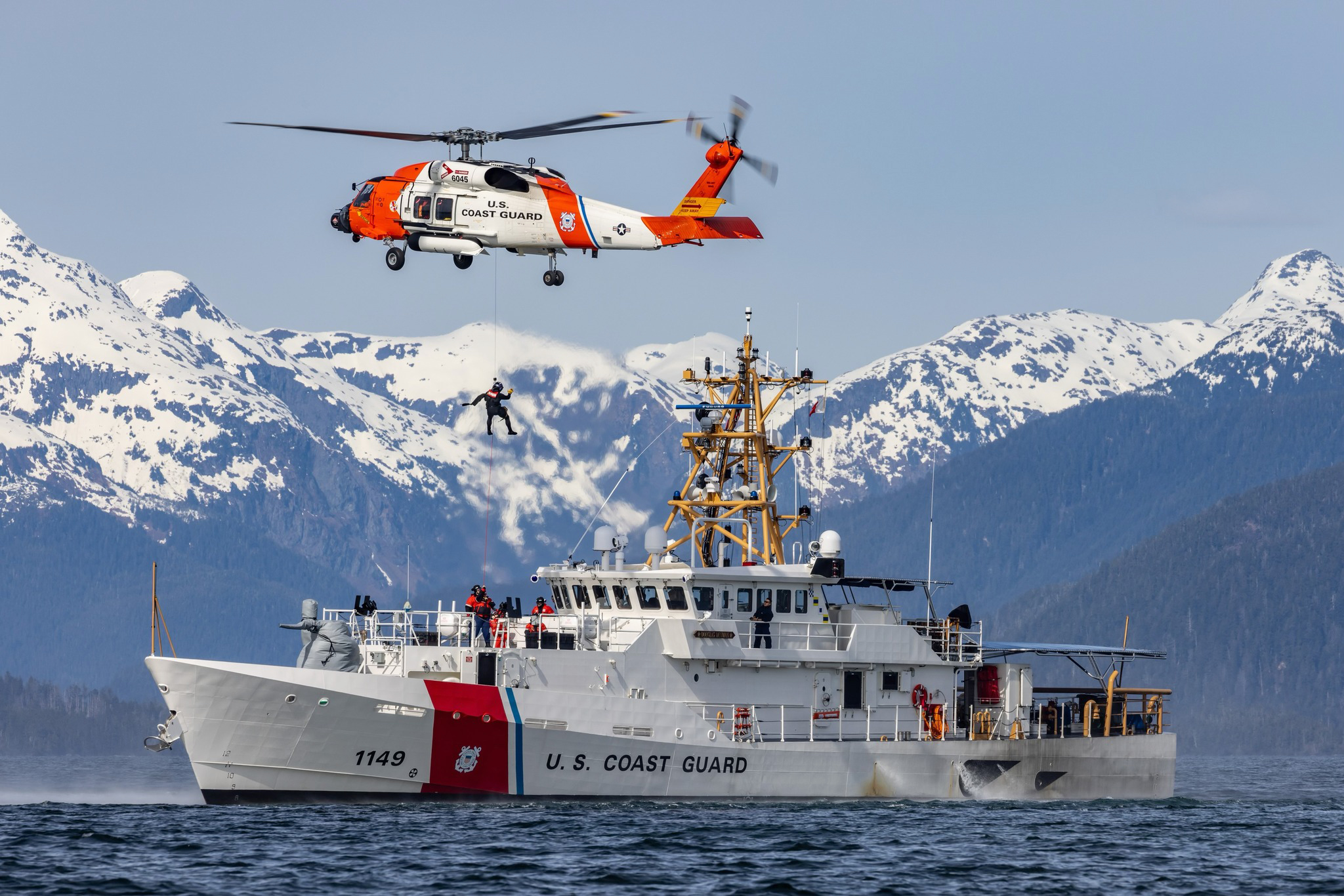
Crews assigned to Coast Guard Air Station Sitka, the Coast Guard cutter Douglas Denman, Sitka Mountain Rescue and the Sitka Fire Department participate in the first day of a weeklong search and rescue exercise in Sitka, Alaska, May 9, 2023.
1977 The Coast Guard commissioned AIRSTA Sitka.
1989 An earthquake registering 7.1 on the Richter Scale hit Northern California, killing 67 people. Coast Guard units assisted state and local agencies in rescue and relief operations.
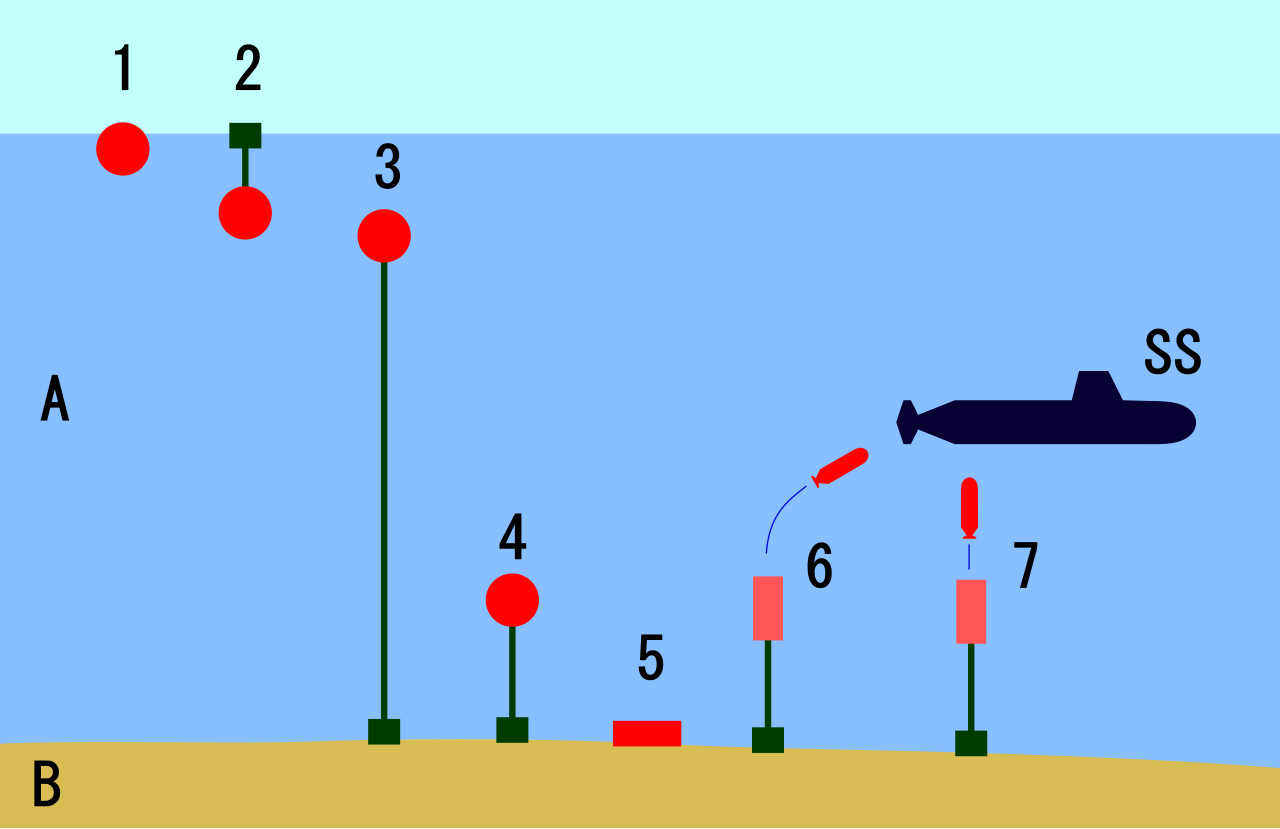
Types of Naval Mines
2014 U.S. and Canadian military personnel and government civilian agencies participated in Exercise Frontier Sentinel 14 (FS 14) from October 17-24, 2014. This full-scale exercise is the final phase of a three-part scenario that focuses on maritime homeland security. FS 14 was a combined U.S. Coast Guard Atlantic Area, Canadian Joint Task Force Atlantic, and U.S. Navy Fleet Forces Command exercise designed to test the coordinated response against a maritime threat to North American ports. “This exercise tests the ability of U.S. Coast Guard, Navy, Canadian forces, and civilian agencies to successfully respond to a complex maritime threat to the homeland,” said VADM William Lee, Coast Guard Atlantic Area commander. “Exercises such as Frontier Sentinel allow us to strengthen partnerships with our Canadian and Navy counterparts in a realistic setting, which will enable us to improve our interoperability, so we are prepared to respond to any and all maritime threats to the homeland.” Phases one and two of FS 14 occurred in August and September and focused on maritime threats in the waters of the Atlantic Ocean, including Halifax, Nova Scotia. Phase three of the exercise will focus on the coordinated detection, assessment and response to a mine threat in the Delaware Bay. The exercise is limited to specific areas in Delaware Bay and should not significantly impact vessel traffic or bay operations. Frontier Sentinel is an annual exercise series, initiated in 2006, established to improve the collaborative information exchange, planning and coordinated response between operational-level commands of the Tri-Party, which consists of U.S. Coast Guard, U. S. Fleet Forces Command, and Canadian Joint Task Force Atlantic, in response to security and defense threats in the maritime domain.
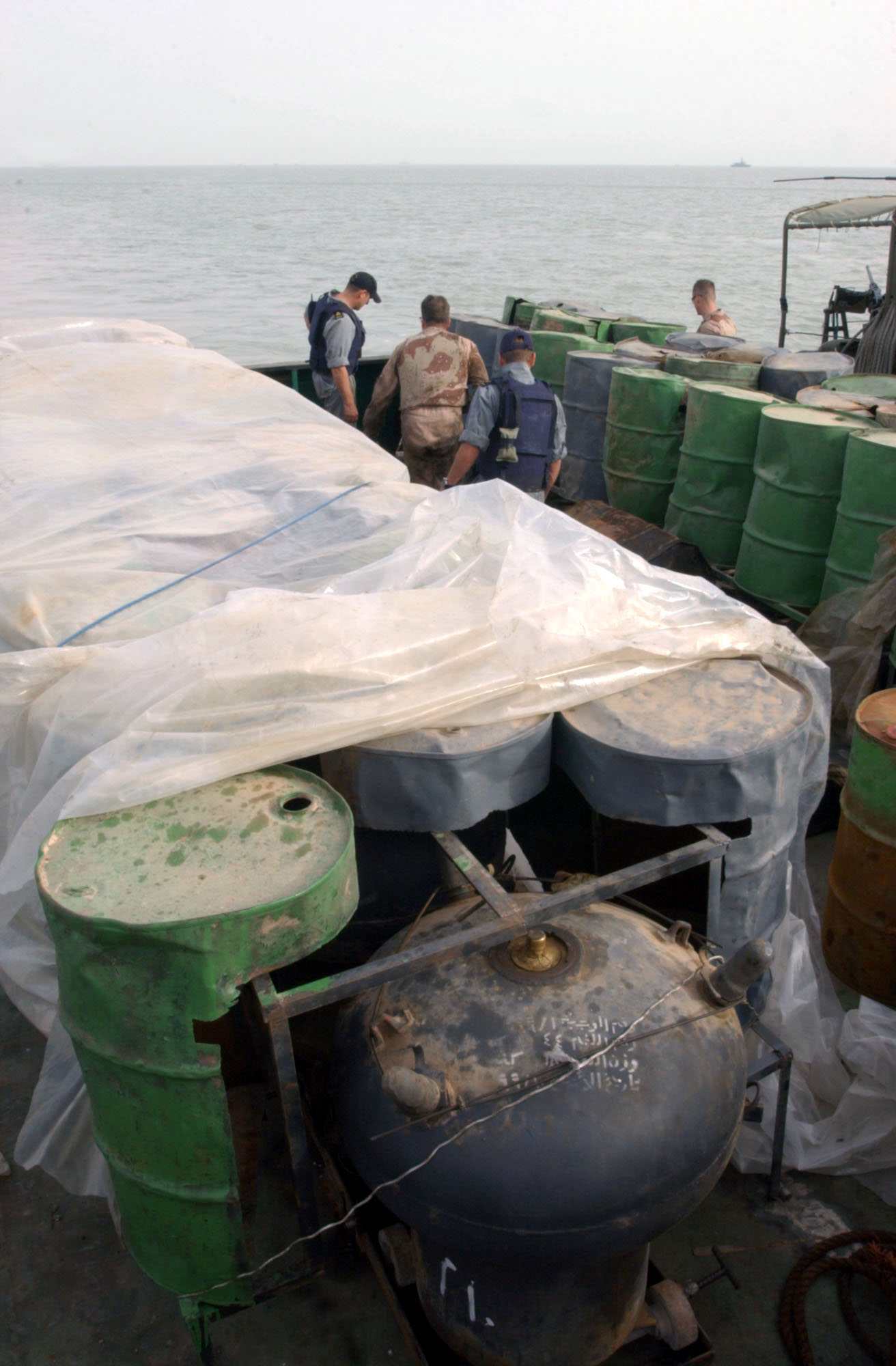
030321-N-4655M-029 The Arabian Gulf (Mar. 21, 2003) — Coalition Navy Explosive Ordnance Disposal (EOD) team members inspect camouflaged mines hidden inside oil barrels on the deck of an Iraqi shipping barge. The shipping barge was intercepted and inspected by Coalition Maritime Interdiction Operation (MIO) and Vessel Board Search and Seizure (VBSS) teams from the patrol craft USS Chinook (PC 9) in the early hours of Operation Iraqi Freedom. Operation Iraqi Freedom is the multi-national coalition effort to liberate the Iraqi people, eliminate Iraq’s weapons of mass destruction and end the regime of Saddam Hussein. U.S. Navy photo by PhotographerÕs Mate 2nd Class Richard Moore. (RELEASED)
2015 The Coast Guard issued a certificate of inspection to the LNG-powered M/V Isla Bella. The 736-foot, 3,100 TEU, U.S.-flagged vessel is the first container ship in the world capable of operating on liquefied natural gas. Isla Bella was the first of two Marlin-class containerships built by NASSCO in San Diego for operation by TOTE Services in the Jones Act trade between Jacksonville, Florida and Puerto Rico.
1790 A contract was signed for the construction of the “first” of the 10 revenue cutters, Massachusetts, at Newburyport, Massachusetts.
1952 A Merchant Marine Detail was established at Yokohama, Japan to handle increased merchant marine problems occurring there as a result of the Korean Conflict.
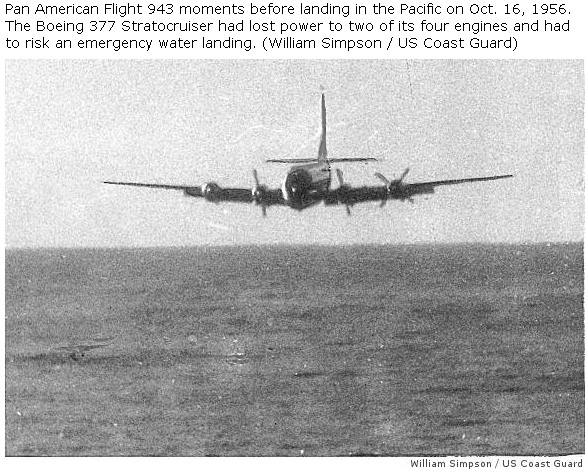
Pan Am Flight 6 ditching in the Pacific Ocean, photographed from US Coast Guard Cutter Pontchartrain. Note that engine #4 appears to be feathered.
1956CGC Pontchartrain, on Ocean Station November, rescued the passengers and crew of Pan American Clipper Flight 6 after the clipper ditched between Honolulu and San Francisco. All 31 aboard survived with only minor injuries.
PanAmFlight6-Ditches. US Coast Guard Photo
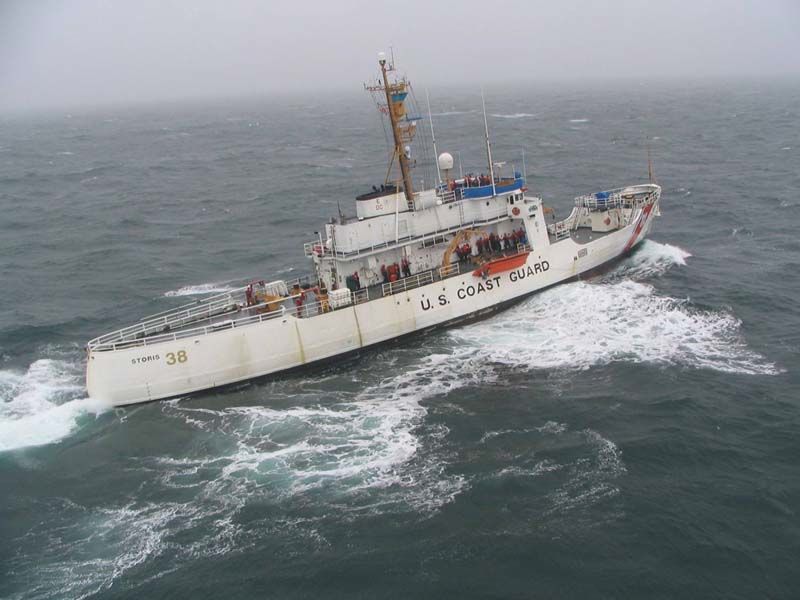
USCGC Storis, a Arctic Patrol Cutter.
1992 CGC Storis became the first foreign military ship to visit the Russian port of Petropavlosk since the Crimean War. During the goodwill visit, Storis conducted joint operations with the Russian icebreaker Volga.
1846USRC McLane ran aground while attempting to tow three ships across the bar of the River Alvarado during the Mexican War in support of U.S. operations there. (McLane was refloated. This was part of the First Battle of Tabasco. Also involved was USRC Forward. McLane and Forward subsequently blockaded the port. Eleven cutters were assigned to cooperate with Army and Navy in the Mexican War. Cutters McLane, Legare, Woodbury, Ewing, Forward, and Van Buren were assigned to the Army. Cutters Wolcott, Bibb, Morris, and Polk were assigned to the Navy.)
1966 Coast Guard Port Security & Waterways Detail arrived for service in Vietnam.
2001 President George W. Bush announced that a letter sent to Senate Majority Leader Tom Daschle was laced with anthrax. This followed a number of other anthrax attacks in Florida and New York. The EPA requested Coast Guard assistance. Members of the Atlantic Strike Team (AST) deployed to Washington, D.C., while Gulf Strike Team (GST) members were deployed to Florida. Strike team members conducted entries into the affected areas, collected samples, and assisted in the cleanup of those areas. The AST members in Washington coordinated entries into the U.S. Capitol, Hart Senate Building, the U.S. Supreme Court, and the Government Printing Office, among others. The GST members took samples and provided decontamination stations at the American Media Inc. headquarters building and post offices in Boca Raton, Florida, the site of the first reported anthrax attack. (History of the National Strike Force)
The cost of ammunition for these systems actually looks trivial compared to the cost of missiles, but I am not really a fan of their use on cutters.
While it has been improved, the basic system goes back to 1973, plenty of time for adversaries to redesign their missiles to minimize its effectiveness.
The projectile is a high density, solid 12.7mm (.50″) sub-caliber discarding sabot round with no explosive content.
An enemy using anti-ship cruise missiles will endeavor to fire several missiles and have them arrive simultaneously. On a Navy DDG or FFG, they can begin countering cruise missiles as soon as they appear over the horizon or even earlier, as demonstrated recently in the Red Sea. Consequently, their Phalanx would only have to deal with rare leakers.
Cutters have, at best, a chance of bringing down a cruise missile with the 57mm. We don’t yet have a smart munition considered reliably effective against cruise missiles.
Phalanx’s effective range is reportedly 1,625 yards. A 600 knot anti-ship cruise missile covers that distance in less than five seconds. New generation supersonic missile cover that distance in far less time. The system does not move on to a second threat until the system’s radar recognizes that the first target is no longer a threat. It seems unlikely that Phalanx could engage more than one missile, much less more than two if they are timed to arrive simultaneously. There is also a good possibility that even if successfully engaged at very short range, missile debris might still impact the ship.
Replacing the Phalanx with SeaRAM, which has an operational range of 9 km (5.6 mi), would at least allow it to engage several targets simultaneously since it is a “fire and forget” system. The switch should be easy. The mount, footprint, and support requirements are the same with minimal changes required to the ship. Like Phalanx, SeaRAM is an autonomous system. It can also be used against surface targets.
Even with their superior long-range systems, the Navy began replacing one of the two Phalanx systems on some destroyers with SeaRAM in 2015. The Littoral Combat Ships which have a combat system similar to the National Security Cutters were equipped with SeaRAM or RAM from the beginning (2008).
There are no US Navy ships armed with only guns and CIWS.









 Chuck Hill's CG Blog