Going Green, Navy, Marines, and Yes the Coast Guard Too

US Naval Institute featured a column from the New York Times that talked about the Navy and Marine Corp going green for reasons any war fighter can understand, including trimming back on a vulnerable logistics tail.

The Coast Guard is also seems to be moving in the same direction. The description of the OPC includes a link to a 16 page (pdf) presentation (powerpoint?) on how the service would like to apply  “green” technologies and concepts to the Offshore Patrol Cutter (OPC).

“Trade Studies and White Papers developed the following areas of
interest for OPC:

“Hull design-Requires early/upfront considerations

  • Fuel Use and Fuel Storage (carbon footprint)
  • Noise (along with prop)

“Outfitting –Modification possible throughout lifecycle

  • Marine Sanitation System
  • Solid Waste Treatment
  • Marine Diesel Engines
  • Oily Water Separators

“Consumables –Provides greatest number of opportunities

  • Lighting
  • Batteries
  • Hull Coatings
  • Fluids and Lubricant”

They might be considered under “fuel and Lubricants,” but bio-fuels weren’t called out specifically. The emphasis seemed to be on controlling emissions and effluents rather than “sustainability,” but if the Navy is going to Bio-fuels, you know we will need at least the capability as well.

The control of engine and prop noise might have a side benefit if these ships ever need to tow a passive towed array sonar.

What’s Wrong With This Picture?

What is wrong with this picture? Not the artist’s concept, the word picture painted by the description found at the acquisition directorate web site, that may be the first thing, perhaps the only thing, that a person learns about the OPC?

——————————————————————————————————–

Offshore Patrol Cutter

Conceptual Rendering of the OPC
(Disclaimer: The conceptual renderings posted on this website are for artistic display purposes only and do not convey any particular design, Coast Guard design preferences, or other requirements for the OPC.)

The Offshore Patrol Cutter (OPC) will complement the Coast Guard’s in-service fleet and next-generation cutters to extend operational capabilities across the mission spectrum. Learn more

Features

  • increased range and endurance
  • more powerful weapons
  • larger flight decks
  • improved Command, Control, Communications, Computers, Intelligence, Surveillance and Reconnaissance (C4ISR) equipment
  • will accommodate aircraft and small boat operations in higher sea states
  • will use “green” technologies and concepts to reduce environmental impact while underway

——————————————————————————————————————–

These ships are not nice to have. They are not gravy or icing on the cake. They don’t complement or extend the “fleet and next-generation cutters.” They are the next-generation cutters and in a very real sense they will be the fleet. That they are equipped, as ships are equipped in the 21st century, should be taken for granted, that is not the reason we are building these ships.

Where is the urgency? These ships will replace ships now long overage. We are 20 years behind in the procurement process, and without them, we will have almost no offshore capability.

Why aren’t we pleading our case, and not just on the web site? Where are the articles in the US Naval Institute Proceedings and the Navy Leagues’ Seapower?

We know the nations needs these ships. If we don’t make them understand why we need them, and need them yesterday, we are failing in our duties.

Indian CG Building Ships, Buying Helos, Domain Awareness

There has been a lot of news about the Indian Coast Guard lately. India is rapidly its Coast Guard, spurred on by the experience of the Mumbai attack.
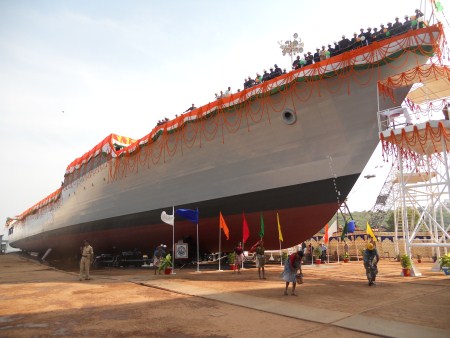
FOR MARITIME PATROL: ‘Vijit', an Offshore Patrol Vessel developed by Goa Shipyard Ltd. for the Coast Guard, will be commissioned on Saturday.

Yesterday they commissioned the Vijit (OPV31), a 310 ft Offshore Patrol Vessel (OPV), 1,800 tons, with 30 mm cannon, helo deck and hanger, and a maximum speed of 26 knots. This is the second ship of a class of three. The first ship of the class, ICGS Vishwast (OPV 30) was entered service March 17.
Another, larger vessel, the Sumitra (seen below), 2,300 tons, 76 mm and two 30 mm, helo deck and hanger was launched Dec 6. She is the forth ship of her class.
There are indications the Indians will soon contract for another six OPVs. So currently the Indian Coast Guard has 18 Offshore Patrol Vessels, they have two under construction, and the apparent intent to add six more. The oldest entered service in December 1983. In addition they are building three 3,300 ton polloution  control vessels, and the Indian Navy has six ships specifically designed to patrol the EEZ that are half sisters of one of the Coast Guard classes.
The size of India’s patrol force compares favorably with our own. Conservatively assuming 20 ships, dividing India’s EEZ 2,305,143 sq km by 20 OPVs the ratio is 115, 257 sq km/OPV compared to the ratio for the US (12,174,629 sq km EEZ/43 OPVs) of 283,181 sq km/OPV.
They have also issued Requests for Information (RFI) as a step toward procurement of 16 six point five ton, max take off weight (MTOW) helicopters for shipboard use and 14 twelve ton MTOW helicopters for use from both shore and ships. “The RFIs require the (sic) both types of helicopters to have hard points for gun mounts that can take both 7.62mm and 12.7mm guns. It also wants the shore-based helicopters to be able to integrate 20/30mm cannons.”
They have also recently awarded a $16M contract to SAAB to supply a coastal surveillance system for the entire 7400-kilometer long Indian coast. Its not clear what they are getting for this, but it is part of a general improvement of their domain awareness and coordination between agencies.

OPC–Some answers

Today, I’ll finish giving my answers to the questions I posed earlier.

My answer to the most basic question, “Why do we need them?” or in fact any large cutters, is here.

What missions will not get done if the program is canceled?

  • Drug Interdiction
  • Migrant Interdiction
  • Defense Readiness
  • Other Law Enforcement (foreign fisheries enforcement)
  • Living Marine Resources (domestic fisheries enforcement)

These missions are largely accomplished by the ships the OPCs are intended to replace and will be impacted severely if the OPC program is canceled.

“Ports, Waterways, and Coastal Security” could also be adversely effected if the current terrorist threat levels take a turn for the worst.

Marine Safety and offshore SAR will also be adversely effected. Large cutters check compliance with commercial fishing vessel safety regulations on board U.S. vessels in isolated areas like the Western/Central Pacific and Bering Sea/Aleutian Islands. Additionally, flight deck equipped cutters with higher sea state capabilities are often essential for offshore SAR.

Are those tasks worth doing?

I have my own doubts about the efficacy of doing maritime drug interdiction, so I am not a fan of sending ships to operate off of Colombia, but that is only a small part of the drug enforcement effort, which is only a part of what these ships do. On patrol in the US EEZ, they are multi-mission resources, and if they are not involved in drug enforcement, they will be doing something else useful.

Frankly, I don’t think we have properly prepared for the possibility of our enemies using a medium to large ship to make an unconventional attack on a US port. Neither the ships we have now, nor the ships that we are building have weapons that can reliably stop a ship from reaching its objective. Nevertheless, adding the weapons that can do that, is easier and quicker than building ships. The ships are needed in any case, to hopefully intercepts inbound threats and make a determination if they are hostile before they get to our ports. (This likely requires attempting to stop and board the vessel.) The larger cutters, as opposed to patrol boats, are likely to make that determination further from the ports, giving us a better chance of successfully stopping an attack.

Offshore fisheries are already among the most dangerous professions in the US, I don’t think we want to make it any more dangerous.

Migrant Interdiction and Fisheries Patrols appear worthwhile, but ultimately the law makers are going to have to decide if the laws they have created are worth enforcing.

What can they do that you can’t do with the 154 ft Hero class fast response cutters (FRC)?

The new Fast Response Cutters are likely to prove unexpectedly useful, even so, they are certainly at a disadvantage compared to the OPC. Much less endurance. Much greater stress on the crew in even moderately bad weather. No helicopter facilities. Only one smaller, less capable ship’s boat. Smaller crews means less depth in the boarding teams, and less experience. OPCs can do boardings in more severe weather. The FRCs will also not have access to some of the intelligence resources that the OPC will have. In some limited circumstances, particularly operating in company with larger cutters, I think the FRCs will prove useful as a patrol asset, but bottom line, they are designed to “respond’ not to patrol.

Why don’t we let the Navy provide the ships, and “You can just put a detachment on board to do law enforcement missions.”

The Navy has been saying that they do not have as many ships as they need. They have about 288 and have repeatedly expressed a need for 313. Using Navy ships to do Coast Guard missions distracts them from their normal operations. Any navy ship used to replace an OPC is likely to cost more both to procure and to operate and will not have the benefit of the more focused and experienced Coast Guard Crew that routinely executes these missions.

Senators and Representatives will ask, “What’s in it for my constituents?”

  • For those concerned about the loss of American productivity, the program preserves the nation’s ship building infrastructure, including smaller yards that can’t build some of the more complicated Navy ships. Using more than one yard could foster competition while broadening political support for the program. Completion of these ships might allow a smaller shipyard to develop the skills and credibility to compete for more complex Navy contracts.
  • For those concerned about unemployment, the program can be thought of as a jobs program that also creates long lasting resources.
  • For environmentalists, these ships police fishing, protect endangered species, and support environmental policy.
  • For those concerned about terrorism and the National defense, in times of crisis these larger cutters will protect US ports from covert attack, freeing Navy ships for offensive roles.
  • For those concerned about the epidemic of drugs in the US, they help to curb the importation of illegal drugs.
  • For those concerned who advocate globalization, these ships insure that our part of the “global commons” are safe for commerce and the exploitation of our resources.

Why do they need to be so big and complicated?

The current concept is not much more complex than the 270s, and only slightly larger. Most of the additional complexity is to allow the ships to take advantage of intelligence resources which should also make them more efficient and effective.  I can even save fuel by pinpointing where the ship should be going instead of more random patrolling. Increasing size has only a small impact on life cycle costs, but it will make the ships much more capable than the smaller ships they replace.

Aren’t the current ships doing the job? Why can’s you build a simpler ship like the 210?

We can build simpler ships,  but depending on our choices they could be unable to catch up with a modern merchant ships, unable to use available intelligence information, unable to make a meaningful defense contribution, unable to use modern sensors, unable to function in severe weather, and unsurvivable in more demanding situations.

Do you really need that many?

25 is really is not that many. In fact it may not be enough. Even building 25 ships as planned the total fleet of large cutters is expected to drop from 43 to 33. The waters off the South Pacific islands and the rapidly expanding Arctic waters are already under served. The US has the largest EEZ in the world, but with only 33 ships, assuming 17 ships underway, their average patrol area would be over 200,000 nautical miles square.

Why don’t you buy Littoral Combat Ships and get economies of scale?

The average cost of Offshore Patrol Cutters are expected to be considerably less than the marginal cost of additional LCS. Perhaps more importantly, the LCS don’t have the endurance we expect from the OPC and their maintenance and operating costs is likely to be considerably higher (bigger ships, more complex and exotic propulsion). The LCS-1 FREEDOM class cannot use their diesels for more than cruising, and have to switch to very thirsty Gas Turbines for higher speeds. The LCS-2 INDEPENDENCE class trimarans have better diesel cruise performance, but their extreme beam, 104 feet, may be problematic for basing at existing Coast Guard facilities and will certainly be more expensive to dry dock.

The LCS manning concepts are yet to be proven and require unusually skilled crews that absorb a disproportionately large percentage of outstanding petty officers to man them, while providing little opportunity to “growing” junior enlisted into the highly qualified petty officer they require. That would have a more severe impact on a small service where these ships would constitute a much larger percentage of the total fleet.

Offshore Patrol Cutter–Why? The Short Answer

Yesterday I outlined some basic questions that have to be answered to justify the OPC program. I’m sure there questions have already been answered in one form or another, but we need to make sure the answers are widely understood and we need to apply whatever influence we may have to help the program along.

We have already gotten some good answers in the comment section, and I’m going to make my own stab at it. I’ll answer each of my questions in detail later, I’m still polishing them, but first, I’d like to provide basic justification for our large cutters.

Why do we need them?

The US EEZ is roughly 3.7 million square nautical miles, about 30% more than the entire land area of the United States. The Coast Guard is the “Department of Emergency Services” for the entire area–fire, flooding, medical, and the only law. Only a small portion of the area can be serviced by patrol boats, so perhaps 3 million square nautical miles must be patrolled by larger cutters. A fleet of approximately 40 cutters can keep no more than about 20 on patrol at any one time, so each  cutter is patrols an average of about 150,000 square nautical miles. On average they would be 1,000 miles apart. Because we don’t distribute the ships evenly, in fact, many times they are closer together in areas of interest, but in other areas the separation is even greater.

If we decide not to build these ships, or some sort of large cutter, we will see a rapid decline in our patrol forces beginning in 2020 running down to a force of only the National Security Cutters with typically no more than four cutters on patrol to cover the entire area.

American citizens are on those waters and they deserve and rightfully expect a minimum level of protection.

The nation and the international community take many of the things we do for granted, but like in the movie, “It’s a Wonderful Life,” consider what that area would be like if there were no large cutters. Some of the things that don’t happen because cutters have been there:

  • Fleets of foreign fishing vessels don’t deplete our fishing stocks
  • Pirates don’t terrorize fishermen and pleasure boaters
  • Fisherman don’t die of treatable injuries
  • Ships don’t pollute indiscriminately

(Somehow the conspiracy theorist in me suspects that the movement to end the OPC program is a result of elements profiting from the NSC, wanting to make sure the NSC program is not truncated in favor of more much cheaper OPCs. If successful, we might even see a continuation of the NSC program.)

Offshore Patrol Cutters–Why?

OPC Conceptual Rendering

Yesterday a report surfaced that OMB was recommending eliminating the Offshore Patrol Cutter Program. I don’t know how serious this threat is to the program. It might just be one of hundreds of line items that might be considered as ways to trim the budget. An OMB recommendation doesn’t necessarily reflect the intent of the President or the department. Certainly the Congress will also have something to say about it.

On the other hand, we know there will be serious attempts to reduce the budget shortfalls, so we can expect any high profile program to get looked at seriously. Within the Coast Guard, it doesn’t get any more high a profile than the OPC program.  This is potentially the most expensive ship building program in our history.

We should expect a fight over this program. There are going to be many questions. Hopefully we will have the answers ready, because if this program is canceled, the character of the service will be changed radically, and the country will loose a vital capability.

  • Why do we need them?
  • What missions will not get done if the program is canceled?
  • What can they do that you can’t do with the 154 ft Hero class fast response cutters (FRC)?
  • Are those tasks worth doing?
  • Why don’t we let the Navy provide the ships, and “You can just put a detachment on board to do law enforcement missions.”
  • and our Senators and Representatives will ask, “What’s in it for my constituents?”

Even if the program is not canceled outright there will be questions about the choices made:

  • Why do they need to be so big and complicated?
  • Aren’t the current ships doing the job? Why can’s you build a simpler ship like the 210?
  • Do you really need that many?
  • Why don’t buy Littoral Combat Ships and get economies of scale?

China Building Six Major Cutters a Year–How many are Enough?

China Defense Blog is reporting “In order to improve the capacity of marine law enforcement and safeguard marine rights, China plans to build 30 vessels for marine law enforcement in the next five years.” The source is here, but the blog has pictures, as well the complete text, while the source has none.

I found this quotation puzzling:

“China has a vast area of seas, but the number and the tonnage of vessels for marine law enforcement are both small. China’s fleet does not meet the standard of one vessel per 1,000 square kilometers (emphasis applied) and there is a huge gap compared to other developed countries, said Li Lixin, director of South China Sea Branch of State Oceanic Administration of China, on Monday.”

For comparison, from Wikipedia:

The US has the largest EEZ in the world: 11,351,000 sq km

Japan EEZ: 4,479,358 sq km

China’s EEZ is much smaller, 877,019 sq km. Even adding the EEZ of Taiwan and other areas claimed by China, but disputed by others (3,000,000 sq km) the total is 3,877,019 sq km.

Applying a one patrol vessel to 1,000 sq km would mean the USCG should have 11,351 cutters. In fact we have 43 patrol cutters over 1000 tons or about 1 per 264,000 sq km. If the Chinese had a ship to patrol area ratio like ours, they would only need three or four ships. Clearly there is a disconnect here.

We talked a bit about a comparison of the Japanese Coast Guard and their Chinese counterparts here, and it is clearly the Japanese they are comparing themselves to.  There is a pretty good article on the various agencies the Chinese use to do maritime law enforcement missions here.

The other nations with the largest EEZs are Australia, France, Russia. Japan, with the 9th largest EEZ, has the largest fleet of cruising cutters in the world. China’s EEZ is 32nd in size.

Still I think the Chinese may be on to something in terms of justifying their fleet. Maybe we ought to do some sort of resource to area of responsibility comparison. We know that our EEZs in the Southwest Pacific and Arctic are under served.

Offshore Patrol Cutter (OPC) Update, Nov. 2010

We have a bit more information since the last update in July. In addition to publishing a new conceptual design, the Acquisition Directorate held an industry day presentation and posted the slides as a pdf. If you would like to see the slides go here, and select “Industry Day Presentation.” Clearly they have not been sitting on their hands the last four months; there is substantially more specificity in the new briefing.

There is more detail on how they expect to award the contracts. The first ship is still expected in FY2019, which seems an awfully long way away. I might feel better about this, if we were making more progress on the National Security Cutter (NSC). If I understand the presentation (all subject to change of course), there will be two phases in the design process, first, up to three contracts will be awarded for competing preliminary designs (a two and a half year process), then after selection, a single contract will be awarded for detail design (a two year process) and construction of the first ship (a three year process with some overlap of the design process). This contract will also include options for ships 2-9. After #9 there will be another open competition for ships 10-25 (which you can bet, if they built the first nine ships the same yard will win). So it sounds like, as had been hoped, the Coast Guard will own the design and documentation shortly after the first ship is contracted, so there is a chance for real competition and the possibility of construction by multiple yards. This makes possible the sort of options discussed in “Rethinking the New Cutter Programs.”

There is a requirement the ships will be built for a projected Operational Tempo / Service Life of up to 230 deployed days for 30 years (this seems to imply multiple crewing); a fatigue Life of 30 years (threshold) –30 years +10 years (Objective); and a traditional monohull, hull form is specified, as is a steel hull and steel or aluminum superstructure.

Surprises and clarifications: Along with the the expected clarifications there were some surprises in the briefing,

  • There was a specific statement that there would be no stern launch boat ramp
  • The towing requirement now includes up to 10,000 LT through Sea State (SS) 2, in addition to equivalent tonnage through SS5
  • There is a cargo handling requirement for an organic capability to move single 5000 lb pallets between ship & pier and internally store 2 (threshold) / 10 (objective) 4’x4’x6’ high pallets
  • The requirement for total accommodations has increased to 120 (threshold) / 126 (objective) total racks capable of supporting mix gender crews with no more than 8 individuals (threshold) / 6 individuals (objective) per space
  • There is a requirement for .50 Cal ROSAM (and crew served machine guns) in addition to an aft minor caliber gun. ROSAM is a stabilized remote controlled mount and presumably the minor caliber gun will be a 25 mm Mk38 mod 2.
  • There is a requirement for a SCIF and a small space for signals intelligence exploitation. This is at least as important for law enforcement as it is for wartime.
  • In reference to the migrant interdiction mission, there is a requirement to embark, process and sustain up to 500 migrants for 48 hours and 300 migrants for 5 days; to provide a temporary shelter for protecting migrants from the elements in a tropical climate and which can be rigged on the forecastle (primary) and flight deck (secondary); and to be able to move migrants from embarkation point to holding location without entering interior spaces.
  • There is a “Rescue and Assistance” requirement to “Embark/debark large group of people directly from the water in SS3 (e.g. capsized migrant vessel with up to 150 people in the water)” and to “Bring individuals aboard that are injured or unable to move on their own.” I’m not sure what that translates to. Will it require an opening in the hull near the waterline line, like on the NSC, with its attendant maintenance problems, or are we talking about having something like a basket and helo style powered hoist, or just J-davits and stokes litters?

There were things I did not see that I expected to. They included:

  • UNREP/Replenishment at Sea. The brief talks about underway refueling, but this is not specifically alongside. They do talk about “CG astern refueling” but that is not defined. Is the OPC being refueled or is the OPC refueling a WPB?
  • There is no stated requirement for a Helo In flight Refueling (HIFR) capability.
  • There is no stated requirement for an Air Search Radar. Its possible this could be covered by the gun firecontrol system, but rudimentary air search capability is now relatively inexpensive so choosing not to provide it is surprising.

There were things I had hoped for but didn’t see:

  • There was no provision for the support of Navy MH-60 R/S helicopters such as storage space for their sonobuoys and weapons. If these spaces were provided, they could certainly be used for storage of other items in until it becomes necessary. The specified endurance for the OPCs is already on the high side. Identifying spaces for this purpose and providing the required security systems would not necessarily take up more space. It would simply mean that when these spaces were used for support of embarked Navy helos, we would trade off some endurance in other areas.
  • 25 knots should be a minimum requirement, rather than 22 knots threshold /25 knots objective. Less than 25 knots and the ship will not be able to catch a modern cargo ship or work with an amphibious ready group.
  • There is no provision for containerized mission modules. Basically 8x8x20 CONEX boxes, the Navy is developing ASW and Mine Warfare modules for the Littoral Combat Ship (LCS), but modules could also be developed to support Coast Guard missions. Looking at the conceptual design for the OPC, it looks like there might be room for three or four of the boxes on the stern, in lieu of the third boat, and if properly configured, the boat crane on the stern might also satisfy both the organic cargo handling requirement and be able to launch and recover the LCS Mine Warfare and ASW mission module unmanned vehicles. Additional modules, as well a the required cargo pallets might be positioned under the flight deck.
  • Certainly the constructions standards will include some weight-moment margins, but too often these quickly disappear. I was hoping the specifications would call out some additional reservation for growth, including additional weapons for possible contingencies. Still the requirement to take on up to 500 additional people and possibly temporarily house them on the flight deck may provide such a margin, if it is recognized in the stability calculations. You would have to figure 500 people, averaging 150 pounds is 75,000 pounds or 37.5 tons on the flight deck, in addition to a helicopter and UAV(s). A Mk-144 RAM Guided Missile Launcher (GML) unit weighs only 12,736 lb 2 oz and stores 21 missiles. A Mk 15 Phalanx CIWS weighs 13,600 pounds. Presumably an 11 round “SeaRAM” with self contained fire control system should weigh about the same. A single Harpoon anti-ship cruise missile, with booster, weighs only 1,523 pounds, so presumably eight rounds with launchers or an 8 round vertical launch system would weigh less than 16 tons. In exchange for the capability of having 500 migrants on the flight deck, in wartime, the ship could carry substantial additional armament. The gun forward might even be exchanged for a 24 round vertical launch system or a 5″/62 Mk 45 to provide naval gun fire support.

The briefing talks a lot about the set of specifications the ship will be built to, “the American Bureau of Shipping (ABS) Guide for Building and Classing Naval Vessels (NVR) w/Coast Guard Appendix.” Generally I don’t think we are giving up much by accepting a lesser standard (or no standard) for shock, noise, and chemical, biological and radiological protection. In a naval environment, any significant hit on a ship this small is likely to take it out of action, and any torpedo hit is likely to sink it rapidly. Still, while I don’t have the specifics (or even access to the standard), I find the reduced requirement for equipment redundancy troubling and I think we need to be careful with this. It effects survivability in case of fire, grounding, or collision as well as wartime circumstances.

Today the “Cutterman” website, that I follow on facebook noted, “16 Nov 1992: The CGC Storis became the cutter with the longest service in the Bering Sea, eclipsing the U.S. Revenue Cutter Bear which had held that distinction since 1929. The Bear was decommissioned in 1929 after serving…for 44 years and two months.” It looks like long before they are replaced, over half of our existing large cutters will have broken that record.

Making the OPCs as versatile as possible, including planning in wartime potential, costs very little and gives more reason for the ships to be built, as well as increasing the potential for larger scale production in terms of foreign military sales and even possibly US Navy versions.

Whats next?

  • Specifications are to be released by the end of 2010
  • Draft RFP and pre-solicitation conference by end of June 2011

The Briefing did not talk about the rate at which these ships will be built, but there is ample evidence the thinking is two a year. As previously discussed, I think this should be reevaluated and the program accelerated. When shipbuilders bid on the contract for the detail design and lead ship, in addition to offering options for the construction of units 2-9 at the rate of two a year, I hope they will also include the options of three or four a year even if unsolicited.

New Renderings of Proposed OPC

OPC Conceptual Rendering (Unfortunately the rendering that originally appeared here is no longer available. This is a later version which appears similar.)

Conceptual Rendering of the OPC

The Acquisition Directorate has given us some more information on the proposed Offshore Patrol Cutter (OPC), including some new renderings of its appearance and information on how it will use “green” technologies and concepts to reduce environmental impact.

I like the fact that the 57mm is up one deck from the foc’sle, because that will provide some protection from green water coming over the bow and, it will allow the weapon to train on targets at relatively close range over the bow. In fact the design looks very much like the successful Floréal class of light “surveillance frigates” designed for the French Navy in 1989.

Looks like they are planning on mounting a 25 mm Mk 38 mod 2 on top of the hanger instead of a CIWS. For our purposes, that is probably a better choice, provided we have the option of substituting a state of the art CIWS like SeaRAM should we go to war. I’d really like to know what they are anticipating for a fire control system. Radar and electro-optical or electro-optical only?

What surprises me is that there is no stern ramp, in spite of the fact that it looks like there is adequate room. I never liked the arrangement we have for launching the boat at the fantail of the 270s, because of what happens when the ship is pitching, and this does not look like an improvement. However, the fact that she has boats on both sides amidships is an improvement.

I would still like to see some space planned for interchangeable containerized mission modules. Maybe there could be an option to put these on the fantail in lieu of the third boat. Aside from the Littoral Combat Ship modules, these might include class rooms for cadet cruises, holding cells for migrant interdiction, operating rooms for disaster relief, or laboratories for scientific research.

Hopefully the larger flight deck means the ships will be capable of operating all the H-60 variants including the Navy’s MH-60 R and S versions and there will be space available to store their equipment and weapons.

Provided the price is reasonable, these ships should have definite Foreign Military Sales potential. I can see variations of this design with Harpoon launchers either on the fantail or foc’sle.

Related posts (newest to oldest):