The State Department has issued a document regarding US policy for the suppression of Piracy of the Horn of Africa (HOA) and in the Gulf of Guinea (GOG). It is a brief four page intro and two annexes, eight pages addressing the HOA and ten addressing the GOG.
“Provide persistent interdiction-capable presence at sea off the HOA. Consistent with other U.S. mission requirements, U.S. Navy and/or U.S. Coast Guard forces operating in the region provide persistent interdiction through presence, conduct maritime counter-piracy operations, and coordinate counter-piracy activities with other forces operating in the region to the extent practicable. When in range, these forces will prevent suspected pirate vessels from operating, respond to reports of pirate attacks with the objective of disrupting such attacks, and, in appropriate circumstances, terminate the act of piracy and any resultant hostage situation with intent to deliver any surviving pirates ashore for prosecution. These forces will also coordinate efforts among all multilateral coalitions such as Combined Maritime forces, NATO’s OPERATION OCEAN SHIELD, the European Union’s OPERATION ATALANTA, and independent naval forces.”
As we know, Customs and Border Protection effectively duplicates the Coast Guard role in drug enforcement and Alien Interdiction in many areas. The Witchita Eagle reports they are currently in the process of buying up to 40 new “multi-role aircraft” in the form of sensor equipped Beech KingAir 350s, or C-12s to use the military designation. (Note Witchita is home of Beech Aircraft)
“According to the agency’s documents, the request calls for a plane whose sensors are able to detect a plane the size of a Cessna 172 from 17 miles away, a 30-foot boat from 29 miles away and a person from seven miles away. It must be able to “classify the target” at a distance of 2 miles, the request said.”
Significantly, the first of these have been assigned to San Diego and Jacksonville, FL, suggesting they will be used for maritime interdiction.
These appear to be extremely capable aircraft, perhaps equal in effectiveness to HC-144 as search aircraft, and cheaper to operate. If we are not careful the CBP may make the CG appear inefficient by comparison.
These might also be more appropriate for the interception mission CG helicopters currently perform over Washington DC.
Even after the C-27J acquisition, it appears the Coast Guard will still be short of its planned total required number of fixed wing search aircraft. Is a common airframe for both CBP and the CG out of the question?
Nationalgeographic.com is reporting that the US will extend the Pacific Remote Islands Marine National Monument to 200 nautical miles off shore, from almost 87,000 square miles (225,000 square kilometers) to nearly 782,000 square miles (2 million square kilometers). This includes the waters off Howland Island, Baker Island, Jarvis Island, Palmyra Atoll, and Kingman Reef, Wake and Johnston Atolls. These are waters that don’t see a cutter very often, and it is almost one seventh of the entire US EEZ.
Doesn’t this look like justification for more Cutters?
Declaring a reserve without enforcement is useless. To me this sounds like ample justification for another cutter to be based in Hawaii. The OPCs are not ready so that means a Bertholf Class. The Coast Guard has been saying they really need nine NSCs Since the workload is increasing, increasing assets is only logical. Long lead items for the eighth and final NSC were included in the FY2014 budget and full funding is expected in FY2015. I’m am sure Huntington Ingalls and their Congressional delegation would be happy to see the series extended by another unit.
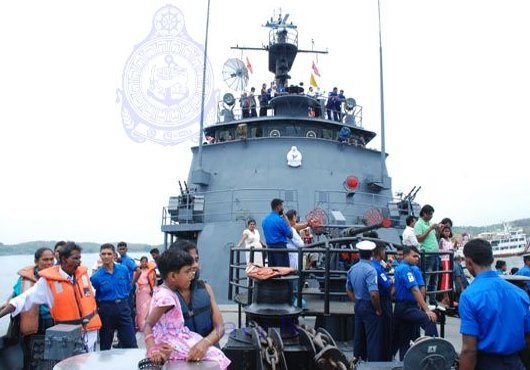
NavalToday.Com reports that the Sri Lankan Offshore Patrol Vessel (OPV) Samudura, formerly the USCGC Courageous donated to Sri Lanka on June 24, 2004, recently took aboard 41 immigrants for repatriation to Sri Lanka after they were intercepted by Australia authorities.
As you can see the ship has been rearmed. Apparently a Bofors 40mm has replaced the 3″/50 or Mk38 25mm that used to be mounted on the foc’sle. I believe the four heavy machineguns in two twin mounts below the bridge are Soviet designed 14.5mm (0.57 inch).
While I’m not sure the former Courageous was used this way, Offshore Patrol Vessels played an important part in ending the bitter civil war against the LTTE, by sinking three ships that were used by the Tamil Tigers as offshore weapons warehouses. Samudura is one of five OPVs in the Sri Lanka Navy.
DefenseTech is reporting that the Coast Guard is looking for means of making its general purpose machine guns into precision weapons, so that if they have to use the weapons, the possibility of collateral damage can be minimized.
“The Coast Guard wants to make its deck-mounted machine guns accurate enough for crowded American harbors.
“To do that, Coast Guard gunners need a weapon mount that’s stable enough to turn an M240 machine gun – a weapon designed to kill area targets on the battlefield – into a precision tool capable of putting every round on target.”
Gratifying to see that the Coast Guard is thinking though how situations might develop where they will need to use deadly force in situations where there is a danger of collateral damage. Its easy to understand that using a machinegun on an unstabilized mount on a boat that is bouncing around might endanger the local population as well as the intended target.
But even that may be too large for some of our smaller boats.
There are smaller alternatives. Thanks to RStoner for bringing this option to my attention:
Looks like this might have trouble accurately firing bursts, but apparently it could accurately fire single shots and give boats some of the disabling fire accuracy of the airborne use of force units without the extensive training.
Still I hope the Coast Guard will look beyond simply making a more accurate machine gun. Any gun is likely to have a percentage of its rounds go astray, possibly endangering the innocent.
Perhaps the Coast Guard should continue this train of thought, applying the same concern on a larger scale. After all, we may need to stop much larger vessels inside US internal waters. Shooting 25mm or even 57mm inside Puget Sound or Chesapeake Bay is a poor option, but given the way cutters are currently equipped, it may be the only option available and ultimately they may be ineffective even for small targets.
Looking at true precision weapons, there are a whole range of options:
Griffin can be used for relatively small targets, here and here.
For larger targets Longbow Hellfire is already in the US Navy inventory or perhaps the largely American made BAE Brimstone/Sea Spear which appears to offer even more target selectivity.
Once the target gets larger than about 1000 tons it is going to be very difficult to stop. As noted earlier I think the answer to this problem is a light weight torpedo that can target a ship’s propellers.
Frankly I doubt we will have a major cutter (WMSL/WHEC/WMSM/WMEC) in the area if the Coast Guard ever suddenly finds itself needing to stop a maritime terrorist threat. They do not hang around US ports when they are underway, and when they are in port, they take too long to go from cold iron to underway. If this ever happens the largest Coast Guard vessel likely to respond is a Webber Class WPC. They are large enough to mount weapons capable of stopping even the largest ship. They really need to be properly equipped for the possibility.
Ran across an account of the defense and subsequent loss of the Revenue Cutter Eagle by the “Riverhead News-Review.” It is a pretty good read. Could not help but notice that the frigate HMS Narcissus, that took the Cutter Surveyor was also involve in this incident.
Oct 11-13 will be the 200th anniversary of the incident. From the report it sounds as if the anniversary will be recognized by the local community. Hopefully the Coast Guard will also participate in some way.


 Chuck Hill's CG Blog