CIMSEC Talks Fisheries Crimes

CIMSEC continues their “Non-Navy” discussion with “Fisheries Crime: Bridging the Conceptual Gap and Practical Response.”

They address more than just Illegal, Unreported and Unregulated (IUU) Fishing. They talk about problems highlighted in a study conducted by the United Nations Office of Drugs and Crime (UNODC) on transnational criminal activities in the fishing industry :

•Fishers trafficked for the purpose of forced labor on board fishing vessels are severely abused;
•There is frequency of child trafficking in the fishing industry;
•Transnational organized criminal groups are engaged in marine living resource crimes in relation to high value, low volume species such as abalone;
•Some transnational fishing operators launder illegally caught fish through transshipments at sea and fraudulent catch documentation;
•Fishing licensing and control system is vulnerable to corruption;
•Fishing vessels are used for the purpose of smuggling of migrants, illicit traffic in drugs (primarily cocaine), illicit traffic in weapons, and acts of terrorism; and
•Fishers are often recruited by organized criminal groups due to their skills and knowledge of the sea and are seldom masterminds behind organized criminal activities involving the fishing industry or fishing vessels.[1]

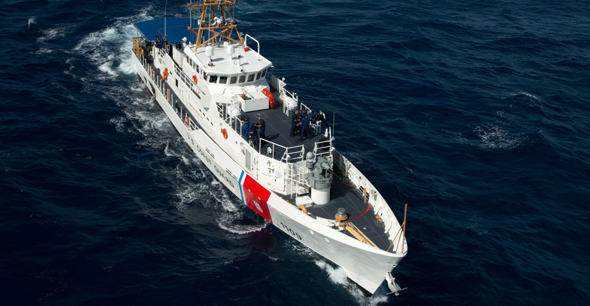
The Coast Guard is most likely to encounter these problems in the EEZ in the Western Pacific, including the Pacific Remote Islands Marine National Monument that is expected to expanded and in the EEZs of friendly island nations that rely on the US to assist with enforcement. Unfortunately assets for enforcement in these areas have been extremely limited.
Maritime Security and the Mumbai Attack–CIMSEC

CIMSEC is doing a series on “non-navies” and the first,”The Mumbai Attack: Terrorism from the Sea, talks about the attack on Mumbai and how it might have been thwarted including cultivating the public as an information source.

This is not the first time CIMSEC has talked about the attack, an earlier post “Indian Maritime Security After Mumbai,” July 2, 2012, by Mark Munson, talked about the difficulty of actually converting domain awareness into actionable information.

We have also talked about the attack, primarily here. (Note, apparently reports that the terrorists killed two Indian Coast Guard officers were untrue.)

Adm Loy Remembers 9-11

The US Naval Institute News service has a short story about the evacuation of more than half a million people from Southern Manhattan following the attack on 9-11 as told by former Commandant James Loy. Apparently this is part of much larger oral history project.

Based on 15 interviews conducted by Paul Stillwell from August 2002 to August 2006. The volume contains 621 pages of interview transcript plus appendices and a comprehensive index. The transcript is copyright 2014 by the U.S. Naval Institute; the interviewee placed no restrictions on its use.

I’ve posted the video above before, but it is an excellent tribute to the spirit of those that responded so unselfishly to this attack.

Big Arctic Cruise Ship and Some Sailor Stuff

Not commentary, but something that has been predicted, and two you might like to see.

As we have been told might happen, gCaptain tells us a cruise ship is planning to transit the North West Passage through the Arctic.

Then, just for fun, there are some great photos of the USS Constitution, and a video of some time spent on the mainmast of the Charles W. Morgan.

Guided Weapons–Getting Closer?

Lockheed Martin animation of Hellfire employment from an LCS

It looks like the Navy is beginning to field some weapons that are appropriate for the Coast Guard’s mission of preventing maritime terrorist attacks while addressing concerns that using weapons in US ports may cause collateral damage.

We talked about this concern recently.

I have always felt this mission had to devolve onto the smaller vessels, because the larger cutters don’t spend much underway time around US ports and when they are in port they usually cannot be gotten underway quickly. For this reason the WPCs need to be able to perform the mission.

Navy Recognition has news of progress on two of these systems, Dual Mode Hellfire and Dual Mode Brimstone.

The Longbow Hellfire is already present in the US inventory in large numbers and is being adopted for the LCS anti-surface module. The Brimstone is very similar in size, warhead, and range (about 8,000 yards), but has the advantage of a datalink that allows a “man-in-the-loop” which I think is desirable. Unfortunately, so far the USN is only looking at Brimstone as an air-launched weapon.

Test of Brimstone against two 40 foot maneuvering targets, discriminating between the targets and similar sized craft

Test of the Griffin. (Note limited damage)

A third system, SeaGriffin has a smaller footprint and warhead and has had a shorter range (only 43″ long, weighing 33 pounds, with a 13 pound warhead, surface to surface range of 5,500 meters), but it appears that the latest version may have a longer range, than either Hellfire or Brimstone, perhaps up to 18,000 yards (assuming they have, as reported, triple the previous range). The latest version of SeaGriffin does have a man-in-the-loop capability. Griffin is already being deployed on US Navy Cyclone class PCs. There are lots of photos showing the relatively small size of this system here.

I have never expected that extreme range was an important consideration for Coast Guard weapons, but for the anti-terrorism mission (or enforcing a blockade in wartime), we probably need the ability to engage from outside 4,000 yards (beyond the effective range of the 25mm Mk 38), because inside that range, there are a number of systems that might be added to a ship that could have a good probability of quickly disabling our vessels.

I still believe none of these weapons is capable of quickly and reliably stopping a medium sized ship or anything larger. For that I think we still need at least a light weight torpedo, but these weapons would significantly improve the chances against vessels of any size and particularly against small high speed maneuvering targets. Equipped with these, a Webber class cutter could be better able to fulfill this mission than a National Security Cutter with its 57mm guns.