Indonesian Bomb Plot?

murrahfederalbuildinginjuriesbyfloor

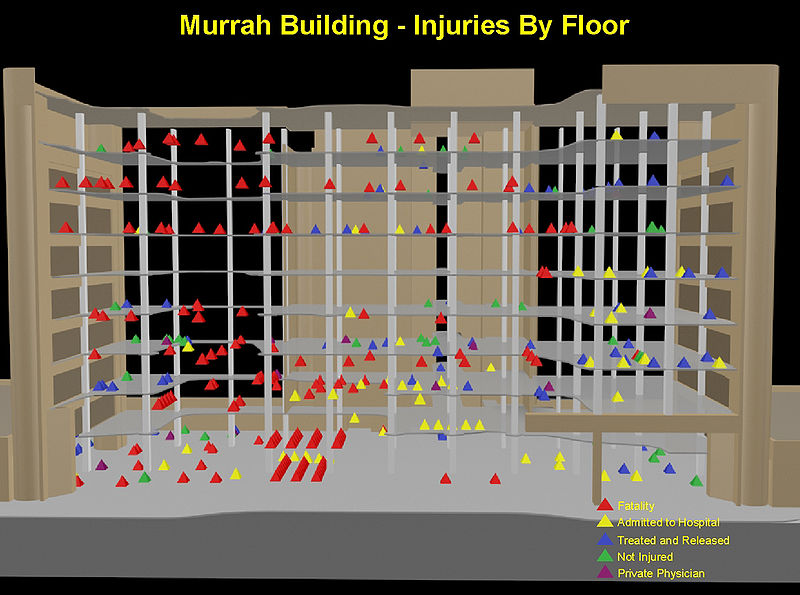
Photo: Floor-by-floor breakdown of the injuries/deaths in the Alfred P. Murrah Federal Building from the April 1995 Oklahoma City bombing. Red triangles indicates a fatality, a yellow one indicates a victim was admitted. Author: Sue Mallonee at Oklahoma State Department of Health Injury Prevention Service

gCaptain is reporting that Indonesian authorities on the resort island of Bali have detained a ship from Malaysia carrying around 30 tonnes of ammonium nitrate which police believe may have been intended for making bombs.

Ammonium nitrate was, you may recall, a primary igrediant in the truck bomb used in the attack on the Murrah Federal Building in Oklahoma City in 1995.

“…the bombing destroyed one-third of the building, killed 168 people, and injured more than 680 others. The blast destroyed or damaged 324 other buildings within a 16-block radius, shattered glass in 258 nearby buildings, and destroyed or burned 86 cars, causing an estimated $652 million worth of damage.”

Total weight of the explosives in that case was perhaps 7.000 pounds or less.

There is no indication that the ship itself was intended to be used as a bomb delivery system.

Bell V-247 Vigilant tiltrotor–The Eagle Eye Look-a-Like

v-247_island-coastal-overwatch-scene_render_160916-r00-768x509

Photo: V-247 Vigilant, Bell Helicopter artist rendering

Earlier we talked about the possibility of a new tilt-rotor UAS with a configuration similar to the Eagle Eye concept that was part of the original DeepWater program. Now we have a Bell Helicopter news release which provides more information on this program and its capabilities, plus a designation, V-247, and a name, Vigilant.” A Breaking Defense post puts the program in context relative to the V-22, the Marines intended use, and the Air Force’s long endurance MQ-9 Reaper UAS.

As noted earlier, this is a much larger aircraft than the Eagle Eye would have been. Bell states that its wing and rotor folded foot print is equivilent to that of a UH-1Y (latest version of the Huey) which is much larger than an MH-65 and only slightly smaller than an H-60. It uses a single 6,000 HP engine. If deployed on a cutter it would replace a manned helicopter.

Below is the Bell news release quoted in full:


FORT WORTH, Texas (Sept. 22, 2016) – Speaking before an audience of aviation and military experts assembled at the National Press Club in Washington, D.C., Bell Helicopter, a Textron Inc. (NYSE: TXT) company, today unveiled the Bell V-247 Vigilant tiltrotor.

To download renderings of the Bell V-247 Vigilant tiltrotor, please follow this link.

The Bell V-247 tiltrotor is an unmanned aerial system (UAS) that will combine the vertical lift capability of a helicopter with the speed and range of a conventional fixed-wing aircraft.  The revolutionary UAS is designed to provide unmatched long-endurance persistent expeditionary and surveillance capability and lethal reach, as well as runway independence to operate successfully in maritime environments and locations without secure runway availability.

The Bell V-247 Vigilant satisfies the comprehensive spectrum of capabilities outlined in the 2016 Marine Corps Aviation Plan, and could be available for production as early as 2023. The Bell V-247 Vigilant is a solution designed to address the evolving demands of the military and transportation sectors for unmanned aircraft for a shipborne UAS platform, including:

  • The ability to operate successfully without a runway, such as in maritime environments
  • Seamless performance in locations without secure runway availability, such as at shrinking land bases in contested areas
  • Significant reduction of the logistical footprint while retaining the superior operational performance by combining the vertical lift capability of a helicopter with the speed and range of a conventional fixed-wing aircraft
  • The capacity to control the battle space effectively with 24-hour intelligence provided by unmatched long-endurance persistent expeditionary and surveillance capability

A Group 5 UAS, the Bell V-247 Vigilant is designed to combine unparalleled capability with unprecedented flexibility to execute a wide array of mission sets, including electronic warfare, ISR (Intelligence, Surveillance and Reconnaissance), escort, C4 (Command, Control, Communications, and Computers), persistent fire missions and tactical distribution. The UAS is expected to accomplish all of this with the benefits of extended endurance through plug-and-play mission packages.

“The Bell V-247 Vigilant is the next leap in innovation making the future of aviation a reality today – it’s a testament to the power and versatility of tiltrotor flight,” said Mitch Snyder, president and CEO at Bell Helicopter. “At Bell Helicopter, we are constantly challenging the traditional notion of what it means to fly by staying on the leading edge of aviation and technological development. The unmanned tiltrotor is the latest example of how we are changing the way the world flies, taking our customers into the dynamic world of next-generation aircraft.”

The Bell V-247 Vigilant’s design boasts a number of unrivaled capabilities and transformational features, including:

  • A sea-based platform, which can be sized for compatibility with DDG guided missile destroyers shipboard applications
  • Single engine tiltrotor unmanned aerial system
  • 24-hour persistent ISR with a two aircraft system
  • Speed: 250 knots cruise speed; 180 knots endurance speed; >300 knots at maximum continuous power
  • Combat range: 450 nautical miles mission radius
  • Time on station: 11 hours
  • Size: 16,000 pounds empty weight / 29,500 pounds max gross weight; 65-feet wing span; 30-feet rotor diameter
  • As it sits on the deck, the V-247 Vigilant can hold a combination of fuel, armament, and sensors, up to 13,000 pounds
  • Blade Fold Wing Stow makes V-247 Vigilant DDG hangar compatible
  • Expeditionary capability with small logistical footprint
  • Open architecture and interfaces
  • Air-to-air refueling
  • Modular payload system to provide maximum flexibility
  • Power distribution system to provide maximum mission capability
  • Redundant flight control system
  • Electro Optical System and Targeting System

The Bell V-247 Vigilant offers a dynamic profile that is uniquely suited to complete highly versatile operations and support missions. It is designed to provide extended range flying from land or ship, matchless expeditionary capabilities and to remain on-station with heightened loiter times for extended periods. With its signature blade fold wing stow design, it will fit inside a DDG hangar space, and two can be loaded on a C-17 aircraft. The open architecture of the modular payload system enhances flexibility for aircraft customization by mission type. The bays on the Bell V-247 Vigilant are designed to carry high definition sensors, fuel, sonar buoys, light detection and ranging (LiDAR) modules, 360-degree surface radar modules, an MK-50 torpedo or Hellfire or JAGM missiles optimally. Regardless of the need, the Bell V-247 Vigilant easily integrates into priority mission sets to complete multiple airborne requirements.

“Leveraging lessons learned from our extensive history and experience with tiltrotors, we have found the best available solution to fulfill the Marine Corps need for a Group 5 UAS,” said Vince Tobin, vice president, advanced tiltrotor systems at Bell Helicopter. “The Bell V-247 Vigilant will give military customers the capabilities needed to reduce the complexity of deployment, increase speed of employment, reduce mission times and increase response time – all critical elements to completing missions to save lives and protect our freedom.”

Bell Helicopter utilized its decades of applied tiltrotor experience to develop this next generation UAS. The Bell V-247 Vigilant design and capabilities bring to bear experience from the V-22 tiltrotor program and UH-1Y/AH-1Z programs, capturing the V-280 Valor’s unmatched design and performance standards in order to provide unparalleled competency to support ship-board compatibility.

Press Contact:
ANDREW WOODWARD
+1 817-280-3100
mediarelations@bh.com

What Does It Take to Sink a Ship–the ex-USS Rentz Sink-Ex

Earlier I explored “What Does It take to Sink a Ship?” as a measure of what it takes to be absolutely sure you can stop one. Then the Japanese Tsunami gave us fishing vessel Ryou-Un Maru, a small vessel USCGC Anacapa attempted to sink with their 25mm gun. Anacapa ultimately resorted to coming along side and using a fire hose to fill the vessel with water, but it took over five hours.

Now the Navy provides us with information about another Sink-Ex. The former USS Rentz (FFG-46), a 4,200 ton, 453 foot long frigate, was the target. In spite of being hit by 22 missiles, she took five hours to sink. The last hit or hits were by Hellfire, and may not have been necessary, but not all the missiles were that small. The caption below appears to indicate at least two Harpoons were used.

harpoonlaunchrentzsinkex

Photo: US Navy. Guided-missile destroyer USS Benfold (DDG 65), foreground, and USS John S. McCain (DDG 56) fire Harpoons missiles as part of a sink exercise (SINKEX) during Valiant Shield 2016.

Reports also indicate that at least one JSOW C-1, an over 1000 pound guided gliding munition with both Infra-Red and Link-16 guidance, was used.

The caption on the photo below seems to indicate multiple AGM-65F were used. These are infra-red homing, Air to Surface Missiles, weighing over 600 pounds with a 300 pound warhead.

U.S. Navy sailors with Patrol Squadron 46 load a P-3 Orion aircraft with AGM-65F MAVERICKS Air to Surface Missiles prior to a sinking exercise (SINKEX) Sept. 13, 2016, at Andersen Air Force Base, Guam, during Valiant Shield 2016. SINKEX provided service members the opportunity to gain proficiency in tactics, targeting, and live firing against a surface target at sea. Valiant Shield is a biennial, U.S. -only field-training exercise with a focus on integration of joint training among U.S. forces. (U.S. Marine Corps photo by Sgt. Justin Fisher)

U.S. Navy sailors with Patrol Squadron 46 load a P-3 Orion aircraft with AGM-65F MAVERICKs, prior to a sinking exercise (SINKEX) Sept. 13, 2016, at Andersen Air Force Base, Guam, during Valiant Shield 2016.

When the video at the head of this post begins, it appears that the ship has already taken at least three major hits. I suspect these were two Harpoons and possibly the JSOW C-1. I suspect the four hits seen in the video were Mavericks launched from the P-8 that made the video.

The video below shows a Hellfire hitting what appears to be an already sinking hulk. It appears to me, the effects are clearly less than those seen in the video at the top of the post.

I would love to have a clearer idea of the sequence and effects of the individual hits, but one thing is clear. It took a lot of ordnance to put even this relatively small ship down. The Coast Guard’s 25 mm and 57 mm guns, with their five ounce and six pound projectiles, will not cut it.

OPC–Eastern Wins the Contract


opc-eastern

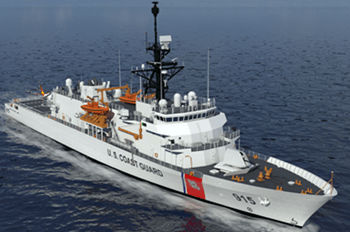
The Coast Guard’s Acquisitions Directorate (CG-9) is reporting Eastern Shipbuilding Group has been awarded the contract for detail design and construction of the first of 25 Offshore Patrol Cutters (OPC) expected to replace the Coast Guard’s overage Medium Endurance Cutter Fleet.

“The Coast Guard today selected Eastern Shipbuilding Group Inc. of Panama City, Florida, to continue to the detail design and construction phase (Phase II) of the offshore patrol cutter acquisition program. The award is worth $110.29 million.

“The full Phase II award covers detail design and production of up to nine OPCs and has a potential value of $2.38 billion if all options are exercised.

Eastern Shipbuilding Group’s notional design is 360 feet long, with a beam of 54 feet and a draft of 17 feet. The OPCs will have a sustained speed of 22.5 knots, a range of 10,200 nautical miles (at 14 knots), and an endurance of 60-days. It is expected to “conduct missions including law enforcement, drug and migrant interdiction search and rescue, and other homeland security and defense operations. Each OPC will feature a flight deck and advanced command, control, communications, computers, intelligence, surveillance and reconnaissance equipment.” It’s hangar will accommodate one MH-60 or an MH-65 and a Unmanned Air System (UAS).

WJHG.com reports, “At a cost of around $484 million per ship, it’s the largest contract the Coast Guard has ever awarded in its 226-year history.”

I’m not sure how that works out because “production of up to nine OPCs and has a potential value of $2.38 billion if all options are exercised” equals $264.4M/ship. If that is the actual shipyard building costs and the remaining $220M is Government Furnished Equipment (GFE) and other costs the ships may be a real bargain.

Hopefully additional details of the design will surface in the near future.

Thanks to Luke for bring this to my attention. 

opcplacemat

Coast Guard Museum

ncgmaconcept

The team putting together the National Coast Guard Museum in New London is asking for help and they have a new “Plank Owner” program that they hope will provide some extra incentive. If you need more information, they have it available in a couple of forms, a 20 page annual report for 2015 that includes a financial statement or you can take a look at their newsletter.

Perhaps most convincing, they point out that the Coast Guard is the only military service without a National Museum. The Army has 56, the Air Force 13, the Navy 11, and the Marine Corp 5. They also have a web site: www.CoastGuardMuseum.org.


Air Force More Into the Drug War

U.S. Air Force E-3 Sentry AWACS, an RC-135, and KC-135s sit at the CURACAO/ARUBA Cooperative Security Location. Photo via SOUTHCOM.

Photo: U.S. Air Force E-3 Sentry AWACS, an RC-135, and KC-135s sit at the CURACAO/ARUBA Cooperative Security Location. Photo via SOUTHCOM.

While the Navy may be providing less support for the Drug War, since all the Frigates have been decommissioned, DODBUZZ reports increased participation by the Air Force. Seems they see detecting and chasing Drug Smugglers as a training opportunity, with a side benefit.

“The large-scale air operation in the Caribbean included a number of U.S. aircraft, including HC-130s, DH-8s, B-1Bs, B-52s, AWACS, JSTARS, Global Hawks, KC-135s and KC-10s, James said. Space and cyber assets “were also brought into the mix,” she said, but didn’t elaborate.”

Somthing I would have loved to have seen:

“In March, a B-1B Lancer flew a low pass over a drug smuggling boat in the Caribbean Sea, prompting those onboard to dump 500 kilos of cocaine into the deep blue.”

Navy Rethinks the LCS–Manning, Crew Rotation, Homeporting

800px-USS-Freedom-rear-130222-N-DR144-367

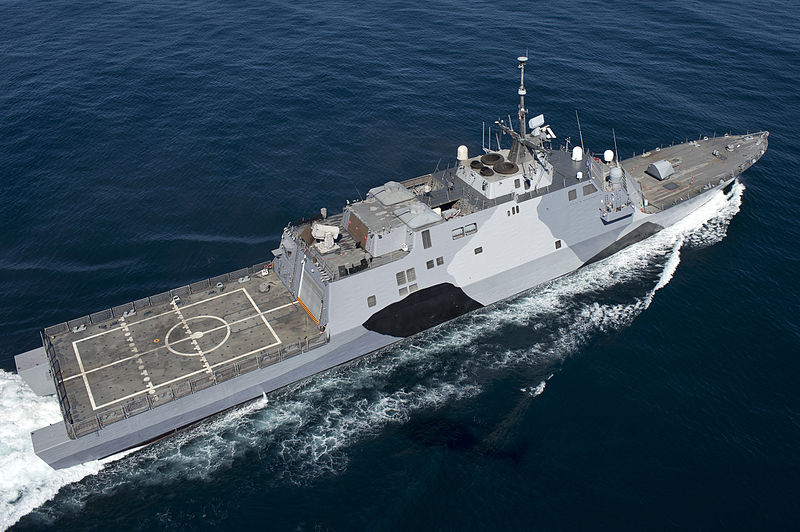
Photo: USS Freedom (LCS-1)

The US Naval Institute news service reports “Results of New LCS Review is Departure from Original Vision.”

Why should we care?:

For one thing the LCS were planned to be multi-crewed. Their plan was a bit different from our Crew Rotation Concept, but the idea was the same, multiple crews rotating among multiple ships to provide more deployed time. The Coast Guard had planned to apply the Crew Rotation Concept to the National Security Cutters, but I have also seen it referred to with regard to the Offshore Patrol Cutters.

Earlier I called the Offshore Patrol Cutter, the other LCS, and it does look like they will continue to share some systems and training. If the OPCs emerge with space for modular systems, we may see even more cross talk between the programs. The two types (LCS and OPCs) are similar in size, so comparisons are inevitable.

Hopefully we can learn from their experience.

The results: 

The Navy is abandoning their planned rotation of three crews among two ships in favor of a plan that would assign two crews to a single ship, much like the way SSBNs are manned by blue and gold crews. The significant difference is that the crews “own” the ships, they don’t expect to walk away to a different hull and never see it again.

The size of the crews is to be increased. Originally there was to have been a core crew of 40. That was increased to 50, and it is now planned to increase the core crew to 70 plus a 23 person air detachment. Maximum berthing is reportedly 98. Adding a CG LE team should max out the berthing. This pushes the crew much closer to what the Coast Guard was planning for the OPC, (pdf) a crew of 104. That means a full crew for each LCS is really 163, two core crews of 70 and 23 in the air detachment.

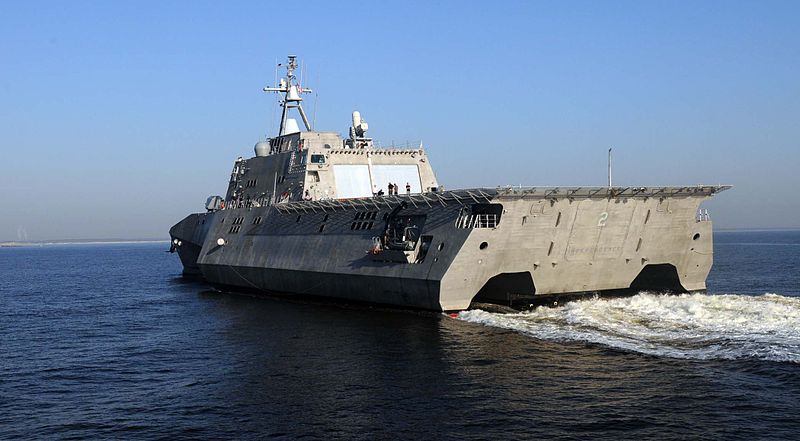
Instead of basing a mix of both types of LCS on each coast, the new plan would put the trimaran Independence class, with its longer range, on the West Coast (San Diego) while the shorter legged, monohull Freedom class will be based on the East Coast (Mayport, FL). That makes a lot of sense.

The ships will be organized into six four ship divisions with each division assigned a single mission (mine countermeasures, anti-surface, or antisubmarine). The four oldest ships will be single crewed, will not be assigned to a division and will instead be used for training and testing. Again this makes sense since subsequent ships are somewhat different, having incorporated lessons learned on the first ships.

That doesn’t necessarily mean there will be one division of each class assigned each of the three missions although that may the result. To me the Independence class appears better suited for ASW and the Freedom class by default better used as minecountermeasures ship.

uss_independence_lcs_2

Photo: USS Independence (LCS-2), U.S. Navy photo by Mass Communication Specialist 2nd Class Justan Williams 

Lessons: 

When the Coast Guard finally decides to abandon the Crew Rotation Concept, as currently envisioned–four crews for three ships. They can point to the LCS experience as justification.

As a means to allow increased time underway, permanently augmenting the NSCs’ crews to allow generous leave and TAD assignments is probably a better solution. After all, if we have a crew of 160 or so assigned to each NSC or OPC, we could probably keep them underway at least as much as the LCS are.

Applying a division staff organization to the NSCs and perhaps the OPCs is probably a good idea. In addition to a post command captain, that could, among other things, provide initial advice to newly arrived COs and possibly a relief CO function; it could provide personnel augmentation for those specialists positions that have little or no redundancy in the typical ship’s organization, allowing them some leave and/or TAD while the ship is underway, with the objective of keeping the crew members underway time at 185 days or less, while the ship is away from homeport for a considerably longer time.

Canada’s Coast Guard, Same Song, Different Accent

CBC reports that the Canadian Coast Guard is in bad shape.

  • Their ships are old.
  • Increased maintenance is eating into their budget and restricting asset availablity.
  • Their new Polar Icebreaker is still a decade away.
  • They have been under funded for decades.

Sounds familiar doesn’t it. In fact, as if to excuse the problems they say, look the USCG has the same problems.