
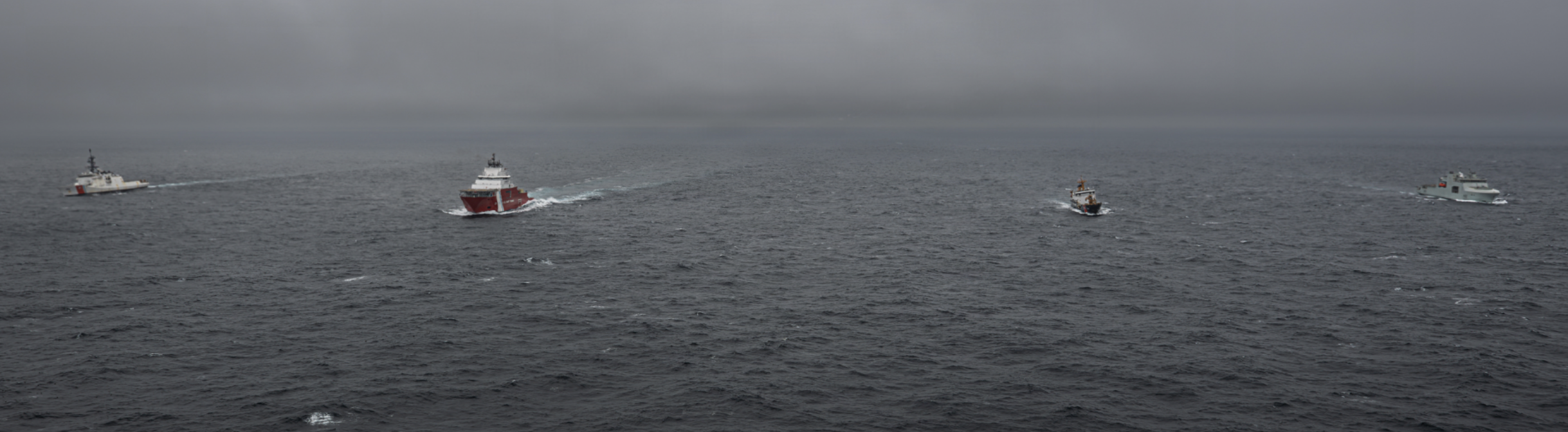
USCGC Munro (WMSL 755), Storis (WAGB 21), Fir (WLB 213) and Royal Canadian Navy vessel HMCS Max Bernays (AOPV 432) sail alongside each other during Operation TUNDRA MERLIN in the Bering Sea, Alaska July 21, 2026. The combined sail reinforces the enduring maritime partnership between the United States and Canada while enhancing interoperability and regional security in the Arctic. Operating under the framework of Operation TUNDRA MERLIN, the combined sail successfully enhanced multi-domain awareness from the sea to space across the Alaskan Theater of Operations. These joint maneuvers allowed participating U.S. and Canadian forces to share critical maritime intelligence and reinforce a layered defense of North America. (U.S. Coast Guard photo by Petty Officer 3rd Class Rylan Singleton)
Below is a District NW news release.
Operation Tundra Merlin was discussed earlier.
Sounds like STORIS did a little bit of everything including breaking ice.
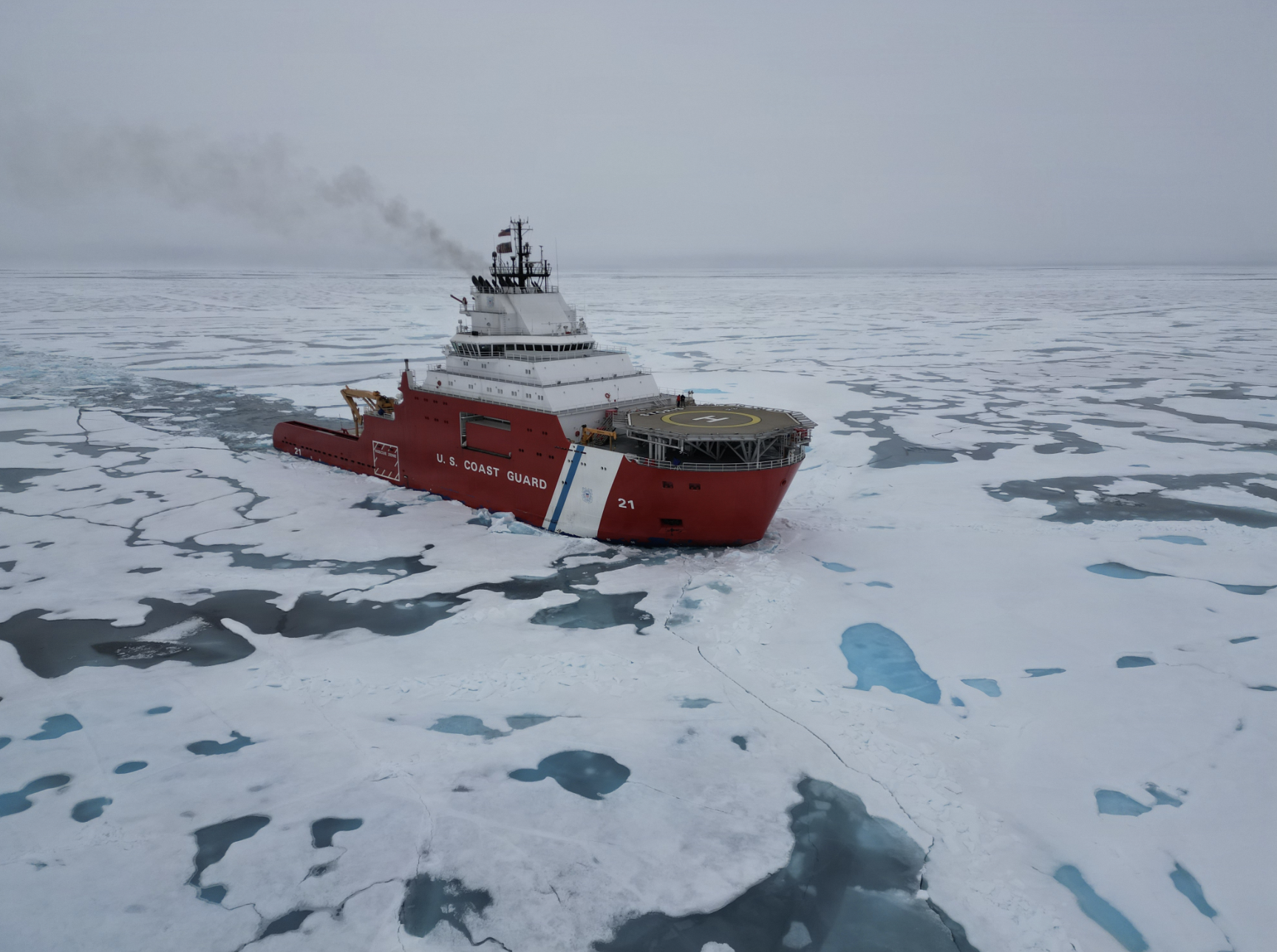
USCGC Storis conducts icebreaking operations in the Arctic Ocean during the cutter’s 133‑day deployment to the region, July 28, 2026. As the Coast Guard’s newest icebreaker, Storis enforced maritime safety, security, border control and national sovereignty as the sole U.S. surface asset deployed to the High Arctic. (U.S. Coast Guard courtesy photo)
Reportedly this is “the first designated law enforcement mission by a polar icebreaker in more than 20 years” so maybe Storis (and the Arctic Security Cutters) will be treated more like an ice strengthened WHEC. There is no indication which polar icebreaker did the law enforcement mission 20 years ago, but maybe it was the previous USCGC Storis (WAGL-38/WAG-38/WAGB-38/WMEC-38) decommissioned 12 Feb. 2007.
That they experimented with use of UAS sounds interesting, wish they had said which UAS(s) were used. (no photos in the release)
Nov. 17, 2026
U.S. Coast Guard Cutter Storis returns to Seattle after 133-day Arctic deployment
SEATTLE — U.S. Coast Guard Cutter Storis (WAGB 21) returned to its temporary home port of Seattle on Saturday after completing a 133‑day deployment to the Arctic Ocean and Alaska theater of operations.
During the deployment, Storis traveled more than 17,000 nautical miles while serving as the sole U.S. surface asset in the High Arctic, conducting maritime safety, security, border control and sovereignty missions.
As part of Operation Frontier Sentinel, Storis spent more than 300 hours monitoring foreign-flagged research vessels across the Arctic. The cutter monitored four Chinese‑flagged research vessels operating over the U.S. extended continental shelf.
The patrol marked the first designated law enforcement mission by a polar icebreaker in more than 20 years. Storis completed multiple fishing vessel inspections in the Bering Sea, including a joint boarding and fisheries plant inspection with the National Oceanic and Atmospheric Administration Office of Law Enforcement.
The crew completed the first live‑fire gunnery exercise by a Coast Guard surface vessel operating in ice‑covered Arctic waters in decades. The exercise familiarized the crew with weapons employment in extreme conditions and produced data expected to inform how future Coast Guard surface assets train, maintain and conduct weapons exercises and national defense missions in the high north.
Storis also conducted a simulated replenishment‑at‑sea exercise with Coast Guard Cutter Stratton (WMSL 752) near Unalaska, Alaska. Using the cutter’s dynamic positioning system and shipboard sensors, the crews demonstrated close‑quarters maneuvering capabilities needed to support refueling and replenishment operations in austere regions.
During the patrol, Storis operated alongside Coast Guard Cutters Munro (WMSL 755) and Fir (WLB 213), as well as the Royal Canadian Navy’s HMCS Max Bernays (AOPV 432), during Operation Tundra Merlin. The coordinated operation strengthened maritime partnerships and enhanced joint interoperability in Arctic waters.
The cutter also responded to the grounded fishing vessel Aleutian Dream, providing initial assistance and escorting the vessel back to Dutch Harbor, Alaska.
“We are serving in a moment of great change in our service, nation and world,” said Capt. Corey Kerns, commanding officer of Storis. “The crew’s hard work exceeded expectations in turning Storis into an actionable, multi‑mission military vessel. Through their steadfast dedication and operational expertise, Storis has set the definitive precedent for the Coast Guard’s future operations in the Arctic region and Alaska theater of operations.”
While in the Bering Sea, Storis partnered with the Coast Guard Research and Development Center and the Defense Innovation Unit to evaluate unmanned aircraft systems in extreme‑cold conditions. Research teams conducted five sorties totaling nine flight hours to assess aircraft performance in high‑latitude environments. The tests supported the Icebreaker Collaboration Effort, a trilateral partnership among the United States, Canada and Finland aimed at rapidly fielding unmanned aircraft systems capable of supporting critical polar missions.
Storis additionally assisted scientific research efforts with the International Arctic Buoy Program, the U.S. National Ice Center and Johns Hopkins Applied Physics Laboratory.
Storis is a 360‑foot medium icebreaker with a displacement of nearly 15,000 tons. Powered by four diesel engines producing 22,500 horsepower, the cutter is capable of navigating through three feet of ice at five knots. Alongside Coast Guard Cutters Healy (WAGB 20) and Polar Star (WAGB 10), Storis supports Coast Guard operations in high‑latitude regions and is equipped to conduct logistics, search and rescue, ship escort, environmental protection, and law and treaty enforcement missions.


It’s nice to see the naysayers proved at least a little wrong. Storis isn’t what they wanted but it looks like she can perform missions.
The WTGB replacement program (HSC-M) offers an opportunity to provide some additional platforms for Alaska patrolling that the CG currently doesn’t have.
A 140 foot powerful oceangoing icebreaking tug with long legs could really provide a valuable asset. Expanding the HSC-M requirements would provide a vessel that can work above the Bering in summer and provide for help with the Port of Nome and other ports to get those ports open sooner or stay open a little later.
I would like to see the WTGB replacement constructed to modern tug standards. Six thousand horsepower with ice-rated diesel electric azimuthing propulsion powering the hotel services from four diesels on a common bus. This would provide the ability to patrol on one or two smaller engines without running the mains lightly loaded (this is a huge problem for the WTGB). The addition of a tow winch on the stern would allow the vessel to handle ATON barges or rescue tows for fishing vessels much more safely than the old towing arrangements.
Now that Denmark has signed a basing agreement for Greenland, a couple of these could also provide harbor access and ship handling assist to these new bases in summer basing out of the NE US and provide winter icebreaker in New England ports.
Of course, a tug this powerful is overkill for the Great Lakes but I don’t think anyone will complain when it crushes through conditions that the WTGB had to back a dram through. It would also handle the current ATON barges much better than the WTGB.
The program of record (HSC_M) is 11 vessels to replace 9 WTGB. The add-on of 5 more would be sufficient to work AK and Greenland. Instead of Homeland Security Medium, I would suggest Arctic Tug Medium, WATM.
Now is the time to build a smaller ice cutter than ASC to modern standards that can sail confidently for the next thirty years.