Request for Information (RFI) – USCG Acquisition Superhighway

The Coast Guard has issued a Request for Information for systems that can improve its acquisitions process. You can see it here. 

Below is the description provided.


Description

The United States Coast Guard (USCG) is issuing this Request For Information (RFI) to gain a better understanding of the current marketplace and obtain information regarding commercial solutions with integrated Artificial Intelligence (AI) capability that will enhance the efficiency and quality of the USCG procurement and acquisition program management process. This is NOT a solicitation and is intended for information and planning purposes only. The USCG is seeking information on commercially available and emerging technologies that can address specific challenges within our current end-to-end procurement workflow.

A faster, more adaptable, and highly effective Coast Guard is required to successfully deliver the full scope of planned reconciliation services and capabilities.  A critical element of that is implementing an agile and responsive contracting and acquisitions (C&A) solution capable of supporting the rapid delivery of cutting-edge technologies and operational capabilities to the field at the speed of need. We will make significant changes across the C&A organization to implement a solution to provide the capabilities necessary to execute the Coast Guard’s increasingly complex missions. This high velocity solution will eliminate unnecessary and time-intensive requirements wherever possible, strengthen oversight and visibility, and leverage innovative procurement solutions to improve cost and schedule outcomes.

A major initiative required to reach that target objective is the successful adoption and use of advanced technology, human-machine teaming, and data to conduct operational, support, and enterprise functions. We will maximize the use of Commercial off-the-shelf software (COTS) and Artificial Intelligence in accordance with FD28 Executive Plan to obtain and integrate new enterprise capabilities that streamlines, automates and improves overall quality and efficiency of current contracting and acquisition workflows and delivers significant value to the enterprise.

This system should meet the gaps of current enterprise business processes by: (1) Interfacing directly with existing DHS & commercial procurement systems of record; (2) Providing a single point of entry for both procurement and acquisition documentation development and approval workflow; (3) enabling the addition of advanced artificial intelligence and business intelligence to supplement documentation development and decision support capabilities; and (4) Provide a community knowledge management capability.

This enterprise capability is intended to significantly improve data quality issues with current disparate and redundant business process workflows, while automating and standardizing workflows to greatly enhance enterprise efficiency and expand scope of current status tracking visibility and planning capabilities.

Interested parties are requested to submit a response to this RFI using the attached documents. All responses and questions must be submitted electronically via email no later than 03:00 PM Eastern Time (ET) on November 25, 2025 to the Contracting Officer, Ryan Shaughnessy at Ryan.W.Shaughnessy@uscg.mil.

“Coast Guard continues to break records, offloading over $362 million in illicit drugs interdicted in Eastern Pacific Ocean” –District Southeast

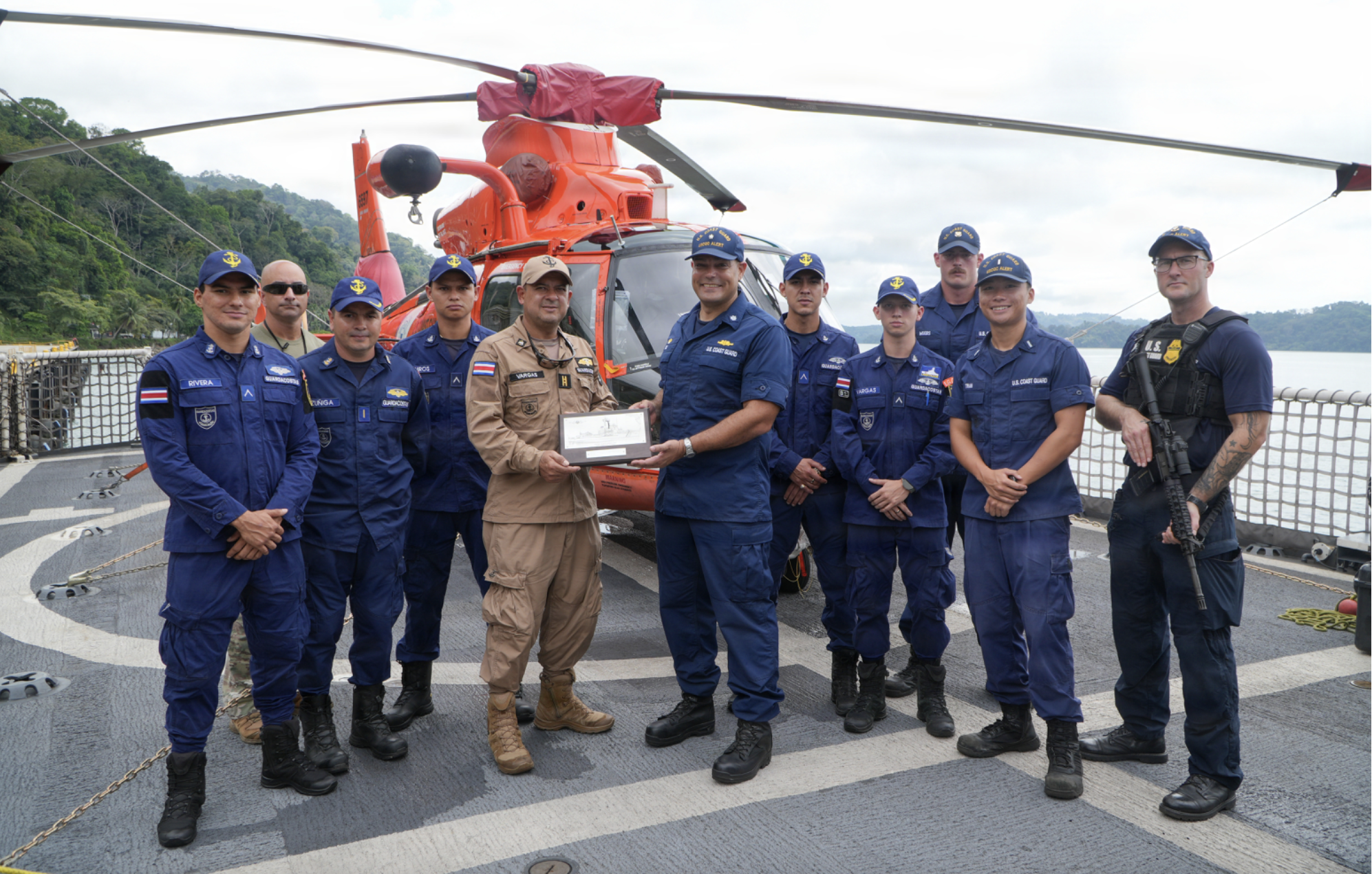
251118-G-G0107-1008 Coast Guard Cutter Stone’s crew poses for a group photo on the flight deck of the ship, Nov. 18, 2025, Port Everglades, Florida. Coast Guard Cutter Stone’s crew offloaded approximately 49,010 pounds of illicit narcotics worth more than $362 million. (U.S. Coast Guard photo by Cutter Stone’s crew)

Below is a news release from District Southeast.

This offload is particularly noteworthy in that it is the most “cocaine seized by a single cutter in one patrol in Coast Guard history,” almost 25 tons. It may also be the largest number of interdictions (15) by a single cutter in one patrol but I can’t confirm that.

This particular success was not a fluke. USCGC Stone was very nearly as successful on her previous patrol making 12 interdictions and seizing 44,955 pounds of cocaine.

Check out the news release, lots of good photos and video. I chose the photo above because it includes the V-Bat UAS.


Nov. 19, 2025

Coast Guard continues to break records, offloading over $362 million in illicit drugs interdicted in Eastern Pacific Ocean

Coast Guard Southeast District – 305-202-3735

MIAMI – U.S. Coast Guard Cutter Stone’s crew offloaded approximately 49,010 pounds of illicit narcotics worth more than $362 million at Port Everglades, Wednesday.

This offload marks the most amount of cocaine seized by a single cutter in one patrol in Coast Guard history.

The seized contraband was the result of 15 interdictions in international waters of the Eastern Pacific Ocean.

“I am extremely proud of the crew’s incredible performance during this deployment,” said Capt. Anne O’Connell, commanding officer, Coast Guard Cutter Stone. “This offload demonstrates our increased posture and continued success in the fight against narco-terrorism and transnational criminal organizations. The Coast Guard, in conjunction with our inter-agency and international partners, continues to patrol areas commonly associated with drug trafficking in the Eastern Pacific, denying smugglers access to maritime routes by which they move illicit drugs to our U.S. land and sea borders.”

The following assets and crews were involved in the interdiction operations:

80% of interdictions of U.S.-bound drugs occur at sea. This underscores the importance of maritime interdiction in combatting the flow of illegal narcotics and protecting American communities from this deadly threat. U.S. Southern Command’s Joint Interagency Task Force -South based in Key West, conducts the detection and monitoring of aerial and maritime transit of illegal drugs. Once interdiction becomes imminent, the law enforcement phase of the operation begins, and control of the operation shifts to the U.S. Coast Guard throughout the interdiction and apprehension. Interdictions in the Eastern Pacific Ocean are performed by members of the U.S. Coast Guard under the authority and control of the Coast Guard’s Southwest District, headquartered in Alameda, California.

To protect the Homeland from ongoing trafficking of illicit narcotics from South America to the United States, the Coast Guard is accelerating our counter-drug operations in the Eastern Pacific Ocean in support of Operation Pacific Viper.

The Coast Guard continues increased operations to interdict, seize and disrupt transshipments of cocaine and other bulk illicit drugs by sea. These drugs fuel and enable cartels and transnational criminal organizations to produce and traffic illegal fentanyl, threatening the United States.

These interdictions deny criminal organizations more than half a billion dollars in illicit revenue. They provide critical testimonial and drug evidence as well as key intelligence for their total elimination. These interdictions relate to Panama Express, an initiative of HSTF Tampa, investigations in support of Operation Take Back America. PANEX identifies, disrupts, and dismantles the highest-level criminal organizations that threaten the United States using a prosecutor-led, intelligence-driven, multi-agency approach.

USCGC Stone is one of four 418-foot Legend-class national security cutters homeported in Charleston, South Carolina, under U.S. Coast Guard Atlantic Area Command.

“Colombia’s Multinational Orion Strategy: Inception, Evolution, and Future Prospects” –USNI

Colombian Navy patrol vessel ARC 20 de Julio carries out an ocean patrol.
(PHOTO COURTESY OF COLOMBIAN NAVY). A post on this class now used by Chile and Colombia and slightly larger class used by Germany and soon Singapore.  

The November 2025 issue of US Naval Institute Proceedings includes an article by the head of the Colombian Navy, Admiral Juan Ricardo Rozo Obregón, that talks about their drug interdiction efforts and the international alliance they have formed to combat international drug smuggling, “which is now a year-round operation that integrates the efforts of 130 institutions from 64 countries and 10 multilateral organizations.”

“The Colombian Navy has achieved significant successes in facing down these threats. For instance, in 2024, the Navy seized 572 metric tons of cocaine—65 percent of the total amount confiscated by Colombian authorities.

“Through efforts aligned by the MOS (Multinational Orion Strategy-Chuck), partner nations have seized 3,830 metric tons of illicit drugs—including cocaine, marijuana, coca base, hashish, and methamphetamines—along with 1,130 vessels, including 81 self-propelled semisubmersibles. These joint efforts have led to 7,456  arrests. To date, these results have cost criminal networks more than $105 billion, prevented 21,966 overdose deaths, and saved $1.427 billion in healthcare costs.”

“Coast Guard to offload more than $362 million in cocaine” –District Southeast

Offload photo from USCGC Stone’s previous patrol in which she made 12 interdictions. Coast Guard offloads over $517.5 million in illicit drugs interdicted in Eastern Pacific Ocean
Crew members from USCGC Stone (WMSL-758) stand at parade rest in front of interdicted narcotics at Port Everglades, Florida, Mar. 20, 2025. The Stone’s crew secured the illegal drugs from 14 interdictions (two by USCGC Mohawk) in the international waters of the Eastern Pacific. (U.S. Coast Guard photo by Petty Officer 2nd Class James Hague)

Below is a news release from Southeast District. USCGC Stone has been doing well. (See the link above.)
In her last patrol, Stone made 15 interceptions. By contrast the Navy with about 12,000 people in the Caribbean, a 13 Billion dollar aircraft carrier, two cruisers, three large amphibious warfare ships, three destroyers, and a submarine and probably more than a hundred aircraft have made 21 interdictions. Stone may have been at it longer. She also had the support of Joint Interagency Task Force South.

Nov. 18, 2025

Media Advisory: Coast Guard to offload more than $362 million in cocaine

Editor’s Note: Media are asked to RSVP by no later than 7 a.m., Wednesday, with the Coast Guard Southeast District Public Affairs Office at 305-202-3735 or by emailing Southeastpublicaffairs@gmail.com in order to be authorized access to the Port Everglades facility. Interested media are requested to arrive by 8 a.m., Wednesday, with media credentials, a valid driver’s license and proof of insurance to be processed through port security.

MIAMI — The U.S. Coast Guard is scheduled to hold a press briefing, Wednesday, highlighting the offload of over 49,000 pounds of illicit cocaine worth more than $362 million at Port Everglades.

The offload is the result of 15 separate interdictions by the crews of U.S. Coast Guard Cutter Stone, with an embarked Helicopter Interdiction Tactical Squadron aircrews and Tactical Law Enforcement Team-Pacific law enforcement detachment, and with the assistance of partner agencies during operations in the Eastern Pacific Ocean.

WHO:  

WHAT: Participating members will comment on and provide context for the Coast Guard’s maritime security and joint drug interdiction mission efforts to keep $362 million worth of illicit narcotics from reaching the United States.

WHERE: Berth 22, Port Everglades – 1800 SE 20th St, Fort Lauderdale, FL 33316. The seaport can be accessed by:

Main entrance. Take I-595 East straight into the port (I-595 become Eller Drive once inside the Port). I-595 runs east/west with connections to the Fort Lauderdale/Hollywood International Airport, U.S.1, I-95, State Road 7 (441), Florida’s Turnpike, Sawgrass Expressway and I-75.

Note:  Due to anticipated traffic associated with the Fort Lauderdale International Boat Show, media are encouraged to use the entrances at U.S. 1/State Road 84 and I-595 Eller Drive, to avoid the SE 17th Street Causeway entrance.

North entrance. Take U.S.1 or A1A to 17th Street Causeway in Fort Lauderdale and turn south at the streetlight onto Eisenhower Blvd. US1/Federal Highway entrance. At the intersection of State Road 84 East and U.S.1 (Federal Hwy.), turn east into the seaport.

WHEN: Wednesday, 9 a.m., Nov. 19.

Coast Guard imagery and b-roll of the drug offload will be published in a multimedia release after the press briefing.

USCGC Stone is a 418-foot national security cutter homeported in Charleston, South Carolina.

“Latest Coast Guard surge begins on Rio Grande River” –The Watch

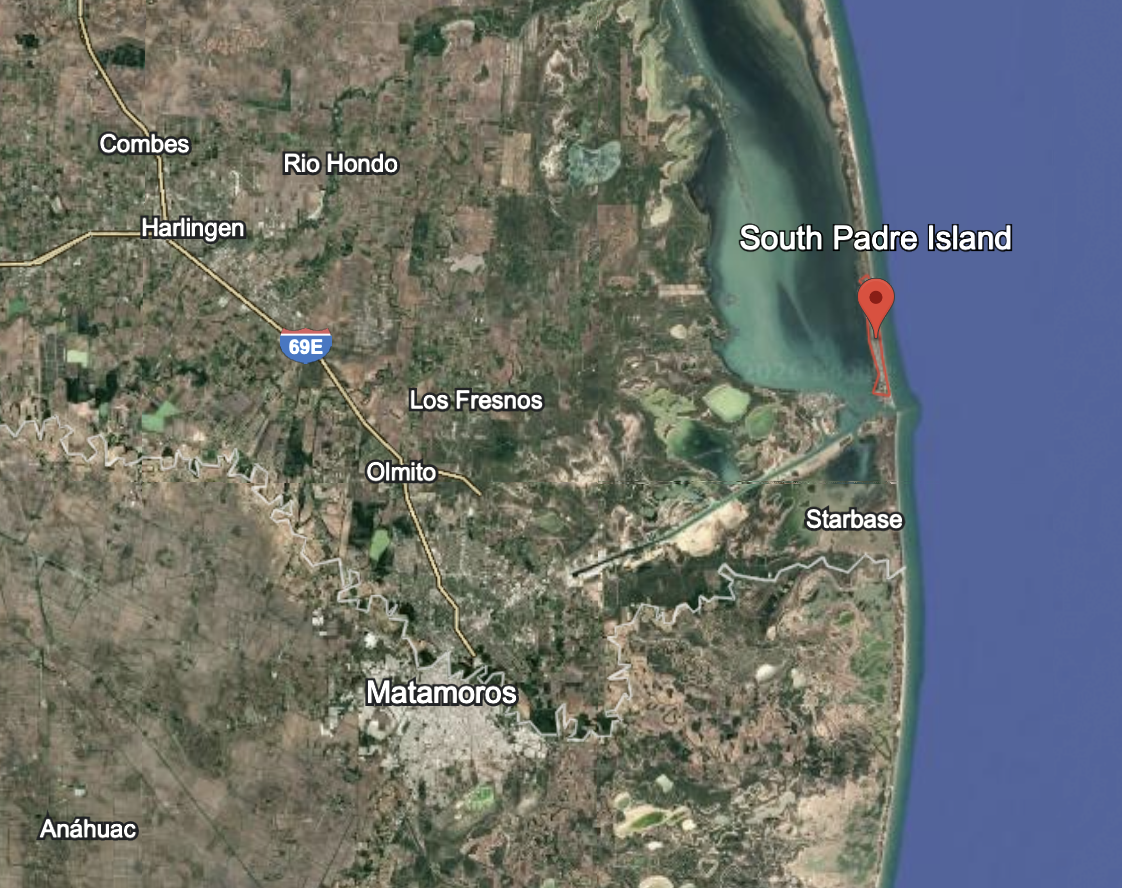
Cameron County is East of Hidalgo County

The NORTHCOM on-line Magazine, The Watch, reports,

“The United States Coast Guard is conducting an unprecedented surge of force along 418 kilometers of the Rio Grande River to complement the activities of federal agencies to secure the Mexico-U.S. border. Operation River Wall, which includes quick response boats and tactical teams, began in October 2025 to further suppress illegal activity along the frontier. The exact number of vehicles and personnel has not been released, according to Stars and Stripes, a military affairs newspaper.

“The Coast Guard patrols the river as it winds through Cameron and Hidalgo counties in southeast Texas, eventually entering the Gulf of America. In the first 10 days of deployment, Guardsmen assisted in detaining 20 illegal migrants, according to Stars and Stripes.”

Much of the area of operation, Cameron and Hidalgo counties, is actually a metropolitan area including McAllen and Brownsville.

Kinetic Attack on Drug Trade

Kinetic attack target #20. Pentagon image.

The US Naval Institute reports,

U.S. forces struck a suspected narco boat in the Caribbean Sea earlier this week, killing four people, USNI News has learned.

The strike, which occurred Monday, killed all four people on board, leaving no survivors, a U.S. defense official confirmed Friday to USNI News. Unlike previous instances, Monday’s fatal strike was not announced by Defense Secretary Pete Hegseth or other members of the Trump administration on social media platform X.

These kinetic attacks have now become somewhat routine, but since this is a continuing topic of interest for my readers, I will report future attacks in the comments section of this post.

Some Background on the OPC Program and the Cutter X Alternative

Below is my input to a discussion among my classmates. It is mostly history, but hopefully useful. As I was preparing this, I was struck by the realization that when the Crew Rotation Concept was thrown out, it should have resulted in a complete revision of our program of record.

When the program of record began, it was to replace 12 WHECs, 32 WMECs, and 49 WPBs, a total of 93 vessels with 8 NSCs, 25 OPCs, and 58 FRCs, a total of 91 vessels. 

 
This plan also assumed the NSCs and OPC would use the Crew Rotation Concept that would have theoretically provided about a third more underway days than conventionally crewed cutters.
 
The Crew Rotation Concept was ultimately discarded, taking with it about 1980 underway ship days or eleven ship years.
 
This was partially offset by adding NSCs #9 and #10, but we are still getting the equivalent of nine large patrol cutters less than originally planned.
Coast Guard missions seem to be expanding. This has been partially addressed by building more FRCs than originally planned. The FRCs have exceeded our expectations and we are planning to have 77 of them, but we are still looking at only 35 large patrol cutters, 10 NSCs and 25 OPCs. I don’t think that is enough.
The Coast Guard has been describing the OPCs this way, The OPC will provide a capability bridge between the national security cutter, which patrols the open ocean in the most demanding maritime environments, and the fast response cutter, which serves closer to shore.”
 
That is not really true. The OPC and the NSC are virtually the same size. The OPC may be intended to replace the MECs, but in fact it is 1250 tons larger than the Hamilton class WHECs and 2.5 times the size of a WMEC270. The OPC will also have a crew almost the size of that of the NSC. With a range of over 10,000 nautical miles they are high endurance cutters. 
 
In 2012 the OPCs were expected to cost about half of what an NSC cost, now the costs to build and operate are approaching that of an NSC. 
Since 2012 I have been suggesting that we could meet the need for more large cutters by building a true medium endurance cutter by basically putting the crew and equipment of a FRC in a large hull (at least 80 meters/262 feet) and trading off some OPCs and FRCs for these medium size ships. https://chuckhillscgblog.net/2012/10/12/the-dhs-cutter-study-trade-offs-and-the-case-for-cutter-x/
Two years later I did a revised look. https://chuckhillscgblog.net/2014/09/28/cutter-x-revisited/ and along the way, I pointed out several ships that could fill the Cutter X role. Actually they just seem to be the typical Offshore Patrol Vessel.
The Japanese are building a class that reflects the Cutter X ideas, a relatively large ship, 312 feet in length, about half the displacement of the OPCs, with a crew of only 30. https://chuckhillscgblog.net/2025/11/14/offshore-patrol-vessels-for-the-japanese-maritime-self-defense-force-launched/
Since the geopolitical situation has changed and war with China looks more likely I have begun to think we should start building cutters that are more immediately useful in the event of war.
Congress has been telling the Navy they need to look at building Corvettes to bulk up their numbers and the next Navy league magazine is supposed to have a story about the proposal. Assuming these are ASW capable corvettes, this might be a class that could be built as a dual service ship, serving in both the Navy and Coast Guard.

“Eastern Shipbuilding Suspends Work on Offshore Patrol Cutter Program” –Maritime Executive

Eastern Shipbuilding, Argus and Chase building. 2021

Maritime Executive reports,

“Florida-based Eastern Shipbuilding Group (ESG) has finally made the tough decision of suspending work on the troubled Offshore Patrol Cutters (OPCs) program, a development that comes six months after the Trump administration announced partial termination of the contract owing to delays and cost overruns.

“ESG CEO Joey D’Isernia announced that owing to the significant financial strains caused by the program’s structure and conditions, the company has opted to suspend work on its in-construction Heritage-class OPCs, resulting in layoffs.”

Can’t say this is a surprise. May 28, 2025 the Department issued a Request for Information for towing and a technical assessment for what could only have been an Offshore Patrol Cutter. OPCs #3 and #4 were cancelled in July.

Now, what will happen to OPC#1, Argus, and is there anything we can salvage from OPC #2, Chase?

This does leave the Coast Guard short of large patrol cutters, particularly in the Pacific. By now, there were supposed to be two OPCs home-ported in San Pedro and two home-ported in Kodiak. This is another reason LANT AREA’s should assume full responsibility for policing the Eastern Pacific drug transit zone. 

There really should be an investigation of how this happened.

Thanks to Pat for bringing this to my attention.

Keel Laying for OPC#3 hull number 917. Presumably future 915 is to the right and future 916 to the left. July 2022.


“USS St. Louis Returns from Deployment in Support of Southern Border Operations” –Seapower

NAVAL STATION MAYPORT, Fla. (Nov. 10, 2025) — The Freedom-variant littoral combat ship USS St. Louis (LCS 19), operating under U.S. Northern Command (USNORTHCOM), returns to Naval Station Mayport, Fla., after completing a surge deployment, Nov. 10, 2025. (U.S. Navy photo by MC3 Jasmin L. Aquino)

The Navy League on-line magazine, Seapower reports,

The Freedom-variant littoral combat ship USS St. Louis (LCS 19), operating under U.S. Northern Command (USNORTHCOM) in the Gulf of America, returned to Naval Station Mayport ), along with the “Valkyries” of Helicopter Maritime Strike Squadron (HSM) 50 Detachment 5 and embarked U.S. Coast Guard Law Enforcement Detachment (LEDET) 408 after completing a surge deployment on November 10, 2025.

This deployment is a bit unusual in that apparently the patrol was in the Gulf under the direction of NORTHCOM and Second Fleet, rather than in the Caribbean and or Eastern Pacific under SOUTHCOM and Forth Fleet like her last patrol.

Neither NORTHCOM nor 2nd Fleet included the news release on their website, 2nd Fleet apparently sending it directly to the Navy League. (In fact 2nd Fleet has not had a news release on their website since 10 August.) We don’t know how long this deployment was since their departure date was not included in the release.

There was no report of a successful interdiction, which is not surprising since historically we do not find much maritime drug smuggling in the Gulf.

USS St. Louis’ previous patrol was more successful, spending eight months operating under 4th Fleet, where she, “disrupted and confiscated over $100 million worth of illicit contraband in five different operations” in addition to participating in exercise UNITAS 2024.


Offshore Patrol Vessels for the Japanese Maritime Self Defense Force Launched

The first and second ships of the Japan Maritime Self-Defense Force’s new patrol vessel class, Sakura and Tachibana, were launched by Japan Marine United (JMU) on November 13, 2025 (photo by Kosuke Takahashi).

Naval News reports the launch of the first two of twelve Offshore Patrol Vessels (OPV) for the Japanese Navy.

“The new patrol vessels measure 95 meters (312 ft) in length, with a standard displacement of 1,900 tons (about 2300 tons full load–Chuck), a depth of 7.7 meters, a draft of 4.2 meters, and a top speed of 25 knots (28.8 mph)…automation technologies have been implemented to reduce crew requirements, limiting the necessary personnel to just 30.”

These ships are particularly interesting because they will operate a relatively large ship with a small crew.

This low crew count is achieved through high levels of automation, including systems like the “Automatic Berthing and Unberthing Function” and an “Integrated Monitoring and Control System” that allows for remote firefighting.

To keep costs down, the ships are relatively simple but include Combined Diesel-eLectric And Diesel (CODLAD) propulsion. The design incorporates space for containerized mission modules below the flight deck.

We have been following this program since its inception.

Over the course of its development, the gun has gotten smaller; the length seems to have been reduced from 100 meters to 95; and the boat and unmanned systems handling facilities have been enclosed as the flight deck was extended to the stern.

Sakura class OPV Japanese Maritime Self Defense Force, at launch. (photo by Kosuke Takahashi).

Two features I was not aware of is that they will use the V-Bat UAS, also used by the USCG and a Mine Counter Measures role has been proposed.

Construction has been very rapid. These two ships were laid down on February 14, 2025. The first four ships are expected to be delivered in 2027.

These will be the first OPVs in Japanese Navy. It is not unusual for navies to include OPVs if they do not have a sea-going Coast Guard, as is the case with the UK, France, and the Netherlands, but Japan has one of the largest Coast Guards in the world, with more large patrol cutters than the USCG. India also has a large Coast Guard and operates OPVs in both its Navy and Coast Guard.