“Guide To Iran’s Navy & IRGC’s Drone Carriers, Forward Base Ships, and Covert Intelligence Ships” –Covert Shores

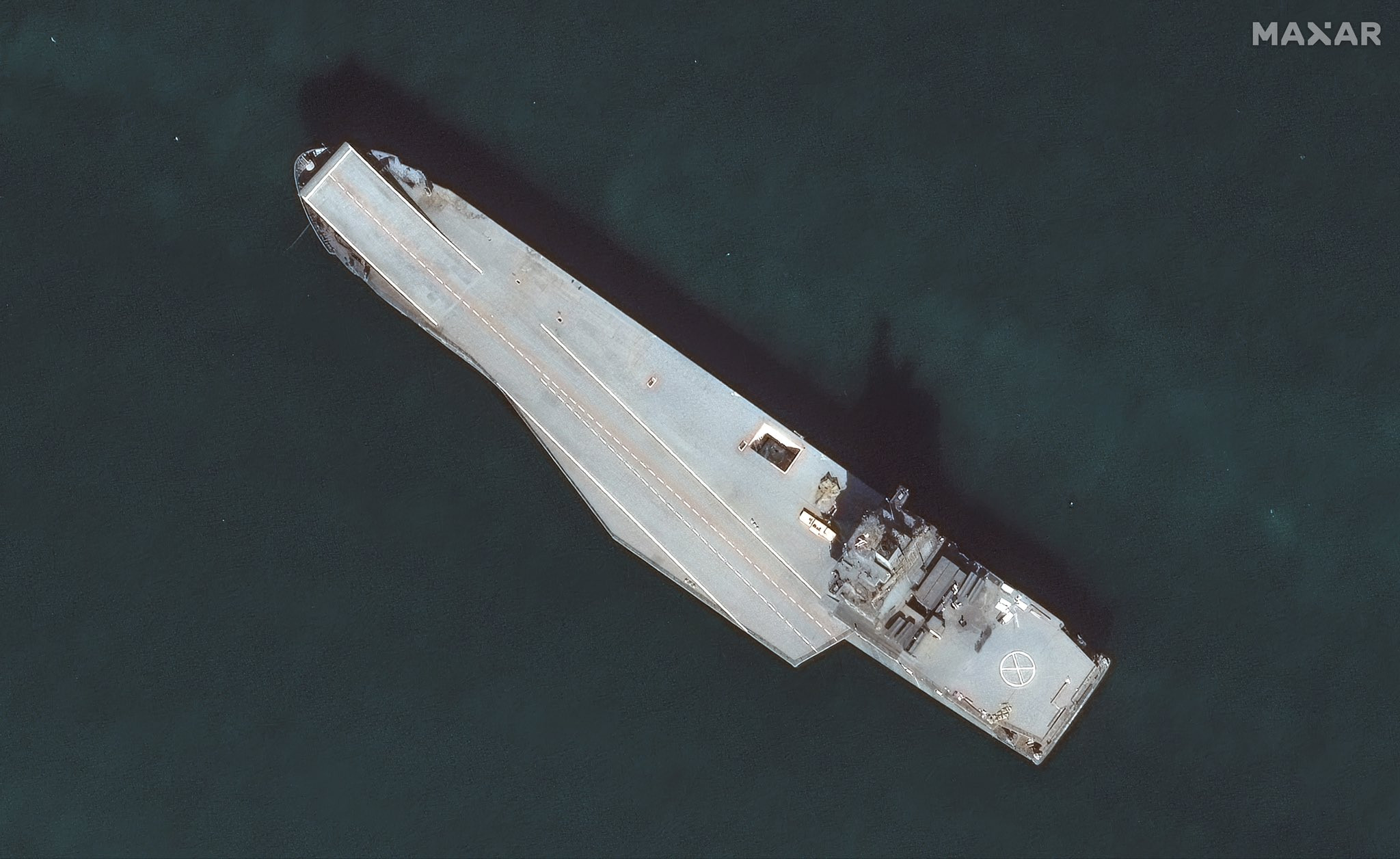
Satellite image of the drone carrier I.R.I.S. Shahid Bagheri (C-110-4) by Maxar Technologies. Note the open aircraft lift and boxed anti-ship missiles behind the superstructure. There appears to be a UAV under netting ahead of the superstructure. This may be a Gaza or similar type

Well, drones are in the news so why not. Drone carriers are becoming a type.

“Covert shores” has an excellent overview of how Iran is converting merchant ships to fulfill naval tasks.

Some are armed with ballistic or cruise missiles.

USCGC Alex Haley Encounters Russian AGI

The Navy League’s on-line magazine, Seapower, reports,

While patrolling the Aleutian Islands, the crew of U.S. Coast Guard Cutter Alex Haley (WMEC 39) detected the vessel 30 nautical miles southeast of Amukta Pass, Alaska.

The Russian vessel was transiting in international waters but inside the U.S. Exclusive Economic Zone, which extends 200 nautical miles from the U.S. shoreline. The Alex Haley did not communicate with the Russian vessel. The Alex Haley confirmed it to be a Russian Federation Vishnya-class naval vessel and followed the vessel as it transited east. An HC-130 air crew from Coast Guard Air Station Kodiak also observed the vessel.

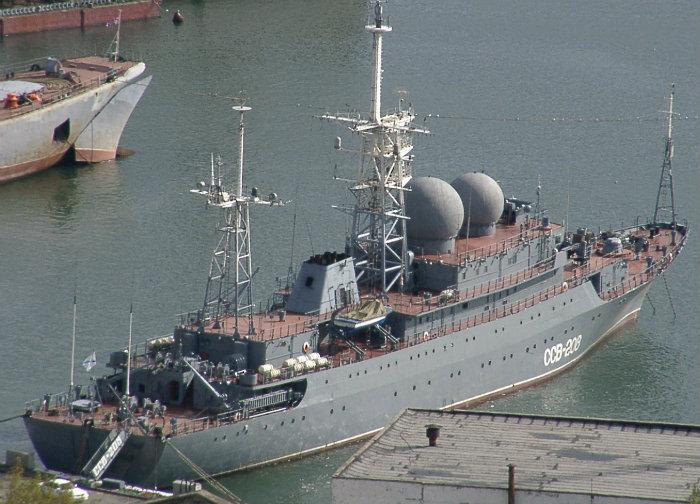
The Vishnya class are intelligence gathering ships completed in the late 1980s, like the one pictured above.

The detection was made 30 miles SE of Amukta Pass (52°27′31″N 172°00′55″W). This is well East of Eareckson Air Force Base (52°42′44″N 174°06′49″E) on Shemya and the former US Naval Air Facility, Adak (51°52′41″N 176°38′46″W).

Distances from Dutch Harbor (53°54′10.5″N 166°31′06.2″W):

  • Shemya 802 miles
  • Adak 446 miles
  • Amukta Pass 242 miles

The report seems to say that Haley simply stumbled across this Russian vessel. This suggests that it had been inside the US EEZ for at least two days before it was detected. That probably is not something to get excited about, but there may, of course, be more to this than we are aware.

USCGC Alex Haley moored in Nome, AK.

“Inside the U.S. Coast Guard’s Aleutian encounter with China’s military — and what it means” –Alaska Beacon

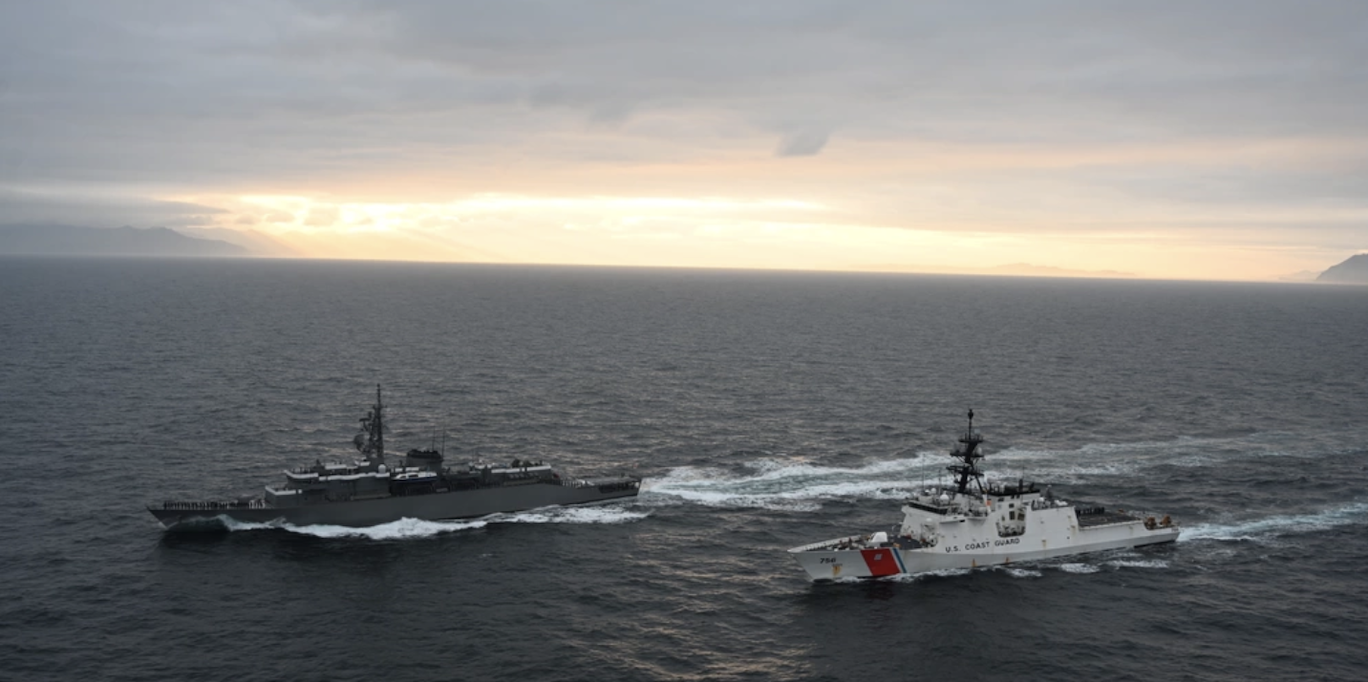
The U.S. Coast Guard Cutter Kimball, right, and a Japanese naval training vessel travel near the island of Unalaska in 2021. (U.S. Coast Guard photo)

The Alaska Beacon reports on the local reaction to the presence of Chinese ships in the Bering Sea, July 6 and 7.

The reaction clearly favored a more powerful and more visible response than a Coast Guard cutter and C-130.

So why use a cutter? Wouldn’t a destroyer or frigate be more appropriate?

A destroyer would have been faster, but the cutter is actually faster than the frigates the Navy is currently building.

The immediate answer is that there probably were no US Navy surface combatants in the vicinity, but would that have even been desirable?

What if they had suddenly become hostile?

Well, the cutter would probably have been sunk. That is a fact, but that is probably equally true of a destroyer outnumbered and taken by surprise at close range. Losing a cutter would be less of a loss and a prompt response from the Air Force would follow, probably quickly sinking the Chinese warships that have no fighter protection. That’s assuming they had not already been sunk by a US Navy submarine that may or may not have also been following them.

The US Navy just does not routinely keep surface vessels in the area of the Aleutians. Apparently, the Chinese were only there for two days. It would probably take longer than that for a USN combatant to make a transit, putting it out of position for its normal duties.

They were probably only doing this because the US does Freedom of Navigation Exercises in their backyard. But their response just plays into our narrative that we have every right to transit the Taiwan Straits–Look, they are transiting a narrow passage between US islands, and we didn’t object.

Would I like to see the cutters better equipped to defend themselves, sure, but it probably would not make any difference if they came to blows. Meanwhile the cutter makes a pretty good AGI. 

The Chinese are unlikely to start a war in the Aleutians unless they simultaneously also start it somewhere else, like Taiwan, but we still want to keep an eye on them, to discourage mischief.

Thanks to David for bringing this to my attention.

“U.S. Coast Guard encounters People’s Republic of China military naval presence in Bering Sea” –D17

A Coast Guard Cutter Kimball crewmember observing a Russian Destroyer in the Bering Sea, September 19, 2022. Coast Guard Photo

Below is a District 17 (Alaska) news release. USCGC Kimball was doing the same thing two years ago. Last year the US Navy had four destroyers doing the shadowing. In 2021 it was Bertholf. Chinese warship operated legally off American shores back in 2015. NORTHCOM’s on-line magazine, The Watch, suggested how these visits should be viewed.

Two items of note, (1) this is a little earlier in the year than we have seen them in the past, (2) where are the Russians? Usually there are Russian ships with the Chinese.

This provides another example of how the National Security Cutters are taking on a role comparable to AGIs of the Soviet Era.

It is ironic and a bit funny that the Chinese are doing “freedom of navigation operations.”

I will note again that the nearest US Navy surface ship is probably at least 1000 miles away, probably in Japan.


July 10, 2024

JUNEAU, AK –The U.S. Coast Guard encountered multiple People’s Republic of China military ships in the Bering Sea, Saturday and Sunday.

The crew of U.S. Coast Guard Cutter Kimball (WMSL 756) detected three vessels approximately 124 miles north of the Amchitka Pass in the Aleutian Islands, and an HC-130J aircrew from U.S. Coast Guard Air Station Kodiak detected an additional vessel approximately 84 miles north of the Amukta Pass.

All four of the People’s Republic of China vessels were transiting in international waters but still inside the U.S. Exclusive Economic Zone, which extends 200 nautical miles from the U.S. shoreline.

“The Chinese naval presence operated in accordance with international rules and norms,” said Rear Adm. Megan Dean, Seventeenth Coast Guard District commander. “We met presence with presence to ensure there were no disruptions to U.S. interests in the maritime environment around Alaska.”

The Chinese vessels responded to U.S. Coast Guard radio communication and their stated purpose was “freedom of navigation operations.” Coast Guard cutter Kimball continued to monitor all ships until they transited south of the Aleutian Islands into the North Pacific Ocean. The Kimball continues to monitor activities in the U.S. Exclusive Economic Zone to ensure the safety of U.S. vessels and international commerce in the area.

The Coast Guard, in coordination with U.S. Northern Command, was fully aware of and tracked the Chinese naval presence. In September of 2021 and 2022, Coast Guard cutters deployed in the Bering Sea also encountered Chinese surface action groups.

The Kimball patrolled under Operation Frontier Sentinel, a Coast Guard operation designed to meet presence with presence when strategic competitors operate in and around U.S. waters. The U.S Coast Guard’s presence strengthens the international rules-based order and promotes the conduct of operations in a manner that follows international norms.

Coast Guard Cutter Kimball is a 418-foot legend class national security cutter homeported in Honolulu, Hawaii.