Another Rotary Wing Air Intercept (RWAI) Mission

MH-65E interior.

Below is a news release from the Acquistions Directorate (CG-9). This is only the second “Rotary Wing Air Intercept” (RWAI) unit that I have heard of, but this may be a trend. The first unit has been flying over the Washington DC area since the 9/11 attack. Over time, it is likely the realization of a need for air policing will grow, and it looks like at the low and slow end of the spectrum, the Coast Guard is getting the job. 


Air Station Savannah plays key role in airspace security during SpaceX launches

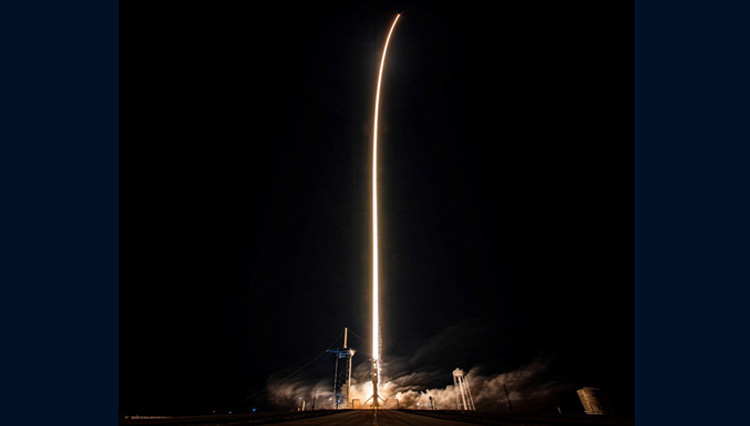
SpaceX Crew-6 launch

The SpaceX Crew-6 launch underway March 2, 2023. Photo courtesy of SpaceX.


Pilots from Air Station Savannah’s Rotary Wing Air Intercept (RWAI) unit stood ready to take to the skies March 2 in the air station’s new MH-65E Dolphin helicopter to provide security support for the manned SpaceX launch from Cape Canaveral, Florida. While this is the first time that the new Echo model was deployed, it marked the seventh launch for which the air station has provided critical flight restriction enforcement since NASA resumed manned space flights in 2020.

All airspace surrounding a space launch is restricted by the Federal Aviation Administration. The highly trained RWAI crew is poised to fly in very close quarters and intercept any unfamiliar aircraft that might trespass into the restricted airspace during a launch. Pilots who fly for the unit possess exceptional flight skills and decision-making abilities as the mission dictates pilots fly in extremely close quarters with other aircraft in order to intercept them.

The upgraded MH-65E helicopter is also more qualified for the task – the Echo configuration automates more flight control functions through use of the Common Avionics Architecture (CAAS) and Automatic Flight Control systems, allowing pilots to set parameters like altitude limits to prevent accidental overclimb into uncontrolled airspace. This and other upgrades ensure that pilots are able to focus on flying the mission with heightened awareness.

“The Echo drastically increases situational awareness and allows for much more complex mission calculations,” says RWAI pilot Lt. Cmdr. Sam Ingham. “This creates larger safety margins in an inherently dangerous environment.”

According to Aviation Special Missions policy director Lt. Cmdr. Mike Gibson, Air Station Savannah has sent NASA-requested RWAI resources to every official U.S. Government human spaceflight launch as part of Operation Noble Eagle. The latest launch was supported by Lt. Cmdr. Felipe Guardiola, Lt. Cmdr. Michael Gonzales and Petty Officer 2nd Class Connor Covert.

“NASA and the Coast Guard have a great relationship, and we’re happy to come down and help where we can,” said Ingham. “Also, it’s cool to have front row seats to watch rockets go to space.”

The MH-65 Conversion and Sustainment Program regularly receives feedback from the operational fleet on how the capabilities of the upgraded Echo allow the crew to continually be safer and more efficient when executing the mission. “It’s really incredible to hear from these crews that the upgrades to the Echo model are increasing their situational awareness,” said Cmdr. Karyn Forsyth, acquisition program manager for the MH-65. “Crews have more confidence in CAAS and its capabilities, especially when performing these special missions.”

The Coast Guard short range recovery helicopter program delivered the fifth and final MH-65E to Air Station Savannah Jan. 18, making it the ninth air station to fully transition to the upgraded configuration.

For more information: MH-65 Short Range Recovery Helicopter Program page
The Coast Guard’s Air Policing Job Over DC and Armed Overwatch

Back in 2014, I published a post, Random Thoughts on CG Aircraft Missions,
that among other things, talked about the Coast Guard’s air policing/intercept duties over the National Capital, now being done by MH-65s, and use of fixed wing aircraft to provide air borne use of force support for Webber class cutters, which is a capability we currently do not have. 
We may have a unique opportunity to address the problems discussed, using excess USAF assets at little or no cost. In the case of the Air Policing operation it might even reduce operating costs.
To outline the problems, as I see them, I will simply repeat the arguments from the earlier post.
The DC intercept: The problems with the current use of H-65s for intercepting general aviation aircraft that violate the standing airspace restrictions over the capital is that: (1) Many general aviation aircraft have a higher maximum air speed than the helicopter. (2) Even if the target is slower, the relatively slow speed of the helicopter may make achieving an intercept problematic. (3) If the aircraft is in fact hostile, the helicopter has to hand over the task of destroying it to an interceptor aircraft or missile battery introducing the possibilities of delays and misdirection.
Airborne use of force for law enforcement: In the Webber class cutters, the Coast Guard has an asset that can perform many of the missions normally expected of a medium endurance cutter, including drug and migrant interdiction, but they do not enjoy the advantage of organic aviation assets. There is no helicopter to augment their search, to chase down high speed contacts, or to use force to compel them to stop. When boardings are performed, they have neither a second boat nor an armed helicopter to provide over-watch as their boarding team approaches a suspected trafficer.
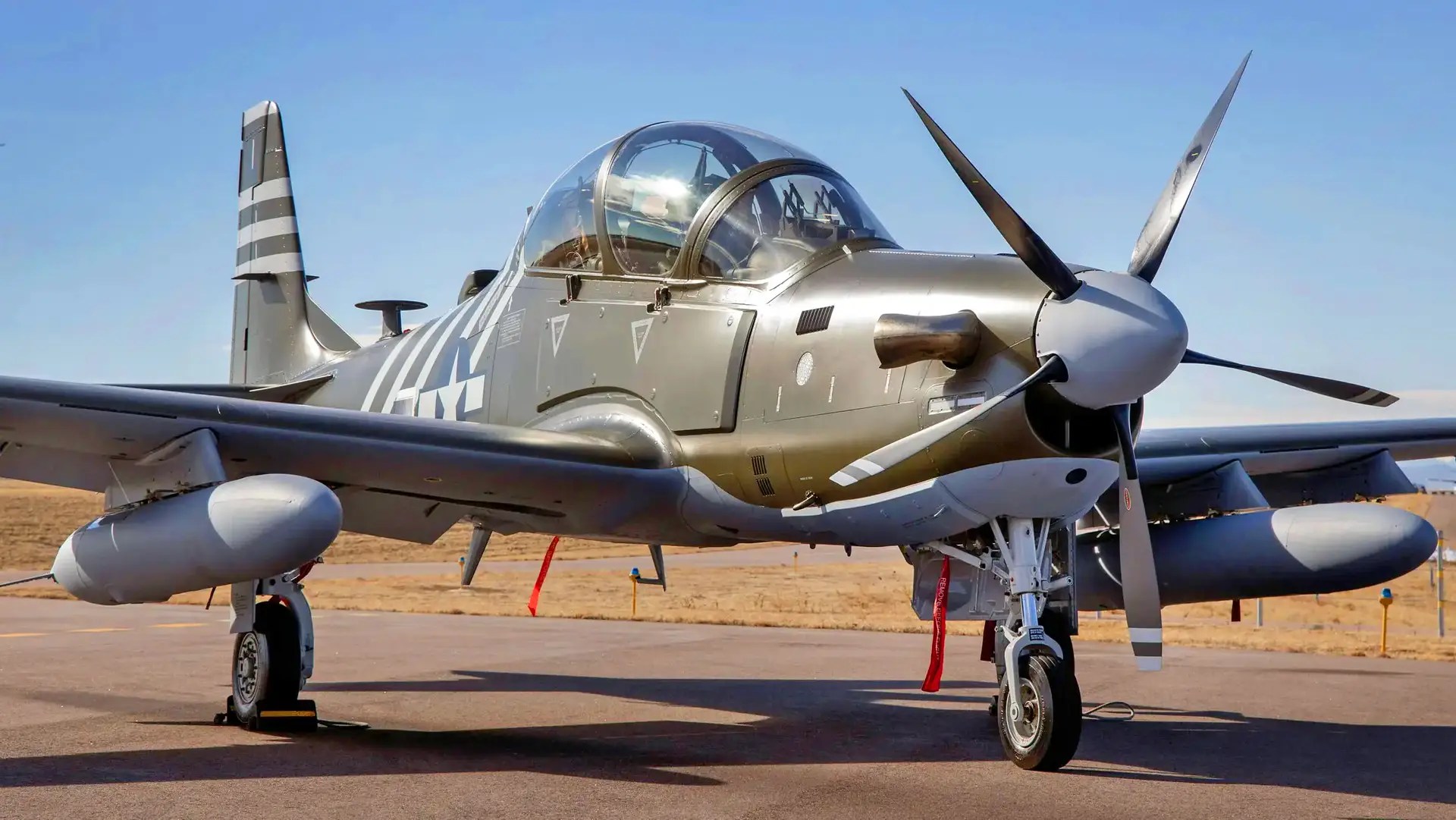
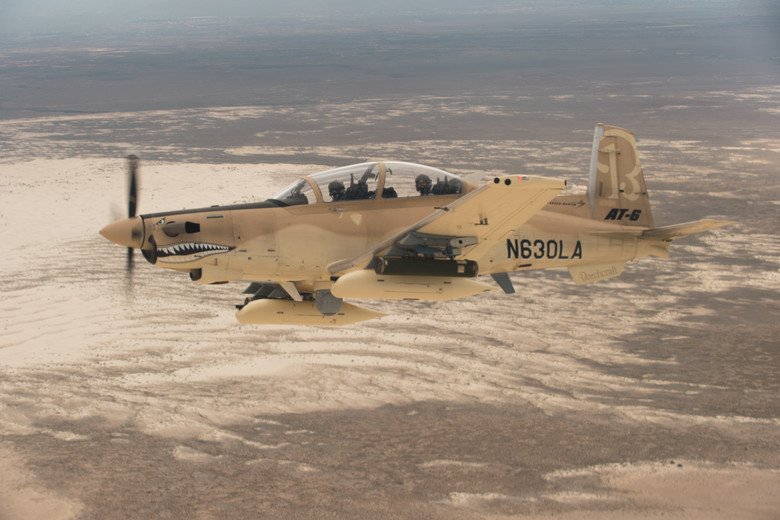
A couple of the aircraft I suggested might be appropriate for these roles were the A-29 Super Tucano and the AT-6 Wolverine.

The second A-29 Super Tucano for Air Force Special Operations Command, which received this one-off heritage scheme honoring the 1st Air Commando Group of World War II. Sierra Nevada Corporation

It just so happens, the Air Force has three A-29s and two AT-6s that are excess, now less than two years old, and they plan to dispose of them.
Compared to our helicopters, these aircraft have greater speed, range, and endurance and are, I believe, less expensive to operate. They are certainly less expensive to operate than our twin engine fixed wing aircraft.
In addition, these aircraft have excellent electro-optics and both air-to-air and air-to-surface capability, should it be necessary.
Replacing the H-65s providing air policing over DC, with the three A-29s, would not only provide a more capable interceptor, one still capable of operating at low air speeds, it would also reduce wear and tear on the H-65 fleet, whose maintenance has become problematic. As Air Force Special Operations Force aircraft, these planes may be better equipped to interface with the Capital Area Air Defenses, including F-16s and Army Surface to Air missile batteries than the MH-65s.

Basing the two AT-6s out of Puerto Rico would allow them to provide armed overwatch to Webber class WPCs in an area of intense activity. They could also be used as search assets given their excellent capabilities. The AT-6s are based on the T-6 Texan II trainer that is used to train all military aviators including Coast Guard. I understand there are now over 1000 T-6s and the two aircraft have 85% parts commonality.

If we chose to arm these, beyond their organic .50 cal. machine guns, we could probably make an arrangement with a nearby DOD air base to arm the aircraft.

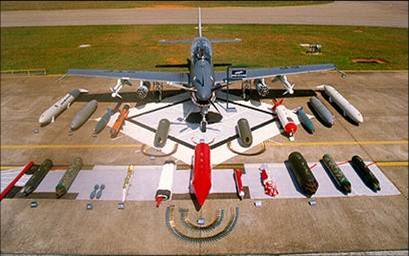
An A-29 Super Tucano with potential external stores. 

Thailand Buys AT-6 for Coast Guard Type Missions

Defense News reports that Thailand has become the first international customer for the Textron Beechcraft AT-6 light attack aircraft.

Thomas Hammoor, president and CEO of Textron Aviation Defense, said in a statement that the Royal Thai Air Force selected the Beechcraft AT-6 to conduct a broad array of missions in support of border security as well as anti-smuggling, counternarcotics and anti-human trafficking operations.

This is basically the same aircraft Coast Guard aviators train on before they get their wings, but with upgrades. I can’t help but think something like this or the similar Embraer A-29 Super Tucano could handle a lot of ISR missions more economically than what we are using now.

They could be used to scout for D7 Webber class FRCs doing drug or migrant interdiction and provide shots across the bow and over-watch in lieu of a helicopter.

The Washington DC air intercept mission in particular comes to mind. Local searches for overdue boats is another possibility. As you can see these aircraft support integrated electro-optical sensors.

An AT-6 Beechcraft is on display at the 2021 Dubai Airshow. (Agnes Helou/Staff)

Armed, these could also provide a response to terrorist attacks. My earlier ramblings on Coast Guard aircraft missions here.

More on the Scorpion ISR/Light Attack Aircraft

I did an earlier post on this aircraft because it was offered also as a potential Coast Guard ISR (intelligence, surveillance, reconnaissance) asset for Coast Guards, but this post seemed to offer enough new insights to justify another post.

It still appears to be a economical, highly flexible, reconfigurable alternative to land based UAVs, that can quickly put sensors where we need them, with additional potential for air-policing and an armed response to maritime terrorist attacks.

I’ll also add this quote I added to the previous post as a comment, from http://www.sldinfo.com/an-update-on-the-scorpion-weapons-separation-testing-progress/

Given all the attention the attack component of the Scorpion has received in the press, it is often overlooked that the aircraft is built around a payload bay.
The modular payload bay is impressive with great volume, electrical and cooling capacity for a wide variety of payloads/sensors.
One example is the L-3 Wescam MX-25 – now capable of full retraction into the payload bay.
The MX-25 is L-3 Wescam’s largest electro-optical/infrared camera.
For comparison purposes, the US Navy P-8 Poseidon utilizes the slightly smaller L-3 Wescam MX-20.
Aside from great payload flexibility, the Scorpion is night vision capable and both the front and rear cockpits are prepared for use with the Thales Visionix Scorpion Helmet Mounted Cueing System.