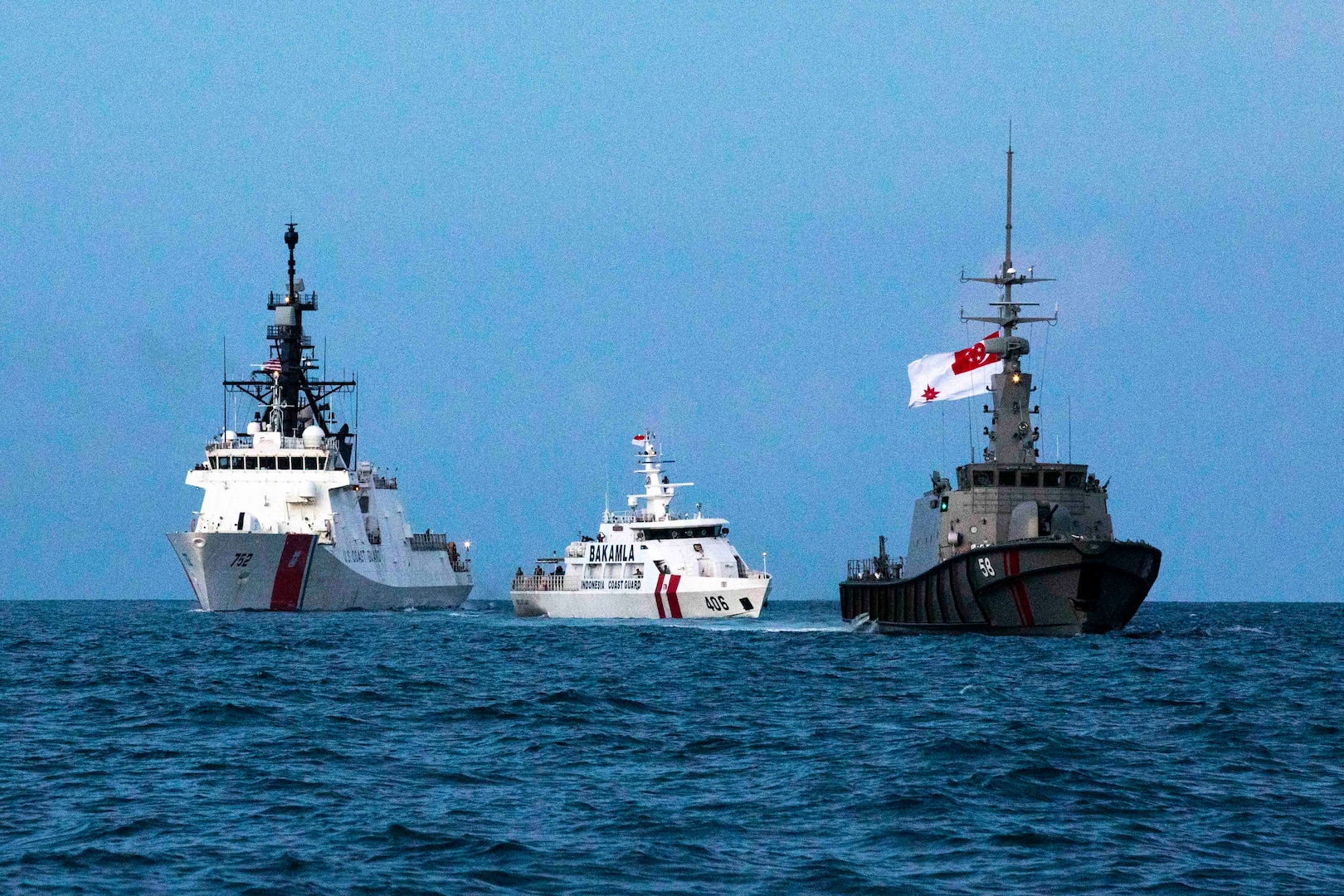
“U.S. Coast Guard Cutter Munro holds a change of command ceremony” –News Release

Royal Navy vessel HMS Spey (P234) (foreground) conducts coordinated ship maneuvers with U.S. Coast Guard Cutter Munro (WMSL 755) Sept. 17, 2023, in the South China Sea. Munro is deployed to the Indo-Pacific to advance relationships with ally and partner nations to build a more stable, free, open and resilient region with unrestricted, lawful access to the maritime commons. (U.S. Navy photo by Chief Petty Officer Brett Cote)

Below is a news release. Routine change of command, but the Munro’s recent activities are interesting for their variety, three very different activities in widely dispersed areas, Eastern Pacific, Western Pacific, and far Northern Pacific. More info in these earlier news releases:


 May 31, 2024

U.S. Coast Guard Cutter Munro holds a change of command ceremony

SAN DIEGO — The U.S. Coast Guard Cutter Munro (WMSL 755) held a change of command ceremony Thursday in San Diego.

Vice Adm. Andrew J. Tiongson, Commander, U.S. Coast Guard Pacific Area, presided over the ceremony in which Capt. James O’Mara IV relieved Capt. Rula Deisher as Munro’s commanding officer.

Deisher served as Munro’s commanding officer from May 2022 to May 2024, sailing over 73,000 nautical miles to 17 ports, including eight foreign countries during patrols in the Bering Sea, Western Pacific, and Eastern Pacific.

Most recently, Munro and the crew were responsible for the interdiction and seizure of illegal narcotics worth an estimated $460 million in wholesale value and over $2 billion in street value while patrolling the Eastern Pacific Ocean in support of the Joint Interagency Task Force-South. Munro’s crew also supported Operation Southern Shield during their recent patrol by conducting 16 fisheries boardings in the Southern Pacific Regional Fisheries Management Organization convention area, upholding the maritime rules-based order.

During Munro’s Western Pacific patrol, the cutter and crew hosted multiple engagements with foreign partners, including a discussion about the SAPPHIRE agreement with Japanese Coast Guard officers, a subject matter expert exchange, an at-sea engagement with the Korea Coast Guard, and participated in CARAT Brunei, where Munro worked alongside the Royal Brunei Navy in professional subject matter expert exchanges, leadership conferences, and an at-sea engagement.

While patrolling the Bering Sea, Munro conducted 24 fisheries boardings and two search-and-rescue cases, including the medical evacuation of a critical patient from Dutch Harbor, Alaska, to Anchorage, Alaska.

“To the crew of Munro, thank you,” said Deisher. “I am so proud of your endless dedication and care toward each other and our mission. This crew is phenomenal, and it has been an honor and privilege to sail with them and learn from them.”

Deisher’s next assignment is to serve as the Seventeenth District’s Response Division chief.

O’Mara, the incoming commanding officer, brings a wealth of experience to Munro.

Reporting from the Coast Guard’s Eleventh District as the Enforcement Branch chief, O’Mara oversaw assets across 1,000 miles of shoreline from the California-Oregon state line to the Mexico border and 73 federal waterways. He also worked closely with the Department of Defense Joint Interagency Task Forces and the Department of Homeland Security Joint Task Force West to conduct effective drug and law enforcement interdiction efforts across the Eastern Pacific.

Munro will be O’Mara’s seventh ship and fourth command, following previous commands aboard the Coast Guard Cutters Active (WMEC 618), Farallon (WPB 1301), Monomoy (WPB 1326), and Narwhal (WPB 87335).

The change of command ceremony, a time-honored tradition, is a significant event conducted before the assembled company of a command. It confirms to the unit’s men and women that the authority of command is maintained. The ceremony symbolizes a transfer of total responsibility, authority, and accountability from one individual to another, marking a new chapter in the command’s history.

Commissioned in 2017, Munro is one of four Coast Guard Legend-class national security cutters homeported in Alameda. National security cutters, measuring 418 feet long and 54 feet wide, boast a top speed of over 28 knots, a range of 12,000 nautical miles, endurance of up to 90 days, and can hold a crew of up to 170. The advanced technologies of the national security cutter class ships support the national objective of maintaining the security of America’s maritime boundaries and providing long-range search and rescue capabilities.

Japan to Build Five Large Cutters for Philippine Coast Guard

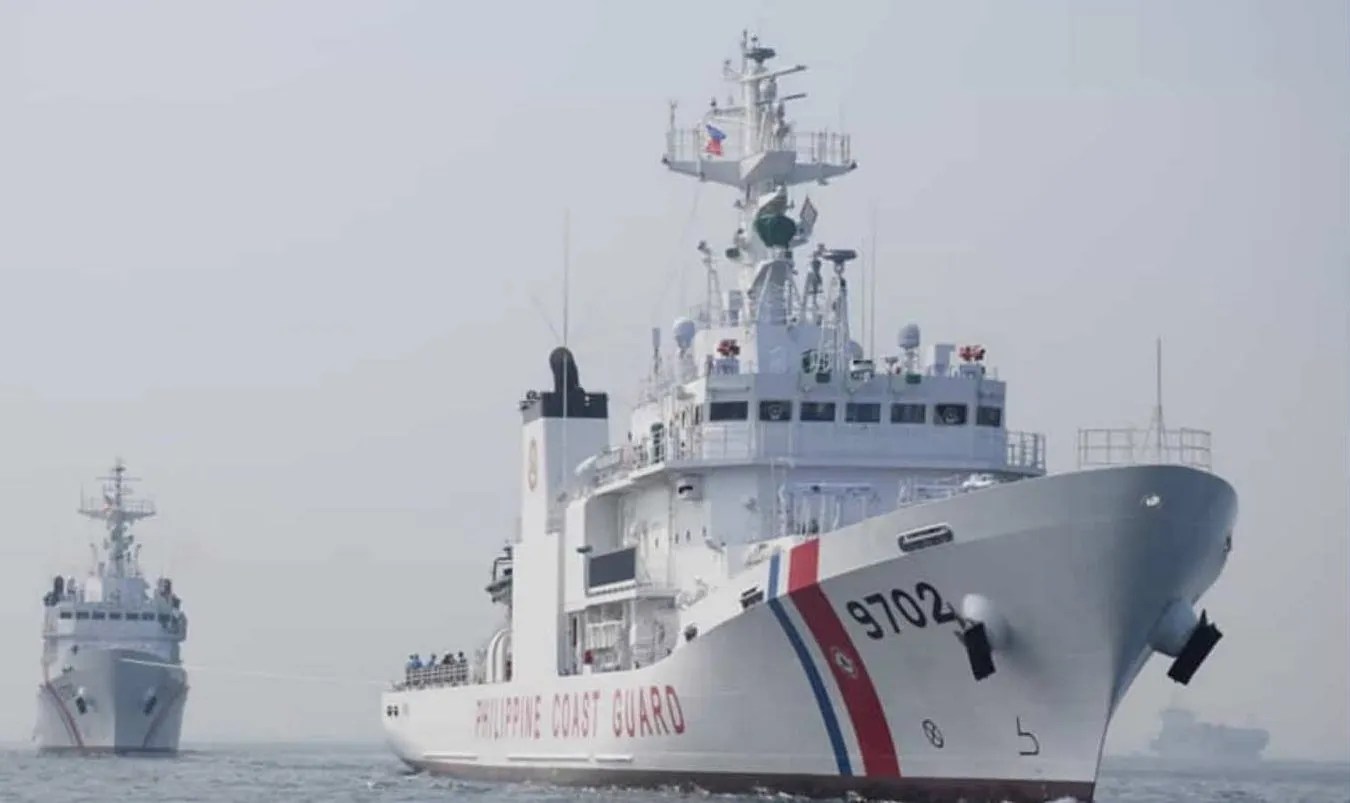
Japanese built Philippine Coast Guard cutter BRP Melchora Aquino

The EurAsian Times reports that Japan and the Philippines have finalized their largest security agreement to date.

“The US $507 million project is funded by an Official Development Aid loan from the Japan International Cooperation Agency. Around $425 million will be utilized in constructing five 97-meter-long multi-mission response vessels (MRRV) and a five-year integrated logistics support package…The patrol vessels are expected to be delivered between 2027 and 2028.”

The Philippine CG already has two ships of this type. We talked about this class earlier. Final specs, if there are no changes, from NavyRecognition,

“The MRRV has a length of 96.6 meters (317 feet–Chuck), a maximum speed of not less than 24 knots, and has a complement of 67 crew members. She has a two 6600 kW (6.6MW) diesel engines.”

That is about 17,700 HP. By comparison, the OPCs, which are longer and twice as heavy. will have 19,520 HP.

It appears the Philippine Coast Guard still has not armed their cutters with anything larger than .50 caliber machine guns. This class does have water cannon. Their Japanese counterparts are armed with either 20mm Gatling guns or Bushmaster II 30mm chain guns in Remote Weapon Stations.

Meanwhile the Philippine Navy is also buying Offshore Patrol Vessels, six from S. Korea. They will be much more heavily armed.

“U.S., Japan, Korea Coast Guards sign trilateral agreement to increase maritime cooperation” –News Release

U.S., Japan, Korea coast guards sign trilateral agreement to increase maritime cooperation
Mr. Kishimori Hajime, deputy Consul General of Japan (left), Japan coast guard Vice Adm. Watanabe Yasunori, Japan coast guard vice commandant for operations, U.S. Coast Guard Vice Adm. Andrew Tiongson, commander, U.S. Coast Guard Pacific Area, and Hyunchul Kang, deputy Consul General of the Republic of Korea, pose with a signed trilateral agreement at Coast Guard Island, Alameda, Calif., May 9, 2024. Japan, Republic of Korea and U.S. coast guards gathered to finalize a trilateral letter of intent, which will drive the three nations to work together to advance maritime safety, security and prosperity in the Indo-Pacific. (U.S. Coast Guard photo by Master Chief Petty Officer Charly Tautfest)

Below is a PACAREA news release.

Like the US Coast Guard, Japan and South Korea have been attempting to help SE Asian nations strengthen their maritime security and law enforcement organizations so that they can deal with what is essentially state supported, state sponsored, and state coordinated theft of their resources.

This should at least allow better coordination and avoid unnecessary duplication. The Philippines and Vietnam are likely to be primary beneficiaries.

We probably have things to learn too. The Japanese and S. Korean Coast Guards are both large and have a lot of experience countering violent resistance.

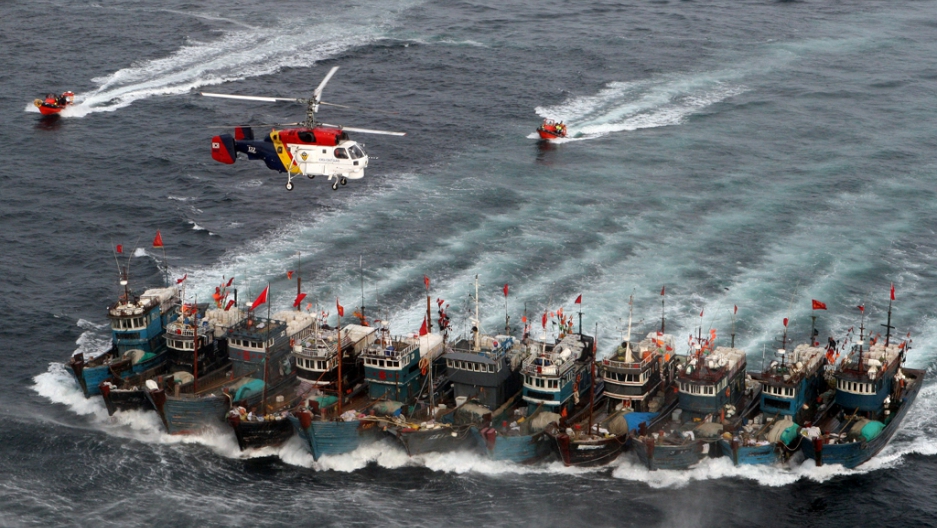
A picture taken on November 16, 2011 from a South Korean helicopter shows Chinese fishermen wielding sticks to stop an attack by South Korean coastguard commandoes armed with clubs aboard rubber boats during a crackdown on alleged illegal fishing in South Korean waters in the Yellow Sea off the southwestern coast county of Buan. South Korea’s coastguard mobilised 12 ships, four helicopters and commandoes for a special three-day crackdown on illegal fishing by Chinese boats this week. REPUBLIC OF KOREA OUT AFP PHOTO / DONG-A ILBO (Photo credit should read DONG-A ILBO/AFP/Getty Images)

Thanks to Paul for bringing this to my attention. 


May 12, 2024

U.S., Japan, Korea Coast Guards sign trilateral agreement to increase maritime cooperation

ALAMEDA, Calif – U.S. Coast Guard, Japan Coast Guard and Korea Coast Guard representatives displayed continued commitment to enhance maritime expertise and promote regional cooperation by signing a trilateral letter of intent, Thursday.

This agreement aligns trilateral cooperation between Japan, the Republic of Korea and the United States to include capacity-building efforts to Association of Southeast Asian Nations and Pacific Island countries. The letter of intent advances a joint statement between the three nations’ leaders, which was held at Camp David in August 2023.

U.S. Coast Guard Vice Adm. Andrew Tiongson, Commander, U.S. Coast Guard Pacific Area, met Japan Coast Guard Vice Adm. Watanabe Yasunori, Japan Coast Guard Vice Commandant for Operations, to finalize a trilateral letter of intent, which was previously signed by Korea Coast Guard Oh Sang Kwon, Deputy Commissioner of the Korea Coast Guard. Oh signed the letter of intent in April with the understanding that the agreement would be finalized upon Watanabe’s May visit to U.S. Coast Guard Pacific Area command.

Mr. Hyunchul Kang, Deputy Consul General of the Republic of Korea, attended the trilateral signing on behalf of the Korea coast guard, and Mr. Kishimori Hajime, Deputy Consul General of Japan, presented brief remarks as well.

“This trilateral agreement between U.S., Japan and Korea Coast Guards is the lynchpin that will drive our coast guards to work together to advance maritime safety, security, and prosperity in the Indo-Pacific,” said Tiongson. “It will enhance our multilateral operations with each other, as well as other trusted partners in the region.”

The agreement specifically recognizes the important of efforts to conserve maritime resources, combat illegal, unreported and unregulated fishing and search and rescue response efforts.

South Korea Seizes Chinese Fishing Vessels –Newsweek

A picture taken on November 16, 2011 from a South Korean helicopter shows Chinese fishermen wielding sticks to stop an attack by South Korean coastguard commandoes armed with clubs aboard rubber boats during a crackdown on alleged illegal fishing in South Korean waters in the Yellow Sea off the southwestern coast county of Buan. South Korea’s coastguard mobilized 12 ships, four helicopters and commandoes for a special three-day crackdown on illegal fishing by Chinese boats this week. REPUBLIC OF KOREA OUT AFP PHOTO / DONG-A ILBO (Photo credit should read DONG-A ILBO/AFP/Getty Images)

Newsweek reports,

“South Korea’s Coast Guard seized five Chinese vessels for allegedly fishing illegally in the country’s waters late last month, confiscating boats and deporting several crew members…The joint patrol’s 30 participating vessels and three aircraft waters were operating in the vicinity of Jeju Island from March 25-31, Korea JoongAng Daily reported.

“The country’s coast guard said that, on average, 300 Chinese vessels fish illegally in the country’s exclusive waters each day, with that figure dropping to an estimated 140 during periods of intensified crackdowns.”

As you can see from the photo above and below. This is not a new problem.

A picture taken on November 16, 2011 from a South Korean helicopter shows Chinese boats banded together with ropes, chased by a coastguard helicopter and rubber boats pacted with commandoes, after alleged illegal fishing in South Korean waters in the Yellow Sea.
Credit: Dong-A-Ilbo

In many cases these encounters have become violent. The South Koreans have not been afraid to seized Chinese fishing vessels, but on the other hand they have not been successful in stopping large scale illegal fishing.

“U.S., Indian Coast Guards Drill Against Drone Attacks In Sea Defenders 2024” –Naval News

USCGC Bertholf and an ICG offshore patrol vessel sail together during Sea Defenders 2024.

Naval News reports,

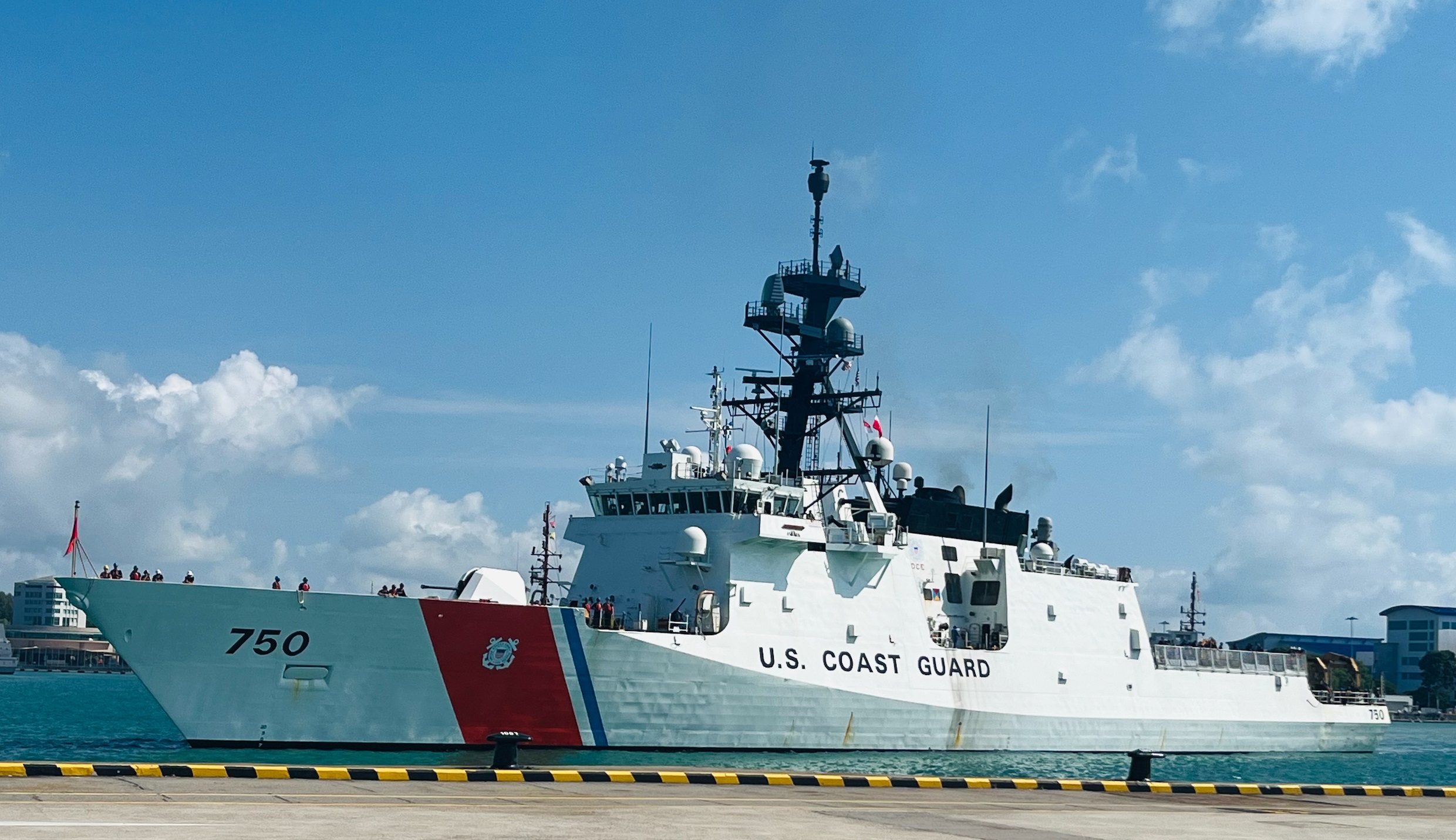
U.S. and Indian Coast Guards held this year’s Sea Defender with recent events in the Red Sea in mind, training against both drone and piracy threats…Taking place off the Malacca Strait off the Andaman and Nicobar Islands, USCGC Bertholf (WMSL-750) and Indian Coast Guard vessels and aircraft held several maritime security activities in port and at sea over four days. This exercise also marked the first time a U.S. Coast Guard vessel visited New Delhi’s southernmost territory, strategically located at the entrance to the Malacca Strait between the Indian and Pacific oceans. 

The Indian Navy and Coast Guard both operate large numbers of Offshore Patrol Vessels. Established in 1978, the Indian Coast Guard has been growing rapidly and is now one of the largest in the world. Following the 2008 Mumbai Terrorist Attack, which came by sea, the Indian Coast Guard grew even more rapidly.

The Indian Coast Guard now operates 27 Offshore Patrol Vessels (OPV), all commissioned within the last 28 years, 18 within the last ten years. The Indian CG has ordered six more. The Indian Navy also operates ten OPVs, all commissioned in the last 35 years, four commissioned within the last eleven years. The Indian Navy has ordered eleven more OPVs.

The US Coast Guard operates, I believe, 36 OPVs now, soon to be 34. Only six of those have been commissioned in the last ten years. 26 of the USCG OPVs are over 33 years old.

The NSCs are doing things we would have never expected when they were conceived.

As included in this exercise, it appears there is an emerging requirement for the Coast Guard to be prepared to counter unmanned systems of various types, both for self defense and for the defense of maritime assets. Unmanned systems are likely the weapon of choice for future terrorist attacks.

Of all Coast Guard assets, the large cutters are currently the most capable against the various types of one-way attack unmanned systems, but they are unlikely to be involved in the most likely scenarios. Attacks on passenger ships, submarines, or aircraft carriers, during transit from port to open sea seem most probable. Here we are decidedly unprepared, but perhaps PATFORSWA is leading the way.

“Coast Guard Cutter Bertholf arrives in Singapore”

U.S. Coast Guard Cutter Bertholf (WMSL 750) arrives at Changi Naval Base in Singapore, Feb. 25, 2024. The Bertholf moored next to USS Gabrielle Giffords (LCS 10), a U.S. Navy Littoral Combat Ship, also in the region to support an open Indo-Pacific region. (U.S. Coast Guard photo by Cmdr. Trevor Parra)

Below is a US Coast Guard news release. You can find more photos at the link. 


March 5, 2024

Coast Guard Cutter Bertholf arrives in Singapore

SINGAPORE – U.S. Coast Guard Cutter Bertholf (WMSL 750) and crew arrived in Singapore, Feb. 25, after transiting more than 8,000 nautical miles over 30 days from San Diego, Calif.

During the visit to the Republic of Singapore, the crew of the cutter is scheduled to participate in several professional engagements and at-sea exercises.

The two-day professional meetings will allow for collaboration, exchanges of best practices, and operational planning for the scheduled two-day exercises at-sea with the Republic of Singapore Navy vessel, Guardian. In addition to the Republic of Singapore Navy, the crew of the Bertholf intend to work with the Singapore Police Coast Guard and Malaysia Maritime Enforcement Agency.

“The crew of the Bertholf is excited to be in Singapore and looking forward to the many events with the crew of the Republic of Singapore Navy, Police Coast Guard, and Malaysia Maritime Enforcement Agency,” said U.S. Coast Guard Capt. Billy Mees, commanding officer of the Bertholf. “The Indo-Pacific region is a dynamic environment and fostering partnerships with our allied nations helps ensure we improve maritime governance in these crucial economic waterways.”

Bertholf is one of four National Security Cutters homeported in Alameda. The U.S. Coast Guard currently maintains 10 National Security Cutters. Bertholf is operating as part of Commander, Task Force (CTF) 71, U.S. 7th Fleet’s principal surface force, promoting a free and open Indo-Pacific, strengthening partner networks, and enhancing maritime safety and security.

Bertholf is the first legend-class national security cutter and has a range of 12,000 nautical miles, endurance of up to 90 days and can hold a crew of up to 170. Coast Guard Cutter Bertholf is homeported in Alameda, Calif.

Why Russia Should be Worried, “ARCTIC PRC’s 13th Arctic expedition creating concerns for Russia” –The Watch

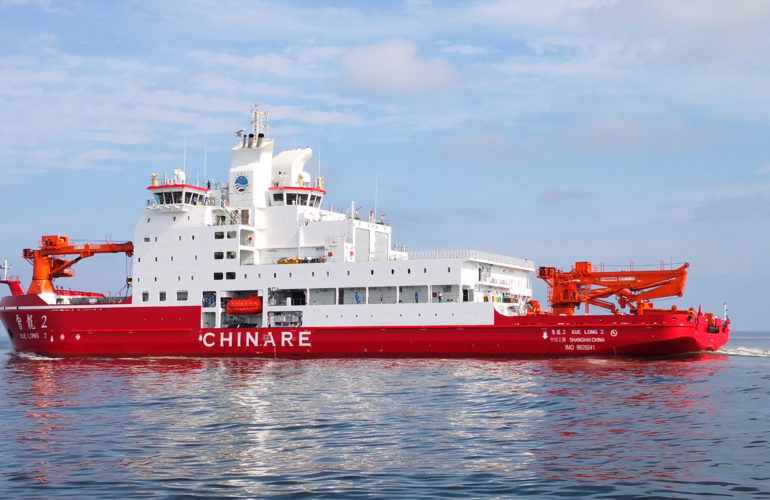
Xue Long 2 on sea trials. Photo by PRIC.

NORTHCOM’s online magazine, “The Watch,” gives us a balanced, non-alarmist, look at Chinese Arctic activity, but also tells us why maybe Russia should be worried.

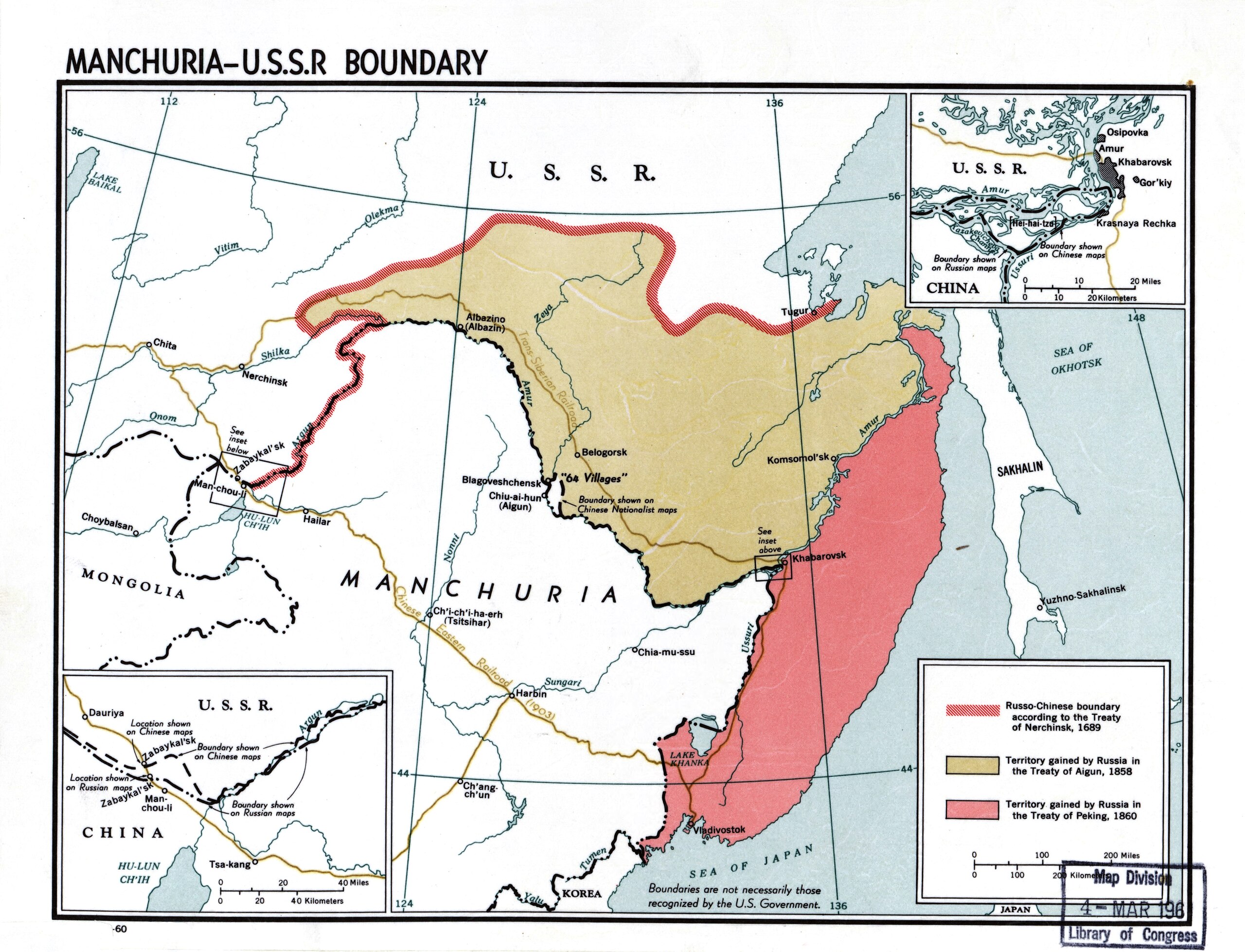
I have contended for a long time that sometime in the future, China will turn on Russia and recover those parts of China ceded to Russia as a result of unequal treaties (and here) in the 19th Century, during what China calls the Century of Humiliation, and while they are at it, maybe a bit more. They have neither forgotten nor forgiven.  

Library of Congress Geography and Map Division Washington, D.C. 20540-4650 USA
DIGITAL ID g7822m ct002999 http://hdl.loc.gov/loc.gmd/g7822m.ct002999

China and Russia have a long history of conflict (here, here, here and here), There was a border conflict between China and Russia (then the Soviet Union) in 1969, when China was clearly the weaker of the two, that lead to China opening to the West and Nixon’s trip to China.

Russia and China’s current partnership has mostly benefited China. China benefited from technology transfers and reverse engineered Soviet and Russian weapon systems.

Now China is clearly stronger than Russia in just about everything except nuclear weapons, and they are now rapidly growing their nuclear capability.

If China should decide retaking Taiwan, which has 215,000 active military and 2,310,000 reservists, a tech savvy population of about 24 million, and is protected by the 100-mile-wide Taiwan Strait and has potential help from powerful allies, may be too risky, they may decide recovery of Outer Manchuria is a good consolation prize.

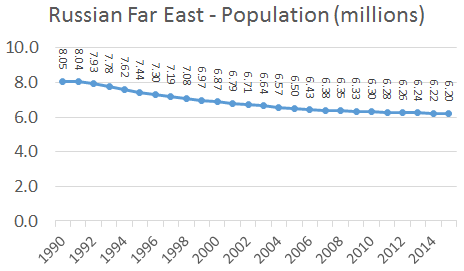
Population of the Russian Far East, 1990-2015 Data source: Fedstat. Author: Underlying lk. (About four million of these live in former Chinese territory.)

The Russian population in the Far East is small and declining. Russian infrastructure connecting industrialized European Russia with the FarEast is weak. Most of the Russian military is in Europe, and their weakness has been exposed in Ukraine.

If China attempted to retake land formerly part of China, they would want to cut Russia’s East/West logistics links. Taking out the few railroad links using airpower would be relatively easy. Air links can’t carry much in the way of heavy equipment. Most Russian supplies and material reinforcements would have to come by sea. Even if the Chinese did not interdict Russian traffic on the Norther Sea Route as suggested in the linked post, China’s Navy and Air Force could dominate Russian access to the Sea of Japan, including the primary Russian Pacific Fleet base in Vladivostok. Chinese submarines and their rapidly expanding force of aircraft carriers could probably cut off access to the Sea of Okhotsk and Petropavlovsk.

From a Chinese point of view recovery would be justified and perhaps far less costly than an amphibious invasion of Taiwan.

If the Russians can be made to see the righting on the wall, they might even be willing to sell the territory back to their friend at wholesale.

“Japan amplifies maritime security amid rising regional tensions” –Indo-Pacific Defense Forum

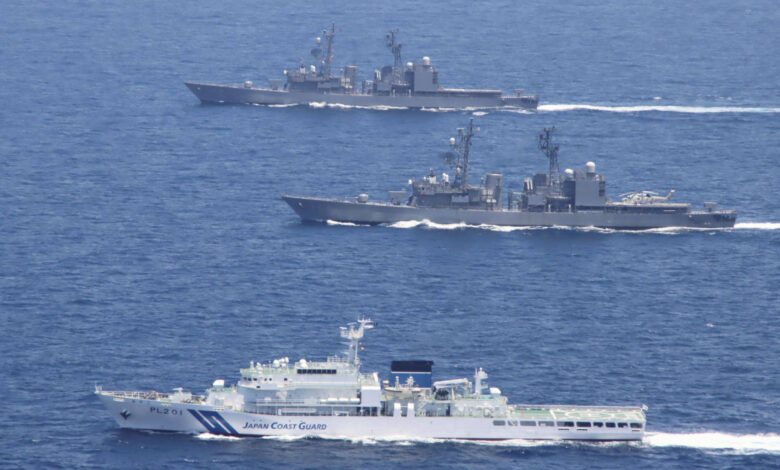
The Japan Coast Guard and Japan Maritime Self-Defense Force conduct a joint drill. IMAGE CREDIT: JAPAN COAST GUARD

Indo-Pacific Defense Forum reports Japan is attempting to increase coordination between their Maritime Defense Force (navy) and Coast Guard.

“Japan’s economic security is wedded to stable sea lines of communication (SLOC) that stretch through the East China Sea to waters around Taiwan, from the South China Seas to the Malacca straits into the Indian Ocean,” Stephen Nagy, professor at the Department of Politics and International Studies at the International Christian University in Tokyo, told FORUM. “The recently announced five-year ocean policy plan aims to bring stability to these SLOCs through more operational synergy between the [J]MSDF and Japan’s Coast Guard.”

There is little doubt this is in response to Chinese misbehavior. Still, until recently there has been little coordination between the two services.

The Japan Coast Guard has a long association with the US Coast Guard. From Wikipedia,

 “…in March 1946, USCG Captain Frank M. Meals was invited to consider the situation. Captain Meals suggested the establishment of a comprehensive coast guard organization based on the USCG. In response to this, the Maritime Safety Agency (MSA) was established as an external station of the Ministry of Transportation in 1948. Its English name was changed to Japan Coast Guard in April 2000.”

The Japan Coast Guard has never had the close association with the Maritime Defense Force that the US Coast Guard enjoys with the US Navy. It appears that is changing.

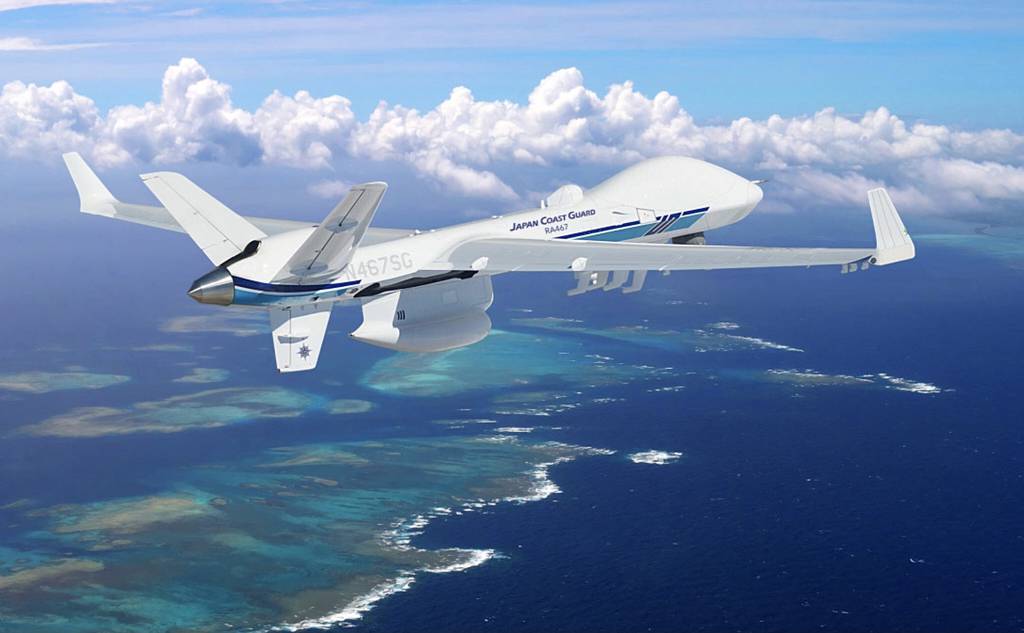
An artist’s rendering shows the Japan Coast Guard’s SeaGuardian drone. (General Atomics Aeronautical Systems)

As noted, the Japan Coast Guard has fielded MQ-9B long endurance, medium altitude, unmanned aircraft, a capability the Japan Maritime Self Defense Force does not yet have.

Seems the Japanese now view the Japan Coast Guard as a trip wire. That if the Chinese make an aggressive move, the Japan Coast Guard is likely to be the first to detect–and feel it.

“Indo-Pacific coast guards try to head off a troubling storm” –Asia Times

The Philippine Coast Guard conducted its first-ever trilateral maritime exercise with the United States Coast Guard (USCG) and the Japan Coast Guard (JCG) in waters off Mariveles, Bataan, from June 1-7, 2023. Photo: Philippine Coast Guard

The Asia Times reports, “Indo-Pacific coast guards and maritime law enforcement agencies are taking additional steps to improve their cooperation.”

We have frequently talked about US Coast Guard actions in the Western Pacific, but this gives us a better understanding of the leadership roles being taken by the Coast Guards of Japan, India, Indonesia, and the Philippines, working in cooperation with Vietnam, Malaysia, Singapore, Bangladesh, Cambodia, South Korea, Sri Lanka and the Maldives.

Perhaps someday we will see something like my proposed Combined Maritime Security Task Force Pacific.

The CENTCOM sponsored Combined Maritime Forces provides a good model.

“Philippine, US, Japanese coast guards carry out anti-terror drill in disputed waters” –Radio Free Asia

GlobalSecurity.Org has a report on a tri-lateral Counter-Terrorism exercise conducted by the US, Japan, and Philippine Coast Guards. This was part of an exercise discussed earlier. The USCGC Stratton was the USCG contingent. The photo above was taken a bit earlier and shows Stratton exercising with vessels from Indonesia and Singapore.