Coast Guard to help the Forrest Service–Fire Aviation

Fire Aviation is reporting an interesting wrinkle in the story of the transfer of Coast Guard C-130s to the Forrest Service,

“We were surprised to hear from Mrs. Jones (a Public Affairs Specialist for the Forest Service at the National Interagency Fire Center-Chuck) …that a joint U.S. Coast Guard and U.S. Forest Service program office will provide logistics, operations, training, maintenance, and support for the C-130H aircraft. The Coast Guard has been managing a fleet of C-130s since 1959, using them for long range search and rescue, drug interdiction, illegal migrant patrols, homeland security, and logistics. They have 24 older C-130Hs which are being upgraded with new center wing boxes and cockpit equipment with new multi-function displays. In 2008 they began replacing some of the C-130Hs with new C-130Js; they have six now with three more on order. All these numbers were valid before the Coast Guard agreed to send seven C-130Hs to the USFS if the Coast Guard could get the 14 almost new C-27J aircraft from the military that had been earmarked for the Forest Service.”

Relatively Good News in the Budget

FierceHomelandSecurity is reporting that while it appears the Coast Guard’s budget is down, it will represent a significant increase over the administration’s request.

“The Coast Guard will get a topline of $10.2 billion, a decrease of $211 million compared to the previous year enacted amount, but $463 million more than called for in White House budget proposal. For acquisition, construction and improvements, the service is set to get $1.376 billion, and to use funds to procure a seventh National Security Cutter and contract for long lead time materials for the eighth (and final) NSC. The omnibus will also fund the production of six Fast Response Cutters–Coast Guard officials have warned that an annual production rate of less than four FRCs would cause the cost of the FRC recapitalization program to rise and put in doubt the service’s ability to buy all 58 planned total FRCs.”

The news is particularly good on the on the AC&I budget, the increase there accounting for what appears to be virtually all the increase over the administration request. Keeping the acquisition programs on track, is probably the best we could have hoped for this year.
This is, I believe, a two year budget. I am curious to see what has been included and planned for the out years.
I note with some distress that the $211M drop in the Coast Guard’s “top line” represents 63% of the total decrease in Department of Homeland Security’s Budget, so the pain is obviously not being spread around equally, but if we include the acquisition of 14 new C-27Js, all in all, not the disaster it might have been.

How Long Did it Take to Build the Pentagon?

File:The Pentagon January 2008.jpgPhoto Credit: David B. Gleason, The Pentagon, headquarters of the United States Department of Defense, taken from an airplane in January 2008

More evidence the government has forgotten how to get things done.

FierceHomlandSecurity reports Doubts have surfaced about the plan to consolidate the DHS headquarters at the St. Elizabeths Hospital location, “In a report signed by Rep. Jeff Duncan (R-S.C.), chairman of the House Homeland Security subcommittee on oversight and management efficiency, committee staff note that the projected cost and time frame for completion of the consolidated headquarters effort have increased by more than a billion dollars and 11 years to $4.5 billion and the year 2026.”

Answer: Ground was broken for construction on September 11, 1941, and the building was dedicated on January 15, 1943.

Vice Adm. Currier Pushes Back

The US Naval Institute News reports, “Coast Guard Pushes Back Against Congressional Calls for Reductions.”

Nice to see Vice Adm. John Currier standing his ground before Congress. Congress seems to want the Coast Guard to tell them which of its eleven missions it should stop doing entirely.

That really makes no sense, because if the job needs to be done, they will have to create a new agency to do it with all the initial start up problems reorganization can entail. Better to simply scale back operations in some areas, retain the expertise, and be ready to expand again if and when additional funds become available.

If on the other hand Congress sees no reason for some missions to be done at all, they should have the courage to repeal the laws and accept the consequences.

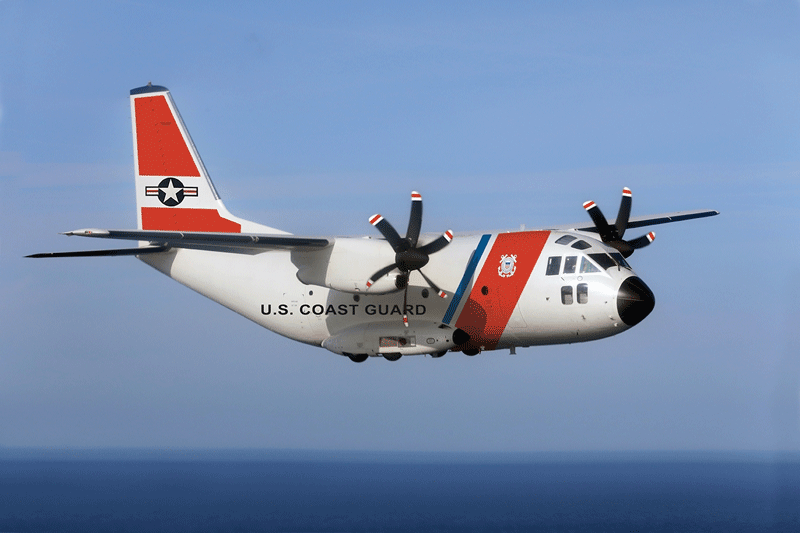
CG to get C-27J

uscg-c-27j-impression
Alenia Aermacchi impression of a C-27J Spartan in U.S. Coast Guard livery. (Photo: Alenia Aermacchi)

I did note this in a comment on the previous post about this, but its probably too important to not to have its own post. Apparently we have confirmation that the Coast Guard will be getting the Air Force’s excess C-27Js.

Question is, if we were going to buy 36 HC-144s and we have bought 18, doesn’t getting 14 C–27s still leave us 4 planes short? and if we are giving some older C-130s to the Forrest Service perhaps a few more?

Does it mean the Coast Guard will be getting more C-130Js?

Coast Guard Capital Investment Plan, 2014-2018

Earlier we discussed the House sub-committee hearings on the Coast Guard’s Capital Investment Plan (CIP). The US Naval Institute has published the plan, you can see it here. It is very short, only six pages, and virtually all the useful information is on the last page.

What I found bewildering is that the Coast Guard does not have any unfunded priorities. The report is supposed to include unfunded priorities, after all the long title is “Capital Investment Plan and Unfunded Priority List.”

“This report responds to the language set forth in
Coast Guard and Maritime Transportation Act of 2012
(Pub. L. 112-213) as per the following:
SEC. 213 CAPITAL INVESTMENT PLAN AND ANNUAL LIST OF PROJECTS……….(b) UNFUNDED PRIORITY DEFINED.—In this section, the term unfunded priority’ means a program or mission requirement that— (1) has not been selected for funding in the applicable proposed budget;(2) is necessary to fulfill a requirement associated with an operational need; and (3) the Commandant would have recommended for inclusion in the applicable proposed budget had additional resources been available or had the requirement emerged before the budget was submitted.”
If you look at the “Fleet Mix Study” it is clear that both the Coast Guard and the DHS agree that in order to accomplish its mandated missions, the Coast Guard has a significant shortfall in assets and would still have a shortfall even if the “Program of Record” (POR) were complete today.
Looking at the table below which was included in the Fleet Mix Study, that concluded the assets under FMA-4 would be required to complete all mandated missions, we can see that the POR is short one NSC, 32 OPCs, 33 OPCs, 22 C-130s, 31 HC-144s, 62 H-60s, 121 H-65s, 22 land based UAS, and 19 Cutter based UAS.
Table ES-8 Alternative Fleet Mix Asset Quantities
—————-–POR       FMA-1       FMA-2        FMA-3        FMA-4
NSC                8             9                 9                 9                  9
OPC              25           32               43                50               57
FRC               58           63               75                80               91
HC-130         22            32               35                44               44
HC-144A       36            37               38                40               65
H-60              42            80               86                99             106
H-65            102          140             159              188             223
UAS-LB          4             19                21                21              22
UAS-CB       42             15                19               19               19
Where are these unfunded priorities? It is one thing to say, “This is what we think we need, but we understand we cannot afford it right now.” It is another thing entirely to preemptively surrender and not even tell Congress what you need when they have asked.
And, at a subcommittee hearing entitled “Examining Cutter, Aircraft, and Communications Needs,” why was there no mention of the Fleet Mix Study except in passing by the Congress’s own researcher?