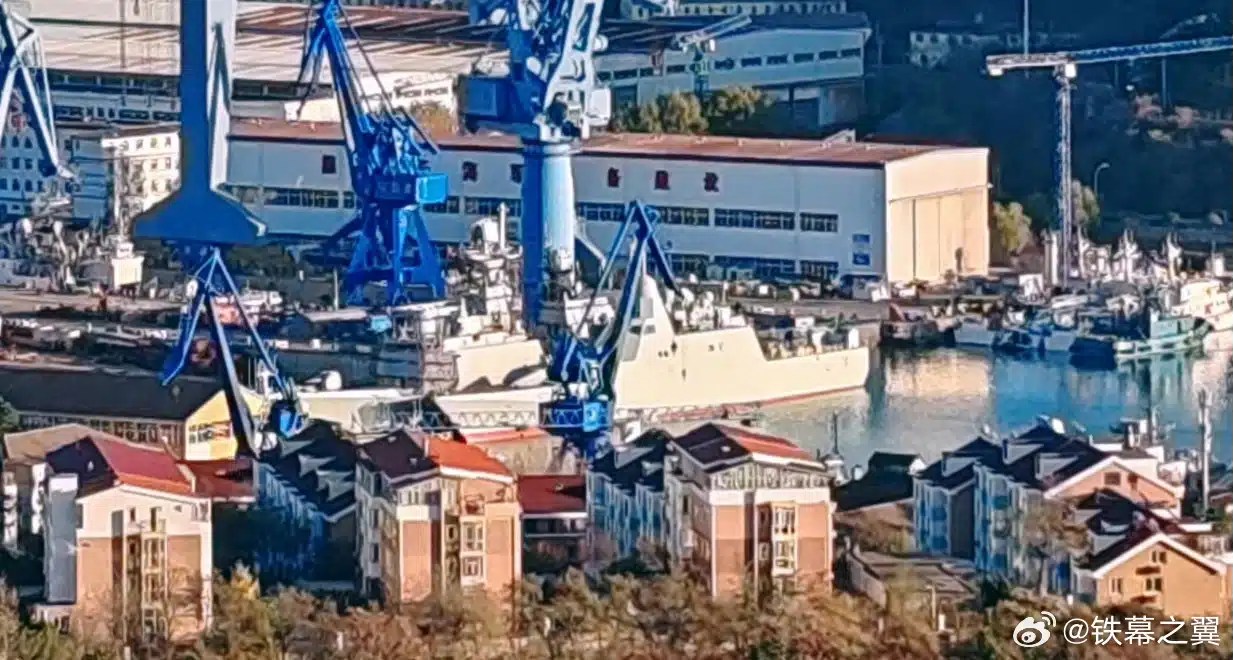
Naval News reports initial information on a new design stealthy small surface combatant, estimated to be 97 meters (318′) in length with a beam of 14 meters (46′). The report suggests the vessel will be 2,000 to 3,000 tons.
CIMSEC has an interesting take on China’s use of its Distant Waters Fishing Fleet (DWF).
“If the U.S. is serious about “Great Power Competition,” it at least needs to stop scoring “own goals” by funding and emboldening the main competitor. But from the standpoints of both defense and security, these issues cannot be overlooked or marginalized. China is using its DWF globally in a manner that accrues tremendous benefits to the Chinese armed forces.”
The US Coast Guard is certainly trying to help other nations protect their EEZs from unauthorized exploitation by Chinese Fishing Vessels, but currently many nations license Chinese exploitation of their EEZ and there is no way we can prevent the Chinese from fishing in the waters beyond national boundaries. Even if the US stopped buying Chinese caught fish, there are other ready markets. The only result would be raising the cost of fish to US consumers.
What we need are alternative competitive provider of seafood.
We could have a true win/win by helping the Compact of Free Association States, (Federated States of Micronesia (FSM), the Republic of the Marshall Islands (RMI), and the Republic of Palau) develop distant waters fishing fleets of their own. This would help keep their interests aligned with ours. Motivate them to keep the Chinese out of their EEZ, and direct more cash flow into these small, friendly and strategically important nations.
Naval News has the story.
Check out the wake of the China Coast Guard cutter 5203 in the first video. She clearly turned into the small Philippine supply vessel.

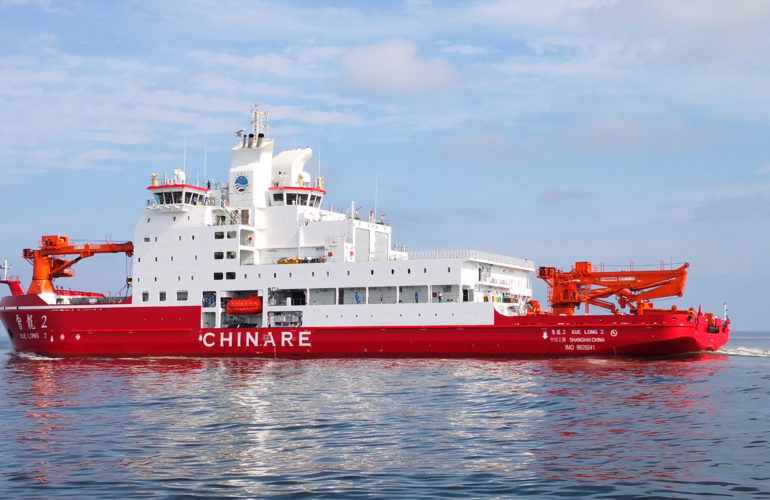
Xue Long 2 on sea trials. Photo by PRIC.
NORTHCOM’s online magazine, “The Watch,” gives us a balanced, non-alarmist, look at Chinese Arctic activity, but also tells us why maybe Russia should be worried.
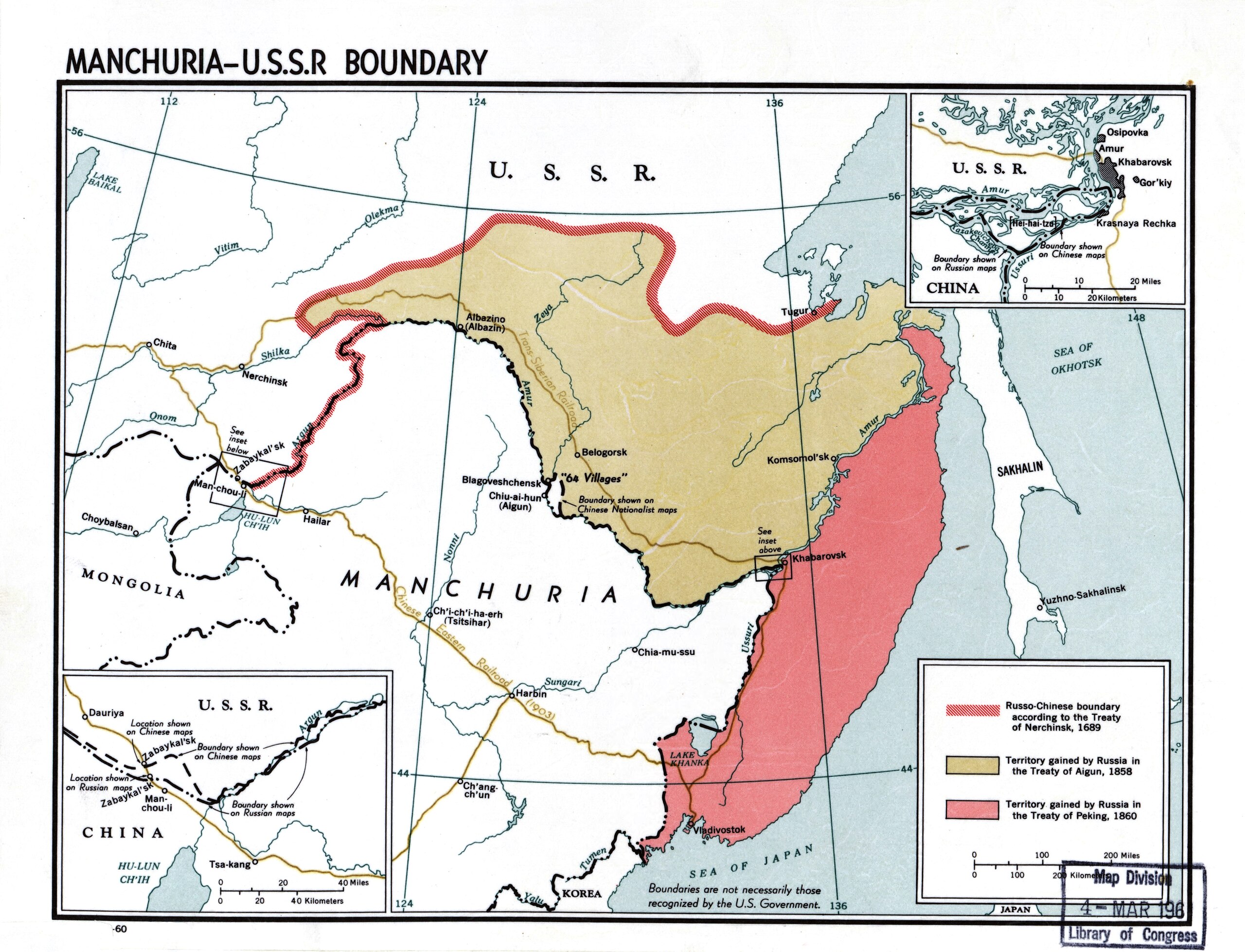
I have contended for a long time that sometime in the future, China will turn on Russia and recover those parts of China ceded to Russia as a result of unequal treaties (and here) in the 19th Century, during what China calls the Century of Humiliation, and while they are at it, maybe a bit more. They have neither forgotten nor forgiven. 
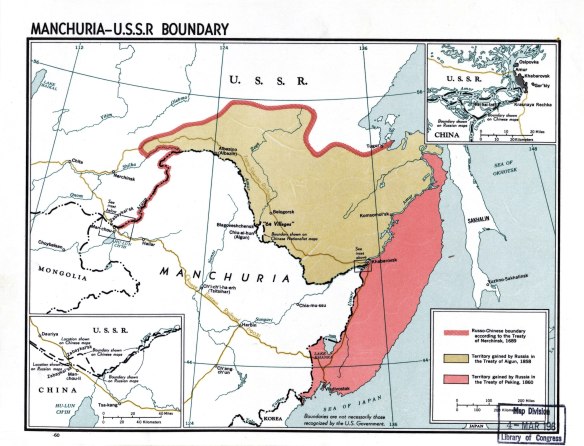
Library of Congress Geography and Map Division Washington, D.C. 20540-4650 USA
DIGITAL ID g7822m ct002999 http://hdl.loc.gov/loc.gmd/g7822m.ct002999
China and Russia have a long history of conflict (here, here, here and here), There was a border conflict between China and Russia (then the Soviet Union) in 1969, when China was clearly the weaker of the two, that lead to China opening to the West and Nixon’s trip to China.
Russia and China’s current partnership has mostly benefited China. China benefited from technology transfers and reverse engineered Soviet and Russian weapon systems.
Now China is clearly stronger than Russia in just about everything except nuclear weapons, and they are now rapidly growing their nuclear capability.
If China should decide retaking Taiwan, which has 215,000 active military and 2,310,000 reservists, a tech savvy population of about 24 million, and is protected by the 100-mile-wide Taiwan Strait and has potential help from powerful allies, may be too risky, they may decide recovery of Outer Manchuria is a good consolation prize.
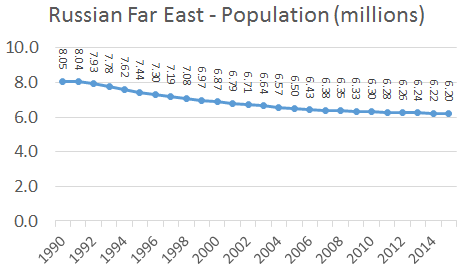
Population of the Russian Far East, 1990-2015 Data source: Fedstat. Author: Underlying lk. (About four million of these live in former Chinese territory.)
The Russian population in the Far East is small and declining. Russian infrastructure connecting industrialized European Russia with the FarEast is weak. Most of the Russian military is in Europe, and their weakness has been exposed in Ukraine.
If China attempted to retake land formerly part of China, they would want to cut Russia’s East/West logistics links. Taking out the few railroad links using airpower would be relatively easy. Air links can’t carry much in the way of heavy equipment. Most Russian supplies and material reinforcements would have to come by sea. Even if the Chinese did not interdict Russian traffic on the Norther Sea Route as suggested in the linked post, China’s Navy and Air Force could dominate Russian access to the Sea of Japan, including the primary Russian Pacific Fleet base in Vladivostok. Chinese submarines and their rapidly expanding force of aircraft carriers could probably cut off access to the Sea of Okhotsk and Petropavlovsk.
From a Chinese point of view recovery would be justified and perhaps far less costly than an amphibious invasion of Taiwan.
If the Russians can be made to see the righting on the wall, they might even be willing to sell the territory back to their friend at wholesale.

The Chinese-flagged Zhong Yuan Yu 16 sails near Ecuador’s Galapagos Islands in July 2021. The CCP uses thousands of distant-water fishing vessels as part of its military-civilian fusion strategy. THE ASSOCIATED PRESS
The Indo-Pacific Defense Forum discusses the implications of the Chinese People’s Republic’s military-civilian fusion strategy.
If there are hostilities between China and the US, the US Coast Guard is likely to have a lot of interaction with nominally civilian Chinese merchant and fishing vessels, but China is blurring the distinction between civilian and military.
Will we have to start hunting them down? Are they innocent or acting on behalf of the Chinese military? They might lay mines, scuttle their ship in an important channel or just report intelligence. Maybe no way to tell without boarding. Will they resist? How do we keep our boarding parties from being attacked or held hostage? Are there circumstances where sink on sight is justified? If they are unexpectedly heavily armed, can we call in backup? What about Chinese vessels in US ports?
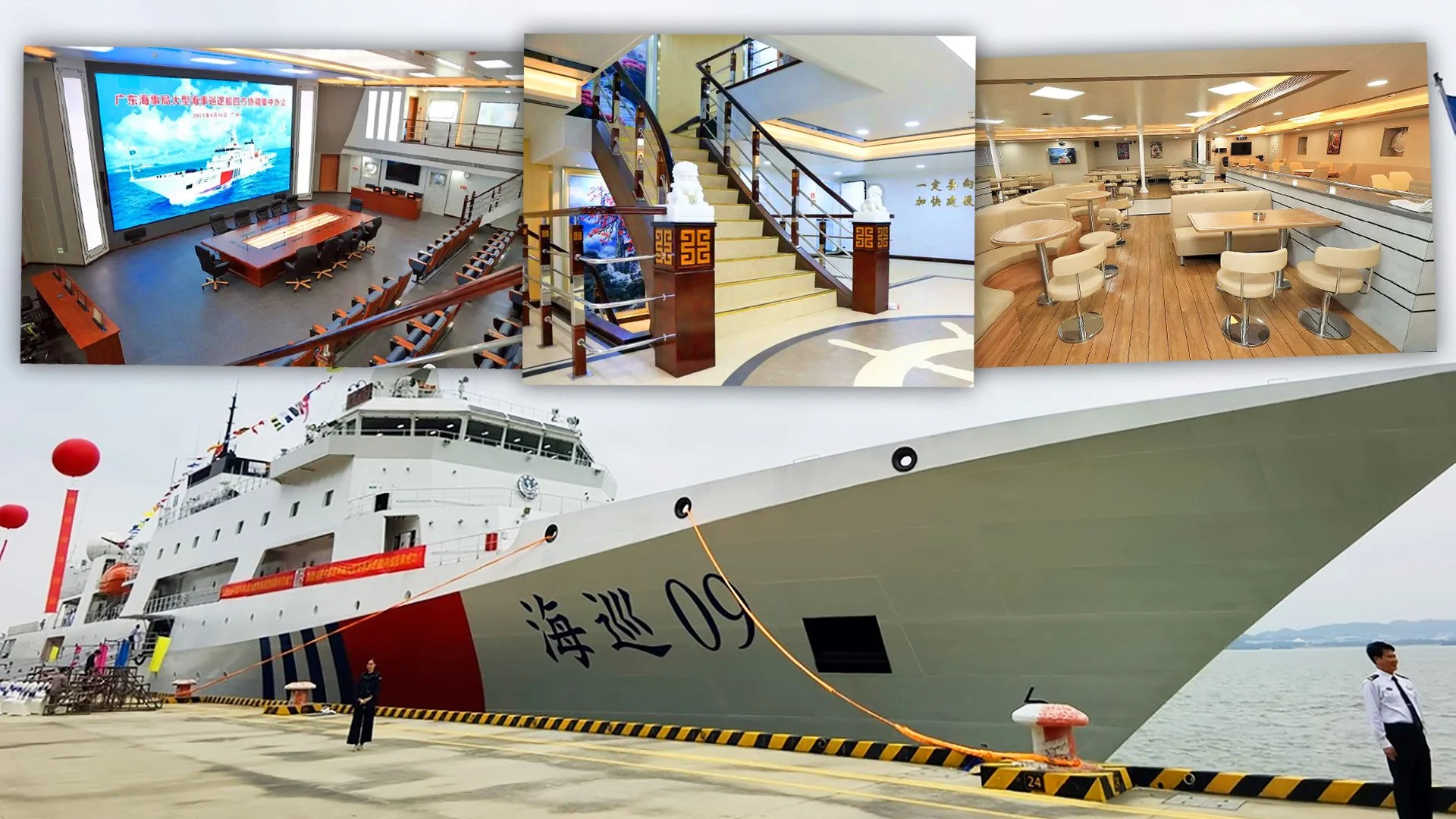
This came out in 2021. I missed it at the time, but it is still interesting. Have not heard any reports of the utilization of this massive ship since it was completed.
There is plenty of speculation within the post as to how the ship will be used. Note this is not China Coast Guard. The China Maritime Safety Administration was the only one of China’s five agencies with Coast Guard like missions that was not consolidated into the China Coast Guard.

CRASH AVERTED This photo taken on April 23, 2023 shows BRP Malapascua (right) maneuvering as a Chinese coast guard ship cuts its path at Second Thomas Shoal in the Spratly Islands. AFP PHOTO.
CIMSEC has a podcast discussing China’s “gray zone” tactics.
Perhaps more importantly they provide links to a series of short posts on specific gray zone tactics with examples.
There is also another post, “Gray Zone Tactics Playbook: Going Dark.” by Miao Shou, SeaLight, August 16, 2023.
Those bulbous bows probably make pretty good rams.
Philippine attempts to resupply Second Thomas Shoal, and Chinese effort to block those efforts have become common. Apparently, the Philippines succeeded recently. There was, in fact, a US Navy P-8 maritime patrol aircraft flying low overhead providing overwatch.
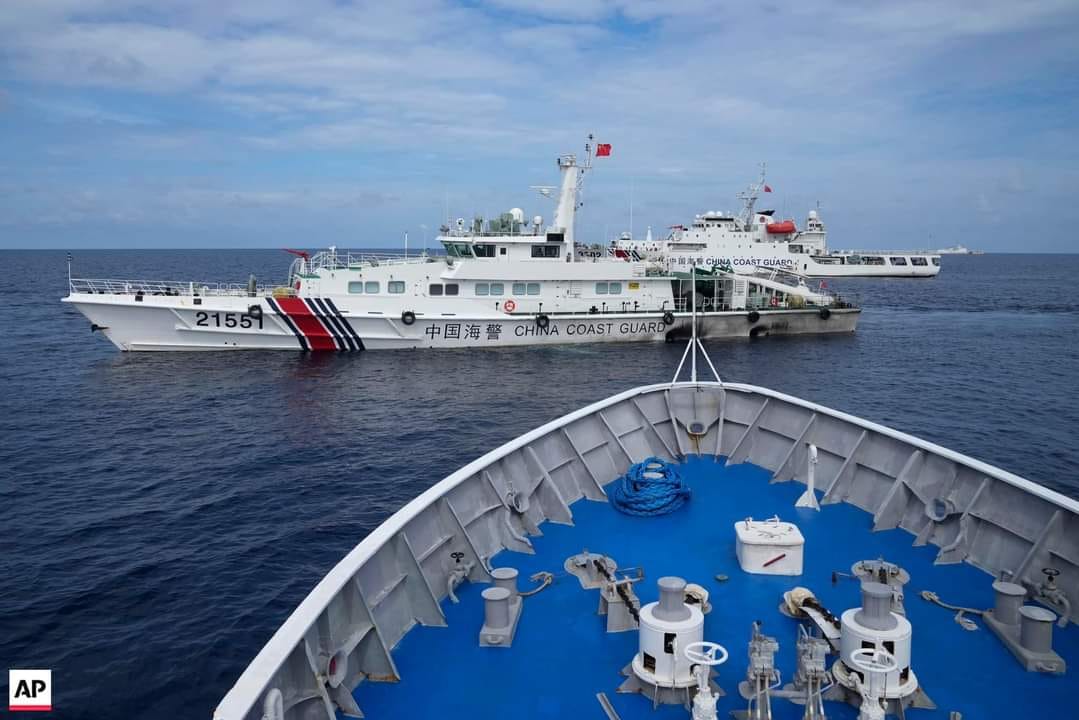
The resulting confrontation provided a lot of photos including ships of a class of China Coast Guard cutters that look a bit like US Coast Guard Webber class cutters.
The only thing I have been able to find out about these little ships was from the Office of Naval Intelligence’s (ONI) Chinese People’s Liberation Army Navy, Coast Guard, Ship Identification Guide, which to my eye identifies them as the Hulai II class, which is reportedly 54 meters (177′) in length, with 30 units in the class. The length sounds right. They appear to be a bit longer than the Fast Response Cutters (47m/154′). I haven’t been able to locate any other information on the class.
Previously, China Coast Guard cutters guarding Second Thomas Shoal all seemed to be relatively large. Perhaps the Chinese realized their larger ships could be outmaneuvered and brought in these smaller ships as backup. Still the Philippines has again succeeded in resupplying the small garrison.
Real Clear Defense has a post by the J. C. Wylie Chair of Maritime Strategy at the Naval War College, Dr. James R. Holmes, discussing the implications of the planned Philippine/US Coast Guard joint patrols in the South China Sea.
It is a thought-provoking article but I would argue for a change of emphasis. The Chinese consider what is happening war without gunsmoke, but if we engage on that basis we are already at war. Rather I would suggest we see this as purely law enforcement vigorously applied–which is of course the reason it is the US Coast Guard rather than the USN that will be conducting these joint patrols.
The Chinese maritime militia has been very useful, but they may also be viewed as China’s weakness, since they are officially civilians. As civilians violating Philippine law, they should be subject to vigorous law enforcement action.

CRASH AVERTED This photo taken on April 23, 2023 shows BRP Malapascua (right) maneuvering as a Chinese coast guard ship cuts its path at Second Thomas Shoal in the Spratly Islands. AFP PHOTO
If a vessel chooses to block a Coast Guard vessel and violates the Rules of the Road in the process, if a collision results and their engineroom floods, it was their violation of the Rules of the Road that caused the collision.
This is lawfare, not warfare, and the law is on the side of the Philippines. The Chinese are acting as a gang of thieves stealing from their weaker neighbors. Diplomatically the US and the Philippines need to work toward something similar to the Combined Maritime Forces organization in SW Asia and fielding a law enforcement alliance like my proposed Combined Maritime Security Task Force Pacific. (“Combined” used this way means multi-national.)
Thought it worthwhile to pass this video along.
First thing, the Chinese are devoting a lot of resources to isolating this particular outpost, an ancient, badly corroded, grounded, but still commissioned former US LST. There are three large modern China Coast Guard cutters visible in the video, 5201, 5305, and 4203. All three are about 100 meters in length or larger, all equipped with 76mm guns. We have seen 5201 before.

CRASH AVERTED This photo taken on April 23, 2023 shows BRP Malapascua (right) maneuvering as a Chinese coast guard ship cuts its path at Second Thomas Shoal in the Spratly Islands. AFP PHOTO
Second, the Philippines would have known what they were up against. Couldn’t they have used something faster and more maneuverable that could have gotten around these large cutters to make this supply run. I hope I am wrong, and I may not understand what it takes to reach this grounded LST, but it is almost as if they are failing on purpose.
The US has warned the Chinese against targeting the Philippine Coast Guard.