“Russia’s new maritime doctrine: adrift from reality?” –IISS

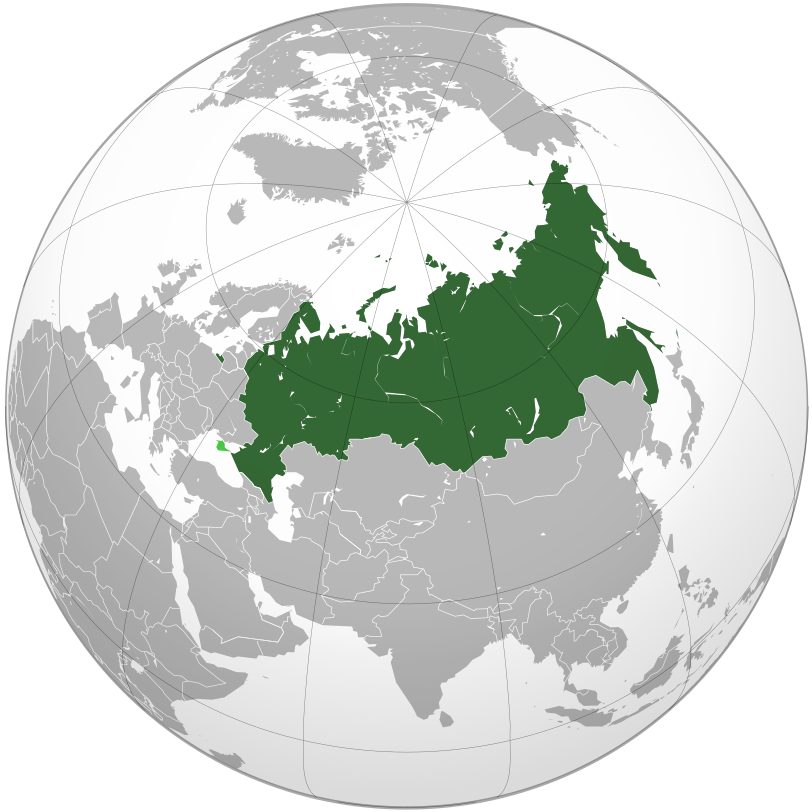
Russian Federation claimed territory. Disputed territory in light green.

The International Institute for Strategic Studies (IISS) has published a short look at Russia’s new maritime doctrine.

There are couple of things that caught my attention in the critique.

  • The Arctic, now comes first, replacing the Atlantic, and
  • No mention of China as a significant ally, while there is a reference to  partnerships and cooperation with India, Iran, Saudi Arabia and others.

The doctrine does not overtly acknowledge a diminished role for Russia on the world stage, but these actions may reflect that realization.

The Arctic: 

“In terms of the regional priorities of Russian naval activities, there is a reordering compared to 2015, with the Atlantic dropping from first to third on the list. The first priority is now the Arctic, with the promise of strengthened capabilities for the Northern and Pacific fleets in response to threats in the region.”

Emphasis on the Atlantic is inherently offensive, because they have to transit long distances through hostile waters to have an impact there. After all Russia has no Atlantic coast line. Access from either the Baltic or Black Sea looks increasing problematic.

Emphasis on the Arctic is primarily defensive. The Arctic is critical to Russia’s economy.  It is their front door. It is their longest border. Its Northern Sea Route is the strongest link between more populous industrialized European Russia and the sparsely populated Russian Far East, and with increasingly open water, the Arctic coast is increasingly exposed.

The Doctrine points out “…the ‘global naval ambitions’ of the United States, NATO activities close to Russia and at sea, an increase in foreign naval presence in the Arctic and efforts to weaken Russia’s control of the Northern Sea Route as the key challenges.” 

The US has made it clear it would like to conduct “Freedom of Navigation” exercises along the Northern Sea Route (which would require Coast Guard icebreakers). Russia has seen her control of the Northern Sea Route as a money maker and they are not eager to see it turned into open sea.

Notably China’s national interest is in opening the route to international traffic.

China: 

“…potential cooperation with China… is strikingly absent from the new doctrine.”

This and upgrades to Russia’s Pacific Fleet, along with improvements to the Northern Sea Route, may reflect a realization that perhaps China will not always be a friend, and ultimately China may turn on them.

A Second Analysis: 

There is a much more detailed analysis of the document here, done by Indian authors. This second analysis seems to confirm greater emphasis on the Arctic and discomfort with the isolation of the Russia’s eastern regions.

“In the 2015 doctrine, the Arctic was at second place after the Atlantic, which has been positioned at third place in the 2022 doctrine. Though the present sequencing may be in no specific order, it may also point to the priority of focus, as the Artic has found detailed mention as indicated earlier. It is evident that Russia recognises the Arctic not only as an area for global economic competition but as an area of military competition as well. The 21 focus areas enunciated for the Arctic region indicate a more positive and perhaps even aggressive approach as they:

—Posit Russia in the lead position in many areas of common regional interest.

—Espouse nuances of control, especially regarding foreign presence and shipping (particularly naval activities).

—Lay emphasis on protection of Russian sovereignty, especially resources.

—Indicate a growing focus on developing the requisite capacity and capability.”

When the Russian Empire fought the Russo-Japanese War (1904-1905), Russia was a great power and appeared to have many advantages, but its logistical links with its Asian holdings were weak. Apparently this is still the case.

Placement of the Pacific at second place is, perhaps, indicative of the Russian approach to the ‘Indo-Pacific’, enunciated in 2012 by the Russian president as the ‘pivot to Asia’, which was aimed at promoting modernisation of the economy. The term ‘pivot to Asia’ is, perhaps, reflective of the belief that “Russia, like China, still strongly opposes the idea of the Indo-Pacific”.
However, Russia will engage nations with which it has long standing strategic relations, like India. Hence, the 2022 doctrine retains the term ‘Asia-Pacific’, and focuses on “overcoming the economic and infrastructural isolation of the Far East from the industrialized regions of the Russian Federation, establishing sustainable sea (river), air and rail links with cities and towns in Siberia and the European part of the Russian Federation, including the development of the Northern Sea Route: This focus apparently seeks to strengthen the ‘pivot to Asia’ strategy, which was termed as a failure, especially due to “Russia’s lack of a comprehensive approach to overcoming the social and economic hardships faced by its least developed regions, namely Siberia and the country’s Far East”.

No Longer a Great Power: 

Despite its ambitions, Russia is not the Soviet Union and is no longer a Great Power. It is a middle weight power with a lot of nuclear weapons, many of which are aging. Potential military power is largely based on economic power, and Russia’s GDP is similar to that of Canada, Italy, Brazil, or South Korea. Even adjusted for “Purchase Power Parity (PPP),” Russia is only number six, behind China, the US, India, Japan, and Germany. In terms of PPP Russia’s GDP is only 14.5% that of China and 17.2% that of the US. Differences are even greater in terms of nominal GDP, 9.2% that of China and 7.2% that of the US.

As systems built during the Soviet era wear out and become increasingly obsolete, Russia’s military power is rapidly fading.

This is not to say that, during a war, Russia would not send at least some submarines into the Atlantic, but they cannot realistically deny the US and NATO control of the North Atlantic. Their SSNs will likely be more more concerned with protecting their SSBNs.

Russian and Soviet Naval thinking has long had an emphasis on coastal defense, that we saw in construction of a large fleet of torpedo and missile boats, corvettes, and light frigates. We still see that in the Karakut and Buyan-M class corvettes, and the retention of large numbers of Soviet era corvettes and light frigates, while they have not laid down a single carrier, cruiser, or destroyer since the fall of the Soviet Union. Even their frigates are smaller than their European counterparts.

Russia, it seems, is desparately trying to maintain its image as a great power, hoping no one, particularly China, will notice, but it simply does not have the means.

“U.S. aims at PRC in new illegal fishing policy framework” –Indo-Pacific Defense Forum

Fijian law enforcement officers and U.S. Coast Guard personnel from USCGC MUNRO board a Chinese-flagged vessel off the coast of Fiji in April 2022 during patrols to counter illegal, unreported and unregulated fishing. IMAGE CREDIT: PO1 Nate Littlejohn, U.S. COAST GUARD

Indo-Pacific Defense Forum passed along an Associated Press report on US efforts to forge an international consensus to combat Illigal, Unreported, Unregulated (IUU) fishing, including  poor labor and environmental practices, first by applying a standard nationally,

It was expected to be followed quickly by new rules from the U.S. National Oceanic and Atmospheric Administration expanding the definition of illegal fishing to include related labor abuses, a first step to the eventual blacklisting of flag states that fail to comply.

Followed by work on an international treaty.

Significantly subsidies are now seen as unfair trade practice with disasterous impact on fish stocks. China has used subsidies to build the world’s largest fishing fleet, and they use it for more than just catching fish.

President Biden’s administration’s announcement came as the World Trade Organization (WTO) heralded a historic agreement, reaching a deal during its June 2022 conference in Geneva, Switzerland, to curb IUU fishing, reduce the strain on dwindling fishing stocks, and ensure more transparency and accountability through improved conservation and management measures. The WTO deal explicitly prohibits subsidies, considered by environmentalists to be the biggest contributing factor to depleting fish populations globally.

BRIDGING THE GAP: HOW THE UNITED STATES CAN IMMEDIATELY ADDRESS ITS ARCTIC CAPABILITY LIMITATIONS –Modern War

The Modern War Institute at West Point published an article that suggests that NOAA ships can help provide presence in the Arctic and that this will contribute to the defense of the Homeland.

Looks like NOAA has about 16 active ships. None are very large and I don’t think any of them are ice rated.

Certainly, NOAA has business in the Arctic, understanding the oceans is an essential part of readiness for conflict, but I don’t see them as any sort of deterrant. On the other hand I don’t see Russia’s large number of icebreakers as adding significant additional threat to US or Canadian security. They simply need a lot of icebreakers to support their economic operations in the Arctic.

Which Arctic are we talking about?

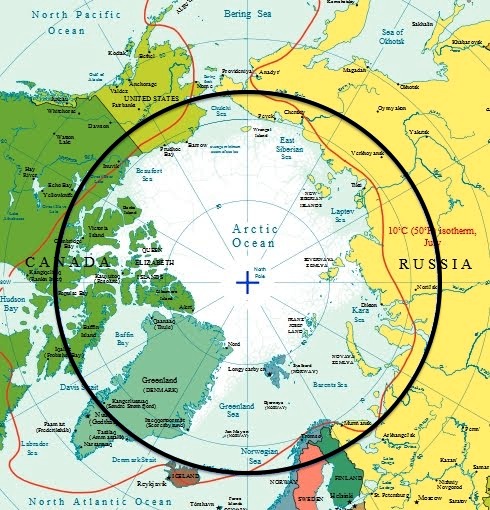
For most of the world, the Arctic is the region North of the Arctic Circle. For some reason the US defines the Arctic as including the Bering Sea and the Aleutians. That does include some pretty cold territory but really, it is not the Arctic, and there is no reason the US Navy should not be operating surface ships there, but they don’t.

I am talking about the Arctic North of the Arctic circle.

What are the military threats to North America that might come across the Arctic Ocean?

While the Russian Arctic build-up threatens Norway, maybe Iceland, and perhaps Greenland, let’s consider only North America.

Much of the Russian build up in the Arctic is defensive, and this is understandable. They have a lot of assets in the Arctic. Much of their national income comes from the Russian Arctic.

There is absolutely no chance the Russians are going to attempt to land an army in the North American Arctic as an overland invasion. It would be too difficult to move and virtually impossibe to resupply. They would be under constant attack by US and Canadian Aircraft. As a Canadian Officer once noted, if Russia landed troops in the Canadian Arctic they would need to be rescued. The most we are likely to see from the Russian Army is Special Forces assaults on sensor and associated communication  systems in the Arctic.

The largest portion of the Russian Naval fleet (30-35%) is based in the Arctic, but not because it is intended to operate exclusively in the Arctic. Much of it is based there because they don’t have better choices. The Northern Fleet has their only relatively unrestricted access to the Atlantic. Even Northern Fleet units have to transit the Greenland-Iceland-UK (GIUK) Gap (or the English Channel) to make it into the Atlantic Sea Lanes, The Baltic Fleet is surrounded by potential adversaries and would have to exit through the Danish Straits. The Black Sea Fleet is bottled up behind the Turkish straits and even after exit would have to cross the Mediterranean and through the Straits of Gibralter.

Russian Submarines do operate under the ice and may launch missiles or conduct commando raids in the Arctic.

The serious threats that could come across the Arctic Ocean will be in the air or in space–aircraft and ballistic and cruise missiles including the new hypersonics.

Coast Guard icebreakers could have a role in facilitating deployment and continuing support of sensor systems in the Arctic.

Gray Zone threats to Sovereignty

The more probable near term threats to the US come in the form of Gray Zone Ops that are intended to reshape the World’s view of normal. We have seen this with China’s Nine Dash Line and their attempts to recast rights associated with the Exclusive Economic Zone.

It appears Russia is trying to do the same. We have seen it in the Black Sea, and we are likely to see it in the Arctic.

The extent of Russia’s continental shelf is as yet undecided, but their claims are expansive.

Looks like China intends to do some resource extraction and fishing in the Arctic and they have not been particularly respectful of the rights of others.

The US Coast Guard will need to do fisheries protection inside the US Arctic EEZ and the Canadian CG inside theirs. There are probably going to be opportunities for cooperation and synergy between the two coast guards in the high North.

With the increase in traffic as ice melts, NOAA probably needs to do a lot of oceanographic research and survey work in the Arctic, but they are probably going to need to either build their own icebreakers or ride Coast Guard icebreakers to do it.

“While China makes Pacific islands tour, US Coast Guard is already on patrol” –CNN

U.S. Coast Guard Cutter Munro is tied up in Suva, Fiji, during a visit to the port city April 22, 2022.  The port call was part Operation Blue Pacific, that aims to counter illegal, unreported and unregulated fishing, and strengthen relationships to enhance maritime sovereignty and security throughout the Indo-Pacific. (U.S. Coast Guard photo courtesy of Office of the FMSRCC, Republic of Fiji Navy)

The Coast Guard got some national recognition for its work in the Western Pacific from CNN. It is being recognized as a counter to increasing Chinese influence in the region.

The Coast Guard’s website shows cutters have spent hundreds of days and steamed thousands of miles in the past two years helping Pacific island nations.

I have not seen this website, but I would like to. I found this one, but it is not a Coast Guard website.

The story mentions the Coast Guard’s role in the administration’s Indo-Pacific Strategy, which goes well beyond fisheries. The Strategy was discussed here.

“THREE ROUNDS OF COERCION IN PHILIPPINE WATERS” –CSIS

China CG Cutter 5203

The Center for Strategic and International Studies’ Asia Maritime Transparency Initiative brings a report of Chinese tracking and harassing vessels conducting legitimate activities in the Philippine’s Exclusive Economic Zone (EEZ) on three occasions.

There are some things worth noting about these three encounters:

  • In the first the Taiwanese Coast Guard was successful in allowing the research vessel to complete its task. In the second encounter, the Philippines appears to have surrendered preemtively while the Chinese vessel came no closer than 0,9 miles. In the third, the two Philippine vessels were successfully intimidated and turned away by China Coast Guard vessels supported by maritime militia vessels.
  • While Chinese vessels approached these vessels and came with 100 meters in the third incident, there was no indication that they attempted to ram or block movement, though blocking did appear to be the ultimate intent in the third incident. Chinese vessels have intentionally rammed in the past, but I cannot recall a Chinese government vessel ramming another government’s vessel. Chinese maritime militia have employed this tactic.
  • In the first encounter the Taiwanese Coast Guard used some of their largest ships as escorts. 5001 is more than 5000 tons full load, larger than the Bertholf class ships (4,500 tons full load). Taiwan Coast Guard’s CG129 is also relatively large at 120 meters (394 ft). It is nominally 3,000 tons, but probably over 4,000 tons full load. China Coast Guard (CCG) 5203 is reportedly 102 meters (335 ft) in length and 14 meters of beam.  It is probably around 3,000 tons full load.
  • The two Philippine Coast Guard cutters mentioned, BRP Capones and BRP Cape Engaño were both Parola class patrol boats, built in Japan and delivered in 2017 and 2018 respectiely. These 44 meter/146 ft vessels are just a bit smaller and slower than the Webber class. They were much smaller than the CCG vessels.
  • Only the Chinese employed vessels were armed with medium caliber naval guns. I was unable to find specs or photographs of CCG 5303 or 5304 but at least CCG 5203 was armed with a modern 3″ gun. The Taiwanese vessels were armed with auto-cannon of up to 40mm. The Philippine CG vessels were armed with nothing larger than .50 cal.
  • Taiwanese and Philippine CG vessels appear to have had a speed advantage, but the CCG had a speed advantage over the vessels being escorted. In the third incident any speed advantage was also largely negated by the larger number of Chinese vessels.

It should be clear that if the Philippines intends to operate in their EEZ, in areas included in the “Nine Dash Line,” they should expect the Chinese will confront them. If they intend to operate there, they need to decide to either support the effort strongly or operate not at all. Being chased out repeatedly strengthens China’s position.

Should the Philippines decide to operate in the disputed waters, it does have some advantages at least for operations of short duration. While the China CG is much larger, the Philippines has the advantage of proximity. Far from their bases, the Chinese cannot reinforce quickly. The Philippines can surge large numbers of units the short distance from their bases quickly.

The Philippines has been pushed around. Perhaps it is time to push back. Not an escalation, but a reponse in kind.

A coordinated sweep of Chinese fishing vessels fishing illegally should be possible.

To deter shouldering, size is important, so the Philippine CG should include their largest ships.

To deter the Chinese from resorting to weapons, Philippine law enforcement vesssels should be supported by Philippine Navy vessels. It would not hurt if Philippine light attack aircraft were airborne.

It would also help if vessels of other nations, including the US, were on scene to witness the encounter.

BRP Capones in Davao Gulf. Philippine Information Agency.

Thanks to Paul for bringing this to my attention.

“Indonesia stands up to PRC’s aggressive moves in South China Sea” –Indo-Pacific Defense Forum

A China Coast Guard ship is seen from an Indonesian naval vessel during a patrol north of Indonesia’s Natuna islands. (Antara Foto via Reuters)

Indo-Pacific Defense Forum reports,

“Indonesia has successfully defended its sovereignty off the northwest coast of the island of Borneo by standing up to aggressive incursions by the People’s Republic of China (PRC), which maintains that its widely dismissed territorial claim in the South China Sea gives it authority to enter the area unimpeded.”

Indonesia is demonstrating it is possible to resist China’s bullying without starting a war.

“From Chinese ambition to Saami tradition, an Arctic snapshot” –The Watch

A small-boat crew from the U.S. Coast Guard Cutter Alex Haley medevacs a man from the Chinese research vessel Xue Long, 15 nautical miles from Nome, Alaska, in 2017

NORTHCOM’s on-line magazine, “The Watch,” reports on a conference on the Arctic. This is a follow-on to an earlier post.

The Watch report looks at China’s interests and roles in the Arctic and a perspective from a representative of indigenous peoples in the European Arctic.

“On the front lines against China, the US Coast Guard is taking on missions the US Navy can’t do” –Business Insider

US Coast Guard cutter Munro transits the Taiwan Strait with US Navy destroyer USS Kidd in August. US Navy

Business Insider reports on the increasing demand signal for Coast Guard assets in the Western Pacific and the necessary balancing act that results. They sum it up this way.

  • The US military has turned more of its attention to the Pacific amid competition with China.
  • The Coast Guard has been key, conducting missions other services aren’t equipped or allowed to do.
  • But it already has worldwide commitments, and higher demand in the Pacific could tax its resources.

None of this should come as a surprise to regular readers here, but it is a nice overview and there are some beautiful photos.

Perhaps more importantly these realities are being brought to a general audience.

Thanks to Mike B. for bringing this to my attention.

“Use the Coast Guard for Freedom of Navigation Operations” –USNI

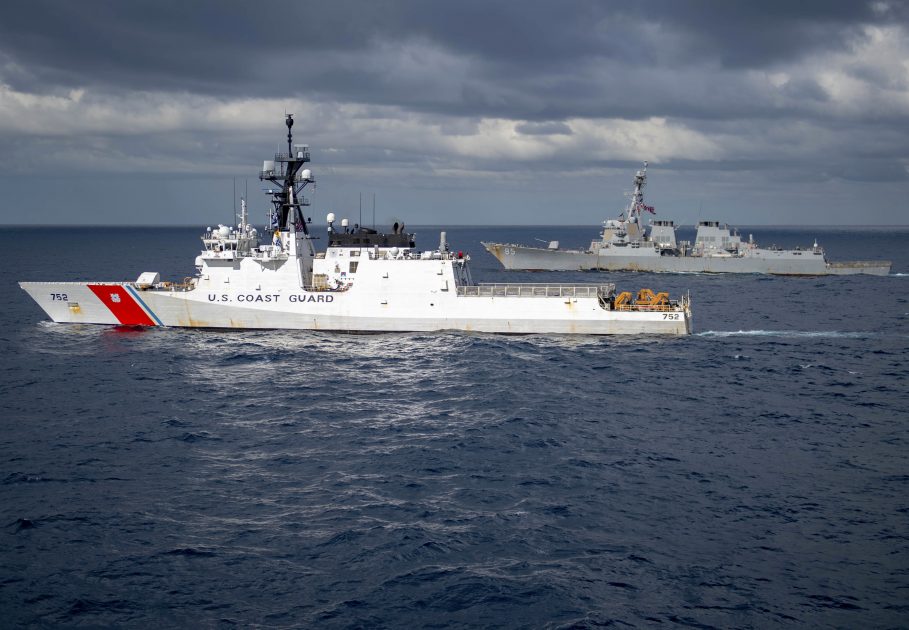
USCGC Stratton (WMSL-752), left, and the U.S. Navy Arleigh Burke-class guided-missile destroyer USS McCampbell (DDG-85) maneuver in formation during Talisman Sabre 2019 on July 11, 2019. US Navy Photo

The December 2021 issue of US Naval Institute Proceedings has an article that suggests, “NSCs and OPCs are ideal vessels to take over FONOPs.”

Why do the authors, two Navy LCdr. and a Marine Capt., think this? They contend:

  • Their destroyers are overworked.
  • The Navy is having a hard time keeping their ships maintained.
  • Cutters are less intimidating
  • and less expensive
  • If the Chinese start playing bumper boats with Destroyers, they might damage expensive equipment. “…if a ship from the Chinese Navy, Coast Guard, or maritime militia were to ram a U.S. vessel conducting a FONOP, the ensuing visuals, narratives, and potential loss of combat capability would be starkly different between a Navy gray hull and a Coast Guard white hull.”

They talk about using LCS as an alternative, but then denigrate the possibility,

The Navy has rightfully used littoral combat ships (LCSs) to conduct limited FONOPs in the South China Sea, somewhat relieving overworked destroyers like the USS John S. McCain. However, the smaller LCS’s myriad of problems, curtailed acquisition numbers, and early retirement of the first four hulls mean the Navy will soon have to lean even more heavily on larger and generally older ships. With only 10 to 14 cruisers and destroyers available to Seventh Fleet at any given time, the Navy can ill-afford to use these high-demand, low-density, Aegis ships for FONOPs.

This, in spite of the fact, that LCS have only recently begun making regular deployments to the Western Pacific and LCSs are being added to the fleet at a rate of four per year.

First, I have no problem with Cutters doing FONOPs when they are in the Western Pacific, but that should not be the only reason, they are there.

US Navy ships are not overworked. That is a fiction. Having looked at the “USNI News Fleet and Marine Tracker” over many years, I can say, Navy ships are typically deployed about one third of the time, and they are underway only about 25% of the time, far less than Coast Guard cutters. That is not to say the people are not overworked, by burdensome administrative and overly broad qualification requirements for their junior officers. The ships are behind in maintenance because of lack of support, not time underway. Ships don’t need to spend 75% of their time, tied up in maintenance, to remain effective.

In war time, well over half the navy should be underway and forward deployed. The fact that they cannot support a much smaller forward presence, of which much of the time is not underway, in peacetime, points to a serious deficit in the Navy’s support structure. Where are the repairs ships, the tenders, the floating dry docks that allow a navy to be truly expeditionary?

If the Navy does not want to use carriers, cruisers, or destroyers for FONOPs because they are afraid of having them damaged, there are other alternatives. They could use amphibs: LHAs, LHDs, LPDs, and LSDs. They could use Military Sealift Command ships. MSC ships are clearly not as intimidating as carriers, cruisers, and destroyers. Were they to be damaged “the ensuing visuals, narratives, and potential loss of combat capability would be starkly different…” 

I would suggest using the new Navaho class tug and salvage ships. They are an excellent choice for playing bumper boats. They have strong steel hulls and are powerful enough to tow a nuclear-powered carrier. Their hulls are reinforced to allow hull to hull contact with other ships. Plus, they are a lot less expensive. Even less expensive than a Coast Guard cutter.

But really, using tugs or cutters to do FONOP kind of misses the point. The Chinese and the Russians are not upset because foreign ships are transiting waters they claim. They are upset because foreign warships are transiting the waters the claim. If we stop sending warships into the waters they claim, we are creating a defacto case that they have a right to such exclusion. That Coast Guard cutters may not be considered warships would weaken our case that, foreign warships in these waters is the norm.

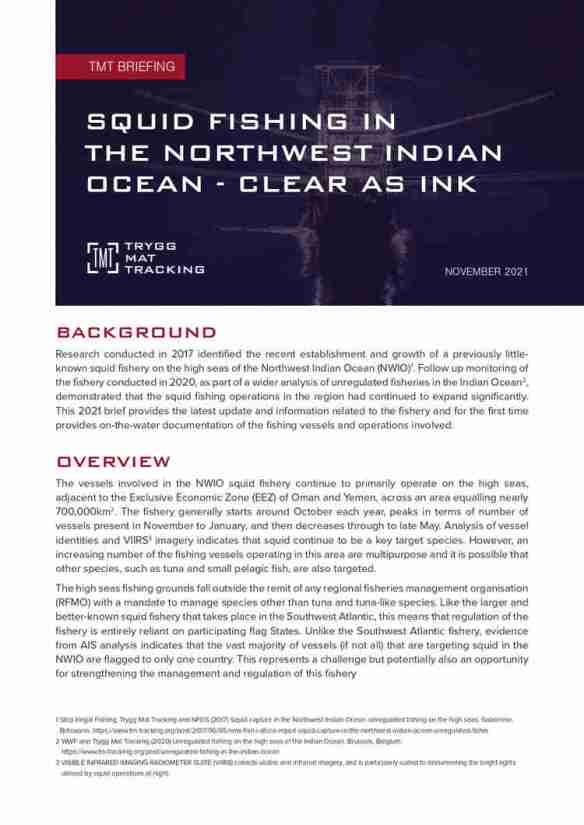
“New Analysis: Squid Fishing North West Indian Ocean: Clear as Ink” –Trygg Mat Tracking

Below is an announcement of publication of a brief from Trygg Mat Tracking (TMT), regarding Illegal, Unregulated, Unreported (IUU) fishing in the Northwest Indian Ocean.

I think this is something the Coast Guard units of PATFORSWA might become involved with, at least in a training and capacity building role.

This is a quote from the website explaining how TMT sees its mission.

“TMT provides national fisheries authorities and international organisations with fisheries intelligence and analysis, to assist enforcement actions and broader improvements in fisheries governance.  While TMT works with governments and organisations worldwide, particular focus is on targeting illegal fishing and associated fisheries crime in and near African waters and assisting coastal African States.”


New Analysis: Squid Fishing North West Indian Ocean: Clear as Ink

December 8th 2021: TMT has been monitoring the high seas squid fishery taking place in the northwest Indian Ocean since 2017. The fishery is currently unregulated and has seen significant expansion year on year.

Earlier this year we were able for the first time to ground truth and document the activities of some of the vessels involved at sea – rather than relying on AIS and other satellite sources only – and have produced a brief: Squid Fishing in the North West Indian Ocean: Clear as Ink.

The brief provides extensive images of the fishing activities taking place. This has provided us with extensive new understanding of this operation, but also raises many new questions and concerns.

Key findings of our analysis include:

·        There are very low levels of AIS transmission by some vessels – a significant number of vessels were identified which transmitted over AIS whilst en route to the region and then switched AIS off or transmitted only very intermittently whilst on the fishing ground. Further to this, the quality of identifying information transmitted over AIS was often poor, making it challenging to monitor the fishery.

·        Transshipment at sea was documented from fishing vessels to reefers, confirming that this is an important component of the operation.

·        There are indications of potential EEZ incursions into Oman and Yemen by vessels in the fleet, but no clarity if these are licensed or not.

·        The vast majority of the vessels were identified as Chinese. Equally the majority of relevant port calls by both fishing vessels and reefers are in China. Chinese research vessels have also been active in the area.

·        All vessels documented in the fishery are using a type of gear we have not previously observed, involving large ‘dip’ nets. Many of the vessels appear to be able to deploy multiple gear types. This is significant for several reasons, including that recent announcements by the Chinese Government to limit high seas squid fishing specified that this applies to squid jigging vessels only.

Recently high seas squid fisheries in the Atlantic and Pacific have quite rightly received significant attention. Quietly however a major fishery in the northwest Indian Ocean has also been growing year on year, but was previously only visible using satellite data. Now we have a snapshot of the operations at sea for the first time – and while some of our questions about this operation have been answered, many more are raised. The vessels observed were not jiggers as expected, but are using a new type of net gear. As well as squid the vessels are taking on board bycatch, including tuna species, fish the vessels are not authorised to catch. We hope this new analysis will help to shape appropriate policies and inform further action that will have real and lasting impacts on the sustainability of the North West Indian Ocean squid fishery and all those that depend upon it” said Duncan Copeland, Executive Director Trygg Mat Tracking.

The fishery is now starting up again for the 2021-2022 fishing season. As they do so it is important to note that this northwest Indian Ocean squid fishery continues to be subject to very little management and limited regulatory oversight. This represents a threat, not only to the sustainability of squid stocks in the region but potentially also to other regional fisheries, given the key role that oceanic squid plays in the marine food chain.

There is a clear need to address the current management gap as this fishery falls outside the geographical scope of the Southern Indian Ocean Fisheries Agreement (SIOFA) and outside the species mandate of Indian Ocean Tuna Commission (IOTC). Positive engagement by China in this process is crucial, as flag state for the fleet and port state receiving the catches, and as the only party with relevant information on the species, catch levels and fishing operations.

This briefing has been produced by Trygg Mat Tracking (TMT), with data and analytical support from Global Fishing Watch. At-sea documentation of vessels and fishing operations conducted in cooperation with Greenpeace International.

Download the 2021 brief: Squid Fishing in the North West Indian Ocean: Clear as Ink.