
Image credit: https://www.scribbler.com/ (adapted by MWI)
Modern War Institute has a light hearted look at the Geo-Political situation in the Arctic, and, for once, no mention of the sorry state of the USCG icebreaker fleet.

Image credit: https://www.scribbler.com/ (adapted by MWI)
Modern War Institute has a light hearted look at the Geo-Political situation in the Arctic, and, for once, no mention of the sorry state of the USCG icebreaker fleet.
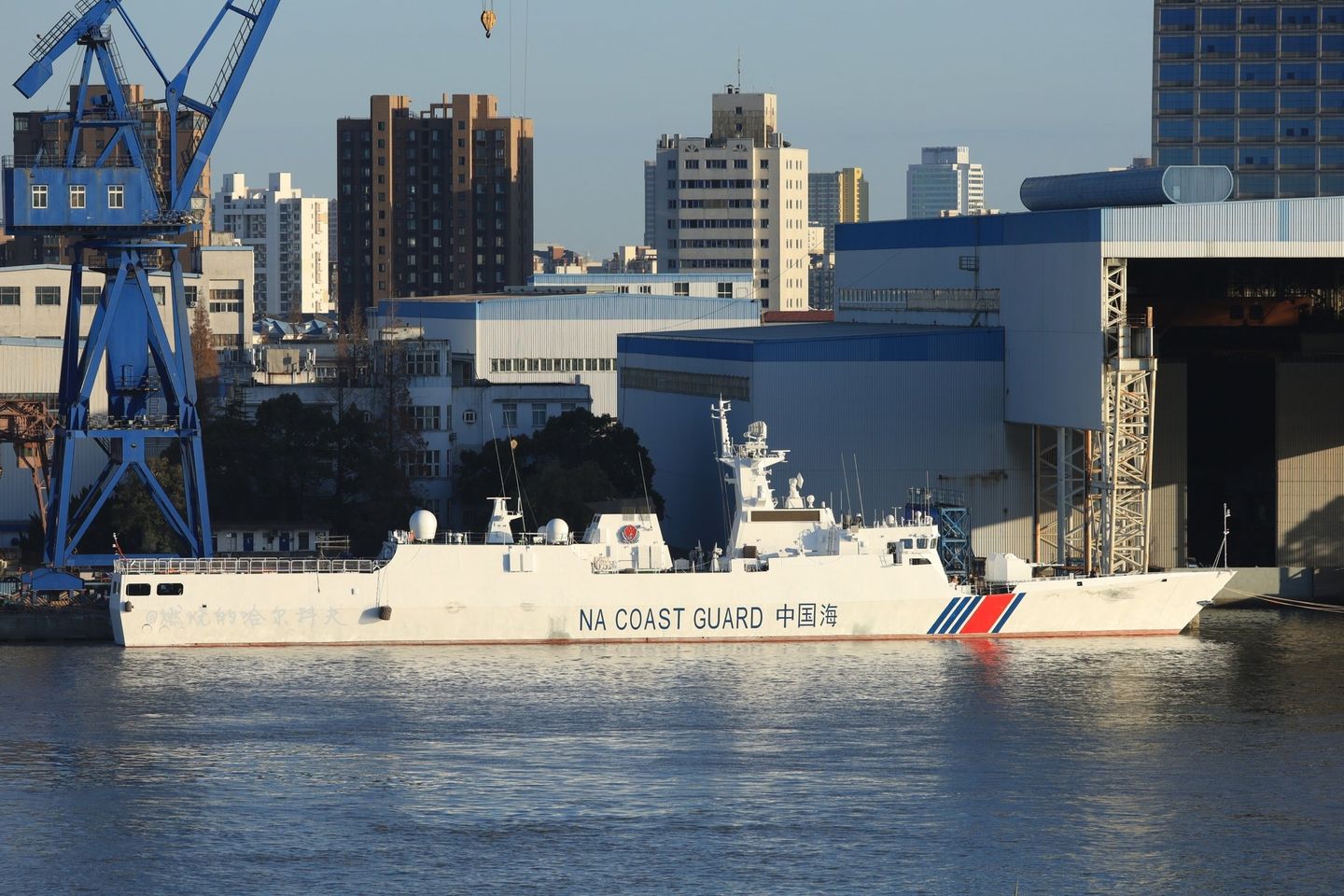
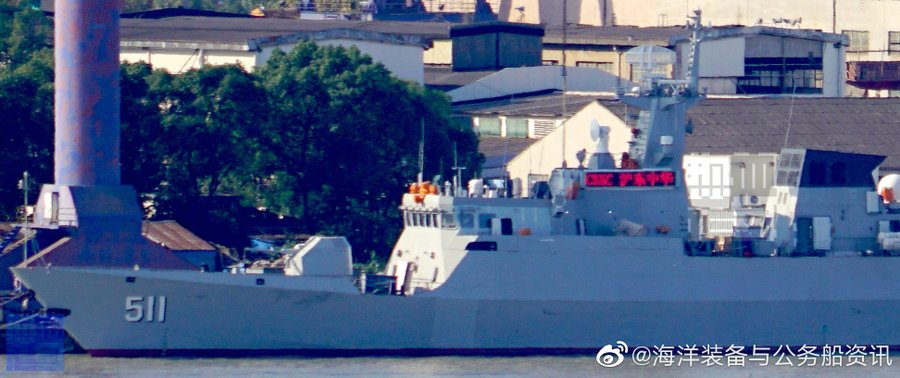
An ex-PLAN Type 056 corvette undergoing conversion for Coast Guard duties.
I reported transfer of 22 Type 056 covettes from the PLA Navy to the China Coast Guard back in November and discussed the implications, but now we have a better photograph and some commentary from Naval News.
The air-search radar, radar fire control, and 76mm gun remain. The ship is now equipped with fire-fighting monitors where the anti-ship cruise missiles were previously installed amidships, on the O-1 deck, above the letter “U” in GUARD.
For the first time, looking at the photo, I realized these ships are armed with an autocannon, I was not familiar with, the 30mm H/PJ-17, a single barrel optionally manned system, that is mounted on the O-1 deck aft of the bridge and below the fire control radar. As can be seen in the photo below, the bulwark can swing down to allow the gun to depress to a greater angle. This may have been in order to fire at targets at close range, or it may have been to allow the gun to continue to follow a target even when the ship is experiencing heavy rolls. I have not been able to find out much about these weapons.

Chinese H/PJ-17 30mm
Information on the Yinhe Incident referred to in the Naval News report is here.
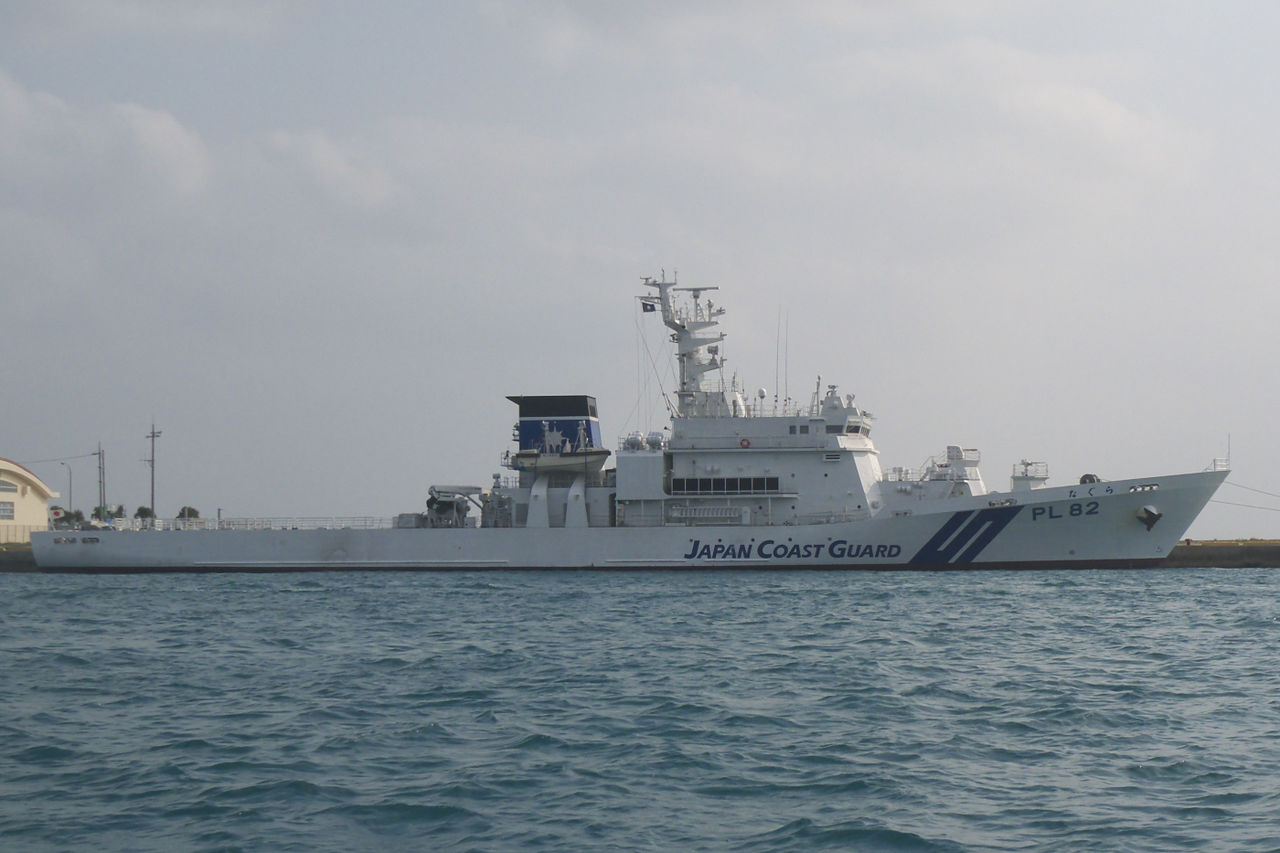
Japan Coast Guard patrol vessel PL82 Nagura at the Port of Ishigaki. Photo from Wikipedia Commons, by Yasu
The Diplomat reports that Japan is considering changes to their laws governing the Japan Coast Guard.
One proposal seeks to add “maintenance of territorial sea integrity” and “security of territorial sea” to the Act’s mission, while another seeks to moderate the prerequisites allowing harm through use of weapons by Coast Guard officers. All of these proposals seek to give the JCG more muscle.
I don’t have a feel for what the actual proposed changes are, but I do know the Japan Coast Guard does not have the same close relationships with the Japanese Navy (Maritime Defense Force) that the USCG enjoys with the USN. It is not a military service. They don’t share equip or even use the same fuel. You can bet they don’t share the same communications systems. This means that the organization is not as useful as it might be in wartime, and, of more immediate concern, it means coordination in crisis is far more difficult.
Currently none of the Japan Coast Guard vessels have weapons larger than 40mm, and very few have an air search radar or any kind of AAW firecontrol system. If Japanese Self Defense Forces are not immediately available as backup, it might be hard not to feel intimidated by better armed China Coast Guard vessels, particularly if supported by aircraft.
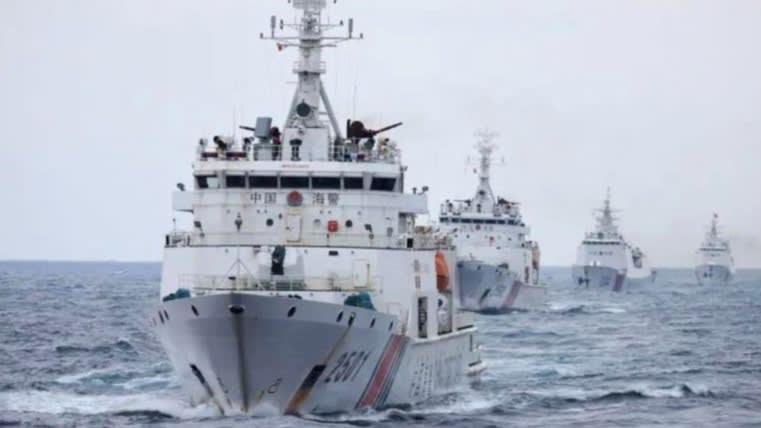
This Chinese coast guard ship is equipped with weapons believed to be 76-millimeter guns. © Kyodo
Craig Hooper, writing for Forbes, points out the very real possibility that China, using the pretext of a rescue mission, might seize a permanent presence in Oceania well East of the First Island Chain.
The idea of coming to the aid of Chinese diaspora is very popular with the people of China. There was a very popular movie, Operation Red Sea (2018), that depicted such an expedition (trailer above), very loosely based on the evacuation of Chinese citizens from Yemen in 2015 with considerable fictionalization of the actual events. As we know, nothing goes public in China unless it serves the goals of the party.
Hooper suggests the Coast Guard is part of the solution.

Type 056 corvette, credit 樱井千一
We have a report from Defence.PK, that 22 PLAN Type 056 corvettes are being transferred to the China Coast Guard. These ships are the early models that were completed without the more sophisticated anti-submarine warfare capabilities of the Type 056A. Rather than upgrade them, the Chinese Navy will build 22 additional Type 054A Frigates.
Reportedly they are adding a LED billboard and the missiles are being removed. Probably the torpedoes as well. But that still leaves a 120 round/minute 76 mm gun and a pair of 30mm Guns.
The China Coast Guard already has more large cutters than the US Coast Guard, despite of the fact that their EEZ is less than 20% that of the US, even if all their outrageous claims were accepted. But most of these cutters have no guns of 20mm or larger. 22 AK-176 76mm guns and 44 30mm Guns will substantially increase the China Coast Guard’s firepower.
These 1500 ton 25 knot ships are a handy size for an area like the South China Sea.
Unlike the US Coast Guard, the China Coast Guard tends to operate their cutters in groups. Three of these, snuggled up to you, at close range, could be very intimidating even to a DDG like those the US Navy uses for Freedom of Navigation Exercises. For relatively unarmed Asian Coast Guard cutters, it would be much more so.
Chinese Naval Forces don’t have a lot of naval victories in their past so the Battle of Paracel Islands, where they defeated the Vietnamese by opening fire at very close range, must assume outsized importance in their imagination.
I note, the cutters China used when they recently turned back a Philippine resupply effort in the South China Sea, included at least one armed with a 76mm gun.

In case you missed it, below is a statement from the US Ambassador to the Philippines (and to China).

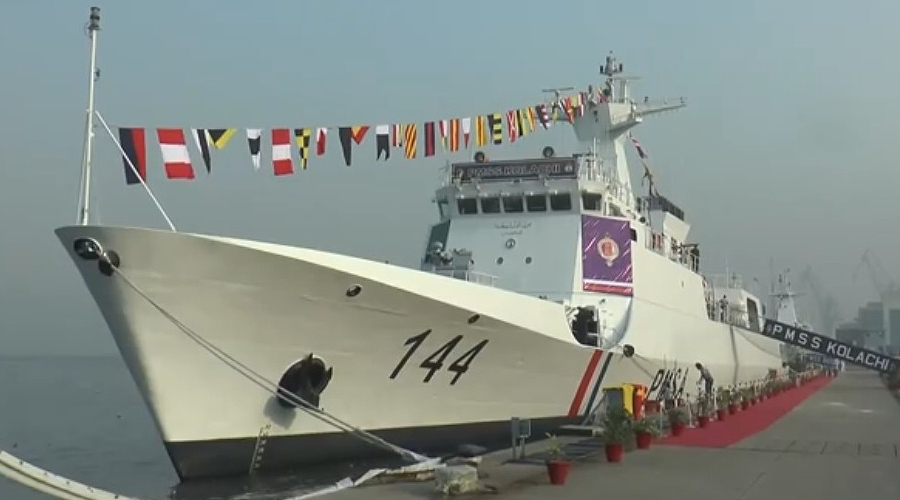
Photo: PMSA
Baird Maritime reports delivery of a Chinese designed Offshore Patrol Vessel to the Pakistan Maritime Security Agency (PMSA), the maritime safety and law enforcement arm of the Pakistan Navy. This second ship was reportedly built in Pakistan while the first was produced in China.
This ship may look a bit familiar. It appears to be a variant of the Type 056 corvette. 72 of the corvettes were inducted into the Chinese PLA Navy between 2013 and 2019. Variants of the class also serve with the Bangladeshi and Nigerian Navies and the China Coast Guard.
There is a Pakistani Coast Guards distinct from the PMSA, but it falls under the authority of the Pakistani Army and functions more like Customs and Border Protection and its Air and Marine Unit, being limited to operations on shore and within the 12 mile limit.

RealClearDefense has a post that offers some suggestions as to how the Coast Guard might contribute to a more positive relationship with China.
To be clear, such a partnership is not a naïve panacea; it must be implemented within a whole-of -government framework, including more forceful military approaches to withstand the “window of vulnerability.” A viable path forward sees the U.S. Coast Guard being used to forge partnerships in the maritime domain, as a powerful element of a more holistic solution. By partnering with the Chinese naval apparatus in new and unfamiliar missions, the Coast Guard can be used as an effective agent of change and diplomacy to help stabilize an intractable geopolitical problem.
One of the principles I have come to believe in strongly, is that even in conflict we should never stop talking. The other side of that is, that when you are engaged in conflict, a ceasefire as a precondition for discussion is not only unnecessary, it is frequently counter productive.
Voice of America reports remarks by SOUTHCOM Commander, Admiral Craig Faller, regarding the growth of Chinese influence in the Western Hemisphere, including criminal activity and Illegal, Unreported, and Unregulated fishing.
This isn’t new. Through contributing author, Sanjay Badri-Maharaj (here and here),I have been following what has been happening in Trinidad and Tobago. I am sure similar interaction is happening elsewhere in the Western Hemisphere. Here is some background:
China, Trinidad and Tobago pledge to consolidate friendship – CGTN
PM and Chinese President Xi Jinping engage in bilateral talks | Loop News (looptt.com)

Official portrait of Admiral Burke as Commander NAVEUR-NAVAF
Naval News reports on a Webinar conducted by Admiral Robert Burke who is Commander of U.S. Naval Forces Europe, Commander of U.S. Naval Forces Africa, and Commander of Allied Joint Forces Command in Naples. Previously he served as Vice Chief of Naval Operations. He is a submariner. Sounds like he spent some time under the ice.
There is a lot here about the Arctic. Keep in mind he is talking primarily about the Atlantic side rather than the waters around Alaska. This is primarily about the Russian threat, but there are concerns about China as well.
The US Naval Institute news service provides a translation of a Chinese review of the Tri-Service Naval Strategy, “Advantage at Sea.”
It is, in my view, a surprisingly even handed evaluation. Not that it does not reflect the Chinese position, but it is at least fairly accurate.
One particular paragraph references the US Coast Guard.
Third, the U.S. will also introduce a new style of struggle, namely, it will bolster competition in the “gray zone.” That is, the U.S. will take greater action in the domains of social media; supply chains, especially defense industry chains; and space and cyber. A fairly obvious early indicator of this was that the USCG—which traditionally operates in the vicinity of the U.S. coast to defend the security of U.S. territory—has recently moved forward into the South China Sea region. It is preparing to conduct military operations in the South China Sea, with the aim of striking China’s maritime forces as well as bolstering joint law enforcement with regional states in the South China Sea, in order to respond to China’s South China Sea rights protection operations.
The idea of the USCG moving into the South China Sea “with the aim of striking China’s maritime forces” is a bit far fetched, but the rest is reasonably accurate and reflects the Strategy’s recognition of the Coast Guard as uniquely qualified to counter aggression in the “Gray Zone.”

 Chuck Hill's CG Blog
