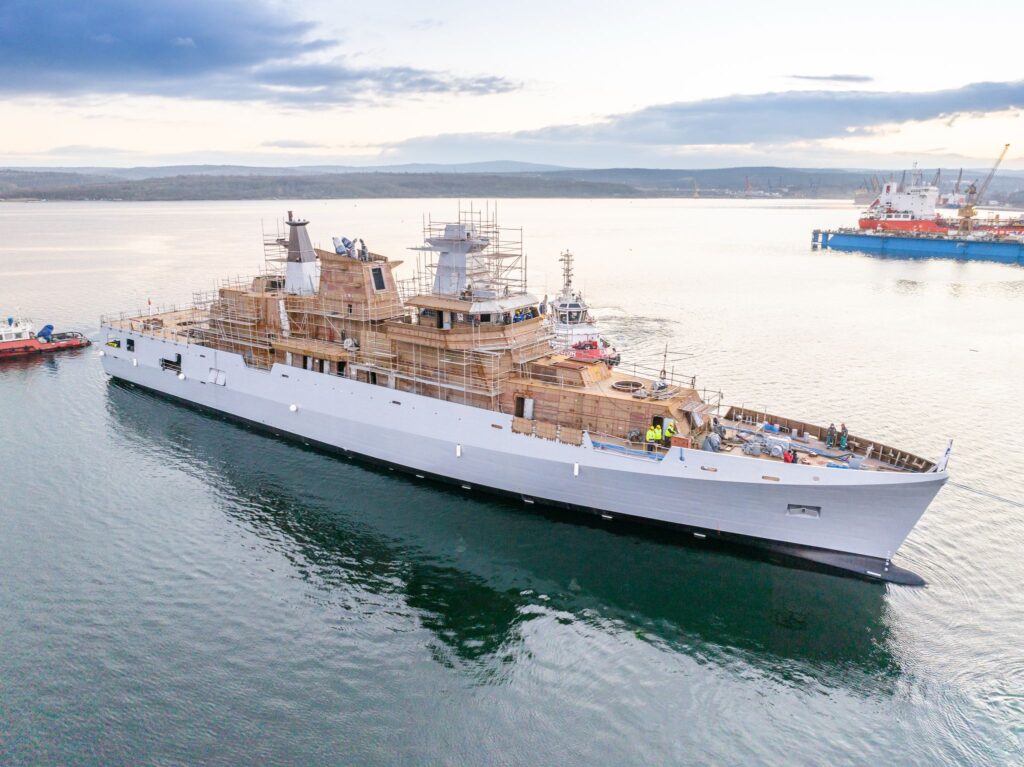
“Building a ‘Heavy’ Icebreaker in Helsinki” –Sixty Degrees North

Sixty Degrees North intends to follow the construction of Canada’s heavy icebreaker in Finland,

“I intend to closely follow and document construction of the Polar Class 2 ‘heavy’ Polar Icebreaker at Helsinki Shipyard in my continuing effort to correct the false belief that Finnish companies cannot build the types of icebreakers needed by the U.S. Coast Guard…

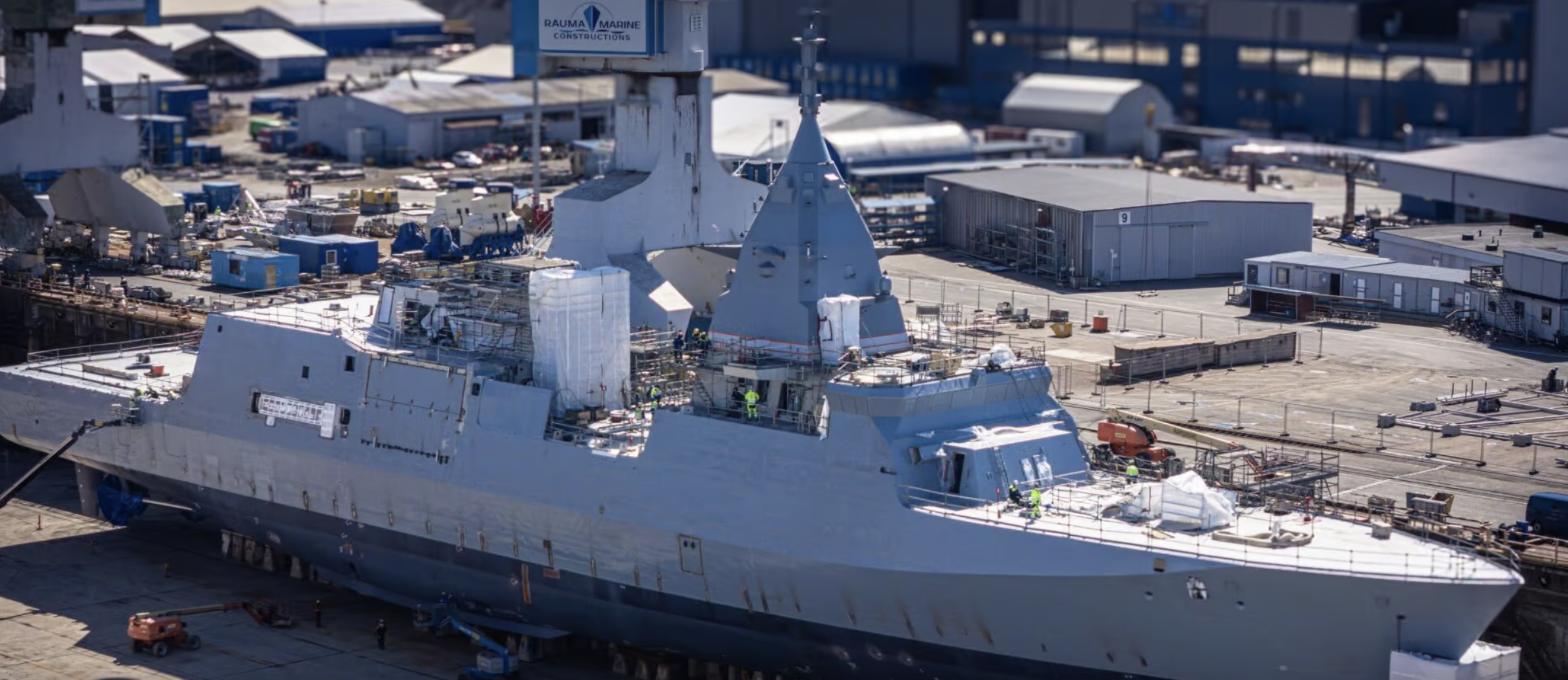
“You will also see me reporting on Rauma Marine Construction’s (RMC) progress building the Finnish Navy Corvettes...At the moment, they have three (of a planned four) Corvettes in simultaneous production.”

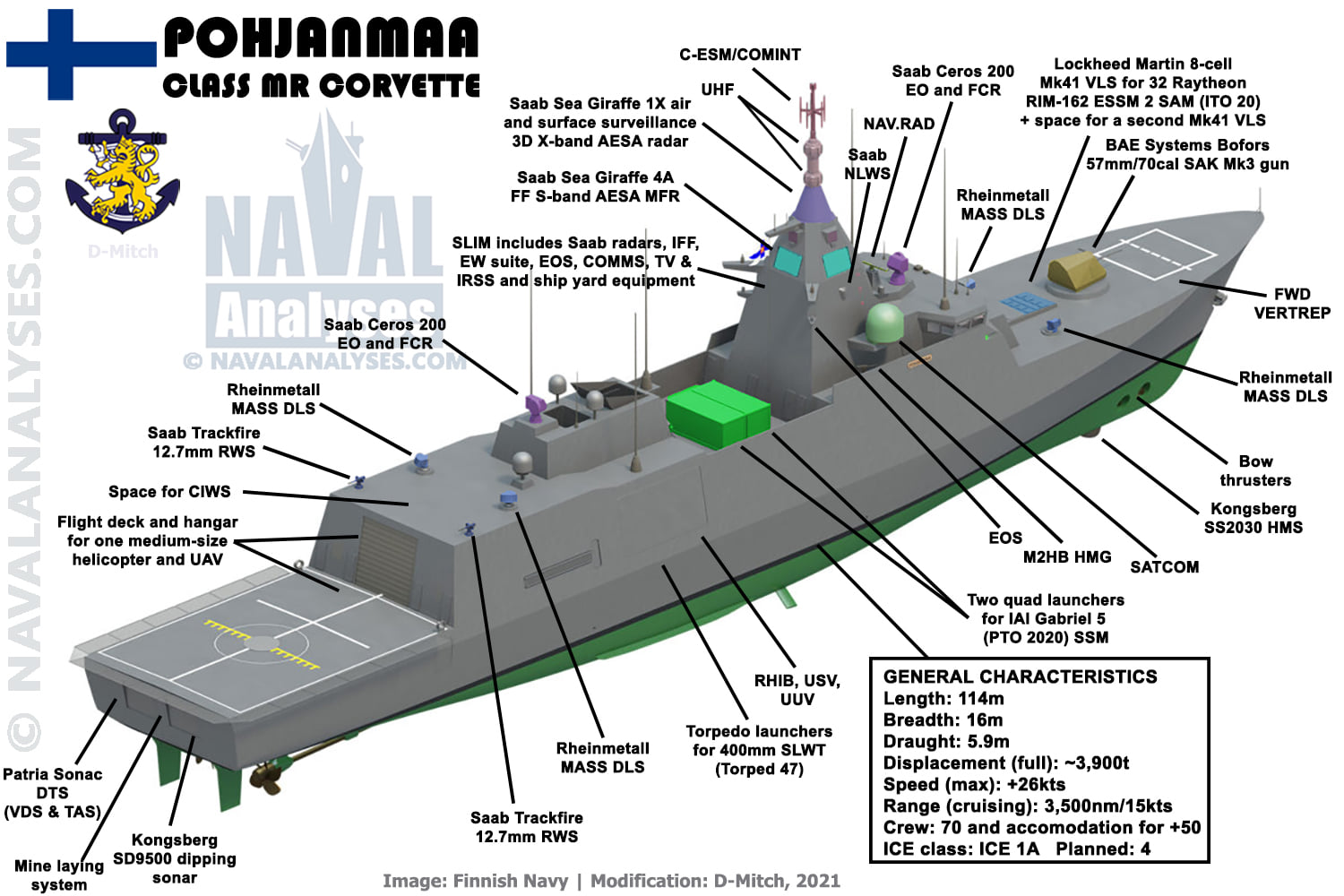
The corvette is also interesting combining significant anti-air, anti-surface, and anti-submarine capability with a hull designed to operate in ice, all in a hull 15% smaller than that of an OPC. I look forward to hearing more about it.

The first multi-purpose corvette built for the Finnish Navy’s Squadron 2020 project was launched at Rauma shipyard on Wednesday 21 May 2025.

“AKER ARCTIC SELECTED TO PROVIDE ADVANCED ICE LOAD MONITORING SYSTEM FOR FINNISH NAVY MULTI-ROLE CORVETTES” –Aker Arctic

Below is an Aker Arctic news release. Frankly I didn’t know there was such a thing as an ice load monitoring system, but it sounds like something we would want on ships going into the Arctic or Antarctic. I presume it is monitoring the role rate (Tups do you have more info?)

Specs for the class have been updated since the graphic above:

  • Displacement: 4300 tons
  • Length: 117 m (384′)
  • Width: 16 m (52.5′)
  • Draught: 5 m (16.4′)
  • Speed: 26 knots (48 km/h)
  • Crew: 73

More on this new class of warships here and here.


Aker Arctic has been chosen to supply its state-of-the-art ice load monitoring system to the Finnish Defence Forces Logistics Command. The contract includes the delivery of Aker Arctic’s ARC ILMS ice load monitoring, measurement and analysis system for the series of four Pohjanmaa-class multi-role corvettes currently under construction at Rauma Marine Constructions for the Finnish Navy.

The ARC ILMS is Aker Arctic’s platform for measuring loads that the ship’s structure experiences when operating in ice-cover waters, providing feedback to the operator on the safety level of the ship in ice.

“Following our recent successes being chosen to supply the ARC ILMS for the Canadian Coast Guard’s Multi-Purpose Vessels (MPV) (here–Chuck) and our collaboration with French cruise company Ponant measuring ice loads on the Le Commandant Charcot as she made her historic trans-Arctic voyage last summer, we are excited with the vote of confidence the Finnish Navy has put in us to supply our ARC ILMS to their important program” said Kari Laukia, Head of Equipment Business and Special Projects at Aker Arctic.

The contract builds on Aker Arctic’s long-term involvement with the Pohjanmaa-class. In addition to the ARC ILMS, Aker Arctic is supplying the ice-strengthened controllable pitch propellers and their pitch control mechanisms, propeller shafts, bearings and shaft seals. In addition to complete design, calculations and material supplies, Aker Arctic is also responsible for installation supervision and commissioning of the propulsion lines.

“Bulgaria’s Second MMPV Launched by Local Shipyard” –Naval News

Naval News reports,

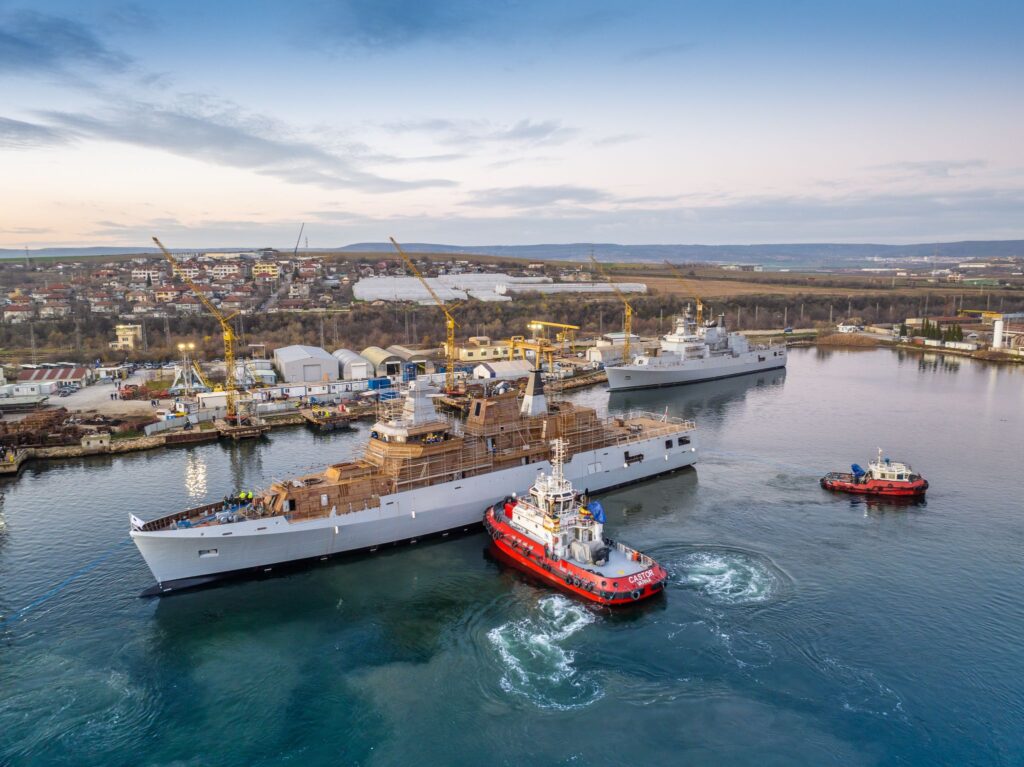
The second of two MMPVs (Multipurpose Modular Patrol Vessels–Chuck) was launched ahead of schedule. According to the contract, it was supposed to take place in April 2025. The two MMPVs are being built under a contract signed November 12, 2020 between the Bulgarian Ministry of Defence and the German shipbuilding group Fr. Lürssen Werft (now NVL – Naval Vessels Lürssen). The vessels will cost about BGN 984 million gross (about EUR 503 million).

These are a significant step up from the earlier Lürssen designed 80-meter Darussalam class built in Germany for the Royal Brunei Navy and the Arafura class building in Australia.

They are to be equipped with two twin launchers for RBS15 Mk3 anti-ship missiles, 8 cells for MBDA VL MICA surface to air missiles, Leonardo OTO Super Rapid 76mm gun, Rheinmetall Millennium 35mm CIWS, and 324mm light weight ASW torpedoes. They will have a SAAB combat management system and a hangar for a Eurocopter AS565MB Panther helicopter, an aircraft that is an evolution of the H-65 design.

Specifications indicate:

  • Displacement: 2,300 tons
  • Length: 90 meters (295′)
  • Beam: 13.5 meters (44.3′)
  • Max Speed: variously reported as 20 to 24 knots
  • Range: 3000 nautical miles at 14 knots.
  • Crew: 70

These ships remind me very much of the new Damen designed Pakistani 2,600 ton, 98 meter OPVs. The layout is much the same:

  • Gun and VLS AAW system forward of the bridge elevated above the main deck
  • Anti-ship cruise missiles behind the bridge
  • Uptakes
  • Hangar with a 35mm CIWS mounted on the roof
  • Flight deck that extends all the way to the stern
  • Reconfigurable space below the flight deck.

Reconfigurable space is becoming common but what really sets these two classes apart from other OPVs is the VLS launchers for small surface to air missiles. On the slightly larger Pakistani ships, which appear more capable, the missile is a bit larger and the gun smaller. The Pakistani ship also has a pair of 30mm guns similar to the Mk38 Mod4.

I think we are going to start seeing this general layout on more OPVs in the future.

Given the need for more than the currently planned 36 large cutters, and the increasingly hostile geopolitical environment, building something like these smaller, cheaper, but more combat capable ships, in greater numbers, rather than the last ten planned OPCs might be worth considering.

I would suggest we could build a cutter with configurable space sufficient to support a towed array, a flight deck, hangar, and magazines sufficient to support an MH-60R, eight Mk41 VLS (sufficient for16 ESSMs and four vertical launch ASROCs) forward of the bridge. Launchers for up to eight Naval Strike Missiles (we don’t need to carry the missiles themselves all the time), SeaRAM, and one or two 30mm Mk38 Mod4s. This should all be possible on a 25 knot ship of less than 3000 tons.
Korean Built Ships for the Philippine Navy and Coast Guard –Naval News

Naval News has a new post, “HD HHI Pitches Horizon 3 Frigates, Corvettes and White Hulls to Manila” that includes the video above.

HD HHI has delivered two “frigates” to the Philippine Navy and has contracts for six offshore patrol vessels (OPV) and two corvettes. Hyundai apparently hopes to continue this successful collaboration with proposals to meet Philippines requirements for larger and more capable “Horizon 3” frigates and for Philippine Coast Guard cutters.

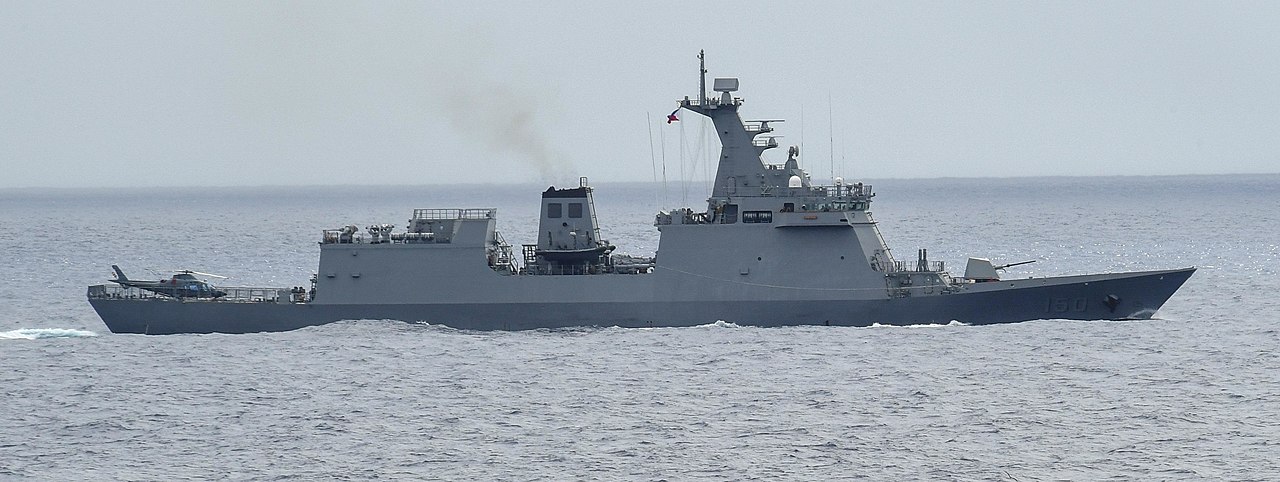
200820-N-TT059-2393 PACIFIC OCEAN (Aug. 20, 2020) Republic of the Philippines Navy ship BRP Jose Rizal (FF 150) participates in a tactical maneuvering drill with U.S. Coast Guard ship USCGC Munro (WMSL 755) and U.S. Navy guided-missile cruiser USS Lake Erie (CG 70) during exercise Rim of the Pacific (RIMPAC) 2020. (U.S. Navy photo by Mass Communication Specialist Seaman Lily Gebauer)

The two Philippine 2,600 ton Jose Rizal class frigates (pictured above) are smaller than the former USCG Hamilton class cutters (3200 tons). The follow-on (3,200 ton) Miguel Malvar class corvettes (or light frigates) will be larger and more capable. The Horizon 3 Frigate will be larger still.

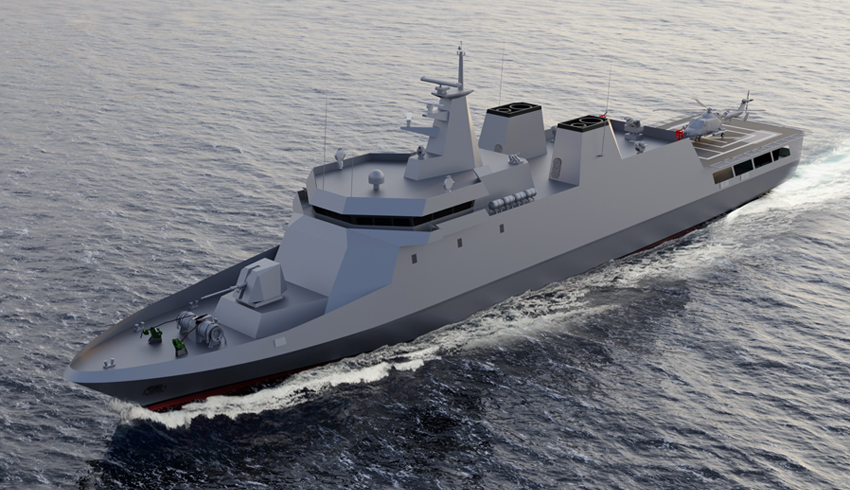
The six Philippine Navy Offshore Patrol Vessels (above) will be 2400 tons full load; 94.4 meters (310′) in length; 14.3 meter (47′) of beam; with a maximum speed of 22knots; and a maximum range of 5,500 nautical miles at 15 knots. It appears they will be armed with a 76mm gun, two 30mm guns, and two Simbad-RC twin-Mistral missile launchers. HHI is proposing cutters based on this design for the Philippine Coast Guard.

Will the Philippine Coast Guard arm its cutters? Currently no Philippine Coast Guard (PCG) vessels have any weapons larger than .50 caliber machine guns, but the models of possible future Philippine Coast Guard vessels all carried some type of installed weapons system, apparently 30mm, 40mm, or 76mm. Was this because the PCG intends to field larger weapons or just because that is the way South Korean CG cutters are armed? The twin 35mm Gökdeniz close-in weapon system (CIWS) mounted on the new corvettes and that appears on the model of the proposed Horizon 3 frigate would be very appropriate for the Philippine Coast Guard.

There is an interesting statement at the end of the post,

“HD HHI plans to realize its ‘Pacific-Rim Belt Vision’, establishing regional hubs in countries such as the Philippines, Peru, Australia, Saudi Arabia, and the United States (emphasis applied–Chuck) based on its advanced shipbuilding technologies.”

Cutter Size Ships Building in Latin America

Damen SIGMA 10714 for Colombia

Always interesting to see what other countries are doing in terms of ships that will perform coast guard style missions. In some countries, these are their largest warships.

Two recent reports from Latin America.

In both cases they have chosen to build ships with the assistance of experienced European shipbuilders. Both are smaller than either the National Security Cutter or the Offshore Patrol Cutter.

Brazil has launched the first of a planned eight Tamandaré-Class Frigates, pictured above, designed by ThyssenKrupp Marine Systems of Germany. It is evolved from earlier MEKO designs that include the German K130 Braunschweig class corvettes and the Israeli Sa’ar 6.

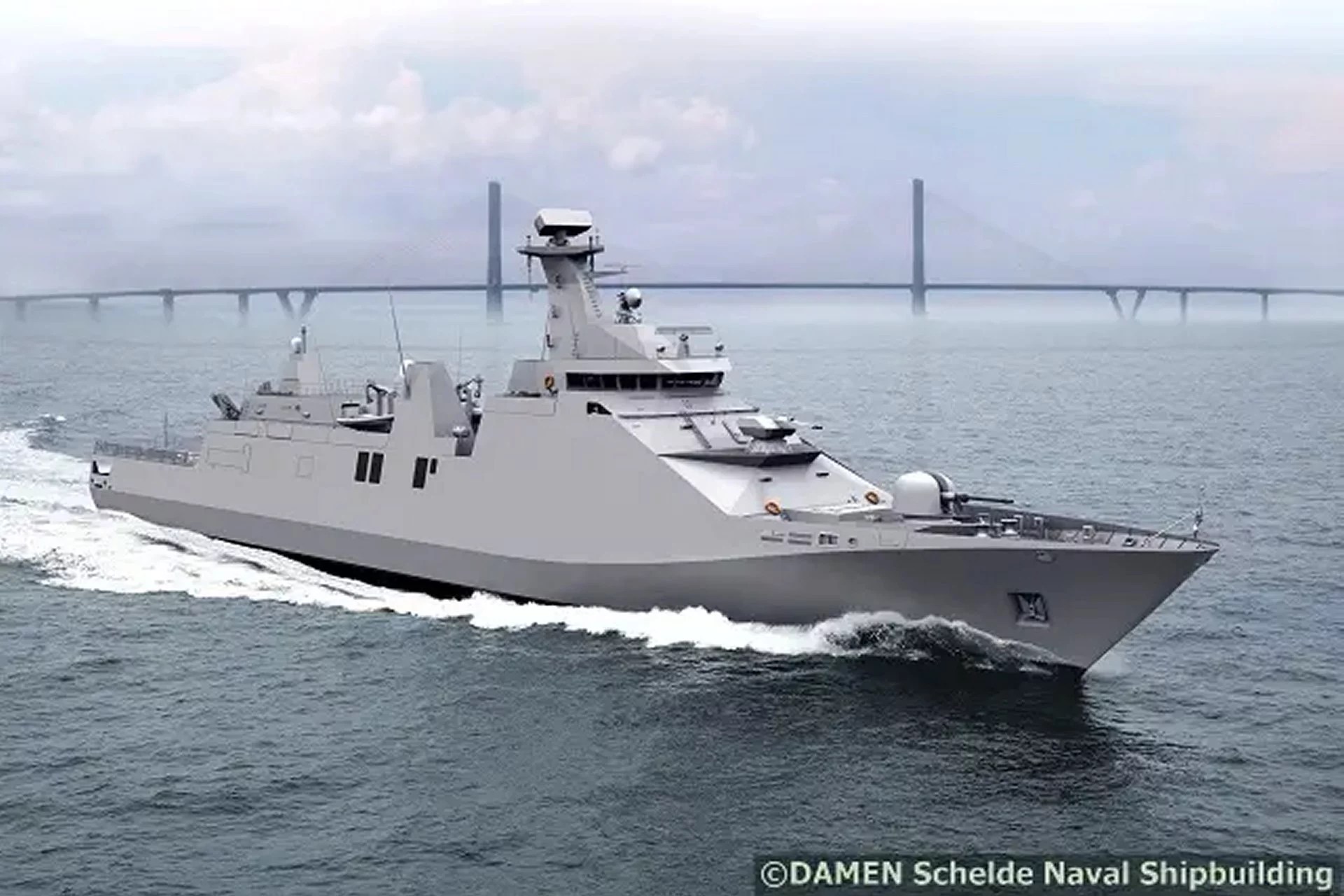
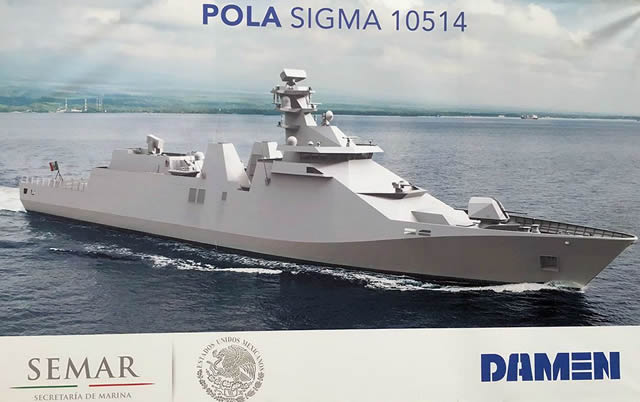
Colombia has contracted with Damen, designers of the USCG Fast Response Cutters, to help locally build the first of five planned light frigates that will replace four somewhat smaller sized Admirante Padilla class ships commissioned 1983/4. The design is a Damen SIGMA 10714 design, meaning it is 107 meters (353′) in length with a beam of 14 meters (46′). The design is closely related to ships built in Mexico (pictured below) and in Indonesia.

Mexico’s Damen SIGMA 10514, ARM Benito Juárez (POLA-101)

“Ukraine Sinks Russian Navy Missile Corvette In Drone Boat Attack” –The War Zone

The War Zone reports,

“A dramatic new view released by the Ukrainian Defense Intelligence Directorate (GUR) shows several of its uncrewed surface vessels (USVs) strike and sink the Russian Tarantul-III class missile corvette Ivanovets. The attack took place Wednesday night local time on the Black Sea near Lake Donuzlav in western Crimea, the GUR said on its Telegram channel.

“A 128-second video posted on Twitter shows what appears to be a complex attack on the Ivanovets by what Lt. Gen. Kyrylo Budanov, commander of GUR, told us were Maritime Autonomous Guard Unmanned Robotic Apparatus (MAGURA V5) USVs operated by the GUR’s Group 13 drone unit.”

Tarantul-class corvette

The vessel in the video is a Tarantul class missile corvette. These vessels are powered by four engines totaling 32,000 HP making them very fast (42 knots). The hot gas turbine exhausts on either side of the transom glow brightly early in the video.

They have a pair of 30mm gatling guns on the aft superstructure with a clear field of fire aft.

This ship appears well equipped to defeat an unmanned surface vessel (USV) attack.

The Drive post analyses the attack, but I would point out that I don’t see as many splashes as I would have expected, if the 30mm guns were functioning. I don’t see muzzle flashes. What I did see appeared to be from heavy machine guns (12.7 or 14.5mm) rather than 30mm.

Many USVs were involved in this attack. The Ukrainians claimed six USVs hit the little corvette. Still other USVs filmed the ultimate explosion and sinking.

Perhaps the 30mm guns had run out of ammunition engaging other USVs by the time the drone in the first video recorded attack gets as close as seen in the video.

The report included this statement,

““The Ivanovets MRK sank while repelling a night attack by the Ukrainian Armed Forces on Sevastopol,” the Russian VoenkorKotenok Telegram channel wrote.”

The Russians have historically stationed a “guard ship” off their ports to prevent surprise attack. Ivanovets may have been stationed off Sevastopol specifically as a counter to a drone attack.

Cutter Size Combatants for Australia

Australia is seeing an urgent need to augment the Strike capability of their Navy. This is reflected in a requirement for light frigate/corvette sized combatants with strong anti-surface (ASuW) and self-defense as well as ASW capability.

The resulting ships are about the size of the latest large US Coast Guard patrol cutters, the 4,600 ton Bertholf class National Security Cutter (NSC) and the 4,500 ton Argus class Offshore Patrol Cutter (OPC), in fact two are smaller. While this may not be an exhaustive list of potential competitors, all three proposals I have seen, are discussed in the video above and outlined below. Each includes 16 to 32 vertical launch system (VLS) cells for a variety of missile types and 16 to 24 deck launchers for Anti-Ship Cruise Missiles (ASCM, presumably Naval Strike Missiles). (As these designs are about a decade newer than the OPC, the winning design might form the basis for a future cutter class.)

Navatia’s offer, the Tasman class corvette, is the same length as the Argus class Offshore Patrol Cutters (110 meters / 360′), but considerably lighter at 3,600 tons full load (vs 4500 tons). This class is to be based on a class built for Saudi Arabia, which is in turned based on a class of Offshore Patrol Vessels built for Venezuela. The proposal includes 16 VLS and 16 ASCM launch tubes. Presumably they will be diesel powered with a speed about the same as the parent designs, 25 knots.

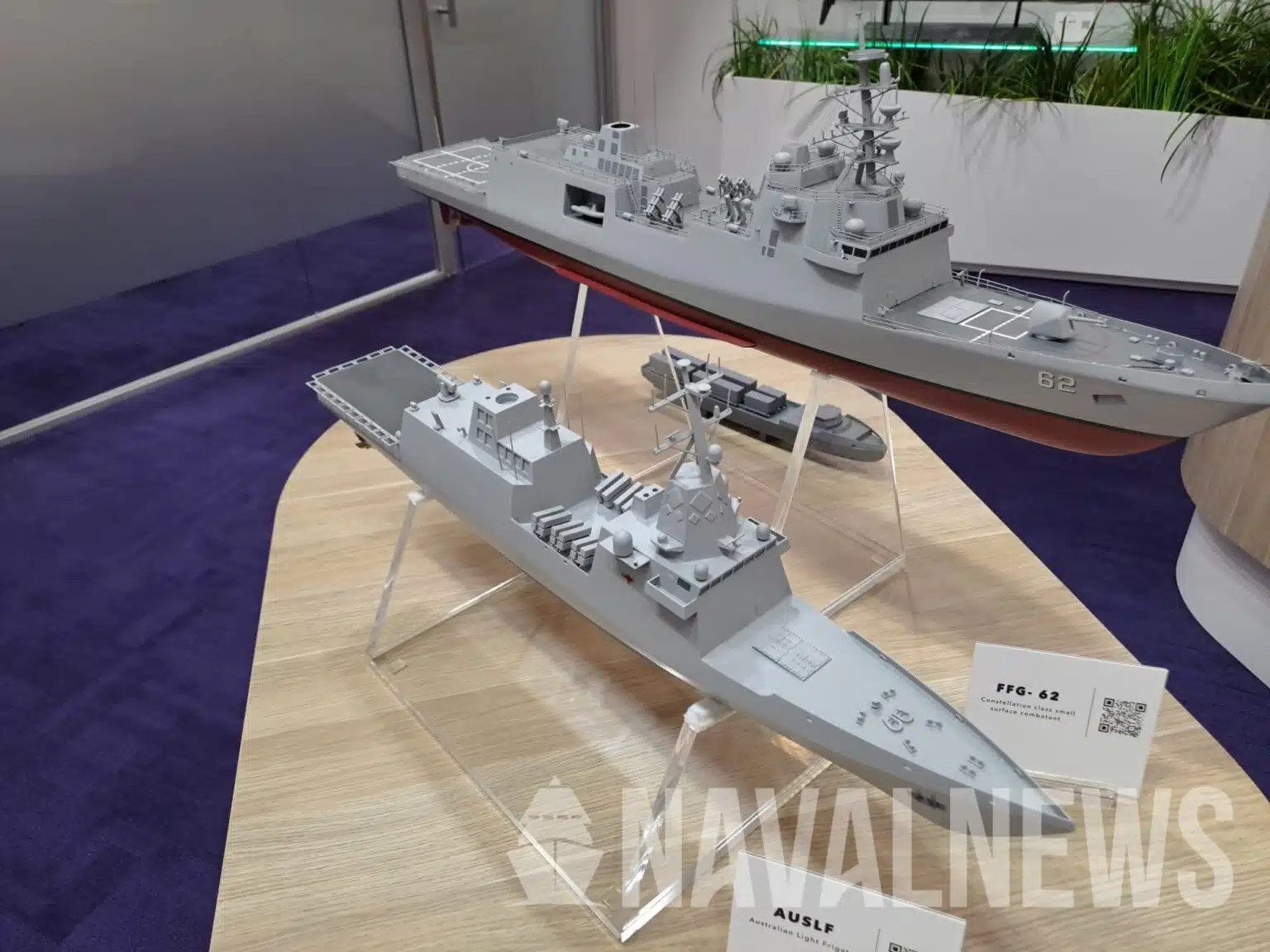
The Australian Light Frigate (foreground) and Constellation class (background) on the Gibbs and Cox stand during Indo Pacific 2023.

Gibbs and Cox proposal (pictured above), at 117 meters in length and 3,800 tons, this design is also smaller than the OPC by 700 tons. It takes the novel approach of deleting the usual main gun entirely in favor of 32 VLS and 24 ASCM launch tubes. CIWS would be provided by Phalanx or SeaRAM and close-in anti-surface and “shot across the bow” signaling would be provided by Mk38 gun mount or equivalent. (This may be taking the trend to smaller main guns to its logical conclusion.) Speed will be at least 30 knots using CODELAG GE LM2500+ propulsion.

TKMS offers MEKO A210 Frigate. This is a bit larger, at 4700 tons, 200 tons larger than the OPC and 100 tons larger than the National Security Cutter. The proposal includes 32 VLS and 16 ASCM. It is powered, like the earlier A200 frigates, by two diesels each driving conventional propellers and a gas turbine driving a central water jet, a system TKMS calls CODAG-WARP (WAter jet and Refined Propellers). Speed is likely 28-29 knots.

“Israeli Navy reveals Reshef corvette plans” –Naval News

An illustration and infographic of the Reshef class corvette (Credit: Israeli Navy)

Naval News reports,

The Israeli Navy is looking to have the first of its new Reshef class corvettes in service at the start of 2027…Speaking at the CNE 2023 conference in Farnborough on 24 May, Commander Yonatan Kudish also revealed that the Reshef vessel will be assembled from hull modules built overseas by a US shipbuilder.

Eight ships are planned to replace eight Sa’ar 4.5 missile boats currently in service with the Israeli Navy. In addition to a 76mm gun, a pair of 30mm remote weapon stations, and anti-ship missiles (presumably Gabriel V), they are expected to have C-Dome missiles, the naval version of Iron Dome as well.

It appears the Israelis are rebranding their helicopter deck as a “multi-purpose mooring deck.” There does not seem to be a hangar.

Compared to the Sa’ar 4.5s they are replacing, they are more than twice the displacement, and 3 or 4 knots slower.

These will be marketed internationally as Offshore Patrol Vessels (OPV) as well as Missile Corvettes depending on how they are equipped, though they seem to be a little small for an OPV on most of the world’s oceans. A 1,000 ton displacement as shown in the graphic would suggest they are smaller than the Coast Guard’s 210 foot WMECs despite a greater length (about 250 feet), but that might not be their full load displacement.

The fact that they are slower than the vessels they replace seems to reflect the diminished value of a high maximum speed since long range missiles and aircraft have replaced other surface vessels as the primary threat. On the other hand, seakeeping, endurance, range, and high cruise speed are probably more important now. Even so the Sa’ar 4.5s had very good cruising range for such small ships (4,800 nautical miles (8,900 km) at 19 knots). Their replacements may not offer any improvement.

China’s PLAN Surface and Sub Order of Battle

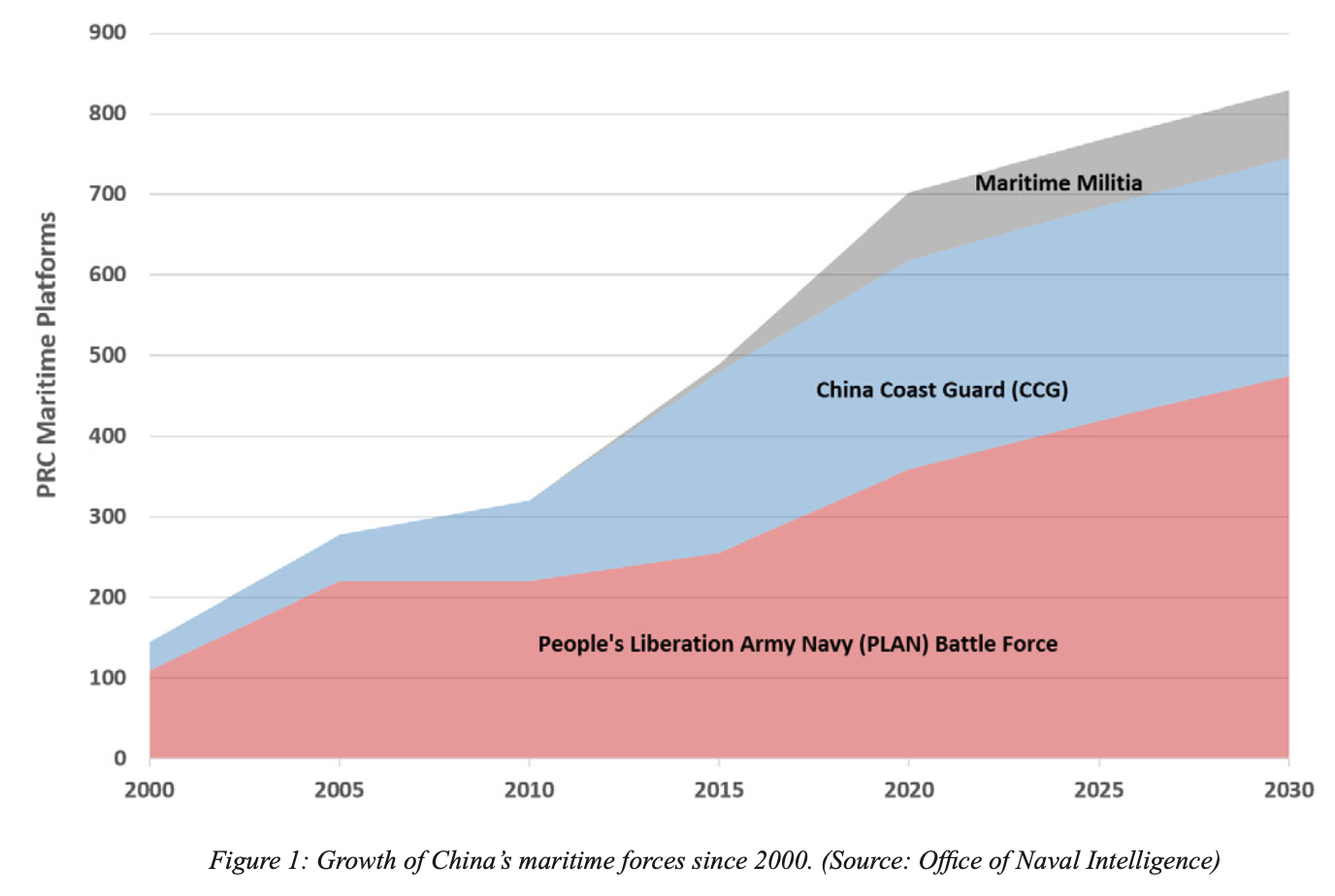
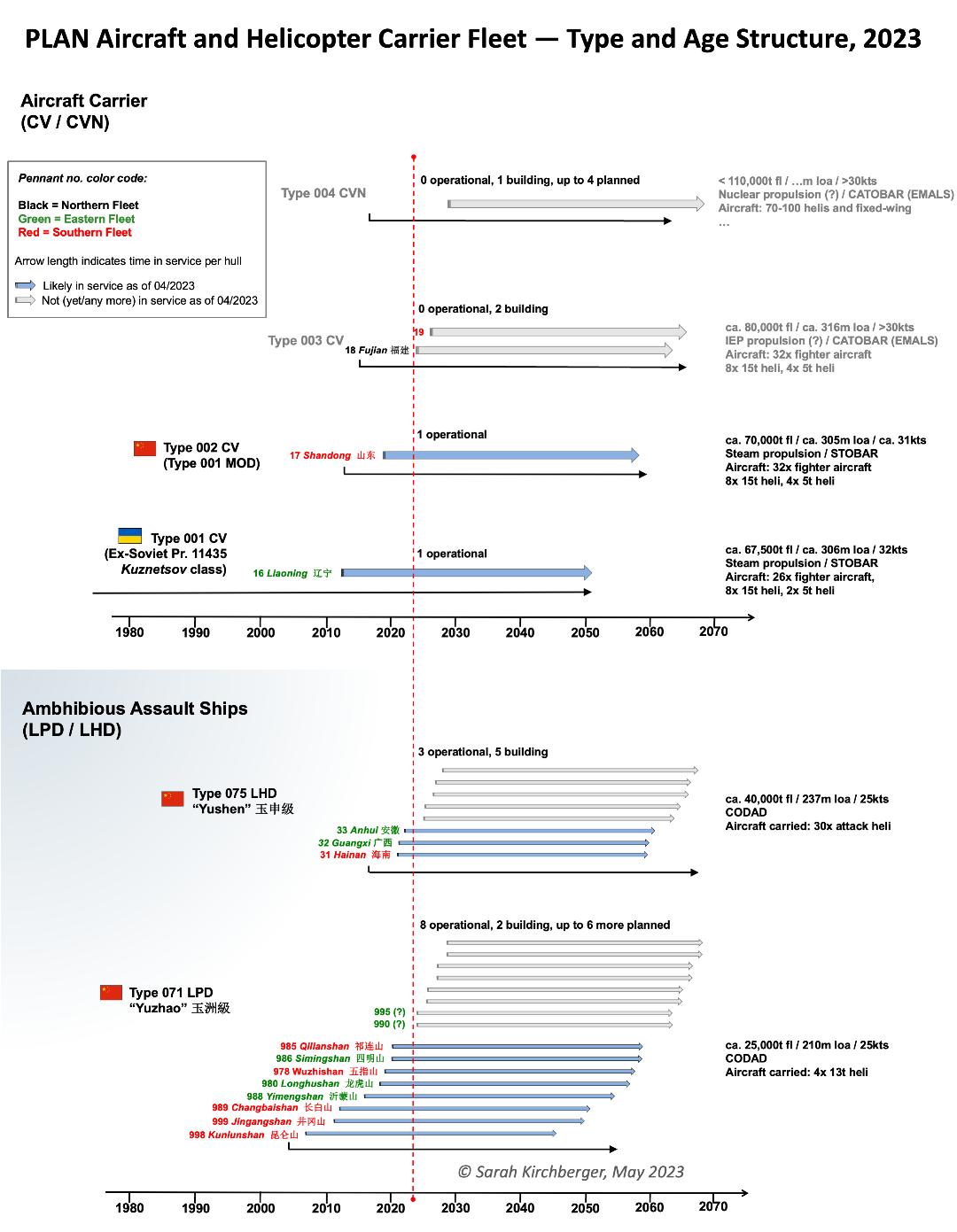
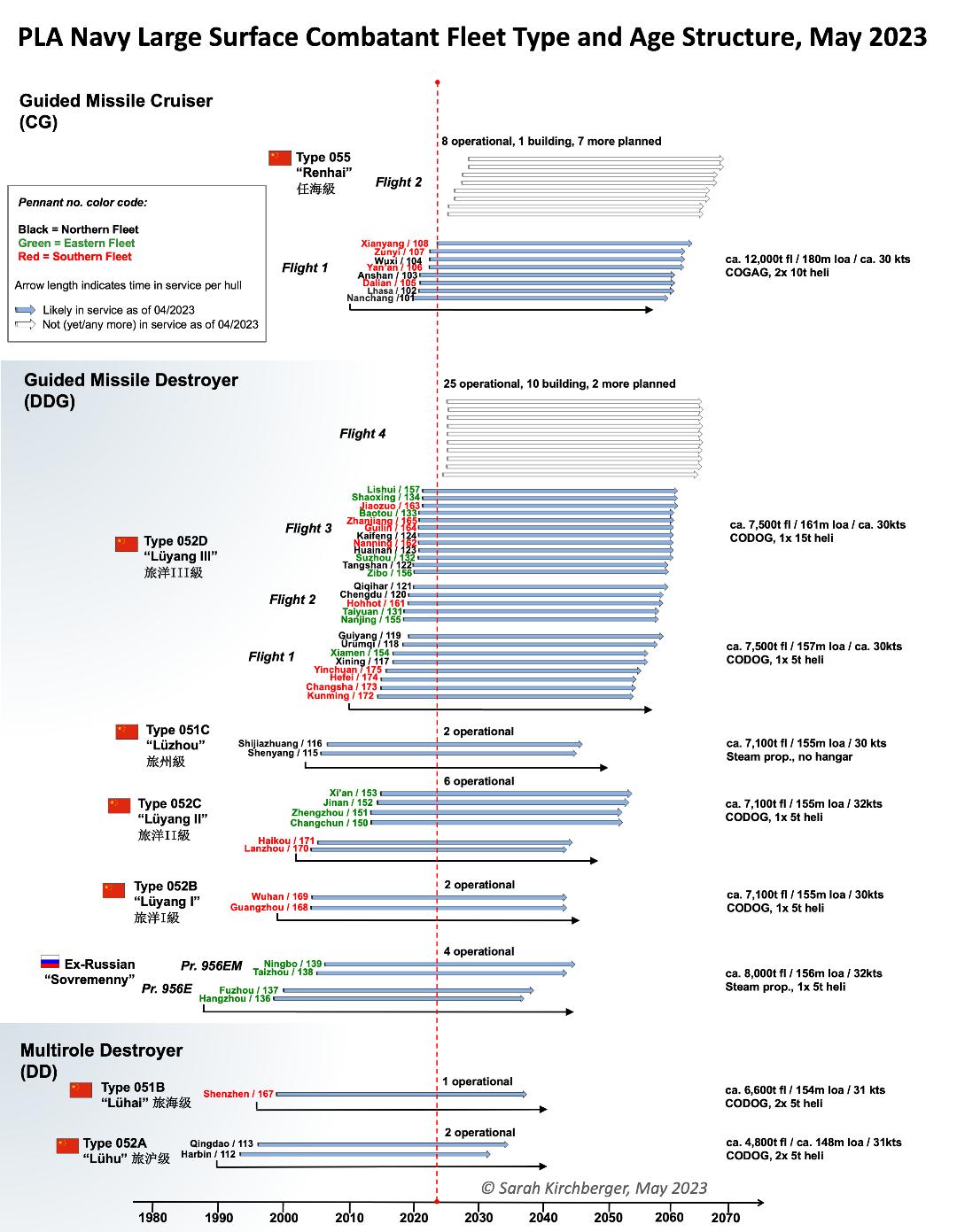
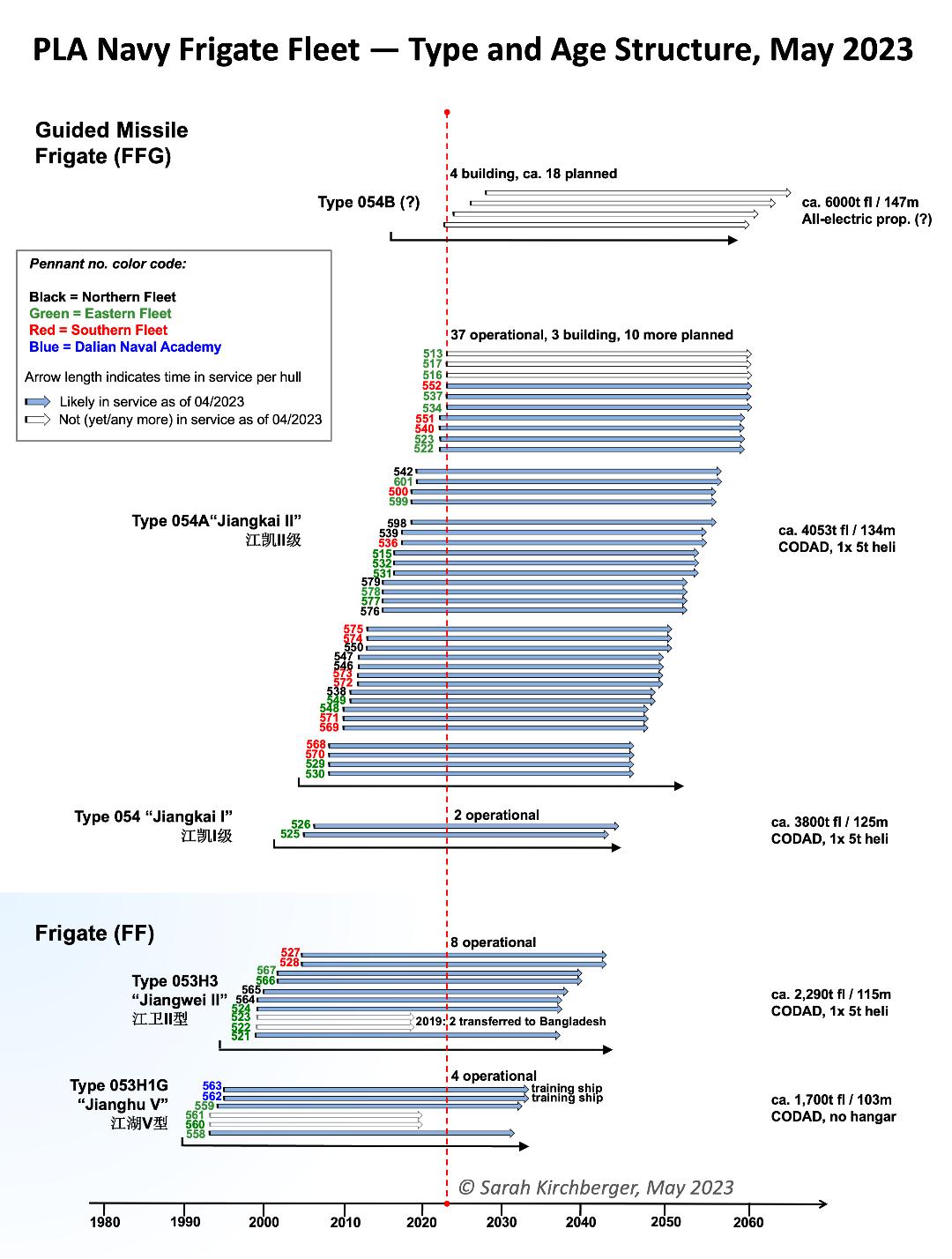
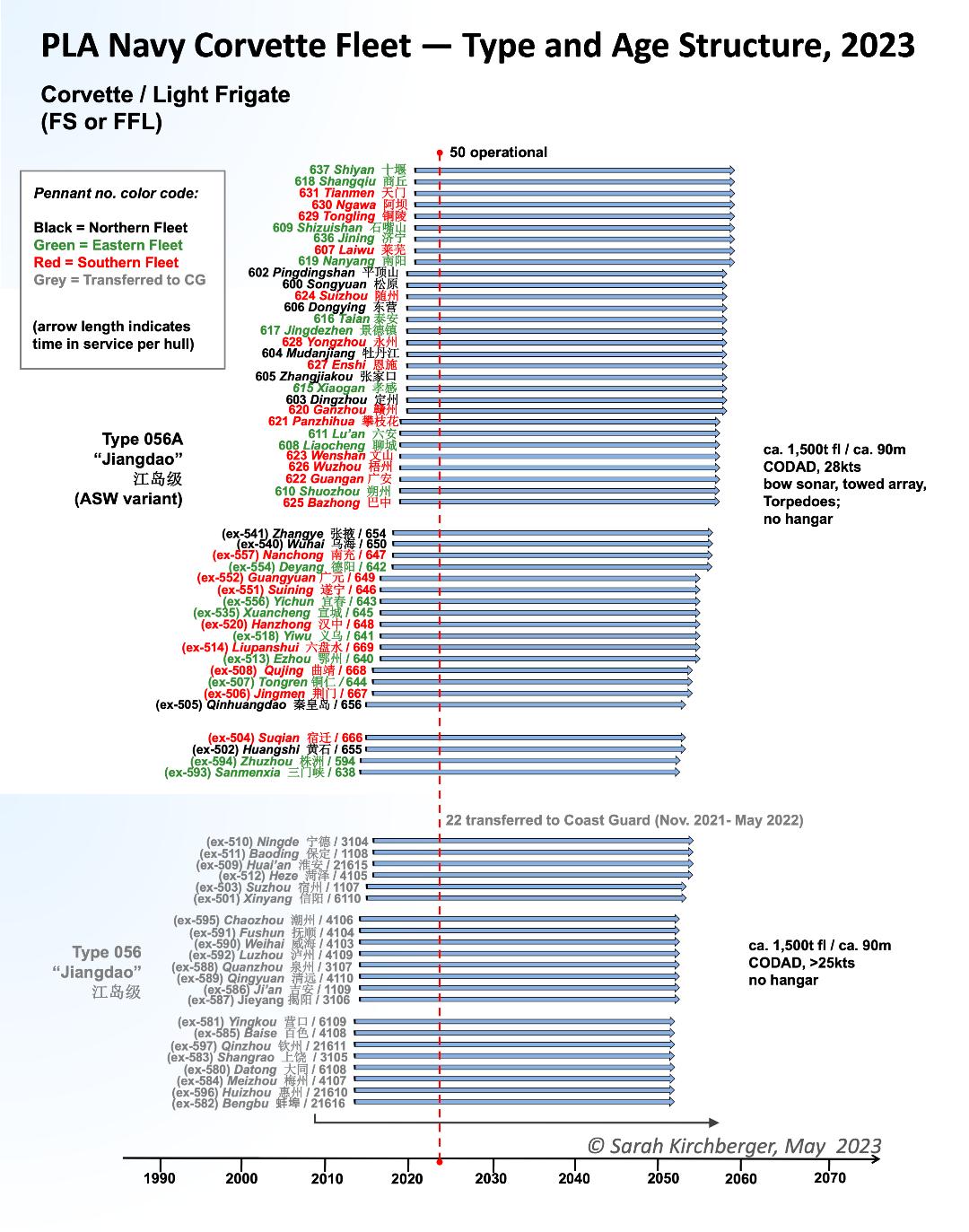
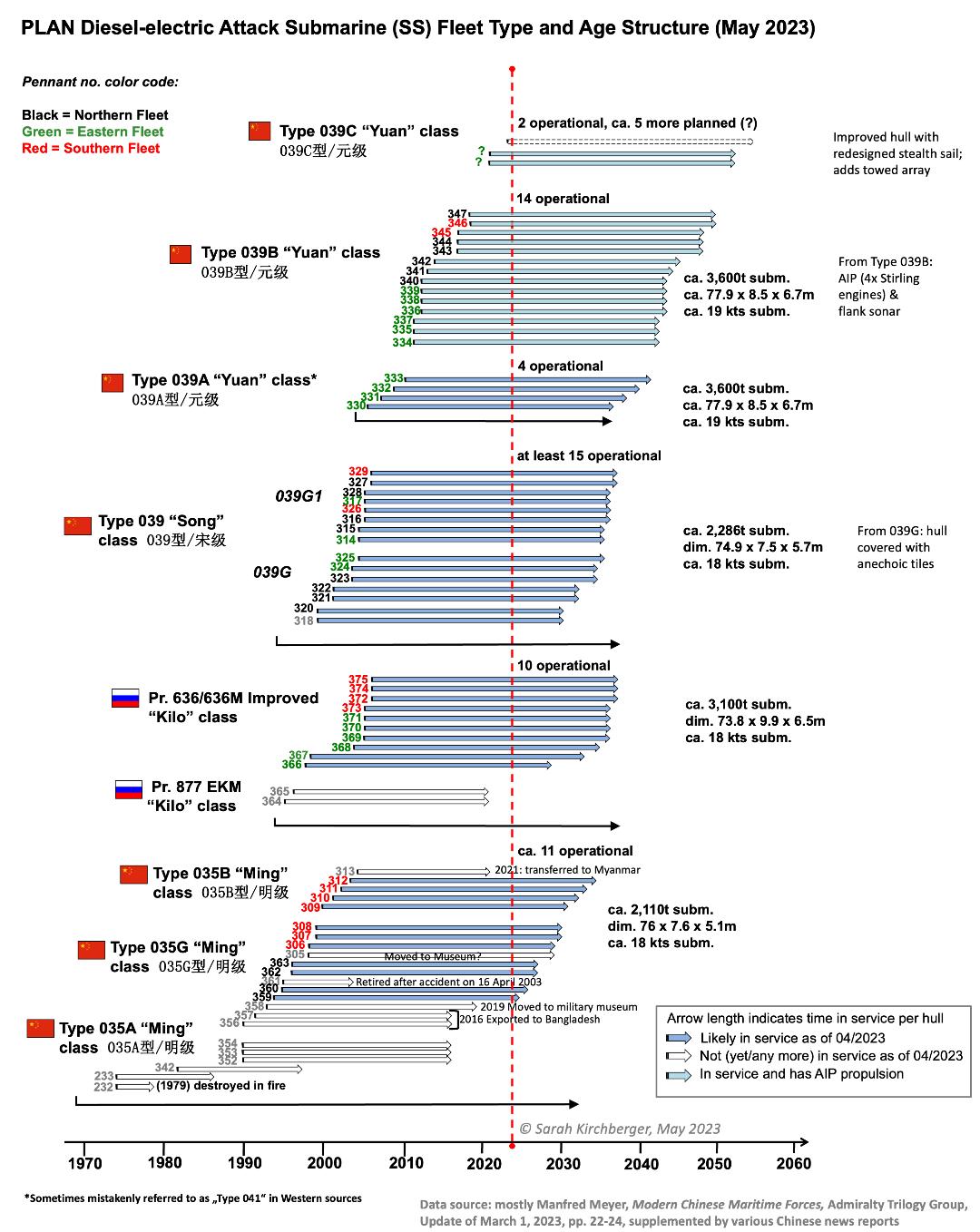
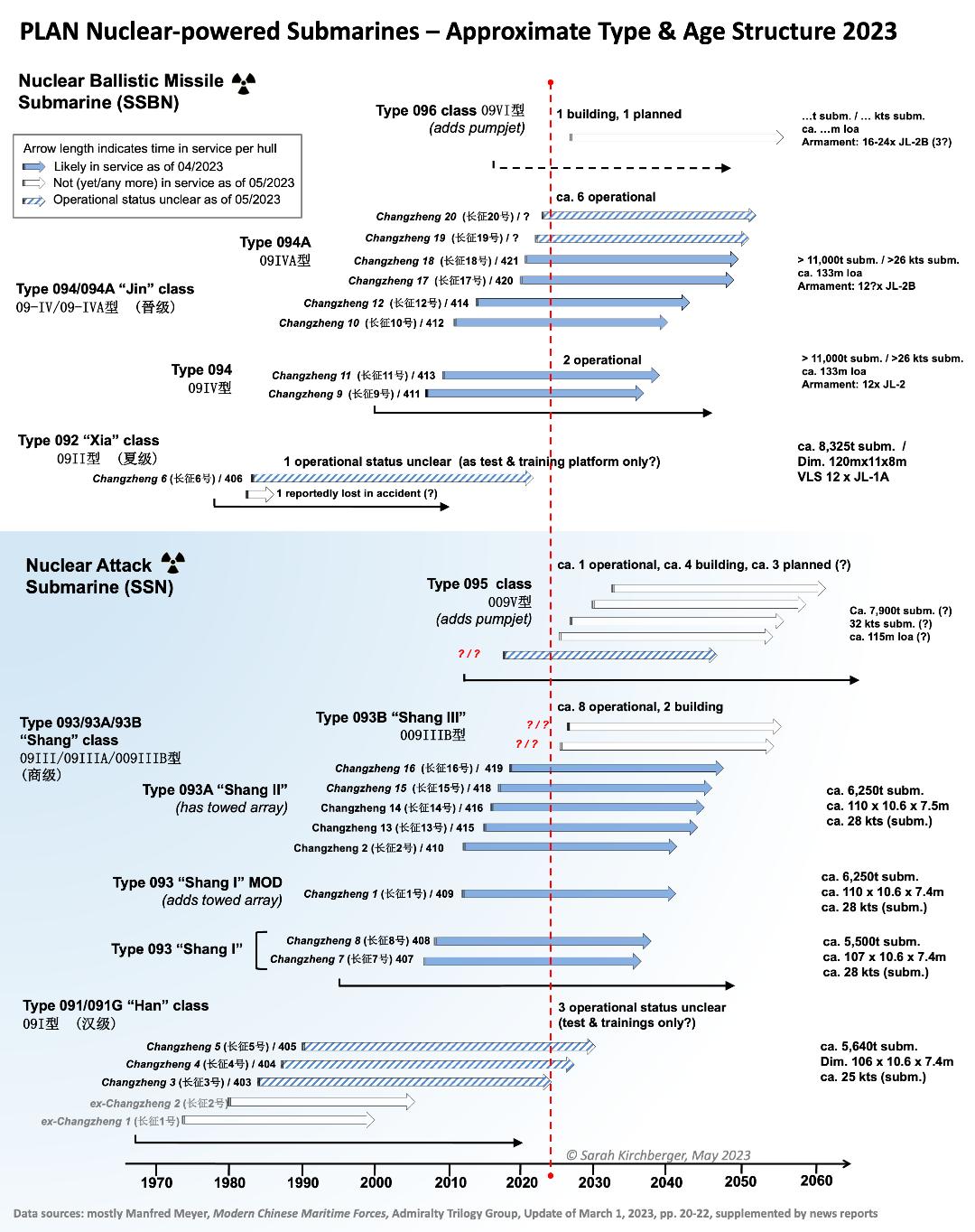
Earlier I published “Chinese Navy Submarine and Major Surface Ship Order of Battle,” that included three infographics prepared by Dr. Sarah Kirchberger that I found on the CIMSEC Internal Discussions Facebook page. At the time I noted that they did not include Chinese aircraft carriers, amphibs, and numerous frigates, corvettes, and other small combatants.

Dr. Kirchberger recently emailed me additional and updated infographics that provide a more complete picture of the People’s Liberation Army Navy’s rapid growth. I have included them all below, including updated versions of the three previously published.

Another resource available is the “Office of Naval Intelligence’s Chinese People’s Liberation Army Navy, Coast Guard, Ship Identification Guide.”

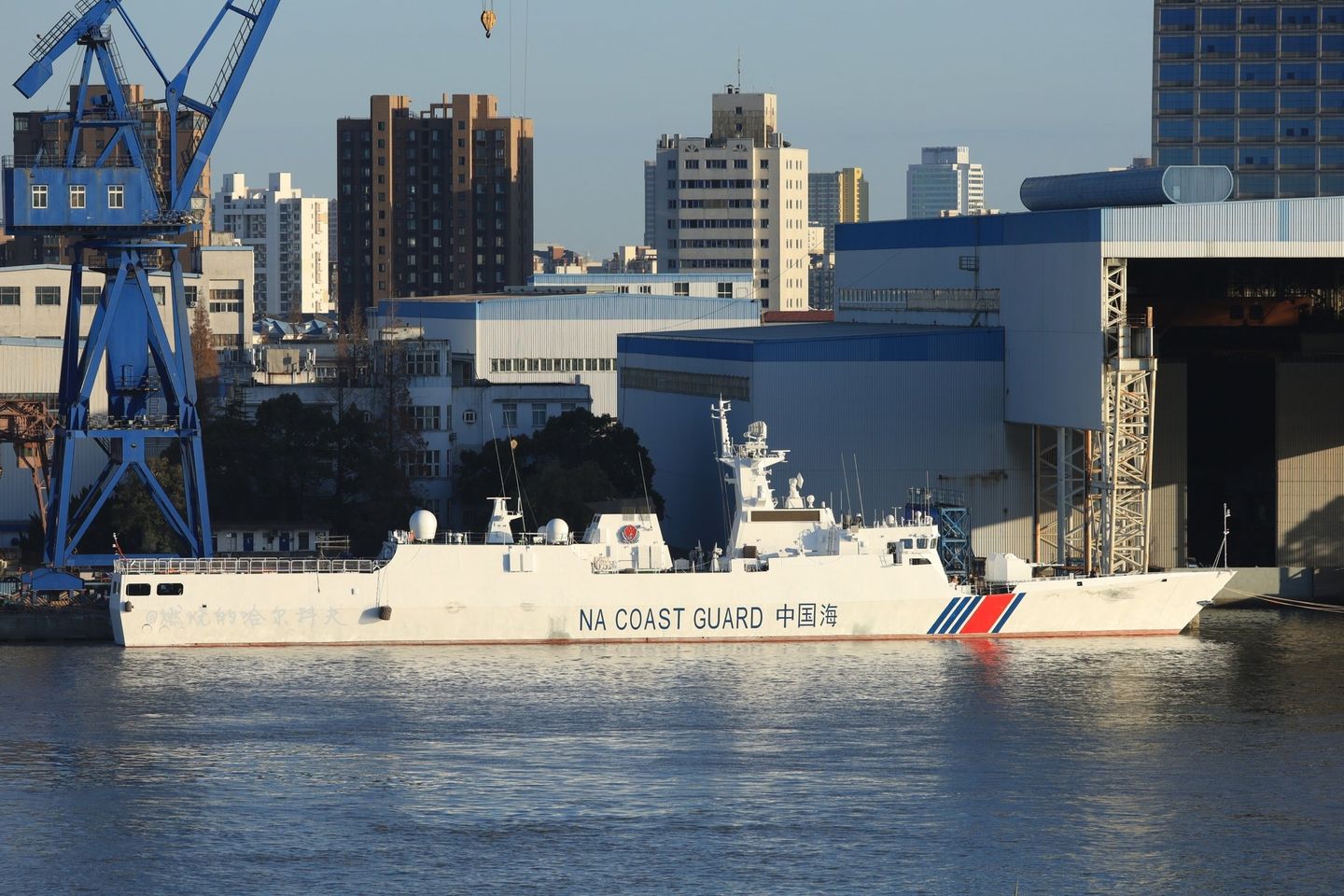
From a Coast Guard perspective, the most interesting development sighted below was the transfer of 22 Type 056 corvettes {photo above) from the Navy to the China Coast Guard. This follows the earlier transfer of four type 053H2G frigates (NATO designation Jiangwei I). In both cases heavier weapons were removed but significant gun armament remained. These added significantly to the China Coast Guard’s close in firepower. When the new China Coast Guard was formed in 2013, very few of their ships were armed with anything larger than 14.5mm machine guns.

Chinese H/PJ-17 30mm

That has changed, particularly since the China Coast Guard was absorbed into the country’s Central Military Commission (CMC), effective July 2018. The standard fit now seems to be a 76m gun and one or two 30mm H/PJ-17.

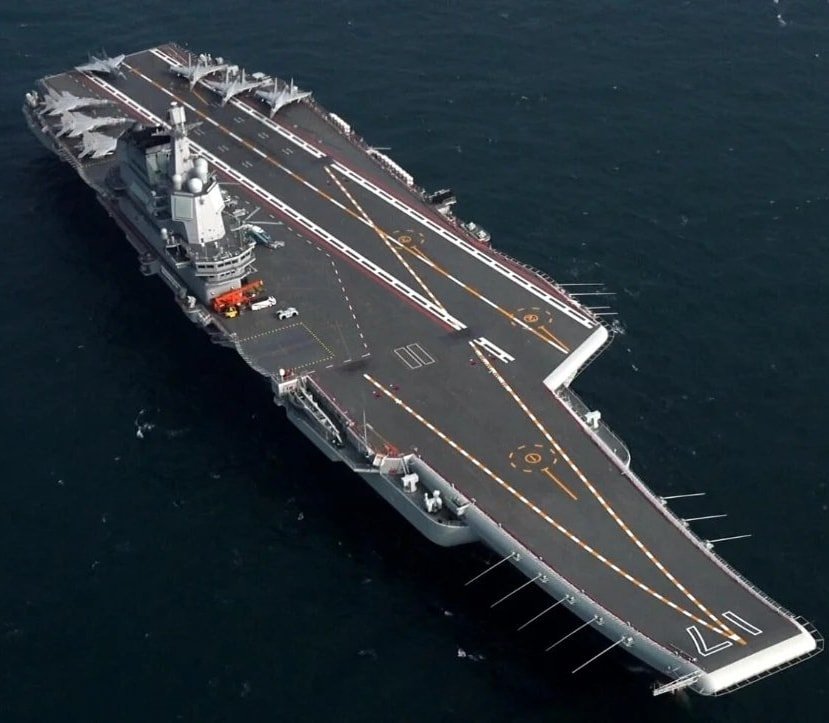
Undated photo of carrier Shandong. PLA Photo

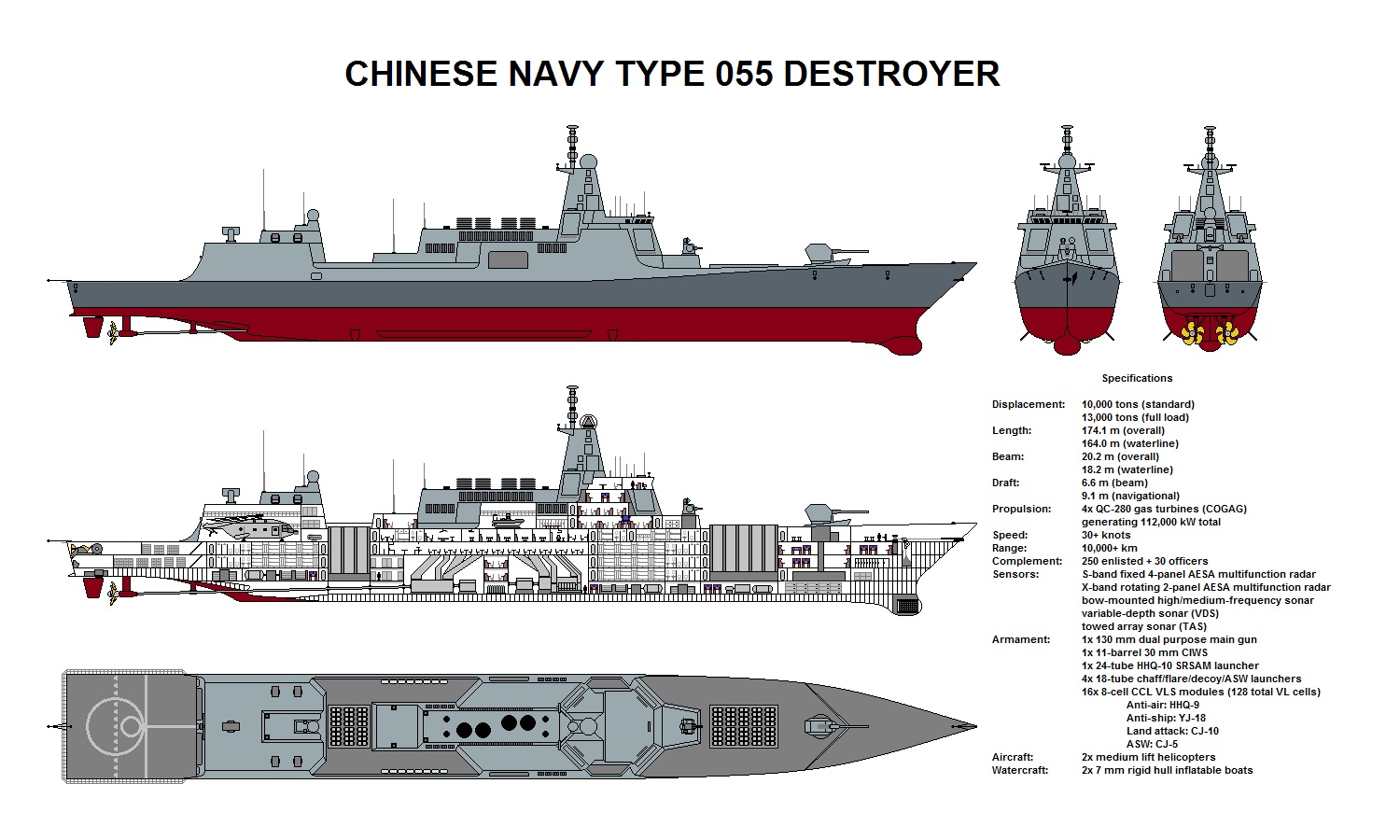
Type 055 Destroyer (Cruiser) SeaWave.com image

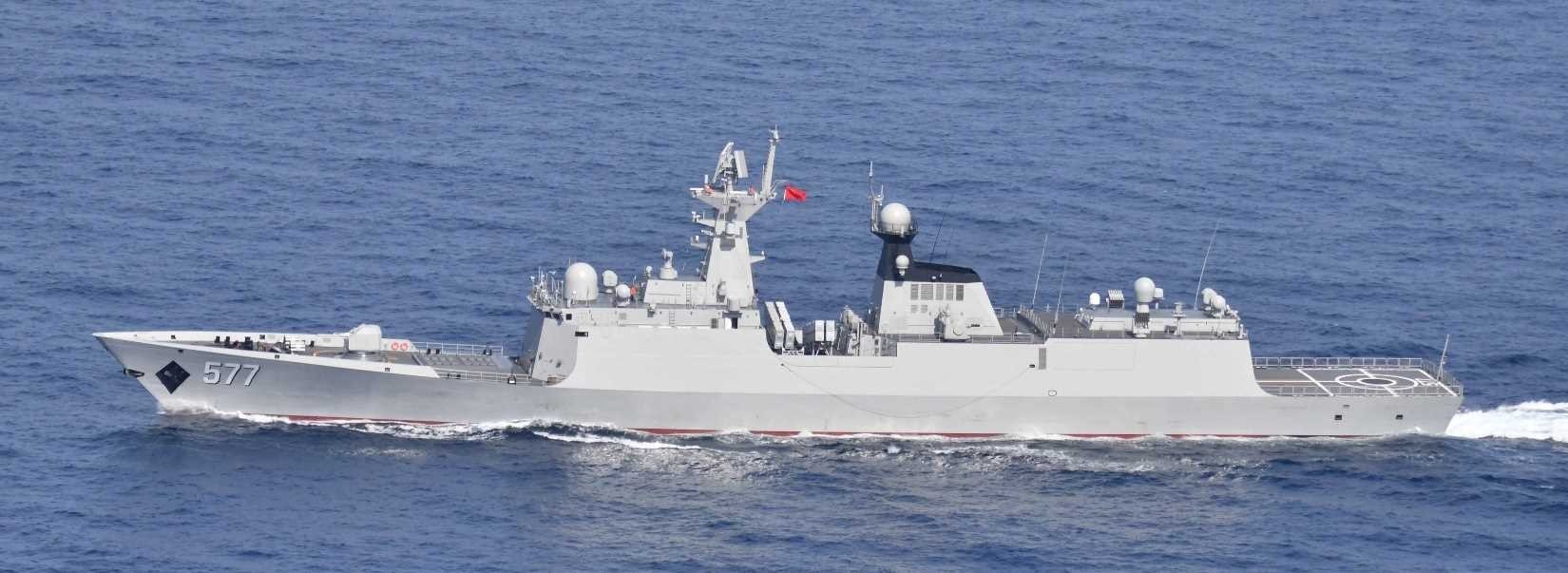
PLAN Type 054A Huanggang (FFG-577), Japanese Self Defense Force photo.

Type 056 corvette, credit 樱井千一

Image: Creative Commons.

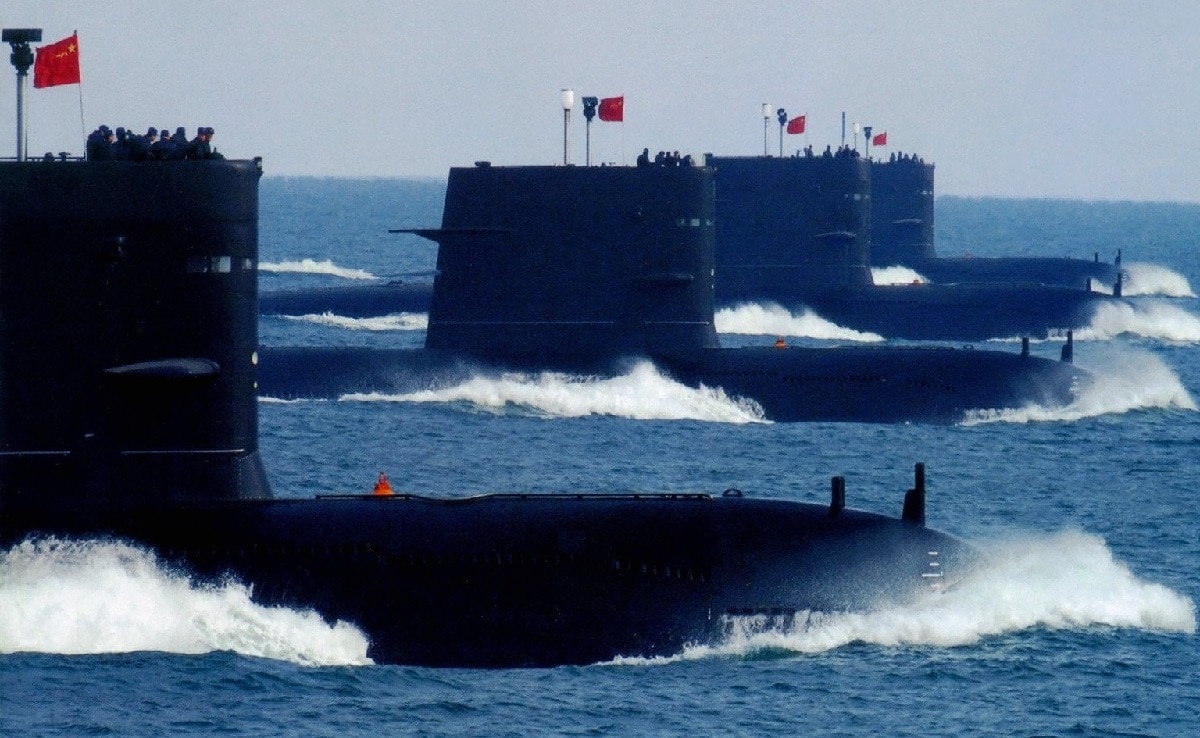
CSR Report RL33153 China Naval Modernization: Implications for U.S. Navy Capabilities—Background and Issues for Congress by Ronald O’Rourke dated February 28, 2014. Page 8 – Figure 1. Jin (Type 094) Class Ballistic Missile Submarine Source: Photograph provided to CRS by Navy Office of Legislative Affairs, December 2010.