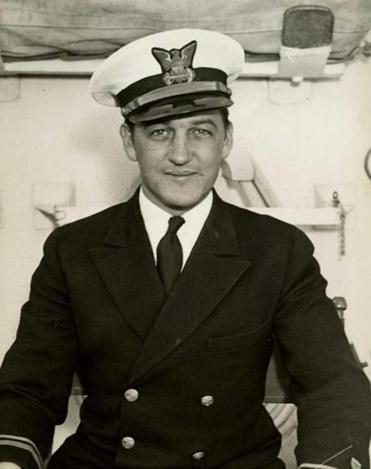
Lt. John F. String, Jr., USCGR, CO USS PC-545, Silver Star Recipient

PC545
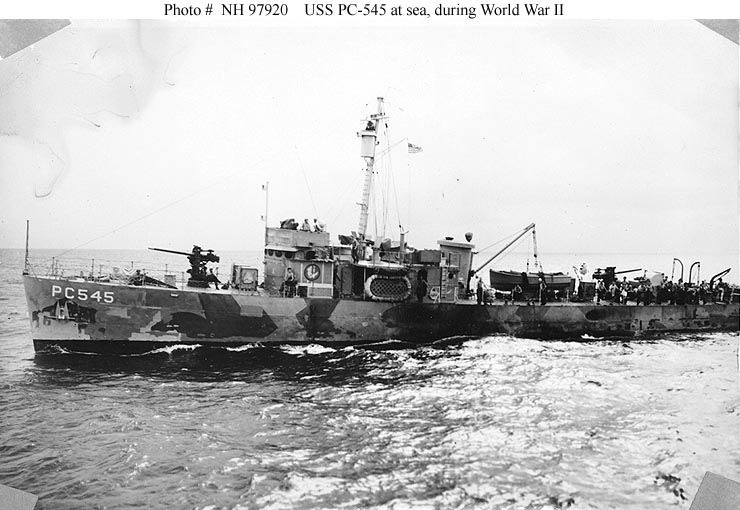
Photo: USS PC-545, Commanded by Lt. String, At sea during World War II. Probably photographed in 1942-43, while wearing rather weathered pattern camouflage. Donation of Phil Wagner, 2001. U.S. Naval Historical Center Photograph.

The “This Day in Coast Guard History” for January 22 included this simple statement,

1944  Coast Guardsmen participated in Operation Shingle – the landings at Anzio-Nettuno, Italy.  Coast Guard units involved were USS PC-545 and LSTs 16, 326, 327, and 381.

The Coast Guard manned only four of these PCs during WWII. I remembered one had performed extremely well. This is the story.

STRING, John F. Jr., LT, USCGR, WWII, Anzio invasion, Silver Star, for conspicuous gallantry in action while serving as commanding officer of the USS PC 545 off Anzio, Italy on March 18, 1944. When an enemy motor torpedo boat was sighted at night. Lt. String immediately ordered the attack. With an expert display of seaman ship, he so skillfully maneuvered the ship that the first shots scored hits on the enemy craft before it was able to maneuver into position to effectively use its torpedoes and the resulting fire caused it to disintegrate in an explosion. This successful action against the enemy contributed materially to the protection of shipping in the Anzio area and to the successful maintenance of forces ashore.

This is a brief summary of USS PC-545 career while Coast Guard manned from NAVSOURCE.

  • Laid down 31 March 1942 by the Defoe Shipbuilding Corp., Bay City, MI
  • Launched 8 May 1942
  • Commissioned USS PC-545, 27 June 1942 with a Coast Guard crew
  • PC-545 participated in the following campaigns: Sicilian occupation, 9 – 15 July, 28 July – 17 August 1943 Salerno landings, 9 – 12 September 1943 Anzio Netturno advanced landings, 28 January – February 1944 and the Invasion of Southern France, 15 August – September 1944
  • Sank a German E-boat 19 March 1944 west of Anzio, Italy
  • Decommissioned 17 October 1944, transferred to France at Toulon, France and named Goumier (W 91). Her Coast Guard crew was removed the same day.
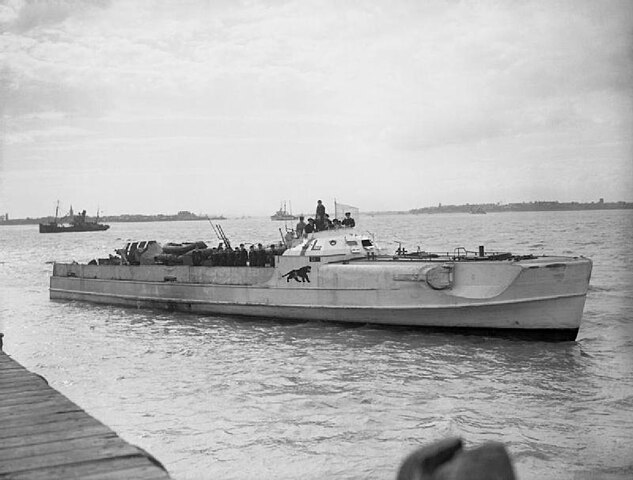
Typical E-Boat. The German Schnellboot (“E-boat”) S 204 flying a white flag of surrender at the coastal forces base HMS Beehive, Felixstowe, Suffolk (UK), on 13 May 1945. The two German E-Boats S 204 and S 205 from the 4th Schnellboot-Flotilla were escorted in by ten British MTBs. On board of S 205 was Rear Admiral Erich Breuning, who had been in charge of E-Boat operations and who signed the instrument of surrender. Note the black panther painted on the side of S 204 which had on board KKpt Kurt Fimmen (CO 4th Schnellboot-Flotilla) and KptLt Bernd Rebensburg (Ia Op/Operations-Officer of the Staff of Führer der Schnellboote/FdS). Lt. J.E. Russell, Royal Navy official photographer

This Day in Coast Guard History, January 21

Based on the Coast Guard Historian’s timeline, https://www.history.uscg.mil/research/chronology/
With inspiration from Mike Kelso

January 21

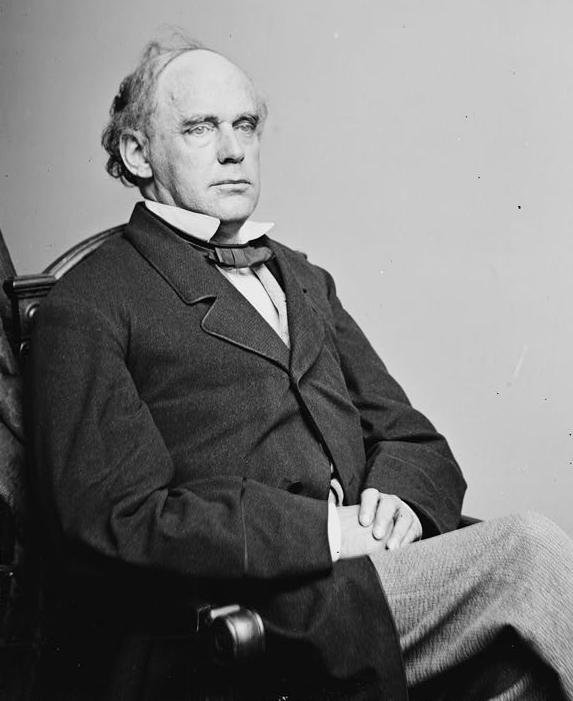
Chase as Lincoln’s Secretary of the Treasury. Library of Congress

1863 Appended to Circular to Collectors, January 21, 1863: “Sir: The question submitted by you [J. Lawrence Boggs, Collector at Perth Amboy, N.J.], whether free colored men are citizens of the United States, and competent therefore to command vessels engaged in our coasting trade, has been submitted to the Attorney General for his opinion, of which the concluding sentence is as follows: ‘And now, upon the whole matter, I give it as my opinion, that the free man of color mentioned in your letter, if born in the United States, is a citizen of the United States, and, if otherwise qualified, is competent, according to acts of Congress, to be a master of a vessel engaged in the coasting trade.’ You will advise the Commander of the Revenue Cutter ‘Tiger’ of this decision of the Attorney General, and direct him to conform to it in all future examinations of vessels engaged in the coasting trade. With great respect, Salmon P. Chase, Secretary.”

Tillamook Rock Lighthouse. An abandoned lighthouse near Tillamook Rock, Oregon, USA.

1881 The light was first shown at Tillamook Lighthouse, located 19 miles south of the Columbia River entrance.

USCGC Point Banks 14 foot Boston Whaler.

1969 CGC Point Banks, while on patrol south of Cam Rahn Bay, received a call for assistance from a nine-man South Vietnamese (ARVN) detachment trapped by two Vietcong platoons.  Petty Officers Willis Goff and Larry Villareal took a 14-foot Boston whaler ashore to rescue the ARVN troops.  In the face of heavy automatic weapons fire all nine men were evacuated in two trips. For their actions Goff and Villareal were each awarded the Silver Star. The citation stated, “The nine men would have met almost certain death or capture without the assistance of the two Coast Guardsmen.”

1982 “Streamlining” plans were put into place when the Commandant, ADM John B. Hayes, announced in ALCOAST 002/82 his plans to consolidate some operations and streamline others to comply with President Ronald Reagan’s goals of “greater efficiency in federal spending” and in accordance with Congressional appropriation levels.  The service eliminated 35 units, including the West Coast Training Center at Alameda, and consolidated all recruit training to TRACEN Cape May.

1984 The tanker Cepheus ran aground near Anchorage, Alaska, on the morning of January 21, 1984, spilling 180,000 gallons of jet fuel into Cook Inlet.  MSO Anchorage and the Pacific Strike Team responded to the incident and monitored the offloading of the damaged tanker and cleared its passage out of Alaska.  The light jet fuel evaporated with little environmental impact.

This Day in Coast Guard History, January 1

Based on the Coast Guard Historian’s timeline, https://www.history.uscg.mil/research/chronology/
With inspiration from Mike Kelso

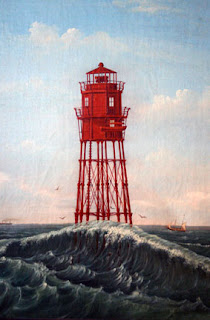
A painting of the original Minot’s Ledge Lighthouse built in 1850

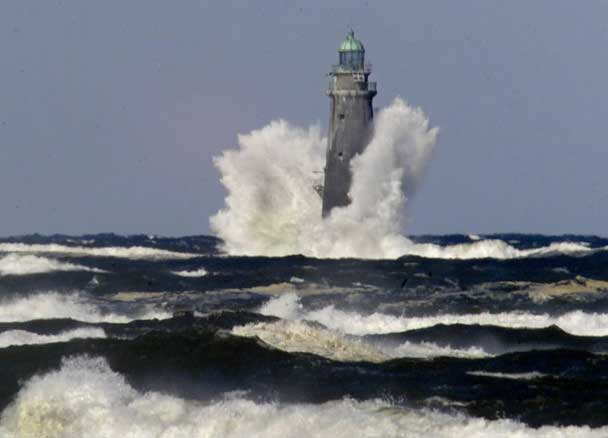
The modern Minot’s Ledge lighthouse built of granite replace the steel lighthouse that was destroyed in 1851

1850  The light in the Minot’s Ledge Lighthouse was first shown.  This lighthouse was the first one built in the U.S. in a position directly exposed to the sweep of the open sea.  It was destroyed and two keepers were killed in a great gale in April 1851.

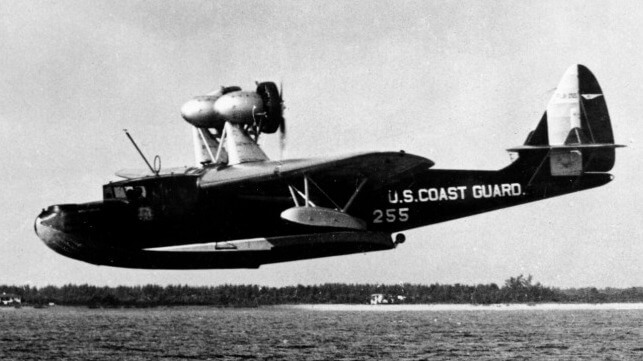
The U.S. Coast Guard SAR aircraft Arcturus (USCG)

1933  Carl C. von Paulsen, a pioneering Coast Guard aviator, and his crew of four rescued a man during a gale off the coast of Florida while flying in the Coast Guard seaplane Arcturus from Air Station Miami.  He and his crew were awarded a Gold Lifesaving Medal, the first Coast Guard aviators to earn the prestigious award.

1937  Effective this date, the dividing point between the 6th and 7th Lighthouse Districts on the east coast of Florida was moved northward from Hillsboro Inlet to St. Lucie Inlet to place the new trans-Florida waterway (through Lake Okeechobee) under one jurisdiction.

1946  The Coast Guard, which had operated as a service under the Navy since November 1, 1941, was returned to the Treasury Department, pursuant to Executive Order 9666, dated December 28, 1945.

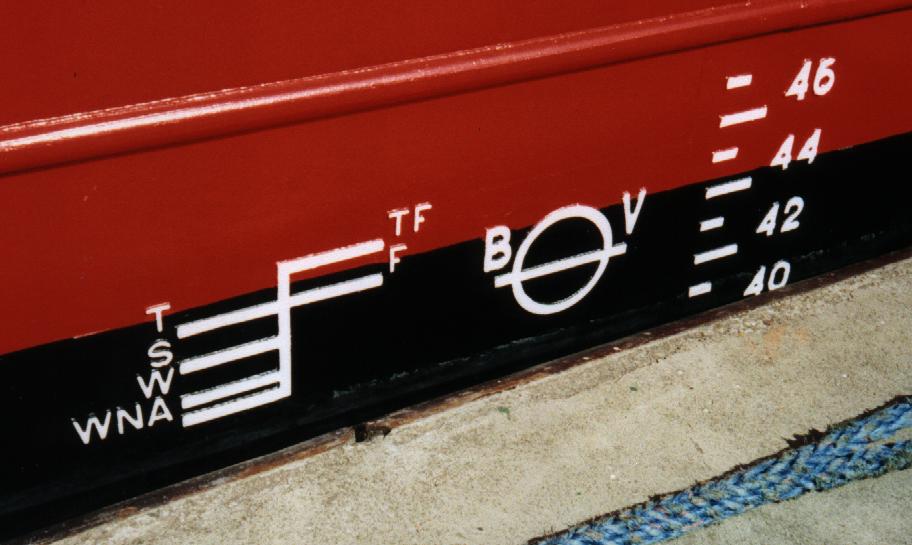
Freeboard mark (Plimsoll mark). Load line markings on a cereal carrier, certified by Bureau Veritas. Photo credit: Wualex

1946  The International Load Lines Convention, which had been suspended since August 9, 1941, was restored to full effectiveness by a Presidential proclamation dated December 21, 1945.  The Coast Guard assumed the enforcement of the convention’s requirements in the interest of safe loading.

Oct. 11, 2020, collision between the offshore supply vessel Cheramie Bo-Truc No. 33 and the Coast Guard cutter Harry Claiborne. NTSB Photo

1954  The “Regulations for Preventing Collisions at Sea, 1948”, commonly known as the “Revised International Rules of the Road”, became law.  These were a result of the International Conference on the Safety of Life at Sea, 1948.

1958  The Coast Guard ceased listening continuously for distress calls on 2670 kilocycles.  Although the countries of the world had agreed at the Atlantic City Convention of the International Telecommunication Union in 1947 to use 2182 kilocycles for international maritime mobile radiotelephone calling and distress, the Coast Guard had continued listening on the old frequency until the public had had sufficient time to change to the new one.

USCGC Point Gammon gets a camouflage coat of dark grey paint at Da Nang, October 1965. Photo credit Lt. Cdr. Richard J. Knapp, USCG

1967  CGC Point Gammon destroyed an enemy trawler in Vietnam.

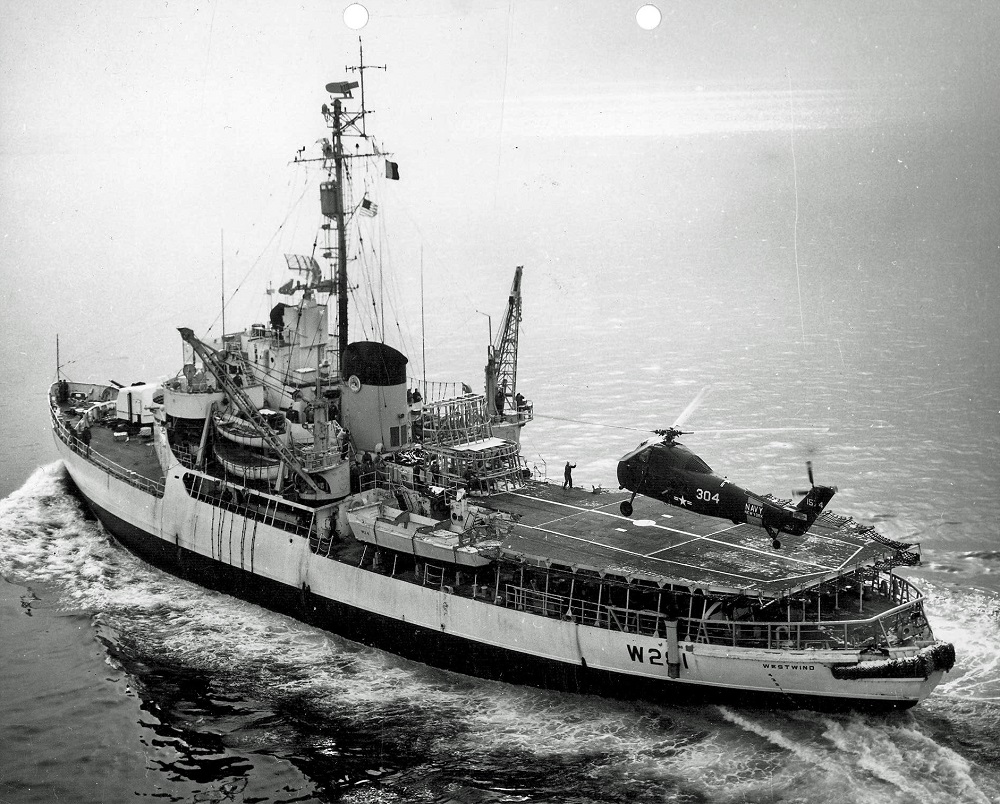
USCGC Westwind

1984  CGC Westwind was heavily damaged by ice in Antarctic’s Weddell Sea.  About 120 feet of the port-side hull was gashed when brash ice forced the ship against a 100-foot sheer ice shelf.  The gash was two to three feet wide and was six feet above the water line.  The crew made temporary repairs.  There were no injuries.

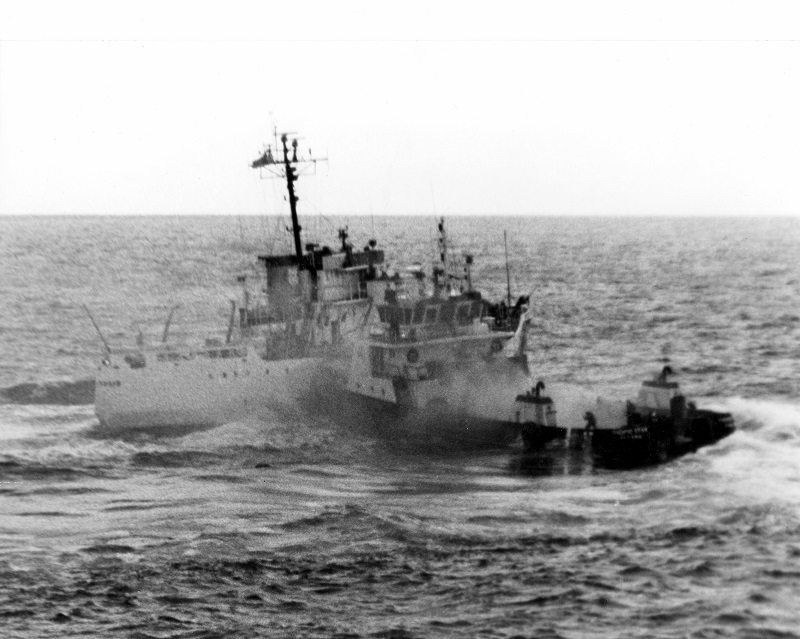
When the boarding team attempted to board the vessel, the master set the Pacific Star on fire and commenced to scuttle the vessel. In a final act of deterrence, the master turned his vessel and rammed Citrus on the starboard side. The boarding team did get on board and located a large quantity of Thai marijuana in the vessel’s forward hold. As the vessel sank, more than 3,800 pound of marijuana was recovered as it floated to the surface and the seven-man crew was arrested.

1985  CGC Citrus was rammed by the M/V Pacific Star during a boarding incident.  The Pacific Star then sank after being scuttled by her crew.  There were no casualties.  The seven crewmen were arrested on drug charges.

1999  The Aviation Machinist ratings merged with the Aviation Structural Mechanic ratings to form the Aviation Maintenance Technician rating with the designator AMT.  The Aviation Electronics Technician rating became the Avionics Technician rating with the designator AVT.  The Aviation Survivalman rating was renamed Aviation Survival Technician.


“The Long Blue Line: Villarreal – Silver Star savior of Vietnam 55 years ago” –MyCG

MyCG has a great first-person Vietnam war story. There is another telling of the same story with more background here. Check it out.

I note, we don’t have a Webber class cutter named after either of these two silver star recipients, EN2 Larry D. Villarreal and GM1 Willis J. Goff.

We need to honor these men.

Steel Cut for DDG Honoring Coast Guard Hero

A graphic illustration of the future Arleigh-Burke class guided-missile destroyer USS Quentin Walsh (DDG 132). (U.S. Navy photo illustration by Mass Communication Specialist 1st Class Paul L. Archer/Released)

Dmitry Shulgin reports,

The U.S. Navy and General Dynamics (GD) Bath Iron Works (BIW) marked the start of fabrication for the future USS Quentin Walsh (DDG-132) with a ceremony at BIW’s Structural Fabrication Facility in East Brunswick, Maine, November 16.

This earlier post tells the story of this Coast Guard Hero.

“Coast Guard, NOAA to hold event to announce the discovery of U.S. Revenue Cutter Bear and arrival of U.S. Coast Guard Icebreaker in Boston” –D1

Appearing very different from its last Greenland visit in 1884, the USS Bear returned in 1944. Unlike in 1884, the Bear relied on a Coast Guard crew during World War II. As part of the Greenland Patrol, it cruised Greenland’s waters and, in October 1941, brought home the German trawler Buskø, the first enemy vessel captured by the U.S. in WWII. (Coast Guard photo)

An interesting news release from CCGD1 below. While looking for an appropriate photo, I found an earlier article, “Hunting for Bear, the Search for the Coast Guard’s Most Iconic Vessel,” by MARK A. SNELL, PH.D., U.S. Coast Guard Auxiliary, beginning on page 56 of the Spring 2019 issue of Proceedings of the Marine Safety and Security Council. This is the way it ends.

A few years ago, an aspiring author posted an ode about the loss of the Bear on a website known as “Ghost Stories for Lovers.” Her thoughts on the final moments of the iconic ship are an apt denouement both for the sinking of the Bear and the conclusion of this article:

“I imagine her exhaustion. I imagine the familiar rush of waves lapping against her parched skin, reawakening every memory of every youthful adventure with such
a flood of overwhelming intensity that the strength of the wind and the salt and the biting northern air that she once drank now aches. Her arthritic timbers swell and throb as they move through the rough ocean. The towline grows taut, too taut, as she struggles to keep pace with the smaller boat. Did she welcome the final gale that snapped it, I wonder, that final push of force that plunged her mast deep into her hull, into her heart, releasing nearly a century’s worth of man’s insatiable hope from her shattered bones and back into the sea from which he crawled?

“She didn’t take anyone down with her. The two sailors who were with her when it happened shivered and gaped from the rails of the tugboat that rescued them as she slipped further into the black water. Slowly. Silently. As if she were never there…”

united states coast guard

News Release

U.S. Coast Guard 1st District Northeast

Media Availability: Coast Guard, NOAA to hold event to announce the discovery of U.S. Revenue Cutter Bear and arrival of U.S. Coast Guard Icebreaker in Boston

Editors’ Note: Media interested in attending are requested to RSVP at 617-223-8515 or D1PublicAffairs@USCG.mil by 9:30 a.m., Oct. 13, 2021 and should arrive no later than 2:45 p.m. and must follow proper CDC guidelines for COVID-19.

BOSTON—The Coast Guard is scheduled to hold an event to discuss the discovery of the wreckage of the U.S. Revenue Cutter Bear and the arrival of the USCGC Healy (WAGB  20) following its recent transit of the Arctic’s Northwest Passage.

WHO: Vice Adm. Steven Poulin, Coast Guard Atlantic Area commander, Capt. Kenneth Boda, USCGC Healy commanding officer, Coast Guard historians and representatives from the National Oceanic and Atmospheric Administration (NOAA).

WHAT: The Coast Guard is announcing the findings of the wreckage of the U.S. Revenue Cutter Bear, a vessel of historical significance to the Arctic, and discussing the arrival of the USCGC Healy, one of the Service’s polar icebreakers.

WHEN: Thursday, Oct. 14, 2021, at 3:00 p.m.

WHERE: Boston Cruise Ship Terminal, 1 Black Falcon Ave. Boston, MA 02210

The USRC Bear was built in Scotland in 1874 as a steamer ship and purchased by the U.S. government in 1884 for service in the U.S. Navy as part of the rescue fleet for the Greely Expedition to the Arctic, which gave world-wide acclaim as the vessel that rescued the few survivors of that disastrous expedition. In 1885, the Bear was transferred from the Treasury Department for service in the Arctic as a Revenue Cutter and for 41 years it patrolled the Arctic performing search and rescue, law enforcement operations, conducting censuses of people and ships, recording geological and astronomical information, recording tides and escort whaling ships. Between 1886-1895, the captain of Bear was “Hell Roaring Mike” Healy. The USCGC Healy was commissioned in 1999 and named in his honor. During World War II, the Bear served during the Greenland Patrols and participated in the capture of a German spy vessel, the trawler Buskoe. It was decommissioned in 1944 and was lost at sea while being towed in 1963.

The U.S. Coast Guard Cutter Healy crew, following in the Bear’s tradition of Arctic service, recently completed a transit of the Arctic Northwest Passage. Healy is one of the Coast Guard’s polar-capable icebreakers and operates as a multi-mission vessel to protect American interests in the Arctic region.

For nearly two decades, NOAA Ocean Exploration, the NOAA Office of National Marine Sanctuaries’ Maritime Heritage Program, the U.S. Coast Guard Research and Development center, and a number of academic research partners have been engaged in a search for the final resting place of U.S. Revenue Cutter Bear.

For more information, please visit NOAA’s Ocean Exploration website.

“The Long Blue Line: Warren Gill—Oregon’s forgotten Navy Cross hero” –Coast Guard Compass

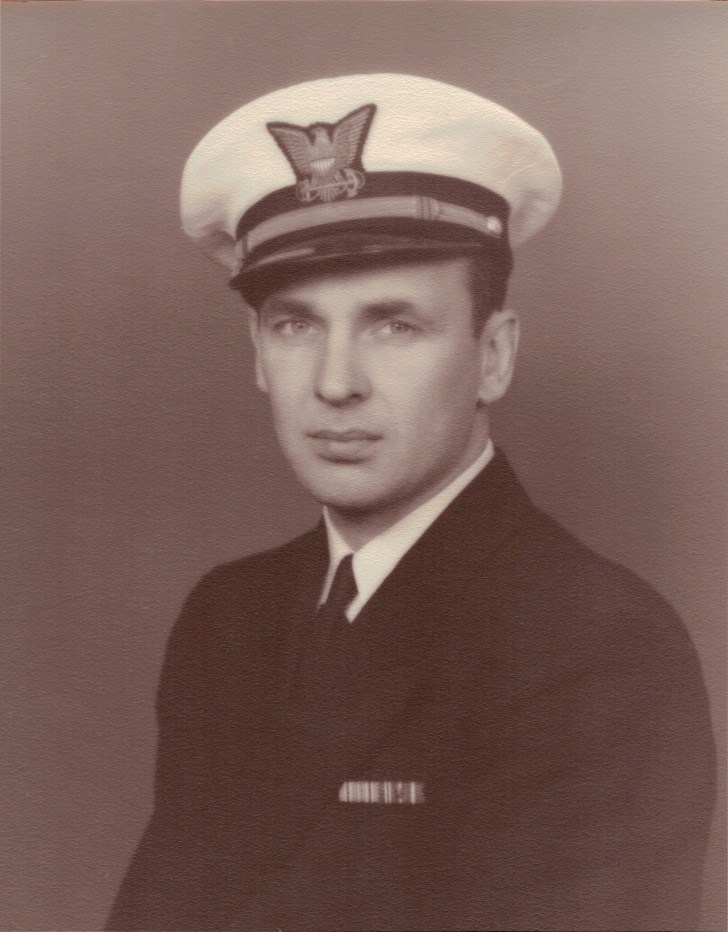
LT Warren Gill’s official portrait in dress uniform photographed by the U.S. Coast Guard. (The Gill Family)

Coast Guard Compass has a short article about a World War II Coast Guard Reserve Navy Cross, Legion of Merit, and Purple Heart recipient that I had not been aware of. This is all the more remarkable because he got the Legion of Merit for actions while an Ensign and the Navy Cross for actions as a Lt (jg). After leaving the Coast Guard, he went on to lead an exemplary life of public service including leadership in the Coast Guard Auxiliary.

This is another hero we might want to name a ship after.

Bringing Jimmy Crotty Home

Lt. Crotty

Press Release, I have mentioned this earlier in comments, but this is a bit more detailed than earlier presss releases. 

united states coast guard

R 290809 OCT 19
FM COMDT COGARD WASHINGTON DC//CCG//
TO ALCOAST
UNCLAS //N05360//
ALCOAST 335/19
COMDTNOTE 5360
SUBJ:  THE RETURN HOME OF LT THOMAS JAMES EUGENE CROTTY, USCG
1. It is my honor to report that we will bring LT Thomas James Eugene “Jimmy”
Crotty, a Coast Guard and American hero, home.
2. LT Crotty was born on 18 March 1912, in Buffalo, New York. He graduated from the
United States Coast Guard Academy in 1934 after serving as Company Commander, class
president and captain of the Academy’s football team. He served his first seven years
after graduation on board cutters in New York City, Seattle, Sault Ste. Marie and San Diego.
3. In the days leading up to the attack on Pearl Harbor, he served with the U.S. Navy as
Executive Officer onboard USS QUAIL, part of the 16th Naval District-in-Shore Patrol
Headquarters, Cavite Navy Yard, Philippines. He aided in the defense of Corregidor during
the Japanese invasion in the early days of WWII, supervising the destruction of ammunition
and facilities at the Navy Yard and scuttling the fleet submarine USS SEA LION to prevent
its use by the Japanese. As the Japanese advanced on Corregidor, LT Crotty eagerly took
charge of cannibalized deck guns from the ship and led a team of brave enlisted Marines
and Army personnel fighting for an additional 30 days until the Japanese bombardment finally
silenced the defense of the island fortress.
4. Following the fall of Corregidor, LT Crotty was taken prisoner by the Japanese and
interned at the Cabanatuan Prisoner of War Camp. After his death on 19 July 1942 from
diphtheria, he was buried in a common grave along with all those who died that day. 
5. After World War II, the U.S. government moved remains from the common graves to the
Manila American Cemetery and Memorial in the Republic of the Philippines. On 10 September
2019, as part of an exhaustive effort by DoD to bring every service member home, LT Crotty
was positively identified from the remains exhumed from the cemetery in early 2018.
6. LT Crotty is the only known Coast Guardsman to serve in defense of the Philippines;
his service authorizes the Coast Guard to display the Philippine Defense Battle Streamer
on our Coast Guard Ensign. He was posthumously awarded the Bronze Star, Purple Heart,
and many other decorations. A full accounting of his service can be found in the blog at:
https://compass.coastguard.blog/2019/09/18/the-long-blue-line-lt-crotty-and-the-battle
-for-corregidor/.
7. On Friday, 01 November 2019, arrival honors will be held at Joint Reserve Base, Niagara
NY at 1000. Funeral services will be held on Saturday, 02 November 2019 at 1200 at St.
Thomas Aquinas Roman Catholic Church, Buffalo, NY followed by interment with full military
honors at Holy Cross Cemetery in Lackawanna, NY.
8. LT Crotty embodied our core values of Honor, Respect, and most especially Devotion
to Duty. As we celebrate his life and legacy, we also celebrate the lives of the more
than 600 Coast Guard members we were not able to bring home from WWII. He represents
the proud legacy of the Long Blue Line of Coast Guard men and women who place themselves
in harm’s way every day in the service to their country and fellow man. He is one of many
who made the ultimate sacrifice; we should never forget his efforts and the sacrifices of
the thousands of Coast Guard men and women who served so bravely in our service over the
last 229 years.
9. To honor LT Crotty, I ask every Coast Guard unit and member to observe a moment of silence
as he begins his journey home on Thursday, 31 October 2019 at 1900Z (1500 EDT/1200 PDT/0900 HST).
10. The Half-masting of the national ensign for all Coast Guard units will take place when
LT Crotty is honored at the U.S. Coast Guard Academy in the spring of 2020. Information will
be sent SEPCOR.
11. Admiral Karl L. Schultz, Commandant, sends.
12. Internet release is authorized.