A good review of the state of the Canadian Navy and Coast Guard, including their icebreakers and patrol ships. In some ways, they may be worse off than the USCG.
Canadian Seapower, Bottoming Out
Reply

A good review of the state of the Canadian Navy and Coast Guard, including their icebreakers and patrol ships. In some ways, they may be worse off than the USCG.
National Defense Magazine reports that the Commandant, while addressing the National Press Club on August 5, made some remarkably positive statements about his expectations for the coming budget year.
“One day after the Coast Guard’s 225th birthday, its commandant predicted that the service would be receiving a big present this year: the largest acquisition budget in its history.”
There were few details, but the Commandant did refer to the prospects for Coast Guard Icebreakers.
“’This is generating a lot of interest and I’m very optimistic that on my watch we will see — no fooling — forward progress as we look at building a national fleet of icebreakers,’ he said.”
We will have to wait to find out what this really means. Will the OPCs be funded; will the program be accelerated? Will we ever see Multi-Year funding of the Webber Class WPCs? Will we see the four aircraft shortfall in the planned fixed wing fleet addressed (and the additional recently identified shortfall in fixed wing flight hours)? Will we see new Inland tenders and new domestic icebreakers? Will we see the obsolete shore facilities upgraded?
Certainly we will not see all the problems fixed in 2016.
Funding for an icebreaker alone could result in the largest budget ever, but I’ve seen no indication we are far enough along in the procurement process to warrant full funding in FY2016. We have authorization for the Navy to build Icebreakers for the Coast Guard. But that would not increase AC&I budget.
The FY2016 AC&I budget request was only $1,017.3M. In 2012 the AC&I budget was $1,463,968,000. I am not sure that FY2012 was the largest ever AC&I budget, but it does mean if the 2016 budget is going to be “the biggest” Congress will need to add at least $446.7M. I suppose several projects could be aggregated to come up to this amount, but there I another possibility.
Could this mean the Coast Guard will get a ninth Bertholf class? It makes a certain amount of sense. The FY2016 budget request funds not a single major cutter. The Fleet mix study has documented the need for a ninth Bertholf. We have a hot, increasingly efficient shipbuilding process, and the shipbuilder, HII, is certainly not without influence in Congress. A third NSC in Hawaii could significantly boost our presence in the Western Pacific and would make the long promised Crew Rotation Concept more nearly possible (not to say I think it could work).
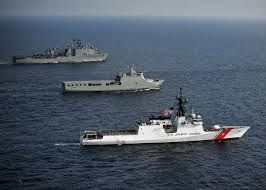
Just adding a Bertholf class to the FY2016 AC&I request would bump it to close to $1.7B, still short of the $2+B/year the CG needs. Will we see genuine long term movement to adequate funding for the Coast Guard?
 Russia’s ’50 let Pobedy’ is currently the world’s largest icebreaker, displacing over 25,000 tons. Photo: Creative Commons
gCaptain reports the Russians are building three huge 33,540 ton 173.3 meter (569 foot) nuclear powered icebreakers that are expected to be delivered by 2020, with the first to be completed in 2017.
These ships will be almost two and a half times as large as the Polar Class.

We got word today of an interesting development in the Senate from frequent contributor Tups.
“Today, U.S. Senators Maria Cantwell (D-WA) and Lisa Murkowski (R- AK) introduced the Icebreaker Recapitalization Act. The bill would authorize the U.S. Navy to construct up to 6 heavy icebreakers. The new icebreakers would be designed and operated by the Coast Guard. The Coast Guard is the sole service responsible for icebreaking missions.”
Here is the announcement of the bill.
The actual bill is here (pdf).
I note few things about how this bill and how it was written.
If we needed proof that icebreakers can be long lived vessels, there is news from MarineLink that Sweden is modernizing two forty year old icebreakers.

Launch of USCGC Mackinaw (WLBB-30) on April 2, 2005. Photo by Peter J. Markham.
gCaptain is reporting that the severe conditions in the Great Lakes over the last two winters and the resulting loss of iron production, have prompted support for another Great Lakes icebreaker at least as large as Mackinaw.
“This is the second year in a row a brutal winter has slowed early season shipments of iron ore and other cargos on the Lakes. In April 2014, shipments of iron ore totaled just 2.7 million tons, a staggering 53.3 percent below the month’s long-term average.
“As a result, Rep. Candice Miller (R-MI) included a provision in the Coast Guard Authorization Act of 2015 (H.R. 1987) approved by the House Transportation and Infrastructure Committee that directs the U.S. Coast Guard to design and build a new, multi-mission icebreaker to enhance its capabilities on the Great Lakes.”
This could be an opportunity not only to build another icebreaker for the Great Lakes but also to design the three Medium Icebreakers the High Latitude Study has shown the Coast Guard needs.
A ship along the lines of Russia’s new oblique icebreaker would be particularly useful in the Great Lakes in that it would open a channel wider than the beam of the icebreaker itself.
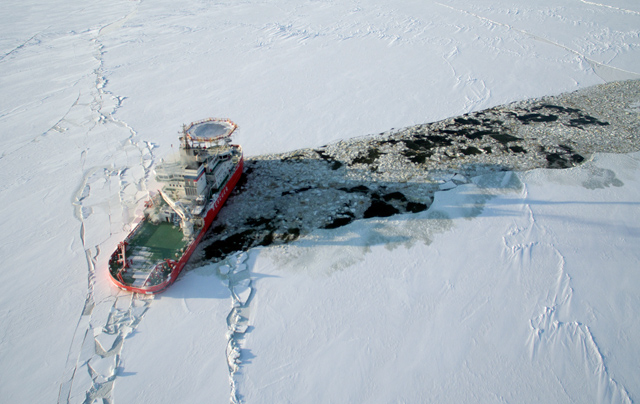
The US Naval Institute has published another report by Congress’s Naval Adviser in residence, Ronald O’Rourke, This one addresses the problems of modernizing the Icebreaker fleet. This is an excellent review of the current situation and the alternatives.
Photo: Acker Arctic, Russian Icebreaker Baltika
gCaptain reports successful completion of trials of Russia new concept icebreaker Baltika. The unique design allows the relatively small icebreaker, similar in size and power to USCGC Mackinaw, to open a channel wider than its own beam. The ship has a beam of 20.5 meters but has demonstrated the ability to open a 50 meter wide channel.
According to Project Manager Mika Hovilainen who was on board the vessel during the ice trials, “Baltika’s voyage to the Gulf of Ob proves the exceptional operational capability of the oblique icebreaker concept in very difficult ice conditions. The vessel could operate in ice conditions that exceeded the design criteria used as the basis of the vessel concept. Baltika could carry out the same operations as conventional icebreakers with just half of the propulsion power as well as perform maneuvers which are not possible for any other vessel currently in service.”
I’ve read reports of Congressional hearings lately that, combined with the continual erosion of Coast Guard AC&I funding have crystalized my view that the Coast Guard’s funding methods need some tweeking.
SOUTHCOM
First there is this story of SOUTHCOM (Marine Gen. John Kelly)’s testimony before the Senate Armed Services Committee in which he pleads for additional Coast Guard cutters to allow him to act on intelligence his organization already has.
“We got 158 metric tons of cocaine last year, without violence, before it ever even made it to Central America,” he said. “I do that with very, very few ships. I know that if sequestration’s happened, I would be down to maybe one, maybe two, Coast Guard cutters. That means, of the 158 tons that I would expect to get this year, I’d probably, if I’m lucky, get 20 tons. All the rest would just come into the United States along this incredible efficient network.”
He later explained, “Once it gets ashore in Central America and moves up through Mexico, we’re taking almost nothing off the market.”
General Kelly has taken to using unusually strong language including the words “defeat” and “existential theat.”
He also suggests that returning ISIS fighters might use the drug and people smuggling routes to enter the US from Latin America
NORTHCOM
Then there is this post from DefenseNews, reporting fireworks, as the Senate Armed Services Committee grilled Adm. William Gortney (NORTHCOM), Thomas Dee (Deputy Assistant Secretary of the Navy for Expeditionary Programs and Logistics) and Vice Adm. Charles Michel (Coast Guard’s Deputy Commandant for Operations) about the Armed Services’ ability to operate in the Arctic and particularly about procurement of another icebreaker.
NORTHCOM has new concerns about the Arctic. Not only have the Russians been building up military forces in the Arctic, they also have new weapons that might make a conventional cruise missile strike against the US feasible.
If we need to rebuild the DEW line to meet a new threat, we are going to need more icebreakers.
The Problem
The irony, of course, is that the Senate Armed Services Committee, as powerful as it may be, has essentially no direct influence on the Coast Guard’s budget, but perhaps it should.
The Coast Guard is after all an Armed Service of the United States at all times.
The Coast Guard has gotten some funding occasionally through the Navy, but not surprisingly this is an anomaly. Organizational dynamics being what they are, the Navy will always think money spent on the Coast Guard as a diversion and will want to either end it as quickly as possible, do the task with Navy assets, or have it funded from the Coast Guard budget. So getting anything like regular funding through the Navy is unlikely.
The DOD budget is not constructed the way you might think. All the money does not go to the services. A substantial part of the budget goes to the Department itself and a number of agencies of the Department outside control of the individual services. In the 2015 DOD budget request this amounted to 18.1 percent ($89.8 billion) – to fund the Defense-Wide account, which includes the Defense Health Program, intelligence agencies, Missile Defense Agency, Defense Advanced Research Projects Agency, and the many smaller DoD agencies. This is actually the fastest growing part of the DoD budget.
Perhaps there is a way DOD can transfer money to supplement the Coast Guard budget to answer the needs of Combatant Commanders (COCOMs) just as it funds independent agenies.
FierceHomelandSecurity is reporting on testimony of VAdm. Charles Michel before the House Transportation subcommittee on Coast Guard and maritime transportation. As we have seen so many times recently, the Deputy commandant for Operations is pointing out that we simply do not have enough cutters to act upon all the intelligence we have for counter-drug operations. (If you look at the actual testimony, he also covers much more.)
It seems the Commandant and his staff have been repeating the same story at every opportunity.
I think they are doing the right thing. The Commandant makes a convincing case for why the country should want to do this. The other theme that accompanies it is the need for three heavy and three medium icebreakers, and the fact that the Coast Guard cannot afford to build them without a substantial budget increase.
It seems the Commandant and staff are doing their best to make a case for more money for shipbuilding. They are using the DHS Fleet Mix Study to point to the need for even more cutters than provided in the program of record and the “High Latitude Region Mission Analysis” to justify the Icebreakers.
I could point to additional shortfalls including the dearth of assets in the Western Pacific, but it looks like the Commandant has chosen his battle, and he is fighting it with determination.
The question now is, is anyone really interested in the Polar regions and our neighbors in Latin America and the problems created by the criminals that run the drug trade there.
 Chuck Hill's CG Blog