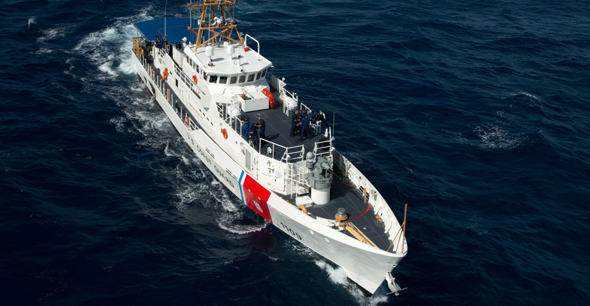
NORTHCOM on the Arctic–Reason Enough to Buy Icebreakers

EagleSpeak has a report on a conversation with NORTHCOM and NORAD Commander, Admiral Bill Gortney, and it seems to suggest that the US military may need a serious icebreaker capability in about ten years.

Q: Sir in the past couple of months, U.S. officials expressed desire for some sort of new multipurpose sensor in the Canadian Arctic, not just for the ICBMs for maritime vessels, airplanes, that kind of thing. Haven’t really gotten much details on that. Can you give us kind of what you’re looking for there? And what timeline …

ADM. GORTNEY: Yeah, well the — the — the DEW (Distant Early Warning) line — the air defense radars that we maintain on northern Canada and then the Canada-U.S. border are, you know, in a few years — I’d say 10 years I think is the number — you know, they’re going to reach a point of obsolescence and we’re going to have to reinvest for that capability.

The question is what sort of technology do we want to use to reconstitute that capability? We don’t want to put in the same sorts of sensors because they’re not effective against the low-altitude, say, cruise missiles. They can’t see over the horizon.

So now the question is, what’s the technology that’s going to work up there? Is it an over-the-horizon radar system that would work, but it has challenges in the Arctic?

So that’s — those are the questions we’re asking the community about.

When the DEW line was being built several icebreakers would go north every Summer escorting ships carrying building supplies and equipment.

Apparently the DOD is studying the problem and should have a report out soon.

Q: The loss of sea ice in the Arctic, what — what security issues does that raise as we see that whole area changing up there?

ADM. GORTNEY: Well, that’s part of what we’re going to be reporting out, the necessary threats.

You know, the reality is, is that it is. The sea ice is melting. The Arctic shelf is getting smaller.

That said, it is still a very inhospitable place, you know. And today, if we wanted to go up there, you know, we don’t have the ability to reliably navigate, communicate and sustain ourselves up there.

And so that’s huge investments for the services to figure out how to do that, and when do we need to lay those investments in to be able to communicate, navigate and sustain?

And — and before we can communicate and navigate, we have to — we have to do the sustainment. We have to supply ourselves. You know, it’s three times as expensive and takes three times as long to put anything up there in the Arctic. I mean, it is a very, very harsh place.

We are seeing more intermodal traffic from ships that are going in there, but we’re not seeing — we’ve worked with the shipping industry and talked with the shipping — the major shipping companies, and they’re not really interested. You know, they need ships that can make them money 350 days out of the year. They can’t rely on a particular period of time; they need to move large numbers of containers and a large number of crude or liquid natural gas that happens to be out there.

But the reality is, there’s going to be more activity up there, and it’s actually more dangerous today than when we had a stable shelf.

So that’s what we’re — I’m looking forward to reporting that out here in the spring.

Observations on the New Naval Strategy

HMAS Success (AOR-304) refuelling probe goes in for a hook-up with the US Coast Guard Cutter USCGC Waesche (WMSL-751) as the Royal Australian Navy Auxilliary Oiler Replenishment Ship conducts a dual RAS (Replenishment at Sea) off the coast of Hawaii during the Sea Phase of Exercise RIMPAC 2014, 19 July 2014. (RAN Photo by Leading Seaman Brenton Freind RAN)

HMAS Success (AOR-304) refuelling probe goes in for a hook-up with the US Coast Guard Cutter USCGC Waesche (WMSL-751) as the Royal Australian Navy Auxilliary Oiler Replenishment Ship conducts a dual RAS (Replenishment at Sea) off the coast of Hawaii during the Sea Phase of Exercise RIMPAC 2014, 19 July 2014. (RAN Photo by Leading Seaman Brenton Freind RAN)

I know many of you do not have the time or inclination to read the strategy, although it is not particularly long for such a document, so in addition to commenting on the contents, I will provide a Coast Guard “Readers Digest” version outlining the elements that are specific to the Coast Guard.

AN OVERVIEW:

In considering this strategy, it would be good to keep in mind this is not a strategy for war; it is a strategy for maintaining the peace, the sometimes violent peace that has become the new norm. As such, it assumes the Coast Guard will continue exercising its normal peacetime priorities. It does not define Coast Guard wartime roles or suggest how the Coast Guard might be shaped to be more useful in wartime.

If you look at the title, “A Cooperative Strategy for 21st Century Seapower: Forward, Engaged, Ready,” the words cooperative, forward, and engaged are particularly relevant in describing the thrust of the strategy.

It expects US naval forces to cooperate and engage with allied and friendly force both to improve relations and strengthen and encourage these friendly forces. The Coast Guard has a major role in this, in bringing expertise in a board range of governance functions that friendly navies and coast guards can relate to.

The Navy also expects to have a substantial part of its force “forward.” Not only forward but also geographically widely distributed. This violation of the Mahanian maxim to keep your battle force concentrated has been the norm for decades, but it has been a reflection of the preponderance of the US Navy that may be eroding. It is a calculated risk that the benefits of working with allies and being on scene to deal with brush fires, outweighs the potential risk of having an isolated Carrier Strike Group or Amphibious Ready Group overwhelmed by a concentration of hostile forces.

The strategy talks about surge forces, but frankly the potential is far more limited than it was when the Navy was larger. For the Coast Guard this “forward” strategy, combined with the apparently ever increasing concentration of US Navy forces in only a few homeports, has important implications. There are long stretches of the US coast that may be hundreds of miles from the nearest US Navy surface combatant.

If a suspicious vessel is approaching the US, that must be boarded to determine its nature and intent, the boarding is likely to be done by a Coast Guard cutter, and not by a National Security Cutter, but by something much smaller. The cutter is also unlikely to have any heavily armed backup.

ORGANIZATION:

Section I THE GLOBAL SECURITY ENVIRONMENT, talks about geopolitical changes since the strategy was last issued, and current military challenges.

Section II FORWARD PRESENCE AND PARTNERSHIP, looks at the specific areas of operation, specifically the Indo-Asia-Pacific, Middle East, Europe, Africa, Western Hemisphere, and the Arctic and Antarctic.

Section III SEAPOWER IN SUPPORT OF NATIONAL SECURITY, talks about the strategy in terms of missions, broken down as “All Domain Access,” Deterrence, Sea Control, Power Projection, and Maritime Security.

Section IV FORCE DESIGN: BUILDING THE FUTURE FORCE, attempts to describe the future force that it contends will be “Flexible, Agile, and Ready.” It goes on to talk about Forces, People, Concepts, and Capabilities.

GEOGRAPHIC PERSPECTIVE: The plan starts getting into specifics regarding the Coast Guard when it talks about specific regions.

Indo-Asia-Pacific Region

“The Coast Guard will rotationally deploy National Security Cutters and deployable specialized forces with the Navy and Marine Corps to safeguard U.S. territorial waters and the Exclusive Economic Zone (EEZ). Additionally, the Coast Guard will work with regional partners and navies using joint and combined patrols, ship-rider exchanges, and multinational exercises to build proficient maritime governance forces, enhance cooperation in maritime safety and security, and reduce illegal, unreported, and unregulated fishing. These multinational efforts are furthered through the Oceania Maritime Security Initiative and participation in the North Pacific Coast Guard Forum.”

Now I’m not sure what the first sentence is getting at. Usually when DETs deploy with the Navy, it is not for operations in the US EEZ, unless perhaps they are talking about the occasional deployment with ships transiting the US EEZ around islands in the Western Pacific, if so they might have been more specific. I don’t know why the strategy in several places refers to the National Security Cutter rather than simply cutters. I think this might have been an attempt to sell the NSC, which is a job now complete, but it frankly does nothing to justify the Offshore Patrol Cutter which can also do this type of work.

This is the first of several mentions of the Coast Guard’s potential for capacity building with navies and coast guards of friendly nations.

Middle East

The Coast Guard will deploy personnel to build partner nation capacity for maritime governance and simultaneously conduct maritime security, infrastructure protection, and Port State Control activities. Coast Guard patrol boats and deployable specialized forces on Navy and coalition ships will counter illicit maritime activity.

It does appear that the Coast Guard patrol boats in Bahrain are expected to remain there. Does this mean these now overage boats will be replaced in the future? Will they or their replacements receive weapons upgrades similar to those of the Navy Cyclone class counterparts?

Europe–No mention of the Coast Guard. Even so the CG will probably be involved in capacity building in Eastern Europe, as it has been in the past.

Africa–the Coast Guard is again mentioned in terms of capacity development and partnership station type activities. There is also interestingly a statement that a base will be developed in Africa.

Coast Guard District and Area Organization

Coast Guard District and Area Organization

Western Hemisphere

We will strengthen partnerships and capacity in the Western Hemisphere to protect the homeland and to counter illicit trafficking and transnational criminal organizations. Coast Guard recapitalization efforts will produce a fleet of highly capable, multi-mission ships and aircraft, including the Offshore Patrol Cutter and the C-27J Spartan maritime patrol aircraft to counter threats, particularly in the Caribbean Sea, Gulf of Mexico, and eastern Pacific Ocean. The Navy will maintain its base at Guantanamo Bay, Cuba, to support joint and combined military operations and to enhance interagency efforts to develop regional security and cooperation. The Marine Corps will employ task forces or SPMAGTFs to support security cooperation activities that increase interoperability with regional partners and strengthen their capacity to interdict transnational criminal organizations. We will employ amphibious ships and other platforms, including Littoral Combat Ships, Joint High Speed Vessels, Afloat Forward Staging Bases, hospital ships, other Military Sealift Command ships, and Coast Guard platforms, to conduct humanitarian assistance and disaster response missions. We will also employ maritime patrol aircraft such as the P-8A Poseidon and unmanned aerial vehicles. Other ships and aircraft will provide periodic presence for recurring military-to-military engagements, theater security cooperation exercises, and other missions.

That is the entire section. Surprisingly no specific mention of using Navy ships for drug interdiction. Use of Navy vessels is mentioned only in the context of “humanitarian assistance and disaster response missions” and “military-to-military engagements, theater security cooperation exercises, and other missions.”

512px-Antarctica_CIA_svg
Competing claims in the Antarctic

Arctic and Antarctic:

Consistent with the predicted growth in maritime activity, the Sea Services will assess Arctic access and presence needs, improve maritime domain awareness, and pursue cooperation with Arctic partners to enhance the maritime safety and security of the region. This will require us to further develop our ability to operate in the Arctic, including in ice-covered and ice-obstructed waters. The Coast Guard will apply the multi-mission capabilities of the National Security Cutter to provide a tailored seasonal presence for command and control and aerial surveillance, and will begin the design process for a new, heavy icebreaking capability to support operations in both the Arctic and Antarctic. The Coast Guard will also pursue the formation of a maritime assistance, coordination, and operations group, open to members of the eight Arctic Council nations. The purpose of this group will be coordination of multinational search and rescue operations, training exercises, maritime traffic management, disaster response, and information sharing.

Again this is the entire section. DOD Maritime Domain Awareness is going to be very important here, and apparently it is already good. Looks like the Navy is content for the Coast Guard to be the face of US Naval presence in the Arctic. Again there is reference to the NSC which is not ice-strengthened and no mention of the OPC which is.

MISSION PERSPECTIVE: The Strategy refers to five essential functions–all domain access, deterrence, sea control, power projection, and maritime security.

All domain access: Not surprisingly there is no mention of a Coast Guard role in kicking in the door.

Deterrence: “The Coast Guard maintains a continuous presence in our ports, internal waterways, along our coasts, and offshore, providing an additional layer of defense against maritime threats.”

USCGC_Owasco_(WHEC-39)_conducting_UNREP_Market_Time
Cutter Owasco (WHEC-39) unreps while engaged in Operation Market Time off the coast of Vietnam.

Sea Control: There is no mention of a Coast Guard role in Sea Control. There should be. Sea Control frequently involves Visit, Boarding, Search and potentially Seizure of non-military vessels, e.g. merchant and fishing vessels. The Coast Guard is ideally suited for this role and has conducted this type of operation in war zones in the past, notably the Markettime Operation during the Vietnam War. In fact the common Coast Guard missions of drug and alien migrant interdiction are forms of sea control that potentially protect the US from non-state actors, but these missions are reflected in the Maritime Security mission.

When it comes to counting assets that might be used to exercise sea control, the Navy has roughly 110 cruisers, destroyers, frigates, LCS, and patrol craft and many of these, particularly the 85+ cruisers and destroyers, probably will have higher priority missions. The Coast Guard includes over 100 patrol boats and about 40 larger patrol vessels that routinely exercise sea control on an almost daily basis.

Force Projection: No mention of a Coast Guard role in Force Projection.

121203-G-XX000-001_CPO Terrell Horne

Maritime Security: It is here that the Coast Guard truly comes into its own.

We conduct maritime security operations by locating and monitoring vessels suspected of carrying illicit cargo or persons. If required, we intercept and board these vessels in support of U.S. law or international sanctions. Operating with the Coast Guard’s unique legal authorities, naval forces combat the illegal drug trade, human trafficking, and the unlawful exploitation of natural resources, particularly in the Western Hemisphere. Maritime security operations further support the broad maritime governance activities of the United States. These include assuring access to ice-covered and ice-obstructed waters in the Arctic and Antarctic.

Because all nations share in the collective benefits of maritime security, it is a promising area for expanded cooperation with our allies and partners. Through multinational exercises and training, we will conduct maritime security force assistance to combat transnational organized crime and protect fisheries and maritime commerce. This function supports the naval missions of defending the homeland, protecting maritime commons, and strengthening partnerships.

WPC Kathleen_Moore

FORCE DESIGN, BUILDING THE FUTURE FORCE

There is not a lot here specific to the Coast Guard. There is discussion about acquisition and personnel policies, but they appear to reflect Navy Department aspirations.

There is potential in the concept of modularity for allowing Coast Guard assets, particularly cutters, to more rapidly transition to a wartime outfit.

This section includes a listing of projected required capabilities tied to each of the missions discussed above. It is in the Maritime Security section that we find statements relevant to the Coast Guard and its missions:

To combat terrorism, illicit trafficking, piracy, and threats to freedom of navigation in the maritime domain, we will:
■ Increase our capabilities in integrated maritime detection, monitoring, and intelligence, along with those of our allies and partners, to improve global maritime domain awareness. This involves exploring more stringent Automated Identification System reporting requirements for vessels weighing less than the currently mandated 300 tons, as well as fielding innovative technologies that enhance effectiveness against the small vessel threat.
■ Strengthen the International Port Security Program to further ensure the integrity and legitimacy of commercial vessels and cargo traveling to our shores.
■ Enhance our interoperability and capability to perform visit, board, search, and seizure in contested environments.
■ Improve interoperability between Navy and Coast Guard vessels, aircraft, and shore facilities, in accordance with the National Fleet Policy to maximize sea control and maritime security capabilities.
■ Support our allies and partners through training, exercises, and the provision of capabilities, via foreign military sales and financing, to increase their capacity to address maritime security challenges.

IMG_4135

EVALUATION:

This is not a war plan so much as a plan for preventing war. From a Coast Guard perspective, it has largely canonized the status quo and the existing recapitalization program of record. It recognizes the Coast Guard’s unique authorities and its ability to contribute to capacity building. It seems to promise greater integration of a multiservice Maritime Domain Awareness.

On the other hand it does nothing to define Coast Guard wartime missions or how it might transition to a wartime footing. The force structure section does nothing to inform the design of Coast Guard equipment so that it might be more useful in wartime. It also does nothing to help that Coast Guard patrol boat I talked about at the beginning that is about to attempt to stop and board a potential hostile vessel that may be about to make an unconventional attack on a US port.

This is only the second iteration of the three service cooperative strategy. It is a marked improvement in specificity over the previous document. Hopefully there will be a process of continual improvement in succeeding editions.

CSIS introduction of “A Cooperative Strategy for 21st Century Seapower: Forward, Engaged, Ready” (CS21R)–a First Hand Report

One of our readers, David Van Dyk, a student at Liberty University, was able to attend the CSIS introduction event for the updated Strategy, and has provided a report of his impressions.

With standing room only and camera crews capturing their footage, Chief of Naval Operations Admiral Jonathan Greenert, Commandant of the Marine Corps General Joseph Dunford and Commandant of the Coast Guard Admiral Paul Zukunft took the stage during the Center for Strategic and International Studies (CSIS) event entitled “A Cooperative Strategy for 21st Century Seapower.”

John Hamre, CEO of CSIS since January 2000, introduced the military leadership on stage, remarking that the Navy and Marine Corps have “loved each other like brothers; Cain and Abel.”

While rivalries between the Sea Services were realized years back, a new cooperative strategy looking forward is not only smart but paramount to our nation’s defense and ability to project power on the high seas and around the coastline.

The meeting’s purpose was to establish and introduce a document signed by all three Sea Service chiefs. “A Cooperative Strategy for 21st Century Seapower: Forward, Engaged, Ready” (CS21R) was penned because of the changing environment, changing threats and changing resources. While all three changes are major actors on the national stage of security and safety, it requires a unity of effort from not only the United States Sea Services, but of those around the world, working in unison to tackle problems ranging from military aggression to disaster relief.

Changing Environment

In a rapidly changing world, the sea services need to align their focus and adapt to the environment. This requires major changes, one of which is the Arctic. According to CS21R, the Arctic is becoming a major player in maritime trade.

“Rising ocean temperatures present new challenges and opportunities, most notably in the Arctic and Antarctic, where receding ice leads to greater maritime activity,” CS21R states. “In the coming decades, the Arctic Ocean will be increasingly accessible and more broadly used by those seeking access to the region’s abundant resources and trade routes.”

With research vessels and ice breakers blazing their own trails through the region, responsible practices must not only be encouraged but enforced. The Arctic Council, made up of eight partner nations, will be chaired by the United States from 2015 to 2017, allowing American leaders to map out a strategic and engaged plan for the changing northern environment. The Coast Guard, according to the document, will also be entering a design phase for a new icebreaker capable of handling the harsh conditions of the Arctic Ocean.

“Some of our biggest concerns in the Arctic (are that) someone’s going to fall in it or oil spills in it and it affects the way of life in the Arctic domain,” Admiral Zukunft said. “We have an Arctic Strategy in place that aligns with a national strategy for the Arctic region.”

Witnessing firsthand the increasing activity in the Polar Regions, the Coast Guard Cutter Polar Star rescued 26 crewmembers aboard an Australian fishing vessel, Antarctic Chieftain, that was trapped in freezing temperatures Feb. 18. Since the Polar Star had just finished “Operation Deep Freeze” to replenish McMurdo Station, according to a Reuters report, they were able to sail 800 miles and cut through 150 miles of ice to reach the vessel and save all lives aboard by towing it to open waters.

Another changing environment mentioned in the document is the increasing amount of trade occurring on the oceans, meaning more traffic for important commercial waterways.

“Skyrocketing demand for energy and resources, as evidenced by a projected 56 percent increase of global energy consumption by 2040, underscores the criticality of the free flow of commerce through strategic maritime crossroads, including the Straits of Hormuz and Malacca, as well as the Panama and Suez Canals,” the document reads. “Closer to home, dramatic changes in energy production and transportation, as well as the completion of the Panama Canal expansion project, will fundamentally alter shipping patterns within the United States and globally.”

The Panama Canal expansion project is nearing a conclusion with 85 percent completed, and it is expected to be fully operational early next year, according to the Christian Science Monitor. With post Panamax vessels taking on 14,000 containers, the new enlargement will bring seaborne giants of commerce to East Coast ports, bringing additional security challenges to Navy and Coast Guard assets.

While CS21R does not mention it, Nicaraguan lawmakers have been dealing with a Chinese billionaire named Wang Jing, Chairman and CEO of the Hong Kong Nicaragua Development (HKND) group, in building their own canal to handle, they claim, even larger ships. While details of the plan remain under intense scrutiny, the competition building in this changing region will only grow larger as maritime trade increases.

“Oceans are the lifeblood of the interconnected global community, where seaborne trade is expected to double over the next 15 years,” CS21R states. “Ninety percent of trade by volume travels across the oceans.”

Changing Threats

While operating in a changing environment, the Sea Services recognize the changing threats taking place in and around these areas. These threats, whether from state or non-state actors, will need to be dealt with both effectively and efficiently.

According to Zukunft, transnational organized crime is worth $750 billion annually. These networks utilize their illicit activities to help fund terrorist activities as well as their own nefarious enterprises.

“Transnational criminal organizations (TCOs) remain a threat to stability in Africa and the Western Hemisphere, especially in Central America and the southern approaches of the U.S. homeland,” CS21R states. “Their networks facilitate human trafficking and interrelated flows of weapons, narcotics and money, all of which could be exploited by terrorists to attack our homeland, allies and overseas interests.”

Transnational criminal organizations are operating not only along the coastlines and drug transit zones of the western hemisphere but also throughout Africa, where terrorist and piracy networks often share intelligence and money to fund illicit activities along the western African coast.

“Construction Battalions (Seabees), Explosive Ordnance Disposal units, Navy SEALs and other Naval Special Operations Forces, as well as Coast Guardsmen and Marines, will continue working alongside partner security forces to combat terrorism, illicit trafficking, and illegal exploitation of natural resources through initiatives such as the African Maritime Law Enforcement Partnership and the Africa Partnership Station,” CS21R states. “West African nations rely heavily on maritime forces to combat illicit trafficking, which have links to terrorist enterprises.”

Another theatre of operations where there is a changing threat is the Indo-Asia-Pacific region, where China’s actions are being hotly contested by Indo-Asian allies, including Japan, Vietnam, the Philippines and Singapore.

“Consistent with developing strong partnerships and relationships, Filipinos have been strong partners for many years,” General Dunford said. “We had a little bit of a dip in the relationship, but that’s a compelling reason for us to cooperate more closely than we have over the past few years.”

According to Reuters, China’s actions have led Japan to recently sign a security agreement with Vietnam and the Philippines, forming an alliance that will counter China’s growing presence throughout the South and East China Sea. This agreement includes the first ever joint naval exercises between Japan and the Philippines, as well as intelligence sharing between the geopolitical adversaries of China.

“With strategic attention shifting to the Indo-Asia-Pacific, we will increase the number of ships, aircraft and Marine Corps forces postured there,” CS21R states. “By 2020, approximately 60 percent of Navy ships and aircraft will be based in the (Indo-Asian-Pacific) region. The Navy will maintain a Carrier Strike Group, Carrier Airwing and Amphibious Ready Group in Japan, add an attack submarine to those already in Guam and implement cost-effective approaches such as increasing to four the number of Littoral Combat Ships (LCS) forward-stationed in Singapore.”

The Coast Guard’s strong ties with several other coast guards in the volatile region will aid in diplomatic discussions and information sharing.

“…The Coast Guard will work with regional partners and navies using joint and combined patrols, ship-rider exchanges and multinational exercises to build proficient maritime governance forces, enhance cooperation in maritime safety and security and reduce illegal, unreported and unregulated fishing,” CS21R states. “These multinational efforts are furthered through the Oceania Maritime Security Initiative and participation in the North Pacific Coast Guard Forum.”

Changing Resources

With budgets under scrutiny and the almighty dollar being hard-pressed, the Sea Services need to fight battles effectively and efficiently by realizing the changing resources available for widespread use.

“In this time of fiscal austerity, our force is sized to support defeating one regional adversary in a large, multi-phased campaign, while denying the objectives of, or imposing unacceptable costs on, another aggressor in a different region,” CS21R states. “This force-sizing construct also ensures our capability and capacity to support global presence requirements.”

In a question and answer period during the CSIS event, Megan Eckstein, a staff writer with USNI News, asked the three admirals how they would handle their services concerning the possible constraints of the FY16 budget, which received acknowledged chuckles from the largely Capitol Hill audience.

“We have to replace the current Ohio-class submarine,” Admiral Greenert said. “We don’t have the money associated to do that without ruining the shipbuilding account which permeates all that this strategy is about for the future. That is my number one conundrum right now.”

Dunford offered a different view into the budget issue, speaking of his recent meeting with Marine Corps leaders reviewing the service’s capabilities in unifying combatant commanders.

“This is really not just FY16 … this is about capability development over the next three to five, frankly seven to eight years,” Dunford said. “It’s not so much about buying more radios. It’s about us coming together and identifying the capability that we need to have and making sure that’s properly resourced.”

According to Zukunft, the Coast Guard needs to not only provide a defensive measure along the coast and in the ports, but also be able to stop dangerous and illegal shipments from even entering the Exclusive Economic Zone (EEZ).

“If you have a shipment destined for the United States, you want a goal line defense inside the sea buoy, or do you want the ability to exert US sovereignty into the territorial seas of where that ship departed?” Zukunft said. “I’d much rather have the latter, but we’re not going to have that as a nation if we don’t make this investment to build affordable ships, but…also the ability to exert our sovereignty well beyond the sea buoy.”

In the revised document, the Sea Services realized the challenges a tighter budget would have on their day to day operations and the need to cooperate on a deeper and more streamlined level.

“A smaller force, driven by additional budget cuts or sequestration, would require us to make hard choices,” CS21R states. “Specifically, in the event of a return to sequestration levels of funding, the Navy’s ability to maintain appropriate forward presence would be placed at risk.”

Changing environments, threats and resources will force the Sea Services to adapt and recognize the fluctuations across world geopolitics. Unifying efforts with allies and partners will enhance Americas own Sea Services, offering opportunities for deeper associations with countries from Latin America to the South China Sea. Whatever the environment and threat may be, America’s Navy, Marines and Coast Guard will remain ready, willing and able to handle the coming century.

Two More New Medium Icebreaker–Not for the Coast Guard

EdisonChouestOffshoreAHTSicebreaker

Drawing by North American Shipbuilding, click for larger

gCaptain reports that Edison-Chouest is building another icebreaker (Anchor Handling Tug Supply (AHTS) ship), with an option for a second. Another gCaptain post appears to indicate that they are in fact building two.

These vessels appear to be similar to the earlier M/V Aiviq.

If I read the report correctly, each ship will have Four 5060 KW generators. If so these ships will each have more horsepower (20,240 KW/27,131 SHP) than the diesel electric engines of the Polar class (18,000 HP), more than the Glacier (16,000 KW/21,000 SHP), and almost as much as the Healy (22,400 KW/30,027 SHP). They will be more than twice as powerful as the Wind class breakers (12,000 SHP), the National Science Foundation’s leased M/V Nathaniel B. Palmer (9,485 kW/12,720 HP), or USCGC Mackinaw (6,800 KW/9,119 SHP). They will also be more powerful than all but one of Canada’s icebreakers

They will be Polar Class 3. Polar class 3 means “Year-round operation in second-year ice which may include multiyear ice inclusions.” It appears we might be seeing the emergence of a whole class of privately owned American medium icebeakers.

Researching this, I found reference to two similar, if perhaps less capable, Class 4 icebreakers, both built in 1983 in Canada, as commercial AHTS vessels, one, CCGS Terry Fox, is now used by the Canadian Coast Guard, and her sister ship, Vladimir Ignatyuk, is now owned by Russia’s Murmansk Shipping Company and was chartered by the National Science Foundation to lead the break-in to McMurdo sound two seasons, during the Antarctic summers of 2011/12 and 2012/13.

The Russian icebreaker Vladimir Ignatyuk breaking a path in the annual sea ice to McMurdo Station, Antarctica on January 26, 2012. Credit: Steve Royce

The Russian icebreaker Vladimir Ignatyuk breaking a path in the annual sea ice to McMurdo Station, Antarctica on January 26, 2012.
Credit: Steve Royce

So far I have seen no indication of official Coast Guard interest in filling the stated requirement for three medium icebreakers. These ships do not have the redundancy we would like in a our ships. But that could be fixed. Plus lower cost might allow a different kind of redundancy, assigning two ships to the task rather than only one, allowing an organic Coast Guard self rescue capability that the Commandant has pointed out is missing with our current very limited icebreaker fleet. If the cost of these is similar to that of the M/V Aiviq ($200M, 16,240 KW/21,760 HP), even after upgrades to meet Coast Guard requirements, e.g. flight deck, hangar, communications, etc., and additional overhead that are included in Coast Guard procurement cost, we should be able to build a medium Icebreaker of similar capability for a third the $1B cost of a heavy icebreaker.

Is a medium icebreaker sufficient for our needs? We already have a documented requirement for three medium icebreakers in addition to three heavy icebreakers compared with the current fleet of one each. In a Defense News interview the Commandant pointed out, “First of all, it’s heavy ice breaking capability. Last year the Polar Star had to rescue a medium ice breaker from China. Just before they arrived, the wind shifted and they were able to get out on their own. Clearly, [that] is no place for a medium ice breaker. It does require heavy ice-breaking capability.” While I would never suggest that a Heavy icebreaker is not desirable, in fact the MV Xue Long (Snow Dragon) is more ice strengthened cargo ship than icebreaker with a large hull (21,025 tons) and relatively weak engines (13,200 KW/17,694 HP) and would be considered by the Coast Guard a light polar breaker (less than 20,000 HP). Historically the Operation Deepfreeze break-in has been done most frequently by ships we would now classify as medium or light icebreakers.

If you look at this chart, prepared by the Coast Guard, in 2013, of the 78 icebreakers of over 10,000 HP, operated by 17 countries, only eight of them were Heavy icebreakers (=>45,000 SHP). 34 were medium icebreakers of 20,000 to less than 45,000 HP, and 36  were smaller icebreakers of 10,000 to less than 20,000 HP. Interestingly, in addition to five heavy icebreakers, four medium, and two smaller icebreakers have managed to make it to the North Pole.

Even if funding can be found for a new heavy icebreaker, by the time it is built, we will again have only one heavy icebreaker (unless Polar Sea is reactivated), because the Polar Star will almost certainly be out of service by the time it enters service. We really need to consider alternatives to give us the numbers we need in the not too distant future. Apparently there is agreement we need at least two more medium icebreakers in addition to USCGC Healy. Getting them into the budget looks a lot more do able than a $1B heavy icebreaker, and far, far easier than two Heavies.