“America’s Coast Guard Faces Impossible Odds Without More Funding” –gCaptain

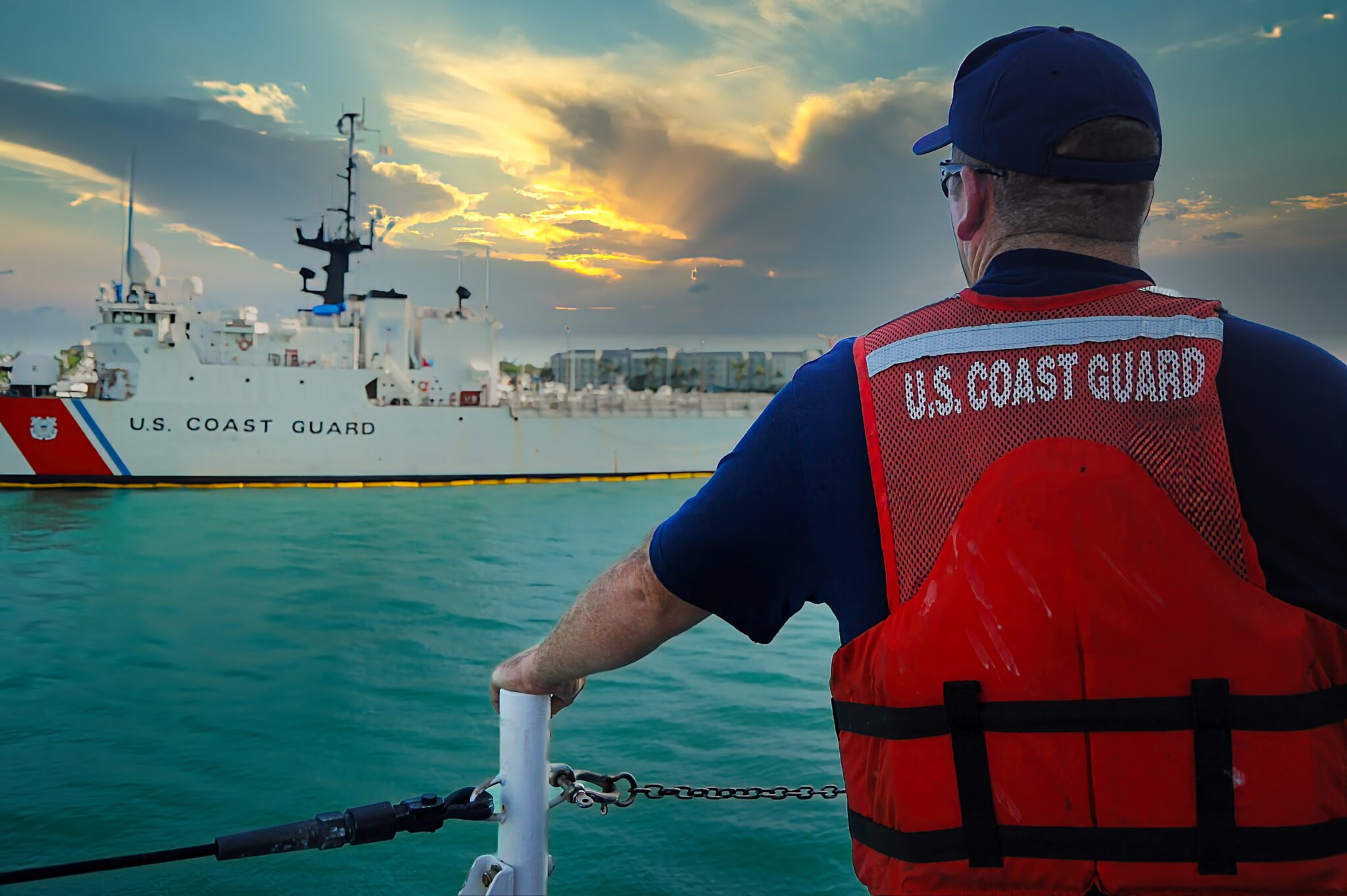
Coast Guard Chief Petty Officer Christian Seay, a chief boatswain’s mate on the Coast Guard Cutter Tampa, looks over to the Coast Guard Cutter Thetis, Key West, Florida. USCG photo by Lisa Ferdinando Sky digitally altered by AI

gCaptain’s John Konrad provides his reaction to the first ever U.S. Coast Guard, the 2024 Operational Posture (OP24). 

Perhaps because the Coast Guard has always been underfunded, he sees the Coast Guard’s current situation even more dire than I do (I will be publishing my own assessment soon), but he also adds an important additional view as a member of the Merchant Marine community.

It fails to address some other massive failures, such as the Coast Guard’s stringent training requirements for U.S. Merchant Mariners, the difficulty in advancing from seaman to officer ranks, and its substantial backlog of medical evaluations. These issues collectively contribute to a mariner crisis that has forced the U.S. Navy to sideline seventeen ships.

These issues should not be ignored.

“Replenishing Controversy: The US Navy’s New Tanker Program” –gCaptain

gCaptain has a post that looks at a Navy proposal to build ten smaller underway replenishment ships, but it goes on to provide an overview of US sealift capacity (see the video above, included in the gCaptain post), and it finds that it is pretty poor.

“…amateurs talk strategy, but professionals talk logistics.”

Why should the Coast Guard care?

Any merchant marine construction in the US is going to be subject to Coast Guard oversight.

The health of America’s shipbuilding industry is in the Coast Guard’s interest.

It would be nice to have enough underway replenishment ships to be able to keep one on station in the Eastern Pacific to support drug interdiction efforts. Might make operating groups of Webber Class WPCs in the drug interdiction role in the drug transit zone more practical. It might even be possible to fly supporting Coast Guard rotary wing or UAS assets from a T-AOL.  It would probably be good to have one in Oceania as well.

Because there are so few US owned merchant ships, and because the MSC and MARAD sealift ships are old, unreliable, and use outdated technology, it is difficult to find crews for them. Then there might also be a problem of getting the mariners we do have, to take what is likely to be a hazardous job.

The Navy has already told MARAD that in wartime they would be on their own. That they should not expect the Navy to protect them.

Take a look at what happened in WWII. The Coast Guard ended up crewing 351 US Navy and 288 Army ships and craft. Many of the Navy vessels and most of the Army vessels were logistics ships. If the Navy has trouble crewing logistics ships, they might well commission them and put Coast Guard crews on them.

The Coast Guard should support MSC and MARAD recapitalization. 

“Merchant Mariner Shortage Has Gotten Worse, but a Partial Solution Is Available” –Real Clear Defense

“Convoy WS-12: A Vought SB2U Vindicator scout bomber from USS Ranger (CV-4) flies anti-submarine patrol over the convoy, while it was en route to Cape Town, South Africa, 27 November 1941. The convoy appears to be making a formation turn from column to line abreast. Two-stack transports in the first row are USS West Point (AP-23) — left –; USS Mount Vernon (AP-22) and Coast Guard manned USS Wakefield (AP-21). Heavy cruisers, on the right side of the first row and middle of the second, are USS Vincennes (CA-44) and USS Quincy (CA-39). Single-stack transports in the second row are Coast Guard manned USS Leonard Wood (AP-25, later APA-12) and Coast Guard manned USS Joseph T. Dickman (AP-26 later APA-13).”

Real Clear Defense reports,

A mariner shortfall in 2018 was a grave concern. Today, with an escalating conflict in Europe and an increasingly bellicose China, the lack of seasoned merchant mariners is a clear and present danger to our national security.

Four years ago, the nation was about 1,800 mariners short to sustain sealift in a crisis beyond six months. Today that number is only increasing.

The proposed partial solution is to increae the size of the Merchant Marine Academy classes.

Coast Guard Academy graduates know the Merchant Marine Academy primarily as a football rival, but it is also a source of many Coast Guard Officers.

The central point of the post is that we don’t have enough mariners to support a war. The great distances of the Pacific exacerbate the problem. Logistics, as always, are key.

I would note that the shortages of mariners is not just in the officer ranks, so something more would have to be done.

This have anything to do with the Coast Guard? Well, a few months before the US entry into WWII, there was a test of our maritime logistics capabilities, and it found that the merchant marine crews of Army transport ships were unwilling to operate in the manner the military thought best, including darken ship. What happened? The ships were commissioned and crewed by the Coast Guard.

I am not suggesting that today’s merchant crews are unreliable, but if there are shortages, it is not impossible the nation will again turn to the Coast Guard to supply mariners for high priority logistics ships.

World Maritime Fleets–UN

The UN has issued an interesting short report on the status of the World’s merchant fleets. I am going to quote it below.

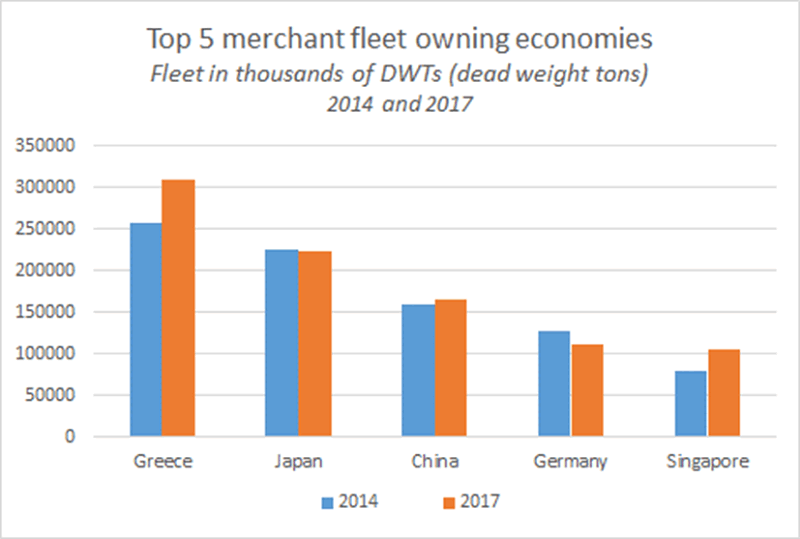
Top 5 ship owners are Greece, Japan, China, Germany and Singapore. Together they have a market share of 49.5% of dwt. Only one country from Latin America (Brazil) is among the top 35 ship owning countries, and none from Africa.

Top 5 flag registries are Panama, Liberia, Marshall Islands, China Hong Kong SAR and Singapore. Together they have a market share of 57.8%. Developing countries flag more than 76% of the world fleet in dwt. In terms of vessel types, bulk carriers account for 42.8% of dwt, followed by oil tankers (28.7%), Container ships (13.2%), other types (11.3%) and general cargo ships (4%).

Only three countries (Republic of Korea, China and Japan) constructed 91.8% of world tonnage (GT) in 2016. Republic of Korea had the largest share with 38.1%.

Four countries (India, Bangladesh, Pakistan and China) together accounted for 94.9% of ship scrapping in 2016 (GT).

The data confirms a continued trend of industry consolidation, where different countries specialize in different maritime sub-sectors, as analyzed in UNCTAD’s Review of Maritime Transport 2016 and a special chapter of the 2011 Review. It also confirms the growing participation of developing countries in many maritime sectors.

For more information, please contact Jan Hoffmann, Trade Logistics Branch, Division on Technology and Logistics, UNCTAD. Jan.Hoffmann@UNCTAD.org

Thanks to Bryant’s Maritime Consulting blog for bringing this to my attention.

An Appreciation of Merchant Fleets

Top ten nations in value of their shipping from www.vesselsvalue.com

Top ten nations in value of their shipping from http://www.vesselsvalue.com

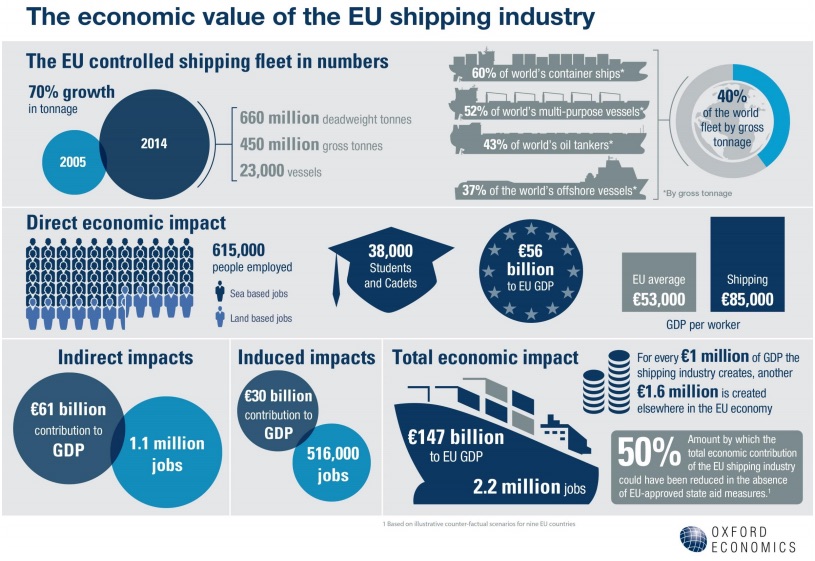
Marine Link brings us the graphic above. It does not come with explanation, but I presume this is “owned” rather than “flagged.” Otherwise I don’t think the US would be #4.

There are a couple of take-aways here:

  1. The overall tonnage has grown immensely, and
  2. The individual ships are far larger than they used to be.

For comparison the size of Japan’s not inconsiderable merchant marine in 1941, at the beginning of WWII was about 6 million tons. The fleets of Japan and China (#2 and #3 in value) are about 25 times larger.

During World War II the average merchant ship was roughly 5,000 tons. 10,000 tons was a big ship. The average Japanese ship is about 35,000 tons and the average Chinese ship is about 32,000. That is the new medium size. The US average is only a little over 23,000 tons. The new large size is larger than a USN nuclear powered carrier.

Something that does not show is that the crews are now much smaller.

Lets talk about the implications.

China’s Naval Militia–A Coast Guard Auxiliary and Much More

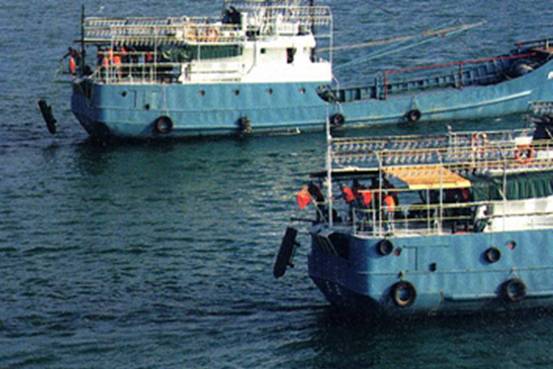
A photo published in a report on Chinese mine warfare by the U.S. Naval War College shows Chinese civilian fishing vessels practicing deploying sea mines at a naval base in Sanya in 2004. —Courtesy of U.S. government

A photo published in a report on Chinese mine warfare by the U.S. Naval War College shows Chinese civilian fishing vessels practicing deploying sea mines at a naval base in Sanya in 2004. —Courtesy of U.S. government

The Wall Street Journal has an interesting story about China’s Naval Militia. It employs not only the crews of their fishing industry, but also their vessels, to support China’s Navy and Coast Guard. It certainly blurs the line between government and non-government vessels.

Presumably this organization also extends to include their ocean going vessels and their crews as well. This is all the more interesting because of China’s recent announcement that they would require the incorporation of military characteristics in newly constructed container, roll-on/roll-off, multipurpose, bulk carrier and break bulk civilian vessels.