Offshore Patrol Cutter Update, June 2012

Several documents have emerged recently that provide more information on the proposed Offshore Patrol Cutter (OPC), also known as the Maritime Security (Cutter), Medium (WMSM). This builds on information previously published (here, herehere, here and here).

The Request for Proposal included a projected build schedule for the first 11 ships.

  • FY 2016 Detail Design
  • FY 2017 OPC#1 Construction begins
  • FY 2018 OPC#2
  • FY 2019 OPC#3
  • FY 2020 OPC#4 and #5
  • FY 2021 OPC #6 and #7
  • FY 2022 OPC #8 and #9
  • FY 2023 OPC #10 and #11

There is a notation that the average cost of units 4-9 shall be $276M in FY2016 dollars. (Looks like there might be potential for a multi-year contract here.)

One of the big surprises to me (found in the Fleet Mix Study) was that the OPCs are expected to essentially take over all Alaska Patrols.

The draft Request for Proposal (RFP) also includes a requirement to equip all of them “to operate in areas of broken plate, pancake, and sea ice ranging from 10 to 30 inches thick.” Along with this, came a requirement to be able to operate an ice capable small boat as well. OPCs are also to have automated topside de-icers.

These characteristics combined with the Commandant’s affirmation that the ships should be capable of boat and helicopter operations in state five seas mean these ships will be very much more capable than the WMECs they are nominally replacing, and at least to some degree, that they are taking over duties previously assigned to 378s.

Towing ability to 10,000 tons is required, same as the 378s.

The ships are expected to be able to do Fueling at Sea (FAS), Replenishment at Sea (RAS), Vertical (Helicopter) Replenishment or VERTREP, and to refuel smaller vessels (apparently reflecting an expectation of sustained operations with WPCs or WPBs at locations remote from their bases).

Minimum ranges was specified as 7,500 nautical miles. (This is a reduction from 8,500 miles). Typical operations as outlined in the Concept of Operations (CONOPS) were 14 days between refueling, 21 days between replenishment, and 45-60 day patrols. It also stated there would typically be a four to six week inport “Charlie” (stand-down/maintenance) period after each patrol; a six to seven week dockside availability every two to three years; and a seven to eight week drydocking every four to five years. “In addition, the cutter will undergo 3-4 weeks of training and evaluation every 10-24 months.”

An expectation that the ships might operate with Expeditionary Strike Groups (ESG) was apparently a recent addition. This helps establish a floor for the ships’ maximum speed, since all the units typically operating in an Expeditionary Strike Group (LHAs, LHDs, LPD, LSDs) have speeds of 20 to 24 knots. When the current generation of LSDs is replaced in the not too distant future, all will do 22+ knots. Of the three ships that typically make up an ESG, the largest (LHAs or LHDs) all do at least 24 knots and frequently act as small aircraft carriers. If the OPCs are to be fast enough to stay with these ships and hopefully maneuver around them, then 25 knots appears to be a minimum rather than a nice to have.

The crew is not to exceed 100, but additional birthing must also be available for a 5 person AvDet and a 5-11 person “Signals Intelligence Support Element,” “and possibly others.”

There was reference to ballistic protection, that I had not seen before.

“The WMSM will provide increased protection for (sic.) small caliber weapons and shrapnel fragmentation around the bridge, CIC, and magazine spaces.”

The ships are to be built the American Bureau of Shipping Naval Ship Rules, but will not have explosive or underwater shock hardening.

Again we do not have access to the draft specifications, but we can deduce some details of the proposed equipment from the Allowance Equipage List included in the Draft RFP. All the systems below are referenced. (In a few cases there may be duplicate listing if different nomenclature is used for the same system.) The outfit, in most respects, repeats or even improves on that of the National Security Cutter:

Communications:

  • Military SAT com
  • Tactical Data Link System
  • IFF
  • SBU (presumably “Sensitive but Unclassified”) Network
  • SIPRNET (Classified Network)
  • NIPRNET (Unclassified Network)
  • Entertainment System

Sensors:

  • TSR-3D RARAD System, a multimode surface and air surveillance and target acquisition radar
  • Electro-Optic/Infrared Sensor system
  • RADIAC

Armament:

  • Mk 48 mod 1 Gun Weapon System (pdf), which includes the Mk 110 57mm gun, AN/SPQ-9B  Surface search and Fire Control Radar, Electro-Optical sensor system Mk 20 mod 0, the Mk 160 GCS Mod 12, and Mk 12 Gun Computer System
  • Mk 15 mod 21-25 CIWS (Phalanx)
  • Mk 38 mod 2 25 mm
  • Gun Weapon System (.50 cal.) SSAM
  • Four crew served .50 mounts including Mk 16 and Mk 93 mod 0 or mod 4 mounts
  • Mk 46 optical sight

Electronic Warfare:

  • Mk 53 Decoy launcher
  • AN/SLQ-32 (v)2

Navigation:

  • Encrypted GPS
  • Electronic Chart Display and Information System

Intelligence:

  • Ships Signals Exploitation Space (A change from SCIF (Sensitive Compartmented Information Facility))
  • Special Purpose Intel System

Aviation:

  • Hangar for helicopter up to and including Navy and Coast Guard H-60s
  • Facilities for the support of unmanned Aerial Systems (UAS)
  • TACAN
  • Visual Landing Aids

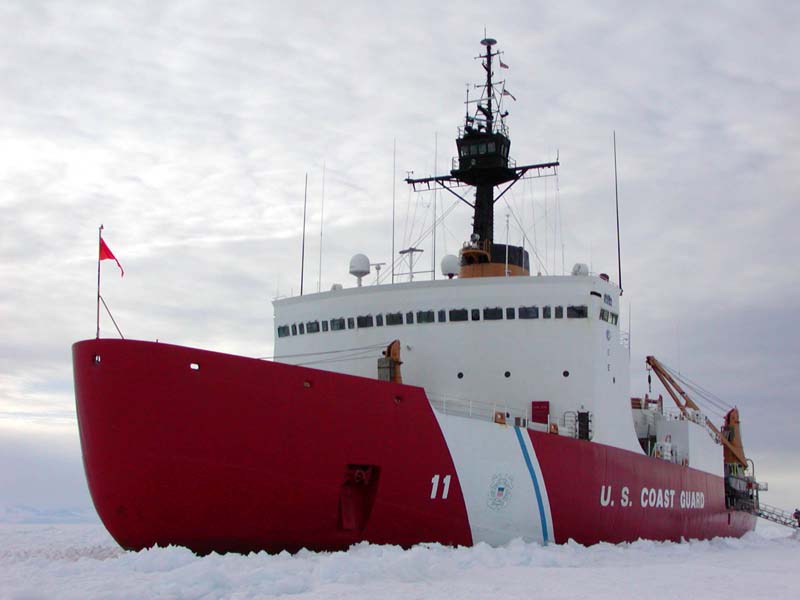
Keeping the Polar Sea?

The plan had been to scrap the Polar Sea (WAGB-11), but it looks like the plan may have changed. The Seattle Times is reporting that the Ship has been spared, at least for now.

“The decision was announced Friday by Sens. Maria Cantwell of Washington and Mark Begich and Lisa Murkowski of Alaska.”

“Cantwell, Begich and Murkowski say the Polar Sea’s hull is in sound condition and rebuilding the ship would be cheaper than building a new icebreaker.”

File:USCGCPolarSea.jpg

US Coast Guard Photo

Coast Guard Releases Draft Request for Proposal for the OPC

Today the Coast Guard released a draft “request for proposal” (RFP) for the construction of the Offshore Patrol Cutters.

They also indicate they expect to meet with industry the week of July 9, request feedback by July 16, and that they will issue the RFP in September.

There is an awful lot of material here to absorb, but one thing I did notice immediately was the apparent intention to make all the OPC ice strengthened. “The discussion of operating environments was expanded to include Arctic climates. An ability to operate in areas of broken plate, pancake, and sea ice ranging from 10 to 30 inches thick was added. However, the summary states that the WMSM will not conduct ice breaking as a mission (page iii).”

There will be more I’m sure.

GAO Responds to Fleet Mix Studies, Part 1, The Report

In my post, Irresponsibly Rebuilding the Fleet-a Look at the Future, I talked about why it was essential that the Coast Guard build at least two Offshore Patrol Cutters (OPC) a year, when it finally starts building them in 2016. My concern is that there is still no wide spread support for funding the Coast Guard’s “Program of Record” which includes 25 OPCs in addition to eight National Security Cutters and 58 Fast Response Cutters.

Conceptual Rendering of the OPC

The Coast Guard has recently gone public with similar concerns.

Studies are playing an important part in the effort to build consensus on what the Coast Guard’s fleet of Cutters should look like in the future and how to get there. May 28 of this year, we looked at the Executive Summary of the Offshore and Aviation Fleet Mix Study completed in 2009, but only recently made public. The Coast Guard completed a second phase of its Fleet Mix Study which looked at the effects of two funding levels on the procurement process in May 2011 and the Department of Homeland Security completed a “Cutter Study” in August 2011.

May 31, 2012 GAO released a report to Congressional Committees titled “Observations on the Coast Guard’s and the Department of Homeland Security’s Fleet Studies” [PDF] along with briefing slides provided on April 20, 2012. I’m going to quote GAO’s report and slides extensively.

GAO saw there objectives as to:

  • “(1) What are the key results of the Coast Guard’s Fleet Mix Studies and DHS’s Cutter Study with respect to recapitalization and operations?
  • “(2) How useful are these studies to DHS, the Office of Management and Budget (OMB), and the Coast Guard for informing recapitalization decisions?” Continue reading

Irresponsibly Rebuilding the Fleet–a Look at the Future

I have seen several references to how the FY2013 budget is “Responsibly rebuilding the fleet,” as if we might otherwise have gone off willy-nilly building ships we don’t really need because we haven’t done prior proper planning. In fact we have been in analysis–paralysis for two decades, since we finished the last 270 in 1990, without building replacements for ten WWII vintage ships that continued to serve.

In the last 22 years the Coast Guard has taken delivery of 21 ships (one WAGB, three WMSL, one WLBB, and 16 WLBs), less than one ship a year, while we should have averaged at least two ships a year (and should do so for the foreseeable future to maintain the current fleet and replace ships at what is generally recognized as the economical end of their useful lives at 30 years).

It gets worse. Over the last eight years, since 2004 the Coast Guard has take delivery of only four ships (one WLBB and three WMSL). We are now in a situation where it may be four years between delivery of NSC#3 and #4 (funded in 2006 and 2010 respectively).

Let’s take look a what will happen if more money is not allocated to the AC&I budget.

The Problem:

By the end of 2020 the Coast Guard can expect to loose the services of at least half the existing fleet of large patrol vessels, 20 ships (six 378s and 14 WMEC 210s). During that time, if there are no changes to current budget, we can expect no more than four new ships to be added (three “National Security Cutters” (NSC) already funded and one “Offshore Patrol Cutter” (OPC)).  This will give the Coast Guard a fleet of 24 large patrol cutters (6 NSC, 3 WHECs, an OPC, the Alex Haley, and 13 WMEC 270s), down from 40 ship in the current fleet, and far less than the 33 ships in the “Program of Record.” Even this is probably overly optimistic in that it assumes all existing ships will be decommissioned only after 50 years of service, with three 378s still in service in 2020. Continue reading

D-Day Normandy Remembered

The Coast Guard Compass has an excellent post on one Coast Guardsman’s perspective as he experienced the landings on the beaches of Normandy in 1944. The Coast Guard historian has a very comprehensive index of information and stories related to the invasion available on the historian’s website.

Coast Guard participation in the invasion included three Coast Guard manned attack transports, two more that were partially CG manned, eleven Landing Ship Tanks (LST), 24 Landing Craft Infantry, Large (LCI(L)), and 60 wooden hulled 83 foot patrol boats. In addition the Coast Guard manned numerous smaller landing craft.

File:Lci-convoy.jpg

Normandy Invasion, June 1944 A convoy of Landing Craft Infantry (Large) sails across the English Channel toward the Normandy Invasion beaches on “D-Day”, 6 June 1944. Each of these landing craft is towing a barrage balloon for protection against low-flying German aircraft. Photograph from the U.S. Coast Guard Collection in the U.S. National Archives. Photo #: 26-G-2333

Sad News from Canada–Two Training Fatalities

I’ve received some sad news from one of our regular contributors, Ken White, who is a search and rescue volunteer with the Canadian Coast Guard.

“I have to tell you that Sunday June 4th 2012  was a very sad day to the maritime search and rescue organization on the west coast of British Columbia when two female members of the Royal Canadian Marine Search And Rescue of Unit 12 of Sechelt British Columbia, Canada died in a training accident when there 40 ft rigid hull inflatable rescue boat capsized on top of them when they where training in a tidal rapids. On the rigid hull inflatable rescue boat the air bags on the back transom over the twin two 250 hp outboards FAILED TO INFLATE when the rigid hull inflatable rescue boat capsized on top of them pinning them in the hull of the boat and what made it worse that the floater survival suits that they where wearing was pinning the two women underneath the hull. The accident was reported quickly on VHF-FM 16 to one of the Canadian Coast Guard Radio Stations that the government of Canada wants to close that is at Comox, British Columbia by several pleasure crafts that where in  the area and they quickly responded to the scene as well. Also dispatched was a Canadian Armed Forces Search And Rescue Helicopter that had two SARTECHS (Air Force PJs) that was fully equipped with underwater dive gear. I was working on the incident  and through the Joint Rescue Co-Ordination Center Victoria I diverted a coastal ferry to do a search of the nearby waters and we also used the coastal ferry as a barrier in a position if the two missing women were being carried in the tidal rapids past the search area. Once the Canadian Armed Forces Search And Rescue Helicopter got on scene it lowered the two SARTECHS (Air Force PJs) to do an underwater search and that is where the SARTECHS (Air Force PJs) found the bodies of the two women pinned under the hull of the 40 ft rigd hull inflatable rescue boat with there floater survival suits and one by one the SARTECHS removed there limp bodies and they transferred them to two pleasure craft which the SARTECHS (Air Force PJs) boarded and started CPR on the women and they where going to be transferred to the Canadian Armed Forces Search Rescue Helicopter that landed nearby to take the two women to Vancouver Hospital with advanced life support. On route to the hospital the SARTECHs (Air Force PJs) worked very hard on the women with CPR but when they had landed in Vancouver the two women did not have a pulse.”