Mexican Navy OPVs

MexNavyOPV

NavalToday reports the Launch of the sixth and last Offshore Patrol Vessel of the Oaxaca Class, the ARM (Armada Republica Mexicana) Hidalgo, for the Mexican Navy. These ships were designed and built by and for the Mexican Navy, but they would look quite at home painted white with USCG stripes and WMEC hulll numbers. Statistically they are very close to Coast Guard 270s.

Mexican-Navy-launches-final-Oaxaca-class-patrol-vessel-Hidalgo-1-768x491

  • ___________________Oaxaca Class_______________WMEC 270
  • Displacement (full load)  1,680 tons_________________1829 tons
  • Length                    282.2 feet (86.0 m)_______________270 feet (82 m)
  • Beam:                      34.4 feet (10.5 m)_______________38 feet (12 m)
  • Draft                         11.8 feet (3.6 m)________________14.5 feet (4.4 m)
  • Speed:                      20+ knots_____________________19.5 knots

The occasion prompted me to take a look at the Mexican Navy. While the Mexican Navy does have six former USN frigates, most of their missions are closer to what we do in the USCG, and most of their ships are offshore patrol vessels. They have 21 ships (soon to be 22 with Hidalgo) in five classes that look an awful lot like WMECs. These ships have evolved over time, with each class an incremental improvement over the previous ships. Only the oldest of these, the Uribe class ships were built in Spain by Navantia, the remaining 17 were built in Mexican Navy shipyards in Tampico and Salina Cruz with the first of the Mexican built ships being commissioned in 1991.

Photo: Uribe class OPV ARM Jose  Aueta (P-122)

The Uribe class were very similar in size and concept to the 210s, with a similar configuration of the foc’sle and flight deck on the O-1 deck. They did include a hangar, were 10 feet longer (67 m overall), and had more than twice the horsepower at 13,320 allowing a maximum speed of 21 knots. Its main gun was a single 40mm/7

The Holzinger or Aquila class were the first class built in Mexico. They stretched the design 24 feet to 244 feet (74.4 m), provided two main machinery spaces vice one, and retaining the same horsepower, achieved 22 knots. Originally they were to have had a 57mm, but because of stability consideration a twin 40mm/60 was used instead.

Holzinger-class patrol vessel

Sierra Class OPVs of the Mexican Navy


The Sierra, Mendz, or Holzinger 2000 class retained essentially the same dimensions as the preceding class, but introduced a number changes. The hull aft was extended upward to create a flush main deck at what had been the O-1 deck. A stern ramp was incorporated in the transom for launching a “chase boat.” The superstructure was given a more “stealthy” form with the RHIBs placed in enclosed pockets.  A Vosper fin stabilization system was also provided, and a 57 mm main gun was included. A max speed of 18 knots is claimed, but it is likely to be more than 22.

ARM_Durango

ARM Durango, Mexican Navy, 8 October 2008, photo by Apodemia.

The four ships of the Durango class were originally intended as units of the preceding Sierra class but the design was modified and is now considered a separate class although statistically they appear little different.

The Oaxaca are a bit larger. They seem to have decided that the “stealthy” superstructure is not worth doing. The 57 mm gun of the preceding class has been replaced by a 76 mm gun, but it is not the newest type so this may have been a case of the guns being available on favorable terms rather than a reflection of dissatisfaction with the 57 mm. There is also a auto-cannon aft (variously reported as 25 or 30 mm) and two remote weapon stations with .50 cal. Like US WMECs the range is substantial at 8,500 nautical miles. They have a crew of 77 and accommodations for 39 special forces and/or marines.

Given that the USCG is now responsible for maintenance of all US 76 mm guns and also operates the 57mm, the Mexican Navy’s choice of weapons suggests this may be an area of potential cooperation.

Auk class minesweeper

Auk class minesweeper now used as an Offshore Patrol Vessel by the Mexican Navy

Unfortunately not all of Mexico’s OPVs are relatively modern. They still have ten Auk  class 1,250 ton (fl), 221 foot, WWII vintage, steel hulled minesweepers that continue to function as patrol vessels. The ships are referred to as the Valle class in Mexican service. They are the same class as USCGC Tanager (WTR-885) that served as a CG Reserve training ship 1964 to 1972. They will certainly need to be replaced soon. Obviously their building program is not complete.

I find it interesting that Mexico with an EEZ of 3,144,295 km2,, with less than a third of the EEZ of the US (11,351,000 km2) has a fleet of OPVs that approaches that of the USCG.

“Latin American Navies Combat Illegal Fishing”–CIMSEC

CIMSEC has a short background article on the scope of, and reaction to, illegal fishing in Latin America.

You might recognize the ship pictured at the head of the CIMSEC post. It is one of a class we talked about earlier.

The post also talks about the sinking of a Chinese Fishing Vessel by an Argentine patrol vessel, an incident we also discussed here.

The two Peruvian patrol vessels seen launched in the post and in the YouTube video above, BAP Rio Cañete (PM-205) and BAP Rio Pativilca (PM-204), are according to a Google translation of this post,  55.3 meters (181 feet) long, 8.5 meters (28 feet) of beam, and a draft of 2.3 meters (7’7″). They have two diesels totaling 6690 HP for a 22 knot max speed, a range of 3600 miles at 14 knots. The crew is 25 with additional space for up to 14 additional boarding party members to man the two RHIBs carried in davits. They are expected to be armed with a Typhoon weapon system, similar to the Mk38 mod2 but with a 30mm gun plus two .50 cal. Their design is based on the South Korean Taegeuk class cutters.

New S. Korean Cutter

SKoreaLargestCutter

Jane’s 360 is reporting that the S. Korean Coast Guard has commissioned their largest and most heavily armed cutter.

Lee Chung-ho has a length of 150.5 m, a beam of 16.5 m, a loaded displacement of 6500 tonnes and a complement of 104 persons, although 140 persons can be embarked.

The hybrid propulsion system has four MTU 20V1163M94 diesels (each rated at 9,900 bhp) and two 750KW electric motors that are connected to the propellers.

How big is it?

The cutter, at 6,500 tons, is 44% larger than the Bertholf class. While its length and beam are almost identical to Japan Coast Guard’s two largest cutters, the displacement is reportedly far less. I have seen no info on the draft, so that is at least possible. In any case, it is definitely much smaller than the huge cutters the Chinese have built.

The post compares the new cutter to the slightly smaller Sambong-ho (pennant 5001), which entered service in 2002 and was previously the largest cutter in the S. Korean Coast Guard, stating it is three knots faster. That would indicate a top speed of 24 knots. The new cutter has a four diesel power plant compared to its predecessor’s two engine plant. In addition, the two 750 HP electric motors mounted on the shafts which should allow the cutter to slow cruise while the main diesels are cold iron.

Weapons: 

According to Wikipedia, S. Korean has 34 cutters over 1000 tons. All are armed with one or more 20 mm Vulcan Gatling Guns and .50 caliber machine guns. Fourteen have Bofors 40 mm guns, and one other also has a 76 mm. The 20 mm and 40 mm mounts are locally produced in S. Korea.

Looking at the armament, it may be an upgrade compared to the typical S. Korean cutter, but only slightly better armed than what appears to be, becoming a world wide standard for offshore patrol vessels–a medium caliber gun, 57 or 76 mm, and a pair of 20 to 30mm machineguns in remotely controlled weapon stations. It is really no better armed than the 1,150 ton PC-1005, the Hankang, smallest of S. Korea’s 34 cutters major cutters, commissioned in 1985.

All the weapons appear to have been recycled from previous installations. In the photo, an older model OTO Melara 76 mm, like those used on the FRAMed Hamilton class WHECs and Bear class WMECs is clearly visible on the bow. There is also a Vulcan 20 mm mount on the O-3 deck superfiring over the 76 mm mount forward of the bridge. It also appears to have a locally built twin Bofors 40 mm compact mount using an earlier version of the Bofors than the 70 caliber weapon currently offered, which appears to be atop the superstructure aft. She has no CIWS, missiles, or ASW capability.

What is it with these very large cutters?:

Japan, China, and S. Korea, have now each built two very large cutters. Why to they exist?

It is their size, not their weapons, that make them exceptional. The Russian Coast Guard has smaller, but much more heavily armed ships (Krivak III frigates and Grisha II class corvettes).

There has been a general trend for ships of all types to grow in size. Their crews are not exceptionally large, so the operating cost may not be that much more.

Still these are significantly bigger than other cutters built by the same coast guards, at the same time, apparently for the same missions.

None of these three nations has a patrol area as distant and demanding as Alaska.

Japan did have a reason for building the first of these. Shikishimacommissioned in 1992, was intended to escort plutonium transport ships between Europe and Japan, but I have seen no explanation for the ships that followed.

Is it prestige, just “keeping up with the Jones?”

Are they intended for a future shoving match? If so, they are giving up agility for presence.

Are they perhaps intended as flag ships for long term operations?

I would love to hear the reasoning from someone in the know.


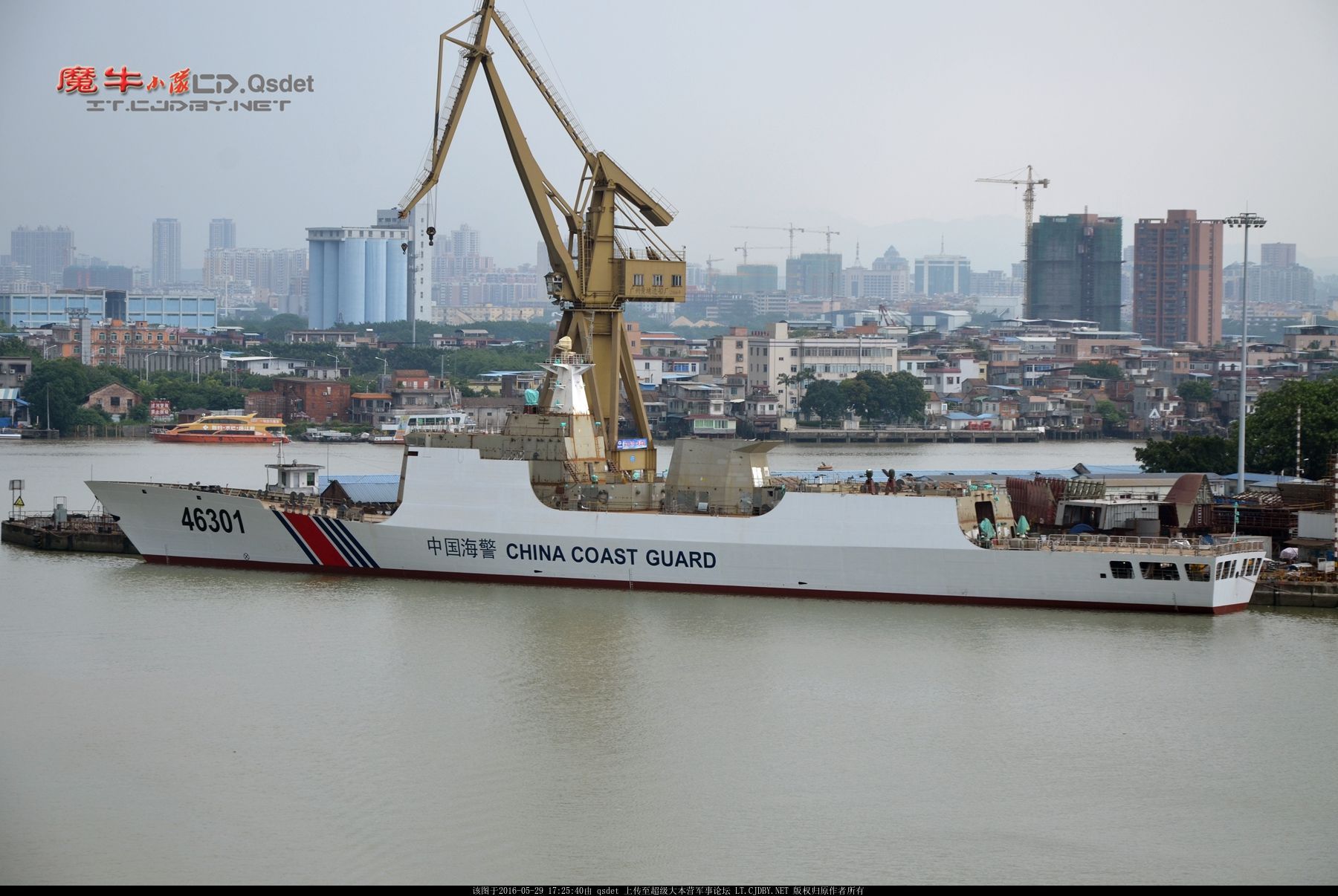
China Coast Guard Cutter Built on Frigate Hull

Type054cutter

China Defense Blog is reporting the Chinese Coast Guard is getting at least one cutter based on the same hull used for the Type 054 frigate. I have to believe there will be several more.

The Type 054 is a large and apparently successful class of frigate. The ships are only slightly smaller than the Bertholf class, displacement 4,053 tons full load, length 134.1 m (440 ft), beam 16 m (52 ft), 30,400 HP, 27 knots, compared to the Bertholf’s 4,500 tons, 127.4 m (418 ft), 16.46 m (54 ft), 49,875 HP, and 28 knots.

My first reaction is that they should make very good cutters. They have a four diesel power plant that should be economical to operate and very flexible. The frigates reportedly have a range of over 8,000 miles. They also have reasonably good aviation facilities.

Type054A800px-Aft-deck_of_the_PLAN_frigate_Yi_Yang_(FF_548)

US Navy photo:  120917-N-YF306-107 GULF OF ADEN (Sept. 17, 2012) Sailors from the guided-missile destroyer USS Winston S. Churchill (DDG 81) board the Chinese People’s Liberation Army (Navy) frigate Yi Yang (FF 548) to meet prior to conducting a bilateral counter-piracy exercise.

The Chinese Coast Guard has been experiencing explosive growth. China has built some huge cutters, they have gotten some hand-me-down frigates from their navy, and there have been reports that the China Coast Guard will be getting ships based on the Type 056 Corvette, but until recently, new construction Chinese cutters were not warships. They looked more like research vessels. Most have been armed with nothing heavier than 14.5 mm machine guns. This ship may mark a change.

Building based on a Navy design assures that should the need arise, these ships can be upgraded to a more combat ready configuration. How they are equipped when commissioned will give us an indication of the future direction of the Chinese Coast Guard. Will it remain essentially civilian, or will it become an increasingly capable naval auxiliary?

Which systems will be retained from the frigate configuration, and which systems are deleted? My guess is, that they will emerge with a medium caliber gun (either the 76 mm being currently fitted to the Navy’s Type 054As or the older 100 mm that was fitted on the original Type 054s) and two 30 mm gatling guns (these may be older model AK-630s rather than the newer CIWS fitted on current Navy Type 054As). I don’t expect to see the Vertical Launch Systems that support AAW and ASW systems, Anti-Ship Cruise missiles, torpedo tubes, or the sonars which are being fitted to the Navy versions, but if any of these are fitted, it will mark a drastic change in the character of the Chinese Coast Guard.

Thanks to Lee for bringing this to my attention.

Project 22160 patrol ships, Russia’s Cutter X

The Zelenodolsk Shipyard in the Volga area will lay down the third Project 22160 patrol ship Pavel Derzhavin on February 18, shipyard spokesman Andrei Spiridonov told TASS on Monday. "The shipyard will hold a solemn ceremony of laying down the Project 22160 patrol ship Pavel Derzhavin developed by the Severnoye Design Bureau in St. Petersburg [in northwest Russia]," the spokesman said.

Recently, NavyRecognition reported Russia was laying down a third Project 22160 patrol ship. The first of this class should enter service next year. In size they fall between the Offshore Patrol Cutter and the Webber class WPCs, in the range I have called “Cutter X.” The size (1200-1800 tons full load) seems to be favored by many navies and coast guards.These ships are a bit unusual among small Russian ships in having a substantial range.

Reportedly the Russians are building six of these. Specs are as follows:

  • Length: 94 meters (308 ft)
  • Beam: 14 meters (46 ft)
  • Draught: 3.4 meters (11.2 ft)
  • Speed: 30 knots
  • Range: 6,000 nmi
  • Endurance:  60 days
  • Crew: 80

At one point there was a public statement that these had been designed to counter piracy off the Horne of Africa. But it has been more recently reported that they will be quipped with Kalibr (Tomahawkski) land attack missiles, the type recently used by ships in the Caspian Sea to attack targets in Syria. The ship is “modular” and has a reconfigurable space under the rear of the flight deck. The missile will be mounted in containers under the flight deck. Adding anti-submarine or additional anti-ship capabilities would require trading off the Kalibr missiles.

Russian Project 22160

The ship has a new naval gun mount incorporating a 57mm gun. The gun is reportedly capable of 300 rounds per minute and a range of 12 km. Effective range is about 4 km. This is a development of gun with a long history in Soviet and Russian Service in both anti-air and anti-armor roles, and as is frequently the case with Russian weapons, the ammunition is shared in common with the Russian Army.

In addition they will carry short range Anti-Air missiles. It appears they will be vertical launched from canisters between the gun and superstructure.

While these ships do not have a strong self defense capability, the mounting of cruise missiles similar to the Tomahawk on small vessels, particularly on one like this, that has a relatively long range, gives them a sort of miniature maritime strike capability, far less capable, but also far cheaper than a Carrier Strike Group. While the ships are small and the weapons unobtrusive, the potential to accurately strike up to eight separate targets would have required an attack by dozens of aircraft not too many years ago.

Apparently all six ships are to be assigned to the Black Sea Fleet and will be home ported in Novorossiysk.

Interestingly, it appears the Russians may also be building a similar size anti-submarine warfare ship. Again NavyRecognition has the report.