Think Defense is reporting Britain’s DSTL (Defense Science and Technology Laboratory) is contucting trials of UAVs from the Naval Surface Warfare Center, Combatant Craft Division’s experimental craft Stiletto.
Three different UAVs were picked for the demonstration and launched from Stiletto’s flight deck, including DRS’ Neptune. DSTL personnel were on board, and observed launch, payload operation, and recovery evolutions near Naval Air Station Patuxent River in Patuxent River
I hope the Coast Guard will look at the results. It appears there is a good possibility of operating UAVs from the Webber Class Fast Response Cutters.
The August issue of US Naval Institute Proceedings is appropriately enough, the “Coast Guard Issue,” although less than a third of the content is Coast Guard related. I was disappointed but not surprised to see that there was no article about the OPC. It includes four articles that are written by Coasties, active or retired, and includes a “rouges gallery” of CG flag officers and senior enlisted as well an orgainizational chart.
There is one particular article I’d like to recommend that actually dares to be a bit controversial, and it is available on line, “Reinvent the Fifth Armed Service, Quickly”. I think it is definitely worth a read.
They talk about
reorganization within the Coast Guard
exploitation of UAS technology
integration of DHS maritime aviation and vessel fleets.
coordination of procurement with the Navy
integration of the NOAA fleet into the Coast Guard
As I say it is controversial, it is going to ruffle some feathers, and hopefully it will start some thinking and some discussion.
Two of these ships are 550 ton ASUW and AAW missile equipped Molniya Class Corvettes like the one pictured above, a development of the older Turantul Class Corvette. The other four are closer to 110 foot WPBs, if a bit more heavily armed.
Costa Rica is apparently concerned. I’ve got a soft spot for Costa Rica. Their only armed service is their Coast Guard, and they have had some run-ins with Nicaragua in the past.
fiercehomelandsecurity.com is reporting that the Coast Guard has adopted the NSA’s “Ozone” widget framework to be used as part of the Watchkeeper port security information sharing network. Perhaps this means something to some of you. I have only a very foggy notion what a widget is, and only because there are some widgets used on this web site.
But there is also some disturbing information also included in the post.
The Coast Guard has acknowledged difficulty in convincing port security agencies to utilize WatchKeeper. During a September subcommittee hearing, Stephen Caldwell, Government Accountability Office director of homeland security and justice issues, noted that research for a February 2012 report (.pdf) found that 82 percent of those given access to WatchKeeper “had never even logged on.”
The Italian Coast Guard launches the first of two new ships. Relatively large at 310 feet long and 3,600 tons full load, but not nearly as capable as the projected Offshore Patrol Cutter, to me this looks like an adaptation of an oil industry Offshore Support Vessel. Most interesting feature is electric propulsion. Raytheon’s integrated bridge system might also be interesting, but there are no details in the story. Reasonable question is, can they can function effectively with a crew of only 38 or do they need additional augmentation for each mission. Apparently they can routinely berth up to 60 in addition to the crew, and up to 600 additional in case of an emergency. This last is a reflection of Italy’s Alien Migrant Interdiction problem.
Defense Industry Daily provided the video above with the encouraging news that NAVAIR and the Coast Guard are working together to develop an open architecture system that will permit real time data link of “video and metadata” including the ability of, what I believe is a Response Boat, Medium, to take control of the camera on the airborne Intelligence Surveillance and Reconnaissance (ISR) asset.
This is an extract of what the current strategy says about homeland defense (from CS21 p. 15):
“Homeland defense is the most obvious example of the requirement for greater integration. It is not sufficient to speak of homeland defense in terms of splitting the responsibilities and authorities between the Navy and the Coast Guard along some undefined geographic boundary. Rather, the Sea Services must—and will—work as one wherever they operate in order to defend the United States. Consistent with the National Fleet Policy, Coast Guard forces must be able to operate as part of a joint task force thousands of miles from our shores, and naval forces must be able to respond to operational tasking close to home when necessary to secure our Nation and support civil authorities. Integration and interoperability are key to success in these activities, particularly where diverse forces of varying capability and mission must work together seamlessly in support of defense, security, and humanitarian operations.”
Unfortunately, if everyone is responsible, no one is responsible.
I think the Coast Guard could benefit from more specificity in the nation’s maritime strategy beginning with a simple declarative statement that while the Navy is primarily responsible for protecting the nation from overt maritime threats, the Coast Guard is primarily responsible for interdiction of covert surface maritime threats in waters surrounding US territory, including territorial sea, contiguous zone, and the exclusive economic zone.
Some might consider this a radical change, but in fact it is just acknowledging the current reality. The Naval Sea Frontiers are no more. The flotillas of minor combatants that once teamed around every port no longer exist. The US Navy no longer makes regular patrols of US waters. Generally, the only times Navy units are in US waters are for training and transit. Otherwise they are either forward deployed or in a very small number of US ports, usually in a condition that would require substantial notice to get them underway.
I believe a quote from Robert Rubel in the comments section of the post reflects the Navy’s position,
“After 2001 the US found itself confronted with a trans-national terrorist network whose tentacles reached across the AoR boundaries. The nightmare scenario was terrorists sneaking WMD into the US. The Navy came to realize it could not by itself assure the country that it could interdict such smuggling; the seas were simply to large. The associated nightmare scenario for the Navy was that it would be chained to the North American littoral to conduct patrols.”
The US Navy does not, and does not want, to patrol the US coast. There is nothing wrong with the concept of meeting threats as far from the US as possible, and nothing in the statement would preclude cooperation between the Coast Guard and the Navy or other agencies, but acknowledgement of the Coast Guard’s role would clarify equipment requirements and eliminate the still natural assumption on the part of many of those individuals that effect the Coast Guard’s budget (including the leadership of Dept. of Homeland Security) that, “The Navy will take care of that.”
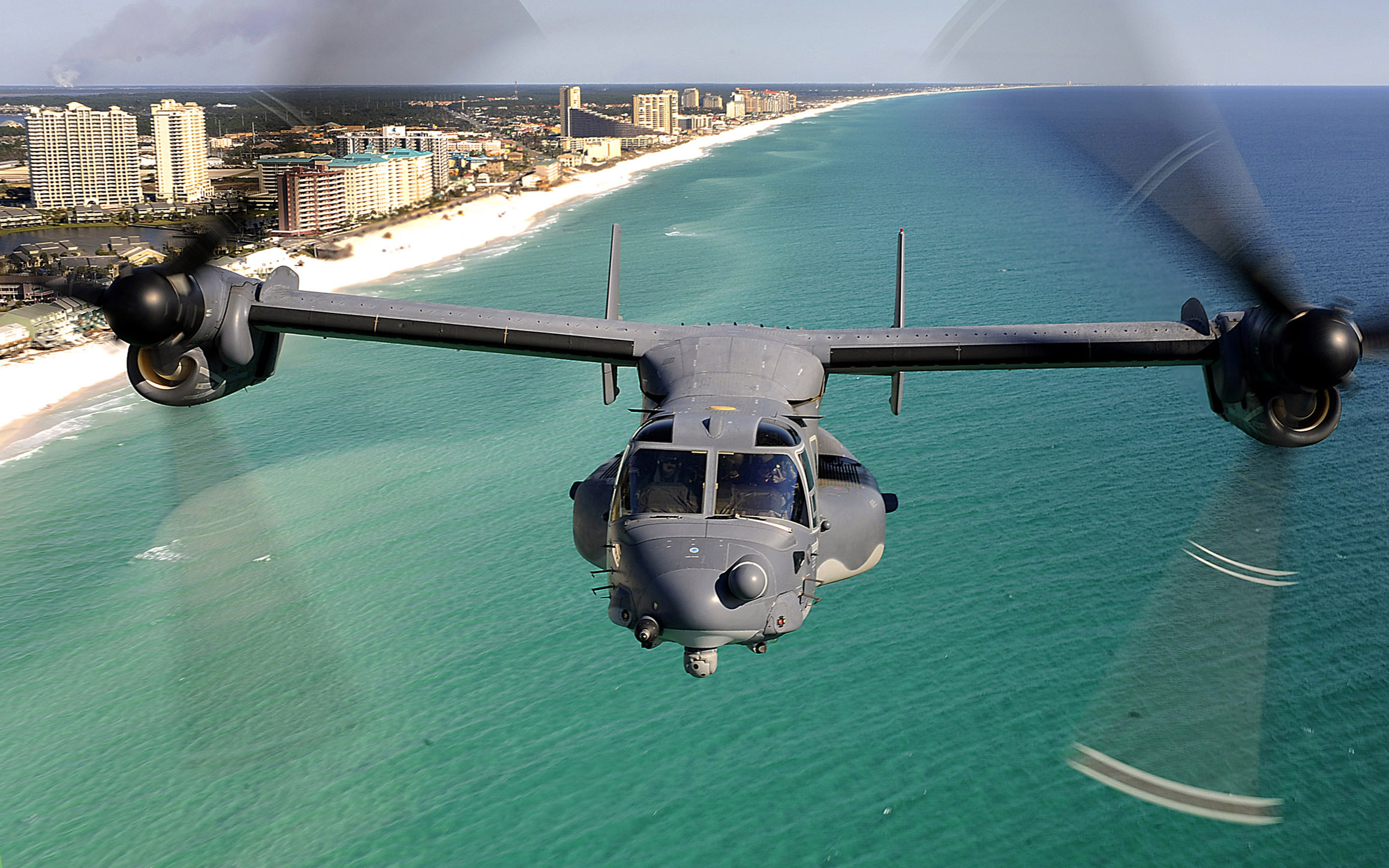
A CV-22 Osprey aircraft from the 8th Special Operations Squadron flies over the Emerald Coast outside Hurlburt Field, Fla., on Jan. 31, 2009. While over the water, the crew practiced using a hoist, which is used to rescue stranded personnel. DOD photo by Senior Airman Julianne Showalter, U.S. Air Force. (Released)
DefenseNews reports members of Congress are questioning an Air Force proposal to use the V-22 Osprey tiltrotar in addition to the HH-60 for Combat Search and Rescue.
Opponents site the very strong downwash from the aircraft and higher cost.
Proponents site the V-22s higher speed and range.
It appears politics may also be at work here, surprise, surprise.
Thinkdefense recently reported on the test of a new application of the proven Brimstone missile. (They also have some additional video, and excellent commentary.) Three missiles were launched almost simultaneously against five boats (four stopped and one underway at about 20 knots) simulating a swarm attack. The three missiles each hit a separate target.
Targeting:
The thing that makes this missile so interesting is the range of options it provides the user to ensure that the right target is hit and there is little or no chance of collateral damage. It is equipped with an all weather millimetric radar that will show the shape of the target, and in the latest version semi-laser homing. It can be “fire and forget,” but it can also allow a “man-in-the-loop.” It can be given a laser designation and then continue to independently track the target. It has a terrain avoidance feature allowing it to hit targets on the far side of islands. A kill box can be designated so that it will ignore targets outside the box and self-destruct if it passes through the box without finding a target. Multiple rounds can be fired in a salvo, against one or more targets.
Will the US consider it?:
Clearly this weapon is being marketed to the US, including apparently for use on the Littoral Combat Ship as a competitor to an enhanced Griffin. US Special Forces have already shown an interest in the missile.
“BRIMSTONE is also being proposed as a surface-to-surface missile for deployment within the SEA SPEAR self-defence system against FIACs (fast inshore attack craft–Chuck) and other small surface threats. With a range of deck-mounted launcher options, from single to six-pack configurations, the system’s very small footprint gives it a high level of deck positioning flexibility making it suitable for small vessels such as FACs as well as much larger vessels such as auxiliary ships.”
Footprint:
It is relatively small, about 107 pounds, less than six feet long, and approximately seven inches in diameter. They claim it is suitable for vessels as small as 15 meters (50 feet).
Alternatives
The nearest similar missile in US service right now is the Hellfire. Brimstone developed out of a program to improve Hellfire, so not surprisingly, Hellfire is very similar in size but has a shorter range. Hellfire has been used on the Combat Boat 90 (a 52 foot boat). It does not have the sophisticated dual mode guidance and collateral damage avoidance features of the Brimstone. Several types have been built. Most are semi-active laser homing, but there is a millimetric radar homing version also, but it does not include the man-in-the-loop feature of the Brimstone. The model that appears most useful in a naval environment is the “N” model. The Thermobaric warhead does sound interesting.
AGM-114N Hellfire II
Target: Enclosures, ships, urban targets, air defense units
New weapons like this are beginning to give even very small craft the punch that once came only with something like a 5″ gun, but perhaps more importantly it allows a very precise application of force. That should be very important to the Coast Guard in that their units are most likely to operating in and around the US including densely populated areas.
This may not be a ship killing, or even ship stopping weapon (although it might help), but it might be useful against a different type of difficult target. We might someday need to stop a terrorist or an enemy in wartime employing a fast highly maneuverable craft operating inshore or among a number other vessels where gunfire is likely to cause civilian casualties. This system would be much safer, and more likely to succeed, than using guns, in that circumstance.
Too good to be true?
With the possibility of being surrounded, pushing one button, and wiping out all your enemies, I was reminded of this sequence from the movie “The Last Starfighter.”
KEY WEST, Fla. (April 24, 2013) The Military Sealift Command high-speed vessel Swift (HSV 2) with a tethered TIF-25K aerostat gets underway from Key West to conduct a series of at-sea capabilities tests to determine if the aerostat can support future Operation Martillo counter transnational organized crime operations in the U.S. 4th fleet area of responsibility. (U.S. Navy photo by Lt. Cmdr. Corey Barker/Released) 130424-N-IC228-114




 Chuck Hill's CG Blog