What a Former WHEC is Doing Now

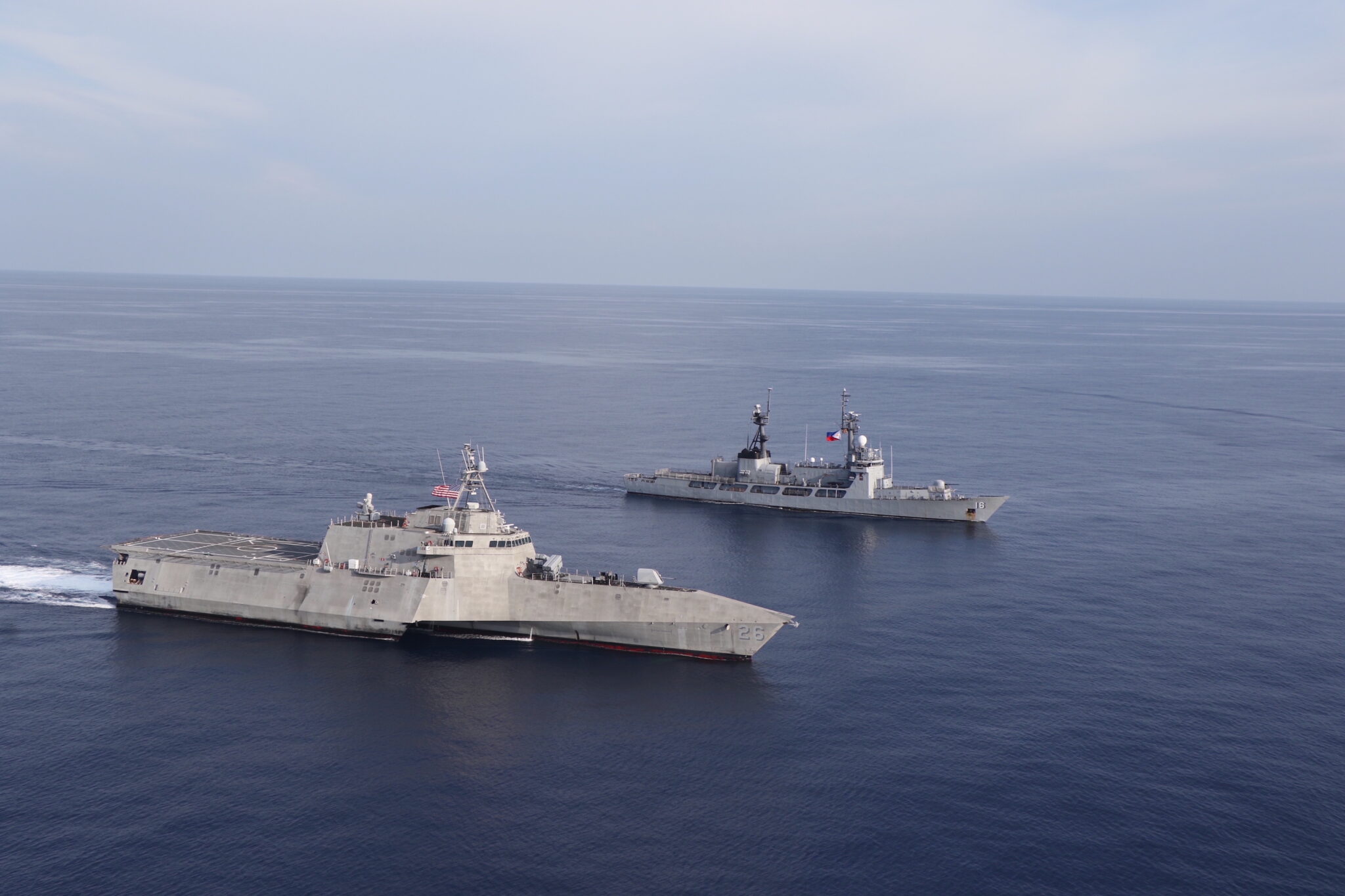
SOUTH CHINA SEA (July 31, 2024) – Independence-class littoral combat ship USS Mobile (LCS 26) conducts a Maritime Cooperative Activity with Philippine Navy’s Gregorio del Pilar-class patrol ship, BRP Ramon Alcaraz (PS 16), (former USCGC Dallas), in the South China Sea, July 31, 2024. Mobile, part of Destroyer Squadron 7, is on a rotational deployment operating in the U.S. 7th Fleet area of operations to enhance interoperability with allies and partners and serve as a ready-response force in support of a free and open Indo-Pacific region. (U.S. Navy photo by Naval Aircrewman Tactical Helicopter 2nd Class Diego Chavez)

US Naval Institute News reports,

U.S. and Philippine warships rendezvoused near a disputed South China Sea feature to conduct a joint maritime patrol on Wednesday.

USS Mobile (LCS-26) and BRP Ramon Alcaraz (PS-16) met off Leslie Bank, a maritime feature within Manila’s exclusive economic zone and Beijing’s 10-dash line claim. The littoral combat ship and ex-Coast Guard Hamilton-class cutter drilled in bilateral surface operations and communication, with a video released by the Armed Forces of the Philippines claiming that the two vessels took up a patrol formation.

Nice to see the LCS is apparently armed with Naval Strike Missiles.

A Question of Proportionality / What to do about Philippine Outposts in the South China Sea?

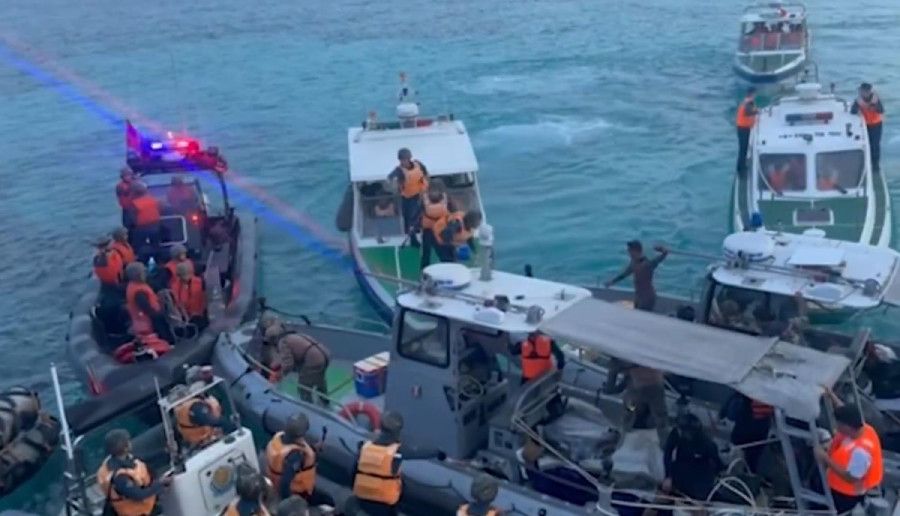
A still image taken from footage released by the Armed Forces of the Philippines showing China Coast Guard personnel confronting a resupply mission (Photo: Armed Forces of the Philippines)

Real Clear Defense reports,

Philippines Vows To Fight Back if Assaulted Again in South China Sea

At first, I was happy to see this, but I think they are making a mistake.

Philippine forces will defend themselves with “the same level of force …“If a knife is used, for example, our personnel will also use a knife, nothing more, under the concept of proportionality.”

If you are outnumbered in a knife fight you will lose. They will be outnumbered, and they will lose. That would be allowing the Chinese to write the rules of the game. Deadly force is deadly force. If someone is threatening you with a deadly weapon, you need to fire a warning shot, and if they keep coming shot the SOB.

Crews need to say, no one will take my vessel from me. As someone said, “Don’t Give Up the Ship.”

The Chinese are not going to start a war that might include the US until they are fully prepared to do so. Then and only then, they will want to open with a surprise attack.

The Philippines needs to raise the stakes for the Chinese to the point that they either back down or start a war with the US before they are really ready.

Right now, the Chinese are attempting to shape the battlefield to their advantage, building unsinkable missile cruisers surrounding Taiwan. The Philippines holds territory where they would like to place another missile launching platform. So does Japan. China should not be allowed to seize these positions.

Immediately the Philippines should make it clear to the Chinese, that they have no right to be in the Philippine EEZ, or any other country’s, behaving as they have. There is no reason to negotiate because they have no standing. That was decided in the international court of arbitration.

It might be possible to make a joint statement by the Philippines, Japan, Vietnam,  Indonesia, and maybe others.

When a move is made, it needs to be made with overwhelming strength on scene. That is possible if the Philippines employs surprise and has international support on scene. Philippine TA-50 jet aircraft should be overhead, ready to deter an attack on Philippine forces.

The result will be an incident, not a war. We have already seen lots of incidents, this will just add to the list, but this time we need the Chinese to back down.

Scarbough Shoal  and Second Thomas Shoal need to be reinforced and built up. The US and Japan could and should help the Philippines do it. Mirror what the Chinese have done. Make an artificial island, garrisoned with Marines, give it radars, effective AAW systems, and some of the Philippines’ BraMos missiles.

The Chinese are not going to like it, but unless they want to start a war with the US before they are ready, they will back down. Pulling a piece or two out of their plan to surround Taiwan with missile firing islands might actually prevent an attack on Taiwan.

Turkish Twin 35mm CIWS on South Korean Built Philippine Corvette (corrected text)

Gökdeniz twin 35mm CIWS (Aselsan image)

Naval News reports,

“On June 25, 2024, Türkiye’s leading defense company Aselsan announced that the Philippine Navy’s newly launched corvette, BRP Miguel Malvar, is equipped with the Gökdeniz close-in weapon system (CIWS).”

This is the first of a class of two 3,200 ton light frigates or corvettes. It is notably larger than the two previous 2,600 ton Jose Rizal class frigates also built by Hyundai Heavy Industries in S. Korea for the Philippine Navy which have yet to receive a CIWS they are expected to mount. I presume they will receive this system as well. Hyundai has also been contracted to build six 94.4 meter Offshore Patrol Vessels. They are well armed for OPVs including a 76mm gun, short range AAW missiles, and two 30mm guns presumably in this mount.


USCG perspective: All three ship classes are considerably smaller than either the NSCs or the OPCs. The 94.4 meter OPV is about a third larger than the Bear Class 270s.

This will be the first CIWS in the Philippine Navy, but it also notable because of its potential effectiveness in other roles. It should be more effective than Phalanx against threats other than cruise missiles, it might even be better against them. This CIWS is equipped with the same 35mm guns that equip the German made Gepard Flakpanzer that has proven so effective against kamikaze drones in Ukraine. An air burst round is available for the gun as well as Armor Piercing/High Explosive/Incendiary and High Explosive Incendiary rounds. 

At effective ranges, 4000 yards or less, these would also be devastating against above water systems on any surface vessel.

At some point, I believe the Philippine Coast Guard will choose to arm their cutters. The largest of these could easily accommodate a 76mm but this twin 35mm might be a good alternative. It or smaller mounts using single 35mms would probably fit on many of their smaller cutters, simplifying ammunition logistics. The Bushmaster III chain gun can use the same ammunition.

Japan to Build Five Large Cutters for Philippine Coast Guard

Japanese built Philippine Coast Guard cutter BRP Melchora Aquino

The EurAsian Times reports that Japan and the Philippines have finalized their largest security agreement to date.

“The US $507 million project is funded by an Official Development Aid loan from the Japan International Cooperation Agency. Around $425 million will be utilized in constructing five 97-meter-long multi-mission response vessels (MRRV) and a five-year integrated logistics support package…The patrol vessels are expected to be delivered between 2027 and 2028.”

The Philippine CG already has two ships of this type. We talked about this class earlier. Final specs, if there are no changes, from NavyRecognition,

“The MRRV has a length of 96.6 meters (317 feet–Chuck), a maximum speed of not less than 24 knots, and has a complement of 67 crew members. She has a two 6600 kW (6.6MW) diesel engines.”

That is about 17,700 HP. By comparison, the OPCs, which are longer and twice as heavy. will have 19,520 HP.

It appears the Philippine Coast Guard still has not armed their cutters with anything larger than .50 caliber machine guns. This class does have water cannon. Their Japanese counterparts are armed with either 20mm Gatling guns or Bushmaster II 30mm chain guns in Remote Weapon Stations.

Meanwhile the Philippine Navy is also buying Offshore Patrol Vessels, six from S. Korea. They will be much more heavily armed.

“Unified Response: Joint Naval Drills in South China Sea” –MSN

Vessels from Australia, the USA, the Philippines, and Japan navigate in formation. (AFP Photo)

MSN reports,

The United States, Japan, Australia, and the Philippines … have announced preparations to perform cooperative naval exercises to preserve freedom of navigation and the rule of law as a display of unity…The combined forces of the participating nations will conduct a series of exercises aimed at improving interoperability and cooperation on April 7 as part of the joint naval and air drills.

Notably, there don’t seem to be any coast guard assets from any nation involved in this exercise.

There has been a lot of speculation about the timing of this exercise being so close to that of the trilateral summit which begins April 11, but the exercise is actually pretty small, with only one ship each from the US, Australia, and Japan. The exercise involves no aircraft carriers, submarines, or amphibious assault ships.

The largest ship participating is the Japanese Destroyer Akebono (DD-108) which is not an Aegis ship, and it is one of their smaller destroyers at 6200 tons full load. The US representative is a Littoral Combat Ship, USS Mobile (LCS-26) at 3,104 tons full load.

“US, Philippines, Japan to tackle South China Sea incidents in trilateral summit, says Manila official” –Reuters

Philippine Coast Guard vessels join Japanese and U.S. Coast Guard ships during joint exercises off the coast of Bataan, Philippines, in June 2023. IMAGE CREDIT: Philippine Coast Guard

Reuters reports,

A trilateral summit between the United States, Japan, and the Philippines will include a discussion of recent incidents in the South China Sea, Manila’s foreign ministry said on Friday.

The summit begins April 11.

Can’t help but think this may result in some additional tasking for the Coast Guard.

Peru to Build OPV(s) With Aid From S. Korea’s HHI

Artist impression of the Frigate, Offshore Patrol Vessel (OPV) and two Landing Craft Units (LCUs) for the Peruvian Navy. HD HHI image.

Naval News reports, that Peruvian shipyard Servicios Industriales de la Marina (SIMA) will be building the first of a new class of Offshore Patrol Vessels (OPV) for the Peruvian Navy, along with a frigate and two LCUs. Korean Shipbuilder Hyundai Heavy Industries (HHI) will provide the design, equipment & material package, and technical support.

“The OPV ordered is based on HD HHI’s HDP-2200 OPV solution, which is 95 meters long, 14.3 meters wide, with a maximum speed of 20 knots and a range of 6,000 nautical miles, capable of operating medium-sized maritime operation helicopters. She is designed with space for two containerized mission modules enabling versatile capabilities.”

Another four OPVs of the class are planned. These Offshore Patrol Vessels appear to be closely related to six similar ships being built by HHI in Korea for the Philippine Navy.

Note, it appears at least some versions of this design have a stern launch system. The other versions of the design also claim to have a top speed of 22 knots, so this may apply to the Peruvian ships as well.

This will not be the first time SIMA has teamed with a South Korean shipbuilder. SIMA also built BAP Pisco (AMP-156), an 11,394 ton full load Makassar-class landing platform dock, designed by Daesun Shipbuilding & Engineering Co., Ltd. commissioned in 2018. They have reportedly launched a second. In the 1980s SIMA completed two Italian designed Lupo class Frigates.

“Manipulated images do not show US-China maritime ‘clash'” –AFP Philippines

Manipulated images do not show US-China maritime ‘clash’
© Provided by AFP Fact Check

MSN reports an Armed Forces Philippines story,

YouTube videos viewed tens of thousands of times in the Philippines do not show a military confrontation between the United States and China in the South China Sea, a hotly contested waterway that has long been a source of tension in Asia Pacific. The videos included compilations of old warship photos — some of which were manipulated — and there have been no official reports of a US-China spat.

“US Coast Guard aggressively confronts a Chinese warship circling near Ayungin,” reads the title of a YouTube video posted on February 7, 2024

The video is no longer on YouTube, but undoubtably, it is still out there somewhere.

Someone created a video reporting an incident between the US Coast Guard and the China Coast Guard that never happened.

The story shows how the images were manipulated.

“China Protests as U.S. Carrier Goes on Patrol With Philippine Navy” –Maritime Executive

BRP Ramon Alcaraz (former USCGC Dallas) equipped with new Sea Giraffe multi-mode radar in Cebu.

Maritime Executive reports,

“This week, the Carl Vinson Carrier Strike Group will carry out a two-day joint patrol with Philippine forces…The carrier USS Carl Vinson leads the exercise, accompanied by cruiser USS Princeton and destroyers USS Sterett and USS Kidd. The Philippine contributions include the former U.S. Coast Guard cutters USCGC Hamilton and USCGC Dallas, which were transferred to the Philippine Navy and renamed.

USS Dewey (DDG-105), bottom, steams in formation with the Philippine Navy offshore patrol vessel BRP Gregorio del Pilar (PS 15, the former USCGC Hamilton) while conducting a bilateral sail in the South China Sea, Oct. 21, 2023. US Navy Photo

The following information is from Wikipedia, concerning their ongoing modernization.

The Philippine Navy plans to modernize the entire ship of the class, with an initial program to upgrade the ship’s sensors, and another program to improve its weapon systems.

Several systems were acquired through US Foreign Military Sales (FMS) and Foreign Military Financing (FMF), which includes the BAE Systems Mk. 38 Mod. 2 machine gun system, the SAAB AN/SPS-77 Sea Giraffe AMB 3D air/surface search radar, and the FLIR Systems SeaFLIR 230 Electro-Optical/Infra-Red Camera.[20]

Meanwhile, the Philippine Navy will launch a program to acquire, install and integrate several other sensors into the ship, as part of the Horizon 2 phase of the Revised AFP Modernization Program. Among those to be acquired are new Combat Management System (CMS), Hull Mounted Sonar (HMS), and a Radar Electronic Support Measures (R-ESM).

Future upgrades are planned to install defensive and offensive missile systems, as well as torpedo weapon system, although funding is still being secured and might only be included in the next phase of the Navy’s modernization program.

In 2020 October 14, Navy chief Giovanni Carlo Bacordo revealed the completion of the 3D modeling program for the entire ship class’ cabling systems to be used for their electronic upgrades (CMS + 4 sensors).

“The Philippines opens a new monitoring base on a remote island in the disputed South China Sea” –AP

Thitu Island, where the Philippine Coast Guard recently opened a monitoring station. AP photo/Aaron Favila

AP reports,

“THITU ISLAND, South China Sea (AP) — The Philippines inaugurated a new coast guard monitoring base Friday on an island occupied by Filipino forces in the disputed South China Sea and plans to expand joint patrols with the United States and Australia to counter China’s “pure bullying” in the strategic waterway, a Philippine security official said.”

The AP story includes 17 additional photos.

Thitu is the second largest of the naturally occurring island in Spratly Islands and has a civilian population of about 200.

Spratly Islands military settlements. Source: Cartothèque Spiridon Manoliu, via Wikipedia.

Thitu lies about 500 kilometers (310 mi) west of Puerto Princesa on the larger Island of Palawan so it is outside the larger contiguous Philippine EEZ.

Ownership of the Spratly Islands is disputed, not only between the Philippines and China, but also by Taiwan, Vietnam, Malasia, and Brunei.

Thanks to David S. for bringing this to my attention.