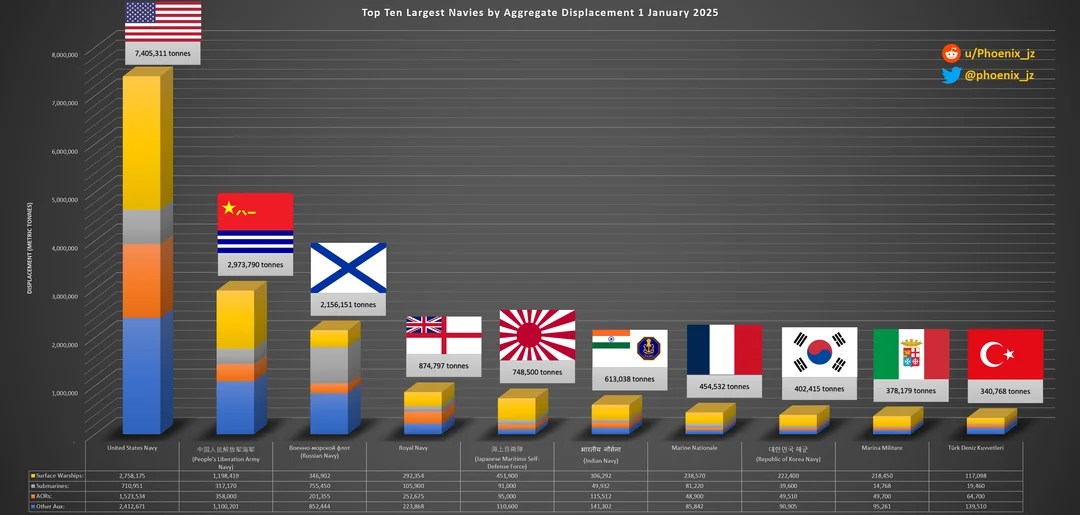
“Top Ten Navies by Aggregate Displacement, 1 January 2025” –Analysis and diagram by Phoenix_jz

This is becoming an annual thing. I do not know but he has produced a version of the graphic above annually and provides brief additional analysis. I just pass it along. You can check out the entire accompanying discussion here.

The graphic above will be hard to read unless you click on it to enlarge.

Again, the author also listed Navies 11–20 in the comments, “No.11 to 20 are as follows for 1 January 2025;”

  • 11: Indonesia – 330,200t
  • 12: Taiwan – 276,166t
  • 13: Egypt – 232,046t
  • 14: Spain – 229,373t
  • 15: Germany: 226,952t
  • 16: Australia: 216,594t
  • 17: Greece – 189,184t
  • 18: Brazil – 163,805t
  • 19: Chile – 161,404t
  • 20: Canada – 143,242t

Note, Coast Guards are not included in this analysis. This leads to some distortion since navy operated Offshore Patrol Vessels (OPVs) and patrol craft are counted as combatants, but coast guard operated OPVs and patrol craft are not counted at all. The US, China, Russia, Japan, India and South Korea all have substantial sea-going coast guards, notably the UK and France do not. The Indian Navy in particular has a large number of Navy operated OPVs and patrol craft.

Just for reference the US Coast Guard’s projected eleven NSC and 25 OPC program alone would amount to 173,000 tons not to mention icebreakers, buoy tenders, and patrol craft. The total projected 64 Fast Response Cutters would add 23,360 tons.


Hello all!

The fourth edition of my top ten navy list arrives with 2025! For those unfamiliar, here are links to 20222023, and 2024, with a general explainer for the whole concept in that first 2022 edition.

The long and short of it is that this graph reflects a personal tracker I keep of almost every large and moderately sized navy, and calculates the aggregate displacement of these navies. It’s not a perfect way to display the size of navies – far from it in fact – but it is at least more representative than counting numbers of hulls alone, in my opinion.

To break down what each of these categories mean;

  • Surface Warships is an aggregate of all above-water warships and major aviation and amphibious assault platforms. This category includes CVNs, CVs, CVLs, LHDs, LHAs, LPDs, CGs, DDGs, FFGs, corvettes, OPVs, CPVs, lighter patrol craft, and MCM vessels.
  • Submarines is what it says on the tin – SSBNs, SSGNs, SSNs, SSKs, and for select nations where applicable (and where information is available), special purpose submarines. Please note dedicated training submarines are counted separately.
  • AORs includes all major fleet replenishment vessels (coastal vessels do not count, however).
  • Other Auxiliaries is a very wide net that essentially captures everything else. Special mission ships, support vessels, minor amphibious assault vessels (LSDs, LSTs, LCAC’s, LCM’s, LCU’s), training vessels, tugs, coastal support vessels, hydrography ships – all essential parts of navies, but generally often paid less attention to as they’re not as flashy as the warships proper.

Interesting trends in data that I thought I would share for various navies, and thoughts and observations otherwise;

The USN’s position remains unimpeachable, and record a slight increase in both overall tonnage (+11,983t, or 0.16%) and numbers of vessels (net +2), commissioning an LPD, a destroyer, an SSN, and three LCS against the decommissioning of four Ticonderoga-class ‘cruisers.’ It is interesting to note that with these commissioning’s, there are only two more LCS – one of each class – and two remaining Flight IIA Burke’s left to enter service before the torch is entirely passed to the Flight III Burke (ten of which are currently building or fitting out) and other future platforms. Only nine of the venerable Ticonderoga-class remain in service.

The PLAN (China–Chuck), no one will be surprised to hear, increases in displacement again this year, though the on-paper 74,350t (+2.56%) from last-years figure does include some ‘fluff’ – I corrected the displacement of the Type 055 up 1,000t and split off the Type 052D’L’ (12) from the Type 052D’s, which netted +9,800t for the PLAN from thin air. 2024 was a relatively light growth year for the PLAN, with only a two new major warships entering service – the first Batch IV Type 052D and the first Type 054B. That being said, several ships are in advanced stages of trials and likely follow in very early 2025 (the second Type 054B and two other Batch IV Type 052D). There is also an addition of at least one new Type 039C SSK – though for full transparency, while I have three vessels listed presently, there is probably ±2 boat margin of error given the difficulty with tracking individual PLAN boats with open-source data. The rest of the increase comes from the auxiliary category in general, with the most notable of these being a second Type 927 ARS (submarine rescue ship, different from the AGOS formerly dubbed Type 927 but now Type 816). I have also struck a pair of Type 053 variants that have clearly left service.

Despite the modest growth, 2024 has been a big year for PLAN-related shipbuilding, crowned by the launch of the Type 076 LHD – a unique catapult-equipped amphibious assault ship – but one that has also seen the launch of the second Type 055 Batch II (with two more in build) and two more Type 052DL destroyers. Additionally, three Type 054AG frigates have been launched – a new, lengthened variant of the Type 054A, able to handle the Z-20 helicopters (also accommodated by the Type 055 and 052DL destroyers). The production of these additional ships and the absence of additional Type 054B builds has been a curious development that may signal the 054B as more of a transitional design, like the original Type 054 frigates, instead of a design the PLAN intends to produce at large scale (as with the Type 054A).

What is more consequential than any of these, however, is the continued launches of what is generally believed to be Type 093B SSNs from Bohai. 2024 may have seen up to three launches this year, indicating a similar pace of 2-3 boats per year as last year. This would mean that since the spring of 2022, five to seven Type 093B have been launched, compared to four American SSNs in the same period. It remains to be seen if these SSNs will just be built in a limited number, as has been the case in the past, or if the PLAN is adopting a more continuous production model for their SSN fleet (as practiced by the United States).

The VMF  (Russia–Chuck) has also seen a very slight uptick in 2024, of 3,605t (+0.17%). Combat losses in 2024 were less severe for the Russian navy than in the first two years of the Russo-Ukrainian War, but still notable. In 2024, Ukrainian forces sank two corvettes, an OPV, and an LST in the Black Sea. Despite this, arguably the largest blow Russian naval forces suffered this year was the collapse of the Assad regime in Syria and the naval base it allowed Russia at Tartus. While Russia appears to be sounding out Libyan National Army under Gen. Haftar to use Tobruk as a base (Cyrenaica, Libya), this will not be able to replace the facilities that had been built up at Tartus.

Russia’s most notable additions to its fleet this year include a fifth Yasen-M SSGN, a second Lada-class SSK, and a new Project 21180M icebreaker. Three new corvettes entered service, though this did not offset losses given the retirement of six other corvettes in addition to combat losses. The growth in the submarine force has been offset by retirements of not just aging Project 877 Kilo’s, but also the first of the deeply unsatisfactory Lada-class.

The British Royal Navy sees a reduction for a third year in a row, with 2025 looking to include an even sharper decline given cuts announced late this year. 2024 reductions include two Type 23 frigates (Argyll and Westminster) and all but the last Sandown-class MCM (HMS Bangor). This equals a drop of 11,072t tons (-1.25%).

An additional Type 23 frigate, as well as both Albion-class LPDs and the two Wave-class AORs will be decommissioned in early 2025. This is more a reduction on paper than in practice given the condition of the vessels, which had little to no chance of ever returning into service. It should be noted that while this is a cut in platforms, the up to £500M the British MoD expects to save on maintenance and refit costs for these vessels over the next five years will remain within the MoD for investment in other programs.

Perhaps the most perilous malfeasance facing the Royal Navy at present is the plight of the Royal Fleet Auxiliary, which for want of pay raises competitive with commercial shipping continues to hemorrhage mariners.

“Quentin Walsh — D-Day planner and Cherbourg liberator 80 years ago!” –MyCG

190606-N-DM308-001 A graphic illustration of the future Arleigh-Burke class guided-missile destroyer USS Quentin Walsh (DDG 132). (U.S. Navy photo illustration by Mass Communication Specialist 1st Class Paul L. Archer)

MyCG has a retelling of the life of my favorite Coast Guard Hero, Quentin Walsh. Read the whole thing, but I have quoted below the section on what he and his 53 man  SeaBee unit did in less than three weeks following the Normandy invasion.

German prisoners march out of surrendered Cherbourg under U.S. Army guard. U.S. Navy photo.

By Tuesday, June 27th, Walsh’s men had fought their way through to Cherbourg’s harbor. During this assault, Walsh moved his men quickly to occupy strategic parts of the port and take control the harbor. During the assault, the men in his unit experienced a twenty-five percent casualty rate. By the end of the day, Walsh’s unit had advanced to the city’s old naval arsenal, where he accepted the surrender of 400 German troops.

After capturing Cherbourg’s port facilities, Walsh learned that the Germans held American paratroopers in the city’s old citadel at Fort du Homet. In the highlight of the Cherbourg operation, and likely his career, Walsh and one of his officers put themselves in harm’s way to save the lives of the Americans. The two officers entered the fort under a flag of truce and met with the commanding officer of the German garrison. By greatly exaggerating the numeric strength of his small force of Sea Bees, Walsh convinced the commanding officer to surrender the stronghold. With the surrender of Fort du Homet, Walsh and his men disarmed another 350 German troops and liberated over fifty American prisoners.

I have added this story to my Heritage page. There is an earlier post here reporting that the Secretary of the Navy had announced the decision to name DDG-132 after Walsh while on the deck of USCGC Eagle, in Cherbourg, June 6, 2019.

USS Quentin Walsh (DDG-132), a Flight III Arleigh Burke class destroyer, is to be built by Bath Iron Works.

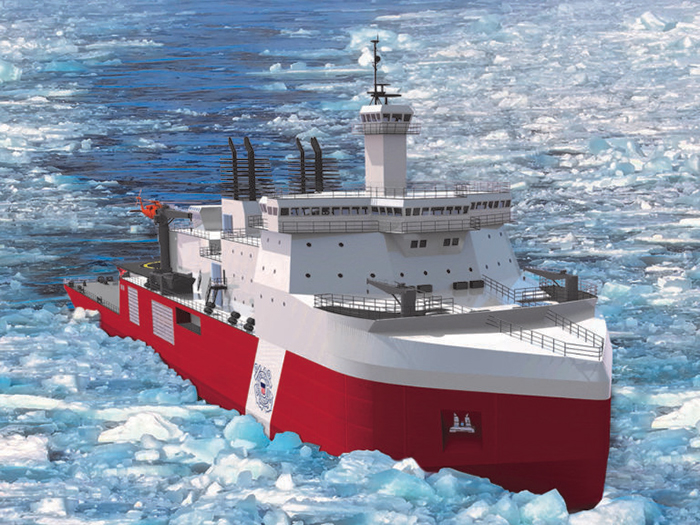
“Coast Guard building nation’s first Polar Security Cutter” –Coast Guard News

USCG Polar Security Cutter [Image courtesy Halter Marine / Technology Associates, Inc.]

Some good news. Below is a news release from Coast Guard News.

The design for the Polar Security Cutter (heavy icebreaker) is sufficiently mature to allow construction, and the shipyard has shown that it can do this type of construction.

Even so, delivery is not expected until 2030.


Dec. 23, 2024

Coast Guard building nation’s first Polar Security Cutter

The U.S. Coast Guard and U.S. Navy Integrated Program Office received approval Dec. 19 to begin building the first Polar Security Cutter (PSC).

The PSC marks the first heavy polar icebreaker to be built in the United States in more than five decades.

The work is being performed by Bollinger Mississippi Shipbuilding in Pascagoula, Mississippi, the prime contractor for design and construction of the future PSC fleet. This decision continues work that has been underway since the summer of 2023 as part of an innovative approach to shorten the delivery timeline of these critical national assets.

The approval incorporates eight prototype fabrication assessment units (PFAUs) currently being built or planned. The PFAU effort was structured as a progressive crawl-walk-run approach to help the shipbuilder strengthen skills across the workforce and refine construction methods before moving into a full-rate production. The PFA has prepared the government and the shipbuilder to begin construction of the PSC class, resulting in more precise, cost-effective and reliable construction processes.

The Coast Guard’s operational polar icebreaking fleet currently includes one heavy icebreaker, the 399-foot Coast Guard Cutter Polar Star, commissioned in 1976, and one medium icebreaker, the 420-foot Coast Guard Cutter Healy, commissioned in 1999.

The service recently acquired a commercially available polar icebreaker to provide additional presence and mission capability in the Arctic.

For more information on the PSC class visit the Polar Security Cutter website.

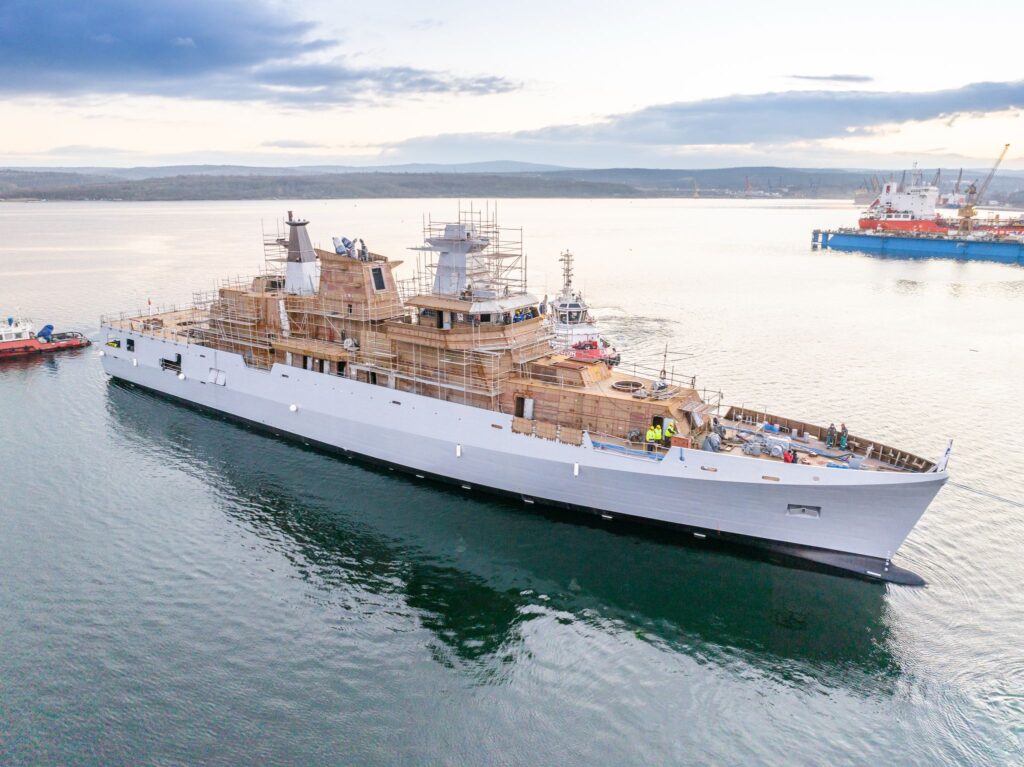
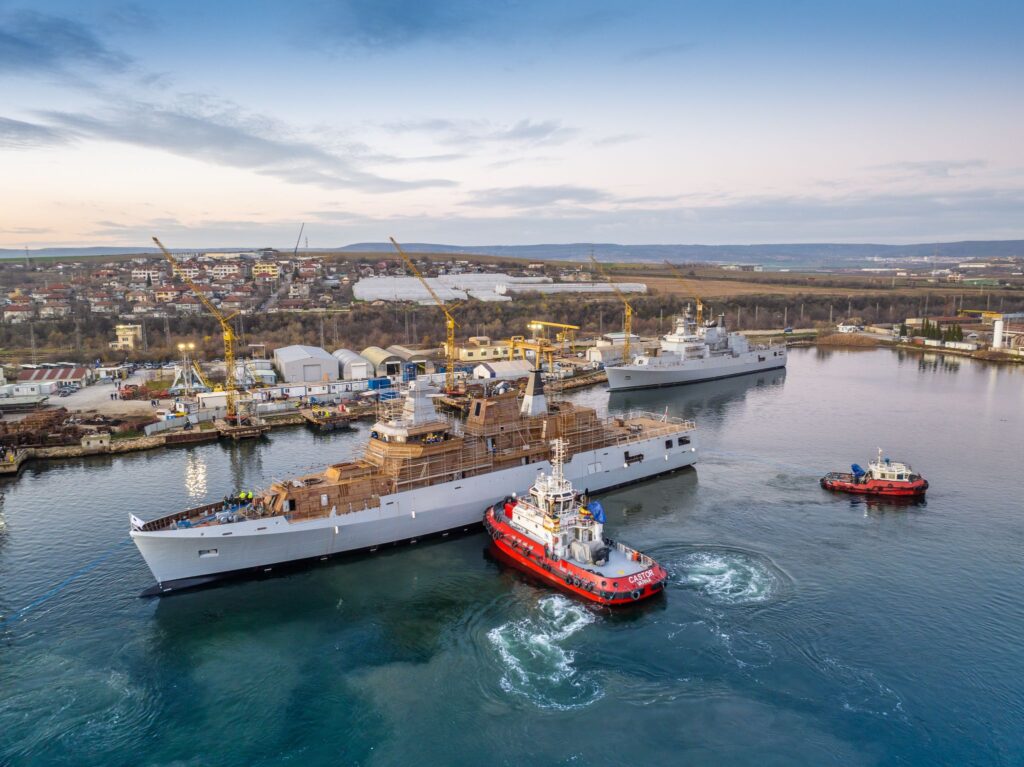
“Bulgaria’s Second MMPV Launched by Local Shipyard” –Naval News

Naval News reports,

The second of two MMPVs (Multipurpose Modular Patrol Vessels–Chuck) was launched ahead of schedule. According to the contract, it was supposed to take place in April 2025. The two MMPVs are being built under a contract signed November 12, 2020 between the Bulgarian Ministry of Defence and the German shipbuilding group Fr. Lürssen Werft (now NVL – Naval Vessels Lürssen). The vessels will cost about BGN 984 million gross (about EUR 503 million).

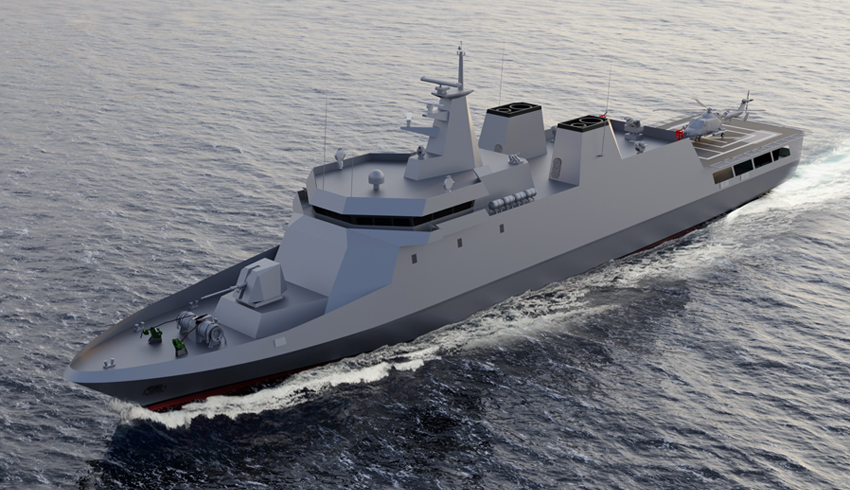
These are a significant step up from the earlier Lürssen designed 80-meter Darussalam class built in Germany for the Royal Brunei Navy and the Arafura class building in Australia.

They are to be equipped with two twin launchers for RBS15 Mk3 anti-ship missiles, 8 cells for MBDA VL MICA surface to air missiles, Leonardo OTO Super Rapid 76mm gun, Rheinmetall Millennium 35mm CIWS, and 324mm light weight ASW torpedoes. They will have a SAAB combat management system and a hangar for a Eurocopter AS565MB Panther helicopter, an aircraft that is an evolution of the H-65 design.

Specifications indicate:

  • Displacement: 2,300 tons
  • Length: 90 meters (295′)
  • Beam: 13.5 meters (44.3′)
  • Max Speed: variously reported as 20 to 24 knots
  • Range: 3000 nautical miles at 14 knots.
  • Crew: 70

These ships remind me very much of the new Damen designed Pakistani 2,600 ton, 98 meter OPVs. The layout is much the same:

  • Gun and VLS AAW system forward of the bridge elevated above the main deck
  • Anti-ship cruise missiles behind the bridge
  • Uptakes
  • Hangar with a 35mm CIWS mounted on the roof
  • Flight deck that extends all the way to the stern
  • Reconfigurable space below the flight deck.

Reconfigurable space is becoming common but what really sets these two classes apart from other OPVs is the VLS launchers for small surface to air missiles. On the slightly larger Pakistani ships, which appear more capable, the missile is a bit larger and the gun smaller. The Pakistani ship also has a pair of 30mm guns similar to the Mk38 Mod4.

I think we are going to start seeing this general layout on more OPVs in the future.

Given the need for more than the currently planned 36 large cutters, and the increasingly hostile geopolitical environment, building something like these smaller, cheaper, but more combat capable ships, in greater numbers, rather than the last ten planned OPCs might be worth considering.

I would suggest we could build a cutter with configurable space sufficient to support a towed array, a flight deck, hangar, and magazines sufficient to support an MH-60R, eight Mk41 VLS (sufficient for16 ESSMs and four vertical launch ASROCs) forward of the bridge. Launchers for up to eight Naval Strike Missiles (we don’t need to carry the missiles themselves all the time), SeaRAM, and one or two 30mm Mk38 Mod4s. This should all be possible on a 25 knot ship of less than 3000 tons.

Korean Built Ships for the Philippine Navy and Coast Guard –Naval News

Naval News has a new post, “HD HHI Pitches Horizon 3 Frigates, Corvettes and White Hulls to Manila” that includes the video above.

HD HHI has delivered two “frigates” to the Philippine Navy and has contracts for six offshore patrol vessels (OPV) and two corvettes. Hyundai apparently hopes to continue this successful collaboration with proposals to meet Philippines requirements for larger and more capable “Horizon 3” frigates and for Philippine Coast Guard cutters.

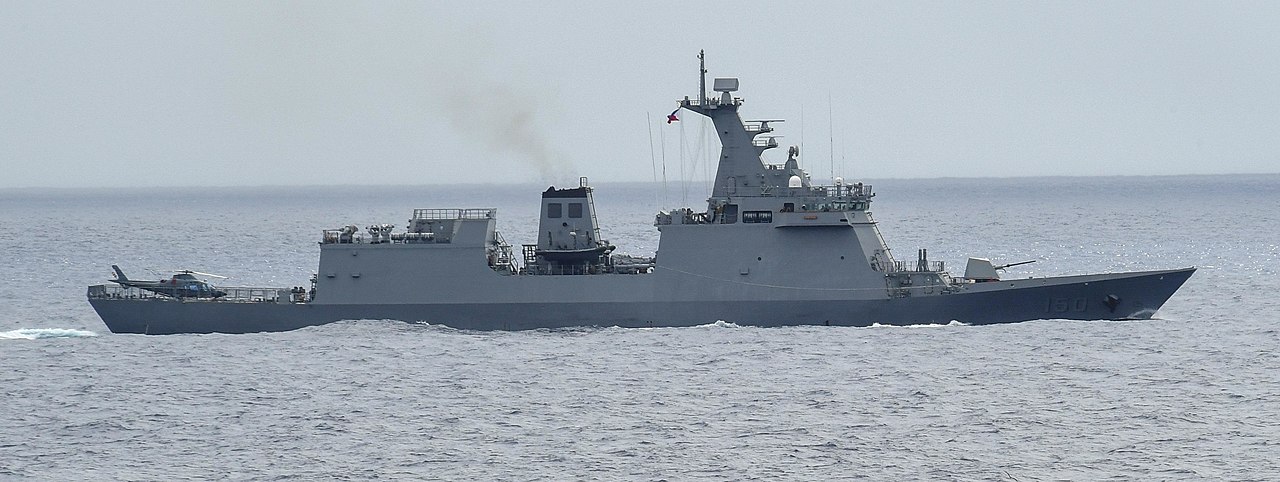
200820-N-TT059-2393 PACIFIC OCEAN (Aug. 20, 2020) Republic of the Philippines Navy ship BRP Jose Rizal (FF 150) participates in a tactical maneuvering drill with U.S. Coast Guard ship USCGC Munro (WMSL 755) and U.S. Navy guided-missile cruiser USS Lake Erie (CG 70) during exercise Rim of the Pacific (RIMPAC) 2020. (U.S. Navy photo by Mass Communication Specialist Seaman Lily Gebauer)

The two Philippine 2,600 ton Jose Rizal class frigates (pictured above) are smaller than the former USCG Hamilton class cutters (3200 tons). The follow-on (3,200 ton) Miguel Malvar class corvettes (or light frigates) will be larger and more capable. The Horizon 3 Frigate will be larger still.

The six Philippine Navy Offshore Patrol Vessels (above) will be 2400 tons full load; 94.4 meters (310′) in length; 14.3 meter (47′) of beam; with a maximum speed of 22knots; and a maximum range of 5,500 nautical miles at 15 knots. It appears they will be armed with a 76mm gun, two 30mm guns, and two Simbad-RC twin-Mistral missile launchers. HHI is proposing cutters based on this design for the Philippine Coast Guard.

Will the Philippine Coast Guard arm its cutters? Currently no Philippine Coast Guard (PCG) vessels have any weapons larger than .50 caliber machine guns, but the models of possible future Philippine Coast Guard vessels all carried some type of installed weapons system, apparently 30mm, 40mm, or 76mm. Was this because the PCG intends to field larger weapons or just because that is the way South Korean CG cutters are armed? The twin 35mm Gökdeniz close-in weapon system (CIWS) mounted on the new corvettes and that appears on the model of the proposed Horizon 3 frigate would be very appropriate for the Philippine Coast Guard.

There is an interesting statement at the end of the post,

“HD HHI plans to realize its ‘Pacific-Rim Belt Vision’, establishing regional hubs in countries such as the Philippines, Peru, Australia, Saudi Arabia, and the United States (emphasis applied–Chuck) based on its advanced shipbuilding technologies.”

“French Navy’s New Offshore Patrol Vessels to Feature Anti-Drone Detection System.” –Navy News/Army Recognition

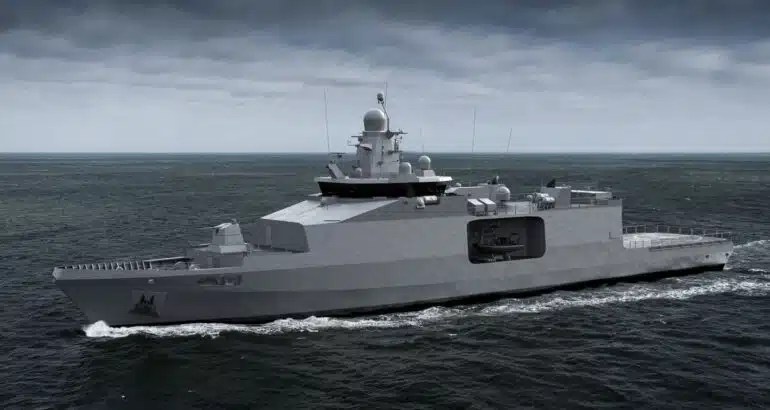
A model of the future French Navy’s Offshore patrol vessel at Euronaval 2024 in Paris, France. (Picture source: Army Recognition) Click on the photo to enlarge.

Army Recognition’s Navy News reports,

“According to a PR published by Cerbair on November 5, 2024, the French Navy’s new offshore patrol vessels, commissioned by the French Defense Procurement Agency (DGA) in 2023, will soon benefit from enhanced protection against drone threats. The French Navy ordered a fleet of seven vessels that will incorporate CERBAIR’s navalized radio frequency (RF) detection system, ensuring a level of security against increasingly sophisticated drone threats. This strategic move is a culmination of years of collaboration among CERBAIR, the French Navy, and key defense industry partners such as Naval Group, CMN, Piriou, and Socarenam shipyards.”

The USCG is also concerned about drone threats. The post seems to be talking an electronic warfare system. The National Security Cutters, Offshore Patrol Cutters, and 270 foot WMECs all have or will have electronic warfare systems. Their effectiveness (or not) against drones is not clear.

Probably the most effective thing the US Coast Guard could do against drones in the short term is to trade the 25mm guns they have in Mk38 mounts for 30mm guns that have airburst ammunition available. That could provide a capability on the OPCs, the SLEPed WMEC270s, and most importantly the FRCs as the units most likely to encounter this threat.

There are two different 30mm chain guns. Both fire airburst ammunition. The 25mm may be better than the 30mm M230/914 family that use the lower velocity 30x113mm round for countering surface threats, but we know the 30mm Mk44 Bushmaster II/XM813 is significantly better than the 25mm against surface targets as well as air targets.

The Army Recognition post included a new photo of a model of the new class of Offshore Patrol Vessels, so thought we might take another look at the program.

These seven ships, which will perform coast guard like missions, were ordered almost exactly a year ago, 17 November 2023 and are expected to be delivered from 2026 to 2030. Three additional ships are expected to be delivered 2031,2032, and 2033.

Artist impression of the Patrouilleur Hauturier OPV underway. Naval Group image.

Wikipedia reports these vessels will be 92 metres (302′) long and will have a fully loaded tonnage of approximately 2,400 tons. They will have a range of 6,000 nautical miles @12 knots with maximum speed of 21 knots. 

“They will be able to accommodate 84 people on board (crew and passengers combined). They will be able to take on board the Navy’s EDO NG and ECUME NG (RHIBs–Chuck). The hangar and the aft deck will be able to accommodate the future Guépard Marine (H160M Cheetah helicopter–Chuck) or a VSR700 type helidrone .

The patrol boats will be equipped with the RapidFire Naval close-quarters weapon system, designed by Nexter and Thales around its 40 CTC telescoping ammunition cannon, equipped with an optronic fire control system, a range of 4,000 m and a rate of fire of 200 rounds/min. They will be equipped with Thales’ Bluewatcher hull sonar as part of their mission to support nuclear deterrence.” (Force Protection for French ballistic missile submarines–Chuck)

I did a post about the gun in 2016.

Late addition. Naval News has a post about this new class. It includes the video below.

“Philippine Coast Guard to Receive 40 Patrol Boats from France in $438 Million ODA Project” –USNI

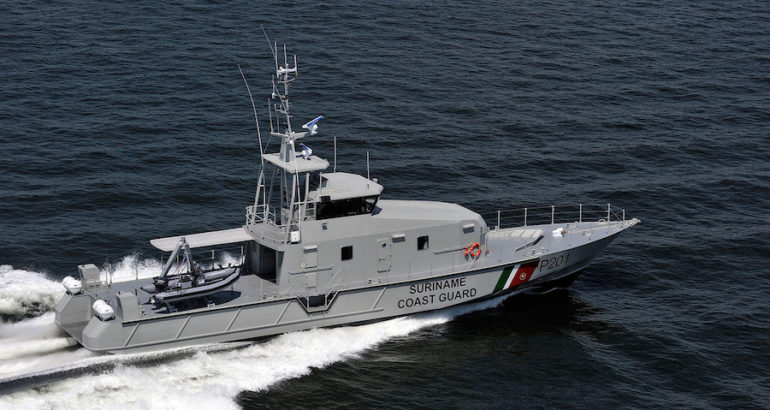
A Suriname Coast Guard FPB 98 patrol boat (Credit: OCEA)

The US Naval Institute News Service reports,

France is set to provide 40 patrol vessels and logistical support to the Philippine Coast Guard following the approval of a $438 million aid project to enhance Manila’s maritime security capabilities across the country’s waters.

The French official development assistance-funded acquisition project of 40 Fast Response Crafts, approved during Tuesday’s National Economic and Development Authority Board meeting, will effectively quadruple the Philippine Coast Guard’s fleet.

The craft are reported to be 30-35 meters in length. 20 are to be built in France and 20 in the Philippines.

There are no specifications for the patrol boats included in the article, but it does state that OCEA is expected be the French shipbuilder that will provide the design and build the first 20. OCEA has already committed to building a shipyard in the Philippines and has previously built vessels for the Philippine Coast Guard (here and here).

There is a good chance the new patrol boats will look a lot like the one pictured above, a class built for Suriname, Algeria, Ukraine, and French Customs. They are powered by two 3,660 HP Caterpillar diesels using waterjets. Specs on the Algerian boats as follows.

  • Displacement: 100 tons
  • Length: 31.8 meters (104’4″)
  • Beam: 6.3 meters (20’8″)
  • Draft: 1.2 meters (3’11”)
  • Speed: 30 knots
  • Range: 900 nmi @ 14 knots
  • Crew: 13

These will be faster and more maneuverable than most of the China Coast Guard and maritime militia vessels that contest Philippines sovereignty in the South China Sea. If they can stand up against Chinese water cannon, they should be a valuable asset.

The Philippine Coast Guard is still not arming even their largest vessels with anything larger than .50 caliber.

“Russia Selects India Over China To Construct Its ‘Cutting-Edge’ Icebreaker Ships; But Why Delhi Over Beijing?” –Eurasian Times

Russian Icebreaker Viktor Chernomyrdin, the largest diesel-electric icebreaker ever built by a Russian shipyard

The Eurasian Times reports,

Russia has chosen India over China for its non-nuclear icebreaker construction program. This decision comes as Russia seeks to develop its Northern Sea Route (NSR) and navigate the challenges posed by Western sanctions…In a significant move towards strengthening maritime cooperation, the Indian government is in talks with two shipbuilders—one state-owned and the other private—to construct four non-nuclear icebreaker ships valued at over Rs 6,000 crores ($750 million).

Does this really signify a preference for India over China? Not really, “…shipyards in China, South Korea, and Japan are fully booked until at least 2028.” India is probably eager for the business. Relations between Russia and India have been good for decades. While India has moved closer to the US in response to Chinese aggressiveness, India has maintained ties with Russia.

India has been developing their ship building industry, and logically they have the cheap labor that could make them very competitive, but they still lag far behind China, S. Korea, and Japan. That Russia is not building these ships in Russia is an indication of the weakness of their own shipbuilding industry.

I don’t think India has ever built an icebreaker. There is no indication of how large or powerful these icebreakers would be other than the price, four for $750M. (That is four icebreakers for about half the price of a Polar Security Cutter.) If this happens, it will be worth watching.

“Austal USA Cuts Steel on Yard’s First Offshore Patrol Cutter, First OPC Argus to Sail in Winter” -USNI

Future USCGC Pickering (Image: Austal USA)

The US Naval Institute news service reports Austal has begun to cut steel for the future USCGC Pickering, the first of eleven Offshore Patrol Cutters contracted to be built by Austal if all options are exercised.

The first four OPCs (915-918) are being built by Eastern. Rear Admiral Campbell, Acquisitions Directorate (CG-9), went on to say of Argus (915) the first of the four, “Dock trails start probably in January and get underway in the early spring and the acceptance trails in [the] third quarter of [Fiscal Year 2025],”

It will be interesting to see if the fourth Eastern OPC (918) is actually delivered before the first Austal OPC (919).

Below is the Acquisitions Directorate’s news release about the event.


Production begins for the Coast Guard’s fifth offshore patrol cutter

The Coast Guard joined Austal USA on Aug. 29 at the contractor’s facility located in Mobile, Alabama, to mark the start of production of the fifth Offshore Patrol Cutter (OPC), Coast Guard Cutter Pickering. Pickering is the first of up to 11 cutters that will be delivered to the Coast Guard through the Stage 2 contract with Austal USA and the fifth OPC to enter production.

Pickering is named after a Revenue Cutter of the same name, built in 1798. That vessel was named in honor of the second Secretary of War, Timothy Pickering. Pickering, who later served as Secretary of State before becoming a U.S. senator and member of the House of Representatives from Massachusetts, advocated for and oversaw the construction of the first frigates built to enforce tariff and trade laws and to prevent smuggling. The cutter is the third Coast Guard vessel to carry the Pickering name. In addition to the Revenue Cutter Pickering, the Coast Guard operated a concrete-hull floating base in the 1920s. The newest addition to the Pickering legacy is expected to be delivered to the Coast Guard in late 2027.

OPCs play an important role in addressing the Coast Guard’s long-term need for cutters that can deploy independently or part as a task group. The OPC will provide a capability bridge between the national security cutter, which patrols the open ocean in the most demanding maritime environments, and the fast response cutter, which serves closer to shore. The ships will feature state-of-the-market technology and will replace the service’s 270-foot and 210-foot medium endurance cutters, which are becoming increasingly expensive to maintain and operate. OPCs are a part of the Department of Homeland Security’s layered security strategy, performing a variety of missions such as responding to disasters, rescuing mariners, performing drug interdictions, uncovering smuggling activities and enforcing fisheries laws.

For more information, visit the Offshore Patrol Cutter Program page.

New Japan Coast Guard Base Ship?

Alex Luck
@AlexLuck9
“Japan intends to procure a very large coast guard hull suitable for supporting helicopter ops and extended EEZ deployments as a “mobile base”, to be commissioned towards 2030.
Reminder that size growth of coast guard assets is a general trend.”

Pulled from X, no idea of the source or validity.

Thanks to Sven for bringing this to my attention.