Wanted to pass this along. A little less than a half hour, but a good way to get up to speed on an emerging weapons technology. It also includes a lot of background on torpedoes.
I would only add that these are likely to be used as terrorist weapons as well as weapons of war.
H. I. Sutton is probably the leading unclassified source for information on unconventional naval warfare systems and has also been a great source on maritime drug smuggling technology. He has a website, “Covert Shores,” that is included on my “Recommended Blogs” page. He is also widely published in the popular press including by the US Naval Institute and in Naval News. He has also published several books.
Shahed-136One Way Attack Uncrewed Air Vehicle (), Source: Covert Shores
Covert Shores makes some interesting observations and asks pointed questions particularly in regard to the terminal homing phase of how the low-cost slow cruise missiles make their attacks on moving targets.
Hitting fixed target in Ukraine is very different from hitting a moving target hundreds of miles off the coast. Even an oil tanker is very small in the vastness of the ocean. The mission would need target location intelligence, and the drone would need targeting during its attack phase. The former is the same for any anti-ship weapon and can be achieved by patrol aircraft, fishing boats. Or, as possibly the case in the Chem Pluto attack, by the target broadcasting its position via AIS (automated information system).
The final phase targeting is more interesting. We do not know, at least in the public sphere, how the drones targeted the tankers. Whether it was a human-in-the-loop camera, or some form of automation.
Do they have satellite communications? Target recognition software? Home on AIS?
Presumably we have recovered at least one of the failed drones and can answer the question, but there is an even simpler solution.
Forward observers in one or more of the many Dhows that traffic the area, who call in a UAV when they have a target, and who can take over control of the drone when it arrives on scene, steering it into the target. This would be a continuation of what we saw with the Houthi remote control explosive motorboats, which unlike the USVs we are seeing in the Russo-Ukraine War, had no satellite link and were apparently steered by a second vessel within line of sight of the target and the attacking USV. It is not unlikely the Iranians and Houthi have a network of such nondescript vessels.
The slow speed of the UAVs does present something of a challenge in getting to the right place at the right time, but that is mitigated by the predictability of shipping lanes and the consistent speed of merchant vessels.
While the Unmanned Surface Vessel was identified as a MARTAC T38 Devil Ray USV, the weapon was not identified. I think we can be pretty the “Lethal Miniature Aerial Missile System” was the AeroVironment Switchblade 300 launched from their Multipack Launcher (MPL).
I have suggested this weapon would be almost ideal for the Coast Guard, should they need to stop a terrorist attack using a small, fast, highly maneuverable boat.
As a counter such an attack, this weapon is far better than a 7.62mm or .50 caliber machine gun.
It has a range of up to 20km so it could engage a target far earlier than a machine gun and from outside the effective range of hostile small arms fire.
With a sprint speed of 100 mph (87 knots) it can cover the 2200 yards nominal effective range of the .50 caliber in about 45 seconds.
It has demonstrated a high probability of a first round hit on target.
It has a man in the loop function so it can be aborted if necessary.
There is little danger of collateral damage compared to firing multiple bursts from a crew served machine gun mounted on a bouncing highspeed boat.
Exercise Digital Talon Advances Unmanned Lethality at Sea
MANAMA, Bahrain –November 02, 2023
U.S. Naval Forces Central Command (NAVCENT) is advancing lethality and the combat capabilities of unmanned surface vehicles (USVs) during live weapons firing exercises in the international waters surrounding the Arabian Peninsula, Oct. 23.
The firing exercises were conducted as part of Exercise Digital Talon and constituted the first use of lethal munitions from USVs in the Middle East region.
During the exercise, NAVCENT’s Task Force 59, the Navy’s first Unmanned and Artificial Intelligence Task Force, demonstrated the ability of unmanned platforms to pair with traditionally crewed ships in “manned-unmanned teaming” to identify and target simulated hostile forces at sea. The hostile forces were represented through the use of a target boat. Then, using live munitions launched from another unmanned platform, NAVCENT forces engaged and destroyed the targets.
During multiple firing events, a MARTAC T38 Devil Ray USV, equipped with a Lethal Miniature Aerial Missile System, successfully scored direct hits each time. A human operator ashore at Task Force 59’s Robotics Operations Center made the engagement decisions.
Digital Talon was coordinated with and supported by Commander, Special Operations Forces Central Command.
This exercise is the second time in as many months the U.S. Navy has successfully demonstrated advanced unmanned capabilities in the region, according to Vice Adm. Brad Cooper, NAVCENT commander. In September, unmanned underwater surface and aerial vehicles were able to track Iranian Navy and Islamic Revolutionary Guard Corps Navy ships and small boats over several days during routine patrols in and around the Strait of Hormuz.
“We are focused on the operational application of new, cutting-edge unmanned systems and artificial intelligence technologies. Last month, we integrated 12 different unmanned platforms with manned ships for ‘manned-unmanned teaming’ operations to conduct enhanced maritime security operations in the waters surrounding the Arabian Peninsula,” he said. “During Digital Talon, we took a significant step forward and advanced our capability to the ‘next level’ beyond just maritime domain awareness, which has been a traditional focus with Task Force 59. We have proven these unmanned platforms can enhance fleet lethality. In doing so, we are strengthening regional maritime security and enhancing deterrence against malign activity.”
Looking ahead, Cooper said, he expects to see the progress expand in scale and impact, including future exercises expanding the arsenal of combat-capable unmanned systems.
“I’m excited about the direction we’re headed,” he said.
U.S. Naval Forces Central Command/U.S. 5th Fleet’s area of operations encompasses about 2.5 million square miles of water area and includes the Arabian Gulf, Red Sea, Gulf of Oman, Gulf of Aden, Arabian Sea and parts of the Indian Ocean. This expanse, comprising 21 nations, includes three critical choke points at the Strait of Hormuz, the Suez Canal and the Strait of Bab al Mandeb.
I certainly applaud the exploits of the Ukrainian Navy in taking the fight to the Russians using innovative means, here and here, but let us look at this from the prospective of the defender.
Naval Blogger Cdr Salamander offers some thoughts on the lessons of the recent attack on the Russian Navy Base in Sevastopol, but I think he may be selling the Russians short, under estimating the effort they put forth and suggesting that we would have done much better.
Quite properly he puts the attack in a historical context and calls for the US to be ready for similar attacks on US assets in US ports, but I have to take issue with his apparent belief that the Russian did not attempt to prepare for this type of attack.
This is another demonstration that the military culture of Russia is broken. The human element in the Sevastopol was manifested in the complete lack of preparation for the attack in spite of the warnings so clearly provided in September.
The Russians have a history of their ships being attacked in port that goes back to at least the Russo-Japanese war when the Japanese opened the war with a torpedo attack on the Russian fleet inport in Port Author. The unpleasant experience was repeated in WWI and WWII. As a result they have a relatively robust coastal and harbor defense organization, maybe better than ours.
The Russians do not appear to have taken the most obvious and immediate steps to address this cheap, low-tech threat. They did not have significant barriers in place at the entrance to their harbors or around their ships’ berths. They did not have Sailors on watch with weapons at the ready.
Actually the Russians did have a physical barrier, probably a net. The shape of the bow, the shallow draft, and waterjet propulsion of the Ukrainian USVs may have allow them to jump the net.
The video above, taken by one of the attacking craft, shows an armed helicopter shooting at the craft. It seems likely this helicopter was there and airborne when the attack occured because it was part of a defense plan.
The Ukrainians applied the “quantity has a quality of its own” principle. I believe I saw a report that nine USVs were used in the attack. If only three ships were damaged, then it appears the Russians successfully countered 67% of the threat. Additionally the response might have resulted in the Ukrainians damaging easier targets, closer at hand, rather than the ones they had originally intended. From the Ukraininan point of view, the damage may have been less than they had expected or hoped for, nevertheless we see it as a success. Unfortunately for the defenders, anything less than 100% success is a failure.
Achieving 100% success is not as easy as the referenced post seems to suggest. Crew served Ma Duce .50 cal. are not adequate weapons. If the Russians had had something like APKWS, in the right places, I doubt those ships would have been damaged.
An Observation on the Ukrainian Attack Craft:
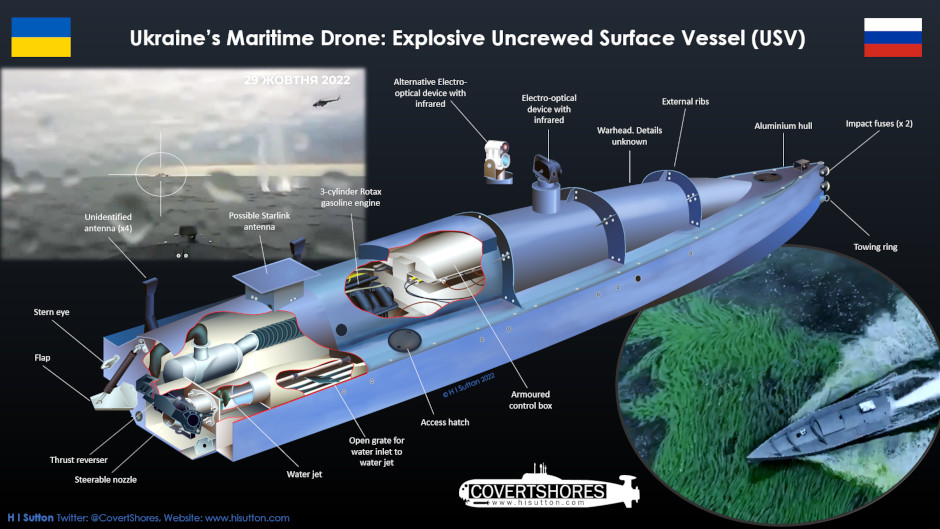
Since our first glimpse of these Ukrainian suicide drone boats, I have wondered about the “external ribs” as they are labeled above. Certainly they could be structural, but that seemed unlikely.
The most likely way to detect these craft at night is by their IR signature or seeing their wake. If the craft is pointed at you, those “ribs” might obstruct the view of the hot portions of the craft and its wake. They would also minimize light reflected from the inevitably wet top portion of the craft.
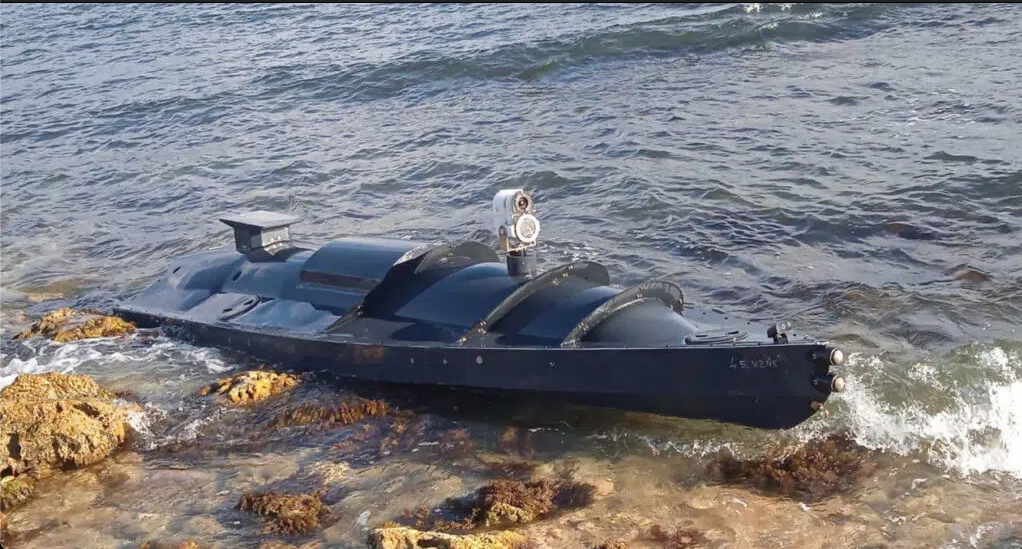
Image of the suspected Ukrainian USV circulating on Russian social media. Image via Naval News


 Chuck Hill's CG Blog