Dmitry Shulgin reports the successful test of a new rocket assisted, laser homing round, the “Guided Multipurpose Munition” (GMM), for the Carl Gustaf Recoilless Rifle (M3E1 in US service) and the AT4 single shot, recoilless, smooth bore, disposable, anti-tank weapon (designated M136 in US service).
The M3E1 is the US version of the M4. An updated M3 using titanium makes the weapon system six pounds lighter, 2.5 inches shorter and has an improved carrying handle, extra shoulder padding and an improved sighting system that can be adjusted for better comfort.
We talked about the possibility of Coast Guard use of the Carl Gustaf before. The M3E1 is now a common weapon that will arm every US Marine infantry squad. In the US Army there will be one for every platoon.
It may be that the laser guided round is only a Special Forces requirement, but after development it is almost certain to become more generally available.
This would not be a comprehensive answer to the Coast Guard need to be able to counter a terrorist attack by surface vessel, regardless of size. Even with the new round, it does not have the 4,000 yard range I believe desirable to minimize the probability of effective counter fire from improvised armament. It is unlikely to be effective against larger vessels, but, particularly with the new guided round, it could certainly be effective against small, fast, highly maneuverable threats.
There is always a concern for providing security for a highly portable weapon like this, but security requirements for these weapons and their ammunition should be comparable to that provided for machine guns.
As noted earlier, if things get hot for PATFORSWA, the cutters there could benefit from having a Marine detachment aboard that can employ the Carl Gustaf.
Other than the PATFORSWA, the first Coast Guard units that should receive armament upgrades are the force protection units that escort Fleet Ballistic Missile Subs during surface transit.
A picture taken on November 16, 2011 from a South Korean helicopter shows Chinese boats banded together with ropes, chased by a coastguard helicopter and rubber boats pacted with commandoes, after alleged illegal fishing in South Korean waters in the Yellow Sea.
Credit: Dong-A-Ilbo
“The United Nations declared June 5 an international day for the fight against illegal, unreported and unregulated (IUU) fishing in late 2017. Yet, on the fourth observance of the annual awareness campaign, the global challenges continue to grow.”
The IndoPacific Defense Forum, which is sponsored by the United State Indo-Pacific Command (USINDOPACOM) is apparently telling the nations of their area of responsibility that the Coast Guard is ready to assist them in combatting IUU fishing. Specifically that we can,
Got a response from a reader who linked a longer tale of the Coastie’s ship, LCI(L) 85: The Four- Leaf Clover. This is the story of a very small ship, about the same size as a Webber class WPC, one that did not even rate a name, in a very big war. Several crewmembers were discussed including what happened to them after D-Day and after the war. Its a great story.
I’ve added both stories to my heritage page. There are several other D-Day stories there as well.
Thanks to Tom Wade for bringing this to my attention.
Petty Officer 2nd Class Dale Veverka, a boatswains mate, Seaman George Degener, and Petty Officer 2nd Class Joshua Post, a machinery technician, conduct maneuvers on the Coast Guard Cutter Northland’s “over-the-horizon” small boat during transit to Rio De Janeiro, Brazil, April 9, 2008. UNITAS exercise, a multinational naval exercise the helps tests the interoperability of U.S. and foreign naval forces. U.S. Coast Guard photo by PA2 Nathan Henise.
The Coast Guard awarded contracts to four companies today, in a step toward acquiring the next generation of Coast Guard over the horizon cutter boats, the OTH V. The awardees are:
Blackfish Solutions LLC of Anchorage, Alaska
Gravois Aluminum Boats LLC of Jeanerette, Louisiana (doing business as Metal Shark Boats)
Inventech Marine Solutions LLC of Bremerton, Washington
MetalCraft Marine US, Inc. of Watertown, New York
Each awardee will produce a single boat that will be operated to demonstrate the actual capability of each design. Following the demonstration, a single contractor will be selected to produce the OTH V over the next 10 years. This production supports new cutter deliveries and recapitalization of OTH IVs. The total value of the indefinite-delivery indefinite-quantity OTH V contract – which includes manufacture, delivery and logistical support – is approximately $100 million.
The requirements for OTH V are similar to the prior iteration, but are intended to incorporate technology improvements. The requirements include a minimum top speed of 38 knots, powered by a diesel engine with waterjet propulsion and a minimum range of 150 nautical miles. The OTH V will carry up to 13 people, with dimensions limited to 26 feet long by 8.5 feet wide, and a performance weight of approximately 8,700 pounds. The updated cutter boat will capture technology improvements for its waterjet, as well as upgraded versions of the scalable integrated navigation and automatic identification systems. This will also be the first Coast Guard boat to include a shock monitoring system providing the crew with real-time information about wave impacts on the vessel.
The OTH V will be deployed across the Coast Guard fleet, including national security cutters, fast response cutters, offshore patrol cutters, polar security cutters and legacy medium endurance cutters. Outfitted with a robust onboard navigation and communications system, the OTH V will provide a high speed capability to extend the parent cutters’ capabilities when deployed in support of multiple Coast Guard missions.
OTH Vs will support mission accomplishment in almost all mission areas, with emphasis on search and rescue, drug and migrant interdiction operations, living marine resources, defense readiness and ports, waterways and coastal security.
The author makes a case as to why these little vessels need to be better than might be assumed. That they are in fact multi-mission vessels. He sees a massive increase in the river cruise industry.
Its an inciteful look at trends on America’s rivers and well worth the read.
A Coast Guard Cutter Valiant crew member embraces his son Feb. 27, 2020, as he returns home to Naval Station Mayport, Florida. The Valiant crew returned home after completing a nine-week patrol in the Caribbean Sea supporting Joint Interagency Task Force South. (U.S. Coast Guard photo by Petty Officer 2nd Class Ryan Dickinson)
The US Naval Institute has an article discussing the Coast Guard’s difficulty getting qualified volunteers for sea duty, Demise of the Cutterman, Part II. This article makes reference to a 2015 post, The Demise of the Cutterman. I think both are currently accessible even to non-members, at least for a limited time.
I considered that perhaps there were other reasons for the difficulties. Was it possible the difficulties were due to the change in the manning requirements of the recapitalized fleet?
Are there more sea duty billets than there were before? I checked this and there does not appear to be great difference in the gross numbers.
I compared the previous fleet of 12 WHEC 378s, 28 WMECs, and 41 Island class WPBs (81 total) to the projected fleet of 11 NSCs, 25 OPCs, and 64 Webber class WPCs (100 total).
The requirements to man 64 Webber class (24 crewmembers each) compared to 41 Island class (16 crewmembers each) required 880 additional.
This was largely offset by the change from 12 WHECs (177 crewmember each) to 11 NSCs (122 crew members each) for a reduction of 782 billets.
There has been no change in the WMEC/OPC fleet yet but the shift from 28 WMECs (requiring a total of 2449 billets) to 25 OPCs (requiring approximately 2500 billets) should only add about 51 billets.
So it looks like the recapitalization should require only about 150 additional billets or an increase of less than 3%. But the specifics of the crews composition may have changed.
I don’t have enough information to investigate these in detail but I suspect three changes have effected our ability to crew the new ships.
Do we have fewer non-rates? I suspect the percentage of the crew who are non-rates has decreased. (It is not hard to fill non-rate billets.) This means that more of the crewmembers are married and have families at home. It also means fewer non-rates are being introduced to sea duty, so the number of prior sea service personnel advancing to petty officer will be reduced. Assuming no change in the proportion of non-rates choosing to return to sea as petty officers later in their career, this will effect the future talent pool as well. It will mean fewer salty first class, chiefs, and warrant officers.
More technical ratings? Again this is a supposition on my part, but presumably the new generation of ships require greater levels of expertise to operate. This means a higher proportion of the crew is mature with more responsibilities and more attractive job possibilities outside the Coast Guard. Increasingly, individuals in this demographic will seek shore duty or choose to leave the service, which is an option for most because they will have completed their initial enlistment.
More officers required? Also a supposition on my part, but at least in the case of replacing 41 WPBs with 64 WPC, we are going from 82 officers to 256, a 210% increase. Junior officers are probably not a problem, so I presume the problem is in getting middle grade billets filled, particularly O-3 and O-4 billets. While I doubt that there is a shortage of volunteers to command Webber class WPCs, I can understand why there would be a hesitance to volunteer for other O-3 billets afloat. If you have ambitions of command afloat, and you don’t get command of a Webber class, the feeling may be that your chances for future command afloat selection are extremely slim, because those who had Webber class command will inevitably be considered better qualified.
There is a cure for this that would provide incentive to take those O-3 billets. Make an O-3 tour, e.g. department head on “big white one” or buoy tender XO, a prerequisite for command afloat as an O-3 or O-4. The result might theoretically reduce the future pool of command afloat candidates, but the pool should still be large enough, and those selected for O-3/O-4 command afloat would be more experienced and will have passed an additional layer of vetting.
National Defense provided the first report I saw on the Presidents FY2022 budget request for the Coast Guard, reporting it as flat relative to the FY2021 budget as enacted.
The Navy League Magazine, Seapower, on line edition has a pretty good summary of what is included.
Actually I find the proposed budget encouraging. $13.1B is only 0.3% larger than the enacted budget for 2021, but that is only because the Congress loves the Coast Guard and has added on to the Administration’s budget every year I have followed the budget process. This 2022 budget request is actually 6.5% greater than the corresponding initial 2021 administration request.
The Procurement, Construction, and Improvement budget is down compared to 2021 enacted budget, but it does include everything we would expect, given the end of the FRC program and the expected pace of Polar Security Cutter and Offshore Patrol Cutter procurement. On the other hand there is a substantial increase in Operations and Support.
“Under Biden’s budget, the service would see a significant boost in operations and support funding in 2022. The $9.02 billion for O&S would be $535 million, or 6.3 percent, more than it received for 2021.”
This includes substantial increases to reduce the maintenance backlog for aircraft and cutters. If you would like to check out the “Program Changes,” follow the link to the full budget document. There are 37 program changes on 20 pages, beginning on the 72nd page of the pdf. The page is labelled USCG–O&S–34.
One of these (#17) indicates new homeports for Webber class in Saint Petersburg, Sitka, and Boston expected in FY2022.
I would not be surprised to see the Congress make some additions. I’ll venture a guess, that about $300M will be added, including a C-130J and three more Webber class to counter Illegal, Unregulated, and Unreported fishing in the South Pacific. If that happens, the resulting $13.4B budget would be a three percent increase over 2021.
After the new administration has had more time to look at the Coast Guard’s programs, I hope they will see fit to accelerate the building of the Offshore Patrol Cutters and/or perhaps add a class of cutters between the OPC and the FRC.
Not directly Coast Guard related but the Army Corp of Engineers is getting a big boost for maritime related work that impacts safety of navigation and risks of flooding.
“The seven missile craft aboard Makran are each approximately 57 feet (17.5 meters) long and match the Peykaap family of medium-sized fast attack craft operated by Iran. There are several variations of these craft in Iranian service, although all are generally similar. The latest Peykaap-II type (also known as the Bavar class) is 57 feet long and can carry two anti-ship missiles and two 12.75 inch torpedoes. The missiles could be of the Kowsar or Nasr types, which are derived from Chinese models with a quite modest range of around 18 nautical miles.”
An 18 nautical mile range may be “quite modest” to the Navy, but it is twice that of anything the Coast Guard has.
The Coast Guard Cutter Naushon (WPB 1311) 110-foot Island-class patrol boat and crew conduct training in Kachemak Bay near Homer, Alaska, Feb. 16, 2018.(Picture source U.S. Defense Visual Information)
Had a question from a reader, how many 110s are still in commission with the USCG?. Figured I could get a quick answer here. We know about the four still with PATFORSWA. Looking at District web sites, I am not sure they are up to date.
The FY20222 budget anticipates decommissioning five more. So how close are we to seeing the last of these cutters in the USCG?
Looking at the Wikipedia page for “Sentinel Class Cutters,” which seems to have been kept up to date, at this point there are 20 Webber class that have not yet been delivered to the Coast Guard. Future homeports have not been associated with 17 of these.
If you know of 110s still in commission please add a note.
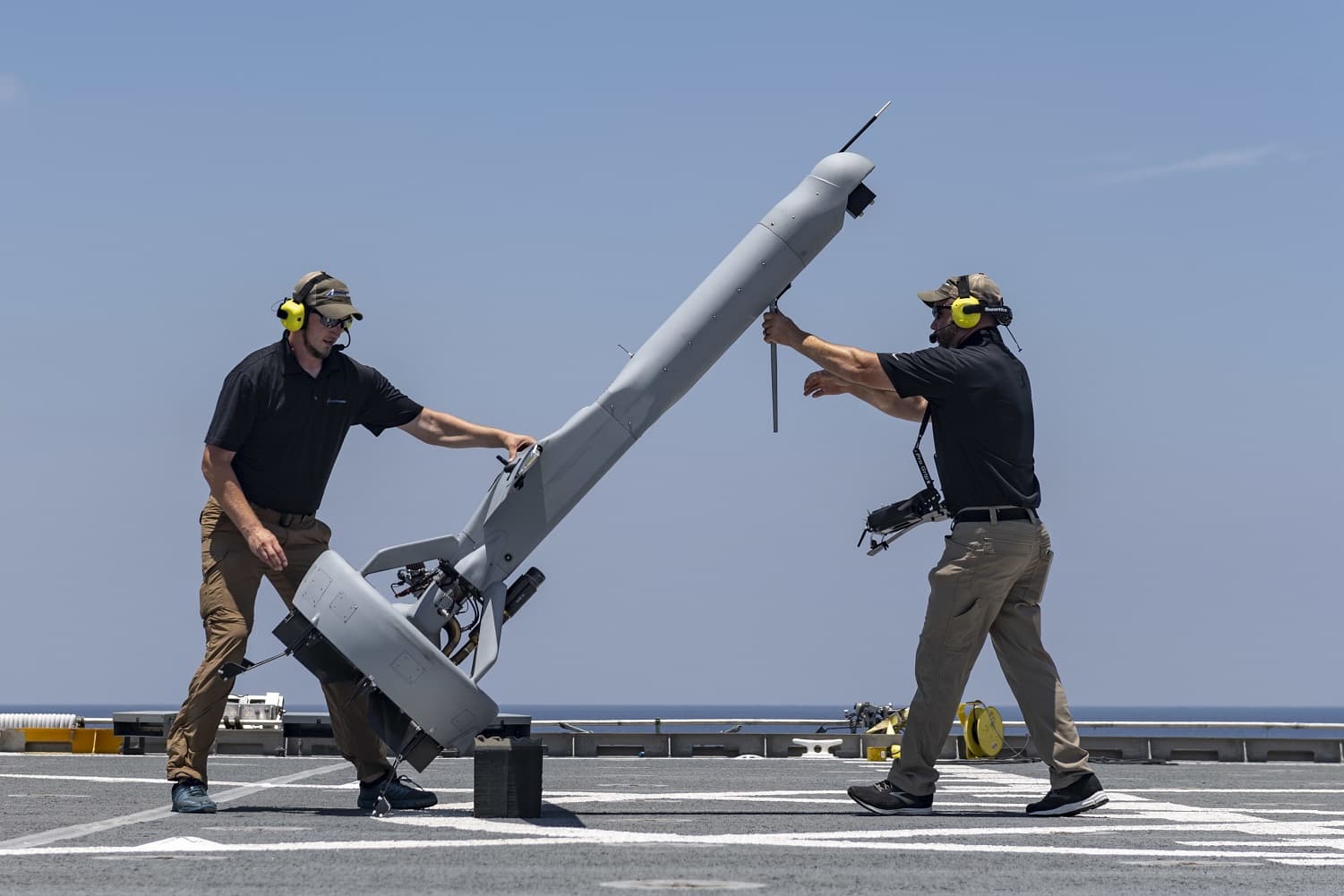
V-BAT Vertical takeoff and landing UAV. Photo by Mass Communication Specialist 2nd Class Anderson W. BranchV-Bat from Martin UAV
Martin UAV has announced improvements to their V-BAT unmanned aircraft, including increased payload and endurance.
Claimed characteristics include a 25 pound payload and an eleven hours endurance. While that endurance does not equal that of the ScanEagle, the payload is about three times greater.
“The Navy selected Martin UAV’s V-BAT for a VTOL UAS prototyping and development effort in order to fulfill new technological requirements driven by the changing nature of threats in austere operating environments.
“The V-BAT was selected to meet these requirements as a result of its minimal logistic support requirements and maximum versatility. The system offers vertical takeoff with a single-engine ducted fan, automatic transition to straight and level flight, easily commanded hovers and stares, interchangeable payloads, and an open architecture.”
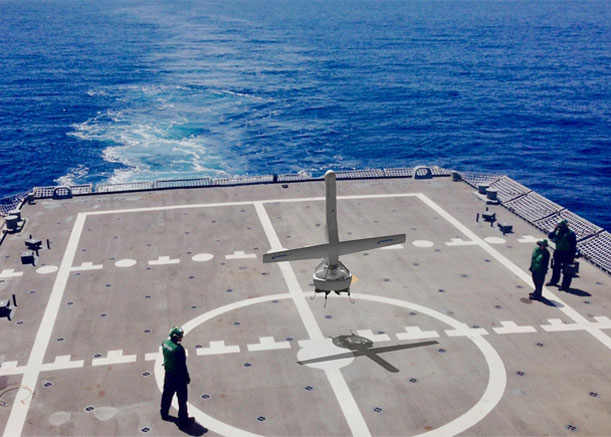
It looks like this system might be able to provide the 270s with the same sort of advantages the National Security Cutters have enjoyed with the use of Scan Eagle despite their much smaller hangar, because it does not need catapult launch or recovery equipment.
The Manufacturer claims that the V-BAT requires only a 12 x 12 foot area for take-off and landing, so a 270 foot WMEC should have plenty of space, even if it also has a helicopter inside a fully extended hangar. We can expect all the 270s to be with us for at least another 13 years, some are expected to remain in commission for at least another 17 years. It is still worthwhile to try to make them as effective as possible.
USCGC Lagare, for reference, beam of this class cutters is 38 feet.