Something from Coast Guard All Hands.
Happy Coast Guard Day
2

Something from Coast Guard All Hands.
Center for International Maritime Security (CIMSEC) had issued a call for articles on the topic of bringing back sea control. Here is a copy of their post.
By Dmitry Filipoff
Articles Due: September 3, 2018
Week Dates: September 10-14, 2018
Article Length: 1000-3000 words
Submit to: Nextwar@cimsec.orgGreat power competition is back, and with it new demands for capability and deterrence. After years of focusing on power projection and low-end missions, many first rate navies have allowed high-end skillsets to erode. As security priorities shift, navies too must change.
One vital mission for winning and deterring great power conflict is sea control, the ability to secure command of the seas. Today sea control has morphed into something of enormous complexity. It can be a convoluted contest, with platforms and payloads projecting influence across multiple domains. Navies are ever more reliant on electronic effects for warfighting functions, turning cyberspace and electronic warfare into pivotal battlegrounds for sea control. Sea control is the sum of many elements of oceanic warfare, requiring diverse skills and tactics.
In spite of technological change, sea control will remain an important mission so long as the oceans remain crucial to human progress. It is the vital prerequisite for projecting power and securing access via the maritime domain. It can enable blockades and commerce raiding, allowing a navy to exert tremendous pressure on a nation’s vitality. Sea control is a mission as timeless as naval power itself, and one deserving of thorough preparation.
How can the navies of today revitalize their sea control capabilities? How can they become proficient in high-end missions and tactics? What will achieving sea control require, and how best to use it once attained? Authors are encouraged to consider these questions and more as navies around the world reconsider their development in the context of renewed great power competition.
Dmitry Filipoff is CIMSEC’s Director of Online Content. Contact him at Nextwar@cimsec.org.
This is an opportunity for some of our readers here to express their opinions and practice their writing skills.
Does the Coast Guard have a role? I think so. Sea Control first has to be won and the USN is prepared for that fight, but it also has to be exercised. That requires a lot of low tech grunt work, not unlike boarding fishing boats. It requires separating good guys from bad guys who may try to conceal their true nature. We did this off Vietnam as part of Operation MarketTime. The Navy really has few units capable of this sort of work, but it is the sort of work the Coast Guard does every day.
I have worked with Dmitry Filipoff and he is a good guy. Time to start writing.
Belatedly, I have taken a look at the July 6, 2018 edition of the Congressional Research Service’s Naval Expert, Ronald O’Rourke’s Coast Guard Cutter Procurement: Background and Issues for Congress. It was published less than seven weeks after the previous edition.
Thought perhaps a short review of the status of the three programs addressed might be welcome.
NSC: The program of record was eight ships, but eleven ships have been funded through FY2018. Six have been commissioned. One additional delivery is expected each year, 2018, 2019, 2020 and presumably 2021 and 2022. The Senate sub-committee has expressed its intention to procure a twelfth NSC, but the FY2019 budget request did not include funding for an addition NSC. FY2020 would not be too late to fund NSC#12 and keep the delivery schedule at one per year.
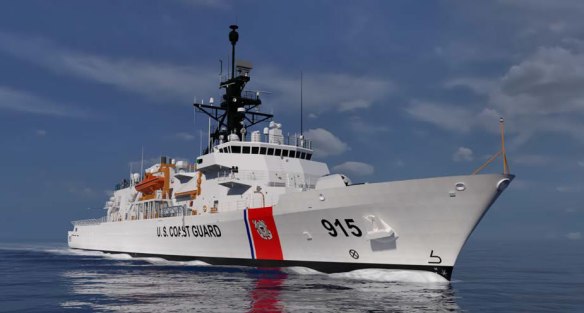
OPC: The program of record is for 25 ships. The First ship was funded in FY2018. The Second ship is in the FY2019 budget request along with long lead time items for OPC#3. If all contract options are exercised, we should see one ship delivered each year 2021, 2022, and 2023. Beginning in 2024 the program anticipates delivery of two ships per year. If they hold to that modest rate, as planned, the last OPC will not be delivered until at least 2033 at which time the newest 270 will be 42 years old. Also at that rate, the newest 210 will be 60 years old when presumably, the last of the class is replaced in 2029. (If you think keeping 40 and 50 year old cutters operational is challenging, wait until you try a 60 year old. Particularly since the Coast Guard plans no major life extension work on the 210s.)
FRC: The program of record is for 58 vessels. There is also a requirement for six more to replace the six Island class 110 foot cutters currently homeport in Bahrain as part of PATFORSWA, that are not included in the program of record. 50 Webber class have been funded through FY2018, with 28 currently in commission. Funding for four additional vessels was included in the FY2019 budget request. The Coast Guard is commissioning Webber class at the rate five vessels annually. The remaining 28 vessel will presumably be commissioned by 2024. Six additional for PATFORSWA would extend that through 2025. Apparently the Congress intends the DOD to fund the six that would go to FATFORSWA so presumably the last Coast Guard funding would be in the FY2020 budget.
If my understanding is correct, it is likely that major funding for the NSC and FRC programs will be complete in FY2020, the same year the third OPC should be funded. At some point, in the not too distant future, we will need to start the process of replacing the 87 foot WPBs, but hopefully we will find a way to accelerate the OPC procurement to something more than two a year.
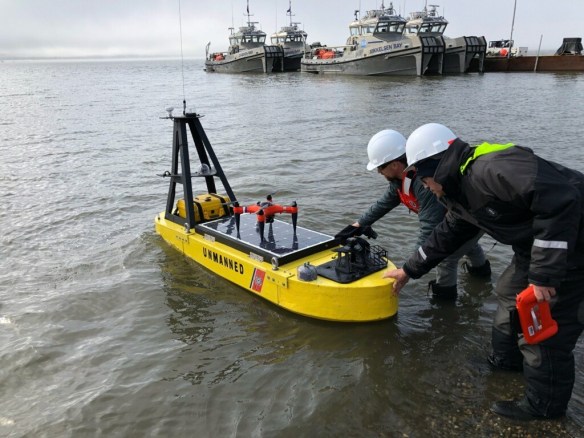
RDC researchers test the effectiveness of pairing the USV and the Splash Drone on a mission. U.S. Coast Guard photo by Alexandra Swan.
The Acquisitions Directorate (CG-9) web site is running a series to show the R&D Centers activities in the Arctic.
The Coast Guard Research and Development Center is conducting its annual operation in the Arctic, Arctic Technology Evaluation 2018, in Prudhoe Bay, Alaska, July 21 to Aug. 3. This year’s research will focus on evaluating how unmanned aircraft systems (UAS), unmanned surface vehicles (USV) and an aerostat balloon can work together as a network, and includes search and rescue and environmental mission scenarios.

National Defense Magazine reports and interview with the new Commandant, Admiral Karl L. Schultz.
These two paragraphs pretty much sum up his stance.
““My intention would be to not deviate too much,” he said. “Obviously, every change brings some different thinking, different ideas, but at our core it’s … steady as you go with trying to pick up speed a little bit.”
“As part of his guiding principles over the next four years, Schultz — who took over in June — said he is focusing on making the Coast Guard a ready, relevant and responsive service.”
He intends to push readiness in terms of operating budget.
“While the service is replacing many of its aging assets, it still has 50-year-old cutters in operation, he noted. Those vessels are expensive to maintain and the newer ships coming down the pipeline will be costly as well, he added.”
Of the new cutters, only National Security Cutters look like they might actually cost less to run than the vessels they replace, based on their smaller crew, but even that is questionable. The Webber class and the Offshore Patrol Cutters are much larger, more powerful, and have larger crews than the 110s and WMECs they will replace. While we may end up with fewer NSCs than 378s (10 v 12) and fewer OPCs than WMEC (25 v 28) it looks like we will have substantially more FRCs than 110s (only 41 WPB 110s were operational when the FRC program began and it looks like we will get at least 58).
The piece goes on to discuss icebreakers and the “waterways commerce cutter” (inland tenders). Additionally, don’t expect any change in the Coast Guard’s commitment to drug interdiction, “…we’re all in.”
Saw this on Facebook. Michael Harrington shared a link to the group: U.S. Coast Guard Retired. It was a year ago, but it resurfaced and thought I would pass it along. Below is the information that accompanied the video on YouTube.
An original musical and visual tribute to the Coast Guard written by Coast Guard veteran, singer/songwriter, Brad Fitch, Estes Park, Colorado. Music and photos © 2011 Brad Fitch. All rights reserved. Produced by Summertown Studios, Fort Collins, CO http://www.SummertownStudios.com Bob Buford, Producer
The following is a quotation in full of a post from the Acquisition Directorate (CG-9)
Coast Guard Releases Request For Information For Polar Star Service Life Extension Project
July 19, 2018
The Coast Guard released a request for information (RFI) July 18 to gather market research for the Coast Guard Cutter Polar Star service life extension project (SLEP) as part of the In-Service Vessel Sustainment Program (ISVS). The SLEP effort will recapitalize a number of major systems – including machinery control and propulsion power distribution systems – and extend the service life of the cutter by four years. The work will include a six-month long lead time material procurement and detailed design phase, followed by a minimum of three annual repair execution phases between 2021 and 2024.
The RFI is available here.
Polar Star, the Coast Guard’s only active heavy icebreaker, was commissioned in 1976. The 399-foot ship is currently responsible for nine of the 11 Coast Guard statutory missions. Each winter, the cutter travels to McMurdo Station in Antarctica as part of Operation Deep Freeze, which supports the National Science Foundation-managed U.S. Antarctic Program.
“The SLEP for Polar Star is essential to maintain year-round access to the polar regions until new heavy polar icebreakers are delivered,” said Ken King, program manager for the ISVS program. “The challenge for this program will be to balance phased SLEP work with continued Polar Star operational deployments.”
The deadline to submit responses is Aug. 3, 2018 at 4 p.m. EDT.
For more information: In-Service Vessel Sustainment program page

Photo: Typhoon MLS-ER (Missile Launch System–Extended Range)
Just ran across a manufacturer’s web page that I thought might be interesting as an example of what can be accomplished in terms of arming smaller vessels. It is not the missiles so much as the launchers I found interesting.
These are two systems from Rafael. Rafael is the designer of the Typhoon gun mount we know as the Mk38 Mod2/3 being installed on the Webber Class WPCs and planned as the secondary weapon for the Offshore Patrol Cutter.
Typhoon MLS-ER
The first of these is the Typhoon MLS-ER (Missile Launch System–Extended Range) seen in the illustration above. The system includes the 8 km range Spike ER missile and reportedly can be installed on vessels as small as RHIBs. It is similar to Hellfire in capability, except that it has the potential advantage of providing for a man in the loop who can retarget or abort after launch.
You can see what appears to be a four round launcher mounted aft on the aft superstructure. The boat seen in the photograph is, I believe, a Super Dvora III. These boats are slightly longer than the Coast Guard 87 foot Marine Protector class WPBs, but are lighter displacement.The description of this boat says that they are armed with the Typhoon gun mount, Spike ER, and Hellfire. This makes me wonder if the missile launcher can launch Hellfire as well as Spike ER.
You can see the Spike ER, as well as the 25 mm gun in the Mk38, in operation in the video below.
Below is the Wikipedia description of the Spike-ER
Extended range or extra-long range version of the weapon. It was formerly also known as the NT-Dandy or NT-D. It has a minimum range of 400 m and a maximum range of 8,000 m (5.0 mi).[23] It has a larger diameter and is heavier than the other (older Spike missile–Chuck) systems, and is usually vehicle mounted. It is used by infantry, Light Combat Vehicle (LCVs), and helicopters. The Finnish Navy’s Coastal Jaegers also operate the version in the anti-ship role. The weight of the missile is 34 kg (74 lb 15 oz), the launchers are 30 kg (66 lb 2 oz) and 55 kg (121 lb 4 oz) respectively for the vehicle and air-launched versions. Penetration is around 1,000 mm (39 in) of RHA (Rolled Homogenous Armor–Chuck).
Typhoon MLS-NLOS (e.g. Non (greater than) Line of Sight)
The second system uses the Spike NLOS, a larger, longer ranged missile. We have seen this eight cell launcher before, on 62 meter Israeli designed patrol vessel built for Azerbaijan.

TYPHOON MLS NLOS has an eight cell Spike NLOS missile launcher and integrated Toplite stabilized observation and target acquisition system (same as on the Mk38 mod2). Photo: RAFAEL via defense-update.com
The Toplite is the same Electro-optic system mounted on our Mk38 mod2 gun mounts. The missile itself is about 50% larger than a Hellfire. The Wikipedia description is quoted below.
“Non Line Of Sight” is an ultra long-range version of the weapon, with a claimed maximum range of 25 km (16 mi). It is a significantly larger missile than other Spike variants, with an overall weight of around 70 kg (154 lb 5 oz). It can be launched from the ground or from helicopters. It was developed following lessons learned in the Yom Kippur War, which showed a need for a high-precision guided tactical ground-to-ground battlefield missile. Codenamed Tamuz (תמוז), the first variants entered service with the IDF in tandem with the Pereh missile carrier in 1981, though the existence of both was not revealed to the public until 2011. The Spike NLOS uses a fiber optic link similar to other Spike versions, but only out to 8 km, after which it employs a radio data link for command guidance.
In 2011 it also became known that in a highly unusual move, the British Army was hastily equipped with the missile, drawn directly from IDF inventory after being exposed to increasing insurgent attacks in Iraq and Afghanistan beginning in 2007. The UK initially acquired 600 missiles, which it designated EXACTOR-1 in British service, later procuring a more advanced variant designated EXACTOR-2. In a deal concluded on 6 September 2011, the South Korean government had agreed to purchase an unknown number of Spike NLOS missiles.
Rafael is working on expanding the missile’s versatility by enhancing the existing EO-IR/CCD seeker with semi-active laser (SAL) capability and different anti-armor, blast-penetration, and high-explosive fragmentation warheads to meet specific applications.
The Super Dvora III Class Patrol Boat:
While I started this post to talk about the missile systems, it seemed the Super Dvora III also has features worth discussing.
This boat is very similar in size to the Marine Protector Class WPBs. Dimensions are 90×18.6×3.6 feet for the Israeli and 87×19.4×5.6 feet for the WPB. The all aluminum construction of the Israeli boat has yielded much lighter displacement, ranging from 58 to 72 tons full load for the Israeli boat compared to 91 tons for the WPB. The lighter displacement would presumably result in both higher speed and lower fuel consumption. I am hoping the next WPB will be composite construction on the assumption that that would combine these advantages with corrosion resistance and lower maintenance.
The Israeli boat initially used an articulated surface drive but switched to a water jet. Both allowed these boats to operate in very shallow water. The Israeli boat is also much faster than the WPB (45 knots compared to 25 knots) for a relatively modest increase in power. (4,175 v 2,950 HP).
The Super Dvora Mk III’s weapons can be slaved to a mast-mounted, day/night, long range electro-optic systems. We will probably want such a system on our next WPB. It could aid in SAR, Law Enforcement, and navigation as well as weapons control.
The Israeli boat does not have a stern boat ramp and may not be as sea worthy as the WPB, but WPBs really are our “fast response cutters” so dash speed is a significant characteristic. I would expect the next WPB to be larger, faster, and better armed. If it could also operate in shallower water than our current WPBs that would also be desirable.

Photo: Israeli Shipyards’ Shaldag Patrol Boat with Spike ER launcher on superstructure aft.
Thanks to Lee for bringing these systems to my attention.

USS Sterett (DDG-104), front, participates in a photo exercise with Chilean Frigate Almirante Lynch (FF-07), second, Royal Canadian Navy Halifax-class frigate HMCS Ottawa (FFH-341), third, French Navy Floreal-class frigate FS Prairial (F-731), fourth, United States Coast Guard Cutter USCHC Bertholf (WMSL-750), fifth, the dry cargo and ammunition ship USNS Charles Drew (T-AKE 10), sixth, and Royal Canadian Navy commercial container ship Asterix. US Navy Photo
US Naval Institute has an excellent post on the upcoming PIMPAC exercise including photos of many of the participants.
USCGC Bertholf will be there as well as a former USCG WHEC.

BRP Andrés Bonifacio (FF-17), the former USCGC Boutwell.
There are going to be a number new type exercises we have not seen in this exercise.
“During the course of the exercise, a series of live-fire events are scheduled, including: a long-range anti-ship missile (LRASM) shot by a U.S. Air Force aircraft; a surface-to-ship missile shot by members of the Japan Ground Self-Defense Force; and a naval strike missile (NSM) shot by the U.S. Army from a launcher on the back of a palletized load system (PLS), marking the first time a land-based unit is participating in a RIMPAC live-fire event, according to the 3rd Fleet statement.”

A small news story from the Washington Post, that the administration is considering transferring some of the Coast Guard’s budget allocation to other parts of the Department of Homeland Security.
Most of the funding would go to Immigration and Customs Enforcement, which also is part of Homeland Security. The department has the authority to move money around between its components and may also shift other funding to pay for ICE operations.
The Coast Guard message stated that $77 million could be shifted and that several courses of action have been presented to Adm. Karl Schultz, the Coast Guard commandant. The Coast Guard Reserve also “may be required to provide a contribution,” the message said.
Not the first time diverting money from the Coast Guard has been considered. $77M is not a lot of money, but perhaps they would be better off diverting ICE personnel now manning check points well inside the US border that have mostly proven good at catching minor amounts of marijuana.
 Chuck Hill's CG Blog