The Following is a press release quoted in its entirety:
Homeland Security Secretary Kristjen M. Nielsen announces selection
of the 26th Commandant of the U.S. Coast Guard
WASHINGTON — Homeland Security Secretary Kristjen M. Nielsen announced the nomination by President Donald J. Trump of Vice Adm. Karl L. Schultz to be the 26th Commandant of the U.S. Coast Guard Thursday.
Vice Adm. Schultz, the commander of the Coast Guard’s Atlantic Area, currently serves as the operational commander for all Coast Guard missions from the Rocky Mountains to the Arabian Gulf, spanning across five Coast Guard Districts and 40 states. Pending confirmation, he is expected to relieve Commandant of the Coast Guard Admiral Paul F. Zukunft in a change of command ceremony June 1, 2018, in Washington, D.C. Adm. Zukunft will retire following the change of command this summer.
“Vice Adm. Schultz will provide the sound leadership and steady hand needed to guide our global military service further into this dynamic and extraordinary era of our Nation,” said Adm. Zukunft.
Vice Adm. Schultz has selected and the president has nominated Vice Adm. Charles W. Ray, the current Deputy Commandant for Operations, as the Coast Guard’s 31st Vice Commandant. Pending confirmation, Vice Adm. Ray will relieve Adm. Charles D. Michel in a change of watch ceremony May 24, 2018, in Washington, D.C. Adm. Michel, the Coast Guard’s first four-star Vice Commandant, will retire following the change of watch.
Below are biographies link above for VAdm. Schultz and VAdm. Ray
Vice Adm. Karl L. Schultz, commander, Coast Guard Atlantic Area, speaks at the Coast Guard Cutter Benjamin Dailey commissioning ceremony in Pascagoula, Miss. Coast Guard Photo
Vice Admiral Schultz assumed the duties of Commander, Coast Guard Atlantic Area on August 4, 2016. He serves as the operational commander for all Coast Guard missions from the Rocky Mountains to the Arabian Gulf, spanning across five Coast Guard Districts and 40 states. In addition to his duties at Atlantic Area, he serves as Commander, Coast Guard Defense Force East, which provides Coast Guard mission support to the Department of Defense and Combatant Commanders. He concurrently serves as Director, DHS Joint Task Force – East, responsible for achieving the objectives of the DHS Southern Border and Approaches Campaign Plan throughout his Joint Operating Area, which covers the Caribbean Ocean and Eastern Pacific Region and Central America.
Vice Admiral Schultz reports to the Atlantic Area having recently served as Director of Operations (J3), U.S. Southern Command in Doral, Florida, where he directed joint service military operations across the Caribbean Basin, Central and South America. Prior flag officer assignments were Commander, Eleventh Coast Guard District, where he was responsible for multi-mission operations from California to Peru, and Director of Governmental and Public Affairs at Coast Guard Headquarters in Washington, D.C., where he was responsible for external engagement with Congress, the media, and inter-governmental entities.
Previous operational assignments include Sector Command in Miami, as well as command tours aboard Cutters VENTUROUS, ACACIA and FARALLON. Staff assignments include Chief of the Office of Congressional and Governmental Affairs; Congressional Liaison Officer to the U.S. House of Representatives; Liaison Officer to the U.S. Department of State, Bureau for International Narcotics and Law Enforcement Affairs; Assignment Officer at the Coast Guard Personnel Command, and Command Duty Officer in the Seventh Coast Guard District Operations Center in Miami.
Vice Admiral Schultz is a native of East Hartford, Connecticut and a 1983 Coast Guard Academy graduate, earning a Bachelor of Science degree in Civil Engineering. In 1992, he was awarded a Master’s Degree in Public Administration from the University of Connecticut, and in 2006 completed a one year National Security Fellowship at Harvard University’s Kennedy School of Government.
His personal awards include the Defense Superior Service Medal, four Legions of Merit, four Meritorious Service Medals, three Coast Guard Commendation medals, two Coast Guard Achievement Medals, and various other personal and unit awards.
Vice Admiral Charles W. Ray
Vice Admiral Charles W. Ray assumed the duties of the Coast Guard Deputy Commandant for Operations in August 2016. In this capacity, he is responsible for the development of operational strategy, policy, guidance, and resources that address national priorities. This oversight of Coast Guard missions, programs, and services includes: intelligence; international affairs; cyber; the maritime transportation system; commercial regulations and inspections; search and rescue; maritime security; law enforcement; defense operations; environmental response; contingency planning; and the operational capabilities of cutter, boat, aviation, shore, and deployable specialized forces.
Vice Admiral Ray’s previous Flag Assignment was as the Pacific Area Commander. Prior to that he held Flag Assignments as the Deputy Pacific Area Commander, the Fourteenth Coast Guard District Commander, service with U.S. Forces Iraq as Director of the Iraq Training and Advisory Mission for the Ministry of Interior, and as the Military Advisor to the Secretary of the Department Homeland Security.
Vice Admiral Ray is from Newport, Arkansas, and is a 1981 graduate of the Coast Guard Academy. After an assignment as a deck watch officer aboard Coast Guard Cutter ACUSHNET (WMEC167), he was selected for Naval Flight Training and earned his wings in 1984.
Vice Admiral Ray has served at six Coast Guard Air Stations from Alaska to the Caribbean. He was designated an Aeronautical Engineer in 1988 and has served as Engineering Officer at three stations and at the Aviation Logistics Center as the Program Manager for the development of the Coast Guard’s Aviation Logistics Management System. He commanded Coast Guard Air Station Borinquen, Puerto Rico from 2002 through 2005. During the course of his career he accumulated over 5,000 hours of helicopter flight time.
Vice Admiral Ray’s staff assignments include a tour as Chief of the Office of Performance Management at Coast Guard Headquarters followed by a tour as the Chief of Staff of the Fourteenth Coast Guard District. Vice Admiral Ray earned a Master of Science Degree in Industrial Administration from Purdue University and a Master of Science Degree in National Resource Strategy from the Industrial College of the Armed Forces in Washington, D.C.
Vice Admiral Ray’s personal awards include the Coast Guard Distinguished Service Medal, five Legion of Merit Medals, one Bronze Star Medal, two Meritorious Service Medals, one Coast Guard Air Medal, three Coast Guard Commendation Medals, and the Coast Guard Achievement Medal.
Great background information here for understanding the environment of Antarctica. I am told there are now a few more flights than indicated but otherwise the video appears accurate.
Coast Guard, NOAA to include Navigation Rules in U.S. Coast Pilot
WASHINGTON – The U.S. Coast Guard and National Oceanic and Atmospheric Administration (NOAA) have teamed up on a consolidated publication that will help mariners save time and money.
The Coast Guard Office of Navigation Systems and NOAA Office of Coast Survey will incorporate the amalgamated International Regulations for the Prevention of Collisions at Sea (72 COLREGS) and the Inland Navigation Rules into NOAA’s U.S. Coast Pilot publications.
The U.S. Coast Pilot publications already include the Coast Guard’s Vessel Traffic Service regulations.
“Adding the Navigation Rules into the Coast Pilot conveniently places three essential navigation safety publications into one easily available publication, available in either bound hard copy or electronic format,” said Capt. Mary Ellen Durley, the chief of the Coast Guard Office of Navigation Systems. “The U.S. Coast Pilot will now provide a one-stop shop for these required publications.”
“Making essential navigational products readily available and convenient for the mariner is a priority for NOAA,” said Capt. James Crocker, the chief of NOAA Office of Coast Survey Navigation Services Division. “We are pleased to collaborate with the U.S. Coast Guard in making the Navigation Rules available in all nine volumes of the Coast Pilot — three required publications in one free download.”
On 1 March, 2018, Admiral Paul Zukunft made is State of the Coast Guard address. You can watch it here.
Below is the draft transcript of the Commandant’s address. The Commandant went off script only slightly. One thing he did note was that he expected the Request for Proposal for the new icebreaker to be issued very soon, perhaps tomorrow.
THE STATE OF THE UNITED STATES COAST GUARD TWO-THOUSAND AND EIGHTEEN ADMIRAL PAUL F. ZUKUNFT COMMANDANT (as drafted)
In the past, we’ve characterized the state of the Coast Guard in a metaphor – one that has often cast a shadow on our Service – “dull knife,” “curse of Semper Paratus,” uncertain and stormy seas…” Metaphors that do not illuminate the great deeds of the men and women of our Service.
Last year I stated that, for a Service that punches above its weight class, it’s high time we were budgeted accordingly. Quite honestly, we had a fly-weight class budget so there was only one way to punch – but up!
More recently, I directed my senior leaders to abandon a do-or-die suicide squeeze bunt stance when it comes to building our budget and approach the plate by swinging for the fences. Seize the initiative.
Today, I am here to report that, thanks to this Congress and this Administration, we have hit our stride, and to quote our Commander in Chief, President Trump, “no brand has gone up like the Coast Guard brand… incredible people that have done an incredible job.”
I couldn’t agree more. The Coast Guard brand is up – way up!
In fact, to say that the State of the Coast Guard is strong would be an understatement.
Our truly incredible workforce has faced curveball after curveball in our response, prevention, and mission support enterprises, but our men and women consistently rise to the occasion… in fact, they hit it out of the park.
I could not be more proud to lead this incredible branch of our Armed Forces.
…
Our brand is like our stock… so, how do we keep our stock on the rise? Well, what inspires investors to stay in the stock market? It’s trust. Trust and confidence. It was Confucius who said, “a State cannot survive without the confidence of its people.”
Nor can any company. Nor can the Coast Guard.
Our Coast Guard cannot survive without the trust and confidence of the Administration… of Congress… and most importantly, of the public we serve.
So I am profoundly grateful to this Administration and Congress… for the trust and confidence they have placed in our Service and in our Service members… for their vision and their leadership to restore military readiness… and for their efforts to help us secure our borders, and to ensure our National and economic security.
Truly, in this uncertain global environment, countering the many threats that face our Nation demands an “all hands on deck” approach – working collaboratively within our DHS, DoD, interagency, and private sector families.
And it is fitting that on this day, March 1st, exactly 15 years ago, the Department of Homeland Security officially opened its doors, and the unique military service that is the United States Coast Guard finally found its ideal home – where our capabilities and broad authorities align perfectly with the DHS missions.
It took DoD over 200 years to become Joint Services under the 1986 Goldwater-Nichols Act. Yet, in a mere 15 years, our Department presents a united front… an alliance that integrates the authorities and personnel from each component to secure our borders and our homeland under the leadership of our Secretary, Kirstjen Nielsen.
Ever since the father emeritus of the Coast Guard – Alexander Hamilton – charged our first Commanding Officers to “be impatient of everything that bears the least mark of a domineering spirit, haughtiness, rudeness, or insult” – sustaining public trust has been a constant in our 227 plus years of Service.
As military and law enforcement officers, members of the intelligence community and enablers of the maritime industry, as lifesavers and first responders – the Coast Guard uses every tool we have to earn the trust placed in us.
Day in and day out, our men and women employ our broad authorities to ensure the security and prosperity of our Nation. While doing so, they stand ready to respond to any disaster – natural or manmade.
…
This past fall, our Nation experienced one of the most catastrophic hurricane seasons on record. Working alongside federal, state, and local partner agencies… with FEMA, CBP, and the countless volunteers this incredible Nation breeds, the Coast Guard surged nearly 3,000 first responders and more than 200 helicopters, cutters, small boats, and fixed wing aircraft.
And we put them to good use, saving nearly 12,000 Americans.
Most of those men, women, and children were rescued from the roofs and flooded streets of Houston, Beaumont, and Port Arthur, Texas… areas not generally accustomed to seeing Coast Guard helicopters circling overhead, dangling rescue swimmers into urban settings, as water engulfed their homes…
You saw the images on the news… heard the stories…
Our crews hoisting a young mother clutching her children to her chest….
Stranded children transported to the hospital to get dialysis… just in time… and then you saw Ensigns Greg Velliky, James Gardner, and others like them go to the hospital when they got some time off to visit the children their efforts helped save.
But something you didn’t see is that our men and women were responding despite catastrophic losses at home… these cities and towns hit by the hurricanes, they are our homes, our communities as well. With spouses and children evacuating, our members showed up to work. Senior Chief Joshua Martin literally lost everything… his house, his beloved motorcycle, everything. But he showed up to work and would not leave until his command practically ordered him to do so.
And Petty Officer Travis Hebrank left his elderly mother to answer the call. But when he flew over her neighborhood he saw that his mother’s home was completely immersed in floodwater, and he saw no sign of his mother. Once on deck, unable to reach his mother, he stopped every arriving flight crew between sorties to ask if they’d seen her. After several gut-wrenching hours, Travis finally learned that his mother was, in fact, hoisted to safety by one of the many helicopters operating out of Air Station Houston and was in the care of a nearby hospital.
Yes – It gets personal.
In the end, 700 Coast Guard families lost their homes and had to be relocated. The most profound impact to our members and their dependents was in Puerto Rico and the U.S. Virgin Islands – communities ravished by Hurricane Maria… communities just starting down the path to long-term recovery as I stand here today.
With most dependents evacuated, our men and women stayed and reported to work. In Puerto Rico, Auxiliarist Mariano Velazquez showed up as Maria was still overhead. He left his home to reconstitute our Coast Guard base… to restore perimeter fencing, remove debris, and fix the damaged radio tower to restore communications.
And then he moved out to reconstitute the island. To ensure aids to navigation were watching properly, and to open the ports to get supplies flowing. An Auxiliarist – a volunteer – a trusted member of his community.
The efforts of our Prevention teams to restore and reconstitute the region’s economically essential ports and waterways, clearly demonstrated the value of our waterways management mission to our Nation. Those ports were opened before commodities were ready to flow!
I could not be more proud.
The American public trusted us to respond. And respond we did.
…
While so many endured these natural disasters, Transnational Criminal Organizations continued to raise havoc and stir civil disorder in the Western Hemisphere.
These networks persistently harm America and our way of life. They undermine social order through drug trafficking and human smuggling networks, increase violent crimes, spur illegal activity along our borders, and directly contribute to historically high drug-related deaths of U.S. citizens each year.
Without question, these criminal organizations are cancerous groups that directly threaten our national security, and the Coast Guard is working to put them in remission.
Last year, our campaign to protect the U.S. border far out at sea netted $7.2 billion worth of cocaine – before it could reach our shores – our streets – our friends and families.
Equally important, last fiscal year, we referred 606 smugglers to the Department of Justice right here in the United States, for prosecution. Evidence we obtained at sea helped our HSI, DEA, and FBI partners open a window into this cancerous world and that enabled them to cripple major networks that capitalize on an illicit and poisonous trade. Prosecution begets more prosecution, and our whole of government approach advances security and prosperity in our backyard.
…
We are also paying attention to our northernmost border. Our 4th Coast. As an Arctic nation, leadership in this most arduous and largely unexplored domain has, for the most part, defaulted to the United States Coast Guard.
We are trusted in the Arctic to preserve our sovereignty over precious oil and minerals, to ensure access to opening shipping routes, and, let’s not forget, to keep our border secure in a region with an emerging U.S. coastline and a mounting Russian footprint.
In fact, the Coast Guard provides, and is the single point of failure, for assured surface access – and the preservation of our national interests – in both the Arctic and Antarctic. But our Coast Guard men and women need the right tools to accomplish this mission… it will take the recapitalization of our Polar Icebreakers.
That is why I am pleased to announce that, very soon we will release a request for proposal, with the support of both the Administration and Congress, to acquire the first heavy icebreaker! The first installment that will recapitalize our Nation’s fleet of icebreakers.
…
But none of our borders – north, south, east, or west – are truly secure without a secure cyber domain. Terrorists used our transportation system as a weapon against us on 9/11. We are trusted to ensure the same does not happen through manipulation of the cyber domain today.
We secure our maritime critical infrastructure – ports, waterways, and commerce that translates to 4.6 trillion dollars in economic activity on an annual basis.
We now have a Cyber Security Program of Record, we have constituted cyber protection teams on budget, and, in 2019, we will launch a cyber major at the Coast Guard Academy in New London, Connecticut.
We must continually innovate and adapt to this ever-changing world of work and that begins with harnessing the talent across our active duty, reserve, civil servant, and auxiliary workforce. We have the right triad – Prevention, Response, and Mission Support – to sustain our Service… as long as we uphold the gold standard of public trust and continually attract, grow, and sustain the enormous talent of our workforce. …
But we don’t live in a perfect world – and, similarly, the Coast Guard has not always been perfect. If public trust was a bank, there have been times when we had to make a withdrawal.
Just a decade ago, we were sitting in front of Congress to explain our faltering acquisitions program. But, we owned our mistakes, did some introspective learning, and ultimately improved. And today, I’d put our acquisition team up against any in the world… bringing gamechanging assets online…on-budget and on-schedule… that meet our operational requirements.
Beyond acquisitions, and with full transparency, we opened our ledgers and attained our 5th consecutive clean financial audit this year…5th! But that only came after many years of hard work to be entrusted stewards of our taxpayers’ precious resources. …
But there is no greater breach of trust, than a breach against one of our own… I’m talking about sexual assault. We embarked on a campaign over 4 years ago to protect our victims and hold those who breach this sacrosanct standard of trust and respect accountable.
We continue to make strides toward removing sexual assault from our ranks. But, there is still so much more we need to accomplish.
To the victims of this crime who continue to stand the watch in the Coast Guard. Thank you for your service and your strength. You have my commitment that we will continue to protect your privacy, your dignity, and your opportunity to serve. And, significantly, this year’s Sexual Assault Prevention and Recovery Strategic Plan will include a specific focus on victim recovery.
All of this rolls into our steadfast commitment to imbue a culture of respect towards and among our entire Coast Guard team… a team enriched by an incredible and ever growing diverse workforce. And our work is far from over.
I must emphasize – that while I require every senior member of our service – every Flag Officer, every Senior Executive, every Gold Badge – to emulate a culture of respect… every single one of us share this quintessential responsibility.
When I take a look back, not long ago, our piers were chock full of tired and aging cutters. Today, you’ll smell fresh paint and see new National Security Cutters… Fast Response Cutters… on the way are Offshore Patrol cutters… we’re closer than we’ve ever been to new Ice Breakers… and we’re working to field new Waterway Commerce Cutters that will replace our oldest fleet on the water today – some of which are over 70 years old! And we are investing in remotely piloted aircraft… and the human capital that comes with all of it.
We are building out the Coast Guard of tomorrow and will need 5 percent annualized growth in operations and maintenance account and a 2 billion floor for acquisitions to continue to do so. It is a small ask for the smallest Armed Service whose full appropriation is less than one line item on the appropriations of the other 4 Armed Services.
We are on the right track – by swinging for the fences – and with the enduring support of this Administration and the 115th Congress – we’ve hit the sweet spot! But the ball is still in play, so to say, and this is just one inning in an infinite game with many at-bats to come!
In fiscal years 2018 and 2019, we are on the cusp of making a major dent in our infrastructure backlog – a list that had swollen to over $1.6 billion dollars worth of necessary projects – a sum that would have taken well over a decade to buy down based on past funding levels.
And none of this would have been possible without public trust… Public trust that originates on the front lines of our Service.
….
This is my last SOTCGA.
Even though my last name means “future” in German, I can’t predict the future. But when I look back at the more than 4 decades that I have served, I see a continuum. A continuum that provides more than a glimpse into that future…
A continuum of professional growth;
A continuum of complexity in a world that is not exactly breaking out in tranquility… and in a world that looks to our United States – and many times the United States Coast Guard – to be the broker of peace and prosperity;
A continuum of ever increasing relevancy and demand placed upon our Coast Guard missions;
And a continuum of being the standard bearers that every coast guard around the world aspires to be… All built upon a rock solid foundation of trust.
To our men and women serving around the world… to our active duty, reserve, civil servant, auxiliary, and especially to our families – you are the light that has illuminated our Service and I could not be more humbled to serve you as your Commandant.
In my 40 years, I have witnessed such incredible progress… a brand whose glide slope soars ever higher – year after year… a glide slope that will continually gain altitude. And I can say with certainty, on June 1st, your 26th Commandant will take the helm of – what is and will continue to be – the World’s Best Coast Guard. Trust me!
So true to our Coast Guard brand that reflects the State of the Coast Guard – our brand is trending up – Way Up! Yes, the State of the Coast Guard can be summed up by the opening stanza of our Service Song… “we’re always ready for the call – we place our trust in thee!”
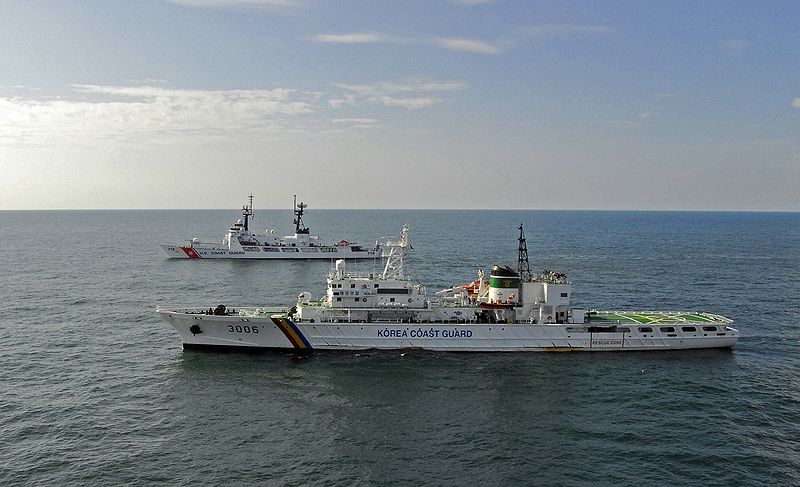
Republic of Korea Coast Guard vessel #3006 in company with U.S. Coast Guard cutter USCGC Boutwell (WHEC-719) during the North Pacific Coast Guard Forum in August 2007. This forum was created to increase international maritime safety and security in the Northern Pacific Ocean and its borders. The Boutwell worked with the Korean coast guard while on their way to Yokosuka, Japan. The Japanese coast guard is one of the six nations involved in the forum.
We previously noted there might be a Coast Guard role in enforcing a possible blockade of North Korea. It now appears that the Administration is planning additional action to enforce existing UN sanctions on North Korea and the Coast Guard, including ships as well as boarding teams may have a role.
Bertholf class NSCs would of course be the most desirable asset, but there just are not many of them. Perhaps FRCs? Whatever is used will need some overwatch, perhaps in the form of Maritime Patrol Aircraft.
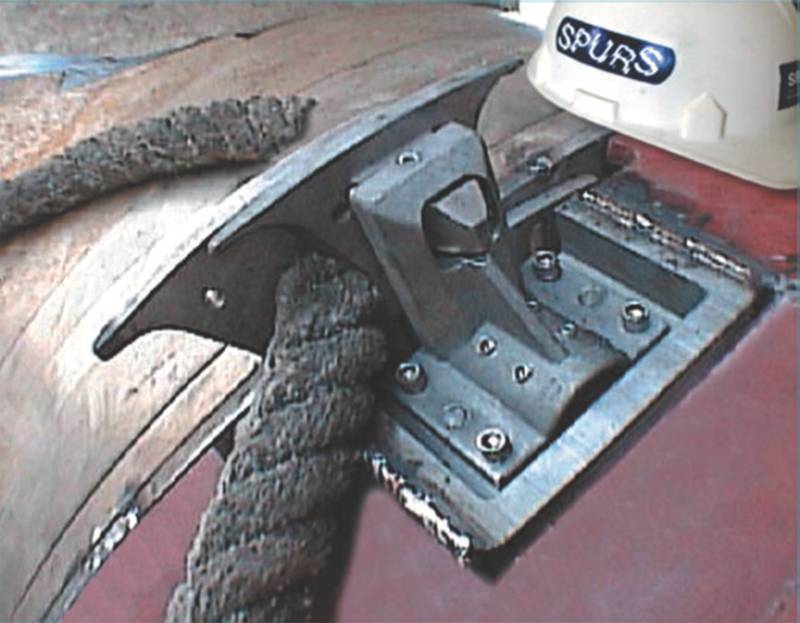
Having had a towing hawser foul a prop shaft once, I found this post from MarineLink very interesting.
We don’t do as much towing as we used to, but it is still an important and frequently used skill. Getting a line in the screws is never a good idea, but it happens. There is also the danger of running afoul of a drift net. This offers a possible cure for the problem.
NSC 5 James on builders trials in the Gulf of Mexico March 30, 2015.
Homeland Security Today gives us the best summary of the proposed Coast Guard budget, and it had an interesting small item.
$32 million in savings associated with the elimination of the Crew Rotation Concept (CRC) pilot program, which standardizes NSC fleet operations and avoids costly and ineffective implementations in two other NSC homeports.
I presume this means they will close down the multiple crewing experiment in Alameda (looks like a nice building) and make no attempt to implement it in Charleston and Honolulu.
I’ve been arguing against this for almost eight years. Its nice to see sanity prevail. Certainly the provision of more Bertholf Class cutter has helped make this more acceptable.
The Coast Guard has issued a Request for Information for a solution to our inland cutter needs. I have copied and pasted the brief description below.
Solicitation Number:
RFI-USCG-WCC-2018-1
Notice Type:
Special Notice
Synopsis:
Added: Feb 14, 2018 3:52 pm
The Coast Guard has a statutory mission to establish, maintain, and operate maritime aids to navigation to serve the needs of the armed forces and commerce of the United States. This Request for Information (RFI) is the first of several planned industry engagements aimed at developing the data the Coast Guard needs to make informed decisions about potential solutions to carry out this mission. The Coast Guard has historically accomplished this mission via a fleet of Coast Guard inland vessels. However, this RFI does not presume a specific solution and is not a statement by the Coast Guard that a final solution has already been identified; it is only one part of an overall effort to better understand the decision space.
Responses to this RFI shall be submitted to Jennifer Sokolower at Jennifer.G.Sokolower@uscg.mil.
This special notice is for market research and planning purposes only. It does not constitute a solicitation and shall not be construed as a commitment by the Government to award a contract from responses to this announcement. Any information submitted by interested parties is strictly voluntary and no monetary compensation will be provided for response preparation.
The Navy has provided their 30 year Ship Acquisition Plan. Here is their news release.
WASHINGTON (NNS) — The Department of the Navy submitted the long-range ship acquisition plan to Congress Feb. 12.
The 30-Year Ship Acquisition Plan is a Congressionally-mandated report which describes the Department of the Navy’s long-range shipbuilding plans for 2019-2048. This year’s report focuses on meeting the Navy’s baseline acquisition requirements needed to build the Navy the Nation Needs (NNN) and sustaining the domestic industrial base to meet that aim.
In support of the National Defense Strategy’s stated goal of achieving a more lethal, resilient and agile force, the plan serves as a roadmap to reach a 355-ship fleet by the early FY2050s, potentially quicker with an aggressive investment of resources. The plan pursues acquisition strategies to build ships more quickly and affordably and places top priority on sustaining the industrial base now and for the future. Ultimately, the plan supports the Navy’s overall effort to build the Navy the Nation Needs to protect the homeland, defend the interests of America and its allies abroad, and preserve America’s strategic influence around the world.
This plan addresses the Navy’s most critical shipbuilding needs by:
* Building CVNs four years apart after CVN 82 instead of five to support a 12-ship CVN force.
* Building 12 Columbia-class SSBNs in support of the Nuclear Posture Review (NPR) and STRATCOM deterrence requirements.
* Establishing a stable profile of two per year Attack Submarines (SSN).
* Establishing a stable profile of 2.5 per year Large Surface Combatants (DDG), plus an additional ship in FY2022.
* Establishing a stable profile of two per year Small Surface Combatants (LCS, FFG) starting in FY2022, accommodating the transition to FFG(X).
* Increasing the pace for amphibious ship production to support a 12-ship LHD/LHA force and modernized lethality in FY2033, FY2036 and FY2039.
* Addresses the candidate long-term replacement for the NNN payload-based submarine, filled mid-term by Virginia Payload Module (VPM).
I have to ask, where is ours? Perhaps Congress should mandate one for us, but we don’t always respond to Congress anyway. There is a mandate for a 20 year plan, but I haven’t seen that yet either. Really Congress is trying to help us communicate our needs without having them filtered by DHS and GAO. Maybe it is DHS and GAO that are the roadblocks, but the Navy seems to find ways to get their needs to Congress.
An important part of the “Acquisition Plan” is really what they plan to decommission. Which constituencies are going to lose an asset? This is something we also need to pass to Congress, and we need to mean it. It is also where we have an advantage because our assets impact so many constituencies. We should not be operating 50-year-old ships.
The Navy does not always get everything they ask for, but at least they ask.






 Chuck Hill's CG Blog