A Case for Propeller Guards & Cutters–Marine Link

Having had a towing hawser foul a prop shaft once, I found this post from MarineLink very interesting.

We don’t do as much towing as we used to, but it is still an important and frequently used skill. Getting a line in the screws is never a good idea, but it happens. There is also the danger of running afoul of a drift net. This offers a possible cure for the problem.

More on the FY2019 Budget—and—Killing the Crew Rotation Concept?

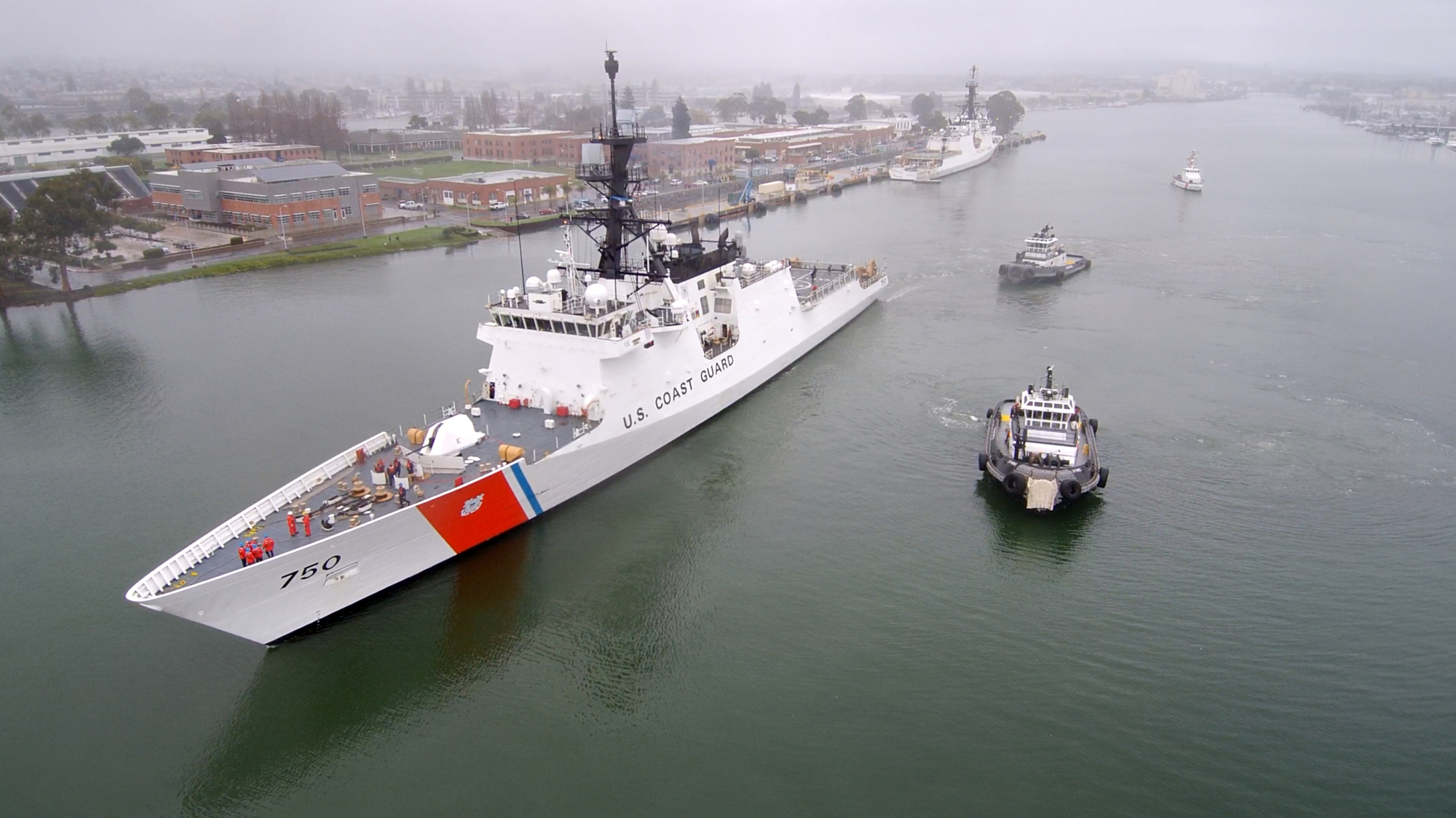
NSC 5 James on builders trials in the Gulf of Mexico March 30, 2015.

Homeland Security Today gives us the best summary of the proposed Coast Guard budget, and it had an interesting small item.

$32 million in savings associated with the elimination of the Crew Rotation Concept (CRC) pilot program, which standardizes NSC fleet operations and avoids costly and ineffective implementations in two other NSC homeports.

I presume this means they will close down the multiple crewing experiment in Alameda (looks like a nice building) and make no attempt to implement it in Charleston and Honolulu.

I’ve been arguing against this for almost eight years. Its nice to see sanity prevail. Certainly the provision of more Bertholf Class cutter has helped make this more acceptable.

Inland (tender) Cutter RFI

USCGC Smilax (WLIC-315)

The Coast Guard has issued a Request for Information for a solution to our inland cutter needs. I have copied and pasted the brief description below.

Solicitation Number:
RFI-USCG-WCC-2018-1
Notice Type:
Special Notice
Synopsis:
Added: Feb 14, 2018 3:52 pm

The Coast Guard has a statutory mission to establish, maintain, and operate maritime aids to navigation to serve the needs of the armed forces and commerce of the United States. This Request for Information (RFI) is the first of several planned industry engagements aimed at developing the data the Coast Guard needs to make informed decisions about potential solutions to carry out this mission. The Coast Guard has historically accomplished this mission via a fleet of Coast Guard inland vessels. However, this RFI does not presume a specific solution and is not a statement by the Coast Guard that a final solution has already been identified; it is only one part of an overall effort to better understand the decision space.

Responses to this RFI shall be submitted to Jennifer Sokolower at Jennifer.G.Sokolower@uscg.mil.
This special notice is for market research and planning purposes only. It does not constitute a solicitation and shall not be construed as a commitment by the Government to award a contract from responses to this announcement. Any information submitted by interested parties is strictly voluntary and no monetary compensation will be provided for response preparation.


30 Year Shipbuilding Plan–Where Is Ours?


The Navy has provided their 30 year Ship Acquisition Plan. Here is their news release.

WASHINGTON (NNS) — The Department of the Navy submitted the long-range ship acquisition plan to Congress Feb. 12.

The 30-Year Ship Acquisition Plan is a Congressionally-mandated report which describes the Department of the Navy’s long-range shipbuilding plans for 2019-2048. This year’s report focuses on meeting the Navy’s baseline acquisition requirements needed to build the Navy the Nation Needs (NNN) and sustaining the domestic industrial base to meet that aim.

In support of the National Defense Strategy’s stated goal of achieving a more lethal, resilient and agile force, the plan serves as a roadmap to reach a 355-ship fleet by the early FY2050s, potentially quicker with an aggressive investment of resources. The plan pursues acquisition strategies to build ships more quickly and affordably and places top priority on sustaining the industrial base now and for the future. Ultimately, the plan supports the Navy’s overall effort to build the Navy the Nation Needs to protect the homeland, defend the interests of America and its allies abroad, and preserve America’s strategic influence around the world.

This plan addresses the Navy’s most critical shipbuilding needs by:
* Building CVNs four years apart after CVN 82 instead of five to support a 12-ship CVN force.
* Building 12 Columbia-class SSBNs in support of the Nuclear Posture Review (NPR) and STRATCOM deterrence requirements.
* Establishing a stable profile of two per year Attack Submarines (SSN).
* Establishing a stable profile of 2.5 per year Large Surface Combatants (DDG), plus an additional ship in FY2022.
* Establishing a stable profile of two per year Small Surface Combatants (LCS, FFG) starting in FY2022, accommodating the transition to FFG(X).
* Increasing the pace for amphibious ship production to support a 12-ship LHD/LHA force and modernized lethality in FY2033, FY2036 and FY2039.
* Addresses the candidate long-term replacement for the NNN payload-based submarine, filled mid-term by Virginia Payload Module (VPM).

The plan can be viewed in its entirety here: www.secnav.navy.mil/fmc/fmb/Pages/Fiscal-Year-2019.aspx.

I have to ask, where is ours? Perhaps Congress should mandate one for us, but we don’t always respond to Congress anyway. There is a mandate for a 20 year plan, but I haven’t seen that yet either. Really Congress is trying to help us communicate our needs without having them filtered by DHS and GAO. Maybe it is DHS and GAO that are the roadblocks, but the Navy seems to find ways to get their needs to Congress.

An important part of the “Acquisition Plan” is really what they plan to decommission. Which constituencies are going to lose an asset? This is something we also need to pass to Congress, and we need to mean it. It is also where we have an advantage because our assets impact so many constituencies. We should not be operating 50-year-old ships.

The Navy does not always get everything they ask for, but at least they ask.


FY2019 Budget

USCGC Polar Sea

Military.com has some information on the Coast Guard budget.

“Overall, the Coast Guard budgeted $7.8 billion for operating expenses, including pay; $1.9 billion to recapitalize equipment; and $1.9 billion in mandatory spending and fees.”

It includes $750M for the first new heavy icebreaker; $400M for the second OPC and long lead time items for the third; and $240M for four Webber class.


In the February 2018 Proceedings

The February 2018 issue of US Naval Institute Proceedings has a couple of articles of interest. You can access the first on line, Coast Guard Defines “All Hands On Deck,” by Capt. Bruce Jones, USCG (retired)

Neither catastrophic disasters nor the national need for a Coast Guard with the capacity and capability to respond vigorously and effectively are going away. The next few decades likely will bring the challenge of multiple, simultaneous major events.

The Coast Guard repeatedly has demonstrated it has the unique skills, organizational culture, and legal authorities to move swiftly into a disaster zone and take effective action at the tactical, operational, and strategic levels, but no longer can it take disaster operations out of hide. It is time to recognize and fund disaster response as a core Coast Guard mission and build the bench strength—in people and assets as well as experience and qualifications—to sustain surge operations without degrading readiness and normal operations unacceptably.

I had an online discussion with Bill Wells in which he pointed out to me that Disaster Response may be a Department of Homeland Security mission through FEMA, but that it is not specifically a Coast Guard mission. Even the Navy has embraced this mission. They call it Humanitarian Assistance/Disaster Relief (HA/DR).  Note the pdf linked here is probably out of date. It also does not mention the Coast Guard.

“Now Hear This: EW Remains at Bare Steerageway in the Coast Guard,” by Michael Milburn. Unfortunately it is behind the pay wall, but if you are interested in the topics on this blog, you really should be a member.

Milburn contends that the Coast Guard is missing opportunities both for training and operational employment of their EW systems and suggests several steps to make better use of the systems.

A Coast Guard Role in Mine Countermeasures

Two posts have recently appeared that make a case for Coast Guard involvement in Mine Counter-Measures (MCM) in peacetime. “Terror in the Water: Maritime Terrorism, Mines, and our Imperiled Harbors,” Second Place Mine Warfare Essay Contest, sponsored by the U.S. Naval Institute with the Mine Warfare Association. by Lieutenant (junior grade) Daniel Stefanus, U.S. Navy, advocates a stronger working relationship between the Navy and Coast Guard, mentioning the Coast Guard 13 times in a relatively short essay.

The January 2018 USNI Proceedings has a short post, “Coast Guard Needs Mine Countermeasures,” by Peter von Bleichert, suggesting that the Coast Guard has a mission implicit in its Ports, Waterways, and Coastal Security mission to deal with Naval mines and underwater improvised explosive devices (M/UWIED) and that the Coast Guard should be equipped and trained for the mission.

“Hardware for a Coast Guard mine countermeasures (MCM) capability could be harvested from the Navy’s Littoral Combat Ship MCM mission package, which existing or planned Coast Guard platforms could use in part or as a whole. These platforms could include hulls such as coastal and seagoing buoy tenders, the National Security and Offshore Patrol Cutters, and Coast Guard aircraft, both fixed- and rotary-wing. Training Coast Guardsmen for MCM operations could be concurrent with that of Navy sailors. As shown during the 2014 International Mine Countermeasures Exercise in the Arabian Gulf and the 2015 Field Training Exercise in homeland waters, the U.S. sea services already train and exercise together for such operations. Further combining MCM hardware acquisition and training will reduce duplication, generate economies of scale, encourage innovation, and increase preparation for joint operations.

“As the tripwire guarding against a conflict or terrorist incident in U.S. waters, and as a security component for naval bases and forces abroad, the U.S. Coast Guard must be given the expertise and tools to protect commercial and military vessels from the ever-growing threat of M/UWIEDs. At the very least, the service’s vessels must be able to detect such weapons. They should also be able to classify and localize them, and ideally to identify and neutralize them.”

Mining one or more US ports might not be that difficult, and while I don’t think the general population would be terrified by a ship sinking, the economic effect could be severe.

The Navy has never been very enthusiastic about the MCM mission, in spite of the fact that, since World War II, more of their ships have been damaged by mines than any other hostile agency.

As Lt(jg) Stefanus points out,

The United States’ mine countermeasures (MCM) triad consists of surface vessels (minesweepers), aircraft, and explosive ordinance disposal (EOD) teams. The surface vessels are the twelve ships of the worn-down Avenger class: homeported overseas with the exception of two in San Diego, and in poor readiness conditions due to repeated life-cycle extensions because of the slow development of the littoral combat ship’s (LCS) mine warfare module. There are no surface mine countermeasure forces available on the East Coast of the United States. (emphasis applied–Chuck)

The aerial leg of the triad is made up of the equally worn-down MH-53E Sea Dragons. Old and outdated, the 28 MH-53Es are only on the East Coast, (again, emphasis applied–Chuck) and suffer from notoriously serious readiness and material issues. While they are slated to remain in the fleet until the final operational capability (FOC) of the LCS mine warfare module in 2024, they are already struggling and will continue to degrade.

I doubt the Coast Guard has had a mine warfare expert since WWII, so I would certainly would not expect any massive shifts in that direction, but there probably is more we could be doing. Back in the Stone Age, when I was active duty, the Coast Guard through the Maritime Defense Zone organization participated in a Craft Of Opportunity Program using side scan sonars to map predesignated routes in and out of harbors to map mine like objects on the sea floor so they would not be mistaken for mines if it became necessary to clear the route–no idea if that still happens.

Types of Naval mine. A-underwater, B-bottom, SS-Submarine. 1-Drifting mine, 2-Drifting mine, 3-Moored Mine, 4-Moored Mine (short wire), 5-Bottom Mines, 6-Torpedo mine/CAPTOR mine  ,7-Rising mine–by Los688

Mine warfare does seem to be changing, particularly the surface ship methods. Instead of specialized ships with low acoustic and magnetic signatures actually entering the minefield, mine hunting, sweeping, and destruction is being done by unmanned systems. Several of our ships, including buoy tenders, might be useful in supporting MCM operations.


OPC Design Evolving?

Below is a comment on an earlier post, “If They Ditch the LCS, Perhaps the OPC as Frigate,” but for some reason, it did not show up on the list of comments. I think it is interesting enough to warrant its own post.

The Brazilian Navy has an on going project to develop and build the new Tamandaré-class corvettes/light frigates which could resemble the OPC derived frigate on this article. Interestingly Eastern Shipbuilding is one of the companies that answered the Request For Proposals. So they might have a conceptual design for an up-gunned OPC. The general requirements include a 25 kt speed, 3d radar, hull sonar, 76 mm gun, 4 deck-mounted anti-ship missiles, multiple torpedo tubes and VLS for Sea Ceptor/ CAMM AAW missiles (the render seems to point to 24 missiles in 2 x 3-cell ExLS).

http://www.janes.com/article/70498/brazil-attracts-multiple-firms-interest-for-ambitious-corvette-project

Quoting from the link, “The Brazilian Navy’s Naval Projects Center developed the corvette basic design project with assistance from Fincantieri’s VARD.” It appears the preliminary design is already done and that it was done with help from VARD, the designer of the Offshore Patrol Cutter (OPC).

This Naval Today post from Dec. 2017  reports, According to the Brazilian Navy’s Ships Projects Center (CPN), the corvettes should be measuring 103 meters in length and displacing up to 2,790 tons.” that is actually a little smaller than the OPC. Delivery of the first of the class of four is expected 2021/22, about the same time as the first OPC. Brazil would like to build the ships within country, but is seeking to partner with another shipbuilder.

Some information on the British developed “Sea Ceptor” missile system here. This missile is larger than the RAM but smaller than the Evolved Sea Sparrow Missiles (ESSM). Like the ESSM, it can be quad packed (that explains how you get “24 missiles in 2 x 3-cell ExLS“). It is currently deployed on British type 23 frigates. Unlike ESSM, Sea Ceptor uses a cold launch system. As explained in Wikipedia, ” …cold launch, where the missile is expelled by gas produced by a gas generator which is not part of the missile itself, and then the missile ignites. “Cold” means relatively cold compared with rocket engine exhaust. A hot launch system does not require an ejection mechanism, but does require some way of disposing of the missile’s exhaust and heat as it leaves the cell. If the missile ignites in a cell without an ejection mechanism, the cell must withstand the tremendous heat generated without igniting the missiles in the adjacent cells.”

“EDITORIAL: Conventional lifeboats are an expensive, complex, heavy and largely inadequate solution”–BairdMaritime

BairdMaritime has an interesting and possibly important editorial concerning passenger ship evacuation equipment. I think its worth the read.

“Lifeboats have undoubtedly saved many lives but mostly under favourable conditions. Launching them, particularly larger and heavier examples, in anything but benign conditions can be very dangerous. This is confirmed by the numerous examples of lifeboat drills gone wrong. Lifeboat drills have arguably killed more people than they have saved.

“I was reminded of this by a press release distributed recently by the British maritime union, Nautilus. The release called for “radical new thinking” about the concept of lifeboats and, “to examine the potential of alternative evacuation systems”.”