A European Union Coast Guard?

We have a press release from the European Union announcing the formation of an EU Border and Coast Guard.

From the description, this will not be a Coast Guard in the way we think of it, rather it will be the marine side of a border protection supervisory agency. They will still depend heavily on the various national agencies. They will, in some respects, combine functions we associate with Immigration and Customs Enforcement and Customs and Border Protection. While SAR is mentioned, the primary consideration is addressing problems that have emerged in the on-going immigration crisis.

The proposed budget and staffing are relatively small, but given that they are authorized to purchase their own equipment, this may be another indication of increasing federalization of EU powers.

” For the first time the Agency will be able to acquire equipment itself and to draw on a pool of technical equipment provided by the Member States…The new Agency’s human resources will more than double that of Frontex, to reach 1,000 permanent staff, including field operatives, by 2020.”

“The Agency will be able to assess the operational capacity, technical equipment and resources of Member States to face challenges at their external borders and require Member States to take measures to address the situation within a set time-limit in case of vulnerabilities.”

“…the Commission will be able to adopt an implementing decision determining that the situation at a particular section of the external borders requires urgent action at European level. This will allow the Agency to step in and deploy European Border and Coast Guard Teams to ensure that action is taken on the ground even when a Member State is unable or unwilling to take the necessary measures.”

Coast Guard surveillance: National coastguards will be part of the European Border and Coast Guard to the extent that they carry out border control tasks. The mandates of the European Fisheries Control Agency and the European Maritime Safety Agency will be aligned to the new European Border and Coast Guard. The three Agencies will be able to launch joint surveillance operations, for instance by jointly operating Remotely Piloted Aircraft Systems (drones) in the Mediterranean Sea.”

The explanation is expanded upon in a Q&A format.

“Its strengthened mandate will include monitoring and supervisory responsibilities, as well as the capacity to intervene in urgent situations either at the request of a Member State or when a Member State is unable or unwilling to act…. The role of the Agency to contribute to search and rescue operations will also be significantly strengthened.”

“Today’s proposals will entail a gradual increase of the Agency budget from the €143 million originally planned for 2015 up to €238 million in 2016 to €281 million in 2017, reaching€322 million in 2020 when all additional staff will be recruited…In order to implement its new tasks the Agency should reach 1000 staff members by 2020, compared to 402 staff members at the start of 2016… Member States will have to make available at least 1500 border guards to be deployed by the Agency in rapid border interventions within days.”

“As a general rule, European Border and Coast Guard teams will act only in the presence of host Member State staff. Any disciplinary action against them would be subject to the disciplinary measures of the home Member State.”
More Ships than the Program of Record?

The Navy League’s publication, Seapower Magazine, is reporting the Commandant, ADM Paul F. Zukunft, speaking at a special topic breakfast, on Dec. 15, sponsored by the Navy League and PricewaterhouseCoopers, sounded remarkably positive.

Regarding the Bertholf Class, “…We said eight National Security Cutters, now we’re negotiating a ninth…Sometimes it’s very difficult to stop at what that program of record is.”

“We will see an appropriation today, and, quite honestly, I will not be surprised if we see a ninth [National Security Cutter] because it won’t penalize the largest acquisition in our history, the Offshore Patrol Cutter…” Of the NSC, he said, “These ships are more than paying for themselves.

Regarding the Offshore Patrol Cutters, he confirmed that he expected construction to begin on the first of class during 2017, but he went on to suggest that there was a good possibility that it was possible, additional ships beyond the 25 planned might added “to the program of record as the cutters demonstrate their worth.”

Regarding new icebreakers, “The good news is that we’ve got great bipartisan support to invest in this…We will find the money,” he said. “This isn’t as expensive as an SSBN [ballistic-missile submarine], but it is an investment that we need to make.”

Observations:

A ninth Bertholf class makes a lot of sense right now. Plus it should ramp up the CG AC&I budget to something more realistic.

I hope we will build more than 25 OPCs, after all the plan is to go from 44 large cutters (not right now, but in the recent past) to 33 (34 if we get a ninth NSC), but that is on a very distant horizon. Right now, the plan is to fund one OPC in FY 2017, 2018, and 2019 and only two per year aft that, until the program is complete. Hopefully, the rate of construction will go to at least three a year after the first of class is tested. The MECs we have now are just not going to last until 2035.

The Commandant has not suggested that the first new icebreaker will be funded before 2020. Even if funded then, we are going to have a problem bridging the gap between now and the commissioning of that icebreaker which, presumably will not be until at least 2024.

It does seem the CG budget is getting some attention, but we will have to wait to see if good intentions materialize in the form of a reasonable AC&I Budget.

A ninth NSC would be a good first step.

Thanks to Daniel for bringing this to my attention.

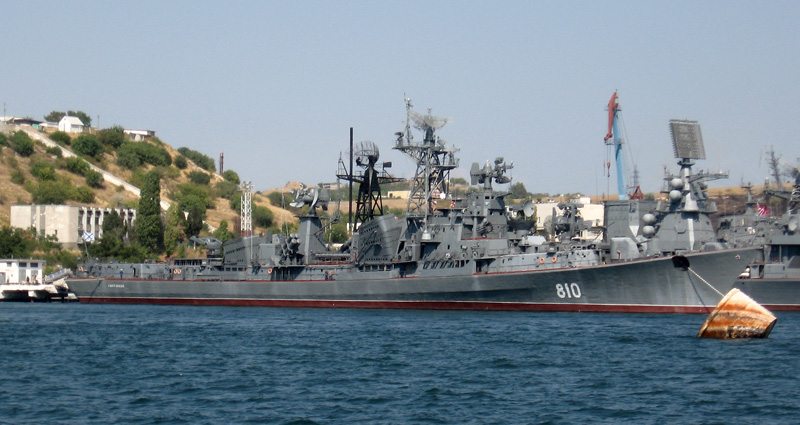
Russian Destroyer Fires Warning Shots to Scare Off Turkish F/V

File:Smetlivyy2007Sevastopol.jpg

Photo: Smetlivyy seen here in Sevastopol. Attribution: Водник

BBC reports that a Russian Destroyer (reported as a frigate), the Smetlivy, used small arms fire to drive off a Turkish fishing vessel that was approaching it as the Russian destroyer lay at anchor near a Greek island in the Aegean Sea.

Given the tensions with the Turks and the possibility of Daesh retaliation for Russian involvement in Syria, they were probably thinking about the USS Cole attack.

“Progress Slowed by Age”–Seapower Magazine

The Navy League’s “Seapower” magazine has an article about how aging assets are impacting the Coast Guard’s mission effectiveness. You can read it on line here. (You will probably have to expand it to make it readable.)

Frankly, I have been disappointed that they had not been talking about this much earlier. There has been entirely too much happy talk about how great the new assets are without much discussion of the general decrepitude of most of the fleet. Of course this has probably been our own fault. Even in this article, there seems to be little sense of urgency.  The article barely mentions the fact that the planned slow motion replacement of Medium Endurance Cutters by the Offshore Patrol Cutter will prolong the pain. After all, we don’t expect the last OPC until 2034, a fact not mentioned in the article. They refer to a “two-plus decade program” to build 91 new surface ship, but in fact the first National Security Cutter was funded in FY2001, and the roots of the program go back further still, so this is at least a three and a half decade program, that was begun at least ten years after it should have.

Icebreaker Bargain?

EdisonChouestOffshoreAHTSicebreaker

Through some comments, from Tups and Matthew Coombs CWO4 USCG (retired), on a previous post we have learned that construction on a medium icebreaker begun for Shell has apparently been suspended because Shell is no longer attempting to drill for oil in the Arctic.

This might be an opportunity for the Coast Guard to obtain one or two reasonably capable medium icebreaker in the near term on favorable terms.

Reportedly the ship was laid down in December so the design and much of the material has already been bought, costs Shell is responsible for.

The icebreaker should be pretty capable, it is reportedly Polar Class 3. Polar class 3 means “Year-round operation in second-year ice which may include multiyear ice inclusions.” My understanding is that the ship will have Four 5060 KW generators. If so it will have more horsepower (20,240 KW/27,131 SHP) than the diesel electric engines of the Polar class (18,000 HP), more than the Glacier (16,000 KW/21,000 SHP), and almost as much as the Healy (22,400 KW/30,027 SHP). It would also be more than twice as powerful as the Wind class breakers (12,000 SHP), the National Science Foundation’s leased M/V Nathaniel B. Palmer (9,485 kW/12,720 HP), or USCGC Mackinaw (6,800 KW/9,119 SHP). It would also be more powerful than all but one of Canada’s icebreakers, and powerful enough to lead a break in at McMurdo Sound.

Politically this might gets some traction because, I am sure the Louisiana delegation would love to see their people go back to work to finish the ship, and the Alaska Senators desperately want more icebreakers. This might even be a circumstance where leasing might make sense.

If Shell is truly abandoning attempts to exploit the Arctic, it is also likely that their other ice class vessels, including the icebreaker Aiviq, are also excess to their needs. Adding Aiviq and the ship under construction to the Healey, would meet the Coast Guard’s stated requirement for three medium icebreakers and provide the backup we need if one of the two existing breakers had a breakdown in the ice.