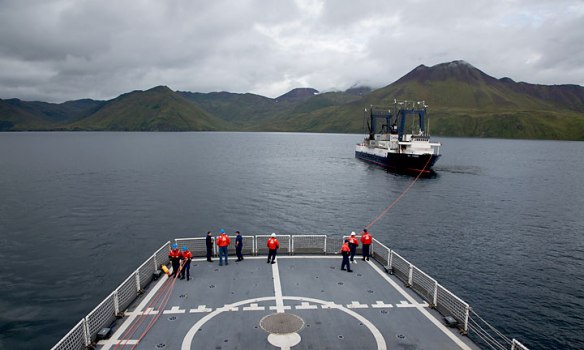
NSC 5 James on builders trials in the Gulf of Mexico March 30, 2015.
The 2017 “Hopley Yeaton Cutter Excellence and Superior Cutterman” awards have been announced.
R 211106 DEC 17
FM COMDT COGARD WASHINGTON DC//CG-7//
TO ALCOAST
UNCLAS //N01650//
ALCOAST 360/17
COMDTNOTE 1650
SUBJ: WINNER ANNOUNCEMENT – 2017 HOPLEY YEATON CUTTER EXCELLENCE AND SUPERIOR CUTTERMAN AWARDS
1. The Douglas Munro Chapter of the Surface Navy Association is honored to announce and congratulate the recipients of the 2017 Hopley Yeaton Cutter
Excellence and Superior Cutterman Awards. Each of the winners was selected from amongst a superb group of highly deserving candidates by a diverse panel of officer and enlisted Cuttermen. The winners selected for this year are:
A. Cutter Excellence Award (Large Cutter): CGC JAMES (WMSL 754)
B. Cutter Excellence Award (Small Cutter): CGC JOHN MCCORMICK (WPC 1121)
C. Superior Cutterman Award (Officer): LTJG Anna Ruth – CGC HAMILTON
D. Superior Cutterman Award (Enlisted): MK2 Jason Tribeck – CGC DILIGENCE
2. Hopley Yeaton Cutter Excellence Award (Large):
A. CGC JAMES (WMSL 754) led 22 successful drug interdictions, spearheaded hurricane relief and recovery efforts as Command Task Unit (CTU) Maria,
aggressively pursued opportunities for community involvement, and exemplified dedication to their crewmembers’ personal well-being. On their first patrol, the JAMES made an unprecedented AUF interdiction of three go-fast vessels, over 40 NM apart within a two hour window. When JIATF-S was forced to evacuate ahead of Hurricane Irma, JAMES assumed Alpha Victor (AV), taking TACON of all assets in the Eastern Pacific for a week. As AV, JAMES facilitated 61 cases through 11 partner nations, five interagency entities, 12 surface assets, and over 24 flight missions. This resulted in the interdiction of 10,881 kgs of cocaine and 747 kgs of marijuana, and set a new benchmark for WMSL capabilities.
B. Honorable Mentions for the Large Cutter Award were:
CGC ALEX HALEY
CGC CYPRESS
CGC NORTHLAND
3. Hopley Yeaton Cutter Excellence Award (Small):
A. As the first Fast Response Cutter (FRC) assigned to District 17, CGC JOHN MCCORMICK (WPC 1121) set lofty standards in crew readiness and training. This ensured JOHN MCCORMICK’s safe and timely transit of more than 6,000 NM from Key West to homeport of Ketchikan, and the crew’s rapid response to engineering and damage control casualties along the way. Upon arrival at homeport, JOHN MCCORMICK was an immediate asset to D17 where the crew conducted 77 fisheries boardings, saved 10 lives, and developed close bonds with the community.
B. Honorable Mentions for the Small Cutter Award were:
CGC BISCAYNE BAY
CGC JOSEPH TEZANOS
CGC WASHINGTON
4. Hopley Yeaton Superior Cutterman Award (Officer):
A. While serving as Combat Systems Officer aboard CGC HAMILTON, LTJG Anna Ruth led her cutter’s pursuit and boarding teams on all 19 of HAMILTON’s drug interdictions, netting over $500 million worth of cocaine in 2017. Shortly after reporting aboard, LTJG Ruth set about correcting 38 mission critical electronics casualties, ensuring the cutter’s full suite of sensors was available for its first patrol. Additionally, LTJG Ruth helped re-establish Naval Weapons Station Charleston, SC for use in ammunition onloads. LTJG Ruth served as a sought-after mentor and role-model for junior shipmates, streamlined the onboard qualification process, and promoted the afloat career path to others.
B. Honorable Mentions for the Superior Cutterman Award (Officer) were:
LCDR Amy Lockwood – CGC WAESCHE
LT Daniel Halsig – CGC CONFIDENCE
LT Paul Ledbetter – CGC SHERMAN
5. Hopley Yeaton Superior Cutterman Award (Enlisted):
A. MK2 Jason Tribeck epitomized dogged perseverance and showcased his ingenuity on numerous troubleshooting and repair efforts. MK2 Tribeck meticulously prepared DILIGENCE for AVSTAN, which earned high praise by Aviation Training Center Ship-Helo Branch throughout the inspection. His attention to detail played a critical role in his success as a government quality assurance inspector for $545K in dockside availability work. Additionally, MK2 Tribeck’s dedication and drive were on full display when he earned his Underway Engineer of the Watch (EOW) qualification, helping his shipmates through a heavy transfer season by improving the watch rotation.
B. Honorable Mentions for the Superior Cutterman Award (Enlisted) were:
MK1 Michael Hilbert – CGC HAMILTON
EM1 Shaun Ryan – CGC LIBERTY
ME1 Daniel Brooks – CGC SHERMAN
6. Awards will be presented in Washington, DC in conjunction with the January 2018 Surface Navy Association National Symposium. If a unit representative is not available to receive the Cutter Excellence Award at the symposium, the award will be sent to the winning cutter’s OPCON for presentation. The Surface Navy Association (SNA) will contact award winners to discuss and coordinate their travel and symposium arrangements. Please contact SNA at navysna@aol.com with any questions or concerns.
7. We applaud all of the deserving nominees for their phenomenal performance. There were an especially large number of nominations this year, all of which represented highly deserving candidates and made the selection of a single winner in any category especially challenging. We also thank the commanding officers and supervisors who took the time to submit high quality nominations for their deserving units and personnel, as well as ADCON units for reviewing and screening nominations.
8. RDML Michael P. Ryan, Assistant Commandant for Capability, sends.
9. Internet release authorized.

“Coast Guard Cutter John F. McCormick (WPC 1121), March 4, 2017. Coast Guard photo by Petty Officer 2nd Class Loumania Stewart”