For the next few days I will be unable to devote much, if any time, to the Blog. I expect to return to normal ops on 29 July.
Please continue the discussion.

For the next few days I will be unable to devote much, if any time, to the Blog. I expect to return to normal ops on 29 July.
Please continue the discussion.
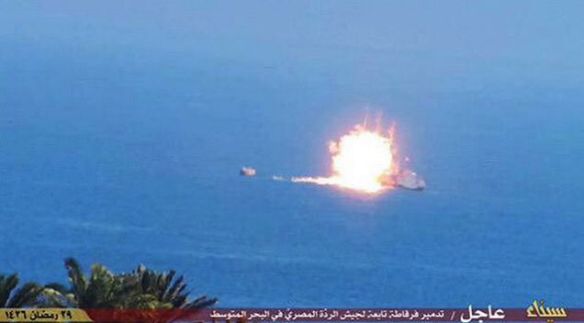
gCaptain reports that an Egyptian Coast Guard vessel has been attacked by a militant group, Egypt’s Islamic State affiliate, “Sinai Province.”
Other reports identified the vessel as a frigate, and the weapon as a guided missile. It does appear that the vessel is smaller and the missile was probably an anti-tank weapon rather than an anti-ship cruise missile.
Reportedly the vessel had been engaging elements ashore.
This is the type of extemporaneous weaponry the Coast Guard could expect a terrorist organization to use against the USCG if they attacked the US. We should be particularly concerned that they not be able to target specific critical systems on our cutters. Currently I consider 4000 yards to be a reasonable standoff distance to minimize this possibility.
This is a straight news release, but I decided to quote it in its entirety because it is says a lot about the importance of what the Coast Guard does for the country. Note these increases are compared to pre-recession activity levels.–Chuck
New U.S. Port Economic Impacts Report Released
Since last nationwide analysis in 2007, U.S. seaport contributions to economy up dramatically
Lancaster, Pa.-based Martin Associates, a leading provider of economic and strategic assessments of the world’s transportation systems, today released the results of its latest economic impact study of United States seaports. Dr. John Martin, Martin Associates’ president, debuted his firm’s 2014 National Economic Impact of the U.S. Coastal Port System report during the second day of the American Association of Port Authorities’ (AAPA) 2015 Spring Conference in Washington, D.C.
In the seven years since Martin Associates’ last nationwide ports economic impact study, the contributions of America’s seaports to the nation’s economy have risen dramatically. From 2007 to 2014, the total economic value that U.S. coastal ports provide in terms of revenue to businesses, personal income and economic output by exporters and importers rose 43 percent to $4.6 trillion. This accounted for 26 percent of the nation’s $17.4 trillion economy in 2014, up from 20 percent of its $16.1 trillion economy in 2007.
Other notable gains since 2007 in Martin Associates’ new report include:
•Federal, state and local tax revenues generated by port-sector and importer/exporter revenues rose 51 percent to $321.1 billion;
•Jobs generated by port-related activity jumped 74 percent to 23.1 million; and,
•Personal wages and local consumption related to the port-sector increased to $1.1 trillion, with the average annual salary of those directly employed by port-related businesses equating to $53,723.
“The growth in jobs and economic importance of America’s seaports reflects the fact that the value of international cargo handled at these ports increased by $400 billion since 2007, reaching about $1.8 trillion in 2014,” said Dr. Martin. “It’s important to emphasize that the key growth in our international trade was in U.S. exports, which saw a 60 percent increase in value over the past seven years.”
Dr. Martin noted that each dollar increase in the value of export cargo supports significantly more jobs in the U.S. than does a dollar value of growth in imports. He also emphasized that the robust growth in the economic impact value from U.S. ports occurred despite the economic recession that severely hampered marine cargo activity between 2008 and 2012.
“The growth in the contributions of our ports to the nation’s economy underscores the need to invest in infrastructure and technology to support and foster good jobs, national security, international trade and our standard of living,” said Dr. Martin.
In agreement with Dr. Martin’s assessment is AAPA President and CEO Kurt Nagle, who said that particularly with the economic contributions of America’s seaports growing rapidly, there’s a significant and urgent need for more federal investment in enhancing the connections with those ports. He added, “On the land-side alone, AAPA’s U.S. member ports have identified at least $28.9 billion in needed investments by 2025. These necessary road, rail, bridge and tunnel improvements are crucial to enable our seaports to efficiently handle their expected cargo volumes, continue providing dramatic economic and jobs impacts, and enhance America’s international competitiveness.”
—————————————————————————————————
About AAPA
Founded in 1912, AAPA today represents 160 of the leading seaport authorities in the United States, Canada, Latin America and the Caribbean and more than 300 sustaining and associate members, firms and individuals with an interest in seaports. As a critical link for access to the global marketplace, each year, Western Hemisphere seaports generate trillions of dollars of economic activity, support the employment of millions of people and, in 2008, imported and exported more than 7.8 billion tons of cargo, valued at $8.6 trillion, including food, clothing, medicine, fuel and building materials, as well as consumer electronics and toys. The volume of cargo shipped by water is expected to dramatically increase by 2020 and the number of passengers traveling through our seaports will continue to grow. To meet these demands, the AAPA and its members are committed to keeping seaports navigable, secure and sustainable.
FOR RELEASE – April 21, 2015
Contact: Aaron Ellis, Public Affairs Director, aellis@aapa-ports.org
(703) 684-5700 or (703) 254-7098
American Association of Port Authorities
1010 Duke Street
Alexandria, VA 22314
Phone: (703) 684-5700
Fax: (703) 684-6321
http://www.aapa-ports.org
The U.N. General Assembly (UNGA) last week adopted a formal resolution to develop a legally-binding treaty for the conservation of marine biodiversity on the ‘high seas’.
The new ocean regulations are proposed to include: area-based management tools, such as marine planning and marine protected areas; environmental impact assessment (EIA) requirements; the transfer of marine technology; and a regime for managing marine genetic resources, including benefit-sharing. These developments have potentially significant implications for ocean economic activities, such as shipping, oil and gas, cruise tourism, fishing, marine mining, biotechnology, submarine cable, as well as for related sectors, such as maritime law, insurance and investment.
Apparently they are seeking comment with a meeting scheduled for November in Singapore.
What are the chances we will see some results from this? Given how long it took to have UNCLOS accepted, I would not expect anything soon, but you have to start somewhere.
There is a new report on piracy available.
Oceans Beyond Piracy has launched the fifth installment of its annual reports detailing the economic and human costs of maritime piracy. “The State of Maritime Piracy 2014” examines both human and economic costs incurred as a result of piracy occuring in the Western Indian Ocean and the Gulf of Guinea, with a never before included analysis of the human cost of piracy in Southeast Asian waters.
A couple of things stand out. The number of seaman being held hostage is way down. The ocean areas around SE Asia are again the most significant areas of danger for piracy (or for robbery inside territorial waters, which is also included in the report, but not technically piracy). That is not to say that the probability of any particular vessel being attacked is higher off SE Asia than in the Gulf of Guinea given the volume of traffic through the waters of SE Asia.

Since before recorded history, merchant vessels have been adapted for offensive purposes by navies, pirates, and privateers to destroy enemy commerce or to launch attacks ashore. Frequently they employed disguise and deception. The UK employed Ships Taken Up From Trade (STUFT) during the 1982 Falklands War, the Malaysian Navy has converted two container ships into pirate hunters, and the US Navy has leased ships to support special operations, but I think the last time they were used to attack commerce was WWII. By the end 1943, it appeared that technology, primarily in the form of reliable radios, plus robust challenge-and-reply procedures, a comprehensive naval control of shipping organization, and a seemingly impervious blockade of the German coast, had made this type of warfare very dangerous, but new technology may now be working in favor of using converted merchant ships as clandestine warships.
The German Experience
During World Wars I and II, the German Navy achieved considerable success using armed merchant ships as clandestine merchant raiders. At small cost they sank or captured a large number of allied merchant vessels, tied down a number of warships searching for the raiders, and even managed to sink allied warships.
In World War I, three raiders, Wolf, Moewe, and Seeadler (a full rigged sailing ship), sank or captured 78 ships totaling 323,644 tons. In addition to the merchant ships they captured or sank directly, merchant raiders proved effective mine layers. One victim of a mine laid by the raider Moewe was the pre-dreadnought battleship EdwardVII, sunk on 6 January, 1915.
In World War II nine German Merchant raiders, Atlantis, Komet, Kormoran, Michel, Orion, Pinguin, Stier, Thor, and Widder, sank or captured 129 ships, totaling 800,661 tons. While this pales in comparison to the sinkings by U-boats, they were far more effective than the regular navy surface raiders, including the vaunted pocket battleships, heavy cruisers, and battleships Scharnhorst and Gneisenau, that managed to sink or captured only 59, totaling 232,633 tons. The merchant raider Kormoran even managed to torpedo and sink the light cruiser HMAS Sydney, before the Kormoran herself was also sunk.
Typically, the raiders of WWII were equipped with six obsolescent 5.9″ guns and large numbers of torpedoes to allow ships to be sunk rapidly. Most were also equipped with aircraft and some with torpedo boats. They were also equipped to change their appearance while underway.
Several of their voyages were extraordinarily long. Michel’s first voyage was 346 days. Orion’s was 510 days. Thor was away 329 days and managed to sink HMS Voltaire, an armed merchant cruiser. Pinguin for 357 days. Komet for 512 days. Kormoran for 350 days before her fatal encounter with HMAS Sydney. The ships were refueled and rearmed by supporting vessels that also took their prisoners. Raiders were also used to resupply submarines.
Perhaps surprisingly, none of these WWII raiders were underway when the war began, when they might have been most effective. They were sortied in two waves in 1940 and 1942.
END OF THE MERCHANT RAIDER
Despite their successes, by the time the last German raider at sea was sunk on 7 September, 1943, by a US submarine shortly after it had sortied from Japan, it had become impossible for ships to sortie from Germany and make it to open sea. Komet and a tenth raider were both sunk attempting to do so. Three of the nine, Atlantis, Pinguin, and Kormoran, were sunk in distant seas by British cruisers. One, Stier, was sunk by the Naval Armed Guard on the Liberty ship Stephen Hopkins. One was destroyed by a nearby explosion while moored in Yokohama. Two, Orion and Widder, survived their career as raiders long enough to return to Germany and be repurposed.
REBIRTH–Weapons and Sensors, Old and New
Technological changes in the form of containerized cruise missiles, satellites and UAVs and other Unmanned Vehicles may have made the merchant cruiser once again a viable option.
Cruise missiles mean that the raider no longer needs to come with visible range of the their victim. With sufficient range and use of way points, the shooter can be over 100 miles from its victim and the missile can come from any direction, not necessarily from the direction of the raider. Plus they can now attack land targets as well as ships. The US has begun to think seriously about the threat of a cruise missile attack on the US and innocent looking container ships are a possible source.
UAVs can provide over the horizon targeting and are likely to be undetected by the target.
Satellites may help or hurt potential raiders. If they have the support of satellites, it may help them find their pray. If the defenders are sufficiently sophisticated (and they are looking in the right place) they may be able to recognize a missile launch as the first step in finding, fixing and destroying the raider.
Similarly the Automatic Identification System may help the raider or the defender. It may help the raider find targets, but it may also help the defender react more swiftly to an attack or help him identify the raider from among all the other ships in the area. There is always the possibility the information may be bogus. Unmanned Surface Vessels might be used to create false targets. We might want to plan for a system of encrypted information for contingencies. Limiting use of the systems is an option that may require careful consideration.
Mines are still potentially effective. The large carrying capacity of cargo ships means they could potentially lay large mine fields. A raider could knowing a war will start soon might lay a large field to be activated when hostilities begin. If hostilities have already begun, the raider is unlikely approach a port closely enough to lay the mines itself, but mobile mines already exist, and Unmanned Underwater Vehicles or even simple semi-submersible unmanned vessels that can lay an minefield should be relatively easy technology.
China, Perpetrator or Target
From an American point of view, China with its huge merchant fleet and large inventory of cruise missile may appear a possible user of Merchant Raiders, but their large merchant fleet and need to import may also make them vulnerable to this this type of warfare if employed by weaker nations.
We know China has a Naval Militia. that will allow them to rapidly increase the size of their naval force. China has recently said it would require its ship builders to incorporate features that would make them usable for military purposes in wartime. These requirements are to be applied to five categories of vessels – container, roll-on/roll-off, multipurpose, bulk carrier and break bulk. What these additional features are to be, is not clear. This could mean upgraded communications, either external or internal. It could mean improved survivability, greater speed, or foundations for weapons upgrades. They may only be thinking of using these ships to support amphibious operations, but these improvements may also make a large number of ships potential merchant raiders.
China’s large merchant fleet and need to import raw materials may make her vulnerable to Guerre d’Course. In the kind of low intensity conflict we have seen between China and her neighbors, it has seemed China has had all the advantages, but if they are pushed too far, China’s neighbors might see this form of warfare as a way to push back.
Non-State Actors
There is also the possibility of terrorist organizations attempting something similar, but they are more likely to attack highly visible targets of a symbolic nature, such as port facilities or major warships. Cruise missile could of course be used to attack major landmarks. They may also be less interested in living to fight another day.
Conclusion: I don’t think we have seen the end of offensive use of Merchant vessels.
Sources:
Addendum:
Lee has seen me some photos of vessels that are being used for military purposes, so I am adding them here:

MSC has chartered the MV Craigside to support SOCOM requirements. It is undergoing conversion in Mobile.

SD Victoria lifts boats and supports crews for UK Special Forces (SBS and SAS).

Malaysian auxiliary warship Bunga Mas Lima

INS Saryu, the lead ship of her class of offshore patrol vessels of the Indian Navy. Indian Navy Photo
We have a report from Brahmand.com, there is at least a possibility India’s future Offshore Patrol Vessels (OPVs) will be built with Anti-Ship Cruise Missiles ASCMs).
India’s leading defence shipyard, Goa Shipyard Ltd (GSL) has submitted a proposal to the Indian Navy to construct offshore patrol vessels (OPVs) armed with missiles.
“We have submitted a proposal to the Indian Navy that all the future OPVs should be developed with the missile on board.
That will give more combat muscle to the vessel. If fitted with missile, the pricing of the vessel goes up only by ten per cent,”
Of course, that does not necessarily mean the proposal will be accepted, but it would make sense, if the Indian Navy is, like the US Navy, thinking in terms of “Distributed Lethality.” Or as it is sometimes expressed, “If it floats, it fights.”
I found the 10% additional cost estimate interesting, but I suspect adding an ASCM capability to the projected CG Offshore Patrol Cutters (OPCs) would probably be closer 5%, given the much higher cost of building the platform in the US. Manning requirement would probably increase at most three enlisted and an officer.
MaritimeProfessional has an interesting short post about the Cutter Ingham with emphasis on its operations during the run-up to the Texas War of Independence. Its a story I was not aware of.
The Navy has initiated a “request for information” (not a request for proposal yet) for a new maritime security/force protection patrol boats about 40 foot (12 meters) in length to replace about 100 existing 25 and 34 foot boats. You can read the solicitation here.
Can’t help but think there would be some benefit if they selected a hull in common with the Coast Guard.
To some extent this sounds a bit like the Coast Guard’s Response Boat Medium (RB-M), but in has some specific requirements for transportability that might rule out a version of the RB-M.
The other CG boat that might provide a basis is the Long Range Interceptor.
The solicitation does include some requirement I don’t think were part of the CG specifications that would require some modification. Here are the specifics:
Mobility & Operational Responsiveness –
Note: The Navy desires to meet boat speed and endurance requirements as specified below and will allow for flexibility in payload requirements. Payload may be varied in order to meet boat speed and endurance requirements.
• Cruise Speed of 25 knots
• Sprint Speed of 40 knots
• 12 hours endurance at patrol to cruise speed
• Range: 250 nautical miles
• Capable of carrying mission payload of at least 4,000 pounds and up to 8,000 pounds (desirable); mission payload includes weapons, ammunition, crew, passengers, and any portable/removable mission systems
• Length: 40 feet (nominal)
• Capable of operating in seas with a 3 feet significant wave height; shall have reduced operating capability in up to 5 feet significant wave heights
• Crew: 2-Operators and 3-Gunners/System Operators; Additional seats and space are desired for up to four additional mission personnel; Shock mitigating seats required for all crew and mission personnelPropulsion –
• Boat must be powered by diesel fuel and be capable of operating on JP-5 and JP-8
• Propulsion equipment should be suitable for operating in shallow water with vegetation, debris and obstaclesSurvivability (Ballistic Protection) –
• At a minimum the craft requires protection against 7.62 mm ball rounds for personnel and critical equipment (e.g., propulsion system and controls)
Lethality (Armament) –
• Space and weight needed for three weapons mounts suitable up to .50 caliber guns
• Space and weight needed for a single station Stabilized Small Arms Mount (SSAM), suitable for up to a .50 caliber gun or MK 49 or MK 50 Gun Weapon SystemsSustainability (Reliability) –
• The craft will allow for affordable Total Ownership Costs by leveraging hull, mechanical and electrical systems that are already in use by the Navy; Leveraging systems that will allow for increased PB-X buying power commonality with other NECC boats is desired
• Innovative hull, mechanical and electrical systems are of interest provided that they can be fielded and supported within the next 2 to 4 years, employ non-developmental technologies, and have proven reliabilityTransportability –
• Sea
– Capable of being transported as deck cargo on Naval Amphibious and Military Sealift Command ships; Specifically, the craft will be launched and recovered; floated-on and off well-deck Amphibious type ships; or transported on a Roll-On/Roll-Off cargo ship with own trailer
• Land
– Must be road transportable on U.S. and NATO roads/highways and comply with applicable oversize load restrictions without escort
– Road transportable also includes off-road (dirt, gravel without significant obstacles) with rough terrain capable trailer
– Capable of launch and recovery from a road transport trailer on a boat ramp
– Capable of being towed by existing NECC prime movers such as a Freightliner FL80 tow truck (40,000 pounds tow) or Medium Tactical Vehicle Replacement MK36 Wrecker truck (22,000 pounds tow)
– In preparation for land, air, or sea transport the craft must allow for removal and stowage of fendering, masts, arches and platforms and weapons; transportation preparation should take less than 4 hours
– The craft shall have hoist fittings that allow for crane launching and external airlift• Air
– Internal air transportable in a C-5 or C-17 (see Department of the Army Field Manual Number 55-9, Chapter 2. Air Mobility Command Aircraft for space and weight restrictions)
– External air transportable by the CH-53 (34,700 pound weight limit)Other Desired Characteristics:
• Minimum operating depth of no greater than 5 feet with a target vessel draft of 3 feet or less
• The hull draft structural design shall be compliant with ABS High Speed Craft (HSC) or Det Norske Veritas (DNV) that are appropriate for the construction material, hull form and speed of the PB-X
• The following stability standards are desired: US Navy Standards for single compartment flooding; and, US Navy Small Craft Beam winds and rolling; passenger crowding standards
• The following electronics/systems will be provided by the boat builder: Commercial AIS,
GPS Chart plotter, Radar, Marine VHF, Emergency Positioning Indicating Radio Beacon (EPIRB), Law Enforcement lights/siren
• The craft should be capable of launching, operating and recovering unmanned systems such as a MK18 Mine Countermeasures Underwater Vehicle System Mod MK 18 Mod 2 (approximate dimensions: 10 feet x 12 inches; weight 500 pounds)
• Construction standards should allow for a service life of 15 to 20 years
• The craft should be outfitted with heavy duty commercial grade fendering/rubrails or strakes, or foam filled sponsons preferred.
(Thanks to Lee for bringing this to my attention.)
The US Naval Institute has an opinion piece strongly supporting the US Coast Guard, written, perhaps surprisingly, by a retired US Navy Rear Admiral, Terence E. McKnight.
Being of a cynical nature, I suspected RAdm. McKnight might be employed by Huntington Ingalls (HII), since he was advocating more Bertholf class National Security Cutters, and he has advocated for other HII products in the past, but there is apparently no direct connection.
Since the first Offshore Patrol Cutter is not due to be commissioned until 2022 now (having slipped again), it certainly would not hurt to get a ninth NSC.
 Chuck Hill's CG Blog