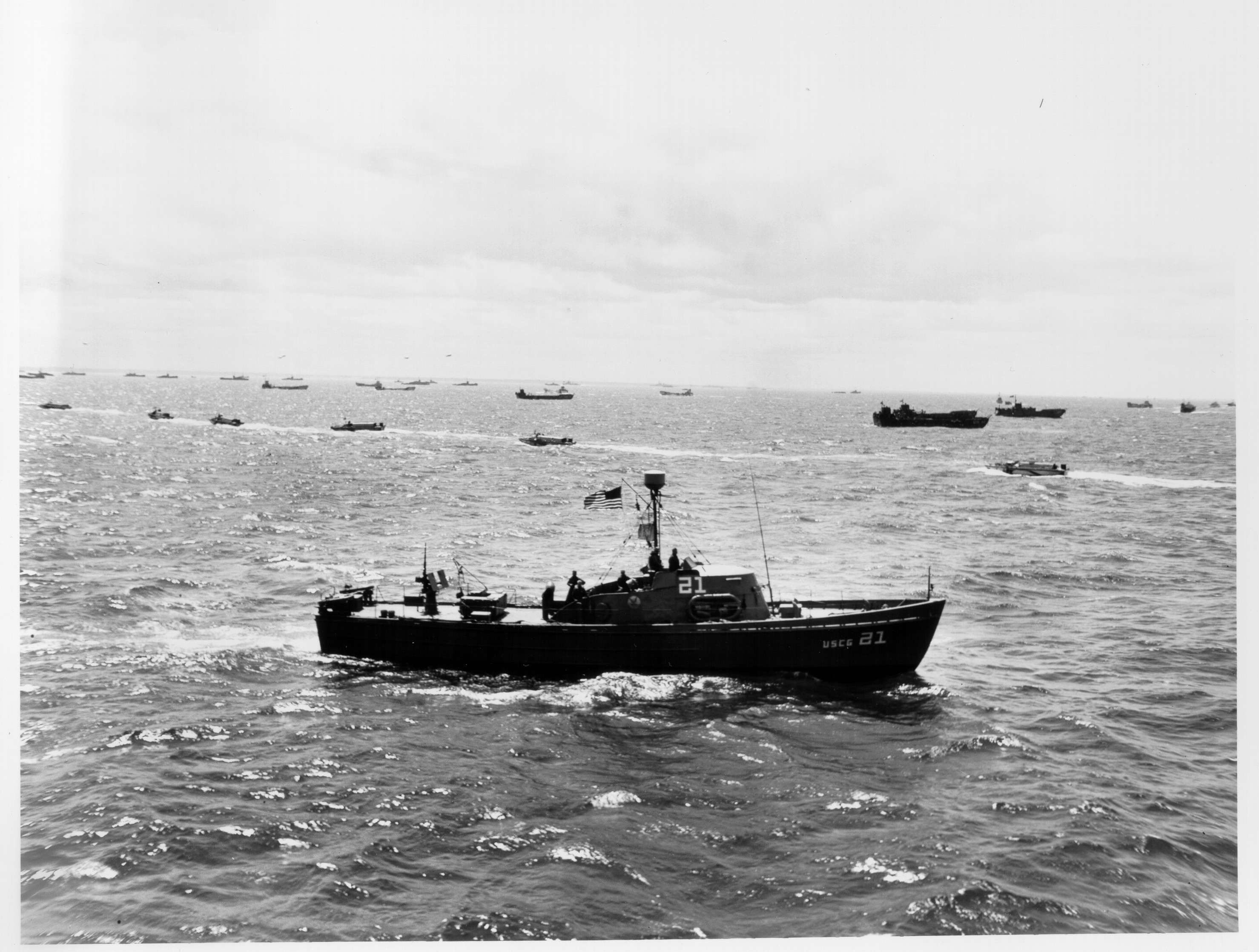
Below are some citations for valor for Coasties who participated in the D-Day invasion.
CLARK, George C., LTJG, USCGR, British Distinguished Service Cross, During the landing of Commandos at Quistreham by LCI (S) on 6 June 1944 Lt. Clark’s cutter was detailed to act as escort to LCI (S) HM LCI(S) 524 on clearing the beach after landing troops received a direct hit and blew up in a sheet of flames leaving a mass of blazing Octane petrol on the water. Although his cutter burned Octane petrol, he did not hesitate to street is craft into the flames and rescue the commanding officer and some of his men.
FRITZCHE, Edward H. CAPT, USCG, Legion of Merit, For exceptionally meritorious conduct, both in the preparation and execution of the amphibious assault on the coast of France June 6, 1944. Captain Fritzche was in command of a main group of the Assault Force, composed of a mixed fleet of American and British transports and American landing craft. He brought these ships an craft to their predetermined stations in the transport area, successfully effected their prompt and efficient unloading and expedited the assault troops and equipment to the designated beaches.—Gold Star in lieu of a second Legion of Merit, For meritorious conduct as commanding officer of a Coast Guard transport prior to and during the amphibious invasion of Southern France August 15, 1944. He efficiently organized and trained his ship and boat group to execute the assigned mission of loading transporting to the assault area and landing the embarked Army assault units on the invasion beaches. His able conduct contributed materially to the effective establishment of the beachhead and to the over all success of the invasion.
GISLASON, Gene R., LT, USCGR, Silver Star, For outstanding heroism as Commanding Officer of the USS LCI (L) 94, while landing assault troops in Normandy June 6, 1944. He successfully directed his ship through numerous beach obstacles to the proper beach, discharged his troops and retracted while his ship was seriously damaged from heavy enemy fire. Ship’s communications, engine telegraph and electric steering were disabled by direct hits on the pilothouse which killed three crewman and one screw and shaft were rendered inoperative by beach obstacles. By his coolness under fire and excellent seamanship, Lt Gislason overcame these difficulties and brought his ship off the beach on hand steering and one screw. He later supervised repairs and in four hours enable the LCI (L) to remain operative in the assault area for three weeks.
HENLEY, Coit T., LTJG, USCGR, Silver Star, For heroism as Commanding Officer of the USS LCI(L) 85 while landing assault troops in Normandy, France, June 6, 1944. Lt Hendley successfully landed his troops despite the mining of his vessel, fire in three compartment and concentration of enemy fire while unloading. His courage and seamanship in directing repairs and retracting from the beach resulted in saving the lives many wounded aboard.
IMLAY, Miles Hopkins, CAPT, USCG, Silver Star, For conspicuous gallantry as Deputy Commander of an Assault Group participating in the initial invasion on the coast of France , June 6, 1944. Undaunted by heavy enemy fire, Captain Imlay courageously took station close to the shore on the early morning of D-Day and throughout the most bitter period of the fighting, coolly and promptly made spot decision on the reorganization, grouping and dispatching of craft to the beach, subsequently relieving the Task Group Commander of his duties when he withdrew his transport from the assault area, immediately thereafter, he was placed in charge of operations afloat as assistant to the naval Officer in Charge of one of the beaches and discharging the duties of this responsibility with distinctive professional ability, contributed essentially to the rapid clearing of the backlog of ships.
OXLEY, Gene E., Sea. 1c [ Seaman, First Class], USCGR, Silver Star, For gallantry while on the USS LCI(L) 85 during the assault on the coast of France June 6, 1944 and for extraordinary courage in volunteering and twice taking a line ashore, in the face of heavy machine gun and shell fire in order to assist troops unloading from the ship to the bench through chest deep water.
SALMON, Robert M., LT, USCGR, Silver Star, For gallantry as commanding officer of a U.S. LCI (L) while landing assault troops in Normandy, France June 6 1944. He pressed the landing of troops despite the mining of his vessel a serious fire forward and heavy enemy gunfire. He supervised the unloading of troops, directed the fire fighting despite the loss of proper equipment and exhibiting courage of high degree remained with the ship until it was impossible to control the progress of the fire and it was necessary to abandon ship over the stern. After abandoning he directed a party searching for fire fighting equipment and subsequently fought the fire on another LCI (L) and assisted her commanding officer until she was abandoned.
VERNON, Albert, LTJG, USCGR, Bronze Star, For meritorious service as Commanding Officer of a Coast Guard Cutter in rescuing survivors of the invasion off the coast of France June 6, 1944. During D-Day, his cutter rescued 97 men. Each rescue was effected in the face of constant enemy fire from the beach which was in no way allowed to deter the splendid rescue operations.
VYN, Arend, Jr., LTJG, USCGR, Silver Star, For gallantry in action as commanding officer of USS LCI 91 in the assault on the cost of France June 6, 1944. LTJG Vyn beached his ship and discharged the Army elements therein the face of murderous fire and a labyrinth of obstacles and mines. In spite of the fact that his ship was mined and repeatedly struck by artillery fire and small arm fire, he continued to land the army load in the face of certain loss of his ship. his determination to put the Army ashore was in keeping with the highest traditions of the offensive spirit of the U.S. Naval Service.
While this happened a little later, I have to add it as part of the invasion story.
WALSH, Quentin R., CDR, USCG, Navy Cross, For heroism as Commanding Officer of a U.S. Naval party reconnoitering the naval facilities and naval arsenal at Cherbourg June 26 and 27, 1944. While in command of reconnaissance party, Commander Walsh entered the port of Cherbourg and penetrated the eastern half of the city, engaged in street fighting with the enemy. He accepted the surrender and disarmed 400 of the enemy force at the naval arsenal and later received unconditional surrender of 350 enemy troops and at the same time released 52 captured U.S. Army paratroopers.




 Chuck Hill's CG Blog