G
gCaptain has a story of a private effort to help Vanuatu after it was hit by Typhoon. Conditions there are difficult and unusual. Some of the techniques they use are interesting.

G
gCaptain has a story of a private effort to help Vanuatu after it was hit by Typhoon. Conditions there are difficult and unusual. Some of the techniques they use are interesting.
I have been thinking about why the Coast Guard seems to be loosing the budget battle within the Department of Homeland Security (DHS). While funding for the Department has grown, the Coast Guard budget has in fact declined in real terms. I suspect it has a lot to do with perceptions of a miss-match between DHS missions and Coast Guard missions.
Congress attempted to address this perceived mismatch in the Homeland Security Act of 2002 by requiring an annual report of resources allocated to DHS missions and non-DHS missions, to ensure non-DHS missions are not ignored. I will refer to this “Annual Review of the United States Coast Guard’s Mission Performance” (pdf) as the Performance Report.
It is an interesting report, but it does have significant weaknesses, largely stemming from the use of undifferentiated and undefined “resource hours” as a measure of effort. I reviewed a report back in 2010 and offered my criticism which have not changed here, here, and here.
Unfortunately, I think this report may be part of the problem, in that it defines several Coast Guard missions as “non-DHS,” and it gives the impression, erroneously I believe, that roughly half of the Coast Guard’s budget goes for things outside the DHS charter.
Of the eleven Coast Guard missions, six were regarded as Non-Homeland Security missions: SAR, AtoN, Living Marine Resources, Marine Environmental Protection, Marine Safety, and Ice Operations.
The five Homeland Security missions are Ports, waterways, and coastal security, Drug Interdiction, Undocumented Migrant Interdiction, Defense Readiness, and Other Law Enforcement (primarily Foreign Fisheries Enforcement).
But these distinctions are fallacious.
The Department views its own missions as:
NON-DHS MISSIONS: All these mission at least in some respects support DHS missions.
SAR: A robust SAR organization is clearly a necessary foundation for “Ensuring resilience to Disaster.” What were Katrina and Sandy but huge SAR cases? SAR command posts and communications are the skeletal structure upon which Disaster Response is based. After all, every SAR case is really a response to a disaster of some dimension. If the 3,000 plus people the CG saves every year had died in a single incident, it would have been a disaster on the order of 9/11.
AtoN: Most of the population lives near the coast or inland waterways. Most depend heavily on marine transportation and in many cases fishing. When there is a disaster, restoring safe navigation is a high priority both for bringing in assistance and for recovery.
Marine Environmental Protection (MEP): The Deepwater Horizon was a disaster. MEP regulation attempts head off disasters and mitigate its effects, that is “Ensuring resilience to Disaster” plus offshore and portside energy infrastructure are potential terrorists targets.
Marine Safety: Marine Safety is designed to prevent marine disasters. A sunken cruise ship could be a disaster on the order of 9/11. Marine Safety standards tends to mitigate the effects of a terrorist attack on marine targets
Living Marine Resources: Destruction of valuable marine resources can actually be as disaster for the economy of some communities.
Ice Operations: Domestic icebreakers can prevent flooding. We recently had a case where a community in Alaska would have been left without fuel, if an icebreaker had not opened a path for delivery.
THE UNLISTED COAST GUARD MISSION:
Safeguarding and securing cyberspace: It is not one of the Coast Guard’s eleven statutory missions, but this is infact one of the Commandant’s key priorities. Still it is not addressed in the Coast Guard’s annual Performance Report.
THE NON-DHS DHS MISSIONS: Two missions listed as DHS missions in fact are of little interest to the department, and performance goals (which are themselves perhaps inadequate) in these two areas are not being met.
Defense Readiness: Apparently the Coast Guard is doing more for Defense Readiness now than it was before 9/11, but really little has been done in terms of adapting resources for wartime roles. Additionally, a potentially major Coast Guard contribution to defense readiness, the major cutters, are being replaced at such a slow rate, the fleet continues to age, making it less reliable.
Other Law Enforcement (primarily foreign fisheries): DHS probably has little interest in this. This mission also suffers from the aging of the cutter fleet, and additionally the very large US EEZ in the Western Pacific has been largely ignored.
Problems in DHS: I do think the Departments placement of priority on counter-terrorism over more general disaster response is misplaced, and this is another source of problems.
CONCLUSION:
I will quote my closing paragraph from my 2010 post,
When it comes time to decide the Coast Guard budget, I would suggest Congress take a different approach. Consider return on investment. If you like the return you are getting from the Coast Guard now, invest more. Don’t say, “Agency ‘X’ isn’t working, we need to put more money into that.” “The Coast Guard, is doing a good job with their current budget so we don’t need to give them any more.” I don’t quote scripture very often. I’m not religious, but there is some wisdom there. Check out the story of the “good and faithful servant” Mathew 25:14-30.
CBC News reports a Canadian Coast Guard icebreaking buoytender, CCGS Ann Harvey, ran aground near Burgeo on the South shore of Newfoundland. She was reported free, but disabled with her motor room flooded.
This morning, at the peak of the rush hour, San Francisco was attacked by a creature of monstrous size and appetite. Hundreds, perhaps thousands are dead or dying.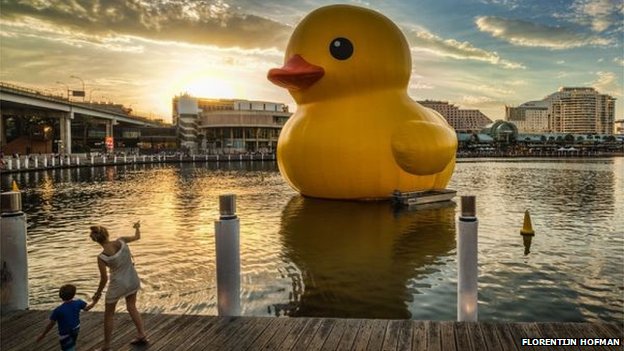
Children stare in horror as the Duck moves close to shore
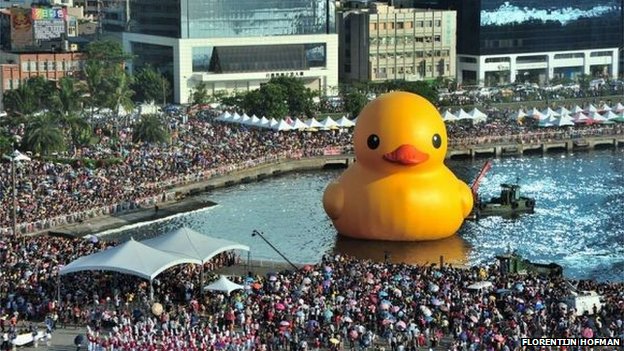
The scene just before the massacre
USCGC Waesche (WMSL 751) attempted to stop the behemoth, but its six pound 57mm projectiles, were according to her captain, “Like water off a duck’s back.”
No one is sure where the feathered horror came from. Scientists speculate that global warming may have released the monster from a glacier’s icy grip. Fox news contends that it is an Islamic Suicide Duck (ISD). MSN reports that it is a product of Disney Studios, an artificial intelligence enhanced animatronic attraction gone terribly wrong.
No one can say where the Demonic Duck will strike next. Meanwhile, Phil Robertson of A&E’s “Duck Dynasty” has been called in as a consultant, as the National Command Authority considers the nuclear option. The Department of Homeland Security has approved a $2M grant to rebuild the San Francisco Fire Department gym destroyed in the attack.
Navy Air/Sea PEO Forum has published a report on Coast Guard cutter procurement written by Ronald O’Rourke of the Congressional Research Service. As far as I can tell this is the same information he has given to Congress. It is fairly long, but very complete, accurate, and balanced.
There are a number of troubling issues identified in the report, most of which boils down to the fact that while the fleet continues to age, funding for replacements continue to fall and most recently is less than half of the approximately $2.5B/year really needed to recapitalize the cutter fleet.
An immediate concern is that, the Offshore Patrol Cutter (OPC) has again slipped to the right with the first ship now expected to be funded in FY2018 instead of 2017.
Another area of concern is how the leadership is portraying the Program of Record (POR).
The Coast Guard estimates that with the POR’s planned force of 91 NSCs, OPCs and FRCs, the service would have capability or capacity gaps in six of its 11 statutory missions—search and rescue (SAR); defense readiness; counter-drug operations; ports, waterways and coastal security; protection of living marine resources (LMR); and alien migrant interdiction operations (AMIO). The Coast Guard judges that some of these gaps would be “high risk” or “very high risk.”
Public discussions of the POR frequently mention the substantial improvement that the POR force would represent over the legacy force. Only rarely, however, have these discussions explicitly acknowledged the extent to which the POR force would nevertheless be smaller in number than the force that would be required, by Coast Guard estimate, to fully perform the Coast Guard’s statutory missions in coming years. Discussions that focus on the POR’s improvement over the legacy force while omitting mention of the considerably larger number of cutters that would be required, by Coast Guard estimate, to fully perform the Coast Guard’s statutory missions in coming years could encourage audiences to conclude, contrary to Coast Guard estimates, that the POR’s planned force of 91 cutters would be capable of fully performing the Coast Guard’s statutory missions in coming years.
We are not being competely honest in that we are painting to rosy a picture of the program of record.
Australian Defence Magazine reports a new version of the Dauphin helicopter. This one to be made in Korea in both civil and military light attack forms.
The USNI news service is reporting,
“The Coast Guard’s Fiscal Year 2016 budget request falls $69 million short of fully funding the Offshore Patrol Cutter (OPC) and instead relies on a funding transfer authority that would let Department of Homeland Security leadership provide the additional funding if the program is deemed affordable and on track, Coast Guard Commandant Adm. Paul Zukunft told the House Appropriations Committee on Tuesday.”
There is supposed to be provision for transferring money into the account if the program is “affordable” and if the Department has not already spent the money on something else.
This is a new low for the Department in failure to act responsibly.
The Acquisitions Directorate (CG-9) has published a quick and relatively painless overview of the FY2016 budget.
This is the table of contents, but you will need to go to the original to access the links:
•Letter from the Commandant
•Posture Statement
•FY 2016 Budget in Brief ◦FY 2016 Budget Priorities
◦Acquisition, Construction, and Improvements (AC&I)
◦Acquisition, Construction, and Improvements (AC&I) Table
◦Operating Expenses (OE)
◦Operating Expenses FY 2015 Request to FY 2016 Request Budget Change
◦Appropriation Summary Table
◦Net Discretionary Budget Authority
•Average Coast Guard Day
•2014 Performance Highlights ◦Maritime Law Enforcement
◦Maritime Response
◦Maritime Prevention
◦Marine Transportation System Management
◦Maritime Security Operations
◦Defense Operations
The Coast Guard Compass reports that the Senior Coast Guard leadership had a Facebook town hall meeting. Some how I miss this, but I have since started following the Commandant’s page. You can find it here.
Center for Strategic & International Studies hosted an event to introduce the updated strategy
Friday, March 13, the Coast Guard, Navy and Marines issued a new strategy document endorsed by all three services. It is a substantial update and revision of the existing tri-service strategy.
CIMSEC has kicked off their discussion of the document with their first post on the topic which also provides links to the document.
We will be discussing it further in the future.
The strategy is being translated into several languages. There is a classified annex.
 Chuck Hill's CG Blog