The new Coast Guard Outlook magazine is available on-line. Click on the turned down corner in the upper right to page through the magazine.
New Coast Guard Outlook
Reply

The new Coast Guard Outlook magazine is available on-line. Click on the turned down corner in the upper right to page through the magazine.
Below you will find a verbatim press release. The US and Canadian Coast Guards are mentioned prominantly, particularly in regard to the formation of Low impact shipping corridors. Certainly the Coast Guard will enforce the fisheries restrictions as well.
THE WHITE HOUSE
Office of the Press Secretary
FOR IMMEDIATE RELEASE
December 20, 2016
In March, President Obama and Prime Minister Trudeau announced a new partnership to embrace opportunities and confront challenges in the changing Arctic, with Indigenous and Northern partnerships, and responsible, science-based leadership. Over the past year, both countries have engaged a range of partners and stakeholders, including Indigenous peoples and Northern communities, state, provincial and territorial governments, nongovernmental organizations and businesses. Those consulted have expressed a strong desire for real and long-term opportunities to build strong families, communities, and robust economies. Today, President Obama and Prime Minister Trudeau are proud to launch actions ensuring a strong, sustainable and viable Arctic economy and ecosystem, with low-impact shipping, science based management of marine resources, and free from the future risks of offshore oil and gas activity. Together, these actions set the stage for deeper partnerships with other Arctic nations, including through the Arctic Council.
Science-based approach to oil and gas:
In March, the United States and Canada committed that commercial activities will occur only if the highest safety and environmental standards are met, and if they are consistent with national and global climate and environmental goals. Today – due to the important, irreplaceable values of its Arctic waters for Indigenous, Alaska Native and local communities’ subsistence and cultures, wildlife and wildlife habitat, and scientific research; the vulnerability of these ecosystems to an oil spill; and the unique logistical, operational, safety, and scientific challenges and risks of oil extraction and spill response in Arctic waters – the United States is designating the vast majority of U.S. waters in the Chukchi and Beaufort Seas as indefinitely off limits to offshore oil and gas leasing, and Canada will designate all Arctic Canadian waters as indefinitely off limits to future offshore Arctic oil and gas licensing, to be reviewed every five years through a climate and marine science-based life-cycle assessment.[i]
Supporting strong Arctic communities:
In March, both countries committed to defining new approaches and exchanging best practices to strengthen the resilience of Arctic communities and continuing to support the well-being of Arctic residents, in particular respecting the rights and territory of Indigenous peoples.
Recently, in direct response to requests from Alaska Native communities, President Obama created the Northern Bering Sea Climate Resilience Area protecting the cultural and subsistence resources of over 80 tribes as well as one of the largest seasonal migrations of marine mammals in the world of bowhead and beluga whales, walrus, ice seals, and sea birds. The United States also launched an interagency Economic Development Assessment Team in the Nome region of Alaska to identify future investment opportunities, with other regions to follow. In addition, the Arctic Funders Collaborative (AFC), a group of 11 U.S., Canadian, and international philanthropic foundations, announced the coordination and mobilization of an estimated $27 million in resources for programs across the Arctic over the next three years.
Today, for its part, Canada is committing to co-develop a new Arctic Policy Framework, with Northerners, Territorial and Provincial governments, and First Nations, Inuit, and Métis People that will replace Canada’s Northern Strategy. The Framework will include priority areas identified by the Minister of Indigenous and Northern Affairs’ Special Representative, such as education, infrastructure, and economic development. The Framework will include an Inuit-specific component, created in partnership with Inuit, as Inuit Nunangat comprises over a third of Canada’s land mass and over half of Canada’s coast line, and as Inuit modern treaties govern this jurisdictional space. In parallel, Canada is reducing the reliance of Northern communities on diesel, by deploying energy efficiency and renewable power. Canada will also, with Indigenous and Northern partners, explore how to support and protect the future of the Arctic Ocean’s “last ice area” where summer ice remains each year.
Low impact shipping corridors:
In March, the United States and Canada committed to working together to establish consistent policies for ships operating in the region. Today, both countries are launching the first processes ever to identify sustainable shipping lanes throughout their connected Arctic waters, in collaboration with Northern and Indigenous partners. The U.S. Coast Guard is launching a Port Access Route Study (PARS) in the Beaufort and Chukchi Seas.[ii] Results from this analysis may be used to establish vessel routing measures including traffic separation schemes, recommended routes, Areas To Be Avoided, or other instruments such as fairways where no structures may be erected. The Canadian Coast Guard and Transport Canada is implementing Northern Marine Transportation Corridors, determining what infrastructure and navigational and emergency response services are needed. Canada is also launching a new program to support training curriculum for Northerners, particularly Indigenous peoples, to join the marine field, as well as programming to support marine infrastructure and safety equipment for communities.
In addition, the U.S. Coast Guard, in consultation with industry, Indigenous communities, and the State of Alaska, has begun a strategy to phase down the use of Heavy Fuel Oil (HFO) in the Arctic. The Canadian Coast Guard is conducting similar outreach and consultations to develop proposals to phase down the use of HFO in 2017. The United States and Canada will each, or jointly, propose a plan for consideration at the International Maritime Organization’s spring 2017 meeting.
Science-based management of Arctic fisheries:
In March, the United States and Canada called for a binding international agreement to prevent the opening of unregulated fisheries in the Central Arctic Ocean and to build on a precautionary, science-based approach to commercial fishing that both countries have put in place in their Arctic waters. Today, the United States commits to supporting and strengthening existing commercial fishing closures in the Beaufort and Chukchi Seas, and to conducting scientific research to improve our understanding of the Arctic. Canada commits to working with Northern and Indigenous communities to build world-leading and abundant Arctic fisheries – based on science – that firstly benefit Northern communities. Together, the United States’ and Canada’s actions will create the largest contiguous area of well-regulated fisheries in the world.
Both countries reaffirm their commitment to a legally binding agreement to prevent unregulated commercial fisheries in the Arctic High Seas until an internationally recognized Regional Fishery Management Organization is in place to provide effective management. Both countries are working towards such an agreement in the coming months.
(Below are apparently footnotes–Chuck)
[i] Taking into account the respective obligations of the United States and Canada under international law to protect and preserve the marine environment, these steps also support the goals of various international frameworks and commitments concerning pollution, including those reflected in the 1990 International Convention on Oil Pollution Preparedness, Response, and Cooperation, the 2013 Agreement on Cooperation on Marine Oil Pollution Preparedness and Response in the Arctic, and the U.S.-Canada Joint Marine Pollution Contingency Plan. Furthermore, with respect to areas of the Beaufort Sea where the U.S.-Canada maritime boundary has not yet been agreed, these practical arrangements are without prejudice to either side’s position and demonstrate self-restraint, taking into account the principle of making every effort not to jeopardize or hamper reaching a final maritime boundary agreement.
[ii] In conducting this study, and consistent with existing authorities, the Coast Guard will consider traditional knowledge from local communities, the effects of shipping and vessel pollution on the marine environment, marine mammal migratory pathways and other biologically important areas, subsistence whaling, hunting, and fishing, and the needs of maritime safety and commerce.
This came to my attention through the Bryant’s Maritime Consulting Blog.

The Navy League’s Magazine, Seapower, has a nice update on Maritime Domain Awareness. This is an area where the Coast Guard is both an active participant and a user. It has also becoming an asset we can offer international partners. You can read the article here.
Nice to see that they both recognize the difficulties in creating a complete picture and that they seem to be making some progress.
Some articles that might be of interest, but not something I’m ready to comment on.
A proposal to hand over all large cutters to the Navy. http://nextnavy.com/how-to-build-president-trumps-350-ship-navy-fast/. I think my friend may have “jumped the shark” here.
The Commandant talks about what we need to include in the new Polar Icebreaker. http://seapowermagazine.org/stories/20161129-icebreaker.html
And a bill to reform the Dept of Homeland Security. https://www.gpo.gov/fdsys/pkg/BILLS-114hr6381ih/pdf/BILLS-114hr6381ih.pdf
Making nice with the Russians in the Arctic. http://www.defenseone.com/threats/2016/11/how-arctic-could-help-warm-us-russian-relations/133502/
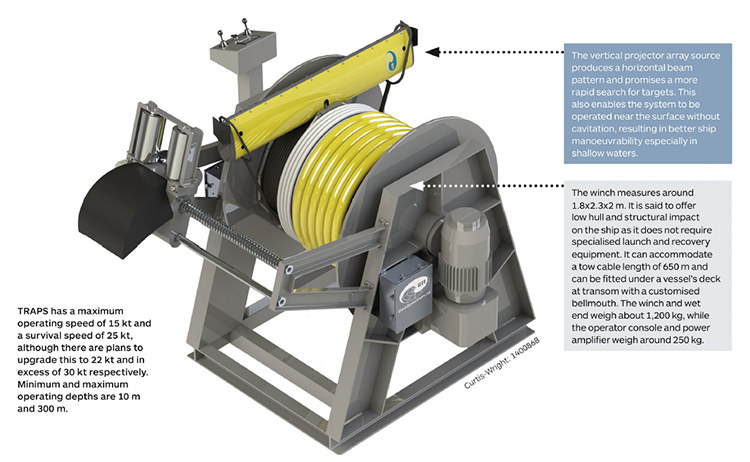
NavyRecognition reports, “GeoSpectrum Technologies Inc. is pleased to announce that it has received a contract through the Build in Canada Innovation Program. Defence Research and Development Canada will test the TRAPS (Towed Reelable Active Passive Sonar) variable depth ASW sonar on Royal Canadian Navy ships.”
This system is seen as a possibility for both the twelve Kingston class “Coastal Defense Vessels” (970 tons, slightly smaller than the 210s) and the projected six icebreaking Arctic Offshore Patrol Ships. There is apparently no intention of using these on the more capable frigates.

TRAPS towing configuration
The system can be fitted in a standard sized 20 foot container.

TRAPS in 20 foot iso container.
“The modular design of TRAPS provides a variety of installation options, including containerization on multi-mission vessels and standard deck-mounting.
“The TRAPS system is ideal for small combatants such as OPVs, corvettes, ships of opportunity, and USVs. Applications include naval defence/surveillance, drug interdiction, homeland security, and other water-borne policing.”
In addition to detecting submarines and surface vessels, the system is claimed to be usable for:
A typical detection range of 50 nautical miles is claimed. If it works as advertised this might give most of our larger ships an ASW capability and perhaps help us detect semi-submersibles. Thales’ CAPTAS series is similar, with CAPTAS 2 and CAPTAS 1, designed for ships of over 1,500 and 300 tons respectively.
If you haven’t seen it already, the Coast Guard has a web site that provides a lot of information about the status of the service. The Coast Guard Overview includes sections on Missions, Workforce, Force Laydown, Assets, Authorities, Strategy, Budget, Leadership, Partnerships, and a Resource Library. (You do have to scroll down from the intro.)
I had not seen this before. It seems to be connected to the preparation for the Presidential Transition Team.
Added a link to the web site to the top of my Reference page, so it will be easy to find. I have to say I have not kept my Reference page up to date. I’ll be pay more attention to it.
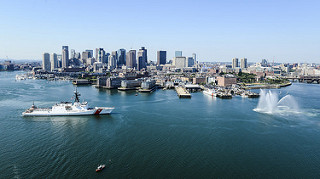
If you are looking for Coast Guard photos, you might want to check out this Flickr page. https://www.flickr.com/photos/coast_guard/
Ran across this thanks to Bob Connelly’s post on the Coast Guard Aviation Association Facebook page.
 Thales RAPIDSeaGuardian Naval Gun System
Navy recognition is reporting the announcement of a new 40mm naval gun system, based on an existing land based system (pdf). It is claimed to be “a new generation CIWS effective against super sonic seaskimming missile thanks to the airburst ammunition, as well as against asymmetric threats…” while having about the same “footprint and weight as a 25mm system.”
The system is interesting, but the star of the show is the gun and its innovative ammunition. The ammunition is “Case Telescoped” meaning that the shell is embedded in the casing and surrounded by the propellent. The gun and its ammunition are products of CTA International, an equal-shares joint venture company between defence companies Nexter (France) and BAE Systems. The resulting round is very short and shaped like a cylinder rather than the typical double tapered shape of most fixed (one piece) ammunition.

The short length of the ammunition means that the portion of the gun inside the mount can be very compact. In the illustration below, the 25mm M242 Bushmaster used in the Mk38 mount is at top right and the Case Telescoped (CT) 40mm is at the bottom right. It’s very compact breech mechanism is apparent.

Image source: thinkdefence.co.uk
If this gun could replace our 25mm guns on the Webber class WPCs and the Offshore Patrol Cutters, either by replacing the mount or perhaps by replacing the gun in the Mk38 mod2/3 mounts (also a BAE product), it would give us improvements in range, accuracy, impact, and particularly penetration. Rates of fire for the two systems are the same.
Range:
The effective range of the Mk38 has been variously reported as 2500 or 3000 yards. This has been a matter of concern to me because when approaching a suspicious vessel that might be being used to make a terrorist attack, I believe a cutter should remain at a distance such that improvised armaments cannot target specific critical equipment on the cutter (like its one gun mount). Improvised armaments might include heavy machine guns, anti-tank guided missiles, or Soviet era anti-aircraft or anti-tank guns of up to 130mm. From my observations and research, in order to preclude targeting critical systems, the cutter should initially approach no closer than 4,000 yards while its boarding party investigates. .
The NavyRecognition post reports a claim of 4,000 meters (4,373 yards) for CTA’s 40mm. While I have not been able to find a claimed max range for the CTA 40mm, the maximum range for the ballistically similar Bofors 40mm/70 is 13,675 yards (12,500 m). The M242 25mm used in the current Mk38 mod2 has a max range of 7,450 yards (6,800 m). Assuming the effective range is proportional to the maximum range, the CTA 40mm should be able to effectively engage from beyond 4000 yards (3,659m).
Penetration:
The image below, from thinkdefence, shows a comparison of effectiveness against armor using armor piercing fin stabilized fin stabilized discarding sabot (APFSDS) rounds.

To me, greater armor penetration translates into being able to penetrate the hull and go on to wreck a larger diesel engine than the smaller round.
As far as I can tell, while there is an armor piercing fin stabilized discarding sabot (APFSDS) round for the 25mm, the Mk110 57mm has no round comparable to the APFSDS round offered for the CT 40mm, which has a muzzle velocity of 1,640 meters/second or approximately 5,379 feet/second. The 57mm round would explode shortly after penetrating the skin of the ship, likely before it reached the engine.
Impact:
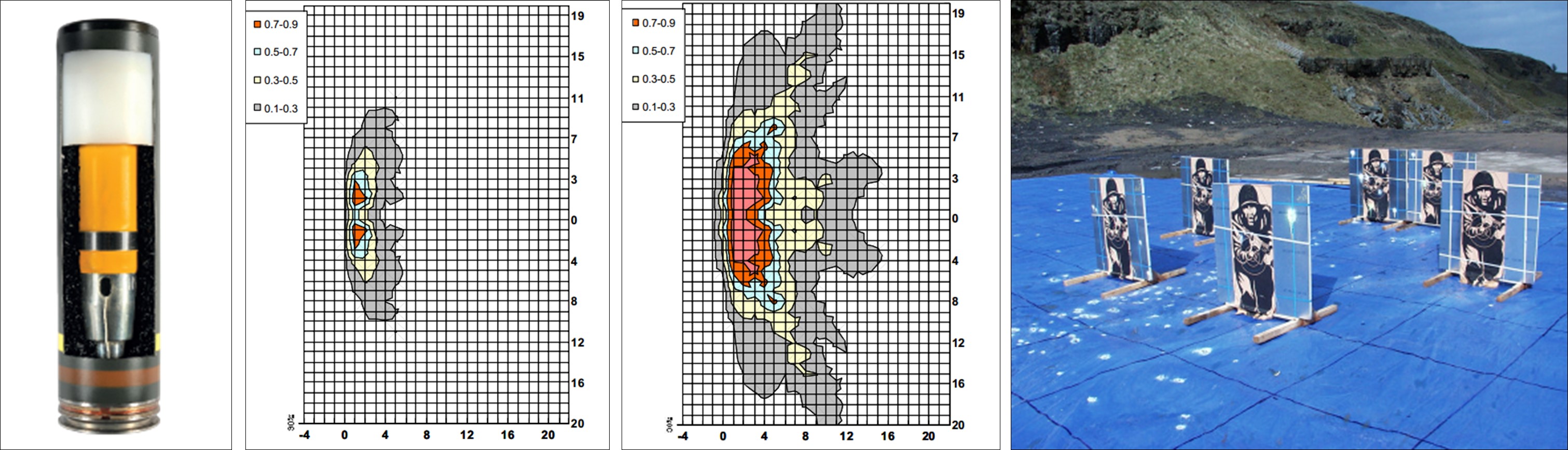
Because the 40mm round is about twice as big as the 25mm round, its effective radius is considerably larger.
The image below (also from Thinkdefence) shows a fragmentation comparison between a 30mm airburst round (left) and the 40mm GPR-AB (40mm airburst). The lethal area for the airburst nature at 1,500m is 125m2. Apparently there is no airburst projectile for the 25mm because it is considered to small to be effective.
Is this gun really ready for “primetime?”
Our friend at thinkdefence.co.uk has done an extensive examination of the development of this weapon.
The gun has been adopted by the British Army for installation on two types of armored vehicles and the French are also planning on using it in one of their armored vehicles.
Apparently the gun is a success and will probably find additional application, including, hopefully, a version of the Mk38.

Russian Coast Guard Naval Ensign
DW.com reports there has been a violent encounter between the Russian Coast Guard and a North Korean fishing vessel.
Reportedly, the North Korean vessel was boarded inside the Russian Exclusive Economic Zone (EEZ). After the boarding party found illegal catch, the F/V, with a crew of 48, attempted to resist the boarding party, take their weapons, and flee the Russian EEZ with the boarding party still aboard.
The Russian Coast Guard enforcement vessel used disabling fire into the North Korean vessel. One member of the boarding party sufffered a head injury and nine North Koreans were injured, one of whom subsequently died.
Clearly fishing is taken very seriously in Asia. This and previous incidents may point to increasing desperation on the part of fishermen as a result of overfishing.
Thanks to Luke for bringing this to my attention.
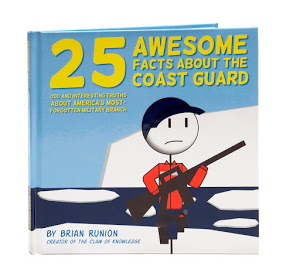
The Claw of Knowledge is a very different sort of Coast Guard web site with a very light hearted view.
The author has published a book you might want to consider:
http://shop.clawofknowledge.com/products/25-awesome-facts-about-the-coast-guard-1
I have not seen the book, but I think this will give you a good idea of the author’s style.
He also has a great story about the Bear.

