Schedule for Barque Eagle

This is a direct quote in full of a Coast Guard News Release. I don’t normally do that, but thought there might be enough interest::

NEW LONDON, Conn. – Coast Guard Barque Eagle has finalized its training schedule for 2014.  During the year, Eagle will sail to the Caribbean, along the East Coast, to Canada, and throughout New England.

In late March, Eagle will sail to North Carolina with the Coast Guard and National Oceanic Atmospheric Administration (NOAA) Officer Candidates.  The voyage will include a port call in Morehead City, N.C.

The Eagle will return to New London in early April and will depart for the annual summer deployment in May to train Coast Guard Academy cadets.  While in New London in April, the Eagle plans to moor downtown at City Pier and open for local tours on a daily basis.

Following cadet final examinations, Eagle will set sail in early May and is scheduled to travel to the following ports: San Juan, Puerto Rico; Oranjestad, Aruba; Cozumel, Mexico; Miami; Sydney, Canada; St. Johns, Canada; New York City, N.Y.; Bourne, Mass.; and Rockland, Maine.  Eagle will return to New London City Pier in early August.  During these voyages, Eagle will train four different groups of approximately 150 cadets each.

In late August, Eagle will depart with the fall Coast Guard and NOAA Officer Candidate classes, traveling to Yorktown, Va. and then to Baltimore. While in Baltimore, Eagle will take part in the celebration of the 200 year anniversary of Francis Scott Key’s penning of the Star Spangled Banner. 

Following the celebration, Eagle will transit to the Coast Guard Yard facility in Baltimore and commence work on its upcoming Service Life Extension Project.  Eagle will remain at the Yard facility until the spring of 2015, when the Barque will travel to New London to commence the 2015 training program.

Specific port call dates are:

Morehead City, N.C.               March 27-30

San Juan, Puerto Rico            May 21-24

Oranjestad, Aruba                 May 28-31

Cozumel, Mexico                   June 7-10

Miami, Fla.                           June 14-17

Sydney, Canada                    June 28-July 1

St. Johns, Canada                 July 4-7

New York City, N.Y.                 July 18-21

Bourne, Mass.                       July 24-28

Rockland, Maine                    Aug. 1-4

Yorktown, Va.                        Sept. 4-6

Baltimore, Md.                      Sept. 11-15

At 295 feet in length, the Eagle is the largest tall ship flying the stars and stripes and the only active square-rigger in U.S. government service.

Constructed in 1936 by the Blohm and Voss Shipyard in Hamburg, Germany, and originally commissioned as the Horst Wessel by the German Navy, the Eagle was taken by the United States as a war reparation following World War II.

With more than 23,500 square feet of sail and six miles of rigging, the Eagle has served as a classroom at sea to future Coast Guard officers since 1946, offering an at-sea leadership and professional development experience.

A permanent crew of seven officers and 50 enlisted personnel maintain the ship and guide the trainees through an underway and in-port training schedule, dedicated to learning the skills of navigation, damage control, watchstanding, engineering and deck seamanship.

To follow the adventure onboard Eagle, visit the ship’s Facebook page at: www.facebook.com/CoastGuardCutterEagle.

While inport in February and March, the Eagle will be available for tours at the Ft. Trumbull pier most days from 10 a.m. until 5 p.m.  For more information, call 860-439-1562,
Problem with Safe Boat RB-S?

Defense News is reporting, “The Israel Navy is restricting use of a US-built, rigid-hulled, inflatable boat pending an investigation of technical and operational conditions that caused one of the small craft to capsize last week off the coast of Gaza.”

I believe these are the same 25 foot boats the Coast Guard uses as the first generation Response Boast, Small (RB-S). Reportedly, the boat capsized as a result of a sharp turn. There were apparently no casualties. The Coast Guard’s new RB-S are produced by Metal Shark.

Thanks for a successful 2013

Before we get too far into the new year I would like to thank my readers, and particularly those who have contributed to the discussion, for what I consider a very successful 2013.

I would also like to thank other bloggers who have seen fit to reference our little corner of the internet, including:

  1. thinkdefence.co.uk
  2. coltoncompany.com
  3. timawa.net
  4. cimsec.org
  5. http://www.defenseindustrydaily.com/
  6. http://forums.bharat-rakshak.com/

Daily readership is up approximately 50% from where we ended 2012. During the course of the year, the site got 155,432 views. New monthly records of successively higher use were set in January, May, June, October, and December, the last with 16,909 hits. On a typical day about 200 individuals visit the site. WordPress tells me we had visitors from 170 countries, but I suspect some of those were were spammers, still, in the last year, readers in 32 different countries have made 200 or more views. Aside from the US the most frequent visits were (in order) from the UK, Canada, Philippines, Netherlands, Australia, France, Germany, Chile, India, Italy, Greece, and Japan, all with over 500 views.

I’m happy to see many readers are using my list of recommended blogs. It is in fact the most viewed post.

The busiest day of the year was December 5th with 1,700 views. The most popular post that day was What is a Corvette? and What Next?.

There were 239 new posts in 2013, pushing the total to 960 posts.

The posts most frequently viewed in 2013 were:

The most commented on post in 2013 was “Reinvent the Fifth Armed Service, Quickly”-USNI

I look forward to 2014 and will continue to try to give you material that is worth your time without duplicating stories on the official sources.

If anyone has any suggestions, or would like to write a post for publication here, you can contact me at chuckhhill@aol.com

Migrant Interdiction, Australian Style

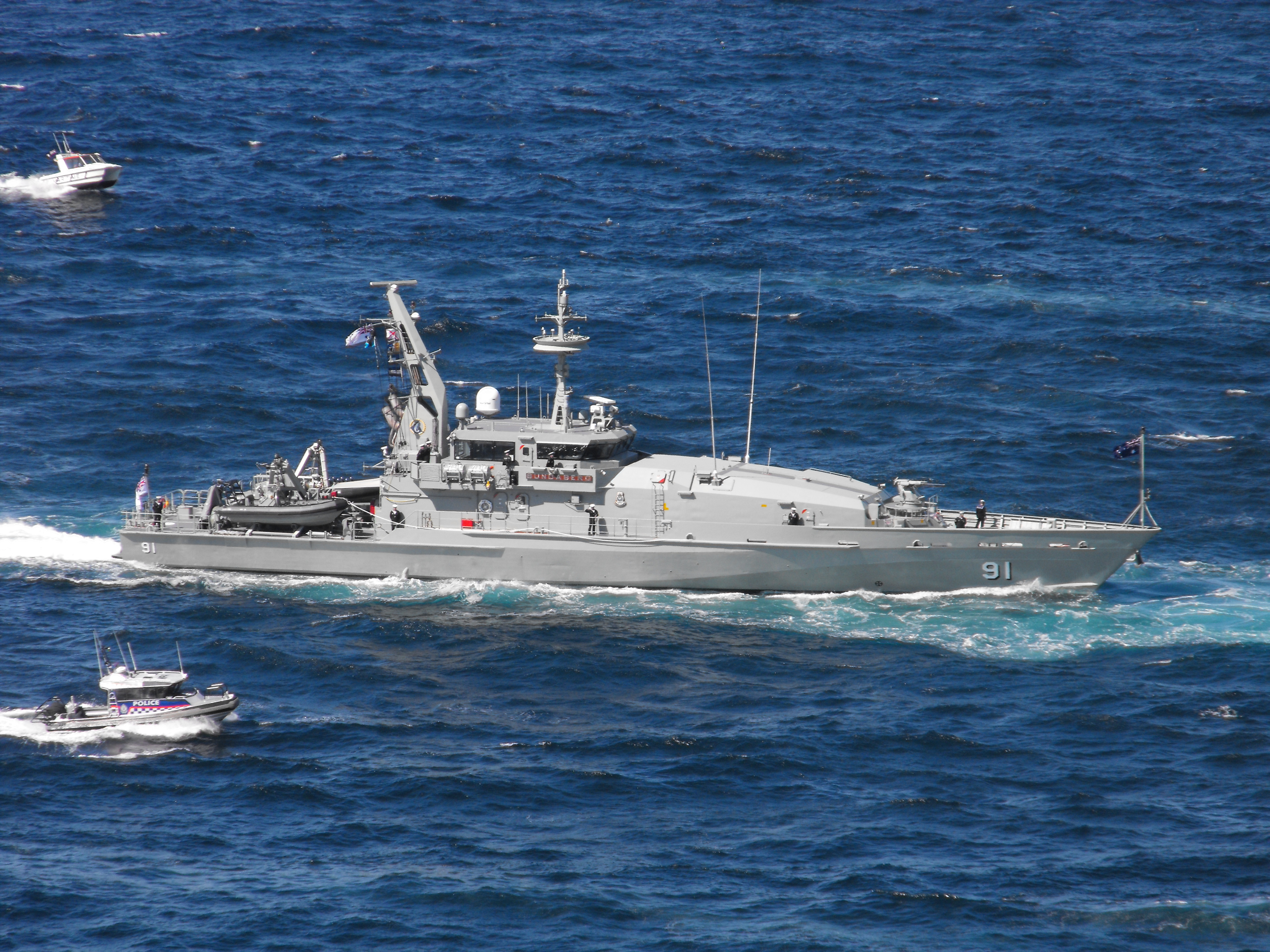
File:RAN-IFR 2013 D2 116.JPGOne of the less glamorous and certainly less rewarding missions the Coast Guard does is alien migrant interdiction operations (AMIO). It seems to come in waves but it never goes away completely.

Other countries have similar operations. We’ve talked about the problems the Italians have been having.

The Australians are having similar problems but their geography works against them. Plus they are trying to address this problem with vessels that simply may not be up to the job, at least not they way they are doing it.

Their workhorse for this mission are ten Armidale Class patrol boats, based in Darwin. These vessels are longer than the Fast Response Cutters, but because of their aluminum hulls, they are actually much lighter displacement. Their range and crew size are similar. They are slightly slower at 25 knots.

The problem is that the emigrants are not trying to come directly to continental Australia, they are trying to get to Australian territory in the form of islands close to Indonesia but distant from mainland Australia, The Cocos Islands or Christmas Island.

The Cocos Islands are less than 600 miles from Indonesia but over 2,000 miles from the boats’ base in Darwin.

Christmas Island is less than 200 miles from Indonesia, but over 1500 miles from Darwin.

These relatively small patrol craft have to transit about 1,500 miles before they can even start to work. The Australian Navy has recently gotten into a bit of hot water over entering Indonesian waters as they try to enforce their immigration laws.

Interviewed regarding Corvettes and Offshore Patrol Vessels

I was interviewed on a pod-cast for Center for International Maritime Security (CIMSEC) talking about Corvettes and Offshore Patrol Vessels, and the series of posts that I managed for them. You can hear the pod-cast here: Sea Control 18 – Naval Corvettes

You can find the original posts in the series here:

http://cimsec.org/corvette-next/

http://cimsec.org/corvettes-persian-gulf-strategic-survey-paul-pryce/

http://cimsec.org/corvette-exists-przemyslaw-krajewski/

http://cimsec.org/opv-missions-wartime/

http://cimsec.org/philippine-navy-frigate-program-opv-name/

http://cimsec.org/corvettes-support-global-seapower/

http://cimsec.org/cheaper-corvettes-coop-stuft-like/

http://cimsec.org/case-pickets/

http://cimsec.org/offshore-patrol-cutters-opc-lcs/

http://cimsec.org/look-corvettes-air-defense/

http://cimsec.org/seafighters-will-never-operate-logistics-free-world-2/


Recapitalization Plan in Eight Slides

FierceHomelandSecurity has a slideshow that summarizes the “Recapitalization Plan” in only eight slides.

If you have been following this web site, there won’t be much new here, but I did note a couple of things that might be significant (or maybe not).

In describing the Webber class Fast Response Cutters (FRC), their endurance is now described as seven days instead of the five that was the contract minimum. (Always figured they were probably good for more than that.)

In describing the Offshore Patrol Cutter (OPC) the speed is given as specifically 25 knots, not as a range from 22 to 25. I hope this is true, because it the increase from 22 to 25 makes the ships a lot more useful as potential naval vessels, if we ever need them to go to war.

The slides do seem a bit out of date in calling the helicopters HH-60 and HH65 instead of the current designations, MH–60 and M-H-65.

Christmas Poem

A seafarer’s Christmas poem by Robert Louis Stevenson, first published in the Scots Observer in 1888 —

“The sheets were frozen hard, and they cut the naked hand;
The decks were like a slide, where a seaman scarce could stand;

The wind was a nor’wester, blowing squally off the sea;
And cliffs and spouting breakers were the only things a-lee.

They heard the surf a-roaring before the break of day;
But ’twas only with the peep of light we saw how ill we lay.

We tumbled every hand on deck instanter, with a shout,
And we gave her the maintops’l, and stood by to go about.

All day we tacked and tacked between the South Head and the North;
All day we hauled the frozen sheets, and got no further forth;

All day as cold as charity, in bitter pain and dread,
For very life and nature we tacked from head to head.

We gave the South a wider berth, for there the tide-race roared;
But every tack we made we brought the North Head close aboard:

So’s we saw the cliffs and houses, and the breakers running high,
And the coastguard in his garden, with his glass against his eye.

The frost was on the village roofs as white as ocean foam;
The good red fires were burning bright in every ‘longshore home;

The windows sparkled clear, and the chimneys volleyed out;
And I vow we sniffed the victuals as the vessel went about.

The bells upon the church were rung with a mighty jovial cheer;
For it’s just that I should tell you how (of all days in the year)

This day of our adversity was blessed Christmas morn,
And the house above the coastguard’s was the house where I was born.

O well I saw the pleasant room, the pleasant faces there,
My mother’s silver spectacles, my father’s silver hair;

And well I saw the firelight, like a flight of homely elves,
Go dancing round the china-plates that stand upon the shelves.

And well I knew the talk they had, the talk that was of me,
Of the shadow on the household and the son that went to sea;

And O the wicked fool I seemed, in every kind of way,
To be here and hauling frozen ropes on blessed Christmas Day.

They lit the high sea-light, and the dark began to fall.
“All hands to loose topgallant sails,” I heard the captain call.

“By the Lord, she’ll never stand it,” our first mate, Jackson, cried. . . .
“It’s the one way or the other, Mr. Jackson,” he replied.

She staggered to her bearings, but the sails were new and good,
And the ship smelt up to windward just as though she understood.

As the winter’s day was ending, in the entry of the night,
We cleared the weary headland, and passed below the light.

And they heaved a mighty breath, every soul on board but me,
As they saw her nose again pointing handsome out to sea;

But all that I could think of, in the darkness and the cold,
Was just that I was leaving home and my folks were growing old.”

Thanks to Peter Lane and Historic Ship Geek